Baldur's Gate 3 Reactions: Why Yours Did Not Trigger
Every creature in Baldur's Gate 3 carries exactly one Reaction charge and gets it back at the start of its turn. What that charge can answer is narrower than the tooltips suggest: the game decides which reactions are eligible for an event before any of them resolve, and whole categories of damage and saving throws are invisible to the system entirely. Here is the reaction list by source and cost, the rules that gate it, and the bugs the wiki has documented on top.
Your Lore Bard has Cutting Words enabled, a full stack of Bardic Inspiration and an untouched reaction. An enemy caster rolls a Constitution save to hang onto the Hold Person pinning your Paladin. No prompt appears. Nothing is broken — Baldur's Gate 3 does not let reactions touch Concentration saves at all, and it does not tell you that anywhere in the tooltip.
The reaction system is narrower and stricter than its own descriptions imply. It runs an eligibility pass before any reaction resolves, it cannot see whole categories of damage and saving throws, and a long list of conditions switches it off silently. The wiki's own theory for why so many class features got wired through it oddly is that reactions arrived fairly late in development. Whatever the reason, the edges are documented, and knowing where they are turns the tab from a mystery box into a set of rules.
One charge, and it comes back every turn
Every creature has one Reaction resource, and it recharges at the start of that creature's turn — the same cadence as Action, Bonus Action and Movement. There is no "reaction per round" pool that refills mid-turn, and the wiki lists exactly one way to hold a second: Duellist's Prerogative, the legendary rapier Lora Bergauz hands over for the Save Vanra quest. Its Elegant Duellist passive grants an extra reaction each turn, and it switches off the moment you put a weapon or a shield in your off hand. If you want the rest of that weapon's kit, our legendary weapons guide covers it.
The important wrinkle is that not every reaction spends that resource. A number of class features are implemented through the reaction system without costing a Reaction charge — Sneak Attack, Divine Smite and Reckless Attack are the ones the wiki names. Those are prompts routed through the same plumbing, not competitors for the charge. So a Rogue who has already used a reaction that turn can still be offered Sneak Attack.
One more consequence worth planning around: a resource that recharges at the start of your turn will recharge almost immediately when it is used outside turn-based mode. If you use it to start combat, though, it does not come back at the start of your turn. That behaviour is labelled "disable free first strikes" and can be switched off in Custom mode.
Where the Reactions tab lives
The tab sits on the spellbook page of the character sheet, and there are two faster ways in: click one of the active reaction icons on the hotbar, or press the hotkey, which defaults to L.
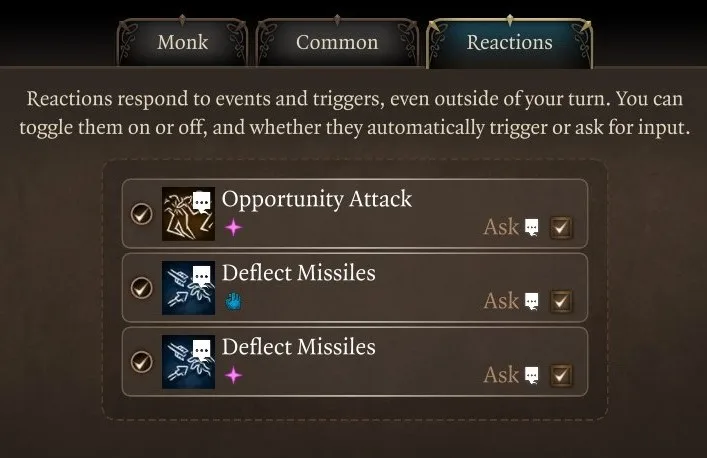
Each entry has a checkbox on the left that enables or disables it outright, and a separate Ask setting. If a reaction costs resources, they are listed under its name — which is how you tell at a glance that Counterspell is about to eat a level 3 slot and Cutting Words is about to eat a Bardic Inspiration charge.
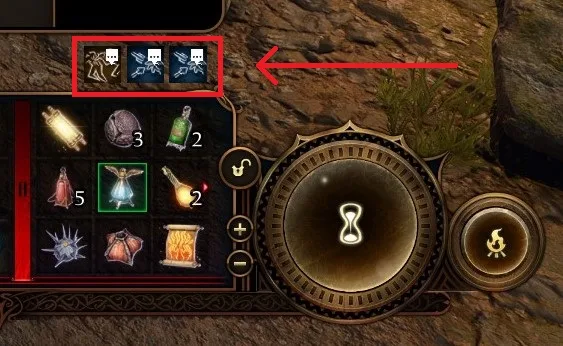
The dialogue-bubble marker on a hotbar icon is the Ask indicator. No bubble means that reaction will fire on its own the moment its trigger occurs.
Sixteen reactions and what triggers them
These sixteen come from a class, subclass, fighting style, feat or spell, and each one can be switched on and off in the tab. They are a selection, not the whole set: the wiki's full list runs to over 140 entries, covering race, item, subclass and monster reactions alongside class features such as Divine Smite and Sneak Attack that route through the reaction system without spending the resource.
| Reaction | Source | Cost | Trigger |
|---|---|---|---|
| Opportunity Attack | All creatures | Reaction | An enemy moves out of your melee reach |
| Polearm Master: Opportunity Attack | Polearm Master feat | Reaction | An enemy moves into your reach, while you wield a polearm |
| Sentinel: Vengeance | Sentinel feat | Reaction | An enemy in melee range attacks an ally |
| Mage Slayer: Attack Caster | Mage Slayer feat | Reaction | An enemy casts a spell within 1.5 m |
| War Caster: Opportunity Spell | War Caster feat | Reaction | A target leaves melee range (casts Shocking Grasp) |
| Defensive Duellist | Defensive Duellist feat (Dex 13+) | Reaction | A melee attack while your main hand holds a proficient Finesse weapon |
| Shield Master: Block | Shield Master feat | Reaction | A Dexterity saving throw against a spell |
| Shield | Sorcerer/Wizard 1, Hexblade 1, Arcane Trickster/Eldritch Knight 3 | Reaction + level 1 slot | You are about to be hit |
| Counterspell | Sorcerer/Warlock/Wizard 5 | Reaction + level 3 slot | An enemy casts a spell |
| Hellish Rebuke | Warlock 1 | Reaction + level 1 slot | An attacker damages you |
| Riposte | Battle Master 3, or Martial Adept feat | Reaction + superiority die | A melee attack misses you within 2 m |
| Protection | Fighter 1, Paladin 2 (fighting style) | Reaction | An enemy you can see attacks an ally within 1.5 m, shield equipped |
| Warding Flare | Light Domain Cleric 1 | Reaction | A creature attacks you |
| Improved Warding Flare | Light Domain Cleric 6 | Reaction | A creature attacks an ally |
| Deflect Missiles | Monk 3 | Reaction | A ranged weapon attack damages you |
| Cutting Words | College of Lore Bard 3 | Reaction + Bardic Inspiration | A creature makes an attack roll, ability check or saving throw |
A few numbers worth having in your head from those rows. Shield is +5 AC until the start of your next turn, and it zeroes Magic Missile damage. Hellish Rebuke is 2d10 Fire with a Dexterity save to halve, plus 1d10 per upcast level. Riposte adds a superiority die on top of the weapon damage — 1d8, rising to 1d10 at Battle Master level 10 with Improved Combat Superiority. Deflect Missiles subtracts 1d10 + your Dexterity modifier + your Monk level from a ranged weapon attack. Cutting Words starts at -1d6 and scales to -1d8 at bard level 5 and -1d10 at level 10 — and despite what its own text says, it cannot be applied to damage rolls here, but it can be applied to saving throws, which in tabletop is an Eloquence Bard privilege.
Three of those entries have restrictions the tooltip does not spell out:
- Riposte only reaches 2 m. That is longer than a normal melee weapon's 1.5 m but shorter than Extra Reach's 2.5 m, so a pike attacking you from full range cannot be riposted. It does not require a melee weapon in hand — a character holding a bow swaps automatically, and one holding nothing ripostes with an unarmed strike.
- Opportunity Attack needs a melee weapon and line of sight. You cannot take one while wielding a ranged weapon, and you cannot take one against a target you cannot see. Dual wielders get both weapons: a main-hand attack followed by an off-hand attack at the same modifiers and damage.
- Defensive Duellist does not raise your AC. It subtracts your proficiency bonus from the enemy's attack roll, and it only offers itself when doing so would actually turn a hit into a miss.
Ask versus automatic
Setting a reaction to Ask pauses combat and hands you the decision. Leaving it automatic spends the resource the first time the trigger fires. Neither is universally right, but the cost line under the name is the tiebreaker: anything that burns a spell slot, a superiority die or a Bardic Inspiration charge is a candidate for Ask, because the game has no idea whether the incoming hit is a goblin's dagger or Orin's opening move.
There is a mechanical consequence to the Ask setting too.
One event, one reaction
A character cannot apply more than one reaction to the same event if any of them prompt for confirmation. The UI enforces it — you get to pick one.
The stricter half of the rule is about timing. The set of reactions eligible for an event is locked in before any of them take effect. Two worked examples from the wiki:
- A character has both Counterspell and the illithid power Psionic Backlash set to Ask, and an enemy starts casting. Both trigger on the same spellcasting event and both want confirmation, so the engine forces a choice. You cannot counter the spell and deal the backlash damage off one cast.
- An ally rolls 16 against a DC 15 saving throw. The roll succeeds, so a Wild Magic Sorcerer's Bend Luck — which assists failed saves — is never added to the queue. If an enemy Bard then lands Cutting Words and drags that roll down to 13, the save now fails, and Bend Luck still cannot be used, because eligibility was decided before either reaction resolved.
That second case is the one that reads as a bug and is not. The queue is a snapshot, not a live evaluation.
The damage the system does not see
Reactions that trigger on damage or on saving throws only fire on the immediate, built-in effects of an action. Damage and saves are ignored entirely when they come from:
- Conditions, including surface and area effects. Burning damage does not trigger a reaction, and neither does the save to avoid slipping on ice or the save to shrug off Hold Person early.
- Explosions from grenades, barrels and other items — with arrows and launched fireworks excluded from that exclusion.
- Most reactions that are not attacks or spells. Opportunity Attack and Hellish Rebuke can themselves trigger reactions; Tenacity's chip damage cannot.
- Passive features, with a short list of saving-throw exceptions below.
- Special weapon hit effects, such as the Silenced save from Sussur weapons.
Concentration saves and death saving throws are ignored too. That is worth sitting with, because it deletes an obvious-looking play: you cannot Cutting Words an enemy's concentration save to break their Hold Person, and you cannot Bend Luck a downed ally's death save.
The exception list is narrower than it looks: what registers is the saving throw of a handful of passive features, and the wiki names them. It covers Reverberation, the Oil of Bane and Oil of Diminution coatings, and the Simple, Serpent Fang, Wyvern and Purple Worm toxins. A named set of equipment passives also counts, including Cindermoth Cloak, Flawed Helldusk Armour, Gontr Mael, Markoheshkir's acid condition, Mourning Frost and Poisoner's Gloves. If you are already carrying coatings for other reasons, our coatings, grenades and arrows guide covers which ones are worth the inventory slot.
The conditions that switch reactions off
Two different lists, and the difference between them matters.
The first blocks most reactions outright: any fleeing condition such as Fearful, any incapacitating condition such as Hold Person, any restraining condition such as Ensnared, any stunning condition, any unconscious condition — which includes Prone — and any polymorph condition other than disguises and Starry Forms. Invisibility blocks all reactions except three narrow ones (Accursed Spectre, Blinding Ambush and Weird Magic Surge).
Prone belongs on that list twice over. It already denies actions and bonus actions and breaks Concentration, as our status effects guide lays out, and it takes the reaction with it.
The second list stops a creature spending the Reaction resource but leaves reactions that do not cost one alone: Arms of Hadar, Dazed, Shocking Grasp, Slowed and Surprised. That distinction has a specific consequence in Honour Mode: boss legendary actions are triggered like reactions but draw on a different resource, so Slowing or Dazing a legendary boss does not switch them off.
Uncanny Dodge is not in that tab

The Rogue's level 5 damage halver consumes a reaction when it triggers, but it is a togglable passive rather than a proper reaction, so it never appears in the Reactions tab and cannot be set to Ask. Two things follow.
First, it is far broader than its own description. The tooltip says "when an attack hits you", but it triggers on any damage received — Fireball, fall damage, even self-damage from Transfuse Health.
Second, it is one of a very small number of multiplicative damage reductions that stack with resistance. Most half-damage effects — Dampen Elements, Aura of Warding, Warding Bond — work by granting resistance, and resistances do not stack with each other. Uncanny Dodge is implemented differently, so pairing it with a resistance gets you to 75% total damage reduction.
The wiki also documents four Patch 8 bugs on it: it requires a reaction to be available but does not actually consume it, it consumes the attacker's reaction resource instead, it can trigger multiple times in a turn if the hits come from different attackers, and it fires under conditions that should prevent reactions, such as Slowed.
Counterspell rolls the wrong ability

Counterspell costs a reaction plus a level 3 slot. If the incoming spell is a higher level than the slot you spend, you make a check against DC 10 + the level of the spell you are countering. Upcast it high enough and no check happens at all.
The tooltip says that check uses your spellcasting ability. It does not. The wiki traces the code and finds it uses your Intelligence modifier regardless of class — which quietly penalises a Sorcerer or Warlock, who have no reason to invest in Intelligence, and rewards a Wizard twice. Plan the slot level accordingly: for a Charisma caster, upcasting past the check is more reliable than rolling it.
The rest of the Counterspell rules are unusually well-behaved: cantrips can be countered, a countered scroll is not consumed, Counterspell itself cannot be counterspelled, it can be cast while Silenced, and even a failed Counterspell still feeds an Abjuration Wizard's Arcane Ward.
Four more documented reaction bugs
- Shield Master: Block does nothing on a failed save. The feat promises half damage on a fail and zero on a success; the wiki records that the failed-save half is not applied. It is also less picky than its text: it is not limited to Dexterity saves or to spells, and it works on Frost Breath's Constitution save while failing to work on some Dexterity-save effects.
- Deflect Missiles redirects without needing a zero. The description gates the Ki-powered throwback on reducing the damage to 0; in practice it does not. Against multi-projectile attacks such as dual-wielded hand crossbows, only the last attack can be deflected at all, and none can be thrown back.
- Warding Flare has no Blinded restriction. The text says it has no effect on creatures that cannot be Blinded. The wiki reports no such restriction exists in the code.
- Form-changing conditions leak. Most reactions are disabled by Polymorphed and Wild Shape but not by Disguise Self or Starry Form — and if a creature has both at once, the reactions are erroneously re-enabled. The same interaction breaks the Protection fighting style in the other direction: it cannot be used while under Starry Form or while Disguised.
The Shield spell has its own small one: due to a coding error it does not grant Arcane Ward charges, so an Abjuration Wizard gets the AC but not the shield refill.
Quick Action Checklist
- One Reaction resource per creature, recharging at the start of its turn. Duellist's Prerogative with an empty off hand is the only listed source of a second.
- Some reactions cost no Reaction resource — Sneak Attack, Divine Smite and Reckless Attack among them — so they can still be offered after the charge is spent.
- The tab is on the spellbook page of the character sheet, or press L. The checkbox enables; the Ask toggle prompts.
- Only one reaction can answer one event when any of them prompt, and eligibility is locked before any of them resolve.
- Concentration saves and death saves cannot be reacted to at all.
- Condition, surface, explosion, passive and weapon-effect damage is invisible to damage-triggered reactions. The only exception list the wiki gives covers the saving throws of certain passives, including Reverberation and the four toxin coatings.
- Prone, Stunned, Fearful, Ensnared, Hold Person and invisibility block reactions; Slowed, Dazed, Surprised, Arms of Hadar and Shocking Grasp only block spending the resource.
- Honour Mode legendary actions use a different resource, so Slow and Daze do not stop them.
- Riposte reaches 2 m and cannot answer a pike attacking from full reach.
- Uncanny Dodge stacks with resistance for 75% reduction and triggers on any damage, including falls.
- Counterspell's higher-level check uses Intelligence, not your spellcasting ability. Upcast instead of rolling if you are a Charisma caster.
Frequently Asked Questions
How many reactions can you take per turn in Baldur's Gate 3?
Where is the Reactions tab in Baldur's Gate 3?
Why is my reaction not triggering in Baldur's Gate 3?
Can you use two reactions on the same attack in BG3?
Does Uncanny Dodge use a reaction in Baldur's Gate 3?
Which ability does Counterspell use in Baldur's Gate 3?
Do legendary actions in Honour Mode use reactions?
Keep Reading
- BG3 Wiki — the Reactions tab, the one-reaction-per-event rule, ignored events and blocking conditions
- BG3 Wiki — Duellist's Prerogative as the only source of an extra reaction
- BG3 Wiki — the Reaction resource, its turn recharge, and reactions that cost nothing
- BG3 Wiki — Opportunity Attack requirements and the dual-wielding double attack
- BG3 Wiki — Sentinel, Polearm Master, Mage Slayer, War Caster, Defensive Duellist and Shield Master
- BG3 Wiki — Uncanny Dodge as a togglable passive, the resistance stack, and its Patch 8 bugs
- BG3 Wiki — Counterspell DC, upcasting, and the Intelligence-modifier bug
- BG3 Wiki — Shield spell duration, Magic Missile immunity, and the Arcane Ward bug
- BG3 Wiki — Hellish Rebuke damage, save and upcast scaling
- BG3 Wiki — Riposte cost, its 2 m limit, and the automatic weapon swap
- BG3 Wiki — Protection fighting style requirements and the Starry Form/Disguise bug
- BG3 Wiki — Warding Flare, Improved Warding Flare, and the missing Blinded restriction
- BG3 Wiki — Deflect Missiles reduction formula and the redirect bugs
- BG3 Wiki — Cutting Words scaling and its saving-throw application
- BG3 Wiki — Shield Master: Block coverage and the failed-save bug
- BG3 Wiki — Defensive Duellist subtracts proficiency from the attack roll
Related Guides
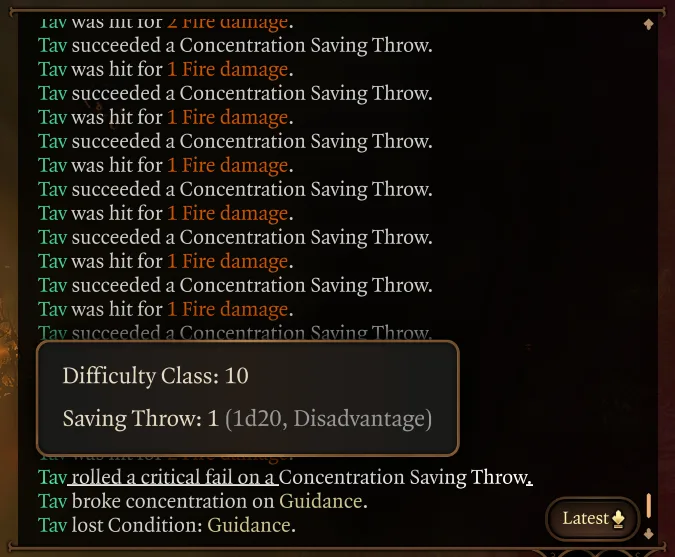
Baldur's Gate 3 Concentration: Why Your Spell Dropped
Baldur's Gate 3 ends concentration in more ways than the tabletop rules do: a natural 1 fails the save whatever your bonus, falling Prone ends it with no roll, and casting a second concentration spell after Haste on yourself costs you both. Here is what breaks it, temporary hit points and Rage included, the gear and feats that hold it, and the spells BG3 stopped making you concentrate on.
Baldur's Gate 3 Stealth: Where You Stand Beats the Roll
Baldur's Gate 3 only rolls a hiding character's Stealth in one of its three obscurity states; the other two decide whether you are found before Dexterity gets a vote. Here is how obscurity and darkvision work, why Fog and Darkness are different tools, what breaks Hiding, and the gear that switches on in the dark.
Baldur's Gate 3 Death Saves: What Actually Kills You
Baldur's Gate 3 keeps the tabletop shape of death saving throws and rewrites the details: no massive-damage deaths, no natural-20 comebacks, and failures that survive stabilising. Here is what kills a Downed character, what stops it, and what each way back from the dead costs.
Baldur's Gate 3 Initiative and Surprise: How to Go First
Tabletop D&D rolls initiative on a d20. Baldur's Gate 3 rolls it on a d4, which turns a +5 from Alert from a nudge into something close to a guarantee. Here is how turn order is built, what Surprised takes away, and the line-of-sight rule that decides whether your ambush gets a surprise round at all.
Baldur's Gate 3 Beginner Guide: What Nobody Tells You
The tutorial teaches you to move and attack. It does not teach you that advantage is worth more than any weapon you will find in Act 1, or that Withers will rebuild your entire character for 100 gold. Here is the actual onboarding.

Baldur's Gate 3 Wild Shape: It Can Kill You With No Save
An Owlbear form shows 65 hit points on a bar that looks nothing like your character sheet. That number is a mask, not a shield — bg3.wiki's own Wild Shape page spells out exactly what happens when it runs out, and it is not a knockdown. Here is the charge economy, what carries over and what shuts off, and the overflow rule that can end a character with no down-and-dying phase at all.