Baldur's Gate 3 Karmic Dice: What It's Secretly Fixing
There is a setting on by default in every new Baldur's Gate 3 save that changes the odds of your next roll based on how badly the last one went, and the game never tells you it exists. Here is the formula bg3.wiki has worked out, the three roll types it can and cannot touch, and the two documented bugs sitting on top of it.
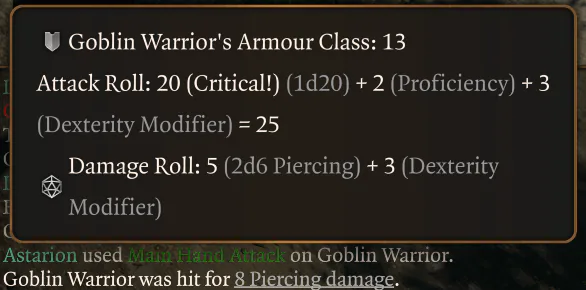
You whiff a 65% attack roll, and the next identical swing lands. You fail a Persuasion check, ask again a minute later at the same odds, and it goes through. Nothing on screen explains why — no buff icon, no combat log entry, no tooltip. That is Karmic Dice, and it has been reweighting your rolls since the moment you started the save, because it is turned on by default and stays on unless you go looking for the option yourself.
This is not the natural-20-always-hits rule, and it is not Guidance or a Lucky feat. Those are visible bonuses attached to a specific roll. Karmic Dice is a second, invisible system that runs underneath every eligible roll in the game, tracking a running "debt" per character and occasionally overriding the dice entirely. bg3.wiki has reverse-engineered the exact formula behind it, so this is not a matter of forum folklore — here is what it actually does, in the terms the wiki itself uses.
On by default, and it touches more than dialogue
The option is called Karmic Dice, and it lives in Gameplay Options. It shipped in Early Access under a different name — Loaded Dice — and Larian's own Patch 4 hotfix notes describe the goal plainly: smooth out the extremes of the dice-rolling bell curve, because players were describing the RNG as harsh, cursed and rigged.
When it is enabled, the game does two separate things: it forces occasional automatic successes on rolls that would otherwise fail, with the odds of that happening rising the more you have recently failed, and it reshapes damage-die results toward the middle of their range instead of leaving every face equally likely. Both effects are covered below.
What Karmic Dice actually touches
bg3.wiki lists exactly which rolls are eligible for the automatic-success half of Karmic Dice, and the boundary is narrower than it first looks — it is not the same boundary that decides whether Inspiration can reroll a check.
| Roll type | Karmic Dice can force an automatic success |
|---|---|
| Attack rolls | Yes |
| Ability checks made in dialogue | Yes |
| Saving throws (only in the causing creature's favour — see below) | Yes, one-directional |
| Ability checks made outside dialogue — lock-picking, Perception checks for traps and hidden objects, and other automatic exploration rolls | No |
That third row is the one worth sitting with. The Inspiration system cares whether the d20 roll menu appeared on screen, and a lock-picking or trap-disarm attempt uses that same menu — which is why Inspiration can reroll it. Karmic Dice cares about something different: whether the check happened inside a dialogue. A trap disarm is not dialogue, so however many times you fail it, Karmic Dice is not building any debt toward bailing you out. Perception checks work the same way — they are automatic, not dialogue-driven, so a string of missed traps is just genuine bad luck with nothing quietly compensating for it.
The hidden roll behind every roll
Internally, the game tracks a value the wiki calls karmic debt, kept separately for the player's whole party, for allied NPCs, and for enemies — with dialogue checks tracked in their own separate pool per character. Every time an eligible roll fails, the probability that roll needed to succeed (call it p) gets added to that pool's debt.
On the next eligible roll from that same pool, the game runs a hidden check before the real dice matter at all: the probability of a forced automatic success is
p ÷ (1 − Debt)
If that hidden check hits, the game manufactures a result — it randomly picks a d20 value from the range that would have succeeded and displays that, rather than actually rolling low and overriding it. If the hidden check misses, the roll happens normally, meaning it can still fail on its own merits. Either way, after a forced success the debt pool drops by 2 × (1 − p), which for anything but a very unlikely roll wipes out most or all of the debt that built it.
Walk it through with a 30% attack roll (p = 0.30):
- Swing one: no debt yet, so the hidden check runs at the true 30%. Say it misses. Debt is now 0.30.
- Swing two, same 30% odds: the hidden check now fires at 0.30 ÷ (1 − 0.30) = 42.9% — a coin-flip-adjacent chance of being forced through outright, before the normal roll even happens. Add the cases where the hidden check misses but the ordinary 30% roll still connects on its own, and the character's real chance to land that second swing works out to 60%, exactly double the number on the tooltip.
One miss roughly doubles your next shot
That doubling is not a coincidence of the numbers picked above — run the same algebra with any single-miss debt equal to the roll's own p, and the combined chance of forced-plus-normal success on the very next roll of identical odds reduces to a clean 2p. Miss a 20% check and the next one at 20% odds is really running at ~40%. Miss a 40% check and the next one is really running at ~80%. It stops being a clean doubling once debt has built past a single miss or the odds involved are lopsided, and the formula does not describe any hard ceiling on the forced-success probability once it is computed — but for the common case of "I just missed one roll, what are my real odds on the next" it is a fast, checkable rule of thumb, not a vague impression.
Saving throws only cut one way
This is the detail most likely to be misunderstood. Karmic Dice does not ever step in to save your own saving throw. What it tracks, on a save, is the caster's success rate — a target successfully saving against your spell counts as a failed roll for you, the caster, and builds your debt. Enough of that debt eventually forces the target's saving throw to fail instead of yours succeeding.
Flip the roles and the same rule runs against you: every time you resist an enemy's save-or-suffer spell, that is a failed roll for the enemy, building the enemy's debt. Enough of it, and the game eventually forces you — the target, not the caster — to fail a save you would otherwise have passed. The mechanic only ever reaches in from the caster's side of the exchange. Your own bad luck at making saves never directly buys you a bailout; it can only ever be spent against whoever keeps failing to land spells on you.
Damage rolls get flattened too
Separate from the automatic-success system, Karmic Dice changes how damage dice resolve. With it off, every face of a damage die is equally likely — a d8 has the same 12.5% chance of landing on 1 as on 8. With it on, results are pulled toward a bell-curve shape centred on the same average, so the extreme high and low ends of a die's range come up less often even though the long-run average per die does not change.
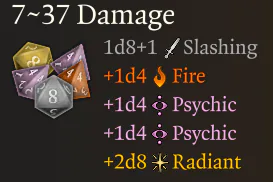
The practical consequence: features built specifically to reroll low damage dice — Great Weapon Fighting and Savage Attacker among them — do less work with Karmic Dice on, because there are fewer genuinely low rolls left for them to catch. If your build leans on those, that is one real argument for playing with the option off.
Two documented bugs sitting on top of it
bg3.wiki flags two known problems with the system as implemented:
- Some scripted dialogues make a character both the source and the target of the same check — the Mirror of Loss conversation is the wiki's named example. Because Karmic Dice reads that as the character rolling against themselves, it inverts the intended effect: debt builds on successes instead of failures, and a forced "automatic success" actually forces the check to fail.
- The probability calculation does not account for Reliable Talent, the rogue feature that guarantees a minimum result on proficient skill checks. Because the game still computes debt as if the roll could fail normally, a check that is mechanically guaranteed to succeed can still accumulate meaningful debt as though it were failing.
Neither bug is something you can see happening from the character sheet — they only show up as results that do not match the stated rules, which is exactly the kind of thing this system's invisibility makes hard to diagnose in the moment.
The toggle, and what Larian has said about it
Karmic Dice is not mandatory, and the studio has been direct about that from early on. Larian's director of publishing, Michael Douse, addressed the debate over the system on Twitter in August 2023 (reported at the time by PC Gamer), describing it as an option for players who are failing more rolls than they would like and want the odds nudged back toward what feels fair — Douse's own phrase for it was that it works "like a friendly DM."
The Patch 4 hotfix that introduced the current behaviour also confirmed, in the same post, that the option can be toggled on or off at any time in Gameplay Options, and that the same rules apply to NPCs and enemies rather than only to the player's party — a distinction that matters, because a run with Karmic Dice on is not simply tilted in your favour. Enemy casters build their own debt against you the same way you build yours against them.
One documented case ran the other way: PCGamesN reported in July 2023 that players had logged enemies landing up to 400% more damage than the stated odds implied, in a pre-launch build. Larian's community team called it an edge-case bug rather than intended behaviour and said it would be addressed before the PC release, which lines up with the "only ever bends in the rolling character's favour" rule the system runs on today.
Turning Karmic Dice off does not remove RNG variance — if anything it restores more of it, since the game stops smoothing out streaks in either direction. What it removes is the invisible thumb on the scale, in both directions, for anyone who would rather see the numbers on the tooltip mean exactly what they say.
Quick reference
- It is on by default. If you have never touched Gameplay Options, Karmic Dice has been running since character creation.
- It only forces successes on attack rolls, dialogue ability checks, and saving throws — never on lock-picking, Perception, or other checks made outside dialogue.
- Your own saving throws are never directly boosted. The system only ever forces a save through the caster's accumulated debt, working against whoever is on the other end of that spell.
- One miss roughly doubles your next identical roll's real odds, using the formula's own math — not a guaranteed effect, but a fast way to estimate what is actually happening after a whiff.
- Damage dice get pulled toward their average. Great Weapon Fighting and Savage Attacker have less to reroll as a result.
- It applies to enemies too. Off is not strictly "harder" — it is more volatile in both directions.
- The Mirror of Loss dialogue and Reliable Talent checks are both documented exceptions where the debt math does not behave as intended.
Frequently Asked Questions
What does Karmic Dice do in Baldur's Gate 3?
Which rolls can Karmic Dice force to succeed in BG3?
Does Karmic Dice help my own saving throws in BG3?
Is Karmic Dice on by default in Baldur's Gate 3?
Should you turn Karmic Dice off in Baldur's Gate 3?
Does Karmic Dice affect enemies in Baldur's Gate 3, or only the player?
Keep Reading
- BG3 Wiki — the Karmic Dice section of the Dice rolls page: the karmic debt formula, which roll types are eligible, the damage-distribution effect, and the Mirror of Loss and Reliable Talent bugs
- PC Gamer (Mollie Taylor, 2023-08-11) — Michael Douse's tweets confirming Karmic Dice is an optional setting and describing its intent
- PCGamesN (Will Nelson, 2023-07-29) — the pre-launch report of enemies landing disproportionately more hits and Larian's response calling it an edge-case bug fixed before release
- Larian Studios forums, Hotfix #10 patch notes (archived) — confirms loaded dice were introduced in Patch 4 to smooth the rolling bell curve, that the option is togglable in Gameplay Options, and the "only bends in the rolling character's favour" rule change that also applies to NPCs and enemies
Related Guides
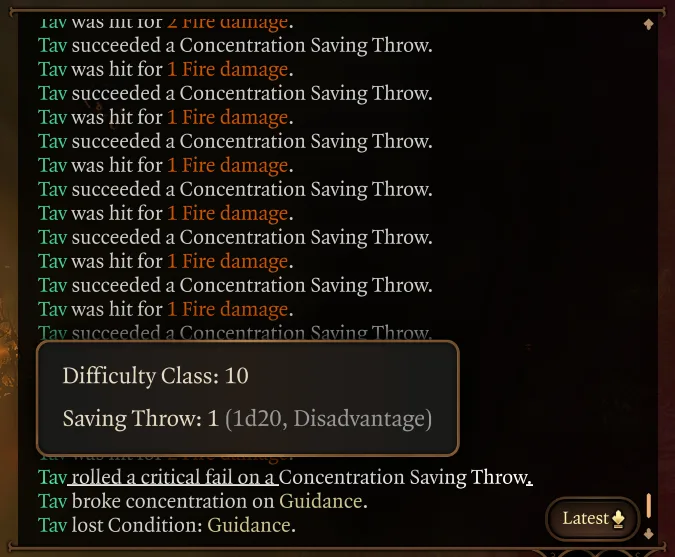
Baldur's Gate 3 Concentration: Why Your Spell Dropped
Baldur's Gate 3 ends concentration in more ways than the tabletop rules do: a natural 1 fails the save whatever your bonus, falling Prone ends it with no roll, and casting a second concentration spell after Haste on yourself costs you both. Here is what breaks it, temporary hit points and Rage included, the gear and feats that hold it, and the spells BG3 stopped making you concentrate on.
Baldur's Gate 3 Stealth: Where You Stand Beats the Roll
Baldur's Gate 3 only rolls a hiding character's Stealth in one of its three obscurity states; the other two decide whether you are found before Dexterity gets a vote. Here is how obscurity and darkvision work, why Fog and Darkness are different tools, what breaks Hiding, and the gear that switches on in the dark.

Baldur's Gate 3 Death Saves: What Actually Kills You
Baldur's Gate 3 keeps the tabletop shape of death saving throws and rewrites the details: no massive-damage deaths, no natural-20 comebacks, and failures that survive stabilising. Here is what kills a Downed character, what stops it, and what each way back from the dead costs.

Baldur's Gate 3 Initiative and Surprise: How to Go First
Tabletop D&D rolls initiative on a d20. Baldur's Gate 3 rolls it on a d4, which turns a +5 from Alert from a nudge into something close to a guarantee. Here is how turn order is built, what Surprised takes away, and the line-of-sight rule that decides whether your ambush gets a surprise round at all.
Baldur's Gate 3 Beginner Guide: What Nobody Tells You
The tutorial teaches you to move and attack. It does not teach you that advantage is worth more than any weapon you will find in Act 1, or that Withers will rebuild your entire character for 100 gold. Here is the actual onboarding.

Baldur's Gate 3 Wild Shape: It Can Kill You With No Save
An Owlbear form shows 65 hit points on a bar that looks nothing like your character sheet. That number is a mask, not a shield — bg3.wiki's own Wild Shape page spells out exactly what happens when it runs out, and it is not a knockdown. Here is the charge economy, what carries over and what shuts off, and the overflow rule that can end a character with no down-and-dying phase at all.