Baldur's Gate 3 Initiative and Surprise: How to Go First
Tabletop D&D rolls initiative on a d20. Baldur's Gate 3 rolls it on a d4, which turns a +5 from Alert from a nudge into something close to a guarantee. Here is how turn order is built, what Surprised takes away, and the line-of-sight rule that decides whether your ambush gets a surprise round at all.
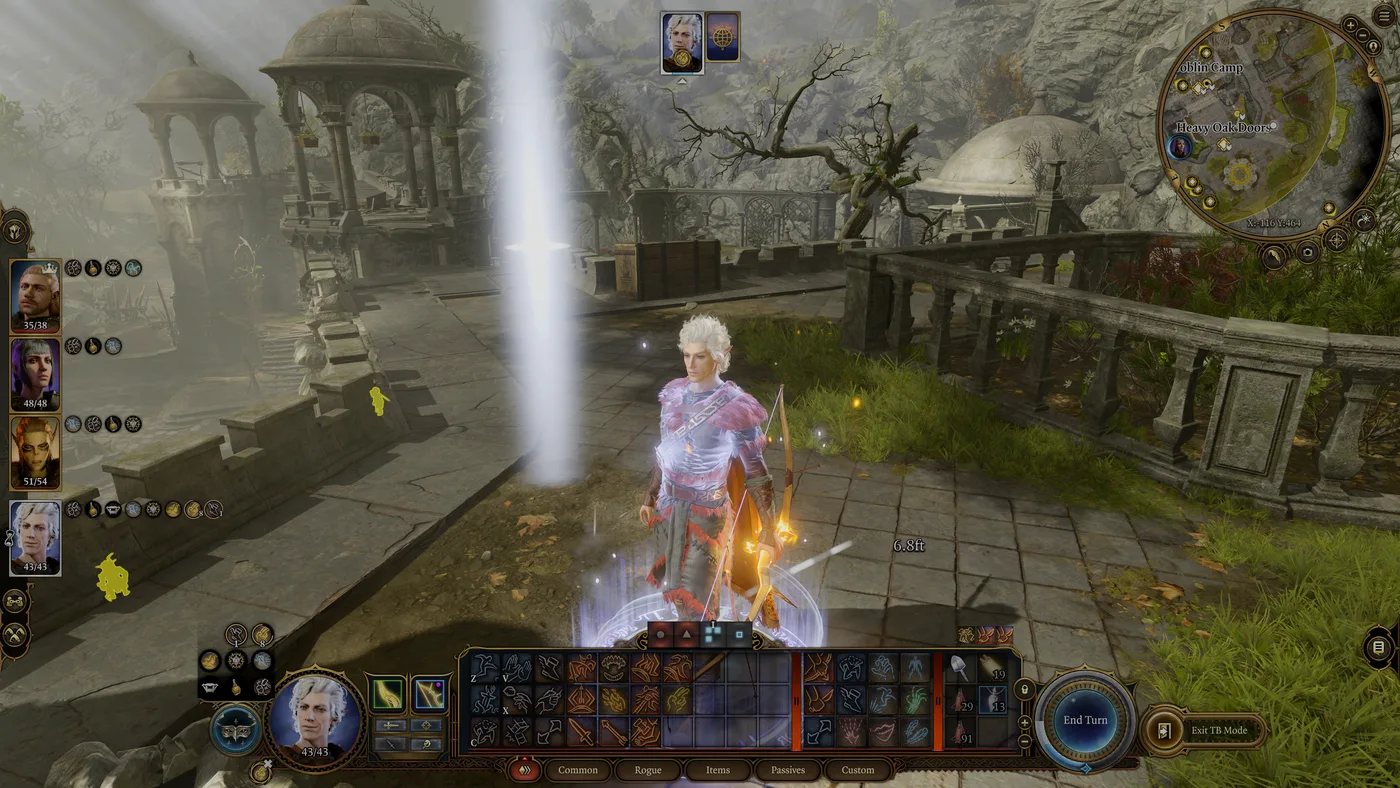
Tabletop D&D rolls initiative on a d20. Baldur's Gate 3 rolls it on a d4. That one die size is the most important number in this article, because a four-sided die has a spread of three — so the +5 on the Alert feat, the +3 on a Sentinel Shield and the gap between an 8 and a 16 Dexterity are not small nudges to your odds of acting first. Against a lot of the room, they settle the question before anything is rolled.
Here is how turn order is actually built, what the Surprised condition takes away, and the line-of-sight rule that decides whether your ambush produces a surprise round or just a normal fight you happened to start. The mechanics come from bg3.wiki's Initiative, Turn-based mode and Surprise pages. Where I have done arithmetic on top of them, I say so.
It's a d4, not a d20
When combat starts, every participant rolls 1d4 + their Dexterity modifier, and turns run from the highest result to the lowest. Three rules sit on top of that roll, all from bg3.wiki's Initiative page:
- Ties go to the higher Dexterity score — the score, not the modifier. A Dexterity 13 goblin beats a Dexterity 12 character on a tied roll even though both carry a +1.
- Characters controlled by the same player who tie act simultaneously, spending their actions, movement and other turn resources in whatever order they like.
- Initiative is not a Dexterity check. In tabletop it is. Here it is its own roll, so the wiki notes that Jack of All Trades and Enhance Ability: Cat's Grace do nothing for it. Jack of All Trades adds to ability checks and Cat's Grace grants advantage on Dexterity checks, and in this game initiative is neither.
That last point is worth knowing before you cast Cat's Grace on your opener and wonder why the turn order did not move.
What a +5 actually buys on a four-sided die
Take your total initiative modifier (Dexterity plus every bonus) and subtract the other creature's. That net difference is the only thing that matters, because both of you are rolling the same small die. Working every combination of two d4s gives this table — my arithmetic, not the wiki's:
| Your net modifier edge | You act first outright | Tied roll | They act first outright |
|---|---|---|---|
| -3 | 0% | 6.25% | 93.75% |
| -2 | 6.25% | 12.5% | 81.25% |
| -1 | 18.75% | 18.75% | 62.5% |
| 0 | 37.5% | 25% | 37.5% |
| +1 | 62.5% | 18.75% | 18.75% |
| +2 | 81.25% | 12.5% | 6.25% |
| +3 | 93.75% | 6.25% | 0% |
| +4 or more | 100% | 0% | 0% |
Ties then go to whoever has the higher Dexterity score.
Read the bottom two rows. At a net +3 you can tie but never lose the roll outright, and at +4 or better you act first every single time. For comparison, the same arithmetic on a d20 — the tabletop die — says a +5 edge wins outright 70% of the time. On Baldur's Gate 3's d4, Alert's +5 is bigger than the die itself. Unless the other creature's Dexterity modifier is two or more points higher than yours, or it brings initiative bonuses of its own, a character with Alert acts before it every time.
Enemies do bring their own. bg3.wiki's Alert page lists the feat on Auntie Ethel, Balthazar, Cazador and Kar'niss, among others — fair warning that the villains are playing the same game you are.
A plate Fighter against a goblin
bg3.wiki gives the Goblin Warrior a Dexterity of 13, so a +1 to initiative. Put a Dexterity 10 Fighter in plate against it — a reasonable build, since heavy armour ignores Dexterity — and the Fighter sits at a net -1: first outright 18.75% of the time, tied another 18.75%, and it loses those ties because 13 beats 10. Call it one fight in five against any one goblin, and every goblin in the room rolls separately.
Give the same Fighter Alert or an Elixir of Vigilance and the edge becomes a net +4: it acts first against that goblin every time. A Dexterity 16 Rogue gets to a net +2 with no help at all — 81.25% outright, plus the 12.5% of ties its higher Dexterity score wins, for 93.75%.
That is the real case for initiative gear in this game. The die is too small to rescue a low-Dexterity character, and too small to threaten one carrying a big bonus.
Your party shares turns when it stays together
Your side does not act one portrait at a time. Per bg3.wiki's Turn-based mode page, allied creatures that are directly adjacent to each other in the turn order and in close proximity to each other usually take their turns at the same time, interchangeably, in groups of up to 10. The Gameplay mechanics page describes the same thing as adjacent creatures sharing one turn-order position.
Two consequences follow:
- An enemy that rolls into the middle of your order splits the block. Four party members sharing one position can land a Hold Person, walk the martials in and start swinging before anything answers. The same four with a goblin wedged into slot three act as two groups with a goblin turn in between. My inference from that rule: lifting your slowest party member's initiative can buy more than lifting your fastest.
- Summons you do not control are not on your side for this. The wiki is specific: a summoned creature that is not controlled by the player — its example is the ghouls raised by the Necromancy of Thay — does not share its summoner's turn.
The proximity clause matters too. A party spread across a map does not get to merge its turns just because the numbers line up.
The initiative bonuses bg3.wiki lists
This is the wiki's own table of initiative sources, in its order. It is the list the wiki maintains, not a claim that nothing else exists.
| Source | Bonus | What it is | Also |
|---|---|---|---|
| Alert | +5 | Feat | Cannot be Surprised |
| Elixir of Vigilance | +5 | Elixir | Cannot be Surprised |
| Feral Instinct | +3 | Barbarian feature, level 7 | Cannot be Surprised |
| Dread Ambusher | +3 | Gloom Stalker feature, level 3 | First-turn extra attack (below) |
| Hellrider Longbow | +3 | Longbow | Advantage on Perception checks |
| Sentinel Shield | +3 | Shield | Advantage on Perception checks |
| Rakish Audacity | +2 to +4 | Swashbuckler feature | +3 at Rogue 5, +4 at Rogue 10 |
| Assassin of Bhaal Cowl | +2 | Headwear | — |
| Mask of Soul Perception | +2 | Headwear | Also +2 to attack rolls and Perception |
| Soulbreaker Greatsword | +2 | Greatsword | — |
| Bhaalist Armour | +2 | Light armour | — |
| Elegant Studded Leather | +2 | Light armour | — |
| Elven Chain | +2 | Medium armour | — |
| Flame Enamelled Armour | +2 | Medium armour | — |
| Ambusher | +1 | Shortsword | — |
| Bow of Awareness | +1 | Shortbow | — |
| Fistbreaker Helm | +1 | Headwear | — |
| Halberd of Vigilance | +1 | Halberd | — |
| Stalker Gloves | +1 | Handwear | — |
| Studded Leather Armour +2 | +1 | Light armour | — |
| Hide Armour +2 | +1 | Medium armour | — |
| Scale Mail +2 | +1 | Medium armour | — |
| Yuan-Ti Scale Mail | +1 | Medium armour | — |

A few of those rows are worth a note:
- The Elixir of Vigilance gets you onto this list without spending a feat, a level or a gear slot — only your one elixir slot, since drinking it replaces any other elixir's effect. It has a base value of 25 gold, takes a bonus action to drink, and lasts until your next long rest. Base value is not the sticker price: bg3.wiki's Trading page says traders multiply it by a modifier of at least 1, which sits at 2.5 on Balanced with zero Persuasion and zero trader attitude and falls as either rises. The wiki lists Entharl Danthelon at Danthelon's Dancing Axe, Kith in Grymforge and Popper at the Circus of the Last Days among its sellers, and you can brew it from a Sublimate of Bloodstained Hook plus any Ashes. Our elixirs guide makes the case for spending the elixir slot on it.
- The Sentinel Shield and the Hellrider Longbow both carry the same passive, Heightened Awareness: +3 initiative and advantage on Perception checks. The shield is sold by Lann Tarv on the main floor of Moonrise Towers (base value 580 gold); the bow by Ferg Drogher near the Requisitioned Barn in Rivington (base value 770). Both carry higher base values in Honour Mode.
- The Assassin of Bhaal Cowl is only sold by the Echo of Abazigal at the Murder Tribunal to a character who has accepted becoming an Unholy Assassin, and the Mask of Soul Perception sits in a locked gilded chest (Sleight of Hand DC 20) in Helsik's room upstairs at the Devil's Fee.
- Alert and the Elixir of Vigilance grant the same two effects: +5 initiative and immunity to Surprised. The wiki does not say whether their two +5s stack, and I have not found a page that does. The surprise immunity is redundant either way, so put the elixir on someone who does not already have the feat.
What Surprised takes away, and who is immune
If a creature is unaware of its attacker when combat starts, the first round becomes a surprise round and that creature gains the Surprised condition. Per bg3.wiki's condition and Turn-based mode pages, a Surprised creature cannot take actions or reactions, and it keeps the condition for the entire first round, until the start of the second. Our reactions guide covers a wrinkle in that second half: Surprised stops a creature spending the Reaction resource, which leaves the handful of reactions that cost no resource untouched.
Two more details change how you should plan around it:
- Some Surprised creatures can warn nearby allies, which stops those allies becoming Surprised too, according to a note on the Turn-based mode page. A surprise round against a large group is not guaranteed to catch every member of it.
- Immunity belongs to one character. Alert, Feral Instinct and the Elixir of Vigilance each stop their holder being Surprised. One Alert character in a party that walks into an ambush acts in round one; the other three can still be caught.
How to make a surprise round actually trigger
bg3.wiki's Surprise page calls surprising a group "challenging and counter-intuitive", and is blunt about why: the key is line of sight. The enemy must have a clear line of sight to the character who springs the ambush. Start the fight from outside it and the enemies begin searching for you instead — and when they find you, the fight starts with nobody Surprised.
So the ambusher has to be in their view and unseen at the same time, which is what Hide and invisibility are for. The wiki's recipe, condensed:
- Hide the entire party, pets included. Hide is an action for most characters; Rogues, Gloom Stalker Rangers and Way of Shadow Monks can do it as a bonus action through class features.
- Ungroup and pick one ambusher.
- Approach from outside the vision cones while the others hang back. Holding the Show Sneak Cones key (Left Shift by default) draws them. Crossing a cone in a Clear Area gets you spotted on the spot; Lightly Obscured means a Stealth check against the watcher's passive Perception, repeated every turn; Heavily Obscured means no check at all. The Stealth page adds that many creatures have a hidden 2 m darkvision, which downgrades your cover inside that range.
- Start the fight from inside their line of sight.
- Start it with the right kind of attack — see the table.
- Then bring the rest of the party in. More on the timing of that below.
How you open matters, per the Surprise page's testing:
| Opening attack | Does it surprise them? |
|---|---|
| Any melee attack | Yes |
| A ranged attack made at melee range | Yes |
| Eldritch Blast (attack roll) | Yes, at melee range or beyond |
| Fear (Wisdom save) | Yes, at melee range or beyond |
| Fireball (Dexterity save) | Only at melee range |
| Witch Bolt (attack roll) | Only at melee range |
| Magic Missile (no attack roll) | No, at any range |
| Grenades | No, even on a direct hit |
Treat the spell rows as observed behaviour rather than a rule: the wiki says its testing "has not been exhaustive" and calls the spell-attack results either bugged or complicated. Two things it is firm on. Whether your opening attack hits or misses makes no difference. And against enemies carrying the Ambushing condition, every type of attack works — grenades included — as long as they have not spotted the party.
The most reliable opener, per the same page, is to turn Invisible and attack. A Potion of Invisibility, the Invisibility and Greater Invisibility spells and the Shadow of Menzoberranzan all qualify, as do the Quasit and Imp pets and the Panther Wild Shape. Keep your own Create Water off that character: as our status effects guide notes, Wet strips ordinary Invisibility with no save.
Attacking from outside their sight is a different play
Opening from outside every vision cone is not wasted — it is a stealth attack, a separate mechanic. After the attack, hit or miss, you make a Stealth check against the Perception of the target and any witnesses. That check has Disadvantage by default, and any source of advantage cancels it. Win, and you stay undetected while they search, though the target gains Advantage on its Perception checks for five turns. Lose, and combat begins immediately — and because you attacked from outside their line of sight, it is not a surprise round.
That is the real choice. A surprise round needs you inside their eyeline while unseen. A string of undetected shots needs you outside it.
Your opening attack comes out of your first turn
The attack that starts the fight is not free. bg3.wiki's Resources page states that an action used to initiate or enter combat does not recharge at the start of that character's first turn, and the Difficulty page lists this rule — "Disable free first strikes" — as switched on in Explorer, Balanced, Tactician and Honour alike, with Custom mode the only place to turn it off. So the ambusher's opener costs one attack or action from its own round-one turn.
The practical upshot: a surprise round mostly pays out for everyone else, who get full turns while the enemy cannot act. The Assassin's Alacrity feature, covered below, exists to undo that cost.
Bring the rest of the party in during round one
Step 6 of that recipe has a deadline, and it is on the Initiative page rather than the Surprise page:
- Join during the first round and you are guaranteed a full turn — but you can only be slotted in among participants who have not acted yet. Anyone who has already taken their turn, including a Surprised creature that passed its turn, stays ahead of you whatever you roll.
- Join after the first round and you automatically skip your turn. Your portrait greys out with an hourglass on it.
The Surprise page says the rest of the party is pulled into the fight when they enter an enemy's vision cone or attack. Put the two rules together: move them in while the enemy is still Surprised in round one. A party member who strolls in during round two has thrown away its first turn, which is exactly the turn the ambush was meant to buy.
Two subclasses built around the first turn

Assassin (Rogue, level 3) gets three features that turn this whole article into damage:
- Assassin's Alacrity restores your action and bonus action at the start of combat — the direct counter to the free-first-strike rule above. The wiki's note says the target does not need to be Surprised for it to trigger, and also that it does not always activate — presumably, the wiki guesses, because of how it interacts with initiative and with what counts as part of a given combat.
- Assassinate: Initiative gives you Advantage on attack rolls against creatures that have not taken a turn yet. That makes turn order a damage stat: every enemy below the Assassin in the order is an advantage target until it acts, which is the argument for stacking the bonuses in the table above on this character first.
- Assassinate: Ambush makes any successful attack roll against a Surprised creature a critical hit. As our critical hits guide explains, a crit doubles every damage die — Sneak Attack dice included.

Gloom Stalker (Ranger, level 3) gets Dread Ambusher: +3 initiative, and on the first turn of each combat, 3 m of extra movement plus an extra weapon attack that deals an additional 1d8, recharging per battle. The wiki logs one bug that dictates the order you do things in: the bonus movement is tied to the extra attack, so once you make the attack, any unused bonus movement disappears. Move first, then swing.
The Swashbuckler's Rakish Audacity is the other subclass feature on the initiative table, and our Patch 8 subclasses guide covers the rest of that kit.
Fights that surprise you instead
bg3.wiki keeps a list of encounters with Surprised participants, and several are rigged to catch the party. The Turn-based mode page notes these often show the words "story event" on screen. Here are the ones where your side can be caught, as the Surprise page lists them:
| Encounter | Act | What happens |
|---|---|---|
| Caskets in the cave inside the Apothecary's Cellar | 1 | Interacting with certain caskets releases an Agile Guardian that surprises the party |
| Petrified Battlefield, Underdark | 1 | Approaching triggers a Spectator cutscene that leaves the party Surprised |
| Underdark Beach duergar | 1 | Attack them straight away and all the duergar are Surprised; call Gekh Coal and have him turn hostile, and the party is Surprised instead |
| Mimics in Grymforge | 1 | Interacting with them in disguise surprises the party; attacking from range starts the fight without surprise |
| Magma Mephits by the mithral vein closest to the Adamantine Forge | 1 | They surprise the party on approach |
| Blights in the Shadow-Cursed Lands | 2 | Three separate encounters can surprise the party if you get too close |
| The Mimic in Moonrise Towers | 2 | Same rule as the Grymforge mimics |
| Meazels in the Ruined Battlefield | 2 | They surprise the party unless a DC 18 Perception check is passed |
| End of Dribbles' performance, Circus of the Last Days | 3 | The party is Surprised unless passive Perception spots the ambush, in which case the ambushers are Surprised instead |
| Doppelgangers in Entharl's basement (The High Harper) | 3 | Dialogue checks and choices decide which side is Surprised |
The Mimic page adds the number behind that row: approaching a disguised Mimic triggers a DC 20 Perception check, and each character who fails it starts the fight Surprised.
The same list has three where the enemy is the one caught out: sneaking into the Overgrown Ruins refectory leaves Andorn Surprised, approaching Nadira surprises the Bugbear Assassin lying in wait for her, and attacking the bloated hyenas on the Risen Road leaves them Surprised.
For the rigged ones, the wiki's counters are the immunity sources above — Alert, Feral Instinct, the Elixir of Vigilance — or being Invisible or hidden in a heavily obscured area, such as a Darkness spell, before you trigger the encounter. In an Honour Mode run, those rows are the fights to drink Vigilance before.
Quick reference
- Initiative is 1d4 + Dexterity modifier, highest acts first. Ties go to the higher Dexterity score; tied characters controlled by the same player act simultaneously.
- It is not a Dexterity check, so Jack of All Trades and Cat's Grace do not apply to it.
- A net +4 initiative edge means you always act first against that creature; a net +3 means you can tie but never lose outright. Alert's +5 is bigger than the whole die.
- Adjacent allies in the turn order who are close together share one turn, up to 10 creatures. An enemy slotting between them splits the block, and uncontrolled summons never join it.
- Alert, Feral Instinct and the Elixir of Vigilance each give initiative and immunity to Surprised — for the character who has them only.
- Surprised means no actions and no reactions for the whole first round. Some Surprised creatures can warn their allies.
- A surprise round needs you inside the enemy's line of sight while unseen. Attack from outside it and they search instead; get found and the fight starts normally.
- Open with melee, a ranged attack at melee range, or from Invisibility. Grenades and Magic Missile do not trigger surprise, per the wiki's testing.
- The opening attack is charged to your first turn in every preset difficulty. Assassin's Alacrity refunds it, when it activates.
- Bring the rest of the party in during round one. Joining after the first round skips your turn.
- Assassins get Advantage against anything that has not acted yet, and any attack roll that hits a Surprised target is a critical hit; Gloom Stalkers get +3 initiative and a first-turn extra attack.
Frequently Asked Questions
How is initiative rolled in Baldur's Gate 3?
Does the Alert feat guarantee going first in Baldur's Gate 3?
Why do my party members take their turns together in BG3?
What does the Surprised condition do in Baldur's Gate 3?
How do you surprise enemies in Baldur's Gate 3?
Why didn't my stealth attack surprise the enemies in BG3?
What happens if a party member joins combat late in Baldur's Gate 3?
Keep Reading
- Mythras blog
- Baldur's Gate 3 coverage hub
- Baldur's Gate 3 best feats guide
- Baldur's Gate 3 elixirs and potions guide
- Baldur's Gate 3 reactions guide
- Baldur's Gate 3 critical hits guide
- Baldur's Gate 3 best armour guide
- Baldur's Gate 3 status effects and surfaces guide
- Baldur's Gate 3 Patch 8 subclasses guide
- Baldur's Gate 3 Honour Mode tips
- BG3 Wiki — Initiative: the 1d4 + Dexterity roll, the Dexterity-score tiebreak, same-player simultaneous turns, joining combat late, the not-a-Dexterity-check note, and the full initiative bonus table
- BG3 Wiki — Turn-based mode: simultaneous turns for adjacent nearby allies (up to 10), the uncontrolled-summon exclusion, surprise rounds, and allies warning each other
- BG3 Wiki — Gameplay mechanics: turn order, shared turn-order positions and the surprise round
- BG3 Wiki — Surprise: the line-of-sight rule, the ambush recipe, which opening attacks trigger surprise, invisibility, and the list of encounters with Surprised participants
- BG3 Wiki — Surprised condition: cannot take actions or reactions
- BG3 Wiki — Hide: action cost, the bonus-action classes, obscurity and sight-cone rules
- BG3 Wiki — Stealth: hiding checks by obscurity, the hidden 2 m darkvision, the Show Sneak Cones key, and stealth attacks from outside line of sight
- BG3 Wiki — Resources: an action used to initiate combat does not recharge at the start of the first turn
- BG3 Wiki — Difficulty: the Disable free first strikes setting and its value in every preset
- BG3 Wiki — Alert: +5 initiative, cannot be Surprised, and the creatures that use it
- BG3 Wiki — Elixir of Vigilance: +5 initiative, surprise immunity, 25-gold base value, duration, sellers and recipe
- BG3 Wiki — Feral Instinct: +3 initiative and surprise immunity at Barbarian level 7
- BG3 Wiki — Jack of All Trades: does not apply to initiative rolls, unlike tabletop 5e
- BG3 Wiki — Heightened Awareness: +3 initiative and advantage on Perception checks
- BG3 Wiki — Sentinel Shield: Lann Tarv, Moonrise Towers, 580-gold base value (790 in Honour Mode)
- BG3 Wiki — Hellrider Longbow: Ferg Drogher, Rivington, 770-gold base value (1,550 in Honour Mode)
- BG3 Wiki — Trading: traders multiply an item's base value by a price modifier of at least 1, set by Persuasion, trader attitude and difficulty
- BG3 Wiki — Assassin of Bhaal Cowl: sold by the Echo of Abazigal at the Murder Tribunal, purchasable only after accepting the Unholy Assassin path
- BG3 Wiki — Mask of Soul Perception: +2 to attack rolls, initiative and Perception; locked gilded chest (Sleight of Hand DC 20) in Helsik's room at the Devil's Fee
- BG3 Wiki — Reactions: Surprised prevents spending the Reaction resource but not reactions that consume no Reaction
- BG3 Wiki — Wet condition: becoming Wet breaks normal invisibility immediately
- BG3 Wiki — Critical hit: every damage die is rolled twice, including additional dice
- BG3 Wiki — Goblin Warrior stat block: Dexterity 13
- BG3 Wiki — Assassin Rogue subclass features: Assassin's Alacrity, Assassinate: Ambush and Assassinate: Initiative
- BG3 Wiki — Assassin's Alacrity: restores the action and bonus action spent starting combat, and its activation caveat
- BG3 Wiki — Dread Ambusher: +3 initiative, first-turn extra attack and movement, and the movement bug
- BG3 Wiki — Mimic: the DC 20 Perception check on approach and the Surprised outcome
Related Guides
Baldur's Gate 3 Concentration: Why Your Spell Dropped
Baldur's Gate 3 ends concentration in more ways than the tabletop rules do: a natural 1 fails the save whatever your bonus, falling Prone ends it with no roll, and casting a second concentration spell after Haste on yourself costs you both. Here is what breaks it, temporary hit points and Rage included, the gear and feats that hold it, and the spells BG3 stopped making you concentrate on.
Baldur's Gate 3 Stealth: Where You Stand Beats the Roll
Baldur's Gate 3 only rolls a hiding character's Stealth in one of its three obscurity states; the other two decide whether you are found before Dexterity gets a vote. Here is how obscurity and darkvision work, why Fog and Darkness are different tools, what breaks Hiding, and the gear that switches on in the dark.
Baldur's Gate 3 Death Saves: What Actually Kills You
Baldur's Gate 3 keeps the tabletop shape of death saving throws and rewrites the details: no massive-damage deaths, no natural-20 comebacks, and failures that survive stabilising. Here is what kills a Downed character, what stops it, and what each way back from the dead costs.
Baldur's Gate 3 Wild Shape: It Can Kill You With No Save
An Owlbear form shows 65 hit points on a bar that looks nothing like your character sheet. That number is a mask, not a shield — bg3.wiki's own Wild Shape page spells out exactly what happens when it runs out, and it is not a knockdown. Here is the charge economy, what carries over and what shuts off, and the overflow rule that can end a character with no down-and-dying phase at all.
Baldur's Gate 3 Beginner Guide: What Nobody Tells You
The tutorial teaches you to move and attack. It does not teach you that advantage is worth more than any weapon you will find in Act 1, or that Withers will rebuild your entire character for 100 gold. Here is the actual onboarding.
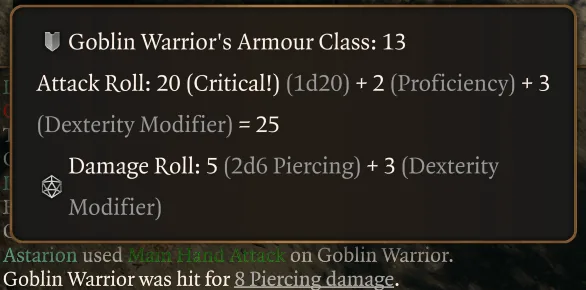
Baldur's Gate 3 Critical Hits: What Actually Doubles
A natural 20 doubles your damage in Baldur's Gate 3 — but "doubled" hides real nuance: which half of that number actually doubles, which of the game's dozen crit-threshold sources stack together, and how "immune to critical hits" still lets a natural 20 miss outright. bg3.wiki's own combat-log breakdown settles all three.