Best Blue Cards in Cookie Run: Braverse, Ranked
Blue is the brain color: draw deep, set up, then win the game in a single explosive sequence. Here are the real Blue cards worth building a combo deck around, ranked top to bottom.
Blue is the color you lose to and don't see coming. Where Red is a stopwatch and Yellow is a war of attrition, a Blue deck spends the early game looking like it's doing nothing - drawing, cycling, holding cards - and then dumps three turns of value into one. Played well, it's the most satisfying color in Cookie Run: Braverse. Played badly, it's a deck that durdles for ten turns and then dies with the perfect hand it never got to use.
This is a ranked tour of the real Blue cards worth building around, pulled from the official card database, plus the framework for evaluating any Blue card that drops next set. Stats below - cost, HP, and effect text - are quoted from the official listings; the {B} symbol is a single Blue resource, {N} is any color, so a cost like "two Blue, one any" is what a card actually demands to fire. If you're brand new, read the five colors explained and deck archetypes first - Blue has the highest skill floor of the five colors, and it shows.
What makes a Blue card good
Color identity is the lens, and Blue's identity is card cycling, hand manipulation, and explosive combo turns. Because Braverse ramps slowly - you only add one Support card per turn, so resources grow steadily rather than spiking - Blue's whole edge is squeezing more out of each turn than the resource curve says you should get. A Blue card is good when it either finds the pieces of your plan faster or converts a full hand into a game-ending sequence. Concretely, the best Blue cards tend to do one of these:
- Draw real cards. Raw card advantage is the engine. The deck that sees more of itself assembles its combo first and has answers to spare.
- Cycle and filter. Effects that let you dig past dead cards or swap a useless draw for a live one are what make a combo deck consistent instead of a coin flip.
- Turn a downside into fuel. Blue often wants to discard or spend cards, and the best Blue cards reward it - several draw conditionally only when your hand is small enough, so emptying your hand isn't a cost, it's the trigger.
- Pay off the setup. The combo finish - the card that takes the cards you dug for and ends the game in one sequence. Without a payoff, you're just a draw engine with no kill.
The combo test: a Blue card earns its slot if it makes your payoff turn come sooner or hit harder. Card advantage you never cash in is just a slower way to lose.
A card that's "fine" value in a Yellow control shell can be a trap in Blue, because Blue isn't trying to grind - it's trying to spike. Consistency and payoff are the currency, not incremental advantage.
How to read this list
We're grouping by role, not by raw power, because role is what survives a meta shift - but within each role the picks are ranked, real cards with their actual numbers. The buckets are: card-draw engines, cycle/filter pieces, combo payoffs, and the Cookies a Blue deck actually wants on the board. Costs and effects are quoted from the official database; the named cards span several sets (Age of Heroes and Kingdoms through Land of Fire & Ruin), so a few will rotate in relevance as new sets land. Treat the ranking as a snapshot of the current pool, not a "run exactly these" decklist.
The card draw engines
This is the slot that makes Blue, Blue. The entire color is built on seeing more cards than your opponent and using that information to win. (The cross-color draw and search ranking covers every color's options.) Ranked top to bottom:
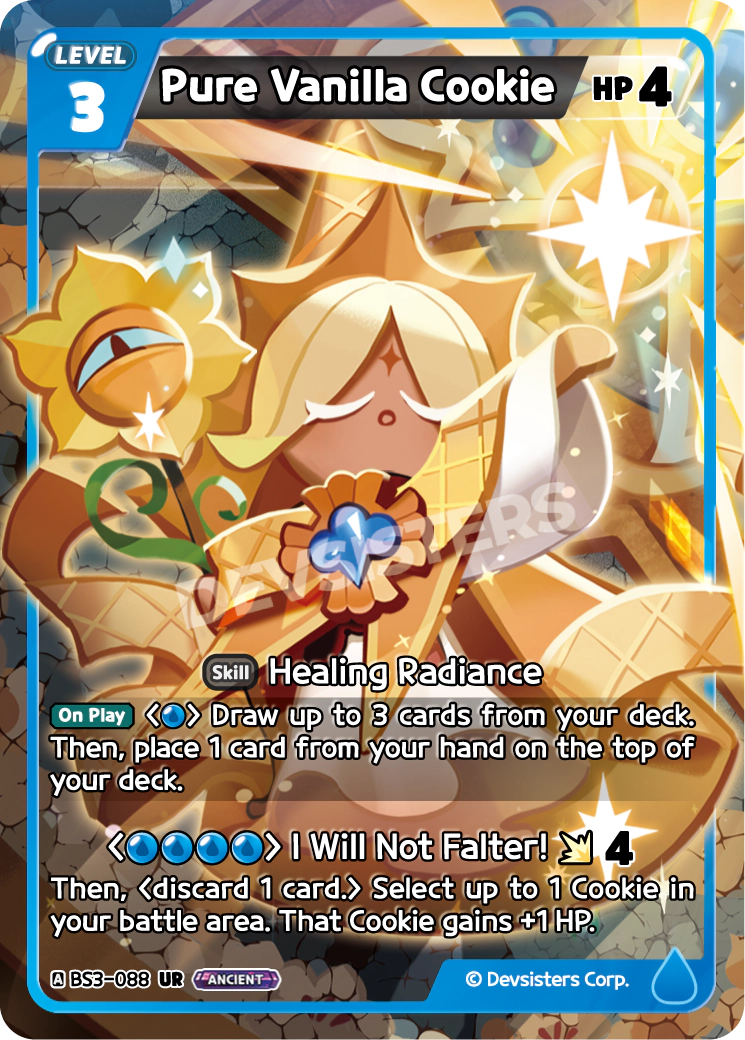
- Pure Vanilla Cookie (BS3-088, Ultra Rare, LV.3, 4 HP). Its Healing Radiance skill costs one Blue and reads: "Draw up to 3 cards from your deck. Then, place 1 card from your hand on the top of your deck." That's net +2 cards and a top-deck setup for one resource - the best raw draw-to-cost ratio in the color. Its attack even heals a Cookie +1 HP, so it isn't dead weight on the board.
- Pure Vanilla Cookie (BS11-070, Super Rare, LV.2, 4 HP). A lower-Level reprint for decks that want the engine cheaper to deploy: discard an 【Ancient】 Cookie on play, draw up to 2. Run it when your curve can't afford the LV.3 body but you still want the dig.
- Lime Cookie (BS10-095, Super Rare, LV.1, 2 HP). A one-cost body whose On Play draws up to 1, then up to 1 more if your hand is six or fewer. Cheap, early, and exactly the kind of repeatable card advantage the deck wants to chain off of turn one.
What you're looking for in this slot, set after set, is the best draw-per-resource you can find, and Pure Vanilla is the current benchmark. The discipline is that draw without a payoff is just a prettier way to deck yourself out, so every engine card has to be paired with something to do with the cards.
A Blue deck wants to be drawing or filtering nearly every turn of the early game. If you're not adding cards or quality to your hand, you're falling behind your own clock.
The cycle and filter pieces
Drawing more cards is half of it; the other half is making sure the cards you draw are the right ones, and that you can keep the engine running without flooding out. Ranked:
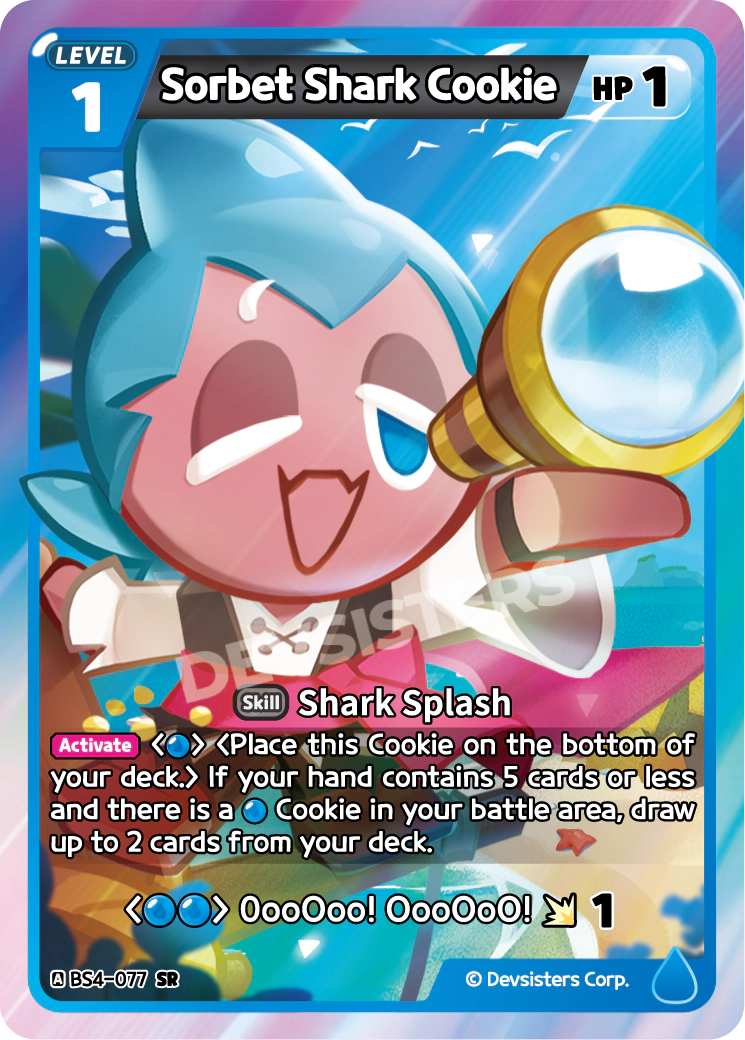
- Sorbet Shark Cookie (BS4-077, Super Rare, LV.1, 1 HP). The defining Blue cycle piece. Its Shark Splash skill: "Place this Cookie on the bottom of your deck. If your hand contains 5 cards or less and there is a {B} Cookie in your battle area, draw up to 2 cards from your deck." It loops itself back into the deck and refills your hand - a one-HP body you're happy to recycle, which is the whole point.
- Sea Fairy Cookie (BS11-069, Super Rare, LV.2, 4 HP). A reactive filter: once per turn, when your opponent attacks, if your hand is five or fewer, draw up to 2 and place 1 back on top. Free card selection on the opponent's turn, which is exactly when a combo deck wants to be quietly improving its hand.
- Black Raisin Cookie (BS9-077, Super Rare, LV.2, 3 HP). Its On Play draws 1 and puts 1 back on top, and its attack places the Cookie back on top or bottom of the deck - pure top-deck sculpting that smooths your next two turns.
These are the effects that let you discard a dead card to draw a fresh one, dig several cards deep, or rearrange the top of your deck. They're unglamorous, and new Blue players skip them for splashier cards - which is exactly why their combo never comes together. Note how many of these only draw when your hand is small: emptying your hand isn't a drawback in Blue, it's the unlock.
The combo payoffs
This is the slot that wins the game and the one that defines whether your Blue deck is actually a deck or just a draw engine with no finisher. Ranked:
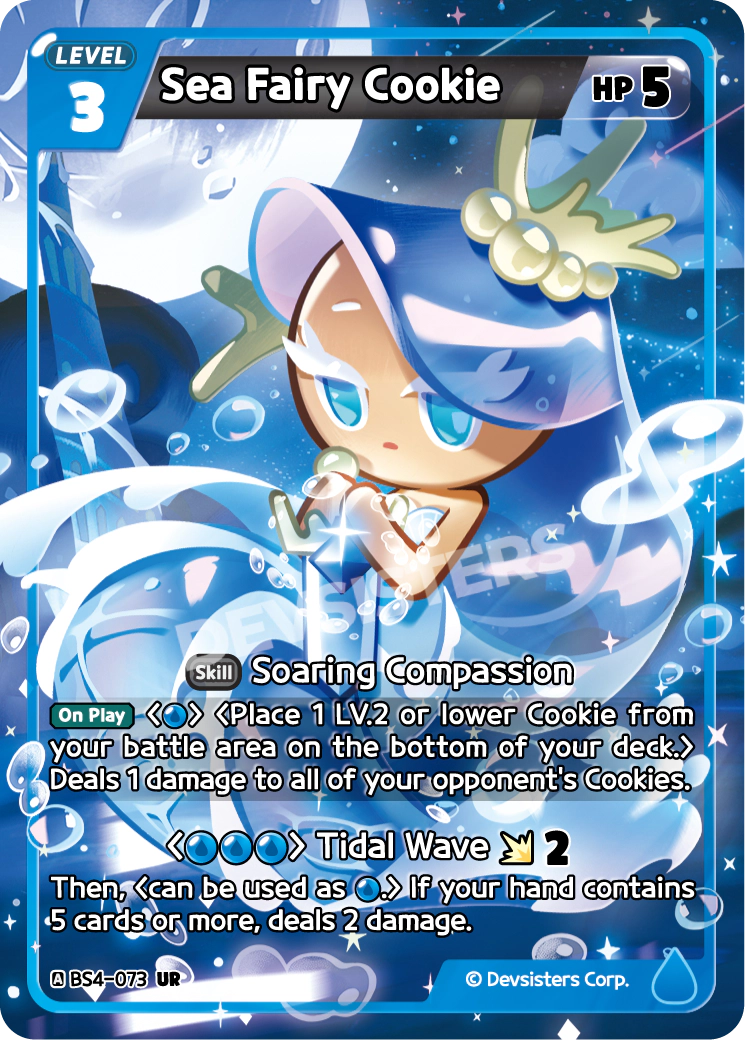
- Sea Fairy Cookie (BS4-073, Ultra Rare, LV.3, 5 HP). The premier Blue board-clear payoff. Her Soaring Compassion skill, for one Blue plus bouncing a small Cookie, "Deals 1 damage to all of your opponent's Cookies," and her three-cost attack deals 2 - then 2 more if your hand is five or more. A full hand turns her into a one-card sweeper-plus-finisher, which is the entire Blue dream in a single card.
- Tide Shards (BS4-085, Super Rare Item). The payoff for a loaded hand: "Discard 4 cards. Select up to 2 of your opponent's Cookies. Those Cookies receive 1 damage each. Then, draw up to 4 cards." A two-Blue Item that removes two threats and refills the four cards you paid - the cleanest "spend your hand, win the exchange" card in the color.
- Soul Jam: Light of Truth (BS3-091, Super Rare Item). The dig-and-equip finisher: view the top 3, take up to 2, then equip it to Pure Vanilla Cookie so that Cookie draws a card every time it attacks. This is the card that turns a draw engine into an inevitability machine.
The best payoffs scale with the work you've put in - the recurring "if your hand is five or more / five or less" clauses mean your payoff hits because you set it up. The risk is real: misfire the combo, or get your payoff answered, and you've spent ten turns building toward nothing.
If you can't point to the exact card that ends the game, you don't have a combo deck - you have a pile of cantrips. Build the payoff first, then build the engine that finds it.
The Cookies Blue actually wants
Blue is an effect-first color, but it still has to survive long enough to combo, which means the Cookies it runs have a specific job: buy time, disrupt, and carry effects. Here's what to look for, with the real cards that fill each lane:
| Card role | Real example | Why it matters |
|---|---|---|
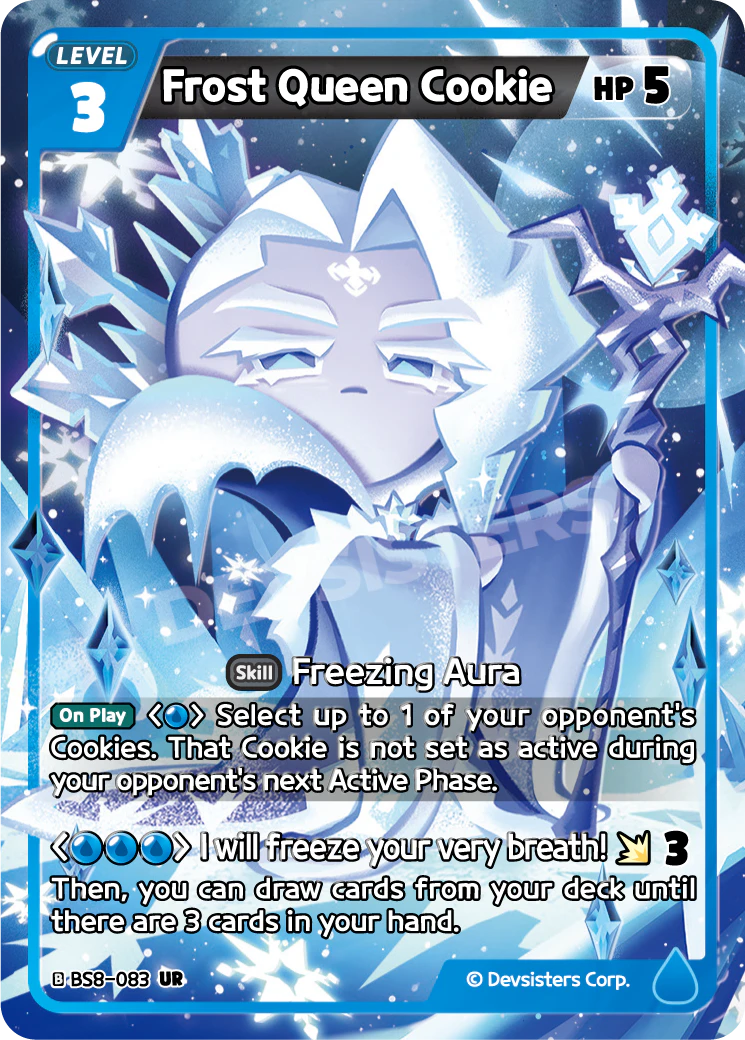
| Disruptive bodies | Frost Queen Cookie (BS8-083, UR) | Freeze and tempo-denial keeps you alive to your payoff |
| Defensive walls | Cream Soda Cookie (BS7-079, UR) | Soaks attacks and shrinks incoming damage |
| Cookies with card skills | Sorbet Shark Cookie (BS4-077, SR) | Doubles your engine onto your board |
| Dragon / top-end | Lotus Dragon Cookie (BS5-071, UR) | A higher-Level removal payoff as plan B |
The single best Blue Cookie for surviving to your combo is Frost Queen Cookie (BS8-083, Ultra Rare, LV.3, 5 HP). Her Freezing Aura skill, for one Blue on play, stops one of your opponent's Cookies from being set active next turn - a clean tempo tax - and her attack deals 3 and then refills your hand back up to three cards. She's a wall, a disruptor, and a draw engine on one body, which is why she's the hero of this list.
Cream Soda Cookie (BS7-079, Ultra Rare, LV.2, 4 HP) is the pure defensive anchor: once per turn, when an opponent's Cookie attacks, discard a card to make that Cookie deal -1 damage. In a deck that wants cards in the trash, that discard is barely a cost. And the confirmed Blue Dragon Cookie, Lotus Dragon Cookie (BS5-071, Ultra Rare, LV.3, 5 HP), is your board-based plan B: discard three or more Blue cards to deal 2 damage to a Cookie, with an attack that draws up to 2 when your hand is small. The discipline across all of these is the same: a Cookie earns its slot in Blue if it advances the combo, defends the combo, or is the combo.
Cards that look good but underperform
A few archetypes of card consistently fool new Blue players:
- Pure card advantage with no payoff. Engines like Lime Cookie or Captain Caviar Cookie (ST4-013) feel great, but if your deck has no Sea Fairy or Tide Shards to win with the extra cards, you're just postponing the loss. Card advantage is a means, not the plan.
- High-cost combo pieces that don't defend. A flashy three-Blue payoff that costs your whole turn and leaves you with no board is how a fast Red deck steals the game before you go off. That's the case for Frost Queen and Cream Soda - bodies that defend while you set up.
- Narrow combo cards with one use. A piece that's only good in a specific two-card combo - say, a Soul Jam that's dead unless you've drawn its exact partner - is a liability in your other fifteen draws. Favor flexible cards that filter or pay off over rigid single-purpose pieces.
Deckbuilding tip: when in doubt, cut the third niche combo piece for another Sorbet Shark or filter card. The most common reason a Blue deck loses is that it never drew its payoff - consistency fixes that, a fourth win condition doesn't.
How many of each to run
A clean Blue combo shell, role by role, looks roughly like this. Treat it as a starting skeleton you tune, not gospel - and remember a legal deck is exactly 60 cards with up to four copies of any card number, at least one Cookie, and up to 16 FLIP cards.
| Role | Rough share of the deck | Anchor cards |
|---|---|---|
| Card-draw engines | A large core block | Pure Vanilla, Lime |
| Cycle / filter pieces | A solid secondary block | Sorbet Shark, Black Raisin |
| Combo payoffs | A small, deliberate set | Sea Fairy (BS4-073), Tide Shards |
| Disruptive / defensive Cookies | A focused package | Frost Queen, Cream Soda |
| FLIP cards | Up to the 16-card cap | Blue FLIP draws like Moon Rabbit Cookie that buy combo time |
The 60-card, four-copy, and 16-FLIP figures are the standard deck-construction limits; confirm them against the official rulebook before a sanctioned event. For the full rules on ratios and curve, see deck-building basics, and for a cheaper way into the color, our budget deck guide.
Quick Action Checklist
- Build the payoff first. Decide how your Blue deck actually wins - Sea Fairy's board clear, Tide Shards' two-for-one - then build the engine that finds it.
- Lead with Pure Vanilla. The BS3-088 draw-3-set-1 skill is the best draw-per-resource in the color and the backbone of the deck.
- Run real filtering, not just raw draw. Sorbet Shark and Black Raisin turn your combo from a coin flip into a plan.
- Keep enough defense to survive. Frost Queen and Cream Soda are bodies that buy the turns your combo needs; a few beat a fourth payoff.
- Don't over-stuff payoffs. A small, deliberate finisher set is enough - too many clogs your hand before you've set up.
- Mind the "small hand" clauses. A huge share of Blue draw only fires when your hand is five or fewer; sequence your spends to stay under the line.
- Respect the skill floor. Blue rewards knowing your deck cold. Play your lines slowly until the sequencing is automatic.
Frequently Asked Questions
What are the best Blue cards in Cookie Run: Braverse?
What makes a card good for a Braverse combo deck?
Is Blue good for beginners in Braverse?
How many combo payoffs should a Blue deck run?
Are Dragon Cookies good in Blue combo?
Why does my Blue deck keep losing before it combos off?
Keep Reading
Related Guides
Best Cookie Run: Braverse Cards for Beginners
You don't need chase rares to play real Braverse. These are the cheap, easy-to-use cards across all five colors that punch above their cost - the staples a new player should actually prioritize.
Best Trap Cards in Cookie Run: Braverse, Ranked
Braverse has 120 different Trap cards and 115 of them are Uncommons. There is not a single Ultra Rare Trap in the game. That means the entire interaction layer - the cards that decide close games - is fully available to anyone who owns a starter deck and a fistful of bulk.
Best Draw and Search Cards in Cookie Run: Braverse
Search the official Braverse database for skills that draw two or more cards and you get 61 hits. Sixty of them charge you something - a discard, a mill, a hand-size cap, a body that has to die first. Exactly one doesn't, and it's a Common. Here's the full draw and search pool, color by color.

Best FLIP Cards in Cookie Run: Braverse, Ranked
FLIP is the signature Braverse mechanic where your own hit points punch back, and here is the strange part: the best FLIP cards are all cheap. Not one is above Rare. These are the standout FLIP Cookies ranked by color and role, with the exact flip text off the official database.

How to Play Cookie Run: Braverse - A Complete Beginner Guide
Cookie Run: Braverse is the rare TCG you can teach in a single match. This guide covers everything a first-time player needs: card types, setup, turn structure, how you pay for cards, the FLIP mechanic, and how to win.
Cookie Run: Braverse Meta Tier List — Best Decks & Archetypes Ranked
Which Cookie Run: Braverse decks are actually carrying right now? Here's a meta tier list of the strongest archetypes - the real cards that anchor each one, why they rank where they do, and what's overrated.