Cookie Run: Braverse Stat Curve: The HP, Cost and Damage Math Behind Every Cookie
Nobody can tell you if a Braverse card is good, because nobody knows what average looks like. So I parsed all 992 unique LV.1-LV.3 Cookies out of the official database and built the curve: what HP, energy cost and damage you should expect at every level, and which cards actually beat it.
Somebody in my playgroup calls a card busted the moment it deals 3 damage. Cool. Compared to what?
That's the honest problem with evaluating Cookie Run: Braverse cards right now. The game is young enough that there's no shared sense of "normal." You can read a card, understand every word on it, and still have no idea whether 4 HP on a LV.2 is generous or embarrassing. Tier lists tell you what wins tournaments. They don't tell you what a fair rate looks like, which is the thing you actually need when you're staring at a new set and deciding what to sleeve.
So I downloaded the official English card database and counted. Every number below comes from parsing that file directly - no vibes, no forum consensus. If a claim here is wrong, you can check it in about ten minutes, which is the whole point.
What 992 Cookies actually look like
Quick note on method, because it changes the numbers. The database ships 2,092 card entries, but a lot of those are alternate-art reprints - the ones with an @ suffix on the card number, like BS1-003@1 sitting next to BS1-003. Those are the same card with different art, so counting them twice would skew everything toward whatever the chase rares were. Collapse them and you get 1,552 unique card numbers. Filter to Cookies with a printed level of LV.1, LV.2 or LV.3 - so no Item, Trap, Stage, Flip or Extra Deck cards - and you land on 992 Cookies. Of those, 986 print a flat damage number on their attack; the other six do something conditional instead.
Here's the curve those 992 Cookies draw:
| Level | Cookies | Avg HP | Most common HP | Avg attack cost | Avg damage | Most common damage |
|---|---|---|---|---|---|---|
| LV.1 | 408 | 2.28 | 2 (52%) | 1.78 | 1.36 | 1 (67%) |
| LV.2 | 399 | 3.40 | 4 (40%) | 2.49 | 2.25 | 2 (44%) |
| LV.3 | 185 | 4.62 | 5 (57%) | 3.01 | 2.89 | 3 (50%) |
Read that table twice, because it's the single most useful thing in this post. The default Braverse Cookie is a 2/1 at LV.1, a 4/2 at LV.2, and a 5/3 at LV.3. That's HP first, damage second. Every card you pick up gets measured against those three shapes.
A few things jump out immediately. LV.1 is a genuinely bad place to be aggressive - 67% of LV.1 Cookies deal exactly 1 damage, and 63% of them have 2 HP or less. LV.3 is where the game's actual bodies live: 69% of LV.3 Cookies have 5 or more HP, and 73% deal 3 or more damage. The jump from LV.2 to LV.3 is worth roughly +1.2 HP and +0.6 damage for +0.5 energy. That is a good trade, which is why the whole leveling and energy system is built to slow it down.
The kill math nobody prints on the card
The curve gets interesting when you point the columns at each other. HP in Braverse is a face-down stack of cards, and damage flips them - so "how many attacks does this take" is a literal, countable number, not an abstraction.
Run the modal Cookie at each level against the modal Cookie at each level:
| Attacker | Defender LV.1 (2 HP) | Defender LV.2 (4 HP) | Defender LV.3 (5 HP) |
|---|---|---|---|
| LV.1 (1 damage) | 2 attacks | 4 attacks | 5 attacks |
| LV.2 (2 damage) | 1 attack | 2 attacks | 3 attacks |
| LV.3 (3 damage) | 1 attack | 2 attacks | 2 attacks |
Look at the top-right corner. A typical LV.1 Cookie needs five swings to remove a typical LV.3. In a game where you add one Support card per turn, five swings is not a plan - it's a concession. This is the mathematical reason pure LV.1 aggro doesn't work in Braverse the way low-curve aggro works in other card games: your cheap bodies aren't slow, they're structurally incapable of threatening the cards your opponent is about to play.
Now the bottom row. A typical LV.3 kills a typical LV.2 in two attacks and a typical LV.1 in one. And critically, it kills another typical LV.3 in two attacks, same as it kills a LV.2. That 5 HP wall is doing much less work than it looks like it's doing, because the average LV.3 damage number (2.89) sits just above half of it. The 6 HP LV.3s are the ones that genuinely change the math - and there are only 22 of them across the whole unique pool.
Damage per energy is the real efficiency stat
Divide printed damage by printed attack cost and you get a rate. Across the 986 Cookies with a flat damage number, that rate climbs steadily with level:
- LV.1: 0.76 damage per energy
- LV.2: 0.90 damage per energy
- LV.3: 0.96 damage per energy
Nobody is getting a bargain here. Braverse prices attacks at slightly under one damage per energy almost everywhere, and the improvement from leveling is real but modest. Which makes the outliers loud.
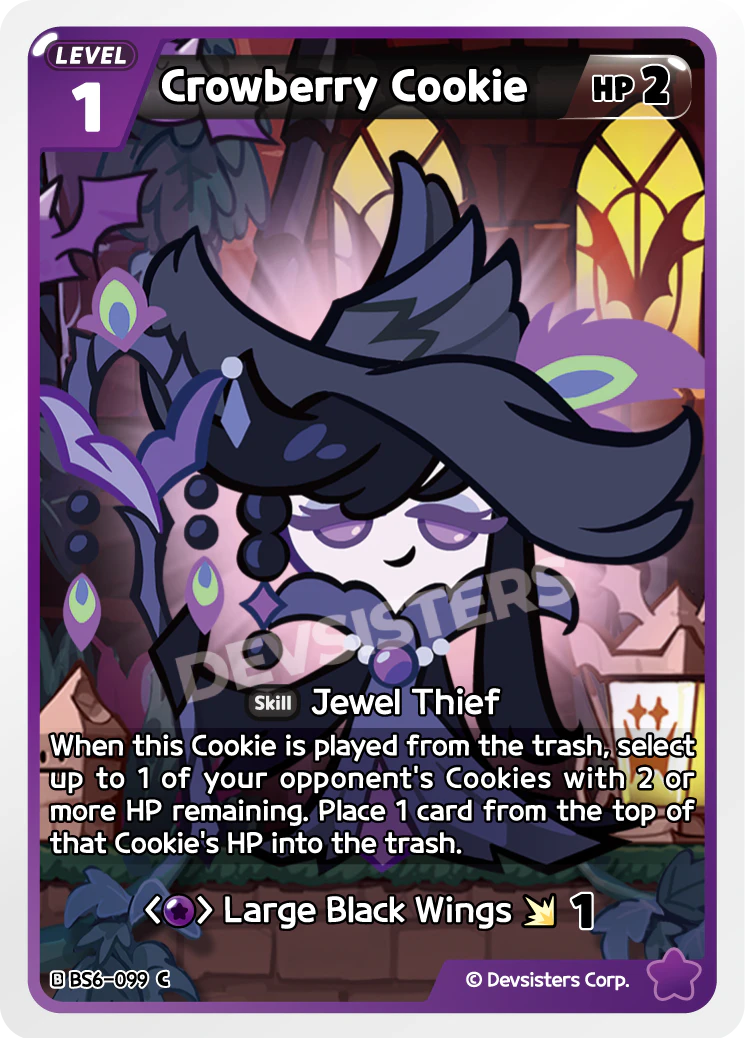
Only 12 of 986 unique LV.1-LV.3 Cookies hit a rate of 2.0 damage per energy or better. That's 1.2%. And exactly one of them clears 3.0: Crowberry Cookie (BS6-099) from Operation Timeguard, a Purple LV.1 Common with 2 HP that swings for 4 damage off a single {P}. A rate of 4.0 in a game whose average is 0.76 at that level. It also has a skill that triggers when it's played from the trash, chipping a card off the top of an opponent's HP stack, which tells you exactly what deck it was designed for.
The rest of the 2.0-and-up club is mostly Operation Timeguard commons and a handful of BRAVE BEGINNING LV.3s with 1 HP - Apple Cookie, Chili Pepper Cookie, Mustard Cookie, Strawberry Cookie, Dino-Sour Cookie, all 1-energy-for-2-damage bodies that fall over to literally any attack in the game. That's the trade the designers keep making, and once you see it you can't unsee it: efficiency is bought with HP.
Braverse taxes colorless flexibility in HP
Here's the finding I didn't expect. I split LV.3 Cookies by whether their attack cost is entirely generic ({N} symbols, payable with any color) or entirely colored:
| LV.3 attack cost | Cookies | Avg HP | Avg cost | Avg damage | Damage per energy |
|---|---|---|---|---|---|
| All generic | 24 | 3.33 | 2.17 | 2.79 | 1.29 |
| All colored | 121 | 4.83 | 3.05 | 2.79 | 0.91 |
Identical average damage. The generic-cost group does it for 0.88 less energy - and pays 1.50 fewer HP for the privilege. Colorless flexibility in Braverse isn't priced in energy. It's priced in durability.
Two honest caveats before you build a deck around this. First, 24 cards is a small sample, and 15 of them are BRAVE BEGINNING commons from a period when the game hadn't finished sorting out its color identities. Second, the effect is LV.3-specific - at LV.1 and LV.2, generic-cost Cookies actually average slightly more HP than colored ones. So this isn't a universal design law.
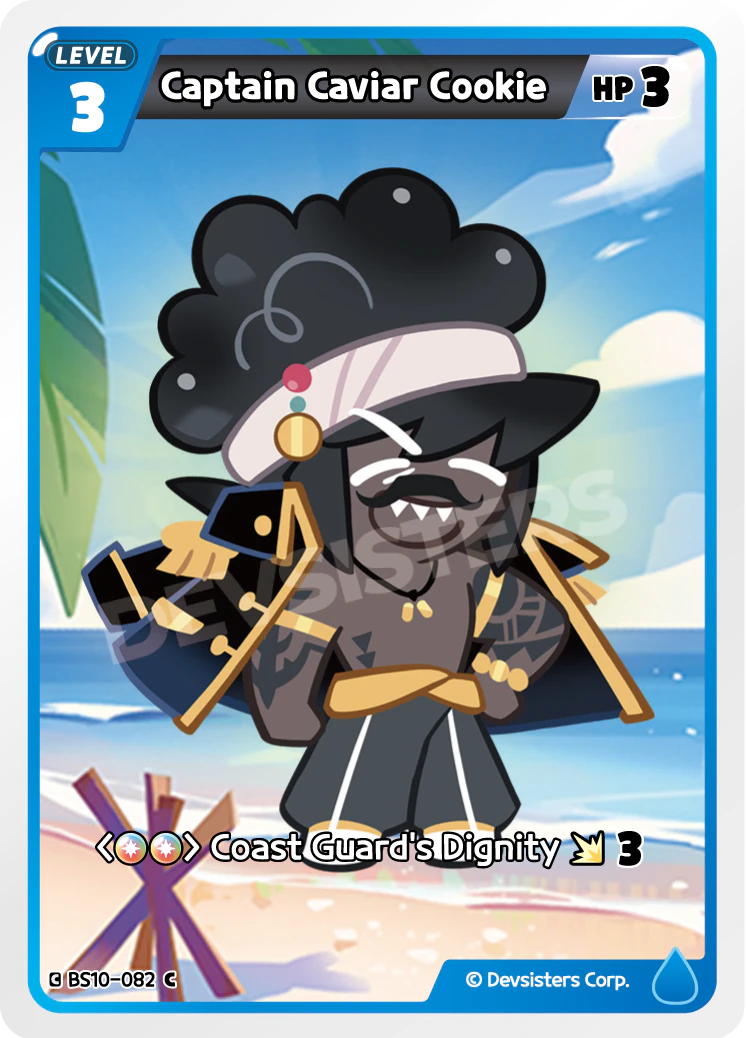
But the modern proof is unmistakable, and it's a cycle. Paradise of Passion & Sloth printed five LV.3 Commons, one per color, all with the same statline: 3 HP, an attack costing {N}{N}, and 3 damage. Tarte Tatin Cookie (Red), Cannoli Cookie (Yellow), Churro Cookie (Green), Captain Caviar Cookie (Blue), and Purple Yam Cookie (Purple). A LV.3 with 3 HP is 1.6 below the LV.3 average, and it is the cheapest way in the game to put a 3-damage attack into any deck regardless of color. That's the tax, printed five times in a row so you can't miss it.
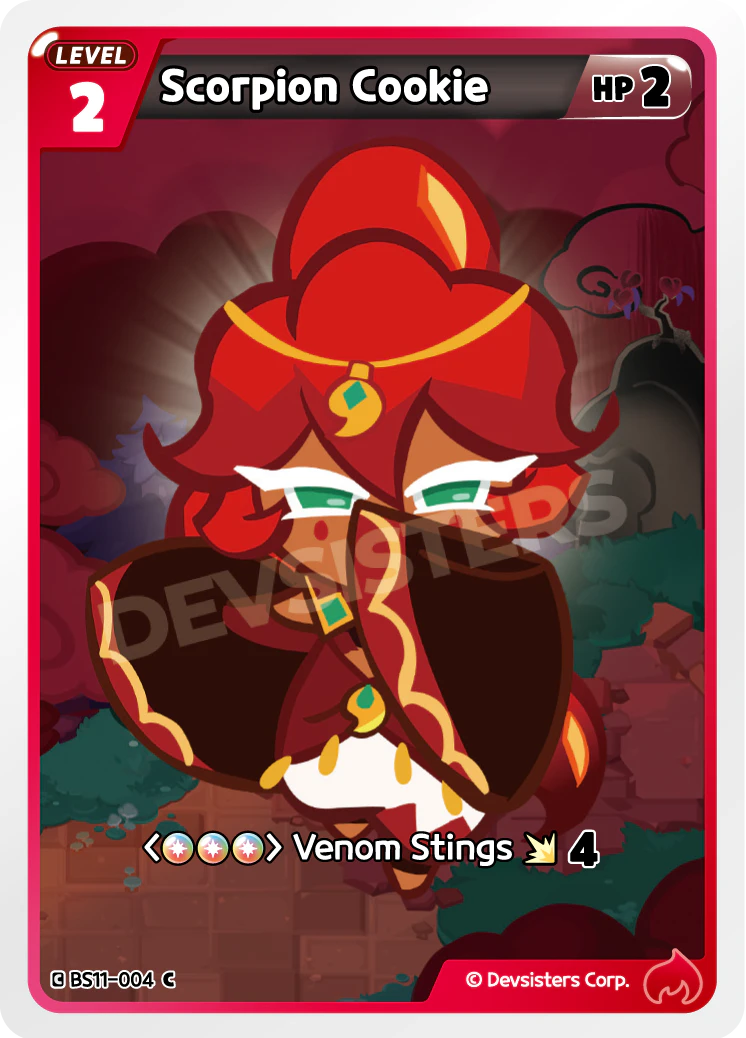
The Dark Enchantress War ran the same play one level down, and harder. Five LV.2 Commons, one per color - Scorpion Cookie (Red), Mozzarella Cookie (Yellow), Bellflower Cookie (Green), Menthol Cookie (Blue), Marble Danish Cookie (Purple) - each with 2 HP and a {N}{N}{N} attack for 4 damage. Four damage at LV.2, when the LV.2 average is 2.25 and only seven LV.2 Cookies in the entire unique pool reach 4. They're splashable, they punch a full level above their weight, and they die to a stiff breeze. If you want to understand how modern Braverse sets are built, that cycle is the whole design philosophy in five cards.
The 4 damage ceiling and the one Cookie that breaks it
Damage numbers in Braverse are aggressively capped, and the cap is 4.
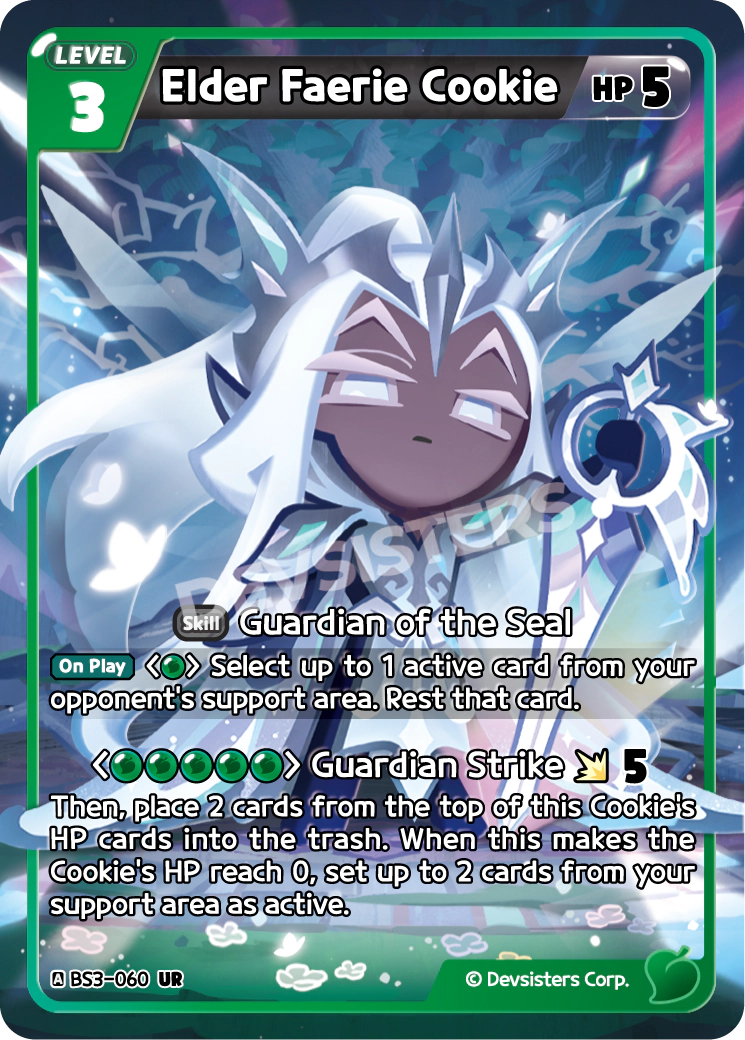
Across all 986 unique LV.1-LV.3 Cookies with a flat damage number, exactly one prints a 5: Elder Faerie Cookie (BS3-060), the Green UR from Age of Heroes and Kingdoms on this post's hero image. Its Guardian Strike costs {G}{G}{G}{G}{G} - five Green energy, the most expensive attack in the main-deck pool - for 5 damage and a rider that mills two cards off its own HP stack. A rate of exactly 1.0, at a cost most decks will never assemble.
Everything above 5 lives in the Extra Deck. Avatar of Destiny (BS11-091) hits for 5 off four generic energy, and Dark Enchantress Cookie (BS11-116) - a LV.5 Extra card, a level that exists nowhere in the main-deck pool - deals 7 for {K}{K}{K}{K}. If you're wondering why Extra Deck cards feel like a different game, that's why. They're allowed above the ceiling.
Practically, this means the highest realistic single-swing damage you'll face from a normal Cookie is 4, and 4 does not kill the 5 HP LV.3s that make up the majority of the level. Braverse is a two-attack game at the top end, deliberately. Anything that lets you skip a swing - direct damage riders, HP-stack manipulation, forcing a Cookie down a level - is worth more than the raw numbers suggest.
Power creep in Braverse is text creep
The usual complaint about any TCG a year in is that the numbers are getting bigger. In Braverse, they mostly aren't. Here's average damage-per-energy by booster set, in release order:
| Set | Cookies | Avg HP | Avg damage | Damage per energy | Cookies with rules text beyond the attack |
|---|---|---|---|---|---|
| BS1 BRAVE BEGINNING | 54 | 3.00 | 2.07 | 0.94 | 15% |
| BS2 BRAVE BEGINNING | 56 | 3.16 | 2.09 | 0.91 | 14% |
| BS3 Age of Heroes | 75 | 3.13 | 2.13 | 0.87 | 35% |
| BS4 Age of Heroes | 71 | 3.37 | 2.04 | 0.84 | 34% |
| BS5 Operation Timeguard | 86 | 3.03 | 1.88 | 0.84 | 30% |
| BS6 Operation Timeguard | 79 | 3.00 | 1.97 | 0.88 | 35% |
| BS7 Arena of Glory | 83 | 3.34 | 2.00 | 0.87 | 28% |
| BS8 Land of Fire & Ruin | 82 | 3.04 | 1.84 | 0.84 | 18% |
| BS9 Truth and Deceit | 68 | 3.25 | 2.12 | 0.87 | 24% |
| BS10 Paradise of Passion & Sloth | 73 | 3.38 | 1.96 | 0.86 | 25% |
| BS11 The Dark Enchantress War | 69 | 3.19 | 2.28 | 0.95 | 39% |
Damage per energy has bounced between 0.84 and 0.95 for eleven sets with no upward trend - BS1 and BS11 are within 0.01 of each other. Average HP has moved from 3.00 to 3.19. That is remarkably flat for a game this young, and Devsisters deserves credit for it.
What has changed is how much the cards say. Average attack-text length has gone from roughly 40 characters in BRAVE BEGINNING to 81 in The Dark Enchantress War - it doubled. The share of Cookies carrying rules text beyond a plain attack went from 15% to 39%. BS11 also posts the highest average damage of any set at 2.28, so there is a mild numerical uptick worth watching, but it's noise next to the complexity curve.
That's the real creep, and it's the one that matters for how the game plays. A BS1 board state is a math problem. A BS11 board state is a math problem wrapped in triggers, and the Special Play mechanic is the clearest example - Dark Enchantress Cookie's LV.3 printing costs you two Black LV.2 Cookies out of your battle area before it ever attacks. Nothing in BRAVE BEGINNING asks you to do arithmetic like that.
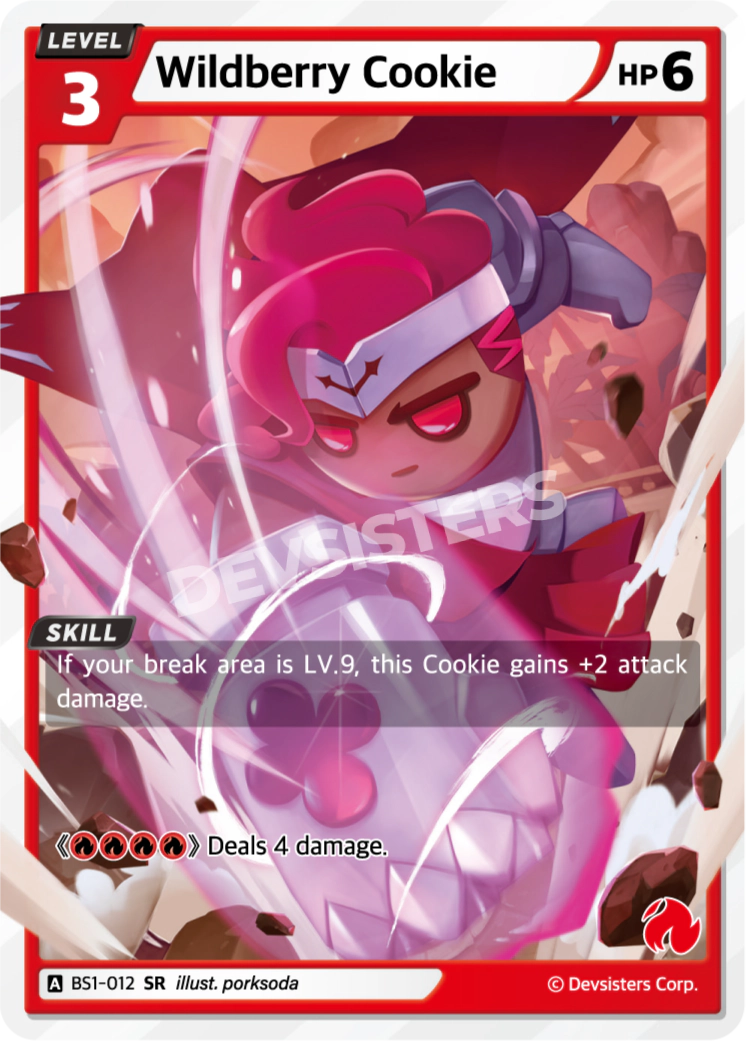
Wildberry Cookie from the launch set is the benchmark that proves it: 6 HP at LV.3, four Red energy for 4 damage, plus a conditional +2 attack if your Break Area is at LV.9. Printed in the very first set, still above the LV.3 average on both HP and damage. The numbers were never the problem.
How to use the curve when you evaluate a card
Three questions, in order, every time you pick up an unfamiliar Cookie.
1. Is the body above or below its level's default? LV.1 default is 2 HP, LV.2 is 4, LV.3 is 5. A LV.2 with 5 HP is in the top 12% of its level. A LV.3 with 3 HP is a glass cannon whether or not the card admits it.
2. What's the damage-per-energy rate, and what did it cost? Anything at 1.0 or better is above the average at every level. Anything at 2.0 or better is one of twelve cards in the game - check what it gave up, because it definitely gave up something.
3. How many swings does it need against a 5 HP LV.3? This is the only question that matters in a real game. Damage 1 or 2 means three or more attacks, which means it's a support piece, not a threat. Damage 3 or 4 means two attacks, which means it can actually close.
Run those three checks and most "is this card good" arguments resolve in about fifteen seconds. It won't tell you whether a card is broken - that lives in the text, not the statline - but it will tell you immediately whether you're paying a premium for stats or for effects, which is the decision you're really making when you build a deck.
Where the curve stops helping
I want to be clear about what this analysis can't do, because a number with false confidence is worse than no number.
The curve measures printed stats only. It does not measure skills, On Play triggers, Flip effects, keyword synergies, or the color identity each card is designed to support. Two Cookies with identical statlines can be a format staple and a draft filler, and nothing in this dataset would tell them apart. Crowberry Cookie's 4.0 rate is real, but its actual value comes from being a Purple trash-recursion piece, not from the ratio.
It also ignores rarity distribution, which matters if you're buying singles rather than theorycrafting, and it excludes the Extra Deck entirely - which is where the genuinely absurd numbers live.
And it's a snapshot. Every set shifts these averages a little; BS11 already pushed average damage to its highest point in the game's history. If Devsisters keeps that up for two more sets, the "0.84 to 0.95 band" claim needs revisiting, and I'd rather you check it against the database yourself than take my word for it a year from now. The file is public, the parsing is ten lines, and the answers change. That's the fun part.
Frequently Asked Questions
What is the average HP of a Cookie in Cookie Run: Braverse?
How much damage does a typical Braverse Cookie deal?
Which Cookie Run: Braverse card has the best damage per energy?
What is the highest damage attack on a Braverse Cookie?
Is Cookie Run: Braverse power creeping?
How many attacks does it take to kill a LV.3 Cookie in Braverse?
Keep Reading
Related Guides
Best Trap Cards in Cookie Run: Braverse, Ranked
Braverse has 120 different Trap cards and 115 of them are Uncommons. There is not a single Ultra Rare Trap in the game. That means the entire interaction layer - the cards that decide close games - is fully available to anyone who owns a starter deck and a fistful of bulk.
Best Draw and Search Cards in Cookie Run: Braverse
Search the official Braverse database for skills that draw two or more cards and you get 61 hits. Sixty of them charge you something - a discard, a mill, a hand-size cap, a body that has to die first. Exactly one doesn't, and it's a Common. Here's the full draw and search pool, color by color.

Best FLIP Cards in Cookie Run: Braverse, Ranked
FLIP is the signature Braverse mechanic where your own hit points punch back, and here is the strange part: the best FLIP cards are all cheap. Not one is above Rare. These are the standout FLIP Cookies ranked by color and role, with the exact flip text off the official database.
Cookie Run: Braverse Black Cards: The Whole Pool and How Black Actually Plays
Black is the smallest color in Cookie Run: Braverse by an absurd margin: 28 distinct cards against roughly 290 for every other color. That is not a color - it is one deck, shipped whole. Here is every card in it, what the skill text actually says black does, and the awkward internal tension nobody is talking about two days into the set.

How to Play Cookie Run: Braverse - A Complete Beginner Guide
Cookie Run: Braverse is the rare TCG you can teach in a single match. This guide covers everything a first-time player needs: card types, setup, turn structure, how you pay for cards, the FLIP mechanic, and how to win.
Cookie Run: Braverse Meta Tier List — Best Decks & Archetypes Ranked
Which Cookie Run: Braverse decks are actually carrying right now? Here's a meta tier list of the strongest archetypes - the real cards that anchor each one, why they rank where they do, and what's overrated.