Special Play in Cookie Run: Braverse, Read Straight Off the Cards
Special Play is the headline mechanic of The Dark Enchantress War, and the marketing copy explains almost none of it. So I pulled all 2,092 rows of the official card database and worked the rule out of the printed text instead - including the parts the cards genuinely do not answer yet.
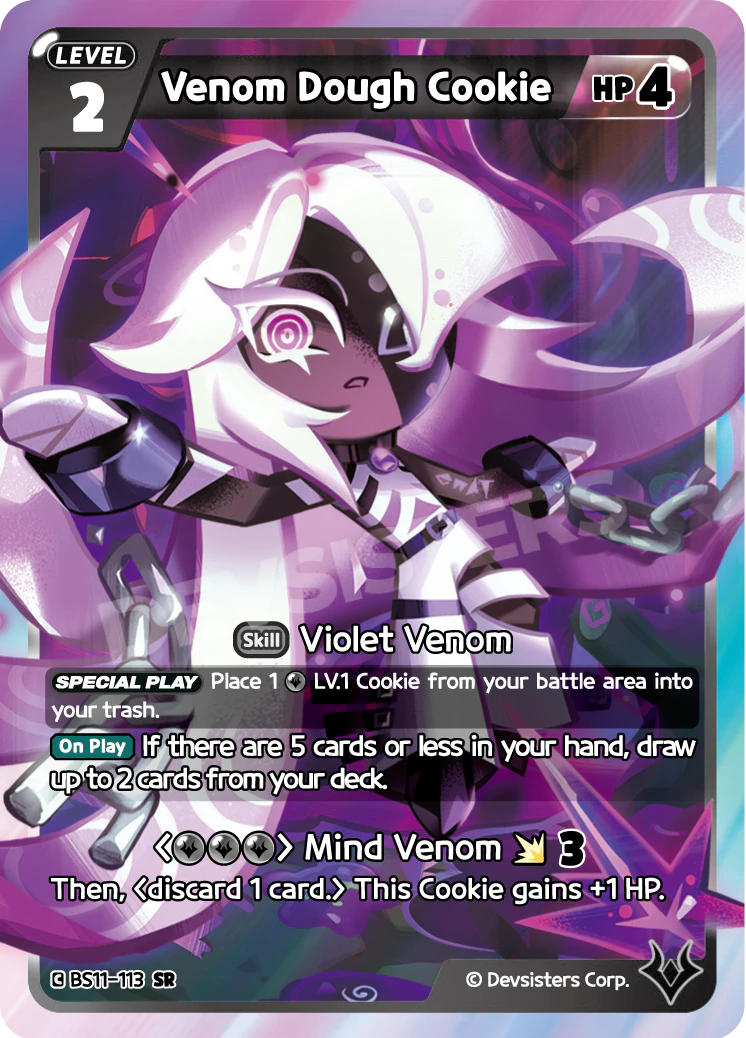
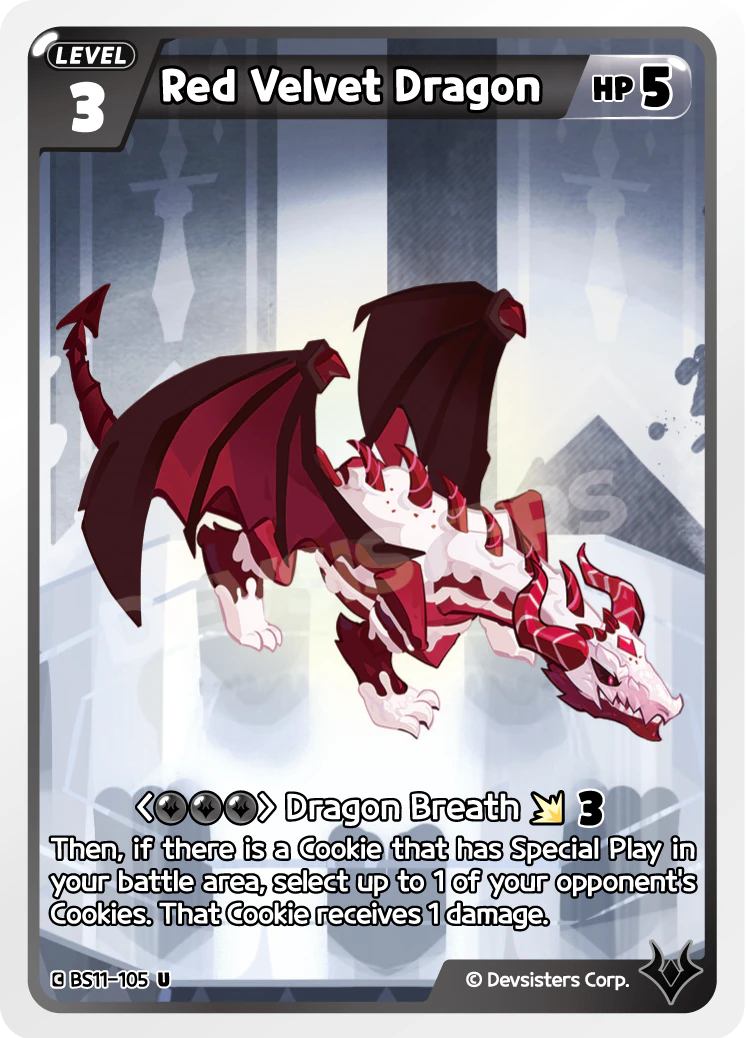
I pulled the official Cookie Run: Braverse card database on July 26, two days after BOOSTER PACK [The Dark Enchantress War] hit shelves, and searched all 2,092 rows for "Special Play." Twenty-three printings came back. The filtered list I started from had twenty-two, because it only checked skill text - and Red Velvet Dragon (BS11-105) mentions Special Play in its attack text instead. Small thing, but telling. The database also has a dedicated keyword field that 285 cards use, and every value in it is a tribal tag like ANCIENT, BEAST, ARENA or DRAGON. Not one card is tagged Special Play. As far as the official data is concerned, this mechanic lives entirely inside rules text.
Which is why this guide exists. Nothing published about Special Play explains the actual rule - what it costs, when you can do it, what it does to your board. So I read every printed line that mentions it and worked backward.
One caveat that applies to any BS11 article this week: the database is incomplete. The press material describes the set as 239 regular cards plus 66 hidden cards. The database returns 158 BS11-numbered printings across 116 unique card numbers, every one flagged as not hidden. Half the set plus the entire hidden sheet is unpublished, and more Special Play cards almost certainly sit in it. For the wider set picture see our set guide; for the color, the black cards guide.
What Special Play actually says
Here is the whole mechanic, verbatim. In the entire published pool there are exactly two Special Play cost lines.
On the LV.2 Cookies:
【Special Play】 Place 1 {K} LV.1 Cookie from your battle area into your trash.
On the one LV.3 Cookie:
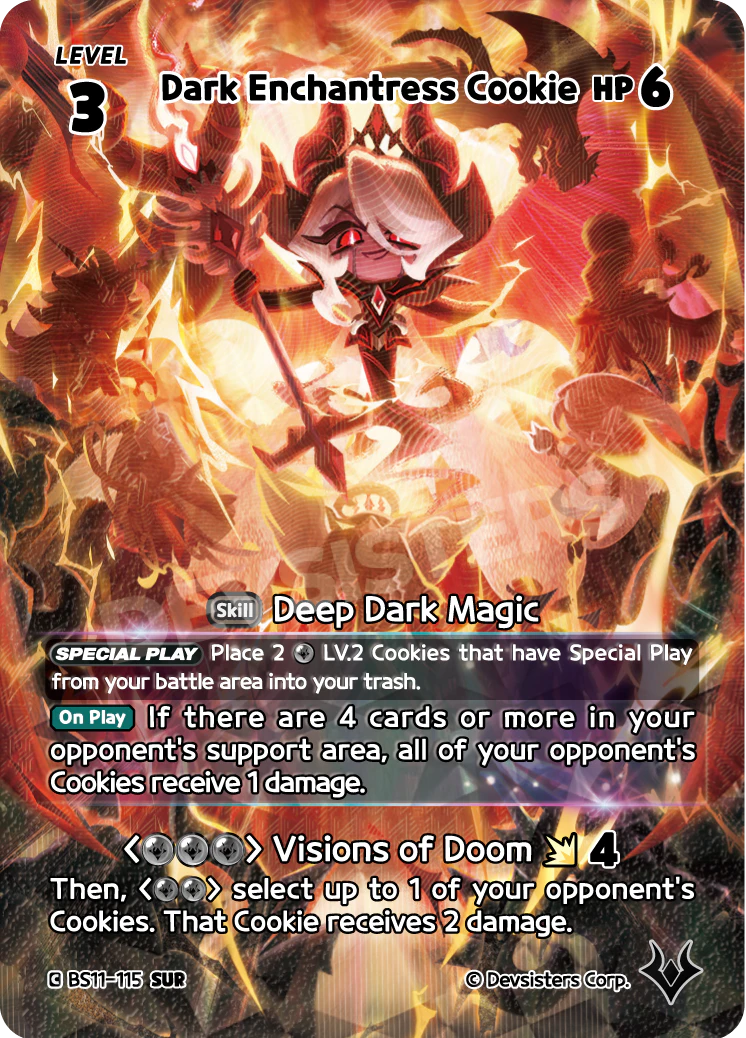
【Special Play】 Place 2 {K} LV.2 Cookies that have Special Play from your battle area into your trash.
That is it. No timing window, no phase, no energy symbol, no "once per turn." Four different LV.2 Cookies share the first line word for word, and share a stat line too - every one Black, LV.2, 4 HP. That uniformity hints Devsisters means Special Play as a repeatable evergreen keyword, not a one-set gimmick.
The shape of the rule falls out immediately: Special Play is an alternative way to put a Cookie into play, paid by trashing Cookies you already control one level tier below it. LV.1 bodies buy a LV.2; two LV.2 bodies that themselves have Special Play buy the LV.3.
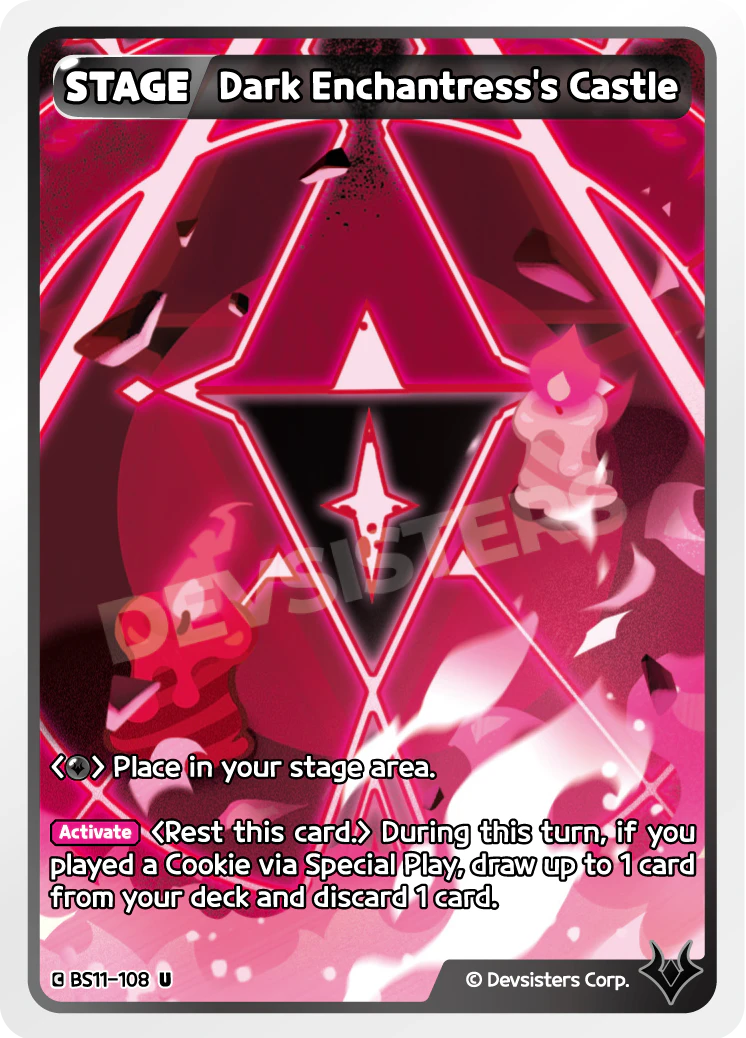
That is not inference - a second card confirms it. Dark Enchantress's Castle (BS11-108), a Stage, activates for: "During this turn, if you played a Cookie via Special Play, draw up to 1 card from your deck and discard 1 card." Played a Cookie via Special Play. The game's own text calls it a method of playing a Cookie.
The cost is bodies, not energy
Braverse's notation convention does the heavy lifting here. As covered in our energy guide, every energy cost in the game lives inside pointed brackets - Venom Dough attacks for {K}{K}{K}, the Castle costs {K} to place, Cream Jelly Worm's skill costs {K} to fire.
The Special Play line contains no pointed brackets at all. The {K} in it is an adjective describing which Cookies are legal fuel, not a payment. By the game's own notation, Special Play costs zero energy. You pay in bodies. The limit of that claim: no card prints the words "instead of paying its cost," so zero energy is derived from the notation rather than stated. That is the sentence to get a judge to confirm.
The second half of the cost line is the part people will skim, and it is the whole reason the mechanic is strong. The fuel goes to your trash, not your break area. Those are genuinely separate zones - 385 cards reference the trash, 169 the break area, and plenty distinguish between them in one sentence. Our break area guide covers why the split matters.
So Cookies fed to Special Play never faint and never add their levels to your break area total. A Cookie that dies in combat moves your break area counter; one eaten by Special Play does not. You convert board presence into a bigger threat with no attrition tax, and clean conversions like that are how combo decks get built.
The five cards that have Special Play
Only five unique card numbers in the published pool carry the keyword - eleven printings once rarity variants are counted.
| Card | No. | LV | HP | Printings | Special Play cost |
|---|---|---|---|---|---|
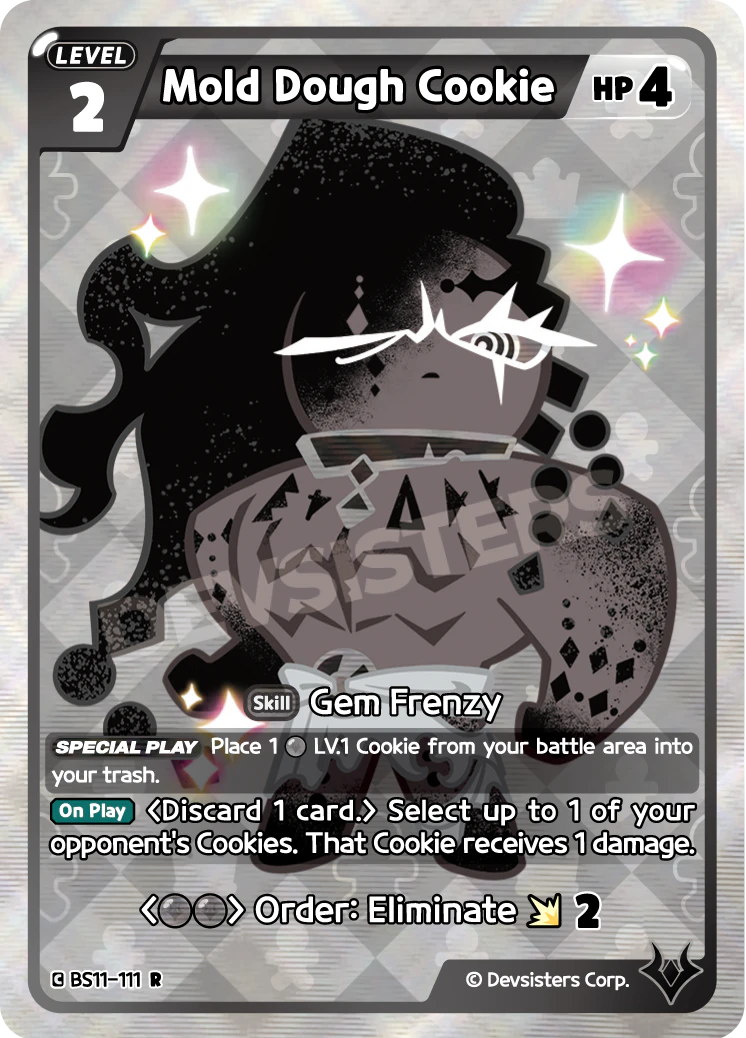
| Mold Dough Cookie | BS11-111 | 2 | 4 | R, SEC | 1 Black LV.1 Cookie |
| Pom-pom Dough Cookie | BS11-112 | 2 | 4 | R, SEC | 1 Black LV.1 Cookie |
| Venom Dough Cookie | BS11-113 | 2 | 4 | SR, SSR | 1 Black LV.1 Cookie |
| Licorice Cookie | P-147 | 2 | 4 | P (promo) | 1 Black LV.1 Cookie |
| Dark Enchantress Cookie | BS11-115 | 3 | 6 | UR, SUR, EXR, GXR | 2 Black LV.2 Cookies that have Special Play |
Two things jump out. First, one of the five is a promo - Licorice Cookie (P-147) is not in the booster at all, so maximum density of LV.2 Special Play bodies requires a card that does not come out of BS11 packs.
Second, the four LV.2s differ only in their riders. Mold Dough discards to ping for 1. Pom-pom Dough returns a Black Cookie from trash to hand at five or fewer cards, and its attack can lock your opponent out of LV.2-or-higher On Play triggers. Venom Dough draws two on the same hand-size condition and grows +1 HP off its attack. Licorice attacks the hand. Same chassis, four jobs - and note that recurring "5 cards or less in your hand" clause, which Skelecake Bomber carries too. Special Play empties your board; these cards want your hand empty as well. Running lean on both axes at once is a demanding ask.
The ten cards that check for it
This is the population people will conflate, so let me be blunt: having Special Play and checking for Special Play are different things, and the second group is twice the size of the first. Ten unique card numbers reference the mechanic as a condition without carrying it.
| Card | No. | Type | What the check does |
|---|---|---|---|
| Cream Jelly Worm | BS11-097 | Cookie, LV.1 | Once per turn, {K} plus a discard: if a Special Play Cookie is in your battle area, faint an opposing LV.1 Cookie that has no Skill |
| Cream Skelecake Archer | BS11-098 | Cookie, LV.1 | Once per turn, {K}: if a Special Play Cookie is in your battle area, 1 damage to an opposing Cookie |
| Cream Roll Hog Rider | BS11-099 | Cookie, LV.1 | If a Special Play Cookie is in your battle area, place this Cookie in your trash |
| Skelecake Bomber | BS11-103 | Cookie, LV.1 | On Play, hand of 5 or fewer: return a Cookie that has Special Play from trash to hand |
| Red Velvet Dragon | BS11-105 | Cookie, LV.3 | After Dragon Breath hits for 3, if a Special Play Cookie is in your battle area, 1 more damage to an opposing Cookie |
| World-reflecting Mirrors | BS11-106 | Trap | Costs 1 {K} less if you control a LV.5-or-higher Cookie or a Special Play Cookie |
| Dark Enchantress's Castle | BS11-108 | Stage | Rest it: if you played a Cookie via Special Play this turn, draw 1 and discard 1 |
| Emblem of Darkness | BS11-109 | Item | {K}: view 5, reveal a Cookie that has Special Play and add it to hand; the other four go to your trash |
| Draining Magic Circle | BS11-110 | Trap | An extra -1 attack damage if you control a LV.5-or-higher Cookie or a Special Play Cookie |
| Dark Enchantress Cookie | BS11-116 | EXTRA, LV.5 | Awakens your LV.3 Dark Enchantress Cookie that has Special Play |
The two Traps are the most revealing entries. Both use the identical compound clause: "a Cookie that is LV.5 or higher or a Cookie that has Special Play." The design treats those board states as equivalent, which tells you where Devsisters places this mechanic on the power curve. A Special Play Cookie is meant to read like a LV.5 body.
Emblem of Darkness (BS11-109) deserves a call-out too: a one-energy tutor digging five deep into a five-card population. That is what turns a theme into an archetype.
Having it and using it are two different things
This is the most useful rules distinction in the mechanic, and it is easy to miss because the difference is one preposition. Nine of the ten checking cards say "has Special Play." One - Dark Enchantress's Castle - says "played a Cookie via Special Play." Those are not synonyms. The first describes a property printed on the card; the second describes an action you took this turn.
The fallout:
- Put Mold Dough Cookie onto the board the normal way, paying no Special Play cost at all, and it still has Special Play. Cream Jelly Worm's removal switches on, Red Velvet Dragon's rider switches on, both Traps get their discount. None of those checks care how it arrived.
- The Castle is the only card that does care - its loot needs you to have actually used the mechanic that turn.
- BS11-116's Awaken targets "your LV.3 Dark Enchantress Cookie that has Special Play" - the property again. A hard-cast Dark Enchantress is still a legal Awaken target.
Get this backward and you misread half the table above. If you have been assuming the Cream cycle only turns on after you execute a Special Play, you have been undervaluing them badly.
A typographic tell, too: only twelve printings use the bracketed 【Special Play】 form - the eleven carrying the keyword, plus Red Velvet Dragon's rider. Every other checking card writes it unbracketed, exactly what you would expect from a keyword the database has not formally indexed.
What the card text does not tell you
A clean list of holes beats papering over them. What the printed text does not settle:
- Whether Special Play fully replaces the normal way you put a Cookie into play. The notation says zero energy. No card says "instead of paying its cost."
- When you are allowed to do it. Not one of the twenty-three printings mentions a phase, a window, or a restriction to your own turn.
- Whether it is limited per turn. No once-per-turn clause appears on any Special Play line, and Braverse prints 【Once Per Turn】 when it means it - 235 times across the database, including on Cream Jelly Worm in this very set.
- Whether faint triggers fire on the fuel. The text says "place into your trash," not "faint," and the game keeps those words distinct. The plain reading is that they do not fire. A reading, not a printed rule.
- What happens to the fuel Cookie's HP stack. Nothing addresses it.
- Whether a Cookie played via Special Play can attack immediately. Silence.
All six matter for a real deck and none is answerable from the database. Anyone stating them confidently this week is filling blanks from the announcement, not the cards.
Building around Special Play
Start with the fuel supply, because it is smaller than you think. The published pool of Black LV.1 Cookies - the only legal fuel for the LV.2 tier - is eight unique cards: Jam Skelecake Grunt (094), Cream Jelly Worm (097), Cream Skelecake Archer (098), Cream Roll Hog Rider (099), Cake Warrior (102), Skelecake Bomber (103), Cake Witch (104), Pomegranate Cookie (114).
Here is the tension that defines the archetype: four of those eight are also the cards that check for Special Play. Cream Jelly Worm's removal only turns on once a Special Play Cookie is on your board, but putting one there means feeding a Black LV.1 Cookie to the trash. Fuel and payoff are the same eight cards, so you need two LV.1 bodies down before either half works - one to be eaten, one to survive and use its check. You are not ramping; you are budgeting bodies.
One workaround sits in the same set. Licorice Cookie (BS11-092) - a Common, and a different card from the P-147 promo despite the name - is a Black LV.2 whose Activate reads: "During this turn, the LV. of this Cookie in your battle area becomes 1." Read that against the cost line: for that turn it is a Black LV.1 Cookie in your battle area. The card never says Special Play, so treat it as derived, but by plain text it turns a LV.2 body into legal fuel.
The full chain: two Black LV.1s onto the board, Special Play two LV.2s by trashing one LV.1 each, then Special Play Dark Enchantress Cookie by trashing both LV.2s. Four bodies into one LV.3 with 6 HP that swings for 4 and can pay {K}{K} for 2 more.
Whether that trade is good depends entirely on the zero-energy reading holding. If Special Play really does skip the normal cost, you have compressed several turns of development into one, in a game where you add exactly one Support card per turn. If it does not, the chain is an expensive way to lose your board.
The support shell is already there: Emblem of Darkness digs for pieces, Skelecake Bomber rebuys a spent one from the trash, the Castle loots off each Special Play, and both Traps get cheaper or nastier once a body is down. Coherent, for a mechanic one set old.
The one card I cannot explain is Cream Roll Hog Rider (BS11-099), whose entire Activate is "if there is a Cookie that has Special Play in your battle area, place this Cookie in your trash." A free way to move your own body to the trash. I can see it feeding Pom-pom Dough's recursion, but nothing published explains why you would want that badly enough to spend a slot. Either the payoff is in the unpublished half of the set or I am missing something - and I would rather say so than invent a reason.
The capstone fights its own mechanic
The top of the archetype is Dark Enchantress Cookie (BS11-116), an EXTRA card at LV.5 with +2 HP, a 7-damage attack, and immunity to being moved out of the battle area by opposing effects. Its condition:
If your break area is LV.7 or higher and [Dark Enchantress's Castle] is in your stage area, you can 【Awaken】 your LV.3 [Dark Enchantress Cookie] that has Special Play.
Read that against everything above and the problem jumps out. Special Play sends bodies to the trash, and the trash contributes nothing to your break area total. The entire chain that builds you a LV.3 Dark Enchantress moves your break area counter by exactly zero. Then the payoff card asks for LV.7.
That threshold is brutal on its own. Searching all 2,092 rows for "break area is LV.7 or higher" returns three printings across just two unique cards in the entire game - BS11-116 itself and Tea Knight Cookie from BS3.
So the deck must do two contradictory things: convert bodies into threats without them dying, and bank seven levels of dead Cookies anyway. That means real combat losses or a deliberate way to place Cookies into the break area, on top of running the Castle and holding the LV.3 - three conditions stacked on a fourth.
I do not think it is an accident; it reads like a deliberate brake on the best card in the set. But the mechanic and its own capstone pull in opposite directions, and anyone buying singles toward BS11-116 this week should know that first.
Is Special Play any good
Yes, for a reason that has nothing to do with stat lines: it converts board into threats through the trash instead of the break area. Turning spare LV.1 bodies into a LV.3 without paying energy or handing over attrition progress does not win unwinnable games - it makes winnable ones arrive several turns earlier.
Where I am skeptical is density. Five cards have it, four are the same LV.2 chassis, one of those is a promo, and the checking cards are mostly Commons with modest effects gated behind a condition that costs a body to switch on. This is a themed sub-archetype inside black, not a mechanic that reshapes the format, and I would not expect it to move the meta tier list on its own.
The unpublished half of BS11 is where that flips. If the sixty-six hidden cards include more Special Play bodies - another LV.3, or a LV.1 that generates fuel - the numbers change fast.
Quick Action Checklist
- Special Play plays a Cookie by trashing Cookies one tier below it. Two cost lines: 1 Black LV.1 for the LV.2s, 2 Black LV.2s that have Special Play for the LV.3.
- The fuel goes to your trash, not your break area - no attrition tax. This is the mechanic's real strength.
- Five unique cards have it; ten check for it. Do not conflate the populations.
- "Has Special Play" is a printed property, not a state. A hard-cast Mold Dough switches on every check except the Castle.
- Fuel and payoff are the same eight Black LV.1 Cookies. Plan on two bodies down before the engine does anything.
- BS11-092 Licorice Cookie can make itself LV.1 for the turn, which by plain text makes it legal fuel. Derived, not printed.
- BS11-116 wants break area LV.7 - one of two cards in the game at that threshold - while Special Play contributes nothing to it.
- Zero energy, timing, per-turn limits, and faint triggers are all unconfirmed. Treat confident claims with suspicion, and ask a judge before a sanctioned event.
Frequently Asked Questions
What is Special Play in Cookie Run: Braverse?
How much does Special Play cost?
Which Cookie Run: Braverse cards have Special Play?
Does a Cookie need to be played via Special Play for other cards to see it?
Do Cookies used as Special Play fuel go to the break area?
When can you use Special Play?
How many Special Play cards are in The Dark Enchantress War?
Keep Reading
Related Guides
Cookie Run: Braverse Battle Rules: How an Attack Resolves
Rule 7-1-3-1-1 settles FLIP timing in a single sentence, and it sits inside a four-step battle procedure. Here is every step of a Cookie Run: Braverse attack, read straight off the Comprehensive Rules Ver. 1.8, plus the March 2026 rule update that locked the damage number mid-resolution and moved multipliers to the end.

Cookie Run: Braverse 2-on-2 Rules and Winning Team Decks
Braverse's standard rulebook says it doesn't cover games with more than two players, so the official 2-on-2 format runs on two separate documents - and they change more than you'd think. One loss counter for two Break Areas, a four-copy limit that belongs to the team, and board wipes that hit your partner. Here are the rules, read off the source, plus what all five Asian 2-on-2 champion teams with published lists actually brought.
Cookie Run: Braverse Errata List - All 29 Corrected Cards
Devsisters has published corrections to the printed text of 29 Cookie Run: Braverse cards. One of them changes an Item into a Trap. Another turns a card that could only trash your own Cookie into one that can trash theirs. And on 24 of the 29, the official card database still serves the wording that was corrected.
Cookie Run: Braverse Turn Structure & Phases Explained
Most Braverse misplays aren't bad cards - they're a phase mistake. Here's the full turn flow, Refresh to End, what you're allowed to do in each window, and the first-turn rules that trip up every new player.

How to Play Cookie Run: Braverse - A Complete Beginner Guide
Cookie Run: Braverse is the rare TCG you can teach in a single match. This guide covers everything a first-time player needs: card types, setup, turn structure, how you pay for cards, the FLIP mechanic, and how to win.
Cookie Run: Braverse Meta Tier List — Best Decks & Archetypes Ranked
Which Cookie Run: Braverse decks are actually carrying right now? Here's a meta tier list of the strongest archetypes - the real cards that anchor each one, why they rank where they do, and what's overrated.