Cookie Run: Braverse Energy & Leveling Explained
Energy is the engine that runs every Cookie Run: Braverse turn. Here's how energy types and color costs work, how the Support Area pays for your cards, and how leveling from LV.1 to LV.3 gates the whole game.
Every Cookie Run: Braverse game is a slow tug-of-war over one thing: how much you can do per turn. That ceiling is your energy, and Braverse meters it out deliberately - you add resources one card at a time, so the difference between a smooth turn and a fumbled one is almost always whether you read your energy and your Cookie levels correctly. Get it right and the game feels like a clean ramp; get it wrong and you'll stare at a Cookie you can't afford to play.
This is the plain-English guide to the two systems that gate everything else: energy (what pays for your cards, and in what colors) and leveling (which Cookies you're even allowed to play, and when). Both are grounded in real cards from the official database. If you haven't read the rules overview yet, start with how to play Braverse; for the strategic layer on top of resources, colors explained covers how each color spends them. One symbol note before we dive in: on the cards, the letters in brackets are energy. {R} is Red, {Y} Yellow, {G} Green, {B} Blue, {P} Purple, and {N} is "any color." So a cost written as two Red and one any is exactly what the card demands.
Energy is the engine of every turn
Braverse doesn't use mana the way you might expect from other TCGs. There's no separate land or energy card you draw and play. Instead, you build a resource zone called the Support Area, and you pay for cards by resting cards already sitting in it. The crucial pacing rule: you add only one Support card per turn. Your resources grow slowly and steadily, which is why turn order and curve matter so much - the deck that's spending efficiently on turns two and three has a real edge.
That single mechanic is the reason Braverse's colors feel so distinct. An aggressive Red deck wants to convert every early resource into damage immediately; a control deck is happy to bank resources and cash in a bigger turn later. Energy isn't just bookkeeping - it's the clock the whole game runs on.
Energy type: the card's color identity
Every card has an energy type - its color identity for resource purposes. In the official database this is the card's energy type field, and it lines up with the five colors plus a couple of special cases:
| Energy type | What it means |
|---|---|
| Red / Yellow / Green / Blue / Purple | A single-color card; its costs are paid in that color (plus any "any color" symbols) |
| (Color) MIX | A card that still belongs to one color but expects an off-color "any" symbol in its cost, so it plays nicely in splashes |
| MIX | A flexible card that leans on "any color" energy rather than a single color |
| Pure / Black | Special non-standard identities tied to specific cards, outside the five-color core |
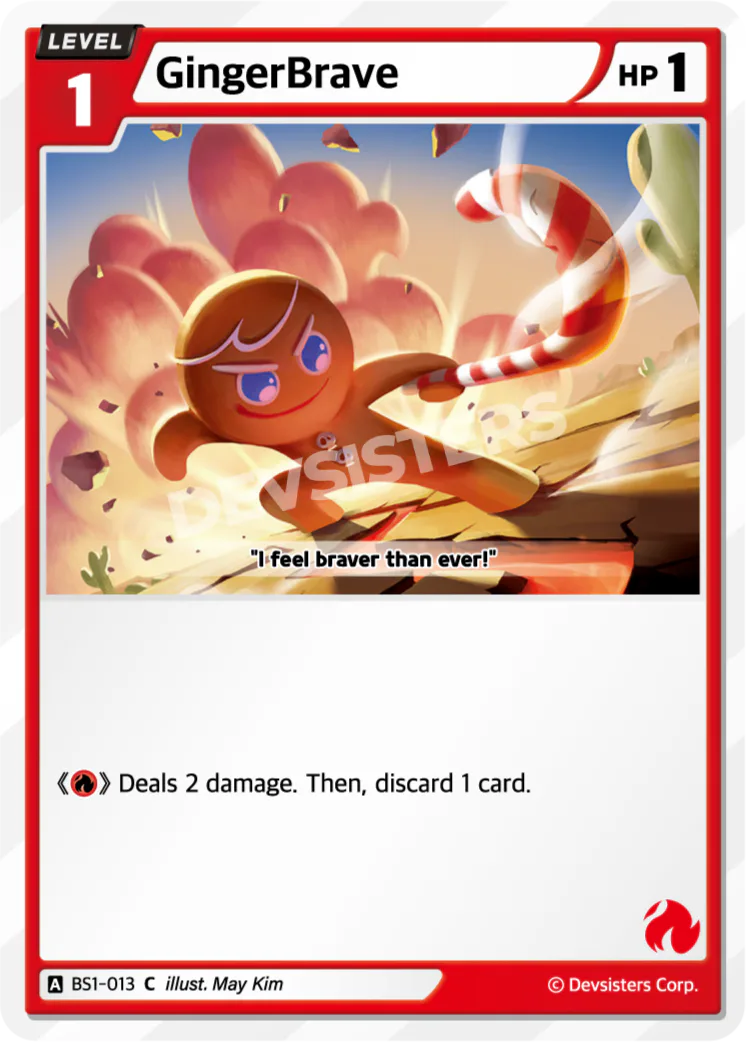
The everyday version: a card's energy type tells you which color of Support it wants. GingerBrave (BS1-013) is energy type Red and costs a single {R} for its attack - the cheapest, cleanest energy play in the game. Peperoncino Cookie (BS4-014) is "Red MIX," and sure enough its attack reads two Red and one any ({R}{R}{N}) - the "MIX" tag is the database telling you this card is happy to dip into a second color.
Reading an energy cost
Costs in Braverse live in pointed brackets, and they show up in two places on a Cookie:
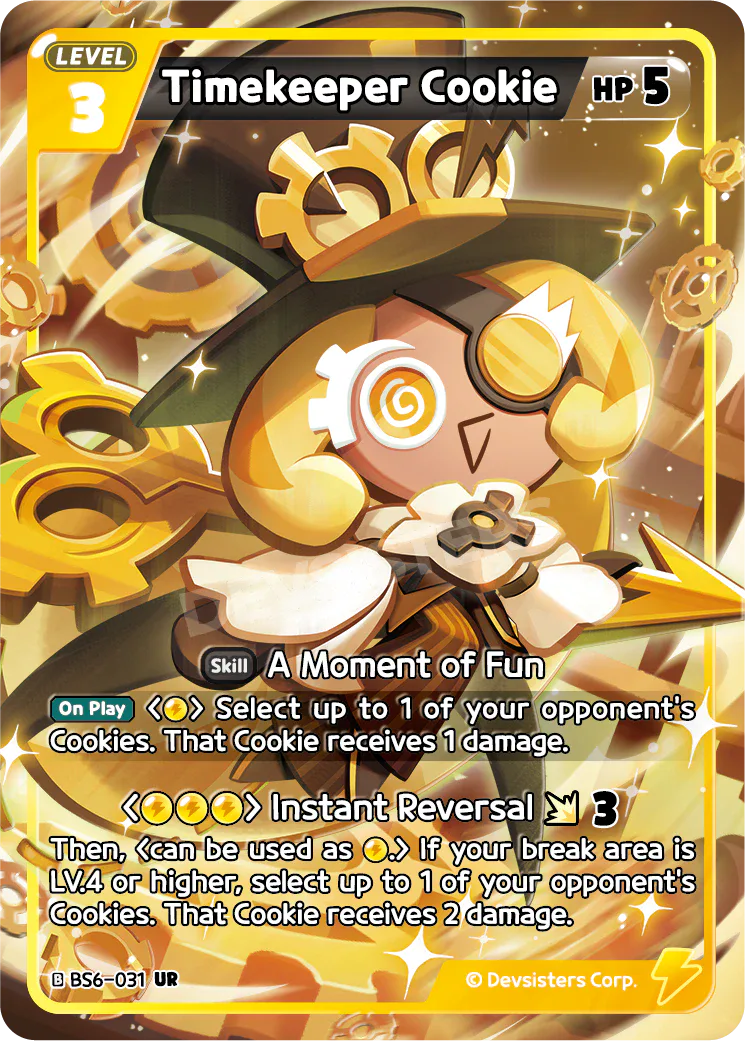
- The attack cost sits in pointed brackets right before the attack's name. Timekeeper Cookie (BS6-031, UR, Yellow, LV.3) attacks for three Yellow: {Y}{Y}{Y}, "Instant Reversal," dealing 3.
- The skill cost sits in brackets inside the skill line, when a skill costs energy to fire. Timekeeper's On Play skill reads {Y} - pay one Yellow and an opposing Cookie takes 1 damage. Not every skill costs energy; many just trigger on a condition.
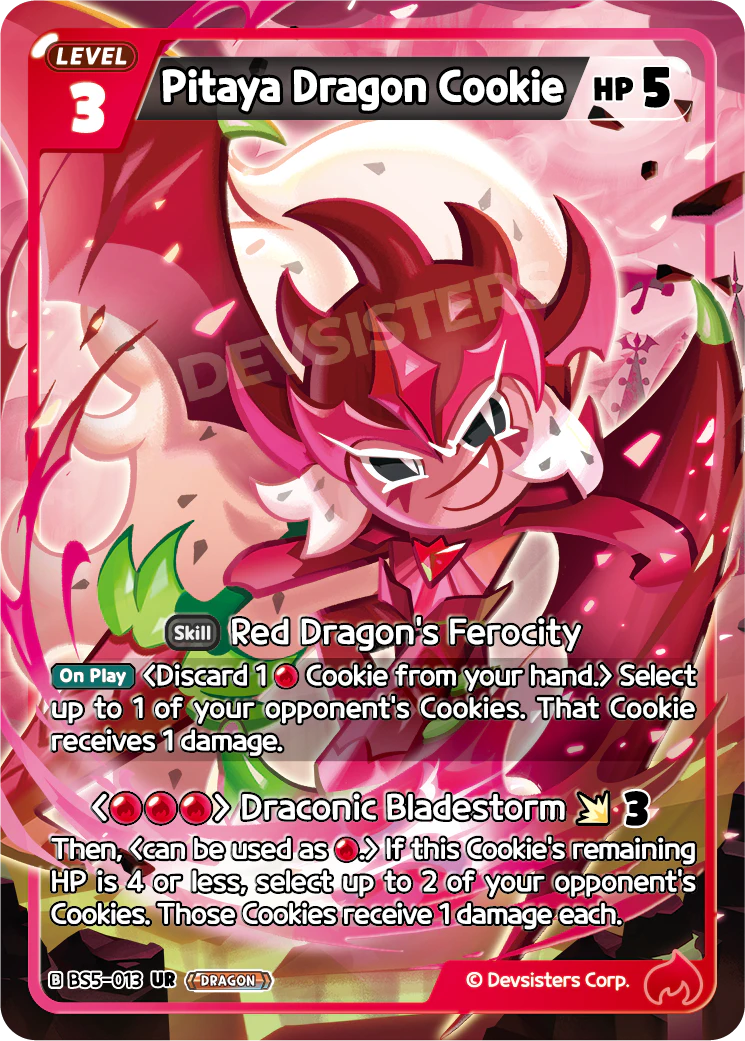
Two more wrinkles worth knowing. First, the {N} symbol means "any color" - it can be paid with Support of any color, which is what lets MIX cards splash. Second, a phrase you'll see a lot is "can be used as {color}." After some attacks resolve, the card can be turned into a resource of a stated color to help pay a follow-up effect that same turn - Pitaya Dragon Cookie (BS5-013) does exactly this, letting its swing double as a Red resource for its bonus damage clause. It's the game's built-in way to squeeze one extra point of energy out of a big turn.
The Support Area pays for everything
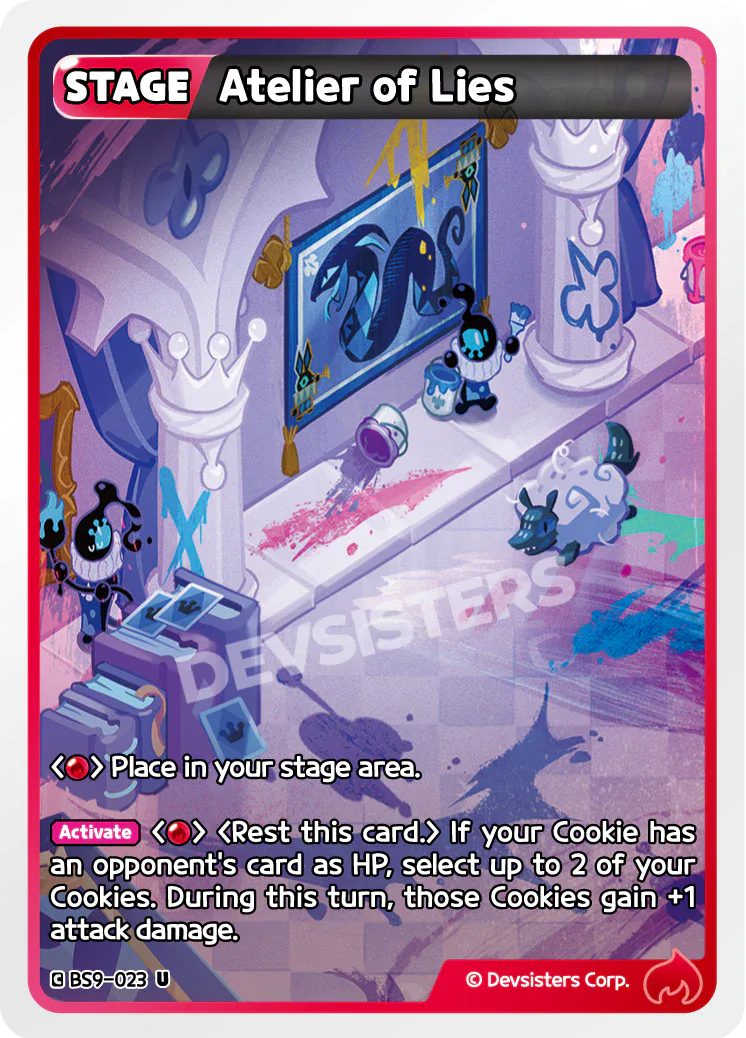
Cookies aren't the only things that cost energy. Items, Traps, and Stages all read their cost in the same pointed brackets and pay it the same way - by resting Support. Juicy Stamina Jellies (BS9-019, Item) costs {R}{R} to give a Cookie +1 attack and +1 HP. Stolen Light of Truth (BS9-021, Trap) costs {R}{R}{R}. Atelier of Lies (BS9-023, Stage) costs {R} just to place into your stage area, then {R} plus resting the card itself to fire its Activate effect.
The throughline: there's one currency in Braverse, and it's "rested Support cards in the right colors." Whether you're casting a one-cost GingerBrave or a four-energy finisher, you're spending the same resource - so every card you commit to the Support Area is a small bet about what your future turns will need.
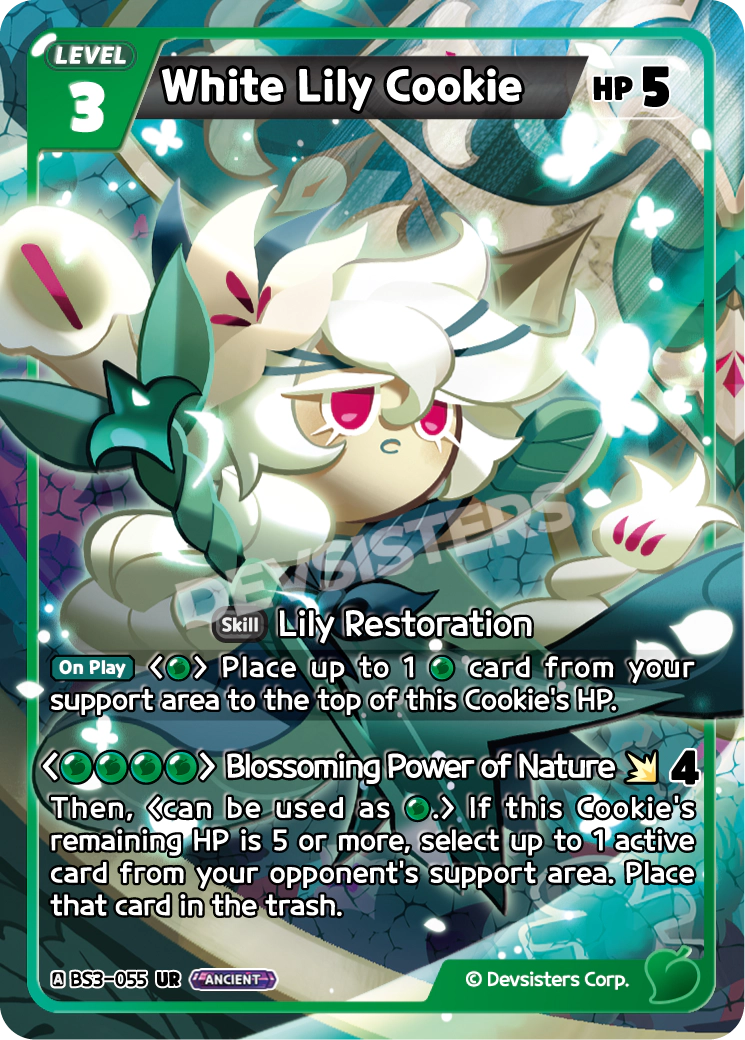
Some cards even interact with the Support Area directly. White Lily Cookie (BS3-055, UR, Green Ancient, LV.3) has a skill that pays one Green to move a Green card straight from your Support Area onto the top of its own HP - turning banked resources into extra durability. It's a neat illustration that the Support Area isn't just a payment pile; it's a zone other cards can read and reshape.
Leveling: LV.1 to LV.3
Energy decides what you can afford; level decides what you're allowed to play at all. Cookies are tagged LV.1, LV.2, or LV.3, and that level is a gate as much as a power band:
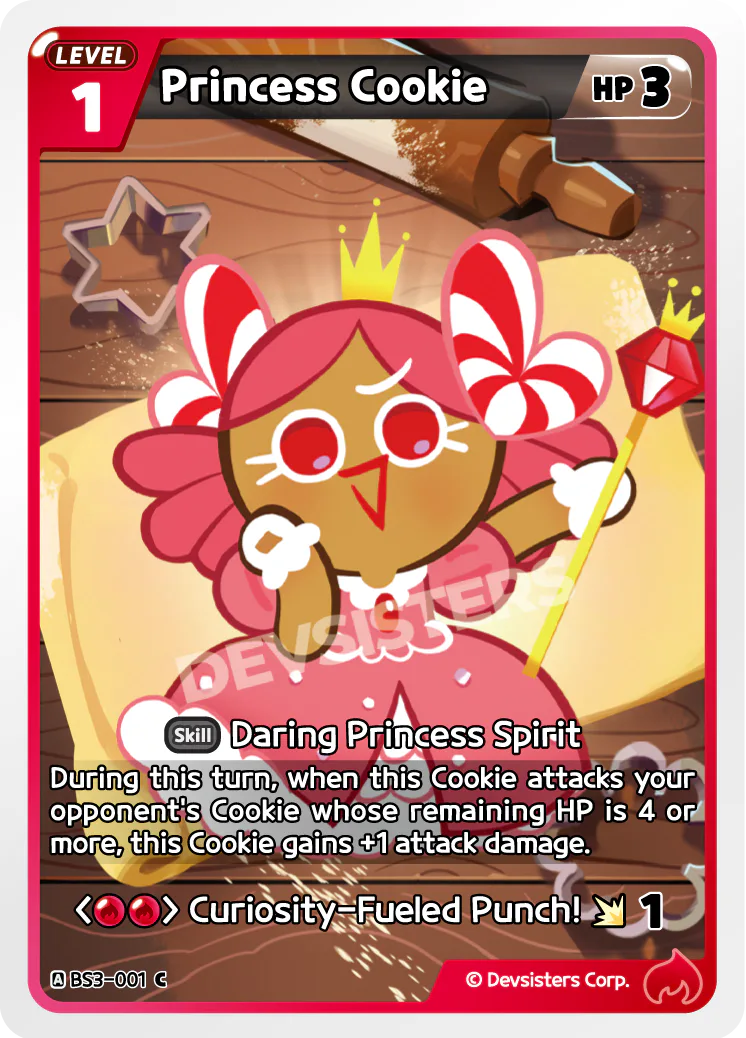
- LV.1 Cookies are your cheap, early plays - the bodies that establish a board and, for Red, start the Break Area race. GingerBrave (LV.1) is the archetype: one energy, immediate pressure.
- LV.2 Cookies are your midgame - stronger bodies and skills that ask for a bit more setup. Peperoncino Cookie (BS4-014) is a LV.2 with a Blocker skill.
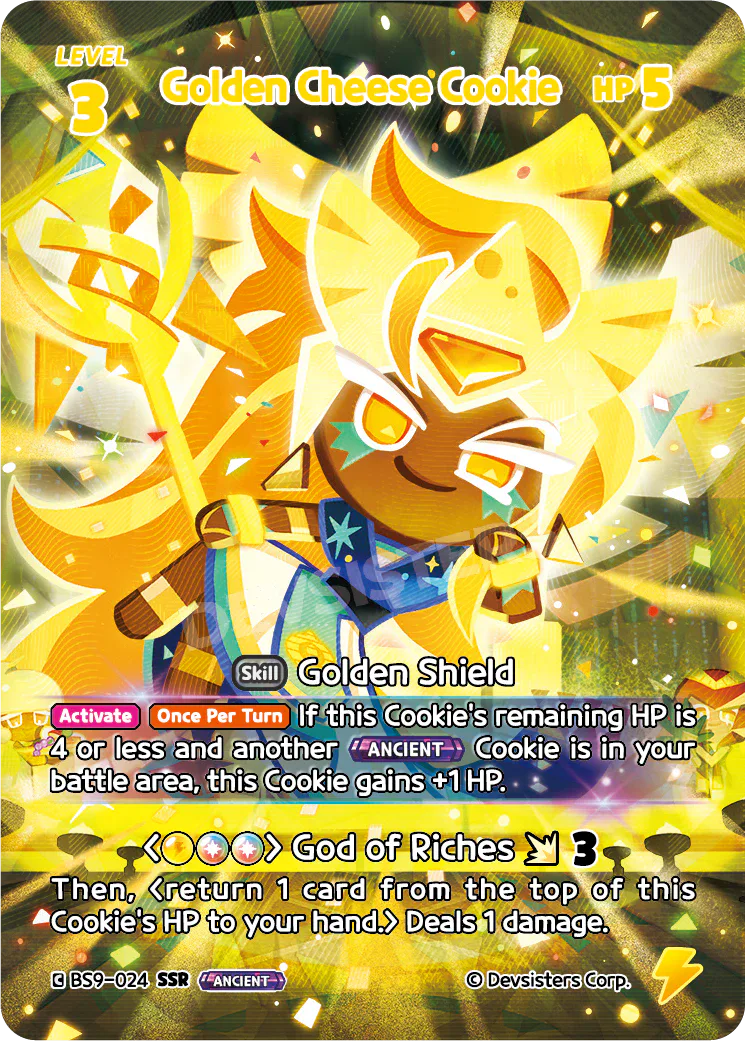
- LV.3 Cookies are your finishers - the biggest, most expensive threats with game-ending attacks. Timekeeper Cookie and Golden Cheese Cookie (BS9-024) live here.
Leveling isn't just "bigger numbers." Many effects key off level explicitly: Capsaicin Cookie (BS7-014) only pings LV.2-or-higher Cookies; Dark Choco Cookie (BS7-067) discards to hit LV.2-or-higher targets. And several payoff cards care about your own LV.1 Cookies - Shadow Milk Cookie (BS9-010) can only be played as an EXTRA if two of your Red LV.1 Cookies fainted last turn. So your level mix isn't just a curve; it's a set of triggers other cards read.
HP is a stack, not a number
Here's where leveling and energy meet the signature Braverse twist. A Cookie's HP isn't a printed health bar you chip down - it's a face-down stack of cards from your deck, equal to the HP value on the card. A LV.3 with 5 HP sits on a stack of five cards; an attack that deals 3 flips three of them.
Two consequences flow from this. First, those flipped cards can be FLIP cards that trigger an ability the instant they turn face-up - so attacking can hand your opponent a free effect. Second, higher-level Cookies usually have bigger stacks, which is part of why LV.3 finishers are so durable: there's simply more to grind through. Because the HP-stack mechanic is deep enough to deserve its own treatment, the full breakdown lives in the FLIP mechanic guide. For energy and leveling purposes, just remember: HP equals stack size, and stack size scales with level.
Common energy and leveling mistakes
The recurring traps, and how to avoid each:
- Over-committing the Support Area. You add one card per turn, so a card you sink into Support isn't attacking or defending. Don't bank resources you have no plan to spend.
- Misreading {N} as a free cost. "Any color" still costs a Support card - it just doesn't care which color. It is not "no cost."
- Forgetting "can be used as" energy. Plenty of big turns are only payable because an attack doubles as a resource afterward. Read the whole attack line before you decide you can't afford the follow-up.
- Ignoring color in a splash. A MIX card wants an off-color symbol; if your Support Area is mono-color, you may not be able to pay an {N}-heavy splash on the turn you want it. Build your colors to match your costs.
- Treating level as just power. Level is a gate and a trigger word. Running zero LV.1 Cookies, for instance, turns off every payoff that keys off your LV.1 bodies fainting.
The throughline: energy is "what can I pay for this turn," level is "what am I allowed to play and what triggers off it." Read both before you commit, and turns stop fumbling.
Quick Action Checklist
- Add one Support card a turn, on purpose. It's your only resource growth - make the color match what you plan to cast.
- Read the energy type to know the color. Single-color cards want that color; MIX cards expect an "any" symbol and splash better.
- Pay {N} with any color, but pay it. Any-color symbols are flexible, not free.
- Use the "can be used as" line. Let big attacks double as a resource to fund their own follow-up clauses.
- Mind the level gate. LV.1 establishes, LV.2 bridges, LV.3 finishes - and other cards trigger off your level mix, so keep a few LV.1 bodies around.
- Remember HP is a stack. Higher level usually means a bigger HP stack, which is why finishers are hard to kill - and why attacking can flip a FLIP card. Send the details to the FLIP deep dive.
Frequently Asked Questions
How does energy work in Cookie Run: Braverse?
What are the energy types in Cookie Run: Braverse?
What does {N} mean in a Braverse energy cost?
How does leveling work in Cookie Run: Braverse?
Why is a Cookie's HP a stack of cards in Braverse?
Keep Reading
Related Guides
Cookie Run: Braverse Turn Structure & Phases Explained
Most Braverse misplays aren't bad cards - they're a phase mistake. Here's the full turn flow, Refresh to End, what you're allowed to do in each window, and the first-turn rules that trip up every new player.
Cookie Run: Braverse Keywords & Abilities Explained
Braverse card text leans on a small set of keywords that mean the same thing on every card they appear on. Learn the ability words - On Play, Activate, Blocker, Equip - and the trait words - Ancient, Dragon, Beast, Arena - and the whole game reads cleaner.
Cookie Run: Braverse Battle Rules: How an Attack Resolves
Rule 7-1-3-1-1 settles FLIP timing in a single sentence, and it sits inside a four-step battle procedure. Here is every step of a Cookie Run: Braverse attack, read straight off the Comprehensive Rules Ver. 1.8, plus the March 2026 rule update that locked the damage number mid-resolution and moved multipliers to the end.

Cookie Run: Braverse 2-on-2 Rules and Winning Team Decks
Braverse's standard rulebook says it doesn't cover games with more than two players, so the official 2-on-2 format runs on two separate documents - and they change more than you'd think. One loss counter for two Break Areas, a four-copy limit that belongs to the team, and board wipes that hit your partner. Here are the rules, read off the source, plus what all five Asian 2-on-2 champion teams with published lists actually brought.

How to Play Cookie Run: Braverse - A Complete Beginner Guide
Cookie Run: Braverse is the rare TCG you can teach in a single match. This guide covers everything a first-time player needs: card types, setup, turn structure, how you pay for cards, the FLIP mechanic, and how to win.
Cookie Run: Braverse Meta Tier List — Best Decks & Archetypes Ranked
Which Cookie Run: Braverse decks are actually carrying right now? Here's a meta tier list of the strongest archetypes - the real cards that anchor each one, why they rank where they do, and what's overrated.