Cyberpunk TCG Keywords Explained: All 9, 86 Cards Use One
Cyberpunk TCG's official card database has a Keyword filter with zero options in it, so nothing tells you the game has keywords at all unless you read every card. It does: nine bracketed tokens, split by the Comprehensive Rules into four trigger keywords, four effect keywords and one activation shorthand it does not call a keyword. Eighty-six of the 151 cards print at least one, four cards print three, and three keywords turn out to be things one card gives another rather than something every printed instance owns.
Open the Cyberpunk TCG card database and filter by Keyword, and the dropdown gives you nothing — zero options, an empty list, as if the game had none. The tags post on this site flagged that field as broken and moved on, because tags were the subject that day. Keywords are the subject today, and the filter being empty does not mean the data is not there. It is just not where the database's own UI looks for it.
It is in the rules text. Read all 151 cards in WeirdCo's official database and nine distinct bracketed tokens turn up inside the printed abilities: {Play}, {Attack}, {Defeated}, {Call}, {Adrenaline}, {Blocker}, {Go Solo}, {Quick} and {Spend}. Cross-reference those nine against the Comprehensive Rules — updated 1 September 2026, confirmed still current on 4 September — and they resolve to real, numbered definitions in Section 11: four trigger keywords, four effect keywords, and one activation shorthand that the rules pointedly do not call a keyword at all.
What a keyword is under the rules
Section 11 (Terms) splits its keyword content into three named groups, and the split is not cosmetic — it changes what a bracketed word is doing on the card.
- Rule 11.17, opening Trigger Keywords: "Trigger keywords are a shorthand for specific conditions. When those conditions are met, the effect associated with it automatically enters pending." The worked example is
[ATTACK] Draw 1— whenever the Unit attacks, you draw a card. - Rule 11.22, opening Effect Keywords: "Effect keywords are a shorthand for specific effects." No timing condition, just a compressed rules text.
- Rule 11.15, under Activation Shorthand rather than either keyword section: "The
[Spend Icon]symbol is shorthand for an activation cost. It means: 'Spend this Unit or Legend to activate the following effect.'"
The four trigger keywords are CALL (11.18), DEFEATED (11.19), PLAY (11.20) and ATTACK (11.21) — each one shorthand for "when X happens." The four effect keywords are ADRENALINE (11.23), BLOCKER (11.24), GO SOLO (11.25) and QUICK (11.26) — each one shorthand for a specific effect. The card database's search index treats all nine identically, wrapping each in curly braces as {Keyword}. WeirdCo's own rules document does not: eight get square brackets and a section under one of the two keyword headings, and Spend gets neither.
All 9 keywords, by print count
Colour columns are Red / Green / Blue / Yellow, counting the cards on which each token appears anywhere in the printed text — whether the card owns the keyword or only refers to it.
| Keyword | Category | Rule | Cards | Card types | R / G / B / Y |
|---|---|---|---|---|---|
| Play | Trigger | 11.20 | 27 | Unit 26, Legend 1 | 6 / 6 / 7 / 8 |
| Spend | Activation shorthand | 11.15 | 17 | Legend 13, Unit 3, Gear 1 | 3 / 5 / 6 / 3 |
| Blocker | Effect | 11.24 | 13 | Unit 9, Gear 2, Legend 2 | 3 / 4 / 3 / 3 |
| Attack | Trigger | 11.21 | 13 | Unit 10, Gear 2, Legend 1 | 2 / 3 / 4 / 4 |
| Quick | Effect | 11.26 | 12 | Program 7, Legend 3, Gear 1, Unit 1 | 1 / 4 / 3 / 4 |
| Go Solo | Effect | 11.25 | 11 | Legend 8, Gear 2, Program 1 | 4 / 3 / 3 / 1 |
| Call | Trigger | 11.18 | 7 | Legend 7 | 2 / 1 / 1 / 3 |
| Defeated | Trigger | 11.19 | 7 | Unit 5, Gear 1, Legend 1 | 1 / 0 / 1 / 5 |
| Adrenaline | Effect | 11.23 | 4 | Unit 3, Gear 1 | 0 / 2 / 1 / 1 |
Two things worth banking straight away. Call appears on nothing but Legends — seven for seven — which follows from the rule itself: Call a Legend (11.11) only ever targets a face-down Legend in the Legends area, so a Trigger keyword built on it has nowhere else to print. And the nine counts add up to 111 keyword instances spread across 86 distinct cards, which means a fair number of cards carry more than one.
![Official Cyberpunk TCG card render for Goro Takemura: Vengeful Bodyguard, a green-bordered Legend. Art by Daniel Valaisis shows Goro in a trenchcoat firing a pistol as armoured mechs collapse around him against a rain-lit Night City skyline. A Null cost symbol, a dash inside a hexagon, sits in the top left in place of a number; a RAM x2 box sits in the top right; the ARASAKA and CORPO tags sit above the text "QUICK 1 eurodollar, [Spend icon glyph]: Give a friendly Unit with cost 4 or less BLOCKER this turn. If you control a value-pair of Gigs, also give it +1 power this turn. When a friendly Unit uses BLOCKER, you may discard 1. If you do, draw 1," with QUICK and BLOCKER printed as pink badges and the Spend cost shown only as a small icon with no accompanying word; power 0 sits in the bottom right.](/images/blog/cyberpunk-tcg/cyberpunk-tcg-keywords-explained/cyberpunk-tcg-goro-takemura-vengeful-bodyguard-quick-spend.webp)
The one token that is not a keyword
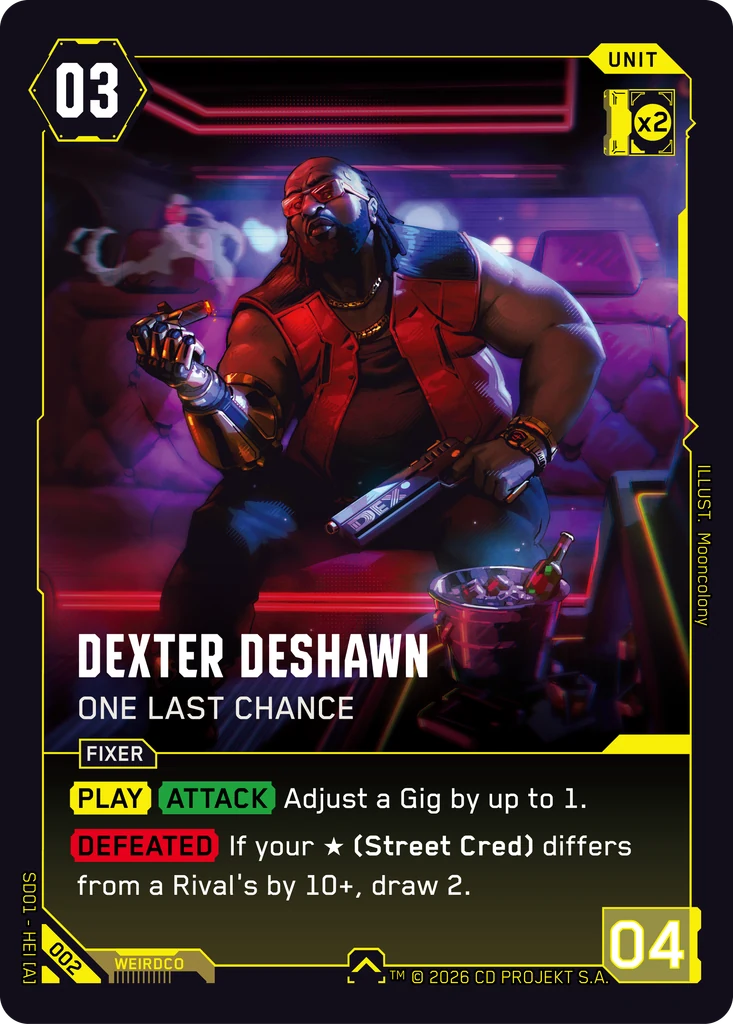
Look at the card itself rather than the database entry and the difference the rules draw between Spend and the other eight becomes visible. On Goro Takemura: Vengeful Bodyguard above, QUICK and BLOCKER print as solid pink badges with the word spelled out. PLAY, ATTACK and DEFEATED on Dexter DeShawn print the same way, each in its own colour. Spend does not: the printed card shows a small icon glyph in place of any word, matching rule 11.15's own name for it, [Spend Icon]. The database's {Spend} is a search-friendly stand-in for a symbol, not a transcription of printed text the way {Blocker} or {Play} are.
That is consistent with Section 11's structure, not a database bug. Activation Shorthand (11.15-11.16) sits in its own subsection alongside X €$ cost notation — a way of writing costs, filed next to the trigger and effect keyword sections rather than inside either. Functionally a Spend-costed ability behaves like the effect keywords: it is an activated ability on a Unit or Legend, paid for by spending the card itself (rule 11.15.2). WeirdCo's own document just declines to call it a keyword.
Keywords you own, versus keywords you're given
Reading each of the 111 instances in context splits them a second way that the rules do not spell out but the card pool makes obvious once you look: most keywords only ever print as something a card does to itself, and three can be handed to a different card entirely.
| Keyword | Total | Card's own | Given to another card | Referenced, not granted |
|---|---|---|---|---|
| Play | 27 | 27 | 0 | 0 |
| Quick | 12 | 12 | 0 | 0 |
| Attack | 13 | 13 | 0 | 0 |
| Defeated | 7 | 7 | 0 | 0 |
| Call | 7 | 7 | 0 | 0 |
| Spend | 17 | 17 | 0 | 0 |
| Blocker | 13 | 9 | 3 | 1 |
| Go Solo | 11 | 8 | 0 | 3 |
| Adrenaline | 4 | 2 | 2 | 0 |
Six of the nine never move: a Unit with {Play} triggers on its own entry, a Program with {Quick} is played reactively by whoever holds it, a Legend's {Call} fires only when that specific Legend is flipped face-up (11.18.1 says "this Legend," not "a Legend"). Adrenaline, Blocker and Go Solo are different, and each breaks in its own direction.
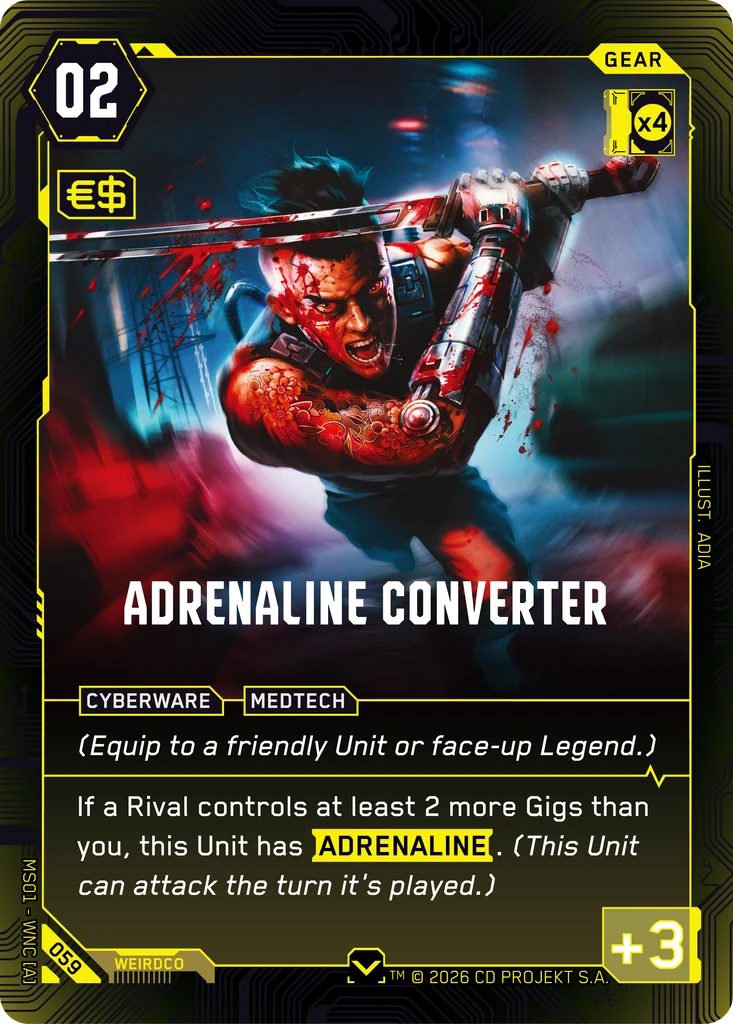
Adrenaline is owned outright by only two of its four cards — Riding Nomad and Modded Kusanagi both print {Adrenaline} as a plain static ability. The other two hand it to somebody else. Adrenaline Converter, pictured below, is a Gear that gives its holder Adrenaline only while a Rival controls at least 2 more Gigs than you — conditional, and read off the equipped card's board state rather than the Gear's own. Valentino Street Racer's {Play} trigger gives Adrenaline to a different friendly Unit with cost 5 or less, for that turn only.
Blocker owns 9 of its 13, and the other 4 split two ways. Goro Takemura: Vengeful Bodyguard's {Quick} {Spend} ability gives a friendly Unit Blocker for a turn, and separately rewards you when any friendly Unit uses Blocker — a payoff for a keyword the Legend itself never carries. Mandibular Upgrade and Riot Shield are both equip Gear that grant Blocker to whatever they're attached to, same mechanism as Adrenaline Converter. Valentino Guerrera is the one pure reference: "this Unit can attack ready Units with {Blocker}" names the keyword only to restrict a target, never granting or requiring it.
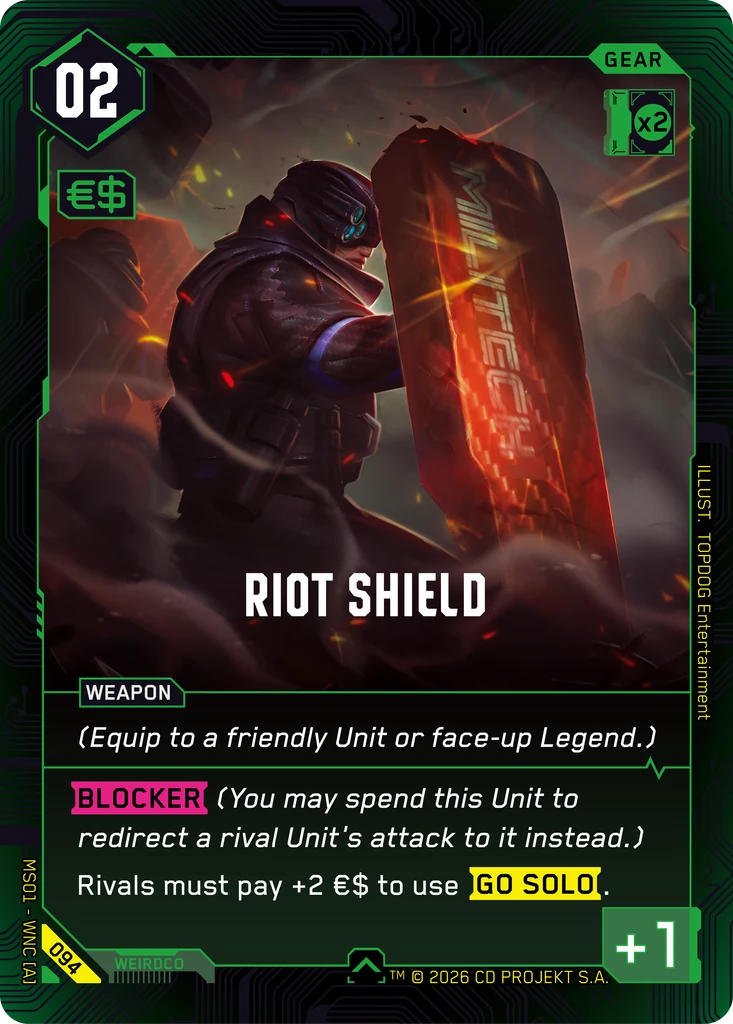
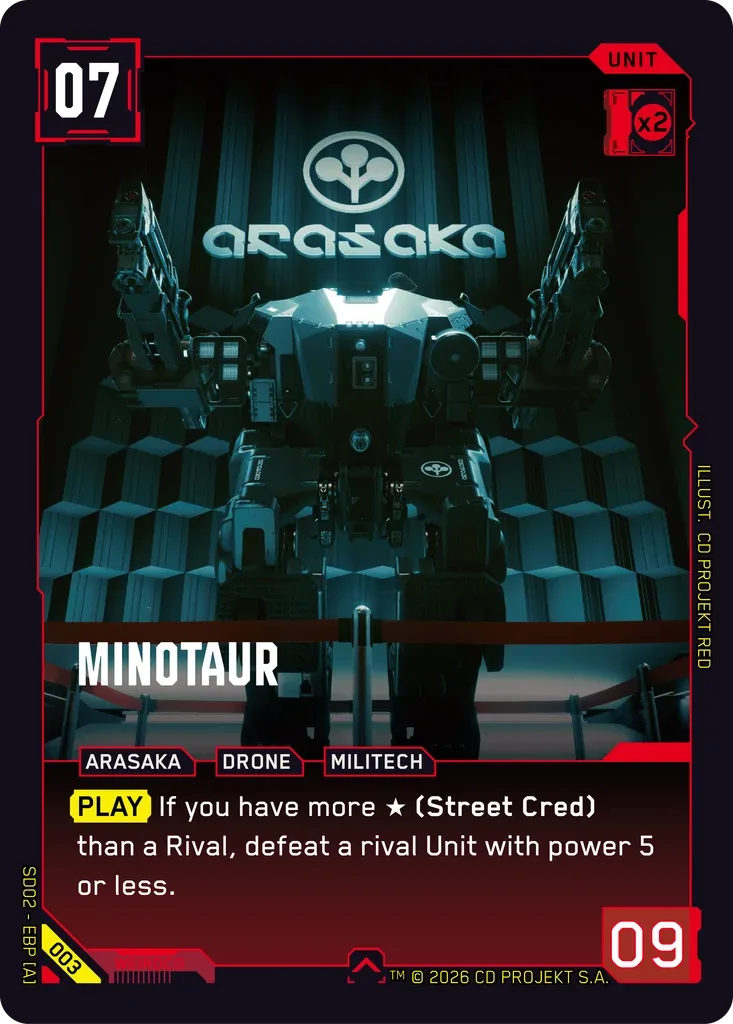
Go Solo owns 8 of its 11 — the eight costed Legends covered in the Comprehensive Rules breakdown, the only Legends able to leave the Legends area under rule 4.5.3. The other three don't grant Go Solo to anything; they interact with a Go Solo a Legend already has, in three different directions. Arasaka Emergency Radioport checks whether a face-down Legend "is ARASAKA or has {Go Solo}" before offering a free Call. Riot Shield, pictured below, taxes it: "Rivals must pay +2 €$ to use {Go Solo}." And Nocturne OP55 N1 discounts it, letting "a friendly Legend... use {Go Solo} for -2 €$ this turn, to a minimum of 1 €$." None of the three creates a new instance of the ability — they all reference one that some other card already prints.
Four cards stack three keywords
Sixty-five cards in the 151-card pool print no bracketed keyword at all. Sixty-five print exactly one. Seventeen print two. Four print three, and nothing in the current database prints more than three:
| Card | Colour, type | Keywords |
|---|---|---|
| Dexter DeShawn: One Last Chance | Yellow Unit | Play, Attack, Defeated |
| Dum Dum: Maelstrom Triggerman | Yellow Legend | Call, Quick, Spend |
| Goro Takemura: Vengeful Bodyguard | Green Legend | Blocker, Quick, Spend |
| Sasha Yakovleva: Won't Let You Down | Blue Legend | Attack, Defeated, Go Solo |
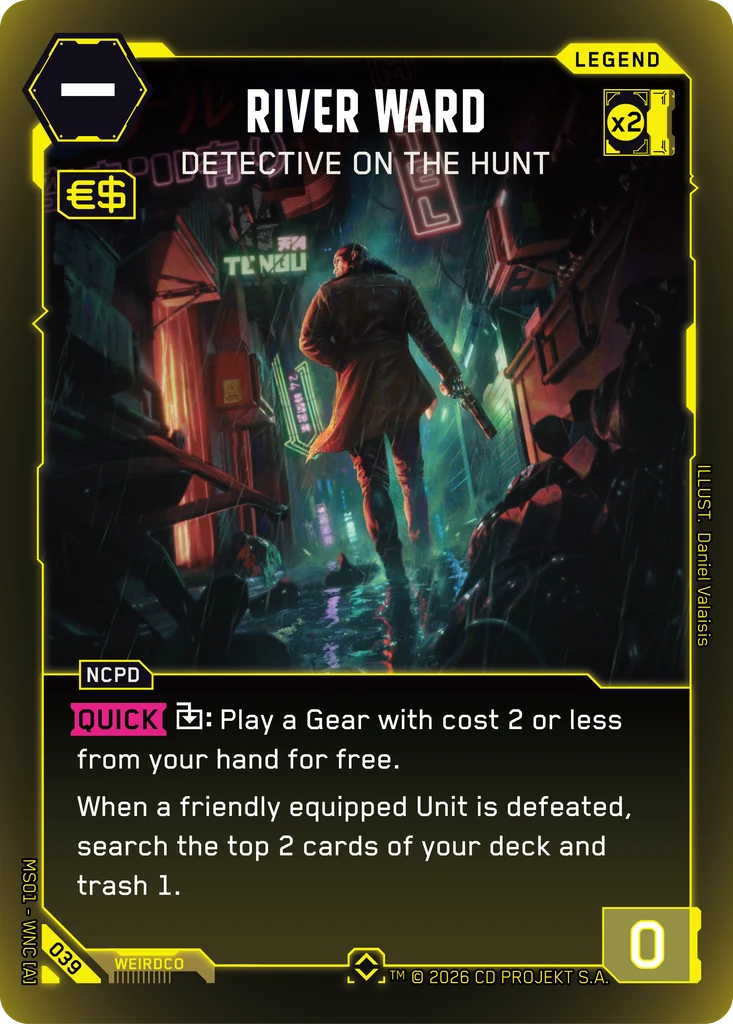
Dexter DeShawn: One Last Chance, this post's hero image, is the only card carrying all three of the game's Trigger Keywords at once — one ability text printed under both {Play} and {Attack} ("Adjust a Gig by up to 1"), a separate one under {Defeated}. Sasha Yakovleva mixes categories: an Effect keyword she owns outright ({Go Solo}) plus two Trigger keywords for the turns she's on the field as a Unit. The other two three-keyword cards, Dum Dum and Goro Takemura: Vengeful Bodyguard, both pair {Quick} with {Spend} — an activated ability you can fire as a reaction, paid for by spending the card itself — which turns out to be tied for the most common two-keyword combination in the pool: five cards run it in total, the two three-keyword ones plus Overwatch: Panam's Gift, River Ward: Detective on the Hunt, and Rogue Amendiares: Queen of the Afterlife. {Call} paired with {Spend} also lands on five cards, one of them Dum Dum again — see the next section.
The Fixer pattern in Call and Spend
One combination in the two-keyword list is not just common, it is a clean design pattern once you check the tags on the cards that carry it. Five Legends pair {Call} with {Spend} — Dum Dum: Maelstrom Triggerman, covered above as a three-keyword card, is one of them, but its Call ability ("You may defeat a friendly Gear. If you do, draw 2. Otherwise, draw 1.") doesn't share the shape the other four do. Those four open their Call ability the same way — "Choose one effect" between two small options, then a separate Spend-activated ability underneath:
- Dexter DeShawn: Off the Grid — Call: give a Unit +2 power or draw 1. Spend: increase a Gig by up to 2.
- Muamar Reyes: El Capitán — Call: protect a Unit from being defeated in a fight, or draw 1. Spend: adjust a Gig by 1.
- Padre: Man of the Cross — Call: spend a rival Unit, or draw 1. Spend: set a Gig to match another Gig's value.
- Wakako Okada: Peace and Harmony — Call: give a rival Unit -2 power, or draw 1. Spend: decrease a Gig by up to 2.
The tags post counted seven cards carrying the FIXER tag. These four are among them — and so are the other three, which means every single FIXER card in the 151-card pool prints at least one keyword, against a 57% carry rate (86 of 151) across the database as a whole. The other three are Dexter DeShawn: One Last Chance, this post's three-keyword hero card, Tyger's Whisper (a lone {Play}), and Rogue Amendiares: Queen of the Afterlife — which is also one of the five cards running the {Quick} {Spend} pairing from the previous section. A "choose an effect off Call, then a Gig-adjusting Spend" shape belonging specifically to four of the seven Fixer Legends is a real, checkable pattern in the current pool, not a rule anywhere in the Comprehensive Rules.
What this does not tell you
The keyword filter is still empty as of 4 September 2026. Checked directly against /api/cards/cyberpunk/filters the same day this was written: the keywords filter option list is [], identical to what the tags post found on 2 September. Nothing about this analysis changes that; it is read entirely off rules_text, not off a keyword field the database actually populates.
This is not playtest data. Welcome to Night City does not reach retail until 6 November 2026. A count of how many cards print {Quick} says nothing about how often a Quick effect matters in a real game — only that the text exists to matter.
Badge colour on the printed card does not map cleanly to category. PLAY and GO SOLO both print as yellow badges despite one being a Trigger keyword and the other an Effect keyword; QUICK and BLOCKER share a pink badge despite naming unrelated effects. The Trigger/Effect split is a Comprehensive Rules classification, not something the card frame visually sorts for you.
The database's tally can still move. Nine keywords and 86 carrying cards is the count as read from all 151 rows on 4 September 2026. WeirdCo has added cards to this pool before without warning — the tags post noted two numbering gaps closing between 31 August and 2 September — so a keyword that reads "zero cards grant it" today is a statement about the pool on this date, not a permanent one.
Quick reference
- Nine bracketed keywords across 151 cards: Play (27), Spend (17), Blocker (13), Attack (13), Quick (12), Go Solo (11), Call (7), Defeated (7), Adrenaline (4).
- Category, per the Comprehensive Rules: four Trigger keywords (Call 11.18, Defeated 11.19, Play 11.20, Attack 11.21), four Effect keywords (Adrenaline 11.23, Blocker 11.24, Go Solo 11.25, Quick 11.26), and Spend, which is Activation Shorthand (11.15) and not called a keyword by the rules at all.
- Cards carrying at least one: 86 of 151. Sixty-five carry none, 65 carry exactly one, 17 carry two, 4 carry three.
- Three-keyword cards: Dexter DeShawn: One Last Chance (Play, Attack, Defeated), Dum Dum: Maelstrom Triggerman (Call, Quick, Spend), Goro Takemura: Vengeful Bodyguard (Blocker, Quick, Spend), Sasha Yakovleva: Won't Let You Down (Attack, Defeated, Go Solo).
- Keywords one card can give another: Adrenaline (2 of 4 granted), Blocker (3 of 13 granted, 1 referenced without granting), Go Solo (3 of 11 referenced — taxed, discounted or checked for — with none of the three granting it outright).
- Call only ever appears on Legends — 7 for 7 — because the game action it shorthands, Call a Legend (11.11), has no other legal target.
- Keyword filter status: empty (
[]) on the official database as of 4 September 2026.
Frequently Asked Questions
What are keywords in the Cyberpunk TCG?
How many keywords does the Cyberpunk TCG have?
What is the difference between a trigger keyword and an effect keyword in Cyberpunk TCG?
Is Spend a keyword in Cyberpunk TCG?
Can a Cyberpunk TCG keyword be given to a card that does not print it?
Why does only the Legend card type get the Call keyword in Cyberpunk TCG?
What is the most common keyword combination on a single Cyberpunk TCG card?
Keep Reading
- Cyberpunk TCG card database, powered by Netdeck.gg (WeirdCo, official) - 151 cards as of 4 September 2026, whose rules_text field every keyword count in this post is drawn from
- Cyberpunk TCG Comprehensive Rules (WeirdCo, official) - Section 11 (Terms), updated 1 September 2026, including 11.15 Activation Shorthand, 11.17-11.21 Trigger Keywords and 11.22-11.26 Effect Keywords
- Dexter DeShawn: One Last Chance card entry (WeirdCo, official) - the only card in the database printing all three Trigger keywords, Play, Attack and Defeated
- Goro Takemura: Vengeful Bodyguard card entry (WeirdCo, official) - a Null-cost Legend pairing Quick and Spend, and granting Blocker to another Unit rather than owning it
- Riot Shield card entry (WeirdCo, official) - the Gear that grants Blocker on equip and taxes a rival's use of Go Solo without ever printing Go Solo itself
- Adrenaline Converter card entry (WeirdCo, official) - one of two cards that grants Adrenaline to another card rather than printing it as its own static ability
Related Guides
Cyberpunk TCG Tags: 39 Printed, 10 With Payoff Cards
Cyberpunk TCG prints 39 tags across the 151 cards in its official database, and the Comprehensive Rules give them a real definition — an effect naming a tag references every card carrying it. Then only 13 cards in the whole pool name a tag at all, covering 10 of the 39. Arasaka is the deepest supported one with four; Netrunner has 13 cards and nothing that cares.
Cyberpunk TCG Starter Decks: Embracing Power vs The Heist
WeirdCo's two Welcome to Night City starter decks share no cards and are built on mirror-image Legend lines. Here are both full lists with every card's cost, RAM and power, the five cards each second Legend exists to pay for, the rulings that change how they play, and which box is the better first buy.
Cyberpunk TCG Rules FAQ: What 269 Official Rulings Settle
Besides the Comprehensive Rules and the Tournament Rules, WeirdCo publishes a third rules document written as the questions a player asks mid-game: a Rules FAQ with 269 official rulings, 244 of them on specific cards. It settles the GO SOLO question the rulebook left open, half-settles the Sell contradiction, and makes clear which card effects you cannot decline.
Cyberpunk TCG's Deck Builder Is Live: 716 Decks So Far
WeirdCo's official Deck Builder went live on 2 September 2026, and by 16 September the community had published 716 public decks through it. Pull every one through the tool's own API and a pattern falls out that the RAM-ceiling math alone could not show: which colours people actually pair, which Legend is in more than a quarter of all decks, and which one of the 27 Legends in the database has never been picked once.
How to Play the Cyberpunk TCG — Gig Dice, Eddies and Street Cred, Explained
WeirdCo raised $28.3 million to build a trading card game where the win condition is a pile of dice. Here is how the Cyberpunk TCG actually works under the beta rules, what the four colors do, and why the release date most sites are printing is out of date.
Cyberpunk TCG Comprehensive Rules: 10 Rulings That Bite
WeirdCo published the Cyberpunk TCG Comprehensive Rules on 28 August 2026 — 11 numbered sections and 660 numbered rules, thirteen days before the first Beta Events. It is the first public document that answers rules arguments rather than teaching the game, and ten of its rulings change decisions you would otherwise make from the Gameplay Guide alone. It also contradicts itself in three places.