Gundam Card Game Colours - I Counted All 892 Cards, and Bandai Has a Colour Pie It Never Published
Thirty-one of the 37 cards whose text carries <Repair> are blue. Twelve of the 14 that carry <Support> are red. Twenty-five of the 52 cards in the game that reach into your own trash are purple - a colour that is only 15% of the card pool. Bandai has never published a colour-identity document for the Gundam Card Game, so I pulled every one of the 892 cards out of the official database and counted. The pie is real, it is sharp, and it decides which two colours you should actually be pairing.
Sixteen of the 17 cards in the Gundam Card Game that open with <Repair> as their own unconditional ability are blue. Twelve of the 14 cards whose text carries <Support> are red. Of the 52 cards in the entire game whose text reaches back into your own trash, 25 are purple - a colour that makes up barely 15% of the card pool.
Bandai does not publish a colour-identity document for this game. There is no "blue does this, red does that" page in the rules index, the FAQ or the card database. The Comprehensive Rules tell you a deck may be one or two colours and then say almost nothing else about what the colours mean.
So I counted. On 15 August 2026 I pulled every card in the official English card database - 892 distinct card numbers with parallel-art variants collapsed - and read the rules text on all of them. The colour pie is there. Bandai just never wrote it down.
The rulebook tells you two colours, and then stops
The deckbuilding guide covers the mechanical half of this: Resource cards have no colour, you pay any cost with any Resource, and splashing a second colour is mechanically free. There is no mana screw in this game. The two-colour cap is a hard wall, not a tax.
Which is exactly why the contents of each colour matter more here than in a game with a fixed cost. You are not choosing colours to fix your mana. You are choosing which two toolboxes you are allowed to open, once, before the game starts - and then you live with it for all 50 cards.
That decision deserves better than vibes, and the raw material to make it properly is sitting in the card database.
How I counted
Method first, because every number below depends on it.
I queried the official card database at gundam-gcg.com/en/cards/ filtered by each of the five colours, collected every card number returned, stripped the parallel-art suffixes (_p1, _p5 and so on), and fetched the detail page for each unique number. That gives 892 cards: 199 blue, 195 green, 193 white, 168 red, 137 purple.
Two checks that the set is complete and clean. The five colour counts sum to exactly 892, so no card carries two colours. And the per-type counts - 560 Units, 145 Commands, 119 Pilots, 68 Bases - sum to 892 as well.
The pool covers GD01 through GD05, EB01, and ST01 through ST10. GD06 Stardust Trails is not in the database yet; it releases 30 October 2026 and will move every number here.
Where I say "cards whose text contains X", I mean exactly that - a text search across the printed rules text, which includes cards that grant a keyword to something else, not only cards that have it. Where I say "printed ability", I mean the keyword is the first thing on the card, unconditional. Both counts are useful and they say slightly different things, so I give both for the keywords that matter.
The pool is not evenly split
Start with the least interesting table, because it sets up the interesting ones.
| Colour | Cards | Share | Units | Pilots | Commands | Bases |
|---|---|---|---|---|---|---|
| Blue | 199 | 22.3% | 127 | 26 | 30 | 16 |
| Green | 195 | 21.9% | 122 | 26 | 32 | 15 |
| White | 193 | 21.6% | 122 | 26 | 32 | 13 |
| Red | 168 | 18.8% | 105 | 21 | 28 | 14 |
| Purple | 137 | 15.4% | 84 | 20 | 23 | 10 |
Blue, green and white are within six cards of each other. Red sits 25 cards behind white, and purple is 62 cards behind blue - meaning a purple deck is picking from roughly two-thirds the pool a blue deck picks from.
The type ratios inside each colour barely move at all. Every colour is 61-64% Units, and every colour has 20-26 Pilots. Bandai is not making one colour the "spell colour" and another the "creature colour". Whatever separates them, it is not card type.
It is also not stats. Average Unit AP runs 3.23 (blue) to 3.50 (purple), and average HP runs 3.08 (red) to 3.42 (purple). That is a spread of well under half a point across the whole game. Colour in this game is not a stat line. It is a rules-text vocabulary.
The keyword map is the whole argument
Here is where it stops being subtle. Seven keyword effects carry the colour identities, and they are exactly the seven the official FAQ files under one heading: <Repair>, <Breach>, <Support>, <Blocker>, <First Strike>, <High-Maneuver> and <Suppression>.
There is an eighth, and it is deliberately outside this table. Comprehensive Rules Ver. 1.8.0 defines <Development> at 13-1-8, and it appears on nine cards, every one of them in the Eternal Nexus [EB01] collaboration or its partner starter Generation Pulse [ST10], and every one carrying the (G Generation) trait. It is an archetype cost - exile (G Generation) cards from your trash to switch on the rest of an effect - rather than a colour identity, and it is spread across the three colours that Source Title is printed in.
This is every card in the game whose text contains each one:
| Keyword | Blue | Green | Red | White | Purple | Total | Concentration |
|---|---|---|---|---|---|---|---|
| <Repair> | 31 | 1 | 1 | 3 | 1 | 37 | Blue 84% |
| <Breach> | 4 | 35 | 11 | 1 | 0 | 51 | Green 69% |
| <Support> | 0 | 0 | 12 | 1 | 1 | 14 | Red 86% |
| <Blocker> | 12 | 11 | 1 | 46 | 12 | 82 | White 56% |
| <Suppression> | 0 | 0 | 3 | 7 | 5 | 15 | White 47% |
| <High-Maneuver> | 5 | 6 | 4 | 5 | 4 | 24 | none |
| <First Strike> | 1 | 2 | 7 | 3 | 1 | 14 | Red 50% |
Four of the seven are near-monopolies. Restrict to cards that print the keyword unconditionally as their own ability and the monopolies get tighter still: of the 17 cards that open with <Repair>, 16 are blue. Of the 41 that open with <Blocker>, 25 are white. Of the 23 that open with <Breach>, 17 are green.
<High-Maneuver> is the deliberate exception - 4 to 6 cards in every colour, no home. It is the one evasion keyword everybody gets.
And <Support> has a quirk worth knowing: not one of the 14 cards prints it unconditionally. Thirteen of them attach it to an 【Activate・Main】 - the fourteenth is ∀ Gundam, which only names it - because using <Support> means resting the Unit that has it. Red's signature keyword is a cost you pay, not a stat you own.
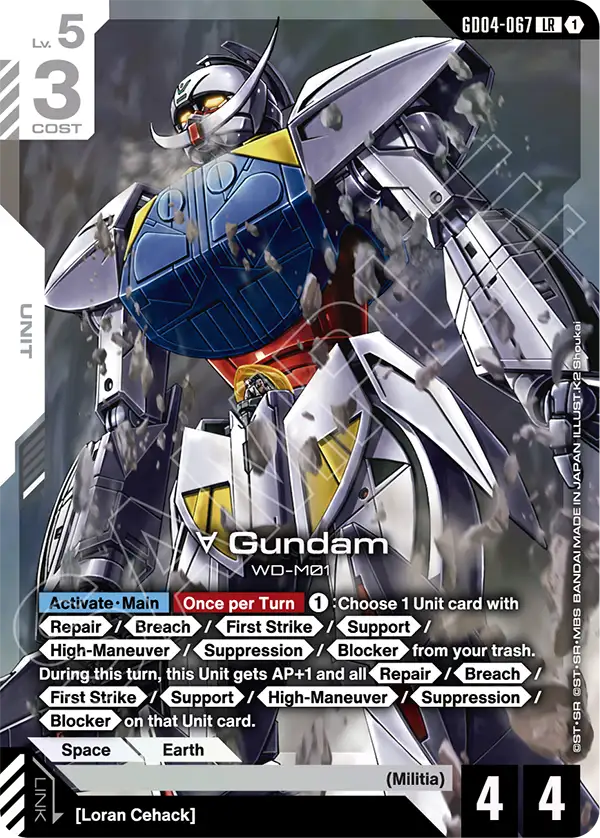
GD04-067 ∀ Gundam is the card that shows how tight that group of seven is. Its 【Activate・Main】 reads across a Unit card in your trash and grants "all <Repair>/<Breach>/<First Strike>/<Support>/<High-Maneuver>/<Suppression>/<Blocker>" from it. Bandai wrote out all seven by name rather than saying "all keyword effects", which is a templating choice you only make when the set is small and fixed - and one the game has already outgrown once, because <Development> arrived two sets later and is not on that line.
Blue heals and taps
Blue's identity is the sharpest of the five, and it is two things at once.
Healing. 48 of the 61 cards in the game that use the word "recover" are blue - 79%. Add the <Repair> monopoly on top and blue owns the entire "my Units do not stay damaged" axis. Damage in this game does not wear off on its own; ruling Q99 confirms it sits on the Unit as a counter across turns. Blue is the colour that removes it.
Tapping. I counted the cards that rest an enemy Unit - the effect that takes a blocker offline or strands an attacker. There are 36 in the game. Blue has 22 of them. Green has zero.
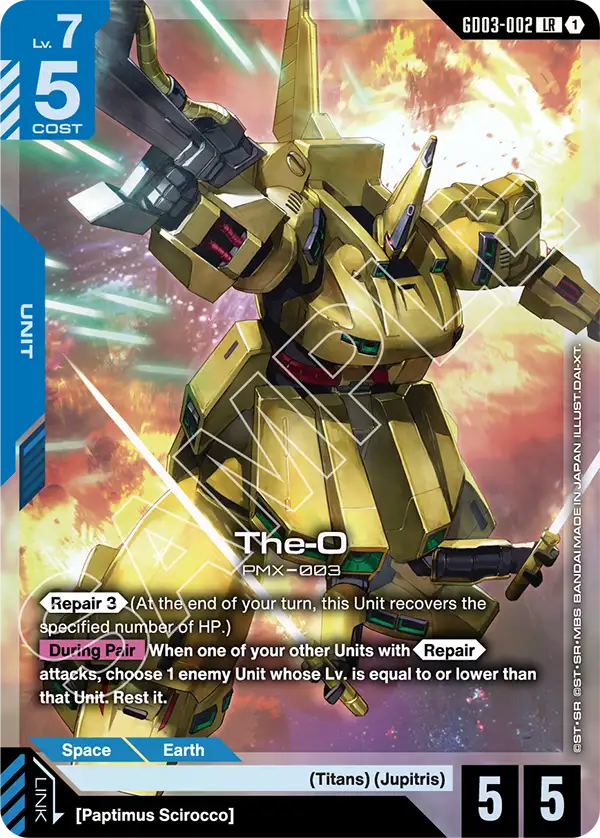
GD03-002 The-O is both halves in one card. It prints <Repair 3>, and its 【During Pair】 rests an enemy Unit whenever another of your <Repair> Units attacks - a card that heals itself and taps down the opposition off the same trigger. Bandai published a decklist called simply "The-O Repair Deck", which tells you they know exactly what this card is for.
Blue also leads on draw: 30 of the 67 cards that draw are blue, the most of any colour. Heal, tap, draw. It is the attrition colour, and it wants long games.
Green ramps and breaches
Green's signature is the hardest number in this whole piece: 22 of the 23 cards in the game that mention EX Resource are green.
The single exception is GD05-118 Incendiary Spark, a white Command that checks whether you used an EX Resource to pay for it rather than making one. So green is not merely the best ramp colour, it is the only colour that generates extra Resources at all.
That matters more here than "ramp colour" usually does. Per rule 2-9-4, EX Resources count toward your Level, and Level - not cost - is the real curve in this game, as the deckbuilding guide works through at length. Green is the only colour that can move that clock.
Its second half is <Breach>, at 35 of 51 mentions and 17 of 23 unconditional prints. <Breach> pushes damage past a destroyed Unit into the opponent's shield area, which is why green also leads on shield interaction: 50 of the 141 cards mentioning shields are green, more than any other colour.
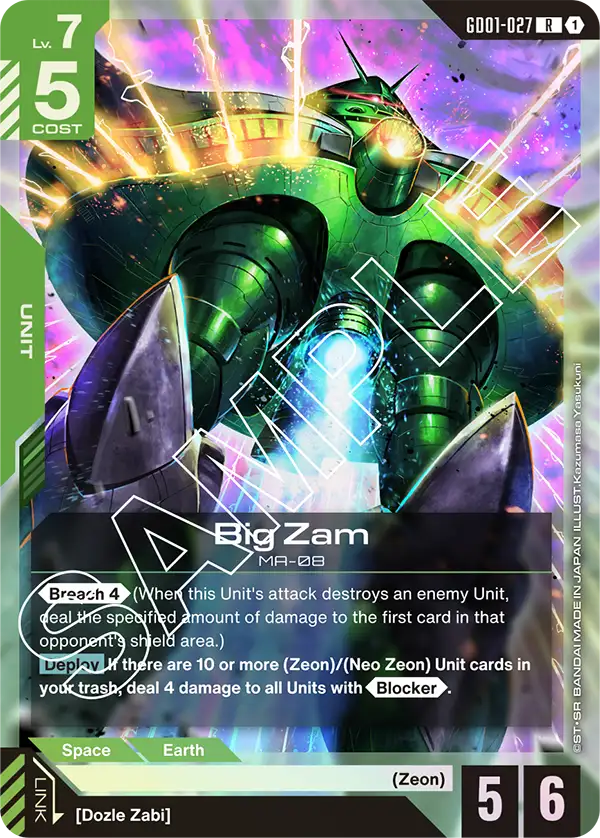
GD01-027 Big Zam is green in one frame. <Breach 4>, and a 【Deploy】 that deals 4 damage to every Unit with <Blocker> if you have ten or more (Zeon)/(Neo Zeon) Units in the trash - a Level 7 body that lands and then deletes the exact keyword that would have stopped it.
The other green tell: 16 of the 23 cards that reveal cards are green, and 16 of the 38 that make tokens. Green digs and multiplies. What green does not do is rest enemy Units - zero cards, in a game with 36 of them.
Red is damage with no undo button
Red is the only colour with a hole you can prove. Not one of the 168 red cards uses the word "recover." Blue has 48. Red has none. Whatever red does, undoing damage is not on the list.
What it does instead is deal damage: 81 red cards mention damage, the most of any colour and more than triple white's 22. It also owns <Support> at 12 of 14, and leads <First Strike> at 7 of 14.
Those two keywords describe the same plan from different angles. <Support> rests one of your Units to pump another's AP, which is a way of converting a body you were not going to attack with into extra damage on a body you were. <First Strike> makes an attacker deal its damage before the defender, which turns a favourable-but-lethal trade into a clean kill.
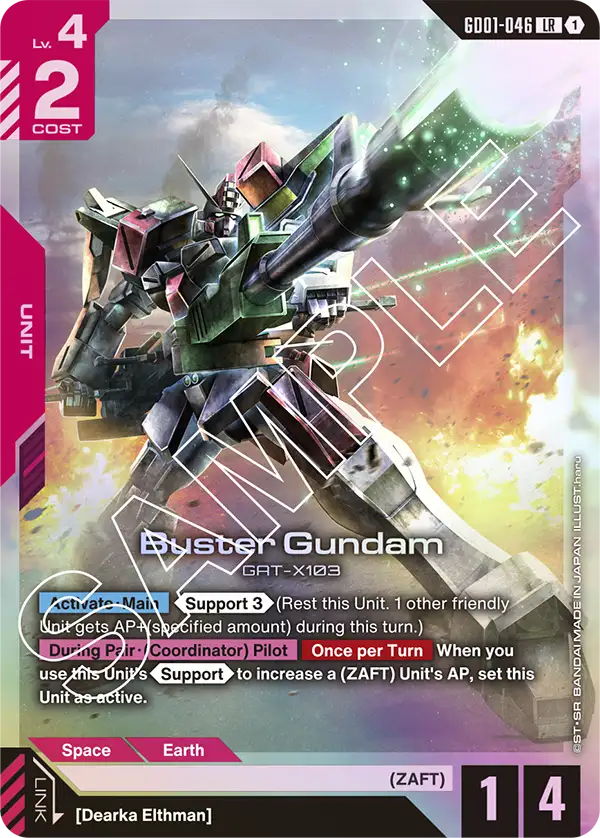
GD01-046 Buster Gundam is the design statement. It is a 1 AP, 4 HP Unit - almost useless swinging on its own - carrying <Support 3>. Its whole job is standing behind something and handing over three AP. Then its 【During Pair】 sets it back active after supporting a (ZAFT) Unit, so it can do it again next turn. Red's engine cards are not the ones that attack.
Red is where you go when you have decided the game ends before turn eight, and you would rather have the extra damage than the ability to fix a mistake.
White blocks and outlasts
White has 46 of the 82 <Blocker> mentions and 25 of the 41 unconditional prints, which is a plurality rather than a monopoly - blue and purple carry 8 unconditional <Blocker> Units apiece.
Where white gets separation is what it stacks on top. It leads both keyword lists at once - most <Blocker> cards at 46 and most <Suppression> cards at 7 of 15, though purple edges it on unconditional <Suppression> prints - and it sits second behind blue on resting enemy Units with 8. ST09-004 Freedom Gundam is the shape: printed <Blocker>, and it gains <Suppression> while you control a Base - defence that converts into a faster clock the moment your board is stable.
White is also the quietest colour on the offensive axes. It has the least damage text of the five at 22 cards, and the least destruction text at 15. It does not kill things. It stands in front of them and waits.
White also has one card worth singling out. GD02-073 Carta's Graze Ritter (Ground Type) hands the opponent a keyword: during your opponent's turn, the enemy Unit battling it gains <First Strike>. That reads like a drawback until you remember white's Units are built to survive the exchange.
Purple plays out of the trash
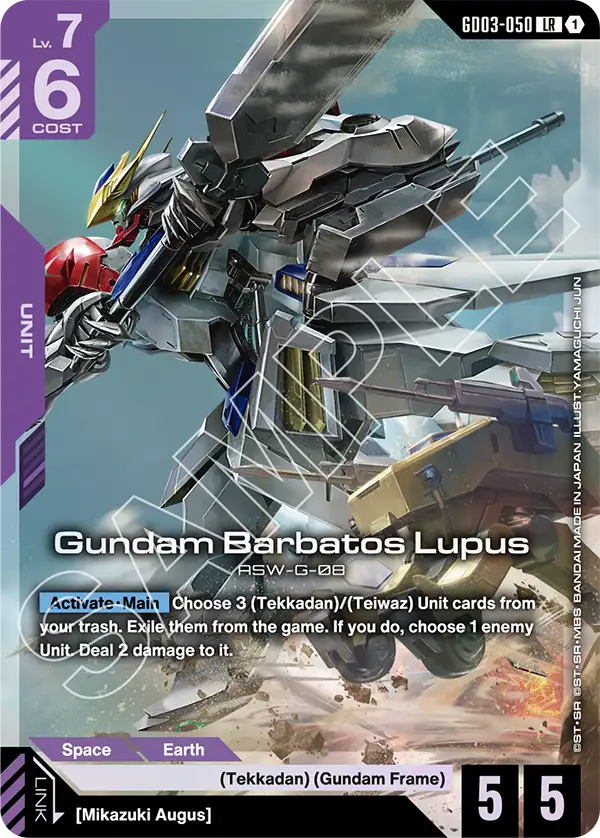
Purple is the smallest colour and the most focused, and its number is the cleanest in the data.
52 cards in the game reference "from your trash". 25 of them are purple. Against pool size, that is 18% of every purple card, versus 6% of white, 4% of green, 3% of red and 2% of blue - a three-times concentration over the next colour.
Purple does not just recur cards, either. Look at the verbs across those 25: deploy a Unit from the trash (GD02-110 Awakened Power, GD03-051 Gundam X Divider), deploy and get paid for having done it (GD04-060 Esperansa draws a card if it entered from the trash), add a Pilot back to hand (GD02-112 Momentary Respite), or exile trash as a cost (GD03-050 Gundam Barbatos Lupus, above, exiles three (Tekkadan)/(Teiwaz) Units to deal 2 damage).
That last one is the important structural point: purple treats its own graveyard as a resource to spend, not just a box to recur from. Which is exactly why the exile zone has seven separate rulings telling you to keep a physical space for it - four of the seven cards those rulings attach to are purple, and if purple's exiled cards get shuffled into its trash, purple's other cards start lying to it.
Purple's second-hand identity is destruction: 38 of its 137 cards use "destroy", the second-highest raw count in the game behind green's 50, from the smallest pool. Purple kills things, then buys them back.
You will not find a signature keyword here. Purple leads <Suppression> on unconditional prints with 3 and that is the whole story. Its mechanic is a zone, not a keyword.
The colours follow the shows
The colour assignment is not random across the franchise, and once you see it you cannot unsee it.
| Colour | Signature traits | Signature source series |
|---|---|---|
| Blue | (Earth Federation) 53, (Titans) 32, (White Base Team) 21 | Z Gundam, Mobile Suit Gundam, Unicorn |
| Green | (Zeon) 47, (Academy) 21, (Operation Meteor) 18 | Mobile Suit Gundam, Wing, Witch from Mercury |
| Red | (ZAFT) 31, (Neo Zeon) 28, (Mafty) 12 | SEED, Unicorn, GQuuuuuuX |
| White | (Academy) 24, (AEUG) 17, (Gjallarhorn) 15 | SEED, Witch from Mercury, Z Gundam |
| Purple | (Tekkadan) 28, (Vulture) 23, (Minerva Squad) 17 | IRON-BLOODED ORPHANS, After War Gundam X |
Blue is the Federation and the Titans - the institution with the budget and the repair bays, which is a tidy fit for the healing colour. Purple is Tekkadan and the Vultures: Iron-Blooded Orphans contributes 43 purple cards and After War Gundam X another 27, two shows about scrappers and salvage crews. The colour that lives in the trash is the colour of the shows about people who live off scrap.
(One database trap on that IBO figure, since it will not reproduce if you check it the obvious way. Bandai prints the Iron-Blooded Orphans Source Title two different ways - 51 cards read "Mobile Suit Gundam IRON-BLOODED ORPHANS" and eight GD05 cards read "Mobile Suit Gundam: Iron-Blooded Orphans" - and the site's series filter only matches the first. Filter for the series and you get 36 purple; read the field off the cards and you get 43. The series guide works through all three spellings the filter misses.)
Practical use: if you are building around a series you actually like, that series has a colour, and it is usually one colour rather than spread across five. Check before you commit.
Nine of the ten pairs, and the one Bandai skips
Bandai publishes decklists on its official DECKS page, and 23 of them name their colour pair in the title. Tallying every one:
| Pair | Decks published |
|---|---|
| Blue-White | 5 |
| Green-White | 4 |
| Blue-Green | 4 |
| Red-Purple | 3 |
| Red-White | 2 |
| White-Purple | 2 |
| Green-Red | 1 |
| Green-Purple | 1 |
| Blue-Red | 1 |
| Blue-Purple | 0 |
Count decks rather than pages there. One entry on that page, dated 26 June 2026, is a single article carrying two complete 50-card lists - the "Blue-Green Support Deck and Blue-White Thunderbolt Deck" - so 23 decks sit across 22 pages.
Five colours give ten possible pairs. Nine of them appear on that page. Blue-Purple does not.
That is not proof the pair is bad, but the shape of the data suggests why it is awkward: blue's plan is to keep Units alive and heal damage off them, and purple's plan is to let Units die and cash them in afterwards. They want opposite things to happen to the same board.
White shows up in 13 of the 23 pairings, more than any other colour, which tracks with a colour whose contribution - blockers that buy turns - is useful next to any plan at all.
The named decks also confirm the identities from outside my count. Bandai's own titles include a "Green/White Ramp Deck", a "Blue-Green Breach Link Unit Deck", a "The-O Repair Deck", and a Purple-White Vulture deck whose official blurb describes it going on a "trash-fueled rampage". That is Bandai independently describing green as ramp, blue as repair and purple as trash.
Picking your two
Compressed to something you can use while staring at a card binder:
- Want the game to go long? Blue holds 48 of the 61 cards that recover HP and 22 of the 36 that rest an enemy Unit, which is the toolkit for surviving to turn eight. Pair it with white for blockers or green for the Resource acceleration.
- Want to close fast? Red has the most damage text and no healing at all, which is a design telling you it is not built to play from behind. Red-White is the published aggro-plus-defence pair; Red-Purple has three official lists.
- Want an engine? Green is the only colour that makes EX Resources. If your deck has Level 6+ cards you actually want to cast, green is how you get there a turn early.
- Want grind? Purple is a three-times outlier on trash interaction, and the smallest pool in the game. Take it when your plan needs the same threat two or three times.
- Not sure yet? White. It is in 13 of Bandai's 23 published pairs, it has the blockers, and it asks the least of your other colour.
And one thing that is true regardless: because Resources are colourless and pay for anything, the second colour is not a cost. It is a package. A four-card splash buys you nothing that a fifty-card single-colour deck would not have done more consistently - if the second colour is in your list, it should be there for a specific set of cards you actually want to draw.
What this count does not tell you
The honest limits.
This is a count of what exists, not of what wins. I have no tournament results data, so nothing here says which colour pair is strongest - only which tools each colour is holding. A colour can own a keyword and still be bad if the keyword is bad.
Text counts are also a blunt instrument in one specific way: "cards whose text contains <Blocker>" includes cards that destroy blockers, grant blockers, or check for them, not only cards that have <Blocker>. I have flagged the unconditional-print counts wherever that gap changes the reading, but if a single number matters to a deck you are building, search the card database directly.
The counts are 892 distinct card numbers as of 15 August 2026, covering GD01-GD05, EB01 and ST01-ST10. GD06 Stardust Trails lands 30 October 2026 with Gundam ZZ and Gundam 0083 cards, and every table here shifts the day it does. The identities probably will not - four sets of consistent keyword assignment is a design position, not an accident - but the percentages will.
If you want the mechanical rules the colour choice sits inside, the deckbuilding guide covers the 50-card and two-colour limits and the Level curve, and the rules walkthrough covers what <Repair>, <Breach> and <Blocker> actually do at the table.
Frequently Asked Questions
How many colours are in the Gundam Card Game?
What does each colour do in the Gundam Card Game?
Which Gundam Card Game colour is the ramp colour?
Why is purple the trash colour in the Gundam Card Game?
Which colour pair should a new Gundam Card Game player build?
How many cards are in the Gundam Card Game?
What are the keyword effects in the Gundam Card Game?
Is there a Gundam Card Game colour pair that does not work?
Keep Reading
- GUNDAM CARD GAME Official Card Database (892 distinct card numbers, counted 15 August 2026)
- GUNDAM CARD GAME Official FAQ database (keyword effect categories)
- GUNDAM CARD GAME Official DECKS page (23 colour-pair decklists tallied across 22 pages)
- Stardust Trails [GD06] product page, releasing 30 October 2026
Related Guides
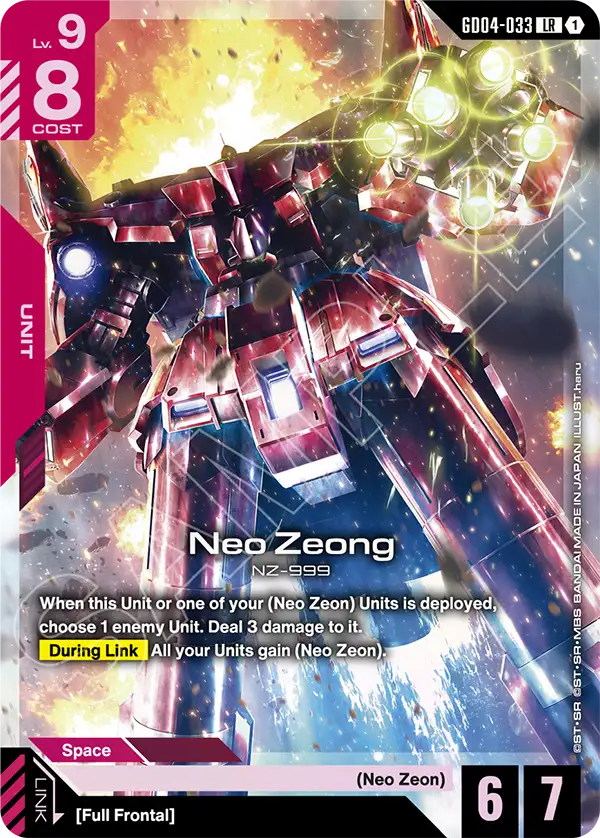
Gundam Card Game Space and Earth Zones Do Nothing
628 of the 1,078 cards in the Gundam Card Game database print a Zone field reading Space, Earth or both - and not one card in the game refers to it. The Comprehensive Rules give zones two lines and never name the values. The FAQ has no Zone category and no ruling that mentions one. So I counted the whole field anyway: the Unit split, the Base split that inverts it, the trait pattern that explains both, and why the first booster printed 43% of the game's Earth-only Units.
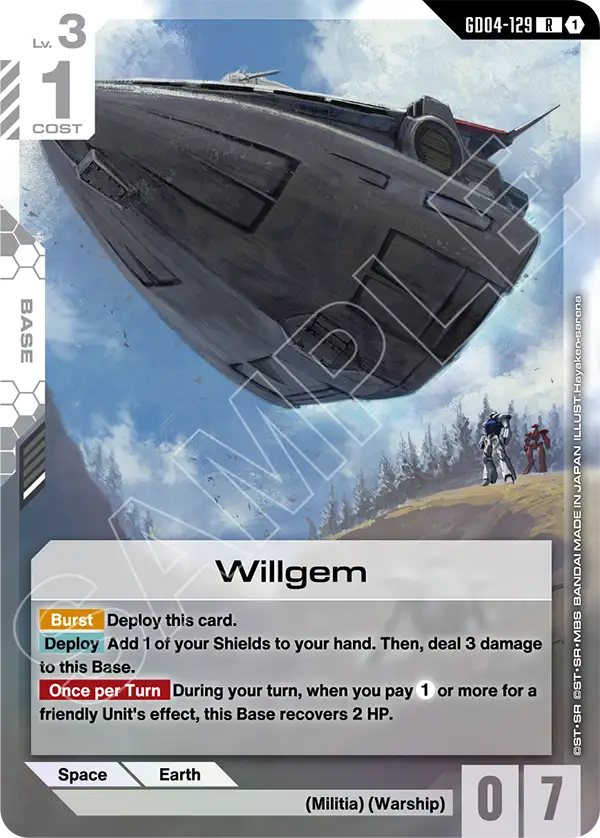
Gundam Card Game Bases - All 68 Counted, and Which to Run
Every Base card in the Gundam Card Game opens with the same two lines. Not most of them - all 68, across five colours and sixteen products, with zero exceptions. That template is why the Base slot is not the throwaway it looks like, and the whole type tops out at Rare - no Base has ever been printed above it. I pulled all 68 out of the official database and cross-referenced them against 41 decklists Bandai published itself.
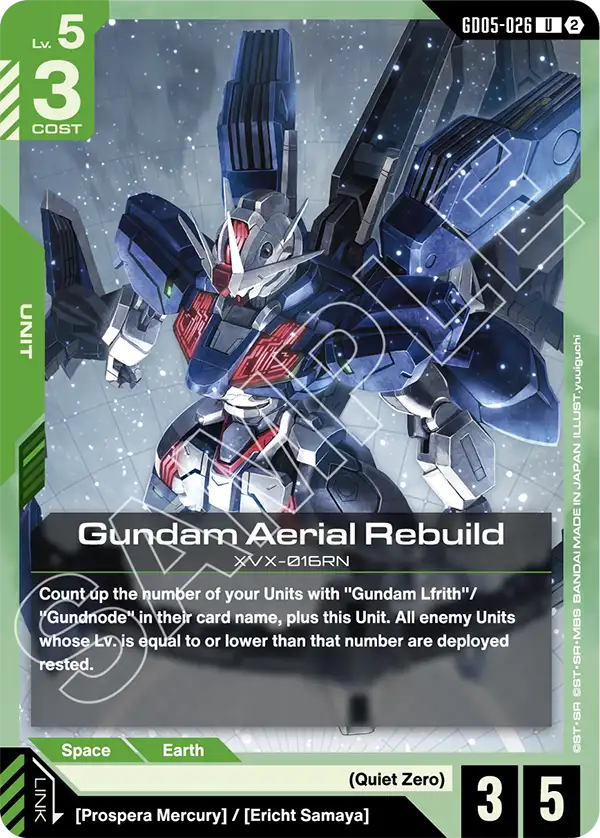
Gundam Card Game Link Units - Every Pilot Pairing, Counted
The link box on GD05-026 Gundam Aerial Rebuild reads [Prospera Mercury] / [Ericht Samaya]. Search the official card database for anything that answers to Ericht Samaya - a Pilot, a Command with a Pilot effect, anything - and you get nothing. Out of 173 distinct link requirements in the game, it is the only one no card can satisfy. I pulled every one of the 892 cards in the official database and mapped the whole link web: which characters have the deepest benches, which Units accept two names, which 35 characters exist only as Commands, and which single Pilot card links with 26 different Units.
Gundam Card Game Commands - All 145, and When to Play Them
Comprehensive Rules 9-2 makes Command the only card type in the Gundam Card Game you can play out of your hand on someone else's turn, and whether a given Command can is written on one line of the card: 84 of the 145 Commands in the game carry an Action effect, which Bandai's own FAQ says can be played during your action steps or your opponent's. I read the timing line off all 145 of them, then counted what Bandai actually puts in its own 41 decklists - and 15 of those lists run none of it at all.
How to Play the Gundam Card Game - Resources, Shields, Pilots, and the Six-Card Life Total
Your entire life total in the Gundam Card Game is six face-down cards with 1 HP each, plus a token base with 3 HP. This is the complete rules walkthrough - the separate resource deck, the Level and Cost split, setup, the five card types, pairing Pilots into Link Units, the five phases, and combat - checked line by line against Bandai's Comprehensive Rules Ver. 1.8.0.
Gundam Card Game Series - All 20, and Which Are Buildable
Gundam 00 has 65 cards in the Gundam Card Game and Gundam Wing has 50 - and Wing is the far easier deck to build, because all 50 Wing cards sit inside one legal colour pair and Gundam 00 is split across four colours. Card count is not the number that decides whether your favourite series is playable. I read the Source Title field off all 892 deck-legal cards and worked out which of the 20 series survive contact with the two-colour rule.