Gundam Card Game Space and Earth Zones Do Nothing
628 of the 1,078 cards in the Gundam Card Game database print a Zone field reading Space, Earth or both - and not one card in the game refers to it. The Comprehensive Rules give zones two lines and never name the values. The FAQ has no Zone category and no ruling that mentions one. So I counted the whole field anyway: the Unit split, the Base split that inverts it, the trait pattern that explains both, and why the first booster printed 43% of the game's Earth-only Units.
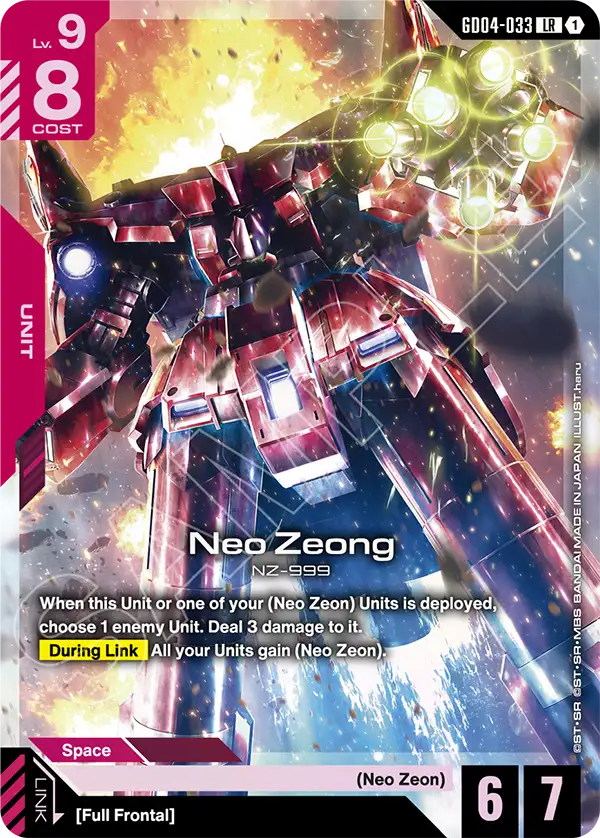
Under the text box on every Unit and Base in the Gundam Card Game there is a small angled banner reading Space, Earth, or both - printed as words, not as symbols. Bandai's card database calls that field Zone. 628 of the 1,078 cards in Bandai's English card database carry one. Not one card in the game reads it.
I went looking for the rule that punishes you for deploying an Earth-only mobile suit into a fight your opponent is running out of a space fortress. There is no such rule. No deployment restriction, no attack restriction, no cost modifier, no keyword, no ruling. The zone is a printed attribute waiting for a card that refers to it, and across all 1,078 card numbers in the English pool, that card does not exist yet.
That is worth knowing before you build, because the label looks exactly like the kind of thing that gates a play.
What the rulebook says, in two lines
The Comprehensive Rules Ver. 1.8.0 (the version the official rules page dates 10 July 2026) run 35 pages. Zone gets two lines of them:
- 2-6-1. "A card's zone. This zone may be referred to within card text."
- 2-6-2. "Zones are mainly found on Unit and Base cards."
That is the whole section. There is no 2-6-3. The rules never even name Space and Earth as the two values - you have to read a card to learn what a zone can say.
Compare the field directly above it. Colour gets 2-4-1 through 2-4-3, including a clause naming all five colours and a clause stating that a paired Pilot does not change a Unit's colour. Trait gets five clauses, including 2-5-5 on whether a Pilot's traits carry over. Both of those fields are defined the same way zone is - "may be referred to within card text" - and both are referred to constantly, which is why they needed the extra clauses.
Zone got the sentence and nothing else, because nothing else has ever been needed.
How I counted
I pulled the official card database on 2 September 2026, filtered by each of the eight card types, and collapsed parallel art (the _p1 and _p2 card-number suffixes) down to distinct card numbers. That gives 1,078 cards: 560 Units, 145 Commands, 119 Pilots, 68 Bases, 106 Resources, 28 EX Bases, 26 EX Resources and 26 Unit tokens. The first four types are the 892 deck-legal cards the rest of this vertical counts, and they match the totals in our Bases guide and colour count exactly.
Then I read the Zone field and the full effect text off all 1,078 card detail pages, and cross-checked both against the database's own freeword search.
Only Units and Bases have one
| Card type | Cards | Carry a zone |
|---|---|---|
| Unit | 560 | 560 |
| Base | 68 | 68 |
| Pilot | 119 | 0 |
| Command | 145 | 0 |
| Resource | 106 | 0 |
| EX Base | 28 | 0 |
| EX Resource | 26 | 0 |
| Unit token | 26 | 0 |
| Total | 1,078 | 628 |
Rule 2-6-2 hedges with "mainly". The data does not: it is exactly Units and Bases, 628 cards, and the hedge covers nothing.
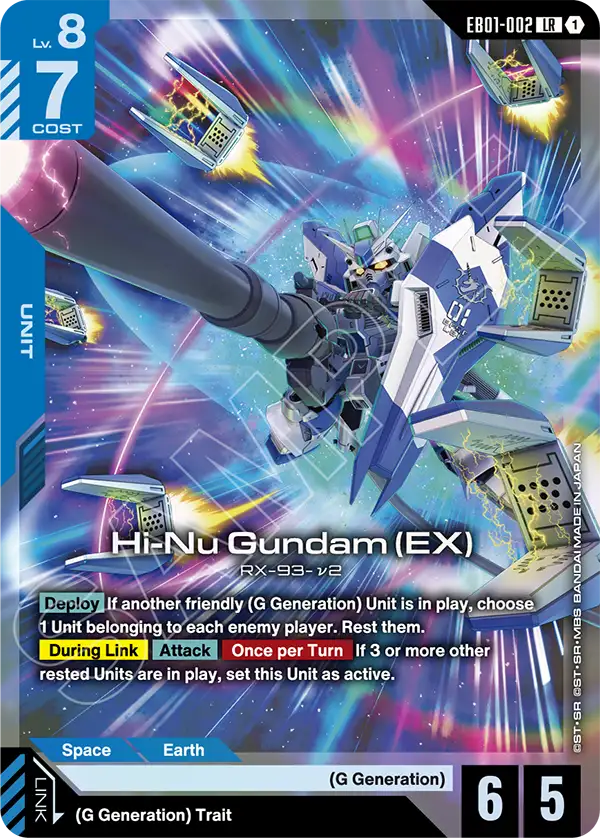
The token row is the strange one. All 26 Unit tokens print a dash where a zone would go, including T-007 Zaku II, while the printed GD01-035 Zaku II is Space Earth. The rules do explicitly exempt tokens from one field - 2-4-2 says every card except Resources and tokens has a colour - but they say nothing at all about tokens and zones. The cards leave it blank anyway.
The Unit split: 474 both, 58 Earth, 28 Space
| Zone | Units | Share | Avg Lv. | Avg cost | Avg AP | Avg HP |
|---|---|---|---|---|---|---|
| Space Earth | 474 | 84.6% | 4.14 | 3.03 | 3.43 | 3.32 |
| Earth only | 58 | 10.4% | 3.09 | 2.29 | 2.74 | 2.79 |
| Space only | 28 | 5.0% | 4.21 | 3.14 | 3.33 | 3.21 |
(AP averages exclude the ten Units that print a dash instead of an AP number - four dual-zone, five Earth-only, one Space-only.)
Five out of every six Units in the game can be deployed with both words printed, so the field is uniform enough to ignore even if it did something. The Earth-only row runs a full level cheaper and about 0.7 AP smaller than the rest, which is not a design rule about zones - it is an artefact of when those cards were printed, and the set-by-set table further down shows why.
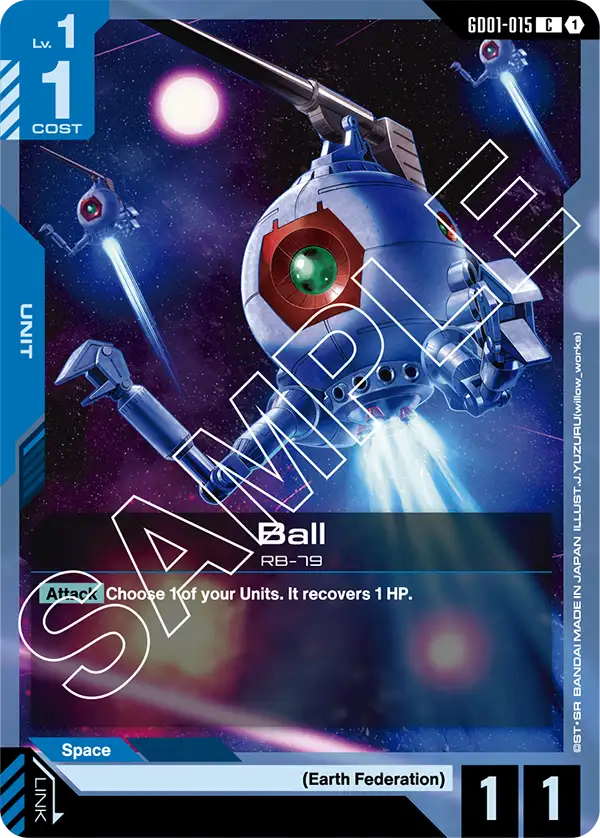
The Space-only 28 span the whole range. GD04-033 Neo Zeong is in there at Lv. 9 / cost 8 / 6 AP / 7 HP - tied with GD05-037 and ST08-001 for the highest level in the game, and holding the biggest AP-plus-HP total of any of the 560 Units - and so is GD01-015 Ball at Lv. 1 / cost 1 / 1 AP / 1 HP. If there is a power pattern in the field, 28 cards spanning that gap is not it.
Zero cards reference it, zero rulings mention it
This is the claim the whole post rests on, so here is the check, twice.
Reading all 1,078 effect texts, twelve cards contain the string "Space" or "Earth". All twelve are faction names - (Earth Federation) or (Earth Alliance) - in cards like GD04-002 and ST04-012. None is a zone reference.
The database's own freeword search agrees, and it is an independent test because it searches card names, effect text and the zone field together. It does not search the trait field: 35 cards carrying an (Earth Federation) or (Earth Alliance) trait, GD01-015 Ball among them, never appear in the Earth results at all.
| Freeword search | Cards returned | What that set is |
|---|---|---|
| Space | 558 | Exactly the 558 cards whose zone contains Space, and nothing else |
| Earth | 564 | The 559 cards whose zone contains Earth, plus 5 more - 3 naming an Earth faction in their effect text, 2 with Earth in the card name |
| Zone | 0 | No card in the game uses the word |
558 is not an approximation. The set the search returns and the set I derived from the zone field are the same 558 card numbers, which means no card name and no effect text in the game contains the word "Space" outside that field. Traits need the separate check, since the search skips them: not one of the 1,078 cards prints a trait containing the word either.
The rulings database says the same thing from the other side. Bandai's FAQ has a category list covering Color, AP, HP, Damage, Target, Token, Unit, Pilot, Command and seven keyword effects. There is no Zone category, and a freeword search of the FAQ for "Zone" or "Space" returns nothing. Our rulings deep-dive walks the questions Bandai has answered; zone is not among them.
One more tell, from the search UI itself: the card database lets you filter by product, rarity, parallel art, level, cost, colour, type, series, trait and link condition. It does not offer a zone filter, even though the freeword box matches the field perfectly well. AP and HP have no checkbox either, so the omission proves nothing on its own - but it does mean there is no way to assemble a zone-themed pile out of the search, even as a novelty.
Bases are the mirror image
Units are overwhelmingly dual-zone. Bases are not.
| Zone | Bases | Share |
|---|---|---|
| Space only | 41 | 60.3% |
| Space Earth | 15 | 22.1% |
| Earth only | 12 | 17.6% |
And the split lines up with the two traits Bases come in:
| Base trait | Space | Space Earth | Earth | Total |
|---|---|---|---|---|
| (Warship) | 24 | 15 | 4 | 43 |
| (Stronghold) | 17 | 0 | 7 | 24 |
| Neither | 0 | 0 | 1 | 1 |
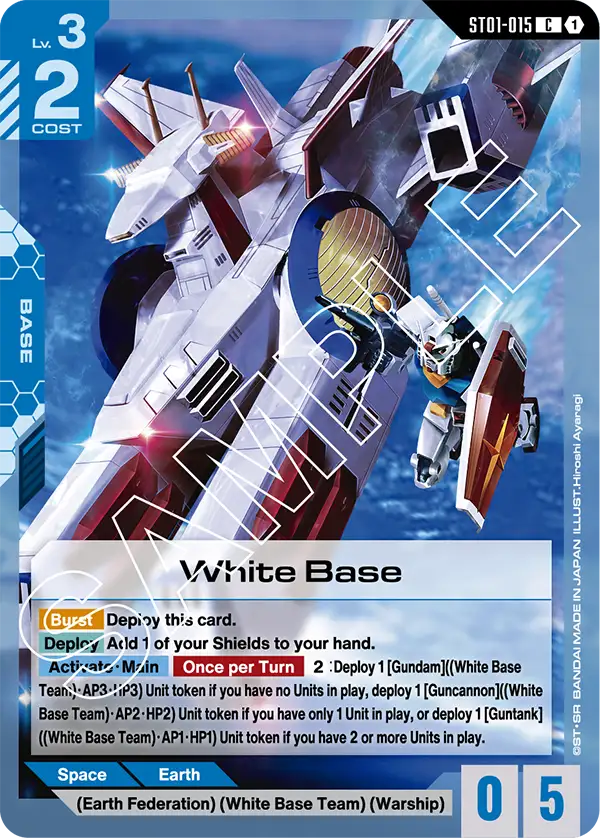
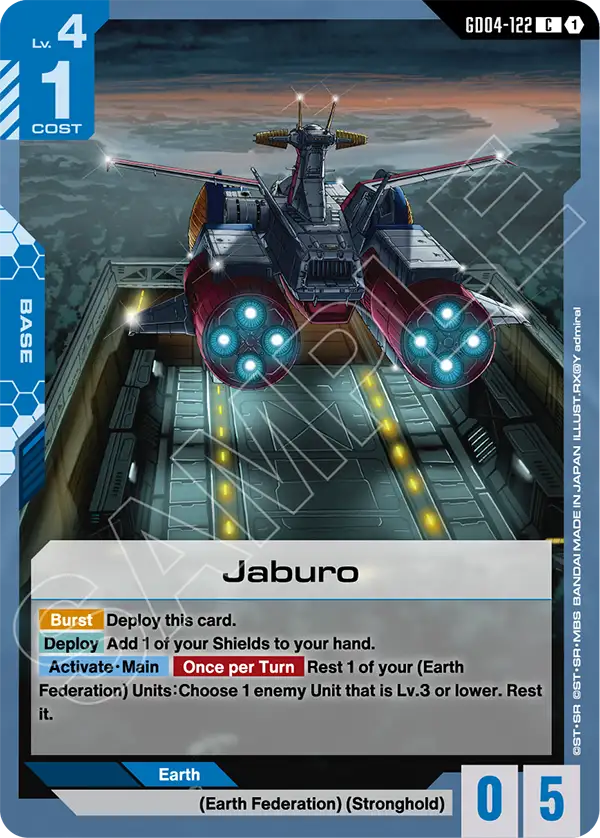
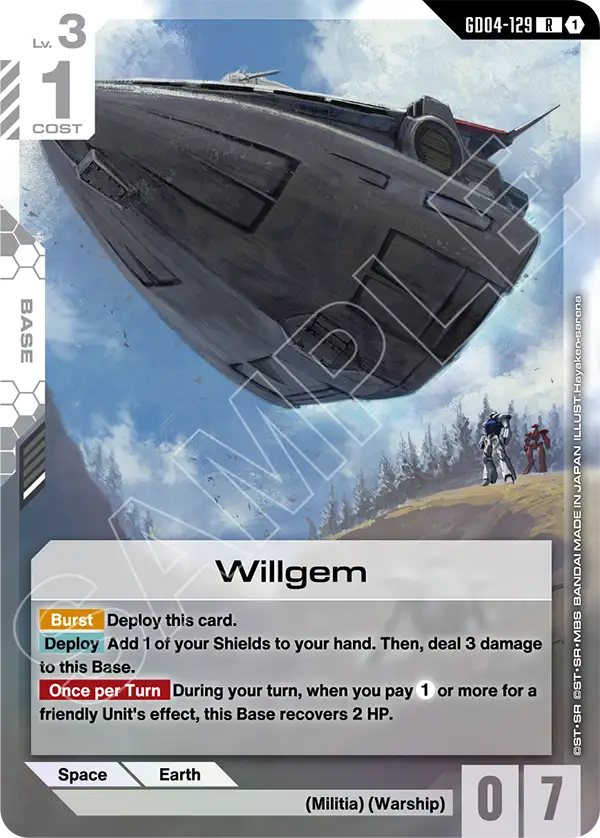
All 15 dual-zone Bases carry (Warship). Not one (Stronghold) in the game is dual-zone. A ship crosses between the two theatres and a fortress does not, and Bandai printed the field to say so - White Base, Archangel, Argama, Nahel Argama and Willgem all read Space Earth, while Jaburo, Corsica Base and A Baoa Qu each pick a side. The one Base carrying neither trait is GD03-126 Cyclops Team, an Earth-only card whose name is a squad rather than a place.
The zones track the fiction, not the format
Once you accept that the field is decorative, the pattern inside it gets more interesting rather than less, because it is one of the most disciplined pieces of flavour in the game.
The Space-only Bases run to places that only exist off-planet: A Baoa Qu (GD04-123), Axis (GD05-129), Jachin Due (GD03-127), Side 7 (GD01-124), Industrial 7 (GD04-130), Mining Asteroid Palau (GD01-128). The Earth-only ones are ground installations: Jaburo (GD04-122), Corsica Base (ST02-016), the Maganac Corps' Underground Desert Base (GD01-126), the Presidential Office (GD05-130), and the Gundam Fight itself (GD05-128).
Units follow the same logic, and the cleanest demonstration is a pair of cards. There are ten Freedom or Justice Gundam Units in the game. Eight of them read Space Earth. The two that do not are GD03-076 Freedom Gundam (METEOR) and GD03-077 Justice Gundam (METEOR), and both are Space only. GD03-070 Freedom Gundam sits in the same set, in the same colour, and reads Space Earth. Same machine, different hardware, different zone.
More of the Space-only list runs the same way: Ball, Elmeth, Zeong, Neo Zeong, Bigro, Zakrello and Alpha Azieru, none of which Bandai has printed with an Earth zone in any set.
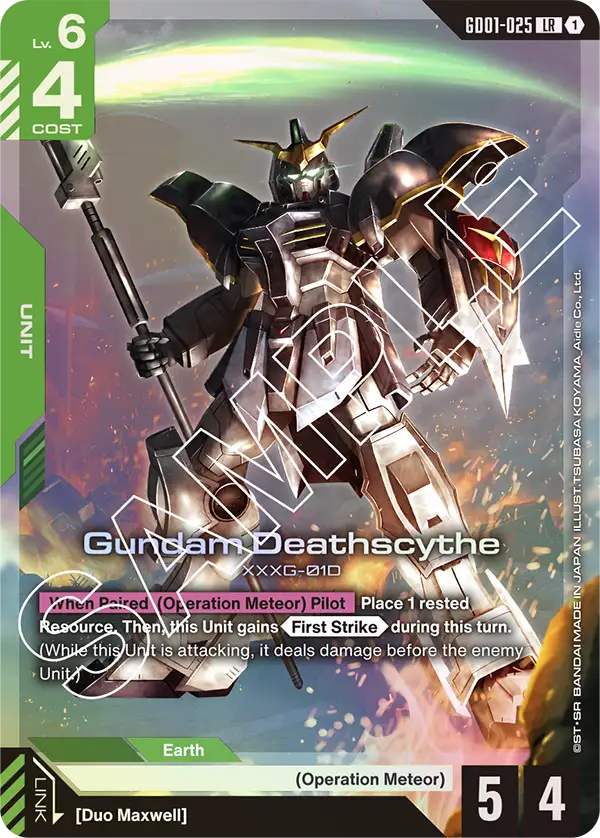
The heaviest Earth concentration is Gundam Wing: 14 of its 33 Units are Earth-only. Nine of the 13 Units carrying the (Operation Meteor) trait are Earth-only, including GD01-025 Deathscythe, GD01-028 Sandrock, GD01-029 Shenlong and GD01-034 Heavyarms; the other four are dual-zone.
And four series with at least eight Units have never printed a single-zone Unit at all: The Witch from Mercury (32 Units), Gundam AGE (21), G Gundam (12) and Endless Waltz (8).
GD01 printed 25 of the 58 Earth-only Units
| Set | Units | Space Earth | Space | Earth | Single-zone share |
|---|---|---|---|---|---|
| Newtype Rising [GD01] | 86 | 58 | 3 | 25 | 32.6% |
| Dual Impact [GD02] | 84 | 75 | 4 | 5 | 10.7% |
| Steel Requiem [GD03] | 83 | 76 | 2 | 5 | 8.4% |
| Phantom Aria [GD04] | 80 | 66 | 7 | 7 | 17.5% |
| Freedom Ascension [GD05] | 80 | 75 | 2 | 3 | 6.3% |
| Eternal Nexus [EB01] | 60 | 51 | 4 | 5 | 15.0% |
| ST01-ST10 starters | 87 | 73 | 6 | 8 | 16.1% |
The first booster is the outlier by a distance. 29% of Newtype Rising's Units are Earth-only, and that single set holds 25 of the 58 Earth-only Units in the entire game - 43.1% of them. By Freedom Ascension the single-zone share is down to 6.3%.
Whether that is a deliberate retreat from a field Bandai decided not to use, or a consequence of which shows each set draws from, Bandai has not said. What the numbers support is the narrower statement: Freedom Ascension, the most recent numbered booster in the database, prints 75 of its 80 Units as dual-zone - 93.8%.
What it means for your deck
Nothing. Not one line of it.
- There is no zone requirement on deploying a Unit or a Base, no zone-based attack or block restriction, and no cost change. The full turn structure never touches the field.
- The two-colour cap, the 50-card main deck and the four-copy limit are the constraints that actually shape a list, and none of them mentions zones - see the deckbuilding guide for the ones that bite.
- You could not build around it if you wanted to, because the card search has no zone filter.
Bandai's own enforcement language makes the point better than I can. The banned and restricted list effective 24 July 2026 defines one of its banned pairs by description rather than by name - "a Unit card that is Lv.2 with cost 1, 2 AP, and 2 HP, and without effects" - and lists the 20 cards that match. Nineteen of them are Space Earth; GD01-060 Zaku Mariner is Earth-only. Bandai treats all 20 as interchangeable for the purposes of that rule, and never mentions the field that separates one of them from the other nineteen.
The two cards the same document polices individually - GD01-020 Anksha, banned, and ST02-016 Corsica Base, restricted to two - happen to both be Earth-only. That is a coincidence of a 58-card and a 12-card pool, not a pattern, and the tournament rules guide has what the list actually does to your 50.
What this count does not tell you
Three limits worth stating plainly.
This is the English card database. I did not audit the Japanese pool, and I am claiming nothing about cards that have not been released in English.
GD06 is not in it. Stardust Trails releases 30 October 2026 with 135 card types plus 8 tokens, and none of them are in the database yet. Whether the set that brings in Gundam ZZ and 0083: Stardust Memory prints the first card that reads a zone, nobody outside Bandai can know today.
And Bandai has published no statement about zones at all - not in the rules index, not in the play guide, not on the GD06 product page. Everything above is what the rules text and the card data say as of 2 September 2026. The closest parallel in the game is the AP that rule 3-5-4 gives every Base and that Bandai's database prints as a dash on all 68, and Ericht Samaya, a link requirement no card in the game can satisfy. This game keeps a few loaded fields lying around unused.
Frequently Asked Questions
What do the Space and Earth icons mean on Gundam Card Game cards?
Can a Space-only Unit fight an Earth-only Unit in the Gundam Card Game?
How many Gundam Card Game cards have a zone?
What is the zone split on Gundam Card Game Units?
Does the Gundam Card Game card database let you search by zone?
Keep Reading
- GUNDAM CARD GAME Official Card Database (Zone, type, colour and effect-text fields read off all 1,078 distinct card numbers, 2 September 2026)
- Gundam Card Game Comprehensive Rules Ver. 1.8.0, dated 10 July 2026 on the official rules index (Bandai, PDF) - Section 2-6 Zone is two clauses long
- GUNDAM CARD GAME Official FAQ database - no Zone category, and freeword searches for Zone and Space return no rulings
- GUNDAM CARD GAME Official Rules Index - Comprehensive Rules updated 10 July 2026, with no zone reference in the play materials
- GUNDAM CARD GAME Banned/Restricted Cards, effective 24 July 2026 - the banned-pair description names Lv., cost, AP, HP and effects, and never a zone
- Stardust Trails [GD06] product page - 135 card types plus 8 tokens, releasing 30 October 2026, not yet in the card database
Related Guides
Gundam Card Game Bases - All 68 Counted, and Which to Run
Every Base card in the Gundam Card Game opens with the same two lines. Not most of them - all 68, across five colours and sixteen products, with zero exceptions. That template is why the Base slot is not the throwaway it looks like, and the whole type tops out at Rare - no Base has ever been printed above it. I pulled all 68 out of the official database and cross-referenced them against 41 decklists Bandai published itself.
Gundam Card Game Link Units - Every Pilot Pairing, Counted
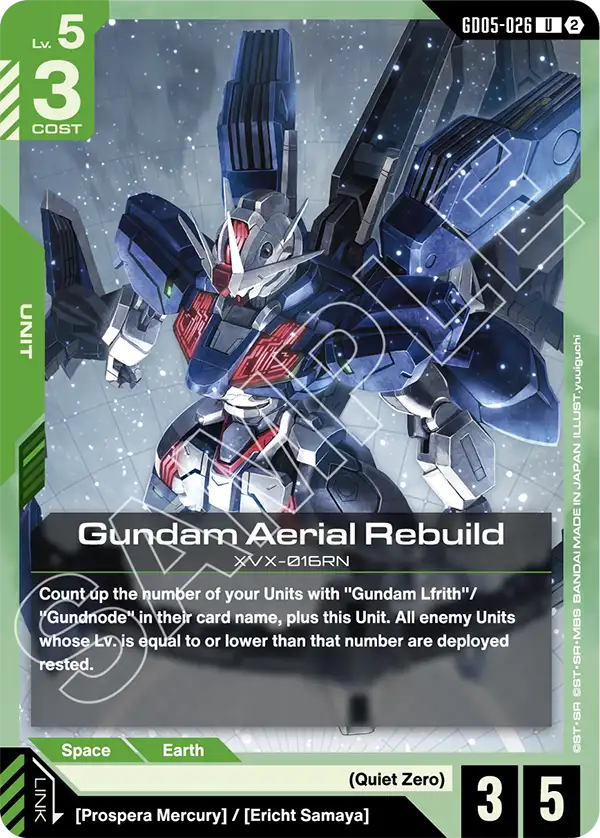
The link box on GD05-026 Gundam Aerial Rebuild reads [Prospera Mercury] / [Ericht Samaya]. Search the official card database for anything that answers to Ericht Samaya - a Pilot, a Command with a Pilot effect, anything - and you get nothing. Out of 173 distinct link requirements in the game, it is the only one no card can satisfy. I pulled every one of the 892 cards in the official database and mapped the whole link web: which characters have the deepest benches, which Units accept two names, which 35 characters exist only as Commands, and which single Pilot card links with 26 different Units.
Gundam Card Game Colours - I Counted All 892 Cards, and Bandai Has a Colour Pie It Never Published
Thirty-one of the 37 cards whose text carries <Repair> are blue. Twelve of the 14 that carry <Support> are red. Twenty-five of the 52 cards in the game that reach into your own trash are purple - a colour that is only 15% of the card pool. Bandai has never published a colour-identity document for the Gundam Card Game, so I pulled every one of the 892 cards out of the official database and counted. The pie is real, it is sharp, and it decides which two colours you should actually be pairing.
Gundam Card Game Series - All 20, and Which Are Buildable
Gundam 00 has 65 cards in the Gundam Card Game and Gundam Wing has 50 - and Wing is the far easier deck to build, because all 50 Wing cards sit inside one legal colour pair and Gundam 00 is split across four colours. Card count is not the number that decides whether your favourite series is playable. I read the Source Title field off all 892 deck-legal cards and worked out which of the 20 series survive contact with the two-colour rule.
How to Play the Gundam Card Game - Resources, Shields, Pilots, and the Six-Card Life Total
Your entire life total in the Gundam Card Game is six face-down cards with 1 HP each, plus a token base with 3 HP. This is the complete rules walkthrough - the separate resource deck, the Level and Cost split, setup, the five card types, pairing Pilots into Link Units, the five phases, and combat - checked line by line against Bandai's Comprehensive Rules Ver. 1.8.0.
![The official Gundam Card Game Unit token T-029 Bit / Funnel from Silent Barrage [ST13]: a beige-framed token card showing purple, red-capped bit pods and magenta funnels firing white beams through a blue starfield, with the line This Unit can't be paired with a Pilot or attack, the Long-Range Weapon trait, and 2 AP and 2 HP along the bottom, under a SAMPLE watermark.](/images/blog/gundam-tcg/gundam-card-game-tokens-guide/gundam-t-029-bit-funnel-token-card.webp)
Gundam Card Game Tokens - All 29, and What to Bring
The English card database holds 29 Unit tokens and 32 deck cards that make them, and Bandai's own Aquatic Assault build needs three token cards from a different starter deck. Here is every token, every card that makes one, the six-copy rule, what three Bandai documents say about substitutes, and where the database gets its own tokens wrong.