Gundam Card Game Bases - All 68 Counted, and Which to Run
Every Base card in the Gundam Card Game opens with the same two lines. Not most of them - all 68, across five colours and sixteen products, with zero exceptions. That template is why the Base slot is not the throwaway it looks like, and the whole type tops out at Rare - no Base has ever been printed above it. I pulled all 68 out of the official database and cross-referenced them against 41 decklists Bandai published itself.
Pull every Base card out of the official Gundam Card Game database and read the top of each one. The first two lines are the same card, sixty-eight times:
【Burst】Deploy this card. 【Deploy】Add 1 of your Shields to your hand.
Five colours, sixteen products - six sets and ten starter decks - and not one exception.
That template is the whole reason the Base slot is not the throwaway it looks like. The deckbuilding guide settles how many Bases belong in a 50-card deck. This one settles which, and what the card type is actually doing while it sits there soaking hits.
Sixty-eight cards, one template
Read the two lines together and you get a card that rebuilds itself out of your own defences. A Base card sitting face down as one of your six Shields gets broken; 【Burst】 lets you deploy it into your base section for free, without paying its cost (rule 13-2-5-1); and the 【Deploy】 that fires on arrival hands you another of your Shields as a card in hand.
Two Shields leave the shield area. One card enters your hand. A 5 HP wall goes up in front of whatever Shields you have left. Against a board of 1 AP attackers that wall soaks five swings where the two Shields it consumed would have soaked two, because rule 11-3-1-1 gives a Shield exactly 1 HP and a Base tracks real damage with counters (8-5-2-4-1).
That is the trade the card type is built around, and it is the same trade on all 68.
How I counted
On 20 August 2026 I queried the official card database at gundam-gcg.com/en/cards/ with the type filter set to BASE. It returns 101 entries; strip the parallel-art suffixes (_p1, _p2 and so on) and 68 distinct card numbers remain. I fetched the detail page for every one and read Bandai's own fields - level, cost, colour, AP, HP, zone, traits and full rules text - rather than reading card scans.
The rest of the pool is unchanged from the colour count five days earlier. Re-running the per-type queries today gives 560 Units, 145 Commands, 119 Pilots and 68 Bases, summing to the same 892 distinct deck-legal card numbers. Bases are 7.6% of the game.
Rules citations are Comprehensive Rules Ver. 1.8.0, dated 10 July 2026. Rulings are Bandai's official FAQ, where a keyword search for "Base" returns 42 entries.
What a Base actually does
The mechanics underneath, compressed, because every number later leans on them.
- Base cards are one of the four types that make up your 50-card deck (rule 6-1-1-1). Played, they deploy into the base section of your shield area (3-5-1).
- You may have at most one Base there (4-6-3), and it is face up and public to both players (4-6-3-1).
- "While a Base is present, damage dealt to the shield area is preferentially dealt to that base" (3-5-3). The attacker gets no say: official ruling Q37 asks "Can I destroy a Shield instead of destroying a Base?" and answers, in three words, "No, you cannot."
- <Breach> goes through the same door. Rule 13-1-2-2 says damage to "the first card in the shield area" hits the enemy Base if there is one, and ruling Q295 confirms a Base can take <Breach> damage because <Breach> is effect damage. Green owns 35 of the game's 51 <Breach> cards, so a 5 HP Base is a green deck's problem as much as a red one's.
- A Base is not a Shield for counting purposes. Ruling Q177, on GD02-037 Gundam Virsago, says "If there are 3 or less enemy Shields" does not count the Base.
- An EX Base is a Base. Ruling Q259 confirms the token satisfies "While a friendly Base is in play" on ST09-004 Freedom Gundam, and rule 5-17-2-1 says tokens are treated like the real thing.
The rules walkthrough covers the shield area from scratch if any of that is new.
The stat the rulebook defines and no Base has
Rule 3-5-4 is one sentence: "Bases have AP and HP." Rule 3-5-4-1 follows it up: "AP shows a Base's offensive strength in battle."
Not one of the 68 prints a number there. Every AP field in the database reads a dash, and the EX Base token is defined at 0 AP with 3 HP (rule 5-17-3-1-1).
The damage step agrees with the cards rather than with rule 3-5-4-1. Unit-versus-Unit combat under 8-5-3-2 is explicitly two-way - attacker and defender deal damage simultaneously. The Base clause, 8-5-2-4, is one direction only: "the attacking Unit deals an amount of battle damage equal to its AP to the Base targeted for attack," and stops. Nothing comes back.
So Bases have an offensive stat with no cards under it. It is space Bandai has left itself, in the same way Ericht Samaya is a printed link requirement that no card in the game can satisfy.
The shape of the sixty-eight
Colour first, and it is the flattest split in the game:
| Colour | Bases | Share |
|---|---|---|
| Blue | 16 | 23.5% |
| Green | 15 | 22.1% |
| Red | 14 | 20.6% |
| White | 13 | 19.1% |
| Purple | 10 | 14.7% |
Purple's shortfall is a GD01 artefact more than a design statement. The launch booster printed eight Bases and not one purple - two each in blue, green, red and white. GD02, GD03 and GD04 then printed exactly ten each, two per colour, with no deviation at all. GD05 broke the pattern again at two blue, two green, two red, one purple and one white. The rest are EB01 Eternal Nexus with six and the ten starter decks with sixteen between them.
Cost against HP is where the type gets genuinely narrow:
| Cost | 4 HP | 5 HP | 6 HP | 7 HP | Total |
|---|---|---|---|---|---|
| 1 | 2 | 38 | 7 | 1 | 48 |
| 2 | 2 | 17 | 0 | 0 | 19 |
| 3 | 0 | 1 | 0 | 0 | 1 |
| Total | 4 | 56 | 7 | 1 | 68 |
Thirty-eight of 68 Bases - 56% of the type - are the same statline: cost 1, 5 HP. Forty-eight of 68 cost a single Resource. Exactly one costs 3, and we will come back to it.
Level spreads a little wider but still clusters: 26 at Lv. 3, 18 at Lv. 4, 15 at Lv. 2, four at Lv. 5, three at Lv. 6, and two at Lv. 1 (GD01-124 Side 7 and GD04-126 Izuma Colony, both 4 HP). Since Level is the gate you have to reach and Cost is what you actually pay - the distinction the deckbuilding guide builds its curve on - a Lv. 3 cost 1 Base is a turn-three play that leaves your Resources almost untouched.
Zones split 41 Space, 12 Earth and 15 that print both. Rule 2-6-1 says a zone "may be referred to within card text," so it does nothing on its own.
No Base has ever been printed above R
| Rarity | Bases |
|---|---|
| Common (C) | 42 |
| Uncommon (U) | 18 |
| Rare (R) | 8 |
| LR, LKC, LKU, LKR, P | 0 |
Filtering the card database by type BASE against each rarity in turn returns zero results for Legend Rare, all three Link rarities and Promo. The rarity guide covers what those tiers mean; the point here is narrower. With the whole type capped at Rare, the strongest available Base and the cheapest available Base can be the same card.
Bandai's own most-played Base is a common.
Four Bases in fifty cards is a 41% opening
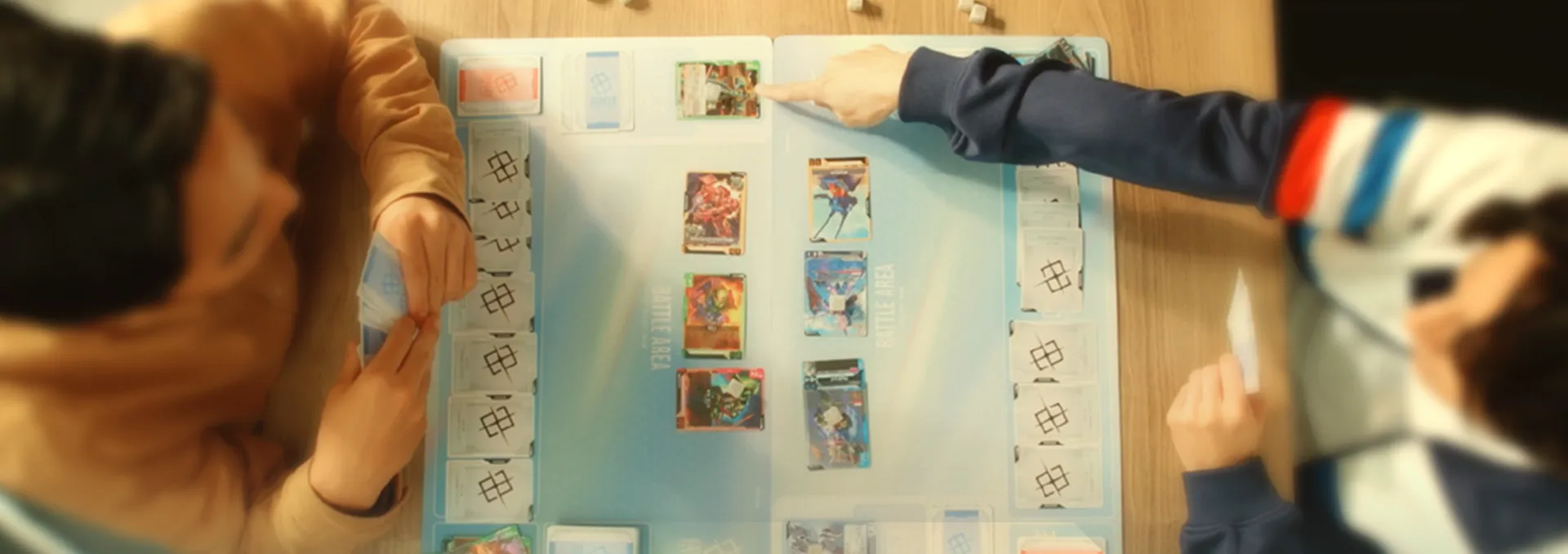
Your six starting Shields are the top six cards of your deck, placed face down one at a time without looking at them (rule 6-2-2). You do not pick them and you cannot reorder them. So the 【Burst】 line on every Base is not a bonus mode you choose - it is a coin your deck flips for you.
Run the standard four copies in a 50-card deck and the chance that at least one of your six opening Shields is a Base is 1 − C(46,6)/C(50,6) = 41.0%. Three copies gives 32.4%. Six copies gives 55.6%. Two of every five games, one of your Bases is already in the shield area before the first turn, and the opponent has to break it to get at anything behind it.
One ruling worth knowing before it costs you a card. Q195 covers a Base flipped by <Suppression>: because <Suppression> destroys its Shields simultaneously, the Shield you add to hand off the Base's 【Deploy】 is the first Shield in your area that was not destroyed. You cannot rescue the one that is already dying.
What Bandai's own decklists run
The official DECKS page carries 41 constructed lists (one page holds two separate 50-card decks). Every one of them runs Bases. None runs fewer than two.
| Bases in the list | Decklists |
|---|---|
| 2 | 2 |
| 3 | 1 |
| 4 | 30 |
| 5 | 3 |
| 6 | 5 |
Thirty of 41 run exactly four, mean 4.20, median 4. Restrict to the 36 standard-format lists - dropping the four Team Battle builds and one Battle Royale build - and it tightens to 29 of 36 at exactly four, mean 4.33, with nothing below four at all.
The three lowest counts in the whole sample are Team Battle lists, and rule 12-3-7 says a team deploys only one Base into their shared base section, which halves what a team needs. It is not a clean rule, though: the fourth Team Battle list, Triple Ship Alliance x AGE 2, runs five.
The most-used Bases across those 41 lists:
| Base | Colour | Statline | Copies | Lists |
|---|---|---|---|---|
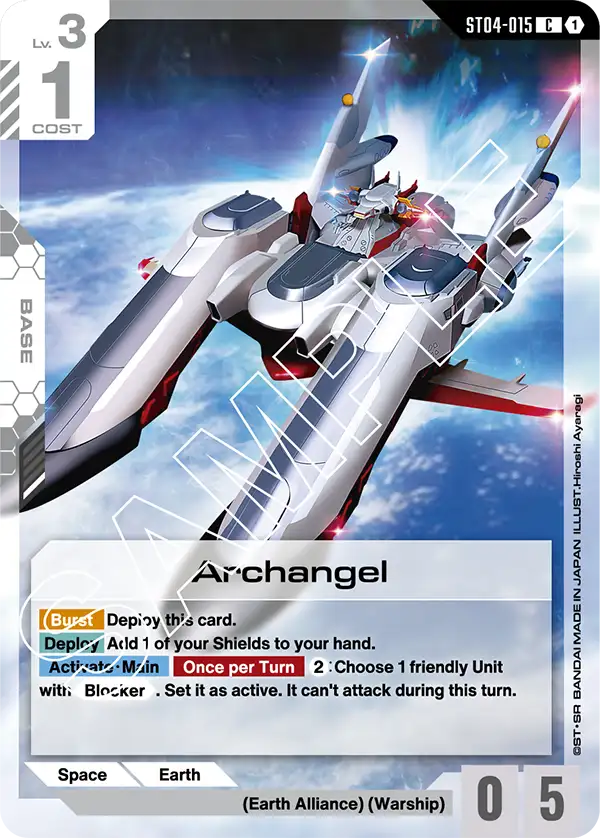
| ST04-015 Archangel | White | Lv. 3, cost 1, 5 HP | 20 | 7 |
| ST09-010 Minerva | Purple | Lv. 2, cost 1, 5 HP | 11 | 3 |
| ST01-015 White Base | Blue | Lv. 3, cost 2, 5 HP | 9 | 3 |
| ST03-015 Rewloola | Red | Lv. 3, cost 2, 5 HP | 8 | 2 |
| ST05-015 Isaribi | Purple | Lv. 3, cost 1, 5 HP | 8 | 2 |
| ST02-016 Corsica Base | Blue | Lv. 3, cost 3, 5 HP | 7 | 2 |
| GD01-124 Side 7 | Blue | Lv. 1, cost 1, 4 HP | 6 | 2 |
| GD03-123 Jupitris | Blue | Lv. 3, cost 1, 5 HP | 6 | 2 |
| EB01-085 Kudelia Aina Bernstein & Isaribi | Blue | Lv. 5, cost 1, 5 HP | 6 | 2 |
| GD02-129 Argama | White | Lv. 3, cost 1, 5 HP | 5 | 2 |
ST04-015 Archangel leads by a distance - 20 copies across seven lists, a common out of SEED Strike [ST04]. Its 【Activate・Main】【Once per Turn】 pays ② to set a friendly <Blocker> Unit active (it cannot attack that turn), which pairs it with the 46 white <Blocker> cards the colour count found.
The tail matters as much as the head: 36 of the 68 Bases appear in at least one official list, and 32 have never appeared in one. Nearly half the card type has never been picked by the people who print it.
The only Base that ever got restricted
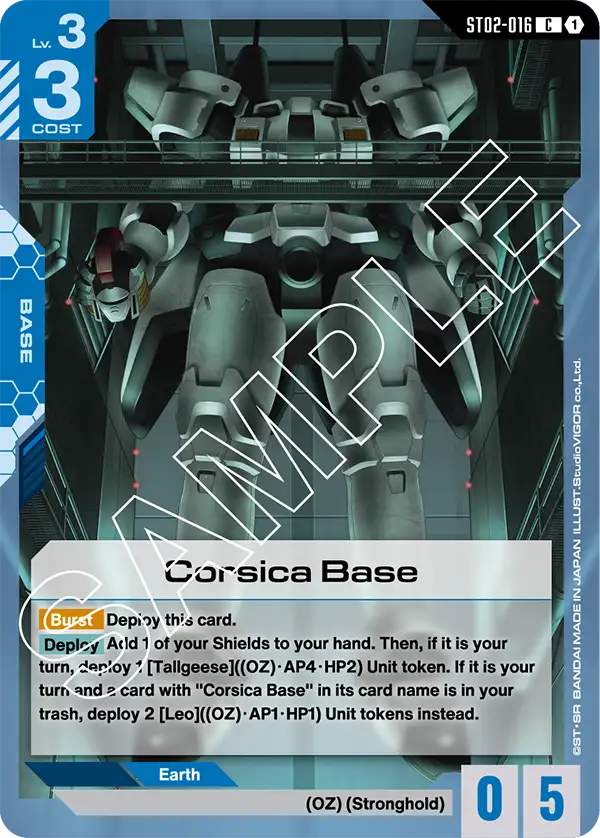
ST02-016 Corsica Base is the only Base Bandai has ever put on its Banned/Restricted list. It has been capped at two copies since the first list took effect on 1 April 2026, and the 24 July 2026 revision made no additions to the restricted column and left it exactly where it was. It is also the only Base in the game that costs 3, and the reason is printed on it: its 【Deploy】 adds a Shield to hand and then, on your turn, deploys a [Tallgeese] Unit token with 4 AP and 2 HP - or two [Leo] tokens instead if a card named Corsica Base is already in your trash.
A 4 AP body off a Base, in a card type where Bases have no AP at all, is a strange thing to print once and a dangerous thing to print four times.
Bandai has not gone back and fixed its own decklists. The ST02 Operation Meteor / OZ list, published 11 July 2025, runs three copies, and the GD03 Blue-Green Cyclops Team Deck, published 30 January 2026, runs four. Both predate the restriction. The ST02 list got an explicit carve-out - the announcement grants that players may still use that starter deck in sanctioned play "so long as no changes are made to its contents" - and nothing similar covers the Cyclops Team list's four copies. If you are copying a list off the DECKS page for an event, check it against the current list first - the tournament rules guide has the full banned and restricted picture, including how the two-copy cap counts across deck and sideboard combined.
What the rest of the card does
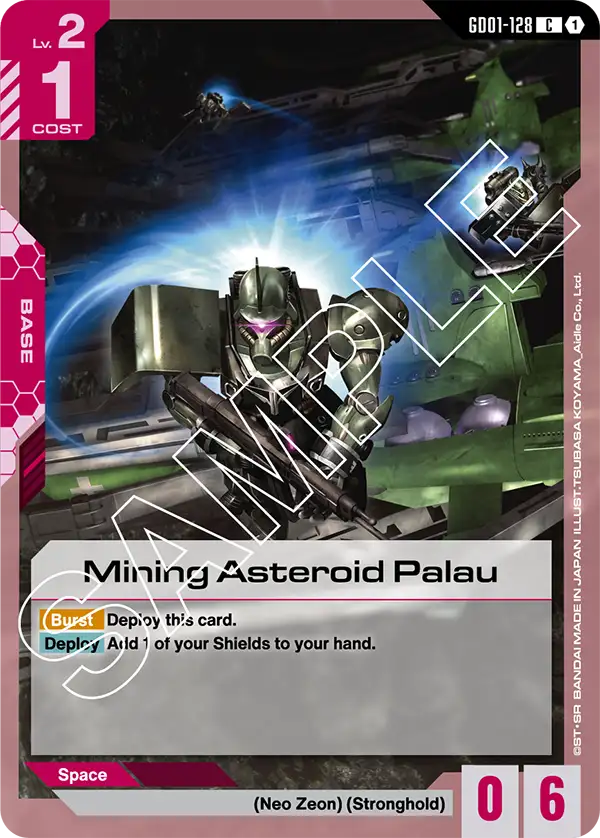
Exactly two of the 68 stop at the template and say nothing else, and they are the same card in two colours: GD01-126 Underground Desert Base and GD01-128 Mining Asteroid Palau, both Lv. 2, cost 1, 6 HP. The two biggest bodies in the game that ask nothing at all of your board.
Everything else adds one of four things:
| What the rest of the card does | Bases |
|---|---|
| Adds a rider to the 【Deploy】 | 26 |
| Continuous or triggered text | 18 |
| An activated ability | 17 |
| A 【Destroyed】 trigger | 5 |
| Nothing else | 2 |
Four of them are worth naming, because they change how the Base gets killed rather than what it does while alive.
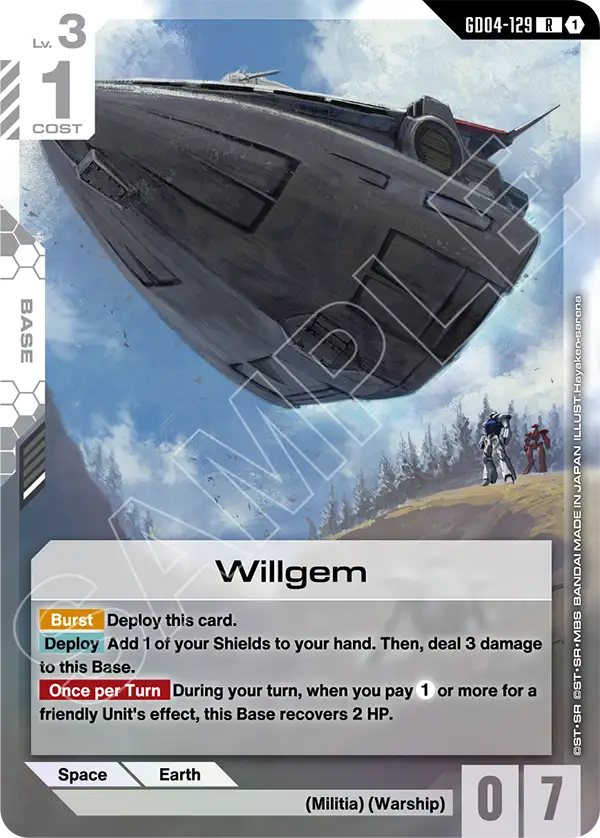
GD04-129 Willgem is the only 7 HP Base in the game, and its own 【Deploy】 reads "Add 1 of your Shields to your hand. Then, deal 3 damage to this Base." It lands at 4. Its 【Once per Turn】 recovers 2 HP whenever you pay ① or more for a friendly Unit's effect during your turn, so the biggest Base in the game is only big in a deck that spends Resources on abilities.
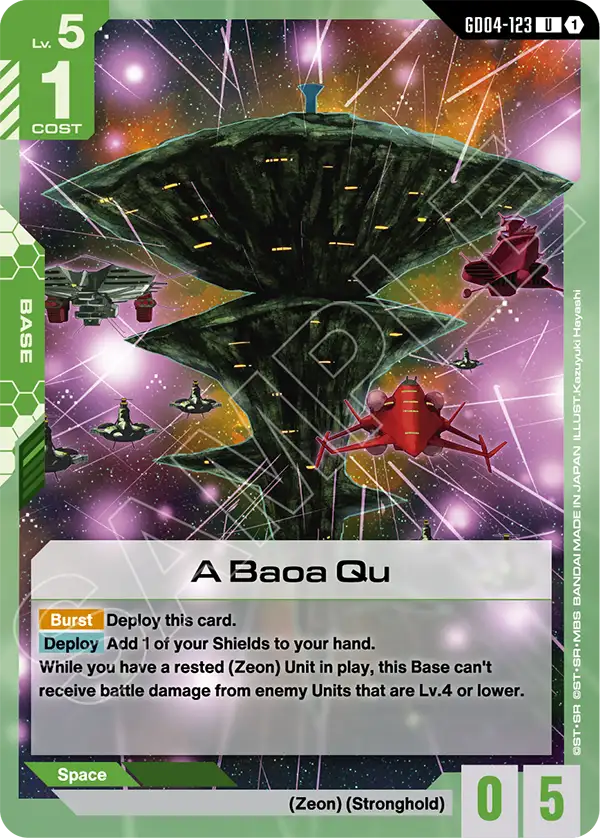
GD02-129 Argama reads "This Base can't receive enemy effect damage" with no condition attached - immunity to <Breach> and to any other enemy effect damage, on a Rare that costs 1. GD04-123 A Baoa Qu blocks battle damage from enemy Units at Lv. 4 or lower while you have a rested (Zeon) Unit in play, and ruling Q295 exists specifically to confirm that <Breach> still gets through it, because <Breach> is effect damage rather than battle damage. ST07-015 Ptolemaios covers both halves - ruling Q204 says its "can't receive damage from enemy Units that are Lv.3 or lower" stops battle damage and effect damage like <Breach>.
Traits are almost binary: 43 of the 68 are (Warship), 24 are (Stronghold), and exactly one is neither - GD03-126 Cyclops Team, which is (Zeon) and (Cyclops Team) and nothing else.
Replacing a Base is not destroying it
Rule 11-5-2 handles the one-Base cap: play a second Base and you choose one already in the section and place it into the trash. Rule 11-5-2-1 adds the important half - "Bases placed into the trash due to this management are not considered to be destroyed" - and ruling Q29 repeats it in plain language.
Two things follow.
Your first real Base of the game trashes the EX Base token you started with. That is 3 HP of soak traded for whatever the new card carries, which is 5 HP in 56 of 68 cases. It is nearly always the right trade, and it is better the more damage the EX Base has already taken, since a fresh Base arrives undamaged.
And the five Bases with a 【Destroyed】 trigger - GD02-126 Shuji's Hideout, GD02-127 Freeden, GD03-132 Radish, GD04-128 Armory One and GD05-130 Presidential Office - do not fire when you overwrite them. Armory One's "All players draw 1" and Radish's rest effect need the Base to actually die. Deploying a replacement on top is how you guarantee you never see them. That whole family of trashed-is-not-destroyed cases is worked through in the rulings deep-dive.
What this count does not tell you
The honest limits. Bandai's DECKS page is promotional content, not a metagame - it tells you what the publisher builds, not what wins. I have no tournament data, so nothing above says Archangel is the best Base, only that Bandai has used it the most.
The counts are 68 distinct Base card numbers as of 20 August 2026, covering GD01 through GD05, EB01 and ST01 through ST10, with parallel art collapsed. GD06 Stardust Trails releases 30 October 2026, bringing Mobile Suit Gundam ZZ and Gundam 0083: Stardust Memory into the game per Bandai's product page, and every number here moves with it. GD02, GD03 and GD04 each printed exactly two Bases per colour, which would put GD06 at ten and the type at 78 - but GD01 printed no purple Base at all and GD05 printed only one purple and one white, so that pattern has already broken twice in five sets.
Frequently Asked Questions
What does a Base do in the Gundam Card Game?
How many Base cards are in the Gundam Card Game?
Do all Gundam Card Game Bases have the same effect?
Can a Base attack in the Gundam Card Game?
How many Bases should a Gundam Card Game deck run?
What is the most-played Base in the Gundam Card Game?
Is any Gundam Card Game Base banned or restricted?
What happens when you play a second Base in the Gundam Card Game?
How likely is a Base to be one of your starting Shields?
Keep Reading
- GUNDAM CARD GAME Official Card Database (68 distinct Base cards, all fields read 20 August 2026)
- Gundam Card Game Comprehensive Rules Ver. 1.8.0, updated 10 July 2026 (Bandai, PDF)
- GUNDAM CARD GAME Official FAQ database (42 entries mentioning Bases, incl. Q29, Q37, Q177, Q195, Q204, Q259, Q295)
- GUNDAM CARD GAME Official DECKS page (41 constructed decklists tallied 20 August 2026)
- GUNDAM CARD GAME Banned/Restricted Cards, effective 24 July 2026
- Gundam Card Game Banned and Restricted Card List, effective 1 April 2026 (ST02-016 Corsica Base restricted to 2; ST02 starter deck exempted as printed)
- Stardust Trails [GD06] product page, releasing 30 October 2026
Related Guides
![The official Gundam Card Game Unit token T-029 Bit / Funnel from Silent Barrage [ST13]: a beige-framed token card showing purple, red-capped bit pods and magenta funnels firing white beams through a blue starfield, with the line This Unit can't be paired with a Pilot or attack, the Long-Range Weapon trait, and 2 AP and 2 HP along the bottom, under a SAMPLE watermark.](/images/blog/gundam-tcg/gundam-card-game-tokens-guide/gundam-t-029-bit-funnel-token-card.webp)
Gundam Card Game Tokens - All 29, and What to Bring
The English card database holds 29 Unit tokens and 32 deck cards that make them, and Bandai's own Aquatic Assault build needs three token cards from a different starter deck. Here is every token, every card that makes one, the six-copy rule, what three Bandai documents say about substitutes, and where the database gets its own tokens wrong.
Gundam Card Game Space and Earth Zones Do Nothing
628 of the 1,078 cards in the Gundam Card Game database print a Zone field reading Space, Earth or both - and not one card in the game refers to it. The Comprehensive Rules give zones two lines and never name the values. The FAQ has no Zone category and no ruling that mentions one. So I counted the whole field anyway: the Unit split, the Base split that inverts it, the trait pattern that explains both, and why the first booster printed 43% of the game's Earth-only Units.
Gundam Card Game Link Units - Every Pilot Pairing, Counted
The link box on GD05-026 Gundam Aerial Rebuild reads [Prospera Mercury] / [Ericht Samaya]. Search the official card database for anything that answers to Ericht Samaya - a Pilot, a Command with a Pilot effect, anything - and you get nothing. Out of 173 distinct link requirements in the game, it is the only one no card can satisfy. I pulled every one of the 892 cards in the official database and mapped the whole link web: which characters have the deepest benches, which Units accept two names, which 35 characters exist only as Commands, and which single Pilot card links with 26 different Units.
Gundam Card Game Colours - I Counted All 892 Cards, and Bandai Has a Colour Pie It Never Published
Thirty-one of the 37 cards whose text carries <Repair> are blue. Twelve of the 14 that carry <Support> are red. Twenty-five of the 52 cards in the game that reach into your own trash are purple - a colour that is only 15% of the card pool. Bandai has never published a colour-identity document for the Gundam Card Game, so I pulled every one of the 892 cards out of the official database and counted. The pie is real, it is sharp, and it decides which two colours you should actually be pairing.
How to Play the Gundam Card Game - Resources, Shields, Pilots, and the Six-Card Life Total
Your entire life total in the Gundam Card Game is six face-down cards with 1 HP each, plus a token base with 3 HP. This is the complete rules walkthrough - the separate resource deck, the Level and Cost split, setup, the five card types, pairing Pilots into Link Units, the five phases, and combat - checked line by line against Bandai's Comprehensive Rules Ver. 1.8.0.
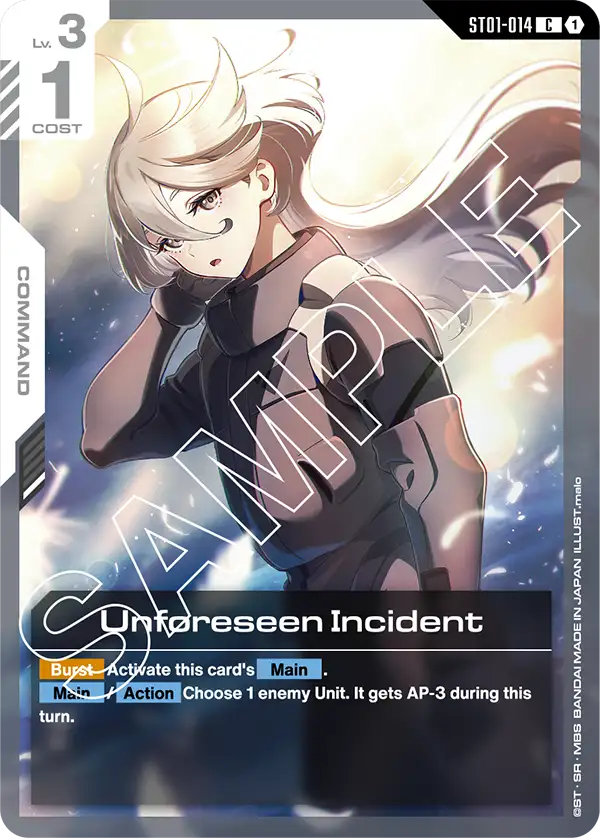
Gundam Card Game Commands - All 145, and When to Play Them
Comprehensive Rules 9-2 makes Command the only card type in the Gundam Card Game you can play out of your hand on someone else's turn, and whether a given Command can is written on one line of the card: 84 of the 145 Commands in the game carry an Action effect, which Bandai's own FAQ says can be played during your action steps or your opponent's. I read the timing line off all 145 of them, then counted what Bandai actually puts in its own 41 decklists - and 15 of those lists run none of it at all.