Gundam Card Game Commands - All 145, and When to Play Them
Comprehensive Rules 9-2 makes Command the only card type in the Gundam Card Game you can play out of your hand on someone else's turn, and whether a given Command can is written on one line of the card: 84 of the 145 Commands in the game carry an Action effect, which Bandai's own FAQ says can be played during your action steps or your opponent's. I read the timing line off all 145 of them, then counted what Bandai actually puts in its own 41 decklists - and 15 of those lists run none of it at all.
Units attack on your turn. Bases sit there. Pilots pair on your turn. Comprehensive Rules 9-2 says a player may do exactly two things during an action step: activate an 【Action】 Command card, and activate an 【Activate・Action】 effect. Only the first of those is a card leaving your hand - which makes Command the one card type in the Gundam Card Game you can put down while your opponent is doing something, and it says so on one line of printed text.
That line is 【Action】, and Bandai's own FAQ defines it without hedging. Q91: "It means that card can be played from your hand during your action steps or your opponent's action steps."
84 of the 145 Command cards in the game carry it. That is the number this article is about, because it is the only lever you have on a turn that is not yours - and because 15 of the 41 decklists Bandai has published contain none of it.
The only cards you can play on someone else's turn
Here is the shape of the card type, before any of the detail.
| Timing printed on the card | Cards | Share of 145 |
|---|---|---|
| 【Main】 only | 61 | 42% |
| 【Main】 and 【Action】 | 55 | 38% |
| 【Action】 only | 29 | 20% |
Fifty-eight percent of Commands can be played at action timing. Forty-two percent cannot, and those 61 are functionally sorcery-speed cards you have to plan a whole turn around.
How I counted
On 30 August 2026 I filtered the official card database at gundam-gcg.com/en/cards/ to card type COMMAND and pulled the detail page for every result. That returns 275 entries; collapsing parallel art down to distinct card numbers leaves 145.
That reconciles with the rest of the pool exactly. The same filter returns 560 Units, 119 Pilots and 68 Bases as distinct card numbers, and 560 + 119 + 145 + 68 is the 892 deck-legal cards the colour count, the Base count and the series count all worked from.
Off each card I read Bandai's printed fields - Lv., cost, colour, rarity, trait, AP, HP, Source Title - and the full rules text, keeping the 【 】 timing keywords intact. Rules citations are Comprehensive Rules Ver. 1.8.0, dated 10 July 2026. Ruling numbers are from the official FAQ. Deck numbers come from the 41 lists Bandai publishes on its own DECKS page.
What a Command actually is
Rule 3-4-1: "When played, Command cards activate their command effects. They are 'Commands' while their command effects are active and 'Command cards' otherwise."
Three consequences worth having straight before you argue about one across a table.
A resolving Command is nowhere. Rule 3-4-3 says Commands with active command effects "are not considered to be located within any specific game location until those effects end," and 4-1-2 repeats it. It is not in your hand, not on the field, not in the trash. Nothing that counts cards in a location sees it mid-resolution.
It hits the trash afterwards, not before. Rule 3-4-4. If the effect cares how many cards are in your trash, the Command itself is not one of them yet.
No legal target, no play. Rule 10-1-8-1-1: "If a command effect requires choosing a target, playing that Command card is not possible if that target cannot be chosen." You cannot fire a removal Command into an empty board to dig it out of your hand. 10-1-8-1-2 extends that to the first half of any effect chained with "Then" or "If you do."
Every one of the 145 has a dash in its Zone field and a dash in its Link field. None of them has an AP or HP value of its own - the 64 that print AP and HP print them as Pilot modifiers, which is the next section but one.
Two keywords, two windows
【Main】 and 【Action】 are not difficulty settings. They are two different clocks.
Rule 13-2-3-1 defines 【Main】 as a command effect "that can be activated by playing the card during your main phase while no Units are attacking." Note the second half. A Main Command is locked out the moment you declare an attack and does not come back until the battle ends.
Rule 13-2-4-1 defines 【Action】 as playable "during an action step" - and rule 9-1 says exactly where those are: "An action step occurs after the block step and during the end phase."
So the number of action-timing windows in a turn is one per attack, plus one in the end phase.
| Window | What you can play | Rule |
|---|---|---|
| Main phase, nobody attacking | 【Main】 only | 13-2-3-1 |
| Action step, one per attack, after the block step | 【Action】 only | 8-1, 8-4-1, 9-1 |
| Action step, first step of the end phase | 【Action】 only | 7-6-1, 7-6-3-1, 9-1 |
Two details inside an action step decide most of the close ones.
The defender moves first. Rule 9-3: the standby player chooses to act or pass before the active player does (9-4). Then it alternates until both pass consecutively (9-4-2, 9-5). If you are attacking into an open board, the person you are attacking gets the first word.
It is after blocks, not before. Rule 8-1 fixes the order: attack step, block step, action step, damage step, battle end step. <Blocker> resolves in the block step (8-3-1), so by the time anyone can play an 【Action】 Command the blocker is already declared and rested. You are pumping or removing a known matchup, not guessing at one.
The timing split: 61, 55, 29
The 55 dual-timing cards are the ones that matter for deck slots, because they cost you nothing to hold. Rule 13-2-4-3 and FAQ Q92 both confirm the obvious reading: a card printing 【Main】/【Action】 can be played at either time, your choice, every time.
GD02-101 Beneath the Mask is the clean example - Lv. 1, cost 1, blue, "Choose 1 to 2 enemy Units that are Lv.2 or lower. Rest them," playable in your own main phase or in the middle of someone else's attack.
The 29 Action-only cards are the interesting ones, because they are dead in your main phase. You cannot cash them in for tempo when the game is quiet. They are held or they are wasted, and 17 of those 29 have a second life the other 12 do not - see the Pilot-Command section.
Level and cost are close together on this card type but not identical: 18 of the 145 have Lv. equal to cost. The rest ask you to be further into the game than the Resources they rest. Two cards share the widest gap in the set, GD01-112 Extreme Hatred and GD03-110 Eliminate Target, both Lv. 6 for a cost of 1.
Which colours get to interrupt
The colour breakdown established what the five colours do. This is where they are allowed to do it.
| Colour | Commands | With 【Action】 | 【Main】 only | Action share |
|---|---|---|---|---|
| Red | 28 | 20 | 8 | 71% |
| White | 32 | 22 | 10 | 69% |
| Blue | 30 | 17 | 13 | 57% |
| Purple | 23 | 13 | 10 | 57% |
| Green | 32 | 12 | 20 | 38% |
Green has the joint-largest Command count in the game and the smallest number of them it can play on your turn. Twenty of its 32 are Main-only. Red has four fewer Commands than green and eight more that work at action timing.
That is consistent with what those two colours do elsewhere in the pool - green is the colour of EX Resource and acceleration, which is a main-phase activity, and red is the colour of damage, which is a combat activity - but the timing line is where it becomes a constraint rather than a flavour note. A green deck that expects to hold up interaction is holding up twelve possible cards.
The Pilot-Command trap
64 of the 145 Commands print a 【Pilot】 effect on the bottom half. Rule 3-4-6-2: when played, such a card "can be paired with a Unit as a Pilot instead of activating its command effect." The Link Unit map covers which Units those 64 pair with; this is about when you are allowed to make the choice.
You are not always allowed to make it. Rule 13-2-4-2:
"You cannot pair a Command card with a 【Pilot】 effect as a Pilot during an action step."
Read that against the timing split and a specific group of cards falls out. 17 of the 64 Pilot-Commands are Action-only - their command effect cannot be played in your main phase at all. Which means the card is exactly one thing in each window: a Pilot in your main phase, a Command in an action step, and never both.
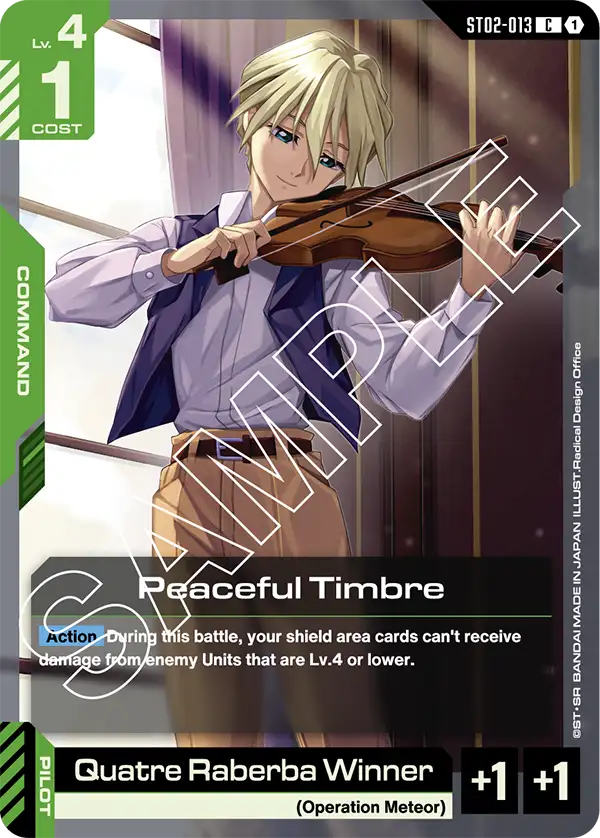
ST02-013 Peaceful Timbre is the card Bandai's own FAQ picks to explain this family (Q163: it "is only treated as a Pilot while in the battle area paired with a Unit"). It is Quatre Raberba Winner at +1/+1 in your main phase, and in an action step it is "During this battle, your shield area cards can't receive damage from enemy Units that are Lv.4 or lower."
All 17 of the Action-only Pilot-Commands cost 1:
| Card | Colour | Lv. | Pilot |
|---|---|---|---|
| Assault on Torrington Base [GD01-114] | Red | 1 | Yonem Kirks |
| Unheralded Attack [GD03-121] | White | 1 | Katz Kobayashi |
| Persistent and Fortudinous [GD02-119] | White | 2 | Carta Issue |
| Valedictorian [GD02-105] | Green | 2 | Xavier Olivette |
| Veteran Tactics [GD03-122] | White | 2 | Sergei Smirnov |
| Aspiring Pilot [GD02-120] | White | 3 | Fa Yuiry |
| At the Risk of One's Life [GD05-104] | Blue | 3 | Helen Jackson |
| Diffuse Beam Cannon [ST10-015] | White | 3 | Claire Heathrow |
| Distant Reunion [GD03-115] | Purple | 3 | Yurin L'Ciel |
| Felsi's Plea [GD05-109] | Green | 3 | Felsi Rollo |
| Fierce Unity [ST06-013] | Green | 3 | Ortega (GQ) |
| Heart Set on Revenge [GD02-118] | White | 3 | Ein Dalton |
| Overcoming Hardships [GD05-108] | Green | 3 | Guel Jeturk |
| White Wolf [GD02-106] | Green | 3 | Woolf Enneacle |
| Peaceful Timbre [ST02-013] | Green | 4 | Quatre Raberba Winner |
| The Blue Giant [ST03-014] | Green | 4 | Ramba Ral |
| A Wind Against Fires [GD05-119] | White | 5 | Zechs Merquise |
Seven of the seventeen are green, tied with white, and green is the colour that otherwise gets the least action timing. That is worth knowing if you are building green: a good share of your interaction is stapled to cards you may already be counting as Pilots.
Commands are cheap, and Pilots are why
107 of the 145 Commands cost 1. That number looks like a design statement until you split it by whether the card is also a Pilot.
| Cost | Pilot-Commands | Pure Commands | Total |
|---|---|---|---|
| 1 | 62 | 45 | 107 |
| 2 | 2 | 21 | 23 |
| 3 | 0 | 9 | 9 |
| 4 | 0 | 3 | 3 |
| 6 | 0 | 2 | 2 |
| 10 | 0 | 1 | 1 |
Every Pilot card in the game costs 1 - that is the finding in the deckbuilding guide - and the Pilot-Commands almost all follow the Pilot price. Only two break it: GD01-106 Fortress Defense and GD02-113 Sisterly Care, both cost 2.
Strip those 64 out and the pure Commands look far less uniform: 45 at cost 1, 21 at cost 2, and 15 spread from 3 up to 10.
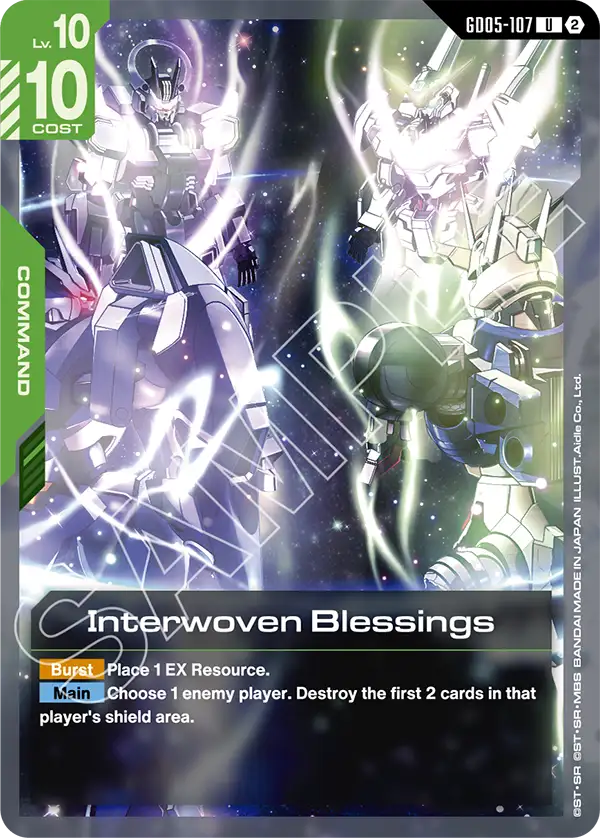
The 10 is GD05-107 Interwoven Blessings, Lv. 10 for a cost of 10, which is more Level than any other Command in the set asks for. Its 【Main】 destroys the first two cards in an enemy shield area. It also prints a 【Burst】 that places an EX Resource - which is to say the card is designed to be more useful sitting in your shield area than in your hand, because reaching ten Resources means the game has gone very long indeed.
No Command has ever been a Legend Rare
Every one of the 145 is Common, Uncommon or Rare: 73 C, 39 U, 33 R. Filtering the database for COMMAND at each higher grade returns nothing at all.
That is not a quirk of Commands. It is where Bandai puts its top rarities, across the whole pool:
| Card type | Legend Rare | Link Rare family | Promo (P) |
|---|---|---|---|
| Unit | 87 | 12 | 0 |
| Pilot | 1 | 0 | 1 |
| Command | 0 | 0 | 0 |
| Base | 0 | 0 | 0 |
| Resource | 0 | 0 | 66 |
Legend Rare is a Unit slot with one exception. The Link Rare family - LKC, LKU and LKR, which the rarity guide explains as parallels that encode a base rarity - is Units only. And the P bucket is almost entirely Resource cards, plus the EX Base and EX Resource promo tokens.
The practical version: no Command card is a chase card. Commands do appear with alternate art (275 database entries against 145 card numbers), but the rarity stamp in the corner never goes past R. If you are buying singles to finish a deck, the interaction is the cheap part.
There is one more list a Command has never appeared on. Bandai's Banned/Restricted page, dated 24 July 2026, names GD01-020 Anksha as banned and ST02-016 Corsica Base as restricted to two, plus a set of banned pairs. None of the card numbers on that page is a Command. The tournament rules guide has the full list.
Burst, and the line Bandai does not cross
45 of the 145 Commands print a 【Burst】 effect - the thing that fires for free when the card is sitting in your shield area and a Shield gets destroyed (rule 13-2-5-1). Blue has the most at 12, then white 11, purple 9, green 7, red 6.
Now the part that is a rule in everything but name. Not one of the 64 Pilot-Commands has a 【Burst】. All 45 are in the 81-card pure-Command group. A card in this game is allowed to be a Command and a Pilot, or a Command and a Burst, and so far never all three.
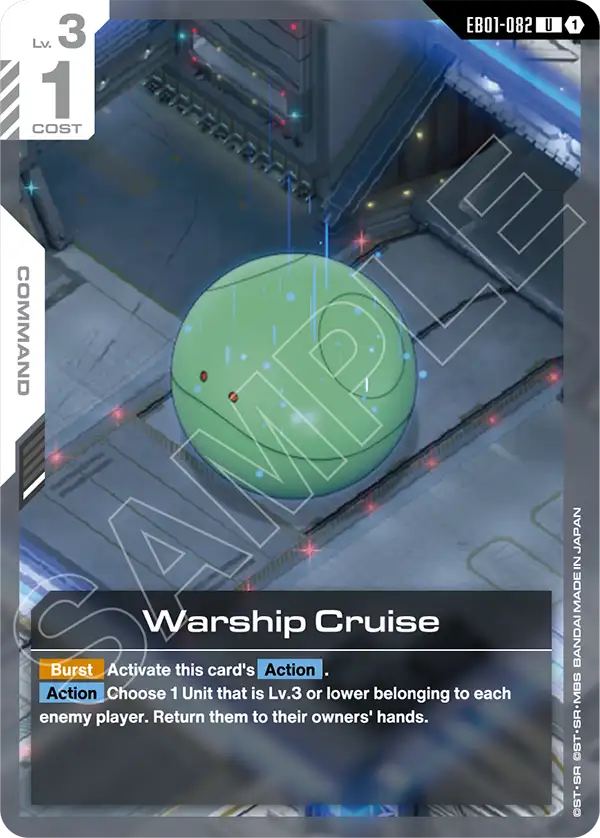
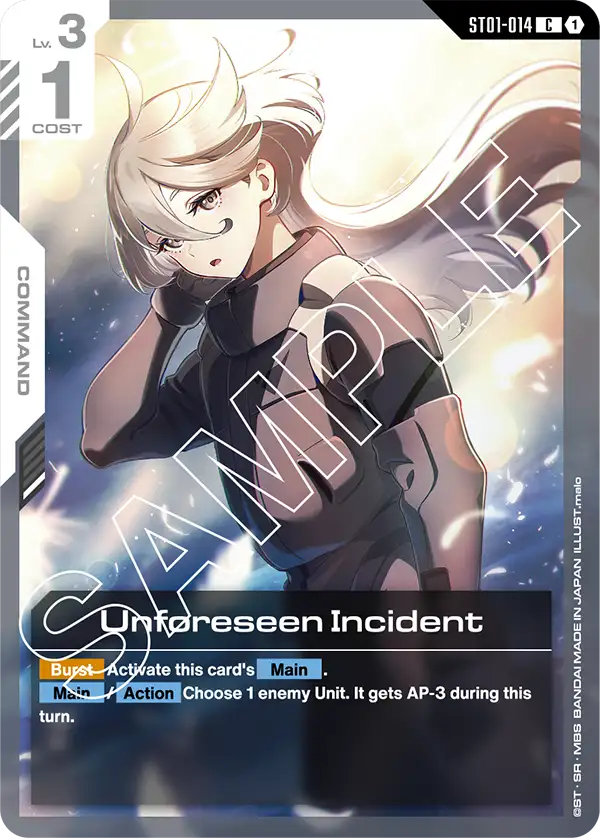
The neatest use of the keyword is the self-reference. EB01-082 Warship Cruise reads "【Burst】Activate this card's 【Action】," and ST01-014 Unforeseen Incident - the hero image at the top - does the same trick with its 【Main】. A Shield that breaks turns straight into the card you would have paid for.
One published limit on that, from the FAQ rather than from inference. Q83: a card taken off your shield area into your hand by an effect does not get to Burst. The card has to be destroyed as a Shield. All 68 Base cards in the game open the same two lines - "【Burst】Deploy this card," then "【Deploy】Add 1 of your Shields to your hand" - so a Base can pull a Burst Command into your hand and pay you nothing for it.
What Bandai's own decklists run
Bandai publishes 41 decklists across 40 pages on its DECKS site - one page carries two lists - and all 41 are exactly 50 cards. Counting every card in them whose card type is COMMAND:
| Commands in the list | Lists |
|---|---|
| 2-4 | 13 |
| 5-7 | 10 |
| 8-10 | 13 |
| 11-15 | 4 |
| 16-20 | 1 |
Median 6, mean 6.9, range 2 to 20. Against a 50-card deck that is a median of 12% of the list, and it lines up with the 6.3 average the deckbuilding guide found in the seven most recent lists.
The action-timing number is the one worth staring at. Across all 41 lists there are 284 Command copies, and only 120 of them carry 【Action】. Fifteen of the 41 lists contain no action-timing Command at all - not one card that can be played on the opponent's turn. Twenty-six run at least one; the deepest is Bandai's "Ξ Gundam x Qubeley (Team Battle Version)" at 13.
The 41 lists between them use 52 distinct Commands out of the 145 available. Ten of those do most of the work:
| Card | Colour | Lv. / cost | Timing | Copies | Lists |
|---|---|---|---|---|---|
| Overflowing Affection [GD01-118] | White | 2 / 1 | Main | 35 | 10 |
| Unforeseen Incident [ST01-014] | White | 3 / 1 | Main / Action | 14 | 5 |
| Striker Pack [ST04-012] | White | 4 / 2 | Main | 12 | 4 |
| Awakened Potential [GD03-118] | White | 4 / 1 | Action | 12 | 3 |
| Fatal Strike [ST05-014] | Purple | 4 / 2 | Main | 10 | 4 |
| Awakened Power [GD02-110] | Purple | 6 / 2 | Main | 10 | 4 |
| A Show of Resolve [GD01-100] | Blue | 4 / 3 | Main | 9 | 5 |
| Battle of Aces [GD01-111] | Red | 3 / 2 | Main / Action | 9 | 3 |
| Siege Ploy [ST02-014] | Blue | 3 / 1 | Main / Action | 8 | 3 |
| Close Combat [ST03-013] | Red | 2 / 2 | Main / Action | 8 | 2 |
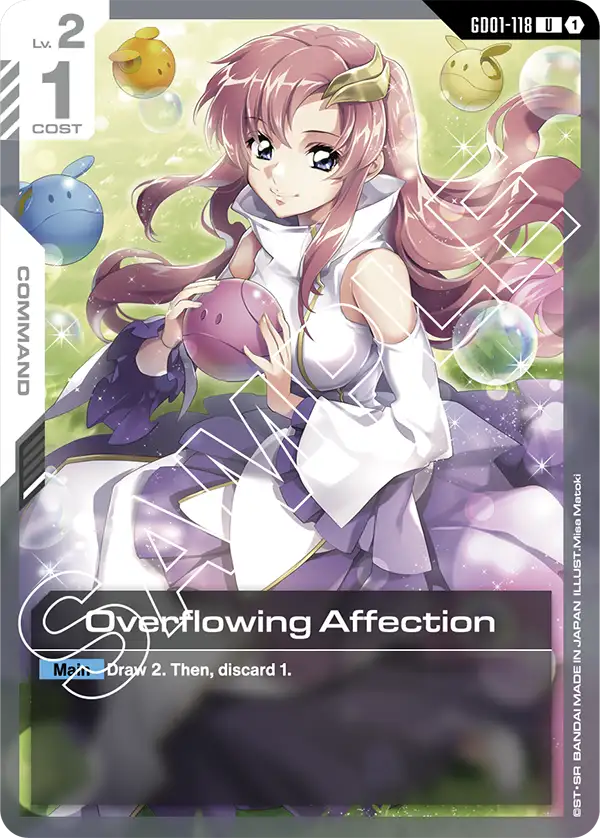
The most-played Command in Bandai's own lists is a cost 1 "Draw 2. Then, discard 1." with no timing flexibility and no interaction whatsoever, at 35 copies across 10 lists. Six of the ten are white or blue, and five of the ten are Main-only.
One honest caveat on this table: Bandai's decklists are pictures of cards with copy counts, so a Pilot-Command in a list is counted here by its printed card type, not by which half the deck's designer intended to use. The 64 dual cards are ambiguous by construction.
The rulebook sends you to the wrong page
If you go to the Comprehensive Rules to check any of this, the Commands section will send you somewhere useless. Rule 3-4-5 - the rule that introduces 【Main】 and 【Action】 - ends "(See 12-2. Keywords)". Section 12-2 is battle royale rules for multiplayer games. Keywords are section 13-2. Rule 3-4-7, on Burst, ends "(See 12-2-5. 【Burst】)". 12-2-5 is the paragraph on winner-takes-all versus last-player-standing. Burst is 13-2-5.
It is not confined to the Commands section. Ver. 1.8.0 contains 30 parenthetical cross-references; I checked each against the section it names, and 11 point at a number lower than the target:
| Rule | Points to | Should be |
|---|---|---|
| 2-7-1 | 7. Attacking and Battles | 8 |
| 3-4-5 | 12-2. Keywords | 13-2 |
| 3-4-7 | 12-2-5. Burst | 13-2-5 |
| 5-5-1 | 5-17. Counters | 5-18 |
| 5-10-3 | 12-2-5. Burst | 13-2-5 |
| 8-4-1 | 8. Action Steps | 9 |
| 8-5-2-3-1 | 12-2-5. Burst | 13-2-5 |
| 8-5-2-4-2 | 12-1-5. First Strike | 13-1-5 |
| 8-6-2 | 6-5. Main Phase | 7-5 |
| 13-2-1-1 | 9-1-7 | 10-1-7 |
| 13-2-2-1 | 9-1-7 | 10-1-7 |
The other 19 are correct, and the document gets the same reference right elsewhere more than once - 8-4-1 points to "8. Action Steps" while 7-6-3-1 points to "9. Action Steps," for the identical section. The rules text itself is fine; only the signposting is off. Look up the section by its title in the table of contents rather than by the number a rule hands you.
What this count does not tell you
A count is not a metagame. I have no tournament results for this game. Fifty-eight percent of Commands being playable at action timing says nothing about whether holding them up beats deploying a Unit, and nothing in a database says which of the 145 is good.
Fifteen zero-interaction decklists are Bandai's teaching material, not a verdict. Most of those 41 lists are published to sell a product - they show off a starter deck or a new booster's archetype. They are evidence of what Bandai builds, not of what wins.
Six dated products are coming and none has a card list. Four starter decks land first - Aquatic Assault [ST11], Raging Onslaught [ST12], Silent Barrage [ST13] and Heavy Dominion [ST14], all on 25 September 2026, each a ready-to-play 50-card deck. Stardust Trails [GD06] follows on 30 October 2026 and Blazing Fist [GD07] on 29 January 2027. Bandai has published card data for none of the six, and the ten ST decks already in the pool contribute 25 of the 145 Commands between them - so every number above is a snapshot, and the first table to move moves on 25 September, not in October.
All counts are 145 distinct deck-legal Command card numbers as of 30 August 2026, covering GD01 through GD05, EB01 and ST01 through ST10, parallel art collapsed.
Frequently Asked Questions
How many Command cards are in the Gundam Card Game?
Can you play a Command card on your opponent's turn in the Gundam Card Game?
What is the difference between Main and Action on a Gundam Card Game Command?
Can you pair a Pilot-Command as a Pilot during an action step?
How many Commands should a Gundam Card Game deck run?
Are there any rare or banned Command cards in the Gundam Card Game?
Keep Reading
- GUNDAM CARD GAME Official Card Database - card type COMMAND filter (275 entries, 145 distinct card numbers; Lv., cost, colour, rarity, trait and rules text read off each detail page, 30 August 2026)
- Gundam Card Game Comprehensive Rules Ver. 1.8.0, updated 10 July 2026 (Bandai, PDF) - 3-4 Commands, 7-6 End Phase, 8-1 to 8-6 Attacking and Battles, 9 Action Steps, 10-1-8 Command Effects, 13-2-3 to 13-2-5 Main / Action / Burst
- GUNDAM CARD GAME official FAQ, Command category - Q90 (Main), Q91 (Action can be played on your opponent's action steps), Q92 (Main/Action is either), Q163 (when a Pilot-Command counts as a Pilot)
- GUNDAM CARD GAME official FAQ, Burst category - Q80 to Q83, incl. Q83: a Shield added to your hand cannot activate its Burst
- GUNDAM CARD GAME Official DECKS page - 41 published 50-card decklists across 40 pages, source for the Command counts and most-used table
- GUNDAM CARD GAME Banned/Restricted Cards, 24 July 2026 - GD01-020 Anksha banned, ST02-016 Corsica Base restricted to two, plus banned pairs; no Command card listed
Related Guides
Gundam Card Game Series - All 20, and Which Are Buildable
Gundam 00 has 65 cards in the Gundam Card Game and Gundam Wing has 50 - and Wing is the far easier deck to build, because all 50 Wing cards sit inside one legal colour pair and Gundam 00 is split across four colours. Card count is not the number that decides whether your favourite series is playable. I read the Source Title field off all 892 deck-legal cards and worked out which of the 20 series survive contact with the two-colour rule.
Gundam Card Game Bases - All 68 Counted, and Which to Run
Every Base card in the Gundam Card Game opens with the same two lines. Not most of them - all 68, across five colours and sixteen products, with zero exceptions. That template is why the Base slot is not the throwaway it looks like, and the whole type tops out at Rare - no Base has ever been printed above it. I pulled all 68 out of the official database and cross-referenced them against 41 decklists Bandai published itself.
Gundam Card Game Colours - I Counted All 892 Cards, and Bandai Has a Colour Pie It Never Published
Thirty-one of the 37 cards whose text carries <Repair> are blue. Twelve of the 14 that carry <Support> are red. Twenty-five of the 52 cards in the game that reach into your own trash are purple - a colour that is only 15% of the card pool. Bandai has never published a colour-identity document for the Gundam Card Game, so I pulled every one of the 892 cards out of the official database and counted. The pie is real, it is sharp, and it decides which two colours you should actually be pairing.
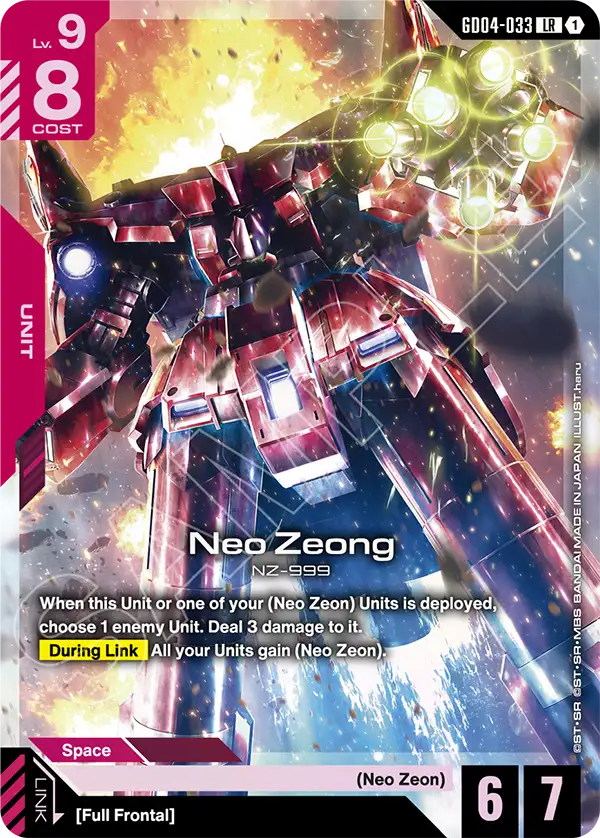
Gundam Card Game Space and Earth Zones Do Nothing
628 of the 1,078 cards in the Gundam Card Game database print a Zone field reading Space, Earth or both - and not one card in the game refers to it. The Comprehensive Rules give zones two lines and never name the values. The FAQ has no Zone category and no ruling that mentions one. So I counted the whole field anyway: the Unit split, the Base split that inverts it, the trait pattern that explains both, and why the first booster printed 43% of the game's Earth-only Units.
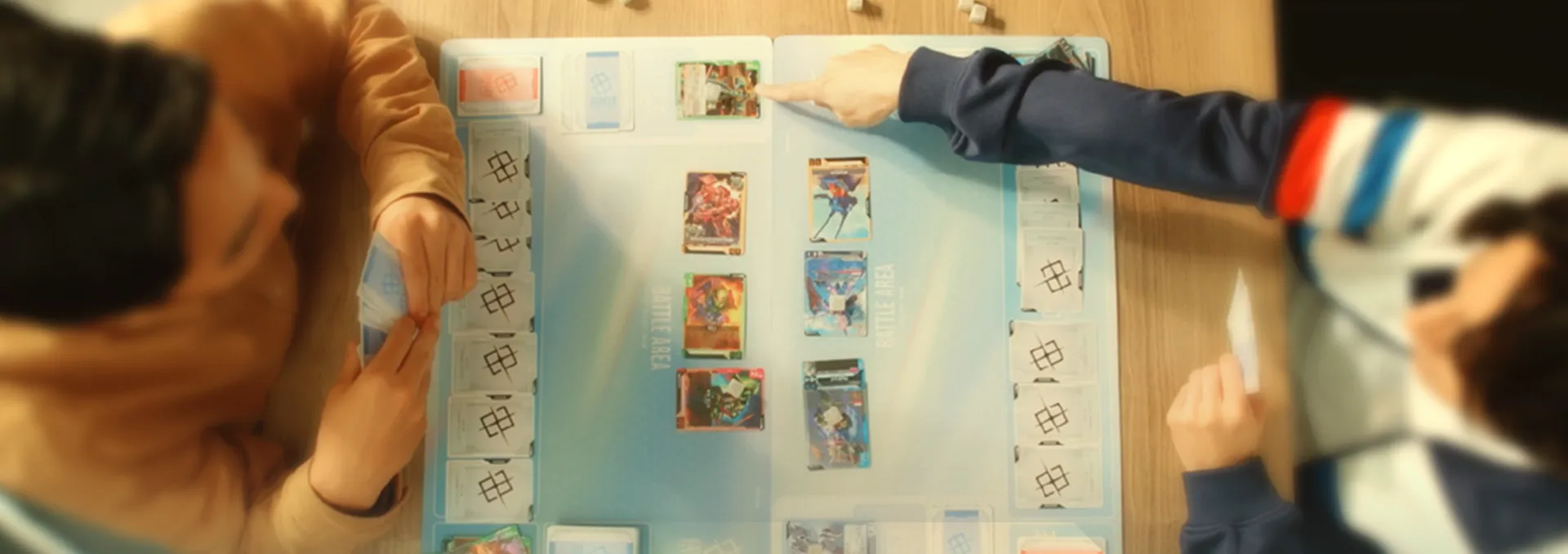
How to Play the Gundam Card Game - Resources, Shields, Pilots, and the Six-Card Life Total
Your entire life total in the Gundam Card Game is six face-down cards with 1 HP each, plus a token base with 3 HP. This is the complete rules walkthrough - the separate resource deck, the Level and Cost split, setup, the five card types, pairing Pilots into Link Units, the five phases, and combat - checked line by line against Bandai's Comprehensive Rules Ver. 1.8.0.
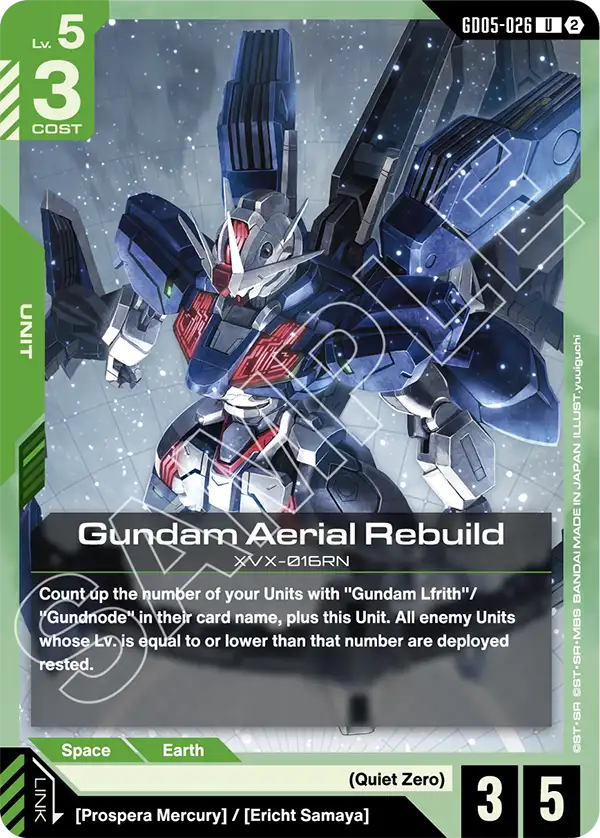
Gundam Card Game Link Units - Every Pilot Pairing, Counted
The link box on GD05-026 Gundam Aerial Rebuild reads [Prospera Mercury] / [Ericht Samaya]. Search the official card database for anything that answers to Ericht Samaya - a Pilot, a Command with a Pilot effect, anything - and you get nothing. Out of 173 distinct link requirements in the game, it is the only one no card can satisfy. I pulled every one of the 892 cards in the official database and mapped the whole link web: which characters have the deepest benches, which Units accept two names, which 35 characters exist only as Commands, and which single Pilot card links with 26 different Units.