Disney Lorcana Inks Explained: What Amber, Amethyst, Emerald, Ruby, Sapphire and Steel Do
Lorcana gives you six inks and lets you pick two. Here is what each ink actually owns mechanically - counted from the card pool through Set 13, not vibes - and why pairing inks in Lorcana costs you nothing.
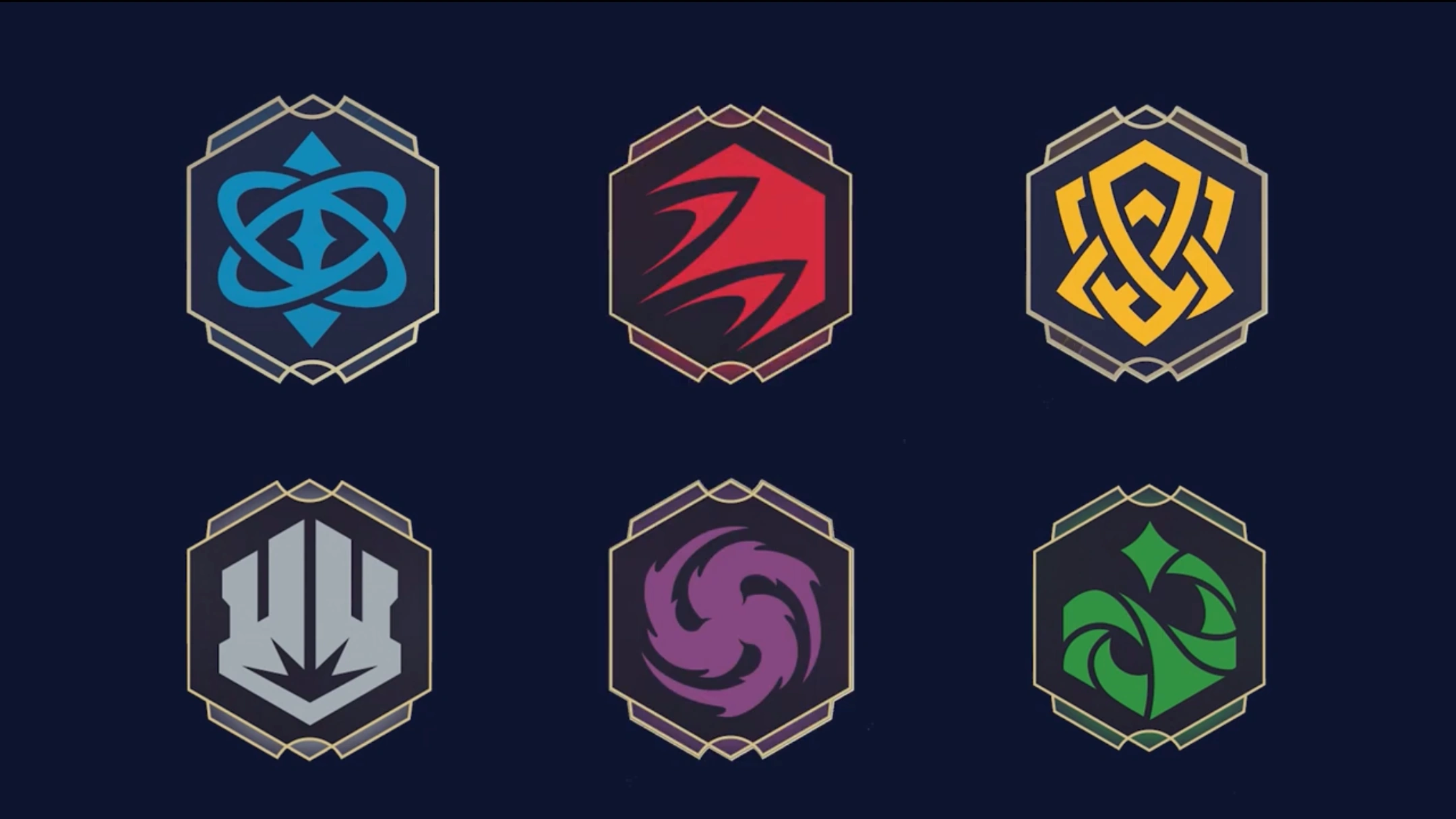
Six inks. Pick two. That is the entire colour restriction in Disney Lorcana, and it is the most important sentence in the rulebook that nobody explains properly.
Here is the version that actually helps: your two inks decide what tools you get, and nothing else. They do not decide whether your deck functions. That is a genuinely different design from every other big TCG, and it changes how you should think about picking a pair.
Ink is a deck rule, not a mana rule
Lorcana has six inks - Amber, Amethyst, Emerald, Ruby, Sapphire and Steel - and the official deckbuilding rules are short: at least 60 cards, no more than four copies of any one full card name, and no more than two inks. There is no maximum deck size, though basically everybody plays exactly 60 because a fatter deck is a less consistent one.
The part people coming from Magic keep tripping over is the inkwell. Once a turn you may put one card from your hand face down into your inkwell, and only cards with the inkwell symbol in their border are eligible. Once it is in there, that ink is generic. A face-down Ruby card pays for a Sapphire card just fine. There is no such thing as being colour-screwed in Lorcana.
That is the whole thesis of this guide. In Magic, the colour pie is enforced twice - once by what each colour may do, and again by whether your lands produce the right symbols. Lorcana enforces it once. A second ink here carries none of the mana-base tax a two-colour Magic deck pays, and none of the resource strain Braverse colours put on your Support Area. The two-ink limit exists purely to stop you jamming the six best cards in the game into one pile.
So the question is never "can I afford this ink?" It is always "what does this ink give me that my other one cannot?" If you have not learned the turn structure yet, go read how to play Disney Lorcana first - the rest of this assumes you know what questing, challenging and lore are.
The six inks at a glance
Ravensburger has been unusually even-handed. As of Set 13, Attack of the Vine!, the inks sit at Amethyst 442 cards, Amber 441, Ruby 441, Emerald 439, Steel 439 and Sapphire 438 - a six-card spread across a three-year card pool. What separates them is which keywords and effects they get.
| Ink | Owns | Signature keywords | Plays like |
|---|---|---|---|
| Amber | Songs, healing, sticky bodies | Singer, Bodyguard, Support | Resilient tempo |
| Amethyst | Card draw, bounce, tricks | Evasive, Challenger, Rush | Flexible midrange |
| Emerald | Hand attack, evasion | Evasive, Ward | Disruptive tempo |
| Ruby | Speed and raw attack | Rush, Reckless, Evasive | Aggro |
| Sapphire | Ramp, items, card quality | Ward, Support | Ramp control |
| Steel | Damage-based removal, big stats | Resist, Bodyguard, Challenger | Grindy midrange |
Unless a line says otherwise, every number below is counted from Lorcast's card data through Set 13, not lifted from a marketing blurb.
Amber: songs, support and characters that refuse to die
Ravensburger describes Amber glimmers as purposeful, patient and dedicated, with an emphasis on community and healing. Mechanically that shakes out as the ink of songs, teamwork and characters that are extremely annoying to remove.
Amber has 28 of the game's 119 Song cards - more than any other ink - and 25 of the 29 main-set characters with the Singer keyword, which lets a character sing a song for free instead of paying its cost. It also anchors Bodyguard alongside Steel, with 32 of the 59 Bodyguard cards, and shares the Support keyword with Sapphire.
The stat line tells the same story. Amber characters have the lowest average Strength in the game at 2.40, but a well-above-average Willpower of 3.98. Amber is not built to kill your board. It is built to stand there, absorb challenges, and keep questing. Amber also has almost no direct removal - just eight cards that banish a chosen character, second-lowest in the game.
Verified examples: Stitch - Rock Star (6 ink, 3 Strength, 5 Willpower, 3 lore), Moana - Of Motunui (5 ink, 1 Strength, 6 Willpower, 3 lore) and Rapunzel - Gifted with Healing.
Play Amber if you want your board to stay on the table and your lore total to climb every turn while the opponent flails at it.
Amethyst: card draw, Evasive bodies and magic tricks
Amethyst is the magic ink - Ravensburger's line is that these are characters fond of using magic to get what they want - and in practice it is the best card-draw ink and the most keyword-flexible one.
Amethyst appears on 62 of the 214 cards whose text includes drawing a card, the highest of any ink. It has the most Evasive characters (48 of 134), 22 of the 38 Challenger cards, and 23 Rush characters, second only to Ruby. It is also the ink of bouncing characters back to hand to re-use their enter-play abilities.
The catch: Amethyst is almost completely locked out of hard removal. Exactly one card in the entire Amethyst pool banishes a chosen character. If an Amethyst deck needs something dead, it challenges it down or brings the other ink.
Verified examples: Madam Mim - Purple Dragon (7 ink, Evasive, 4 lore), Elsa - Spirit of Winter (8 ink, 4 Strength, 6 Willpower, 3 lore) and Merlin - Goat.
Play Amethyst if you like having options every turn and you are comfortable solving problems by out-drawing them rather than out-shooting them.
Emerald: hand attack and slippery questers
Emerald is the ink Ravensburger calls flexible and quick-thinking, and it is the only ink that attacks a resource nobody else touches: your opponent's hand.
Of the 30 cards in the game that make an opponent choose and discard, 26 are Emerald. That is 87 percent of an entire effect category living in one ink. Emerald also splits Ward - which stops opponents choosing your character for effects - almost evenly with Sapphire, 27 cards to Sapphire's 28, and has 47 Evasive characters, functionally tied with Amethyst for the most.
Emerald characters also have the highest average lore value in the game at 1.64, narrowly ahead of Sapphire. Pair high lore with Evasive - which means only other Evasive characters can challenge them - and you get Emerald's real plan: land a hard-to-answer body, quest with it every turn, and strip the answers out of the opponent's hand.
Verified examples: Prince John - Greediest of All (3 ink, Ward, 2 lore), Belle - Hidden Archer (5 ink, 3 lore) and Flynn Rider - Charming Rogue.
Play Emerald if you enjoy winning the game by making the opponent's cards not matter.
Ruby: speed, Rush and the biggest attack numbers
Ruby is aggression, and unusually for a TCG the numbers back the flavour text exactly. Ruby characters have the highest average Strength at 3.45 and the lowest average lore at 1.30. That trade is the ink in one line: Ruby glimmers hit hard and quest badly.
Ruby owns Rush, which lets a character challenge the turn it is played, with 28 of the 52 Rush cards. It owns Reckless outright - all 20 Reckless cards in the game are Ruby or a Ruby dual-ink card - which forces the character to challenge if it can. It leads the game in banish-a-chosen-character removal at 29 cards, and it has 44 Evasive characters.
It also has the worst card draw in the game by a distance, at 19 draw cards. Ruby is not designed to refuel. It is designed to have already won.
Verified examples: Scar - Vicious Cheater (7 ink, 6 Strength, 5 Willpower, Rush), Aladdin - Heroic Outlaw (7 ink, 5 Strength, 5 Willpower) and Maleficent - Monstrous Dragon (9 ink).
Play Ruby if you would rather remove the opponent's board than solve a puzzle, and you can accept the games where you run out of gas on turn eight.
Sapphire: ramp, items and inevitability
Ravensburger calls Sapphire glimmers intelligent and creative, focused on strategy and tactics. In deckbuilding terms, Sapphire is the ramp ink and it is not close.
You can normally ink only one card from your hand per turn, and Sapphire is the ink that gets around that. Through Attack of the Vine!, every card that puts an extra card into your inkwell is Sapphire or a Sapphire dual-ink card, with two exceptions: Webby Vanderquack - Junior Prospector and HeiHei - Bumbling Rooster, Emerald catch-up cards that only work while an opponent has more cards in their inkwell than you. Ravensburger's own Ink Drop Deep Dive describes adding cards to your inkwell as something it normally does only in Sapphire. Sapphire also leads on Items with 51, shares Ward with Emerald, and leads Support with 30.
So Sapphire reaches its expensive cards early. The cost is thin removal, and every turn spent ramping is a turn not spent questing or defending. A fast Ruby draw punishes that hard.
From 16 October 2026, when Comprehensive Rules 2.3 takes effect for Hyperia City, every ink gets a way to make extra ink. An ink drop is a counter that goes into your inkwell and can be removed to pay 1 ink toward any cost - playing a card, using an activated ability or moving a character. The Deep Dive says "every ink color combination can make them, not just Sapphire", and the card data agrees: by our count, 36 of Hyperia City's 204 standard cards make ink drops - Emerald 10, Steel 10, Amethyst 6, Ruby 4, Sapphire 4 and Amber 2. The difference is permanence. You can save drops across turns, but each one is gone once you spend it, while a card in your inkwell readies and pays again every turn. On the same count, every Hyperia City card that can put a card into your inkwell is Sapphire, so lasting ramp stays Sapphire's. Our Hyperia City rules changes guide covers how drops are paid.
Verified examples: Cogsworth - Grandfather Clock (5 ink, Ward, 2 Strength, 5 Willpower), Aurora - Dreaming Guardian (5 ink, 3 Strength, 5 Willpower) and Belle - Strange but Special.
Play Sapphire if the satisfying part of a card game is building an engine and then cashing it.
Steel: damage removal and the toughest bodies
Steel is described officially as the imposing, armoured, plain-powerful ink, and the card pool is blunt about it. Steel characters have the highest average Willpower at 4.04 and the highest average ink cost at 3.87. Big, expensive, hard to kill.
Steel also has a near-monopoly on one of the two removal styles in the game. Of the 63 cards that deal damage to a chosen character, 52 are Steel - about 83 percent. Where Ruby removes things by challenging them or banishing them outright, Steel shoots them from across the table. Steel owns Resist, which reduces incoming damage: all 38 Resist cards in the game are Steel or a Steel dual-ink card. It shares Bodyguard with Amber and Challenger with Amethyst.
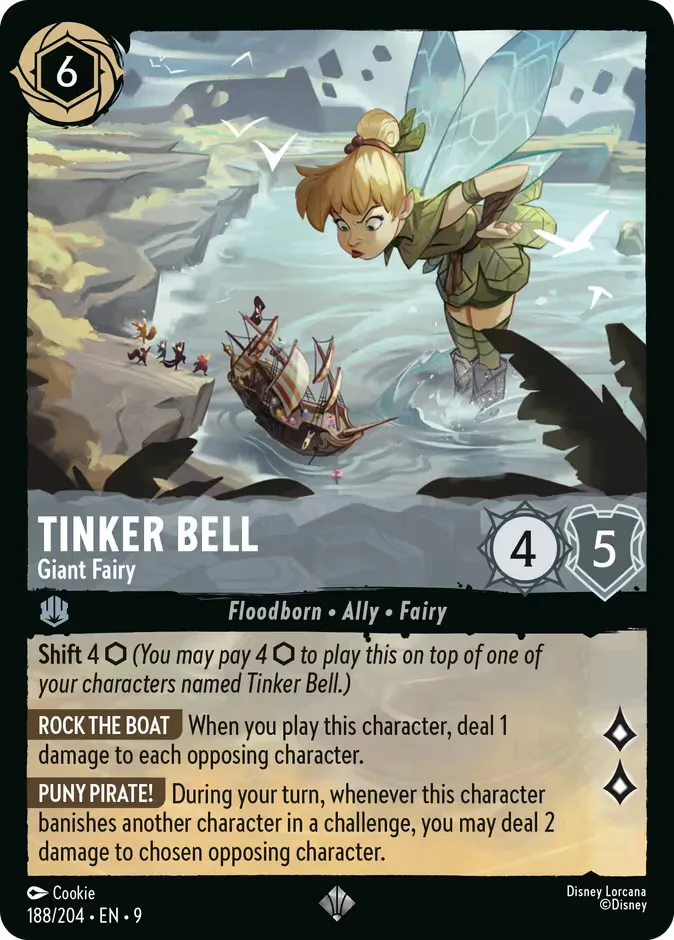
Verified examples: Cinderella - Stouthearted (7 ink, Resist, 3 lore), Beast - Tragic Hero (5 ink, 3 Strength, 5 Willpower) and Tinker Bell - Giant Fairy (6 ink, 4 Strength, 5 Willpower).
Play Steel if you want a removal suite that does not care how well-defended a character is, attached to a board the opponent struggles to clear.
How two-ink pairings actually work
Fifteen pairings exist. Because ink is generic, none of them costs you consistency - so the only question is coverage.
The fastest way to see this is to notice that each of these keywords is concentrated in one to three inks:
- Bodyguard lives in Amber and Steel
- Ward lives in Emerald and Sapphire
- Rush lives in Ruby and Amethyst
- Challenger lives in Amethyst and Steel
- Support lives in Amber and Sapphire
- Resist lives in Steel alone
- Reckless lives in Ruby alone
- Singer lives overwhelmingly in Amber
- Evasive is split three ways between Amethyst, Emerald and Ruby
Pick any two inks and you can read off exactly which of those tools your deck will and will not have. Amber and Steel doubles down on Bodyguard and gets you two flavours of defence plus Steel's damage removal - the classic protect-a-quester shell. Ruby and Sapphire pairs the worst card draw in the game with the best ramp, which is a real fix rather than a cute one. Emerald and Steel bolts hand attack onto damage removal so the opponent has neither a board nor a hand.
The traps are pairings that stack the same hole twice. Amethyst plus Amber gives you one banish effect between two inks; Sapphire plus Amber gives you a lovely engine and almost no way to interact with a threat. Those decks can work, but know going in that your answer to a resolved problem is "quest faster."
If you have built two-colour decks before, the same instinct applies - our MTG colour pairs guide and the Braverse colour pairs guide run the same "what does the second colour actually fix" logic in games where the mana cost is real.
One caveat on the meta: community trackers through mid-2026 showed Amber pairings near the top of Core Constructed, but the first official result of the post-rotation season cut the other way. The North America Championship Top 16 (28 August – 1 September 2026) was 11 Emerald/Steel decks against five that touched Amber at all - 3 Amber/Amethyst, 1 Amber/Emerald, 1 Amber/Steel - though Dillon LeDuc took the title on Amber/Amethyst. Tournament results move set to set; read them as a snapshot, not a ranking of the inks.
Dual-ink cards changed the maths
Set 7, Archazia's Island, introduced dual-ink cards: cards printed with two ink types instead of one. There are now 136 distinct dual-ink cards across three sets - 60 in Archazia's Island, 60 in Reign of Jafar and 16 in Attack of the Vine!
They are spread almost perfectly evenly. Fourteen of the 15 possible pairings have exactly nine dual-ink cards, and Amethyst/Sapphire has ten. Nobody got left out.
The rules impact is sharp: a dual-ink card can only go in a deck running both of its inks. Because you are capped at two inks total, playing a single Amethyst/Sapphire card locks your entire deck into Amethyst and Sapphire. These cards are pushed precisely because that commitment is a real cost - they are the one place in Lorcana where your ink choice carries a hard mechanical price.
Which pairing should you start with
Start with Amber plus Steel. It is the most forgiving pairing in the game: Amber keeps your questers alive with Bodyguard and high Willpower, Steel answers the one thing Amber cannot with direct damage, and neither ink asks you to sequence a combo correctly to get value.
From there, if you want to go faster, swap Amber for Ruby. If you want to go longer, swap Steel for Sapphire and learn how ramp works. If you want the most decision-dense version of the game, take Amethyst and let the card draw hand you options.
Switching costs almost nothing - no mana base to rebuild, no dual lands to buy. Try a pairing, notice which problems keep beating you, then swap the ink that was not solving them. Our Disney Lorcana beginner guide covers the product side, including which preconstructed decks are worth buying while you figure that out.
Frequently Asked Questions
How many inks are in Disney Lorcana?
Can a Lorcana deck use three inks?
Does the ink colour of a card in my inkwell matter?
Which Lorcana ink is best for beginners?
What does each Lorcana ink do?
Which ink has the best removal in Lorcana?
What are dual-ink cards in Lorcana?
Which ink ramps in Disney Lorcana?
Keep Reading
- Disney Lorcana - Inks and Their Attributes (Ravensburger)
- North America Championship 2026 - results and Top 16 ink breakdown (Ravensburger)
- Lorcast - Disney Lorcana card database and search API
- Disney Lorcana Wiki
- Every Disney Lorcana ink type explained - Wargamer
- Ink Drop Deep Dive - Sam Johanson, September 2026 (Ravensburger)
- Disney Lorcana Comprehensive Rules 2.3.0, effective 16 October 2026 (Ravensburger)
Related Guides
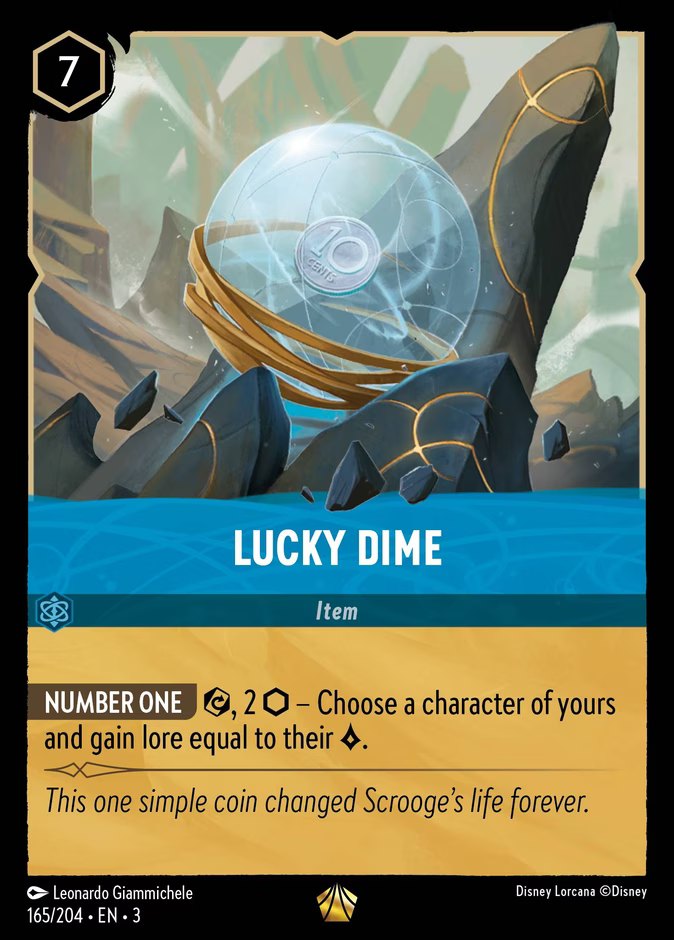
Disney Lorcana Items Explained: All 205, and Why Nothing Can Attack Them
The item card type gets four numbered rules in a 55-page rulebook, and not one of them explains how to get rid of one. Here is the whole type, counted from the live card pool - 205 items, the cheapest average cost in the game, and the 32 cards that can actually remove one.
Lorcana Shift Explained: Stacks, Damage and All 6 Variants
Shift is 199 cards across the 13 main sets before Hyperia City and a full page of rules, and most of that page is about the card underneath. Here is what a shifted character inherits, why 63 Core-legal cards care about the stack, where every card goes when the top one leaves play, and what each of the six variants actually lets you shift onto.
Disney Lorcana's Bag Explained: How Trigger Order Works
Six other posts on this site mention "the bag" in passing and none of them explain it. Here is the actual rule: what goes in, what never does, the exact order it resolves in when two abilities fire at once, and the two different ways a Lorcana card can make something happen later.
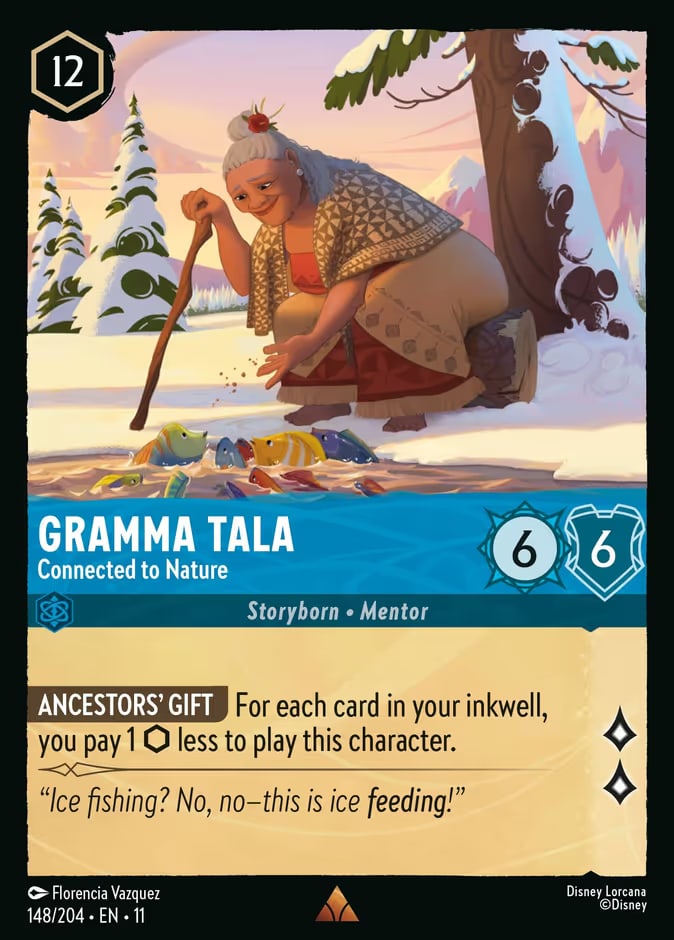
Disney Lorcana Uninkable Cards: All 585, and How to Ink One
The inkwell symbol is the first rule Lorcana teaches and the last one anybody puts a number on. Here is the whole uninkable pool counted off the live card data - 585 of 2,476 cards - cut by rarity, cost, type and ink, plus the Comprehensive Rules clause that lets five specific cards put an uninkable card into your inkwell anyway.
How to Play Disney Lorcana - Rules, Turn Structure, and the Race to 20 Lore
Lorcana is the rare TCG where you never attack your opponent directly. You race them to 20 lore. This is the full rules walkthrough - inkwell, turn phases, questing, challenging, drying, card types, and deck limits.
Disney Lorcana Format Coconut Explained: All 18 Beta Cards
Ravensburger put a new multiplayer format into open beta and then did not print a single card for it. The 18 Coconut cards live in the Companion app, the rules fit on one page, and the deckbuilding restrictions are stranger than the summary makes them sound. Here is the whole thing, with the card pool behind each Coconut counted.