Minecraft Mangrove Swamp Guide: Frogs, Froglights, and Mud
The mangrove swamp looks like set dressing until you realize it's the only biome that hands you a light-level-15 block farmed from a frog eating a magma cube. It's also a trap: every tadpole raised there becomes the same frog variant, so most players end up with one froglight color and no idea why.
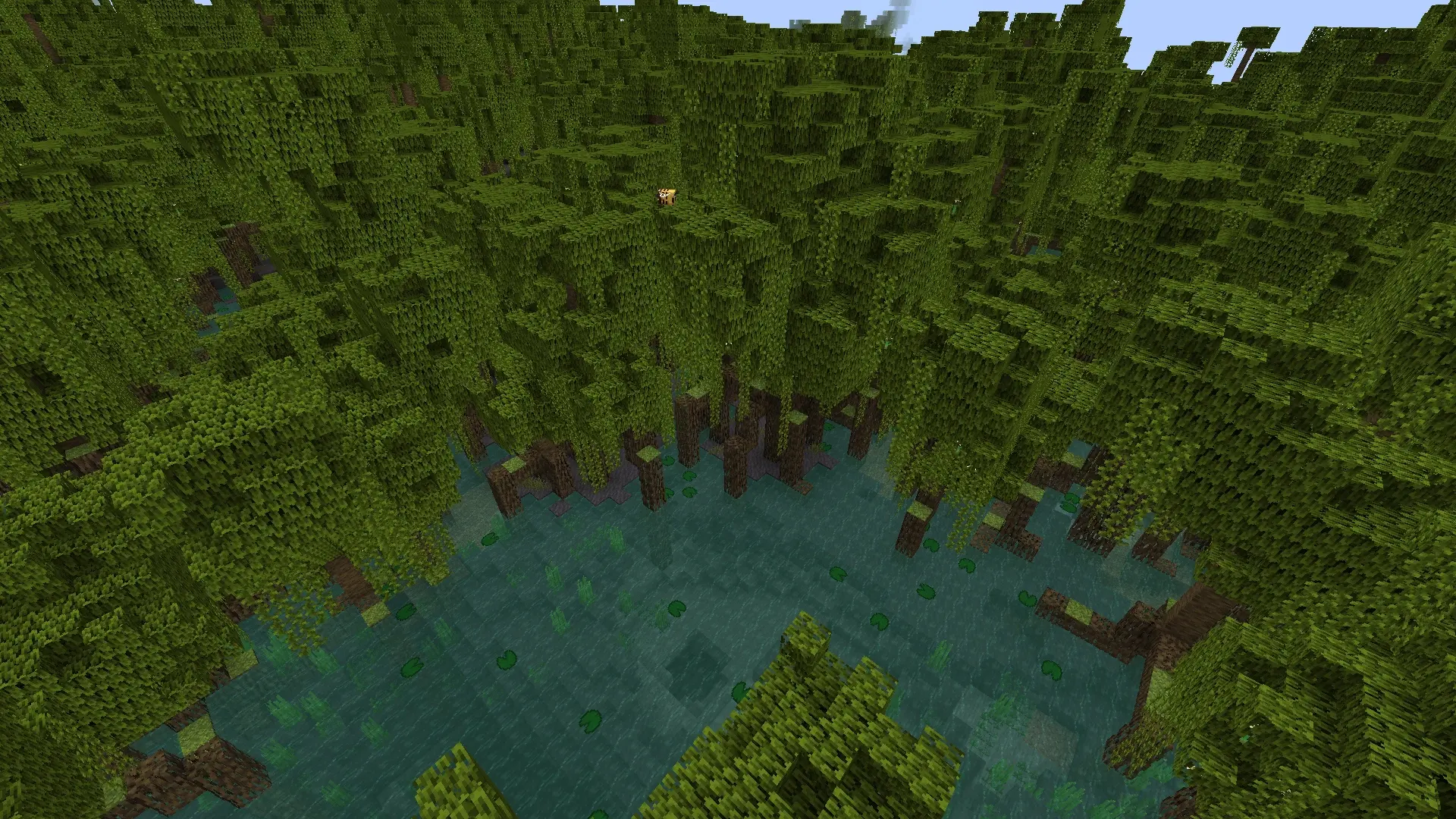
Every tadpole you raise in a mangrove swamp grows into a warm frog. Every warm frog that eats a magma cube spits out a pearlescent froglight. So if you set up camp in a mangrove swamp, build a frog pen, and grind out froglights the obvious way, you will end up with exactly one color — and a nagging sense that the wiki lied to you about there being three.
It didn't. The froglight color is decided by the frog variant, and the frog variant is decided by the biome where the tadpole grew up, not where its parents live. That single dependency is the whole puzzle of this biome, and it's why the mangrove swamp rewards players who understand it and quietly punishes everyone else.
Here's the full tour: what generates here, what mud is actually for, how to grow a mangrove tree without wrecking your build, and how to walk away with all three froglights.
Where mangrove swamps generate
The mangrove swamp is a variant of the swamp biome that generates in warmer regions — usually next to jungles and deserts. That's your search heuristic: if you're standing in snow, you're in the wrong hemisphere of the map entirely.
It's visually distinct from a regular swamp in ways that make it easy to confirm at a glance:
- The floor is mainly mud blocks, with occasional grass block or dirt disks.
- The water is teal, not the gray-green of a normal swamp.
- Leaves and vines carry a unique light green tint.
- In Java Edition, mushrooms don't generate here at all — unlike regular swamps, where they're more common than in most Overworld biomes.
Like all swamps, it sits in flat terrain near sea level and replaces rivers in those areas. Swamps never directly border an ocean — some other biome always generates in between — though their water bodies often connect to one.
One thing the mangrove swamp does not have: swamp huts. Those are a regular-swamp feature, along with the witch and black cat inside. If you're hunting witches, you want the normal variant. Our biomes guide maps out how the two swamp types sit relative to everything else.
Mud is the quiet star
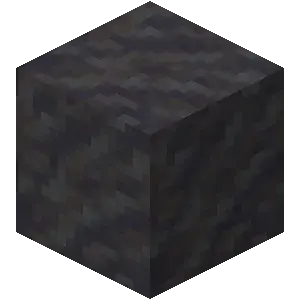
Mud generates naturally and abundantly in mangrove swamps, and you can make more anywhere by using a water bottle on dirt, coarse dirt, or rooted dirt. That process can be automated with a dispenser, which matters more than it sounds.
Mud has properties no other block quite shares. It's not a full block — entities standing on it sink slightly, the way they do on soul sand. But unlike soul sand, mud doesn't slow movement at all. You get the visual sink without the speed penalty, which makes it a genuinely good decorative floor.
The mechanically useful quirk: falling blocks that land on mud drop as items instead of settling as blocks. Pair that with a hopper underneath the mud and you have a clean, cheap gravel or sand collector — no rails, no flowing water. It's one of the tidiest item-collection tricks in the game and it exists because mud isn't a full block.
Turning mud into clay
Mud placed directly above a block that has pointed dripstone underneath eventually turns into clay. This is renewable clay, and it's the reason mangrove swamps quietly solve a problem that used to require dredging lake beds forever.
Two constraints worth pinning down. The stack has to be mud, then a block, then pointed dripstone below it — the dripstone drains the mud from beneath. And the conversion does not happen in the Nether, so don't build your clay farm through a portal to save space. If you're already running a dripstone setup for other reasons, the lush caves guide covers where to source pointed dripstone in bulk.
Packed mud and mud bricks
Packed mud is crafted from mud and wheat, and it's the intermediate step toward mud bricks. It breaks by hand — a pickaxe is just faster — and it always drops itself regardless of tool.
The wheat requirement is the real design here: it turns a swamp block into something you need a farm to mass-produce. Mud bricks give you a full block, stair, slab, and wall set in a warm earthy tone that fills a real gap in the palette — see building tips for where they land against the other brick families.
Mangrove trees and propagules
Mangrove trees grow on water or land, which almost nothing else does. They have large canopies and aerial root systems, and their wood is a distinctive vermillion. They can even be planted in the air — their roots always reach down to the ground.
A mature mangrove hands you a long list of materials: mangrove leaves (with shears), logs, roots, muddy roots, stripped logs, vines, moss carpet, propagules, sticks, and sometimes a bee nest. When a mangrove grows, it converts any mud in the path of its roots into muddy mangrove roots automatically.
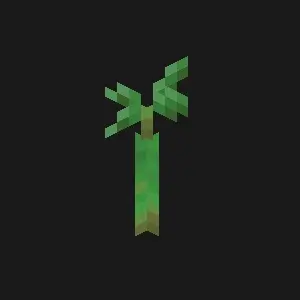
Propagules are the sapling equivalent, but they behave differently. Hanging propagules generate under the leaf blocks of naturally-generated mangroves, and their drop chance depends on age: at ages 0–3 they drop nothing at all, and only at age 4 do they have a chance to drop themselves. That's why players wander a mangrove swamp punching leaves and coming away empty — they're harvesting immature propagules.
You can force the issue with bone meal on a mangrove leaf block that has space underneath, which produces a hanging propagule at age 0. Or skip the whole thing: wandering traders sell mangrove propagules for 5 emeralds. If you just want one tree at your base, that's the fastest path — see the villager trading guide for how to make traders show up reliably.
Growing one on purpose
This is where people get frustrated, because mangroves are pickier than oaks. A hanging propagule cannot grow into a tree — it has to be planted.
The requirements, concretely:
- Plant it on any dirt variant except dirt paths, or on a moss block, or on mud.
- It needs a light level of at least 9.
- It needs at least 6 empty spaces above the propagule.
- Roots spread up to 5 blocks horizontally from the propagule, and tree height depends on how far they can spread. Cramped roots, short tree.
- It needs at least one solid block within the 9×9×9 cube directly beneath and centered on the propagule (outside the propagule's own column), and solid blocks for the root bottoms to land on within 11 blocks below, in a 9×9 area.
- Mud does not count as a solid block for that check.
That last one is the gotcha. You're standing in a biome made of mud, planting a tree that refuses to acknowledge mud as a foundation. The farther the solid blocks sit below the propagule, the more attempts the game needs to find a workable tree shape — so a propagule planted over deep water and deeper mud may simply never grow.
There's a strange exception too: dirt blocks in the space above the propagule don't block growth — the dirt stays put and the tree generates around it. In Java Edition, all log and wood blocks and their stripped versions behave the same way. In Bedrock Edition they don't: logs and wood stop growth like any other block. Worth knowing if you're growing mangroves inside a structure.
Full-size mangroves need at least a 5×5 of clear space, and their maximum blueprint occupies a 13×13×18 volume. Plan accordingly, or plant it somewhere you don't mind losing.
Frogs, tadpoles, and the variant trap
Frogs spawn in groups of two to five in both swamp and mangrove swamp biomes. They can jump 8 blocks high and take 5 less fall damage than most mobs, and they can't drown.
Breeding works like this: frogs follow any player holding a slimeball within 6 blocks. Feed two frogs a slimeball each and one becomes pregnant — similar to turtles. She then seeks out a water block with at least one adjacent water block and air above, and lays frogspawn. That hatches into 2–5 tadpoles.
Tadpoles are treated by the game as a completely separate mob from frogs, not a baby variant. They take one Minecraft day — 20 minutes — to grow up, and feeding them a slimeball cuts 10% off the remaining growth each time. You can scoop them with a water bucket. Be careful on land: they flop like fish and die quickly. And unlike frogs, tadpoles are hunted by axolotls, so don't build your nursery next to one.
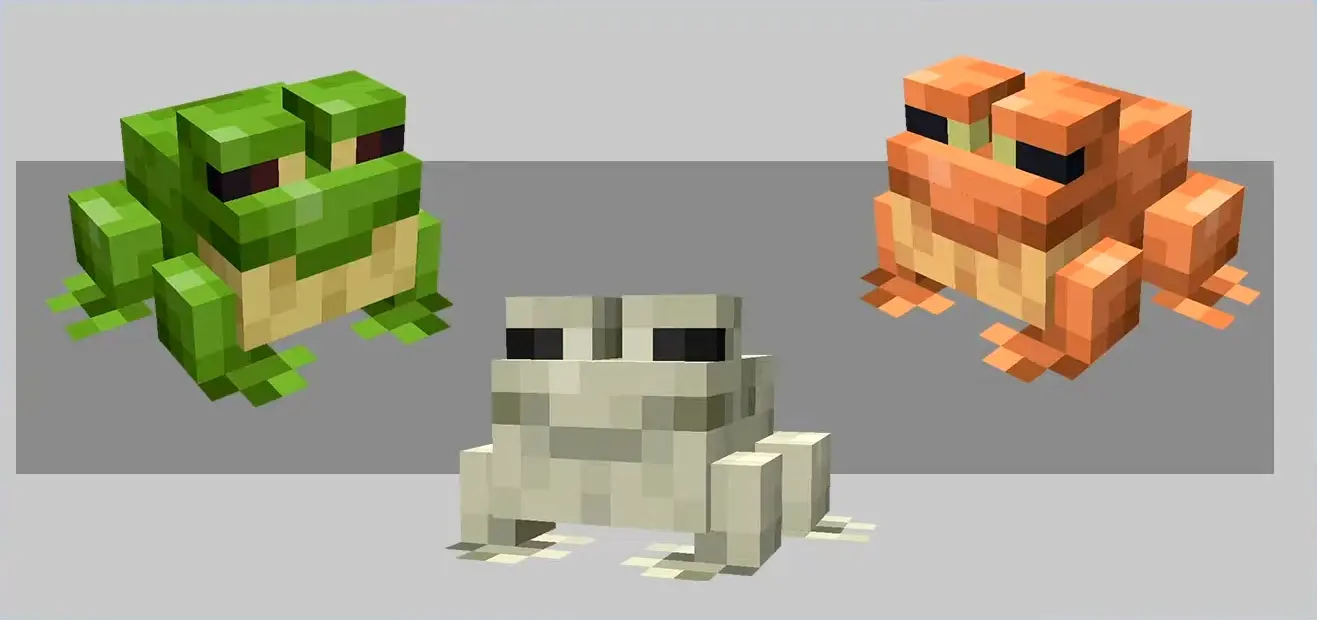
Now the important part. There are three frog variants, and the variant is decided entirely by the biome in which the tadpole matures:
- Temperate — plains, forests, taigas, rivers, beaches, meadows, mushroom fields, dripstone caves, lush caves, cherry grove, and regular swamp.
- Warm — jungles, badlands, desert, savanna, warm ocean, mangrove swamp, and every Nether biome.
- Cold — snowy biomes, frozen rivers and oceans, groves, peaks, ice spikes, snowy taiga, the deep dark, and the End.
Read that list again with your base in mind. A mangrove swamp is a warm biome. Raise tadpoles there and you get warm frogs, forever, no matter what variant the parents were.
Froglights are the real prize
A froglight drops when a frog eats a tiny magma cube. That's the only source — there's no crafting recipe, no chest loot, no trade.
They're worth the trouble. Froglights emit light level 15, the highest possible for a light-emitting block, and they have a smooth texture that doesn't read as "utility block." They can be placed in three orientations like logs and basalt, and break with any tool or by hand.
One practical quirk: froglights melt snow layers within 3 blocks and ice within 4 blocks (taxicab distance). Gorgeous in a snowy build, right up until your ice feature puddles.
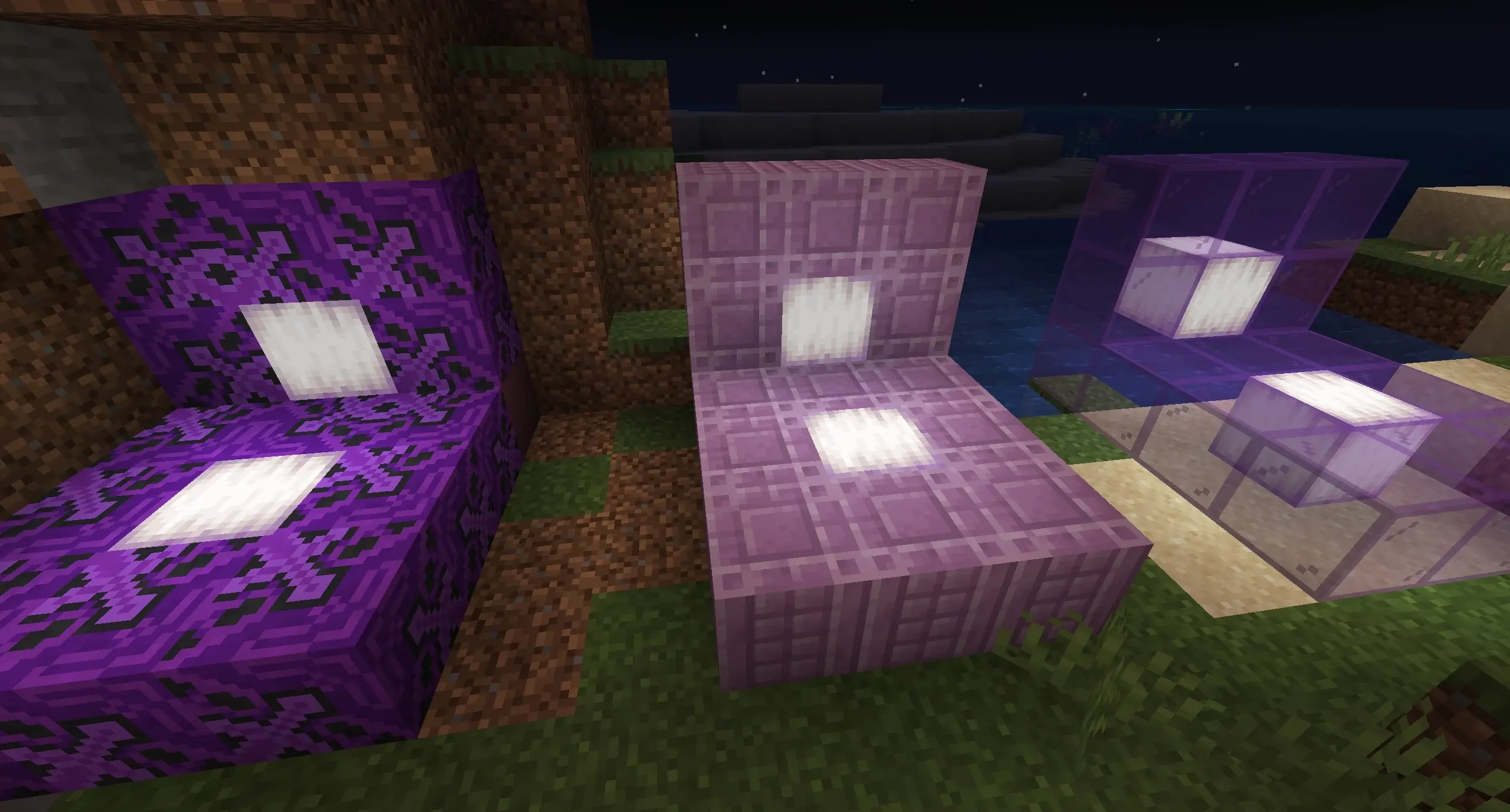
Getting all three colors
The mapping is fixed and it is not intuitive, so commit it to memory:
| Frog type | Froglight color |
|---|---|
| Warm | Pearlescent |
| Temperate | Ochre |
| Cold | Verdant |
"Warm gives pearlescent" and "cold gives verdant" are the two everyone gets backwards — verdant is green, which sounds warm and swampy, but it comes from the cold frog.
So the actual method for a complete set:
- Breed frogs anywhere and collect the tadpoles in water buckets.
- Bucket them to three different biomes: one warm, one temperate, one cold.
- Let each grow up locally — 20 minutes, or faster with slimeballs.
- Bring all three frog variants back to one magma cube source.
- Feed tiny magma cubes to the frog whose color you want.
The convenient part: the Nether is a warm biome and it's where magma cubes live, so pearlescent froglights are easy. The inconvenient part: you have to physically move temperate and cold frogs to your magma cube supply. Most builds bucket the tadpoles out, raise them in a cold biome and a temperate one, then lead the grown frogs back with slimeballs.
Slimes are your other dependency — frogs also attack small slimes, which drop the slimeballs the whole breeding loop runs on. Swamps are the only aboveground place slimes spawn, exclusively between Y=50 and Y=70 at night, and their spawn rate follows the moon phase: most common at full moon, zero at new moon. If your slime farm suddenly dies, check the moon before you tear it apart.
What else lives here
Villagers that spawn in swamps get a unique swamp-themed skin, but no village ever generates with them — the only way to get one is to breed a villager in a swamp or cure a zombie villager that spawned there. It's one of the game's rarest cosmetic variants and it's entirely a manual project. The villager jobs guide covers what to do with them once you have one.
Mangroves also frequently host bee nests, so the biome is a reasonable place to start an apiary — see the bees and honey guide for the harvesting setup.
Building a base in a mangrove swamp
The case for: mud floors that don't slow you down, renewable clay, mangrove wood in a color nothing else provides, bee nests, frogs, and abundant water.
The case against: it's flat, it's wet, mobs spawn on the mud everywhere, and mangrove roots are a pathfinding nightmare for anything you try to lead through them. Light it up properly — this is what the froglights are for — and expect real time on drainage before anything looks intentional.
The strongest play is a satellite outpost, not a main base. Come for mud, propagules, clay, and tadpoles; take them home. Treating the biome as a supply depot with excellent scenery saves you from fighting the terrain for a week.
Quick Action Checklist
- Search near jungles and deserts — mangrove swamps only generate in warm regions.
- Confirm the biome by the teal water and mud floor, not the trees.
- Bulk-collect mud; make more anywhere with a water bottle on dirt (dispenser-automatable).
- Put mud over a block with pointed dripstone underneath for renewable clay — never in the Nether.
- Craft packed mud from mud + wheat, then mud bricks.
- Harvest propagules only at age 4 — younger hanging propagules drop nothing.
- Bone meal a mangrove leaf block with space beneath to force a propagule, or buy one from a wandering trader for 5 emeralds.
- When planting: light level 9+, 6 empty blocks above, solid ground below — mud doesn't count as solid.
- Leave a 5×5 clear footprint minimum; a full mangrove can occupy 13×13×18.
- Breed frogs with slimeballs; collect tadpoles in water buckets.
- Raise tadpoles in three different biomes — the biome at maturity sets the variant permanently.
- Memorize the mapping: warm → pearlescent, temperate → ochre, cold → verdant.
- Feed tiny magma cubes only. Full-size ones won't work.
- Keep tadpoles away from axolotls, and don't strand them on land.
- Check the moon phase before debugging a dead slime farm — new moon means zero spawns.
Frequently Asked Questions
Where do mangrove swamps generate in Minecraft?
How do you get all three froglight colors in Minecraft?
Why is my mangrove propagule not growing?
How do you turn mud into clay in Minecraft?
What is the difference between a swamp and a mangrove swamp?
Keep Reading
Related Guides
Minecraft Ice Caves Guide: Frostbite, Icicles and Freezing
Minecraft's fifth cave biome is mostly packed ice, its icicles drop when you light them, and its new zombie variant applies a brand-new Freezing effect with its melee hits. The ice caves drop is playable today in Bedrock Preview 26.60.29 and not yet in Java. Here is what is in it, with the numbers, and what could still change.
Minecraft Wilderness Bound Guide: Dappled Forest and Camps
Minecraft quietly swapped its whole version-numbering scheme and shipped a full content drop the same week — a new autumn biome, camping structures with a chest that hides in a different spot every time, and the game's first real sit-down furniture. Here is every number from Wilderness Bound, checked against the wiki the day after launch.
Minecraft Sulfur Caves: Geysers, Cinnabar, and Sulfur Cubes
Java 26.2 dropped a cave biome that does not reward you with a mob you fight, or loot you carry home. It rewards you with a ball. The sulfur cube takes on the physics of whatever block you feed it, and the game ships twelve different physics profiles to choose from — bounciness, friction and air drag, all published numbers. Here is the whole biome, including the geyser maths.
Minecraft Pale Garden Guide: Creaking, Resin, and Pale Oak
The pale garden is the only biome in Minecraft that turns your music off on purpose, and it guards the only mob in the game you cannot damage. Here is how the creaking staring contest actually works, how to turn its heart into a renewable resin farm, and every Java/Bedrock number that matters.
Minecraft Survival Guide for Beginners: Your First Days
You have about ten minutes of daylight before the sun sets and the world tries to kill you. Here is exactly what to do with them — punch a tree, build a tool chain, and get a roof over your head before the zombies arrive.
Best Minecraft Enchantments, Ranked — The Ones Worth Your XP
Mending is the enchantment that ends the grind — gear that repairs itself forever. Everything else is a fight over your XP and anvil uses. Here is what actually earns a slot, ranked, with the real max levels.