Minecraft Cherry Grove Guide: Wood, Pink Petals, and Mobs
The cherry grove is the prettiest biome in Minecraft and one of the most underrated places to start a world. It's a meadow with pink trees on paper, but it quietly hands you a whole salmon-colored wood set, a renewable decoration block, emeralds in the hills, and bees on the branches.
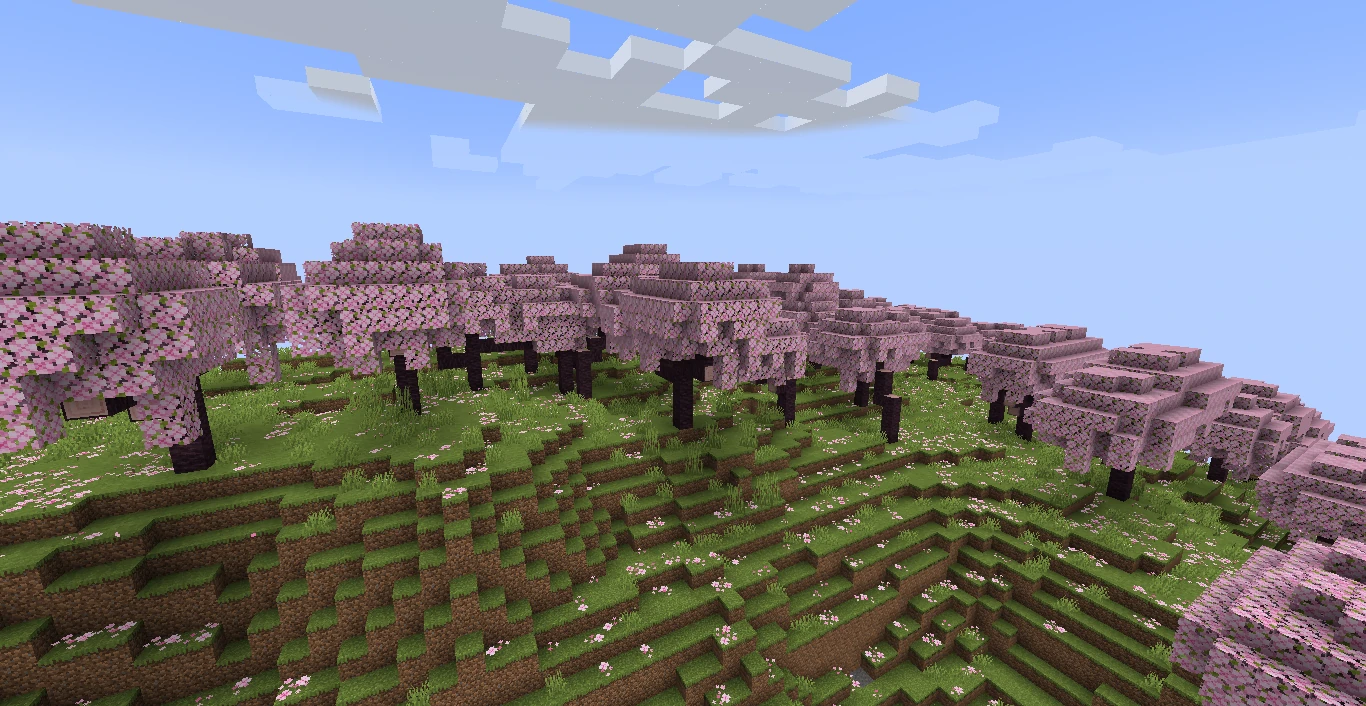
The cherry grove is a meadow that got a paint job, and that undersells it badly. Yes, mechanically it shares the exact shape and mob spawning of the meadow biome — but it's the only place in the entire game where cherry trees generate, which means it's the only source of a full pink-hued wood set that looks like nothing else you can build with. Add emerald ore in the hills, bee nests on the branches, and a renewable decoration block scattered across the grass, and you have one of the best-value biomes Mojang has ever shipped.
It arrived in the 1.20 Trails & Tales update — the same patch that gave us the sniffer and archaeology — and it went straight to the top of most players' "build my base here" lists on looks alone. This guide covers where to find one, everything worth harvesting, how to grow your own trees, and how to turn pink petals into a self-sustaining supply.
Where cherry groves generate
The cherry grove is a mountain biome, one of seven, and it shares its terrain profile with the meadow. That's your first search clue: look uphill. It usually generates on the lower slopes of mountains, but it can also appear standalone on plateaus, most often next to plains or sunflower plains, and it's frequently separated from actual meadows by a river.
It is rarer than the meadow, so don't expect to trip over one. The dead-giveaway from a distance is the color — a sea of pink leaves on curved-branch trees, sitting on grass that renders in a distinctive yellow-green (the biome uses a grass and foliage tint of #B6DB61) beside unusually bright blue water. Once you've seen one, you can spot it on the horizon from a long way off.
A couple of climate notes that matter for base planning: the biome runs warm (temperature 0.5 on Java, 0.3 on Bedrock) with a downfall value of 0.8, and critically, snow never accumulates here even at altitude. You get rain, not snow layers, which keeps the pink-and-green look intact year-round. If you're hunting one on a fresh world, our Minecraft biomes guide maps how the mountain biomes sit relative to each other, and a strong world seed can drop you next to one at spawn.
What you actually find here
Walk into a cherry grove and the surface reads as grassland: grass block, tall grass, and pink petals on the ground, with cherry trees scattered sparsely enough that you can see where you're going. The sparseness is a feature — dense jungle-style canopy is where people get lost, and this biome mostly avoids that, though cherry trees can occasionally generate thickly enough to form a real leaf cover.
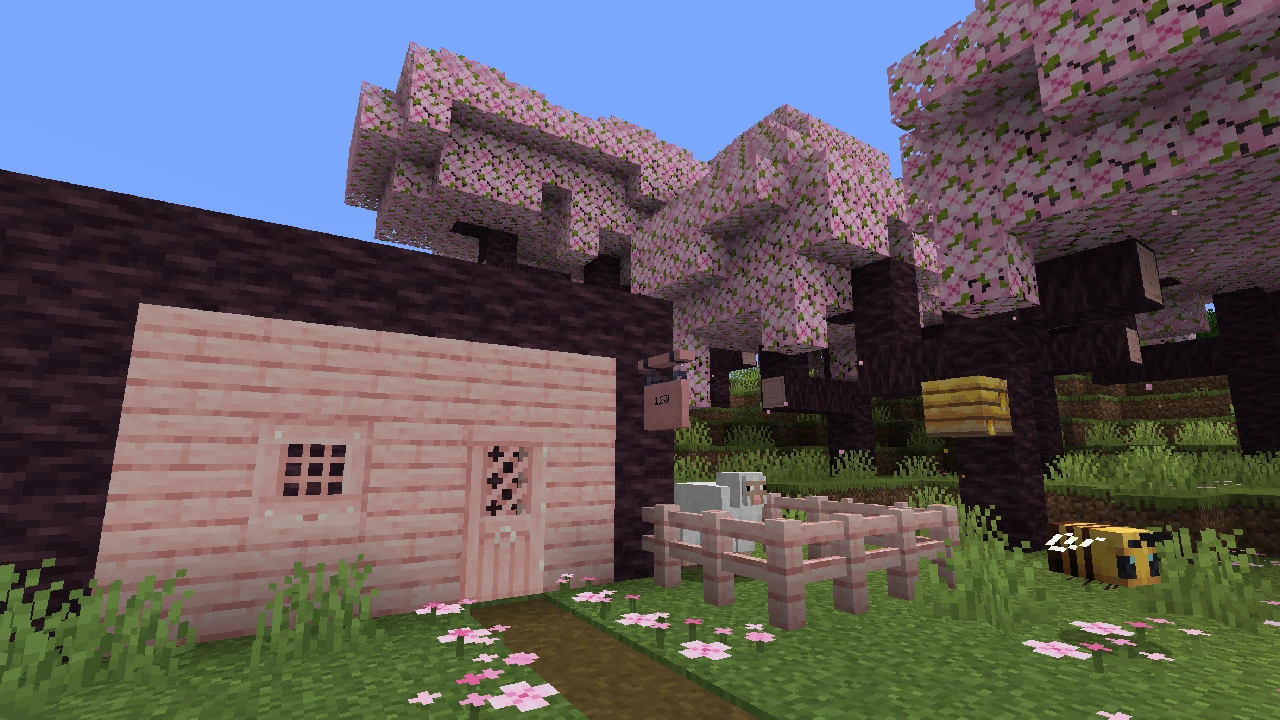
The best passive perk is the bee nests. They generate somewhat commonly on the sides of cherry trees, which makes this one of the friendlier biomes for starting an apiary — you don't have to go hunting for flower forests or plains oaks. Pair that with the pink petals underfoot (bees will happily pollinate them) and you have a honey operation ready to go before you've even placed a bed. The bees and honey guide covers how to relocate a nest without angering the swarm.
Ores, pillagers, and what's missing
Like the meadow, the cherry grove is quietly generous with ores. Emerald ore generates here — especially at higher altitudes, so the more mountainous your grove, the better your emerald odds — and both coal and iron are common. That's a genuinely useful early-game trifecta from a biome you picked for its looks. Just watch your step underground: infested block blobs generate naturally in cherry groves, so a stray pickaxe swing can spill a nest of silverfish.
Two structure facts are worth pinning down. Villages cannot generate inside a cherry grove — if you want villager trades nearby you'll need a neighboring biome, and the villages guide explains how border biomes work. On Java Edition, though, pillager outposts can spawn here, so keep an eye out for a raid captain if you plan to settle in (the raids and pillagers guide has the countermeasures).
One quirk that trips up farmers: on Java Edition, sugar cane and pumpkin patches do not generate naturally in cherry groves, unlike almost every other Overworld biome. It doesn't stop you planting your own — it just means you won't find wild starts lying around.
Cherry trees and the wood set
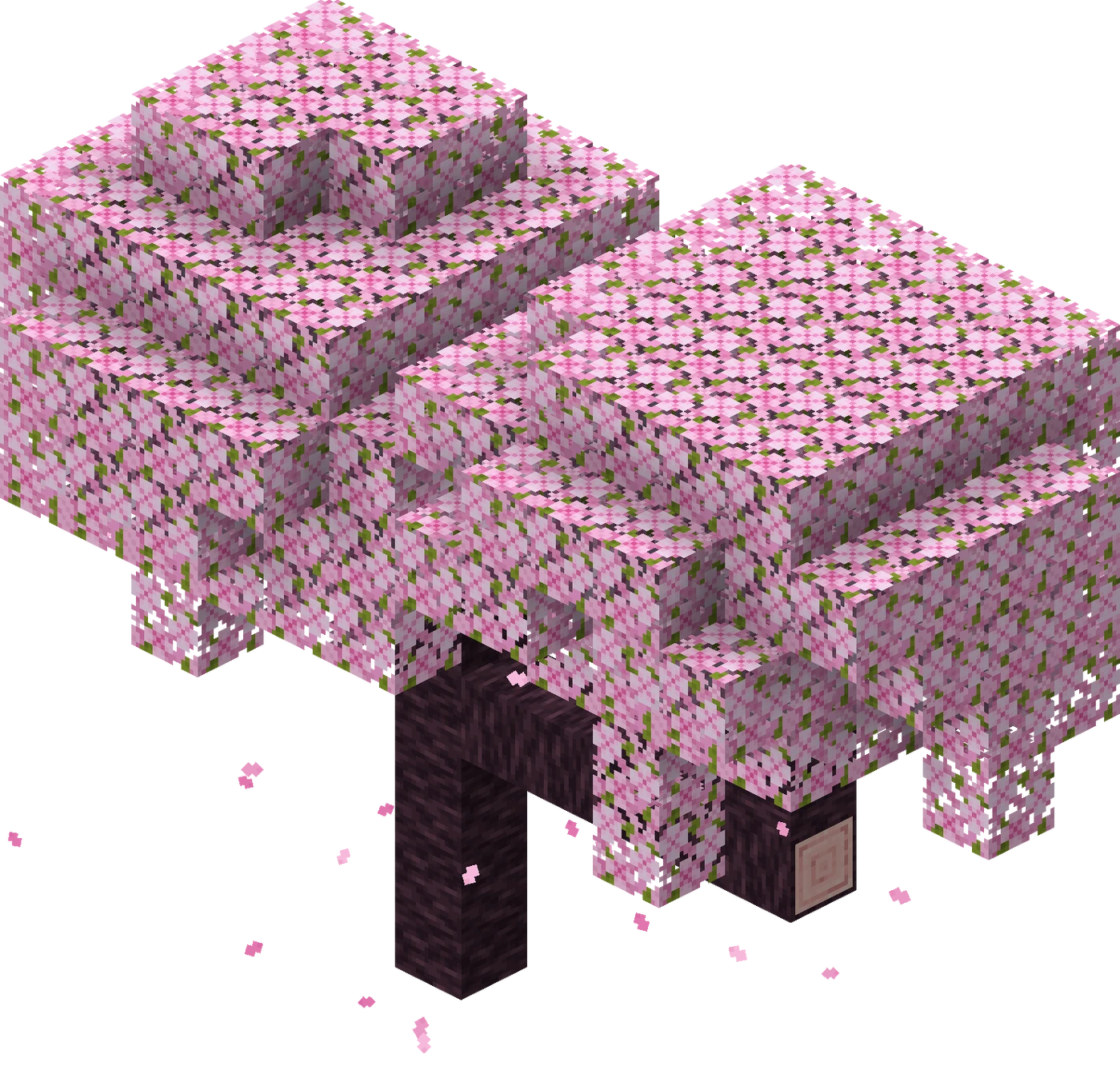
Cherry trees are the whole reason to care. They're identified by their pink leaves, curved branches, and a unique falling petal particle effect that drifts down beneath them constantly. A mature tree gives you the full harvest list:
- Cherry log — breaks with any tool, or by hand.
- Cherry leaves — only drop as blocks when harvested with shears.
- Cherry sapling and sticks — a chance drop when you break leaves.
- Stripped cherry log — made by using an axe on a placed log.
- Bee nest — if the tree generated with one.
Crafting a log into planks gives you the payoff: cherry planks are a soft salmon-pink, a color the game provides through no other wood type. From there you get the complete wood family — planks, stairs, slabs, fence, fence gate, door, trapdoor, button, pressure plate, standing and wall signs, hanging signs, and both a boat and a chest boat. For builders, that pink palette is the single biggest reason cherry groves get colonized on sight; the building tips guide has ideas for pairing it without turning your base into a bubblegum machine.
Growing your own cherry trees
You don't want to strip a natural grove bare, so start a sapling farm. Cherry saplings plant on a generous list of surfaces: dirt, grass block, coarse dirt, podzol, mycelium, rooted dirt, moss block, farmland, mud, and muddy mangrove roots — the same forgiving spread you get with the trees in a mangrove swamp.
The growth requirement is where cherry trees are actually easier than most: a sapling needs a 5x5 area of unobstructed space, 8 blocks above the sapling (9 blocks including the sapling's own layer). What makes them pleasant is that no horizontal clearance is needed at the base — a sapling planted in a one-block-deep hole still grows fine — and their growth is not hindered by logs, leaves, or saplings. You can plant them close together and cram them in ways a spruce would refuse. Bone meal speeds the whole thing up, exactly as you'd expect.
Pink petals: the biome's signature block
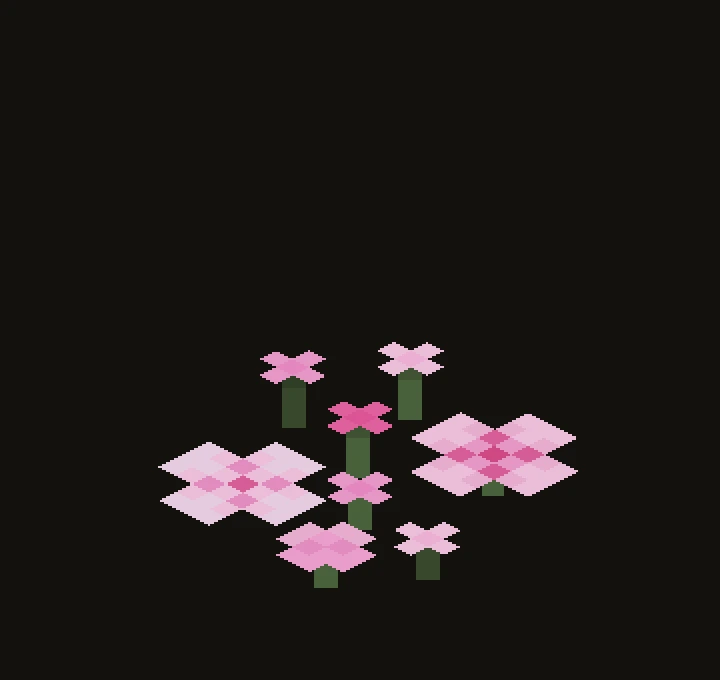
Pink petals are the small decorative block scattered across the grass, and they're more interesting than they look. Each block can hold up to four petals, and the block visibly gets fuller as the count rises from one to four. They break instantly with any item or your bare hand — reaching for shears does nothing except waste durability — and they'll also pop off if water runs over them or a piston shoves a block into their space.
Placement is flexible: petals sit on grass block, podzol, mycelium, dirt, coarse dirt, rooted dirt, moss block, mud, muddy mangrove roots, or farmland, and you can stack more than one on a block the way you would sea pickles or candles. Their main uses are decoration and crafting into pink dye — a renewable pink dye source that doesn't require peonies or flower farms. A nice touch for landscapers: sheep can eat the grass underneath pink petals without knocking the petals off, so a grazed lawn keeps its pink flecks.
Farming petals with bone meal
Here's the renewable loop, and it's dead simple. Every time you apply bone meal to a pink petals block, the petal count goes up by one. Once a block already holds four petals, the next bone meal makes it drop a copy of itself — exactly the way tall flowers behave. So a single petals block plus a bone meal supply is an infinite pink petals (and therefore infinite pink dye) machine.
There's a second trick unique to the biome: applying bone meal to a grass block inside a cherry grove spawns pink petals on the ground instead of the usual random small flowers. If you're standing in the biome, you can carpet an area in petals just by bone-mealing the lawn. Bring a stack of bone meal from a skeleton or mob farm and you'll never run short. Bees also let you breed with pink petals, so the flower doubles as breeding food for your apiary.
The mobs that call it home
On Java Edition, cherry groves use the exact same mob spawning table as meadows, which keeps the biome calm and beginner-friendly. The passive fauna you'll actually see are sheep and rabbits grazing the hills, plus the bees living in the tree nests. On Bedrock Edition, pigs join the mix, while Java worlds can still turn up the occasional donkey — handy if you want an early pack animal, and the taming and breeding guide covers leading one home.
Hostile spawns are the standard Overworld set — creepers, skeletons, spiders, zombies, the odd enderman and witch — but because the terrain is open and grassy, there's nowhere near the mob pressure of a cave-riddled biome. Light the place up properly at night and it stays quiet. This is also a great biome to run into a wandering sniffer project or set up an archaeology dig nearby, since the cherry grove shipped alongside both features in Trails & Tales; see the sniffer guide if you're after those ancient seeds.
Is a cherry grove a good place to start?
Honestly, yes — it's arguably the best-looking survival start in the game and it doesn't punish you for choosing looks. You get wood, emeralds, coal, iron, bees, and a renewable dye all in one open, low-threat biome, with passive mobs and enough tree cover to matter without the risk of getting lost. The wiki itself flags cherry groves as one of the easiest of the seven mountain biomes to spawn into.
The only real caveats are the missing pieces: no natural village, no wild sugar cane or pumpkins on Java, and those silverfish blobs lurking in the stone. None of that is a dealbreaker — it just means your first day includes planting a few crops and mining carefully. For most players, the trade of "slightly less starter loot for the prettiest base site around" is an easy yes.
Quick Action Checklist
- Search the lower slopes of mountains and plateaus near plains — cherry groves are a rarer meadow variant, spotted by pink leaves and bright blue water.
- Expect no snow accumulation, warm climate, and yellow-green grass — good year-round build conditions.
- Mine for emerald ore (best at higher altitudes) plus common coal and iron, but watch for silverfish from infested blocks.
- Remember: no villages generate here, Java pillager outposts can, and Java has no wild sugar cane or pumpkins.
- Harvest cherry logs by hand, cherry leaves with shears, and grab any bee nests on the trunks.
- Craft logs into salmon-pink cherry planks for the full unique wood set — plant a sapling farm rather than stripping wild trees.
- Plant saplings needing 5x5 clear space, 8 blocks up; no base clearance required, and nearby logs/leaves don't block growth.
- Bone meal a pink petals block to four petals, then again to duplicate it — infinite pink petals and pink dye.
- Bone meal a grass block inside the biome to spawn petals instead of flowers.
- Start a bee apiary using the tree nests and pink petals as breeding food.
- Light up at night — the biome is low-threat but still spawns the standard hostile mobs.
Frequently Asked Questions
How do you find a cherry grove in Minecraft?
What can you make with cherry wood in Minecraft?
How do you farm pink petals in Minecraft?
How do you grow a cherry tree in Minecraft?
What mobs spawn in a cherry grove?
Keep Reading
Related Guides

Minecraft Ice Caves Guide: Frostbite, Icicles and Freezing
Minecraft's fifth cave biome is mostly packed ice, its icicles drop when you light them, and its new zombie variant applies a brand-new Freezing effect with its melee hits. The ice caves drop is playable today in Bedrock Preview 26.60.29 and not yet in Java. Here is what is in it, with the numbers, and what could still change.
Minecraft Wilderness Bound Guide: Dappled Forest and Camps
Minecraft quietly swapped its whole version-numbering scheme and shipped a full content drop the same week — a new autumn biome, camping structures with a chest that hides in a different spot every time, and the game's first real sit-down furniture. Here is every number from Wilderness Bound, checked against the wiki the day after launch.
Minecraft Sulfur Caves: Geysers, Cinnabar, and Sulfur Cubes
Java 26.2 dropped a cave biome that does not reward you with a mob you fight, or loot you carry home. It rewards you with a ball. The sulfur cube takes on the physics of whatever block you feed it, and the game ships twelve different physics profiles to choose from — bounciness, friction and air drag, all published numbers. Here is the whole biome, including the geyser maths.

Minecraft Pale Garden Guide: Creaking, Resin, and Pale Oak
The pale garden is the only biome in Minecraft that turns your music off on purpose, and it guards the only mob in the game you cannot damage. Here is how the creaking staring contest actually works, how to turn its heart into a renewable resin farm, and every Java/Bedrock number that matters.
Minecraft Survival Guide for Beginners: Your First Days
You have about ten minutes of daylight before the sun sets and the world tries to kill you. Here is exactly what to do with them — punch a tree, build a tool chain, and get a roof over your head before the zombies arrive.

Best Minecraft Enchantments, Ranked — The Ones Worth Your XP
Mending is the enchantment that ends the grind — gear that repairs itself forever. Everything else is a fight over your XP and anvil uses. Here is what actually earns a slot, ranked, with the real max levels.