Naruto Card Game Rules Text: 15 Life, 4 Card Backs
The NARUTO CARD GAME sample cards that circulated around Gen Con were full-art showcase pieces with no text box, and the honest summary at the time was that Bandai had published no card text at all. That is no longer the case. Bandai's own ABOUT page carries seven cards with printed rules text, sitting in the card-type and how-to-play blocks rather than the showcase gallery, and between them they cover three of the gaps our launch coverage listed as unknown: the Leader's starting Life, how a Chakra cost is notated, and what the keyword vocabulary looks like.
The NARUTO CARD GAME sample cards that went around at the end of July were full-art showcase pieces: SAMPLE watermark, no text box, and the same DMG 3 / POW 6 / HP 6 on each one. The honest summary at the time, ours included when we covered the Gen Con debut, was that Bandai had published no card text, no Chakra cost notation and no Leader Life value.
That is no longer true, and it has not been for a while. Bandai's own ABOUT page carries seven cards with printed rules text, sitting in the card-type and how-to-play blocks rather than in the showcase gallery. They were already on the page in the Internet Archive's 12 August 2026 capture. Between them they cover three of the specific gaps our launch coverage listed as unknown: the Leader's starting Life, how a Chakra cost is notated, and what the keyword vocabulary looks like.
Nothing below is a claim about how the game plays. NARUTO CARD GAME is not on sale, the worldwide release is Summer 2027, the published routes to playing it are Bandai-run demo sessions, and each card image here carries Bandai's SAMPLE watermark. This is a transcription of what Bandai has printed, and a note about what it still has not.
Seven cards on Bandai's own page carry text
Here is the full set, with everything printed on the frame. Card numbers are read off the bottom-right corner of each card, where they are legible.
| Card | No. | Type | DMG | POW | HP / LIFE | Chakra cost | Trait line |
|---|---|---|---|---|---|---|---|
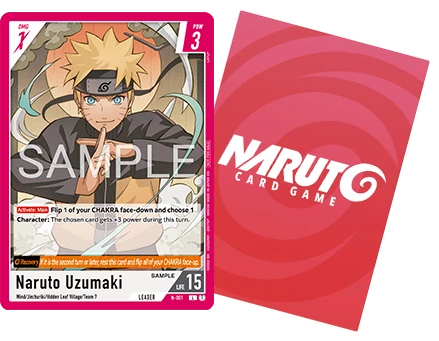
| Naruto Uzumaki | N-001 | Leader | 1 | 3 | LIFE 15 | — | Wind/Jinchuriki/Hidden Leaf Village/Team 7 |
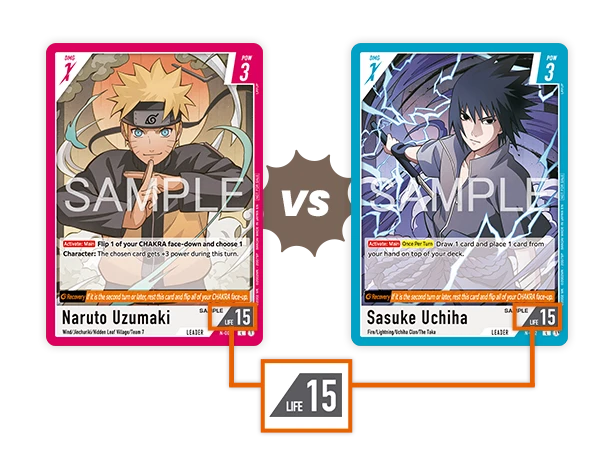
| Sasuke Uchiha | not legible | Leader | 1 | 3 | LIFE 15 | — | Fire/Lightning/Uchiha Clan/The Taka |
| Gamabunta | N-005 | EX Character | 2 | 10 | HP 8 | — | Water/Toad/Mount Myoboku |
| Shikamaru Nara | not legible | Character | 1 | 6 | HP 4 | 1 | Special/Hidden Leaf Village/Team 10 |
| Ino Yamanaka | N-011 | Character | 2 | 5 | HP 8 | — | Special/Hidden Leaf Village/Team 10 |
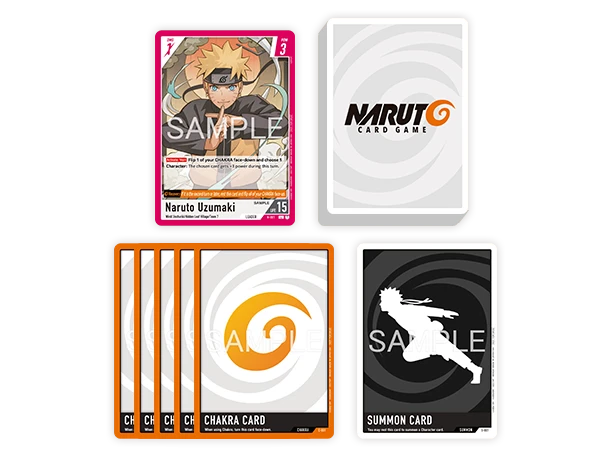
| Chakra Card | C-001 | Chakra | — | — | — | — | — |
| Summon Card | S-001 | Summon | — | — | — | — | — |
Six of those seven sit in the five card-type illustrations; the Sasuke Leader comes from the head-to-head diagram lower down the page. The Chakra and Summon cards are generic, non-character cards with a single line of text each, which is why most of their columns are empty.
Two card numbers are missing on purpose. Sasuke's sits underneath Bandai's own orange callout graphic. Shikamaru's is printed, but the largest image Bandai publishes of that card is 610 pixels wide, which renders the number about four pixels tall — enough to see that it is an N- number, not enough to tell one digit from another. I am not going to guess at either.
Both published Leaders have 15 Life
The Leader's starting Life was one of the specific unknowns a month ago. It is now printed in a grey box in the bottom-right corner of the card, next to the word LIFE, and Bandai draws an orange callout line to it in the head-to-head diagram to make sure you notice.
Of the two Leader cards Bandai has published, both read LIFE 15, and both read DMG 1 / POW 3. Two cards is not a rule, and Bandai has not said whether Life is a fixed constant or a per-Leader stat. What the card layout does tell you is that Life is printed per card, in its own box, rather than left to a rulebook — which is the layout you would use if the number were ever going to differ.
The two Leaders do not have identical text. Naruto's reads:
[Activate: Main] Flip 1 of your CHAKRA face-down and choose 1 Character: The chosen card gets +3 power during this turn.
Sasuke's reads:
[Activate: Main] [Once Per Turn] Draw 1 card and place 1 card from your hand on top of your deck.
Then both carry the same orange keyword bar along the bottom of the art:
◇Recovery If it is the second turn or later, rest this card and flip all of your CHAKRA face-up.
So on the two published Leaders, Recovery is identical text — the resource reset — while the [Activate: Main] ability above it is what differentiates them. Note also that Naruto's version has no [Once Per Turn] tag and Sasuke's does.
Two other things worth pulling out of those lines. "Rest" appears as a cost, and it is being applied here to the Leader card itself, which sits outside the deck — Bandai never defines the word in print, though its summon diagram draws a rested Summon card lying on its side, which is the usual Bandai TCG convention. And Sasuke's trait line carries two elements — Fire and Lightning — where Naruto's carries one.
The Chakra cost is printed, and Shikamaru's is 1
The other big unknown was how a cost gets notated, given that Chakra lives outside the 51-card deck in its own five-card zone. The answer is a black tab down the left edge of the text box, labelled CHAKRA, with a number in it.
Shikamaru Nara is the only one of the seven that has one, and it reads 1:
[SUPPORT] Shadow Possession Jutsu [During Your Opponent's Attack] Summon this card and interrupt that attack.
That is a lot of vocabulary in two lines. SUPPORT sits as a banner heading over a named Jutsu, so a card can apparently carry a named ability as a labelled block rather than as plain body text. "[During Your Opponent's Attack]" is an explicit response window printed on a Character card. And the effect is to summon the card itself from hand, off-turn, which is not something the four published rules bullets from July would have told you was possible.
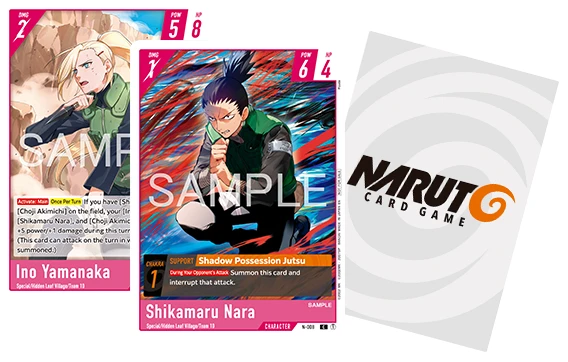
Ino Yamanaka, N-011, has no Chakra tab, and her ability is an [Activate: Main] instead. Her text is cropped in the card-type illustration; the full line is legible in the summon diagram further down the page:
[Activate: Main] [Once Per Turn] If you have [Shikamaru Nara] and [Choji Akimichi] on the field, your [Ino Yamanaka], [Shikamaru Nara], and [Choji Akimichi] all gain [Rush] and +5 power/+1 damage during this turn. (This card can attack on the turn in which it is summoned.)
That is the Ino–Shika–Cho trio written as a named-card check, and it confirms what the trait lines were signalling in July: cards reference other cards by name, in brackets, and grant keywords. It also names a fourth character, Choji Akimichi, who has no card of his own anywhere on this page.
Every keyword on the seven rules-text cards
Bandai has not published a glossary, a comprehensive rules document or a keyword index — the English NARUTO CARD GAME site's entire navigation is ABOUT, NEWS and FOR RETAILERS, with no rules section, where the Gundam Card Game site of the same publisher carries a RULES page. This table is only what appears in brackets or banners on the seven cards above, with the reminder text where a card prints one. It is not a complete keyword list for the game, and it is not meant to be.
| Printed term | Appears on | Printed reminder text, if any |
|---|---|---|
| [Activate: Main] | Naruto Leader, Sasuke Leader, Ino Yamanaka | none |
| [Once Per Turn] | Sasuke Leader, Ino Yamanaka | none |
| ◇Recovery | Naruto Leader, Sasuke Leader | "If it is the second turn or later, rest this card and flip all of your CHAKRA face-up." |
| [SUPPORT] | Shikamaru Nara | none — used as a banner over a named Jutsu |
| [During Your Opponent's Attack] | Shikamaru Nara | none |
| [Rush] | Ino Yamanaka | "(This card can attack on the turn in which it is summoned.)" |
| [Summon Requirements] | Gamabunta | none |
| [On Summon] | Gamabunta | none |
Two of those eight carry printed text, and only [Rush] carries a parenthetical that defines the keyword itself. Recovery is described rather than defined — it appears in a fixed orange bar in the same position on both Leaders with the same wording, which reads to me like a Leader-slot ability rather than a general keyword, though that is my inference and not something Bandai has stated. The other six are timing and condition tags whose meaning Bandai has not written down anywhere public.
Two more terms show up as plain words rather than bracketed keywords, and neither is defined on any published card: trash, used for the pile a card is placed in and summoned back out of, and rest, used as a cost on both the Leader and the Summon card.
The EX Character is paid for with a Character
EX Character was the card type with the least behind it in July — "playable after meeting certain in-match conditions," and nothing about what a condition looked like. Gamabunta, N-005, prints one.
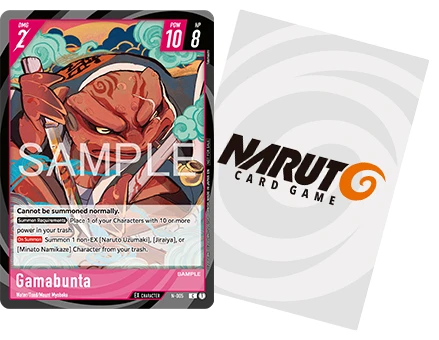
Cannot be summoned normally. [Summon Requirements] Place 1 of your Characters with 10 or more power in your trash. [On Summon] Summon 1 non-EX [Naruto Uzumaki], [Jiraiya], or [Minato Namikaze] Character from your trash.
Three things fall out of that. The requirement is a Character with 10 or more power rather than a Character whose printed POW is 10 or more, which implies power is a value that can change during a game — the Naruto Leader's own ability grants +3 power, so it demonstrably can. The cost is paid in board presence, not in Chakra. And the On Summon clause pulls a specific named Character back out of the trash, so the trash is a place cards come back from and not only a place they go.
Gamabunta's type line reads EX CHARACTER in the bottom-right corner where the other two read CHARACTER, so EX is its own printed type on the card frame — which settles the four-types-or-five question that some launch coverage split on.
Four different card backs, one per zone
This is the detail I did not expect. Bandai's card-type illustrations show each card next to its own back, and across the five illustrations there are four visually distinct backs:
| Zone | Card back |
|---|---|
| Leader | Crimson/pink spiral, white NARUTO CARD GAME wordmark |
| Deck (Character, EX Character) | Light grey spiral, black wordmark with orange spiral mark |
| Chakra | Solid orange spiral, white wordmark |
| Summon | Black spiral, white wordmark with orange spiral mark |
The back on the deck in Bandai's setup diagram is the grey one. The other three sit on cards the same diagram places outside the deck — the Leader in its own slot, five Chakra cards in a row, one Summon card — so a distinguishable back on those is not a marked-card problem. If the illustrations hold — Bandai's own footer warns the images may differ from the finished product, and no packaging, set or product configuration has been announced at all — that is a physical answer to a design question: the Chakra and Summon zones would be not only rules-separate from your deck but printed separate.
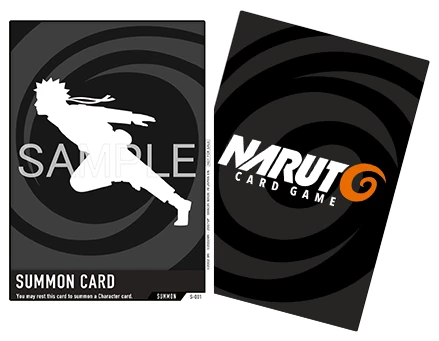
The two generic cards carry the shortest text of anything published so far. The Summon Card, S-001: "You may rest this card to summon a Character card." The Chakra Card, C-001: "When using Chakra, turn this card face-down." That second line is word for word the rules line on CP-001, the convention promo Chakra card — we went through CP-001 separately — so the promo and the ABOUT page's C-001 do the same job under different numbers.
The numbering runs N, C and S
Small but useful if you plan to track this game's card pool. The prefixes so far:
- N- for Leaders, Characters and EX Characters in one shared run — the Naruto Leader is N-001, the Gamabunta EX Character is N-005, and the Ino Yamanaka Character is N-011. Leaders are not on their own numbering line.
- C- for Chakra cards (C-001).
- S- for Summon cards (S-001).
- CP- for the convention promo Chakra card (CP-001), so promos are a separate run from the C- line.
Bandai has published no set code, so none of those numbers carry a set prefix yet.
The stat line finally varies
Bandai's showcase gallery now runs to twelve cards, where the 29 July reveal showed five. Boruto Uzumaki and Tsunade are in there now, and there are three separate Sasuke cards with three different trait lines. I opened all twelve: each one is a CHARACTER card reading DMG 3 / POW 6 / HP 6, and none of them has a text box. Those numbers are art-mockup filler and reading a power curve into them was always a mistake.
The rules-text cards are different. Across the five of them that carry stats you get DMG 1, 2; POW 3, 5, 6, 10; HP 4, 8. Shikamaru is the cheap responsive one at POW 6 / HP 4 for a Chakra, Ino is the tougher body at POW 5 / HP 8, Gamabunta is the 10/8 that costs you a board slot. That is at least a shape. It is not a balance read — five stat-carrying cards from a marketing page a year before release is not a power curve — but it is published evidence that the numbers on this game's cards are meant to differ at all.
What is still not published
The list is shorter than it was in July, and these are the pieces still missing:
- Turn structure. No phase list, no order, no explanation of what "Main" is the main phase of.
- How Chakra refreshes. Recovery flips all your Chakra face-up on the second turn or later, and using Chakra flips a card face-down. Whether that is the only way to reset, and whether all five start face-up, is unstated.
- Combat. How DMG, POW and HP interact when a Character attacks. Three numbers, no resolution rules.
- Deck-building limits. No copy cap, no colour count, no confirmation of how many Leaders exist.
- A glossary. Six of the eight printed terms above have no published definition.
- Product and price. No set, no booster, no starter, no MSRP.
Bandai's 29 July press release listed "Further information — December 2026" and in-store tutorial sessions rolling out from January 2027, ahead of the Summer 2027 worldwide release. The ABOUT page's roadmap graphic carries the same two beats — a 12 marker reading "More Information Revealed" and an 01 marker reading "In-Store Tutorial Sessions Roll Out", before the Summer "Scheduled Release" — with BANDAI CARD GAMES Fest 26-27 drawn as a bar spanning October 2026 through January 2027. Before any of that, the roadmap's own header line says more new information will be revealed at New York Comic Con, 8–11 October 2026.
Either way, the useful change since Gen Con is that there is now something concrete to read. Seven cards is not a rulebook. It is a lot more than four bullet points.
Frequently Asked Questions
What is the Leader's starting Life in the NARUTO CARD GAME?
How is a Chakra cost shown on a NARUTO CARD GAME card?
What keywords have been revealed for the NARUTO CARD GAME?
How many card backs does the NARUTO CARD GAME have?
How do you play an EX Character in the NARUTO CARD GAME?
Has the NARUTO CARD GAME released yet?
Keep Reading
- ABOUT NARUTO CARD GAME — official card types, deck composition, roadmap and the seven sample cards with printed rules text
- Official Leader card illustration — Naruto Uzumaki N-001, DMG 1 / POW 3 / LIFE 15, [Activate: Main] and ◇Recovery text, crimson card back
- Official Character card illustration — Ino Yamanaka N-011 and Shikamaru Nara with printed text and the grey deck back
- Official EX Character illustration — Gamabunta N-005, [Summon Requirements] and [On Summon] text
- Official Chakra Card illustration — C-001, "When using Chakra, turn this card face-down," orange card back
- Official Summon Card illustration — S-001, "You may rest this card to summon a Character card," black card back
- Official setup diagram — Leader, deck, five Chakra cards and one Summon card, showing each zone's card back
- Official Leader comparison diagram — Naruto Uzumaki and Sasuke Uchiha, LIFE 15 callout on both
- Official NARUTO CARD GAME roadmap graphic — the 12 "More Information Revealed" and 01 "In-Store Tutorial Sessions Roll Out" markers, and the Summer "Scheduled Release"
- ABOUT NARUTO CARD GAME as archived 12 August 2026 — the rules-text sample cards were already on the page
- NARUTO CARD GAME Shows Its Hand — Bandai press release, 29 July 2026 (deck composition, five card types, December 2026 and January 2027 beats)
- NARUTO CARD GAME official news index — latest item 28 August 2026
- GUNDAM CARD GAME official RULES section — the rules page a shipped Bandai TCG carries, which the NARUTO CARD GAME site does not yet have
Related Guides
Naruto Card Game Explained: Bandai, Kayou or Mythos?
Search "Naruto cards" and you get three unrelated products stacked on top of each other: a competitive TCG from Bandai that nobody can buy until Summer 2027, a line of Chinese-made collectible cards from Kayou that has been in Walmart since 2025, and a third game — Cicaboom's NARUTO Mythos TCG — that has been on European shelves since March 2026 and is already running sanctioned tournaments. Here is exactly what each one is, what each publisher has actually confirmed, and which one the person asking the question actually wants.
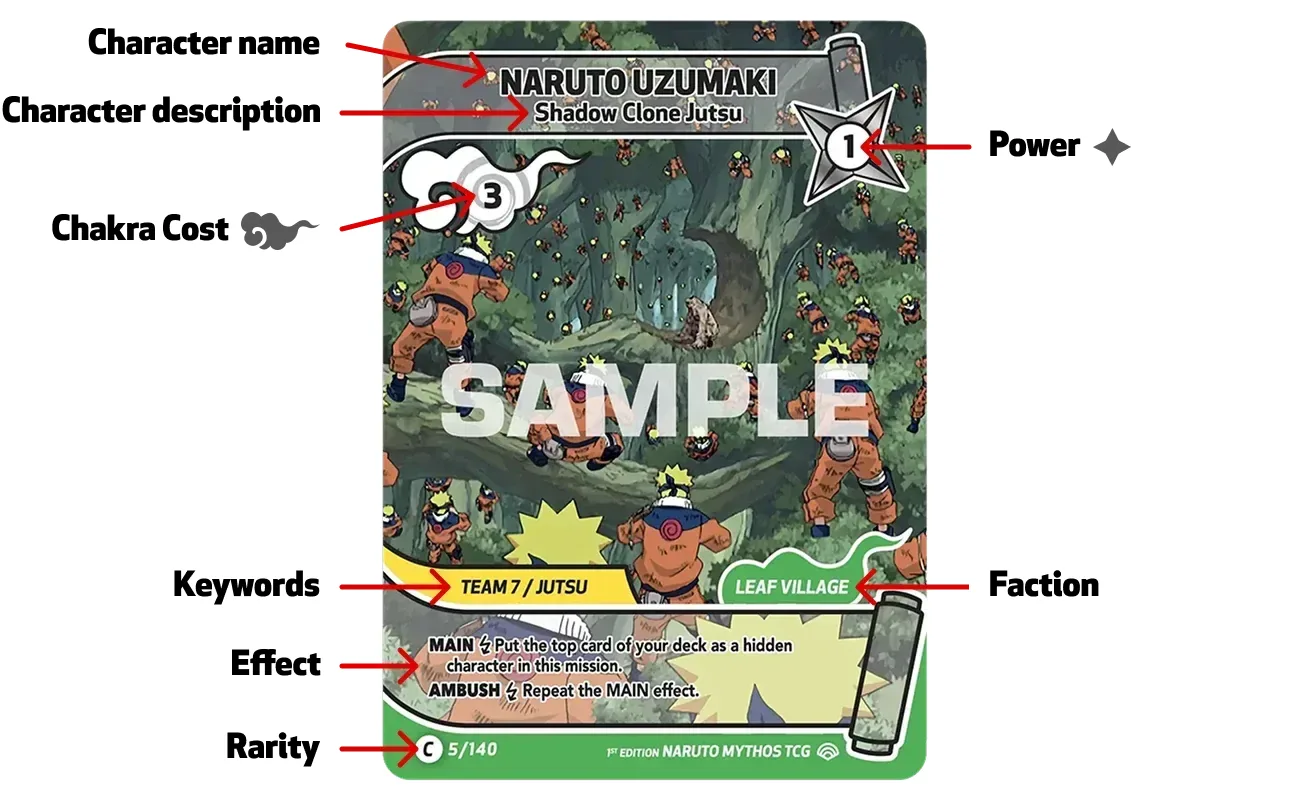
How to Play NARUTO Mythos TCG: Rules, Decks and Scoring
Our NARUTO Mythos TCG explainer covers the rules in a handful of bullets. This is the full walkthrough, built only from Cicaboom's rulebook, Tournament Rules, FAQ and Game Mechanics pages: the 30-card, two-per-number deck rules, how the coin flip decides whose Missions land where, the four ways to put a card on a Mission, why a hidden card pays for itself, how Set 2's Attachments work, and why the first Mission revealed can be scored four times while the last is scored once.
Naruto Shippuden Deck-Building Game — How It Actually Plays
Every Naruto card conversation right now is about a Bandai game that ships in Summer 2027, a Kayou product with no rulebook, or Cicaboom's NARUTO Mythos TCG, a two-player collectible game that is on shelves and already running Regionals. Meanwhile there is a complete, self-contained Naruto card game that Cryptozoic put out in 2014, seats up to five players in 45 minutes, and does something genuinely clever with Chakra. It was printed once and never reprinted. Here is how it actually works — setup, turn, Chakra Points, Hand Signs and the four-level Archenemy ramp — pulled from the official rulebook, the retailer solicitation sheet and the designer previews.
The Original Naruto CCG (2006-2013) — How Bandai's First Naruto Card Game Actually Worked
Before Kayou and before the NARUTO CARD GAME launching in 2027, Bandai shipped a full competitive Naruto TCG that ran 28 expansions and died in 2013. It had 40-card decks, a turn counter that gated what you could play, and a win condition that literally milled your opponent. Here is how it worked, pulled from the original Bandai rulebook and the card database — and what carried over into the new game.
NARUTO Mythos TCG Shinobi Shiren: Set 2 Cards and Rarities
Set 2 of NARUTO Mythos TCG has been in European stores since 4 September, and Cicaboom's Products page still lists it as "Coming soon". The official Collection Guide says a great deal more: 150 numbered cards, a new Attachment card type, four rarities Set 1 never had, and serialized runs of 300, 400 and 1,500. Here is the whole set, rarity by rarity, checked against the official card gallery and events page.
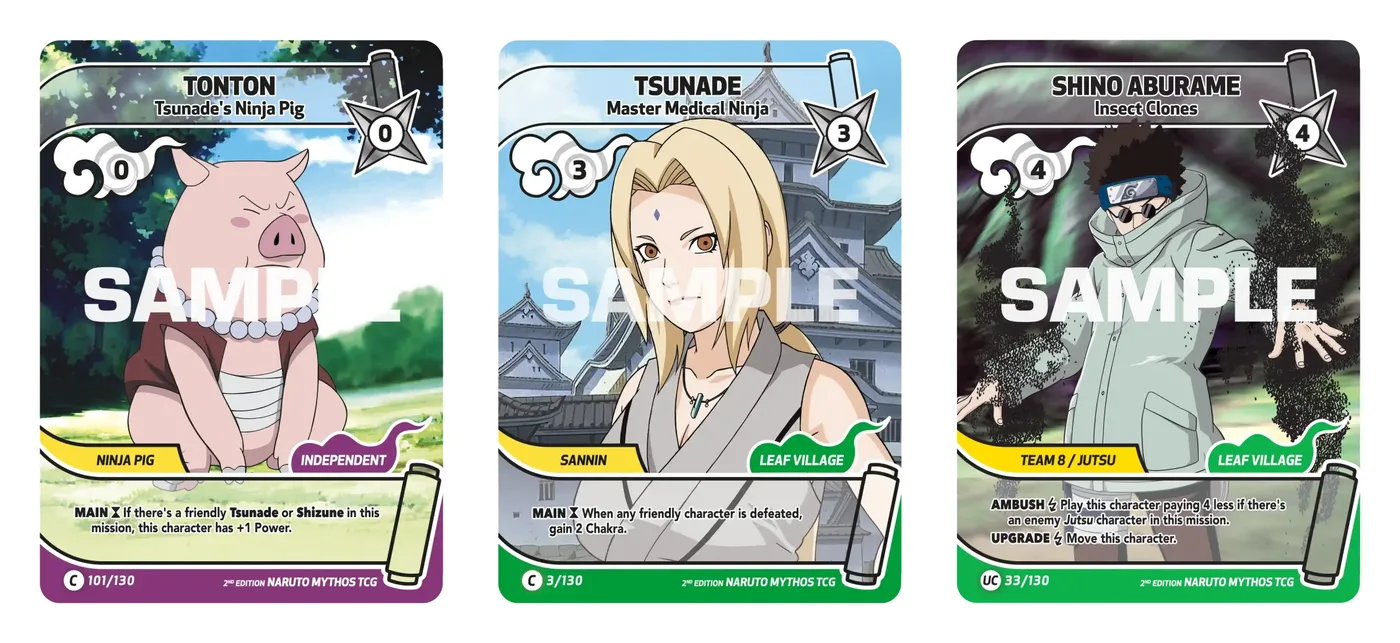
NARUTO Mythos TCG Orlando Regional: Results and Decklists
Cicaboom's website has not posted a result for either of its 2026 Regionals. The Orlando one is on TopDeck.gg anyway, the platform Cicaboom sent players to for registration, with final standings and 43 player-submitted decklists. The champion went 3-3 in the Swiss, took the last Top 16 seat on tiebreakers, and beat the only 6-0 player in the first round of the cut. Here is the bracket, the champion's 30 cards, and what the Top 16 had in common.