Naruto Shippuden Deck-Building Game — How It Actually Plays
Every Naruto card conversation right now is about a Bandai game that ships in Summer 2027, a Kayou product with no rulebook, or Cicaboom's NARUTO Mythos TCG, a two-player collectible game that is on shelves and already running Regionals. Meanwhile there is a complete, self-contained Naruto card game that Cryptozoic put out in 2014, seats up to five players in 45 minutes, and does something genuinely clever with Chakra. It was printed once and never reprinted. Here is how it actually works — setup, turn, Chakra Points, Hand Signs and the four-level Archenemy ramp — pulled from the official rulebook, the retailer solicitation sheet and the designer previews.
Three Naruto card products are getting all the oxygen right now. You cannot sit down and play two of them, and the third wants you to start a collection.
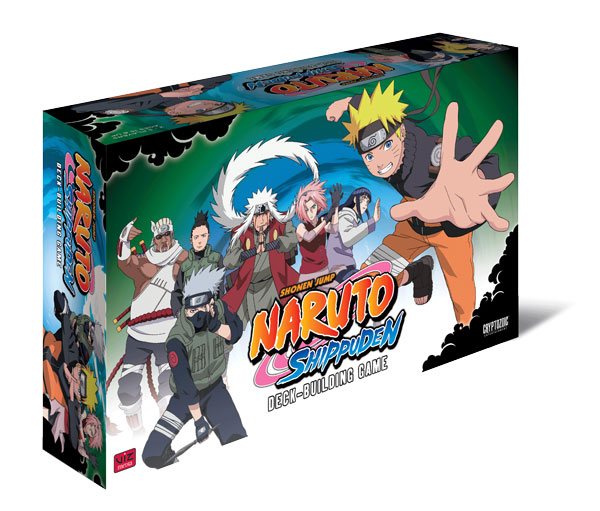
Bandai's NARUTO CARD GAME does not ship until Summer 2027. Kayou's cards are collectibles with no rulebook attached. Cicaboom's NARUTO Mythos TCG is the one you can actually buy and play today — it has a public rulebook, and Cicaboom ran Store Championships across Europe in summer 2026 and its first Regional Championship in Paris that September — but it is a two-player collectible TCG sold as Starter Packs, boosters and expansion sets, so one box is the start of a collection rather than the whole game. Bandai's original CCG has been out of print since 2013, so you would need to source a shoebox of it first. The one nobody brings up is the one that needs none of that: in 2014 Cryptozoic Entertainment put out the Naruto Shippuden Deck-Building Game, a complete boxed game for up to five players that needs no boosters, no collecting and no second purchase.
It never got an expansion and it quietly went out of print. It is also, mechanically, the most interesting thing anybody has done with a Naruto licence on cardboard. Everything below comes off Cryptozoic's own rulebook, product page, retailer solicitation sheet and designer previews rather than a decade of forum memory.
What Cryptozoic actually shipped, and what is in the box
ICv2 reported the game on 14 January 2014 for a summer release. The designer is Matt Hyra, Cryptozoic's lead board game designer since 2010; the rulebook credits the Cerberus Engine itself to Hyra and Erik Larsen. Cryptozoic's retailer solicitation sheet, with an order-due date of 7 March 2014, promised a July 2014 release. Cryptozoic's own product page ended up listing the release as 08.27.2014. About a month of slip is baked into the record.
The retail specs are consistent across every first-party document: $40.00 MSRP, 2 to 5 players, ages 15 and up, 30 to 45 minutes, ISBN 978-1-61768-350-3, packed six games to a case.
The card counts are not consistent. Cryptozoic's product page and the rulebook's own contents page disagree, and the rulebook disagrees with itself:
| Component | Cryptozoic product page | Rulebook contents page |
|---|---|---|
| Main Deck cards | 109 | 111 |
| Punch cards | 36 | 36 |
| Vulnerability cards | 16 | 16 |
| Kick cards | 16 | 16 |
| Weakness cards | 20 | 20 |
| Hand Sign cards | 12 | 12 |
| Archenemy cards | 12 | 12 |
| Oversized Character cards | 7 | 7 |
| Rulebook | 1 | 1 |
The gap is entirely in the main deck. Add the product page's list up and you get 221 small cards plus 7 oversized Characters; add the rulebook's list up and you get 223 plus 7 — under a header that says 211 Game Cards. Two first-party sources, three totals, no correction issued. If you are checking a used copy, count the stacks you actually care about rather than the grand total.
The seven playable Characters are Naruto, Kakashi and Sakura, plus Hinata, Jiraiya, Shikamaru and Killer Bee. That second group was not a design choice. Cryptozoic and Viz ran a public poll on the Shonen Jump website from 14 to 20 January 2014, offering ten secondary characters — Rock Lee and Sai were on the shortlist and did not make it — and the four winners went into the box.
Four of the seven Characters in this box were elected. That is a genuinely unusual thing for a licensed game to do, and it is why Killer Bee is playable in a game where Rock Lee is not.
First-printing copies came with a promo Minato Character card, and an oversized Mecha-Naruto promo followed later. Those two cards are the entire post-release content history — Cryptozoic never released an expansion.
Setting up before your first turn
The setup is fifteen minutes the first time and three minutes after that, but the Archenemy step has a shape that matters, so do it in this order.
- Deal Characters. Each player gets a random oversized Character, or everyone picks a favourite. From your second game on, the rulebook suggests dealing two per player and letting each of you choose one.
- Everyone starts identical. Seven Punch cards and three Vulnerability cards each. Punch is a Starter worth +1 Power. Vulnerability does nothing at all when drawn or played — it is dead weight you want to destroy.
- Shuffle the main deck, then deal the top five face up as the Line-Up.
- Set four stacks at the end of the Line-Up: 16 Kicks, 12 Hand Signs, 20 Weaknesses and the Archenemy stack. All the Kicks, all the Hand Signs and all the Weaknesses are in play every single game. Only the Archenemy stack changes.
- Build the Archenemy stack — Level 4 on the bottom, Level 1 face up on top. Full walkthrough further down.
- Randomly pick a first player. Everyone shuffles and draws five. Turns go clockwise.
Two setup rules people skip. Archenemies, Punch, Vulnerability, Kick, Hand Signs, Weaknesses and the oversized Characters never go into the main deck — the main deck is literally every other card. And Weaknesses are never bought; you only ever gain them from unfriendly card effects, while Kicks, Hand Signs and the current top Archenemy are always buyable while cards remain.
Know the ending before you start, because it arrives without warning: the game stops immediately the moment you cannot flip up a new Archenemy, or cannot refill all five Line-Up slots.
A deck-builder is not a TCG, and that is the point
This is the thing that trips people up when they find the box on a shelf and assume it is a starter for something bigger. It is not. There is no bigger.
In a deck-builder, everyone starts with the same ten cards, buys better cards out of a shared pool during the game, and throws the whole thing back in the box afterwards. You do not build a deck at home. You do not own singles. There is no format, no rotation, no organised play and no chase card, because the cards you want are sitting face up in the middle of the table where everyone can see them.
| Naruto CCG / NARUTO Mythos TCG / NARUTO CARD GAME | Naruto Shippuden Deck-Building Game | |
|---|---|---|
| Where your deck comes from | Built at home from a collection | Built during the game, from a shared row |
| What you buy | Boosters, starters, singles | One box, once |
| Players supported | 2 | 2 to 5 |
| What happens after the game | Your deck persists | Everything goes back in the box |
| Ongoing product | Sets, releases, reprints | None ever released |
That framing explains why it exists at all. By 2014 Bandai's Naruto CCG had been dead a year and Cryptozoic was not a trading card publisher — it was the studio running a house deck-builder engine across DC Comics and The Lord of the Rings. Naruto got the engine, not a card game line.
The Cerberus Engine in one turn
If you have played the DC Comics Deck-Building Game you already know eighty percent of this.
Play cards from your hand in whatever order you like. Total your Chakra and pay for Chakra abilities. Total your Power and buy anything from the Line-Up or the stacks whose combined cost is at or under that total. You can keep playing cards after you have bought, and you can pass entirely. Anything you buy or gain drops straight into your discard pile unless a card says otherwise, so it does nothing for you until your deck reshuffles.
Then end the turn in this order:
- Resolve any "at the end of your turn" effects, and return any Hand Signs you played to the Hand Sign stack.
- Discard everything you played plus anything still in hand. Unspent Power and Chakra are lost. Draw five.
- Refill every empty Line-Up slot off the main deck — not the moment you buy, only now.
- If the top card of the Archenemy stack is face down, flip it face up.
One habit to unlearn from other deck-builders: you do not reshuffle the moment your deck runs dry. You wait until you actually have to draw, discard or reveal a card, and only then does your discard pile become your new deck.
Locations are the one card type that sticks. They go to your discard pile when bought like anything else, but once you play one it stays face up in front of you for the rest of the game with an Ongoing ability you may use once during each of your turns. You can have any number out at once.
Scoring is the standard deck-builder trick: cards carry Victory Points and you count them at the end, pulling your Locations, your hand and your discard pile back into your deck first. The wrinkle is that every Weakness in your deck subtracts 1 Victory Point, so cards that hand out Weaknesses are doing real damage rather than just clogging draws. If two players tie on VP, whoever holds more Archenemy cards wins.
Chakra Points are the entire design
Here is the part that makes this game more than a Naruto reskin of the DC set.
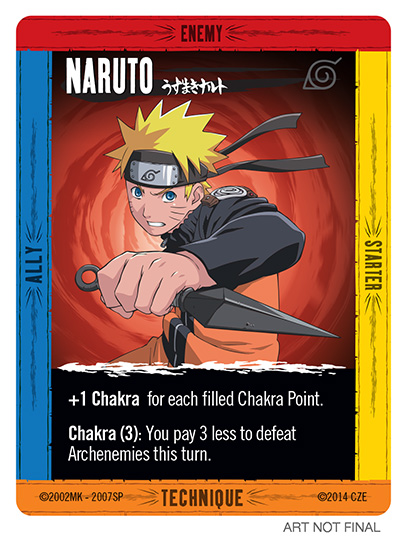
Your oversized Character card has four coloured edges, each labelled with a card type. When you play a matching card from your hand, you can slide it against that edge instead of just dropping it in front of you, and that generates +1 Chakra — immediately, before the card's own text resolves, which is what lets a card pay for its own Chakra ability.
Four points, so four Chakra a turn maximum from your Character. Each point takes exactly one card and it has to be empty — a second Punch played into an already-filled Starter point is just +1 Power and nothing else. Decide at the moment you play: if you choose not to put a card into a point, you cannot move it there later. Cards parked in Chakra Points are not stored either; they get discarded at end of turn like everything else you played.
Chakra spends like Power but only on Chakra abilities, and any unspent Chakra at the end of your turn is lost. A given card's Chakra ability can only be paid for once per turn unless the card says otherwise, and a face-down Character has no Chakra Points and no Chakra ability at all.
The shipped Naruto card carries two Enemy points, one Ally and one Starter, per the rulebook. The pre-release gallery image above — stamped ART NOT FINAL by Cryptozoic — shows a Technique edge along the bottom where the finished card has a second Enemy. If you have seen that image floating around as a rules reference, it is out of date.
Naruto's printed text reads "+1 Chakra for each filled Chakra Point," then "Chakra (3): You pay 3 less to defeat Archenemies this turn." That first line restates the base rule rather than doubling it — Cryptozoic's own worked example finishes with four points filled and 4 Chakra, not 8.
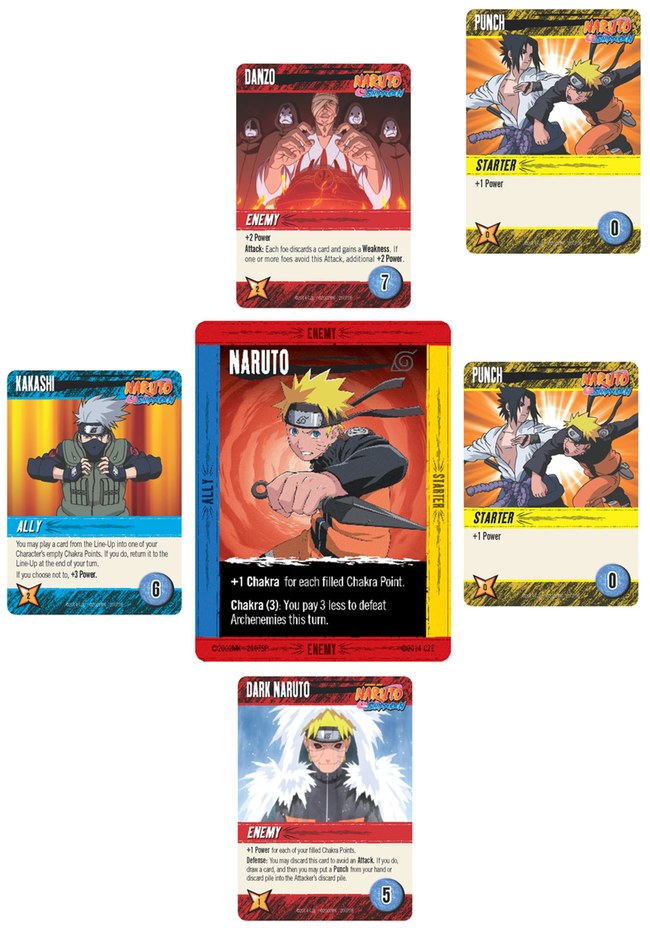
That worked example is the cleanest way to see the loop, so here it is exactly as Cryptozoic published it:
- Play a Punch into the Starter point: +1 Chakra, +1 Power. The second Punch in hand cannot go into that now-filled point, so it is just +1 Power.
- Play Danzo, an Enemy costing 7, into an Enemy point: +1 Chakra, +2 Power, and an Attack that makes each foe discard a card and gain a Weakness.
- Play Kakashi, an Ally costing 6, into the Ally point: +1 Chakra. Kakashi reads "You may play a card from the Line-Up into one of your Character's empty Chakra Points. If you do, return it to the Line-Up at the end of your turn. If you choose not to, +3 Power."
- Take the fetch: pull Dark Naruto, an Enemy costing 5, out of the Line-Up into the last empty point. +1 Chakra, and Dark Naruto reads "+1 Power for each of your filled Chakra Points" — all four are filled, so +4 Power.
That is 8 Power and 4 Chakra from a hand that opened with two Punches, and 8 is exactly enough. The Archenemy face up in Cryptozoic's example is Nagato at cost 11, and Naruto's Chakra (3) ability takes 3 off.
Kakashi's fetch does not care which point you fill — it reaches into any empty Chakra Point on your Character. The real question is whether the card you pull beats a flat +3 Power, because whatever you pull goes back to the Line-Up at the end of your turn for the next player to buy.
The rulebook flags the same trade-off for Hinata, with one hard edge: you cannot put either of them into an Ally Chakra Point after the ability has resolved. Order of play is the whole puzzle, and there is no undo.
What buying a Hand Sign actually does to your deck
Twelve Hand Signs sit in their own stack next to the Kicks, Weaknesses and Archenemies, always available while the stack has cards in it.
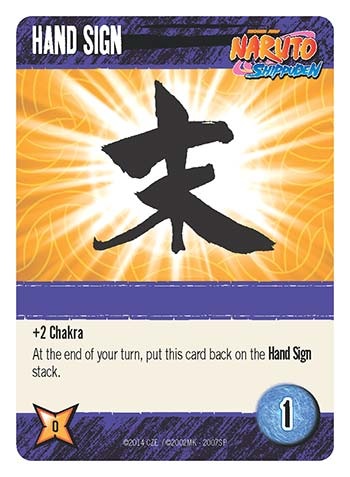
They cost 1 Power, are worth 0 Victory Points, and read "+2 Chakra. At the end of your turn, put this card back on the Hand Sign stack."
Read that second line carefully, because it is the one people get backwards. Buying a Hand Sign is not renting it. Buying is buying: like every other purchase in this game it lands in your discard pile and becomes part of your deck. What is unusual is the exit. A Hand Sign leaves your deck the turn you play it, and only if you play it — the rulebook is explicit that "if you don't wish to lose a Hand Sign, simply keep it in your hand and then discard it at the end of your turn," in which case it stays in your deck for another lap.
So a Hand Sign is a one-shot you paid 1 for. It clogs exactly one draw and then removes itself. At 0 VP that is still an excellent rate, but it is not free of your deck, and buying four on a big Power turn means four cards to draw through before any of them do anything.
Two more details that decide games:
- You cannot buy a Hand Sign you played this turn, because played ones do not go back until end of turn. If the stack is empty you cannot buy one at all.
- Hand Signs have no card type, the same as Weaknesses. They cannot be played into a Chakra Point and they will not trigger anything that counts card types. Hyra's own warning: they "won't combo too well with anything looking for different card types."
Each of the twelve carries a different animal of the Chinese zodiac as its kanji. All twelve do the identical thing. It is pure art variance, and it is a nice touch.
Now the ceiling, because this is the other thing that gets misreported. Your Character generates at most 4 Chakra a turn, one per point, and plenty of cards want more. Hand Signs are the cheapest and most reliable way past that ceiling — they are not the only way. Cryptozoic's retailer sheet says so outright: "There are some cards that also generate Chakra, so you are not limited to just the four that your Character can generate. One of the best ways to generate Chakra is with Hand Signs." Hyra hedges identically in his preview: "one of the best ways." The rulebook's card clarifications back it up — Shark Skin doubles all the Chakra you have generated and not yet spent plus anything you generate later that turn, Gakido hands you a Hand Sign straight off the stack, and the Gentle Step Twin Lion Fists entry spells out the general case: even with a face-down Character and no Chakra Points at all, "you may still generate Chakra and use Chakra abilities with cards you play."
Positive Attacks flip defending on its head
The other genuinely new mechanic, and the one most likely to cause an argument at the table.
A normal attack hurts your opponents, and they may each play a Defense card to avoid it — one Defense per attack, and avoiding it only protects the player who defended. A Positive Attack does the opposite: it benefits only you. Your opponents still get to interact with it, using the exact same Defense cards, but now they are spending resources to deny you a bonus rather than to protect themselves.
The resolution rules are tight, and worth reading before your first game:
- Starting with the player on your left and continuing clockwise, each opponent gets one chance to stop it.
- The moment one player stops it, nobody else gets a chance and you get nothing.
- You cannot pass and then change your mind after later players fail.
- You cannot avoid your own Positive Attack.
- If it is stopped, the card does nothing else — but it still fills the Chakra Point you played it into, and since Chakra is generated the instant a card enters a point, you keep that Chakra too.
The rulebook is also strict about what counts. Per the Shadow Stitching clarification, a card is only a Positive Attack if it literally has "Positive Attack:" in its text box followed by an attack effect. Shadow Stitching uses the words without the colon and without an attack, so it does not qualify.
Hyra was candid that these are "overpowered cards, to be sure" — and that the whole balance rests on them being stoppable. He also documented the obvious exploit before anyone else could: lead with a small ordinary attack to bait Defenses out of opponents' hands, then follow with the Positive Attack once nobody can answer it.
That single interaction turns Defense cards from a safety net into a resource you have to budget. Burning one on a two-card discard because it was scary in the moment is how you hand the leader a free swing.
The Archenemy stack is a four-level difficulty ramp
This is the part the box does not explain on the back, and it is the reason the game has a shape at all. The twelve Archenemies are sorted into four Levels, printed in the middle info bar of each card:
| Level | Cards in the box | How many reach the table |
|---|---|---|
| Level 1 | 1 (Orochimaru) | Always 1 |
| Level 2 | 5 | 3, drawn at random |
| Level 3 | 5 | 3, drawn at random |
| Level 4 | 1 (Tobi) | Always 1 |
A standard game uses eight of them, and you build the stack from the bottom up:
- Tobi goes face down on the table. He is always the last boss you face.
- Shuffle the five Level 3 cards, take three at random, place them face down on Tobi. The other two go back in the box.
- Shuffle the five Level 2 cards, take three at random, place them face down on top of those. Two more sit out.
- Orochimaru goes face up on top.
So the six variable slots are not six free picks from twelve. They are 3-of-5 and 3-of-5 out of a pool of ten, with the two bookends fixed, and the stack always runs Level 1, then three Level 2, then three Level 3, then Tobi. That works out to 10 x 10 = 100 different eight-boss casts, and because the three cards inside each level land in a random order, 60 x 60 = 3,600 distinct stacks. Want a longer game? Use more than eight. Orochimaru and Tobi are in either way.
The Level number is live rules text, not flavour — Choji reads its X off the Level of the current Archenemy, and you do not get to choose that value.
Every Archenemy except Orochimaru carries a Group Attack, and it fires exactly once, at the moment the card is turned face up. That flip happens at the end of a turn, which means Group Attacks land between turns rather than during anybody's. Each player may answer with a Defense card; anyone who does not, eats it. Beating a boss hands the whole table a new problem, and Orochimaru — face up from setup — is the one Archenemy that never gets to swing.
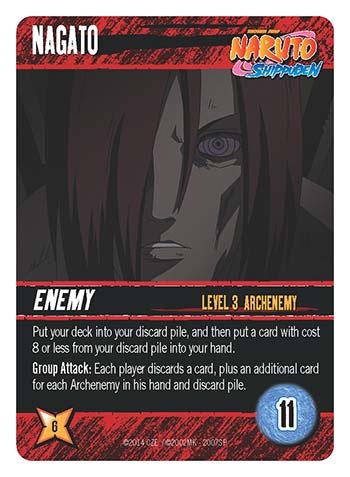
Archenemies cost between 8 and 13, and since the stack is randomised you check the cost on whatever is face up. Nagato is a good worked example: a Level 3 Archenemy costing 11, worth 6 Victory Points, whose Group Attack makes each player discard a card plus an additional card for every Archenemy in their hand and discard pile. His own text, once he is in your deck, dumps your deck into your discard pile and then puts a card costing 8 or less from that pile into your hand.
Read that Group Attack again, because it is the sharpest bit of design in the box: it punishes you in proportion to how many Archenemies you have already collected. The player in the lead takes the worst of it. A licensed anime deck-builder shipped a self-correcting rubber band and did not make a fuss about it.
Three rules govern the whole subsystem. You may defeat at most one Archenemy per turn — the next card stays face down until your turn is over. "Defeat" just means buy or gain, and defeated Archenemies go into your own deck as playable cards. And Archenemies are Enemies, with Archenemy being a title rather than a card type, which means a defeated boss can later be slotted straight into an Enemy Chakra Point and does not count as two card types. That is why Naruto's pay-3-less ability is as strong as it is, and why the tiebreak is decided on Archenemy count.
Mixing it with your other Cerberus Engine boxes
If you own the DC Comics or Lord of the Rings deck-builders, the rulebook prints its own translation table:
| Naruto | Other Cerberus Engine games |
|---|---|
| Ally | Hero |
| Enemy | Villain |
| Technique | Super Power |
| Character | Super Hero |
Two catches. No other Cerberus Engine game uses Chakra, so if you want to play a borrowed Character you have to park a Naruto oversized Character next to it purely to supply the Chakra Points — and whether the borrowed Character also keeps its own ability is your call. And do not just shuffle everything together: Cryptozoic warns that dumping 220-plus main deck cards from another set into this one dilutes the combos in both, and recommends favouring the Naruto main-deck cards that carry Chakra abilities.
Where this sits between 2006 and 2027
Five Naruto card products now exist, and this is the only one that is a self-contained boxed game rather than a card line.
| Naruto CCG (2006-2013) | Shippuden Deck-Building Game (2014) | NARUTO Mythos TCG (2026) | NARUTO CARD GAME (Summer 2027) | |
|---|---|---|---|---|
| Publisher | Bandai | Cryptozoic | Cicaboom | Bandai |
| Format | Collectible TCG | Boxed deck-builder | Collectible TCG | Collectible TCG |
| Players | 2 | 2 to 5 | 2 | 2 |
| Ongoing purchases | 28 expansions | None | Boosters and expansion sets | Expected |
| Playable today | Only with old cards | Yes, with one box | Yes | No |
It is worth being blunt about what the 2014 box does not do. It has no metagame, no deck to tune between sessions, and no reason to come back beyond the fact that the game itself is good. Thirty-six hundred stack arrangements sounds like a lot, but you always open on Orochimaru and close on Tobi, and the six in between come from a pool of ten. A TCG's variety comes from what other people bring; this one's comes from a shuffle, and a shuffle runs out of surprises faster.
What it does do is the one thing none of the card lines do. Bandai's 2027 title is a two-player duel built around a Leader card and a Life total, the 2006 CCG was two-player as well, Mythos is written for two players on its own How to Play page, and Kayou's cards have no rules at all. Of the five, the Cryptozoic box is the only one that seats more than two people. That was true twelve years ago and it will still be true the week Bandai's game lands.
Quick Action Checklist
- Check which product you are looking at before buying anything — a Cryptozoic box says Deck-Building Game on the front and contains a rulebook, unlike Kayou's collectible packs.
- Confirm a used copy has all 7 oversized Character cards and the rulebook; the small cards are replaceable, the oversized Characters are not.
- Do not trust the printed totals when you count a used copy. Cryptozoic's product page says 109 main deck cards and the rulebook says 111, and the rulebook's own header does not match its own list.
- Build the Archenemy stack bottom-up and in level order — Tobi, three Level 3, three Level 2, Orochimaru face up — or the difficulty ramp the game is built on simply does not happen.
- Teach it with the Chakra Points first and everything else second; the four coloured edges are the only rule that is not standard deck-builder boilerplate.
- Buy Hand Signs for the turn you want them, not by reflex. Each one sits in your deck until you play it, so four at once is four cards to draw through.
- Play your fetch cards before you fill the point they want, and hold at least one Defense once somebody is a boss ahead — Positive Attacks are only balanced if somebody can actually stop them.
- Ignore the pre-release gallery card that shows Naruto with a Technique Chakra Point; the shipped card has two Enemy points, and the rulebook is the authority.
Frequently Asked Questions
Is there a Naruto card game I can play right now?
How does the Naruto Shippuden Deck-Building Game work?
What are Chakra Points in the Naruto deck-building game?
Do Hand Sign cards go into your deck?
How does the Archenemy stack work?
What is a Positive Attack?
Did the Naruto Shippuden Deck-Building Game ever get an expansion?
Keep Reading
- Naruto Card Game Blog Hub
- The Original Naruto CCG (2006-2013)
- Naruto Card Game Explained: Bandai, Kayou or Mythos?
- NARUTO Mythos TCG: The Card Game Already on Shelves
- NARUTO CARD GAME at Gen Con 2026
- Kayou Naruto Cards Explained
- How to Play the Pokemon TCG
- How to Play Disney Lorcana
- How to Play the Gundam Card Game
- Naruto Shippuden Deck-Building Game official Cryptozoic rulebook (PDF) — setup, turn sequence, Chakra Points, Hand Signs, Archenemy Levels, card clarifications
- Cryptozoic Entertainment — Naruto Shippuden Deck-Building Game product page (box contents, MSRP, player count, 08.27.2014 release date)
- Cryptozoic retailer solicitation sheet — Chakra Point cap, other Chakra sources, ISBN 978-1-61768-350-3, order-due 7 March 2014 and a July 2014 target
- Cryptozoic First Look Part 1 (20 May 2014) — the Chakra Cross worked example, Kakashi, Danzo and Dark Naruto
- Cryptozoic First Look Part 2 by Matt Hyra (8 August 2014) — Hand Signs and Positive Attacks
- ICv2 — Naruto Shippuden Deck-building Game announcement and character poll (14 January 2014)
- NARUTO Mythos TCG official site (Cicaboom Srl) — game on sale, store locator, Regional Championship listings, checked 26 September 2026
- NARUTO Mythos TCG How to Play — two-player, four-round structure
- NARUTO Mythos TCG Store Championship hub — 26 June to 12 July 2026 season, TopDeck registration
- Cicaboom announcement, "The Official Locations Are Here!" — Store Championships "in selected partner stores across Europe", dated 27 June to 12 July 2026 on this page
- The First NARUTO Mythos TCG Regional — Paris Montreuil Expo, 11-13 September 2026
Related Guides
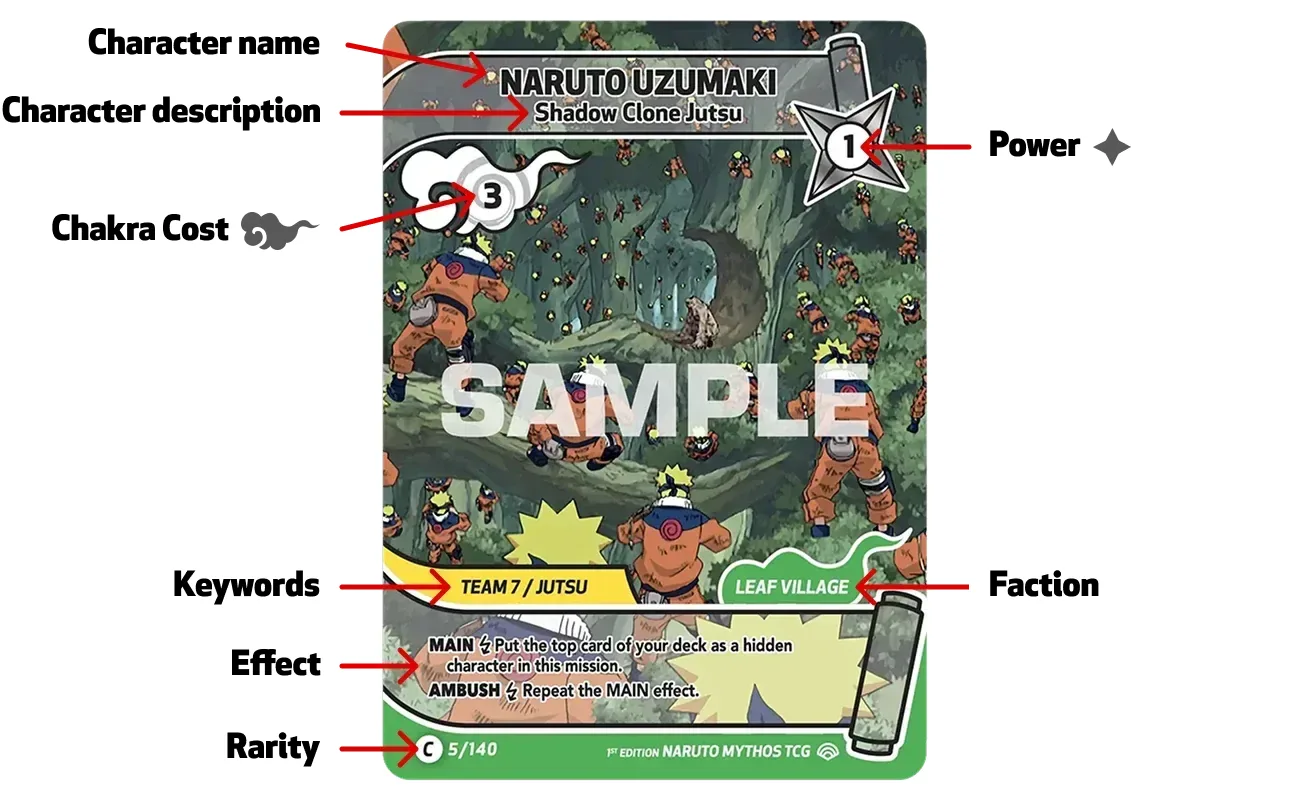
How to Play NARUTO Mythos TCG: Rules, Decks and Scoring
Our NARUTO Mythos TCG explainer covers the rules in a handful of bullets. This is the full walkthrough, built only from Cicaboom's rulebook, Tournament Rules, FAQ and Game Mechanics pages: the 30-card, two-per-number deck rules, how the coin flip decides whose Missions land where, the four ways to put a card on a Mission, why a hidden card pays for itself, how Set 2's Attachments work, and why the first Mission revealed can be scored four times while the last is scored once.
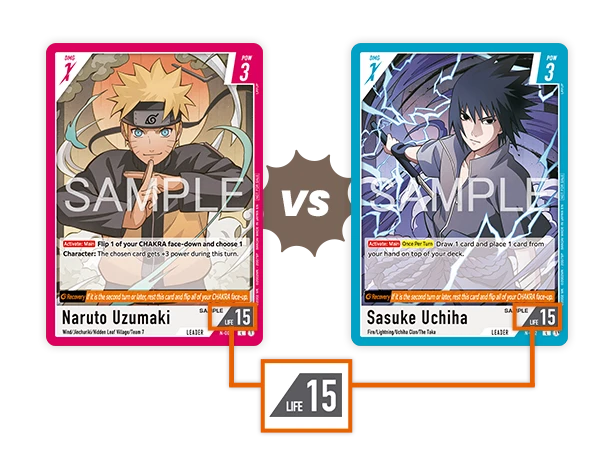
Naruto Card Game Rules Text: 15 Life, 4 Card Backs
The NARUTO CARD GAME sample cards that circulated around Gen Con were full-art showcase pieces with no text box, and the honest summary at the time was that Bandai had published no card text at all. That is no longer the case. Bandai's own ABOUT page carries seven cards with printed rules text, sitting in the card-type and how-to-play blocks rather than the showcase gallery, and between them they cover three of the gaps our launch coverage listed as unknown: the Leader's starting Life, how a Chakra cost is notated, and what the keyword vocabulary looks like.
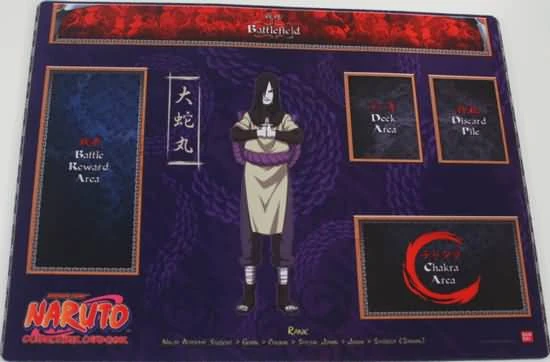
The Original Naruto CCG (2006-2013) — How Bandai's First Naruto Card Game Actually Worked
Before Kayou and before the NARUTO CARD GAME launching in 2027, Bandai shipped a full competitive Naruto TCG that ran 28 expansions and died in 2013. It had 40-card decks, a turn counter that gated what you could play, and a win condition that literally milled your opponent. Here is how it worked, pulled from the original Bandai rulebook and the card database — and what carried over into the new game.

NARUTO Mythos TCG Münster Regional: Prizes and Side Events
Cicaboom's third NARUTO Mythos TCG Regional runs 27 to 29 November 2026 in Münster, Germany. Paris listed three scheduled side events; Münster lists eleven, including four alternative formats. Here is what each ticket costs, what every Main Event placement wins, how Mini-Mythos, Evolving, Bad Deck and Highlander work, and the Tournament Rules update that takes effect today.
Naruto Card Game Explained: Bandai, Kayou or Mythos?
Search "Naruto cards" and you get three unrelated products stacked on top of each other: a competitive TCG from Bandai that nobody can buy until Summer 2027, a line of Chinese-made collectible cards from Kayou that has been in Walmart since 2025, and a third game — Cicaboom's NARUTO Mythos TCG — that has been on European shelves since March 2026 and is already running sanctioned tournaments. Here is exactly what each one is, what each publisher has actually confirmed, and which one the person asking the question actually wants.
Naruto Card Game Premier Demo Events: Dates and Prices
Bandai published its NARUTO CARD GAME Premier Demo Event pages on 13 October, and its four regional sites describe three different versions of the event. English-site stores run two waves from 5 February to 5 March 2027, Japan names 11 stores from 16 January, and the Asia pages plan early January behind a face-photo check. Here are the dates, how to apply, the two demo decks, and what the $20 CHAKRA Set and $40 playmat actually contain.