Palworld TCG Lucky Pals - All 24 in the Launch Pool, and How Many to Run
The Lucky Pal icon is the single most important number in Palworld TCG deck-building, and almost nobody has counted the pool. I pulled every card from Bushiroad's own card database and found 24 Lucky Pals across the three launch products - six per colour, at costs 5, 6, 7, 7, 8 and 8, in all four colours, identically. Not one of them is a Common. Here is the full list, the real cancel probabilities, and why raising your Strike is the worst way to beat them.
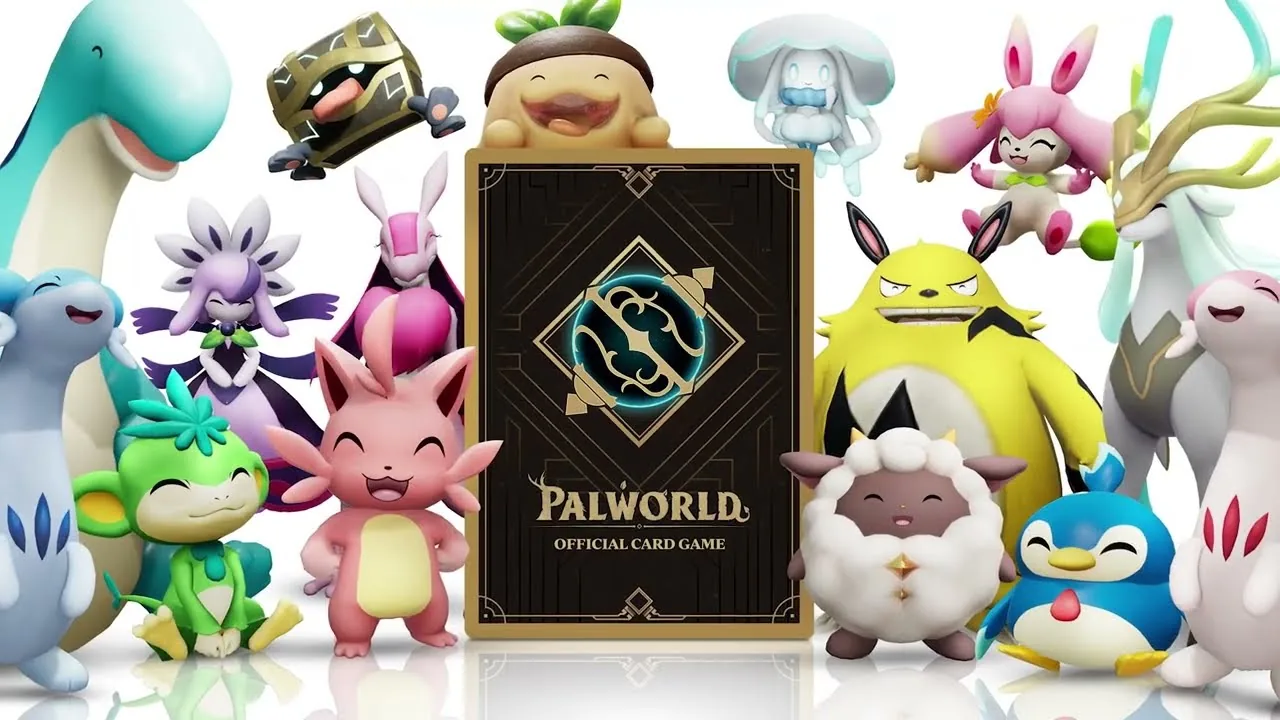
Every Lucky Pal in the Palworld TCG costs at least 5 souls. All twenty-four of them.
I pulled all 243 rows out of Bushiroad's own card-list API on 2 August 2026, collapsed the parallel treatments down to base card numbers, and counted. Twenty-four Lucky Pals exist across the three launch products. The cheapest is a 5-drop. There is nothing at 2, 3 or 4.
That single fact reframes the whole eight-card cap. Your damage cancellation is not a cheap insurance policy you slot in around the edges - it is the top of your curve, and it is competing for the exact slots your finishers want.
What the Lucky icon actually does
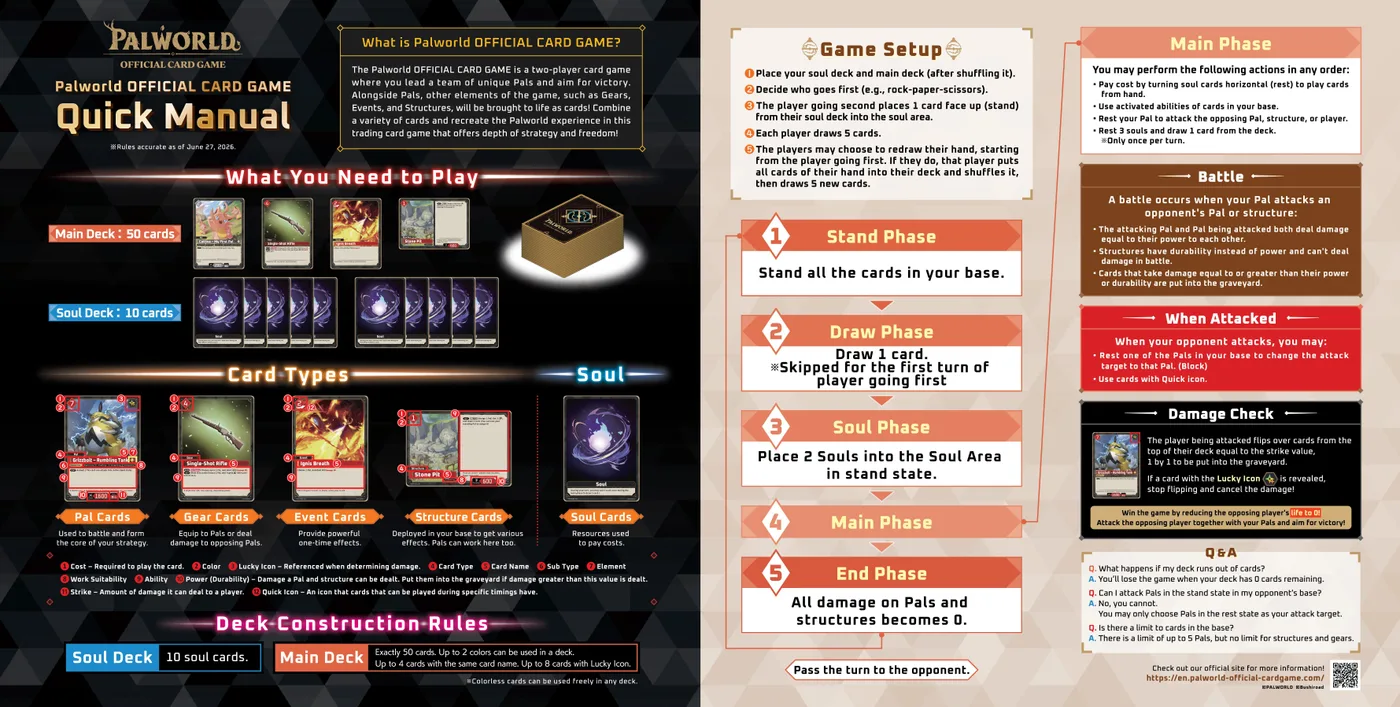
First, a naming thing, because it trips people up when they go looking in the rulebook. The English Comprehensive Rules ver. 1.00 never use the phrase "Damage Check" - not once. That is community shorthand borrowed from Cardfight Vanguard, and yes, our own how to play the Palworld TCG guide uses it too, because it is what everyone at the table says. The rules call it player damage resolution, section 11.2.
Here is the actual loop, and the order matters:
- Put the top card of your deck into your graveyard.
- If that card has a Lucky Pal icon, jump straight to step 4. You lose no life.
- Otherwise, if the number of cards you have milled during this resolution is equal to or greater than the damage you took - or your deck is empty - lose that much life, then go to step 4.
- Set damage taken to 0. Resolution ends.
Three consequences that come straight out of that wording.
It is all or nothing. You do not lose partial life. A single Lucky Pal revealed against a Strike 4 hit cancels the entire four, not one point of it.
You stop the moment you hit one. Against a Strike 3 attack you mill at most three cards, and often fewer, because the loop exits early on a hit.
An empty deck turns the shield off. That "or the number of cards in that deck is zero" clause means a decked-out player takes the full damage with no chance to cancel - which matters in a double-loss race.
One for the rules nerds: rule 6.1.1.3 cross-references section 2.9 for the Lucky Pal icon. Section 2.9 is Strike - the Lucky Icon is 2.10, which rule 11.2.2.2 cites correctly. A typo in ver. 1.00.
Eight is a ceiling, not a plan
Rule 6.1.1.3: the main deck may include up to a total of 8 cards with the Lucky Pal icon.
Note the word cards. Not names. Eight is eight physical pieces of cardboard, so two names at four copies each is legal, and so is eight different names at one copy each, and so is everything in between. The separate 4-per-name rule still applies on top.
Nothing forces you to run eight. Zero is legal. And unlike most format-defining numbers in a new game, this one is not a matter of taste - the correct answer is very close to "always eight", and the maths below is why.
The cancel odds, by Strike and by count
Chance that an incoming attack is fully cancelled, off a fresh 50-card deck:
| Incoming Strike | 8 Lucky | 6 Lucky | 4 Lucky | 2 Lucky |
|---|---|---|---|---|
| 1 | 16.0% | 12.0% | 8.0% | 4.0% |
| 2 | 29.7% | 22.8% | 15.5% | 7.9% |
| 3 | 41.4% | 32.4% | 22.6% | 11.8% |
| 4 | 51.4% | 41.1% | 29.1% | 15.5% |
Compare the 8-Lucky and 4-Lucky columns. Against a Strike 1 poke, halving your count barely registers - 16% to 8%. Against the fat hits it is brutal: a Strike 4 attack goes from a coin flip to a 29% cancel. The cards that punish you for skimping are exactly the cards that end games.

Chillet – Dragon Whisperer is one of four Lucky Pals tied for cheapest at 5 souls, and the only one of them printed at RR. Below it, the curve is all Normal Pals.
Why big Strike numbers get taxed
Now flip the table around and ask what an attack is actually worth. Expected life removed per attack, against a full eight Lucky Pals:
| Attacker's Strike | Expected life removed | Per point of Strike |
|---|---|---|
| 1 | 0.84 | 0.84 |
| 2 | 1.41 | 0.70 |
| 3 | 1.76 | 0.59 |
| 4 | 1.94 | 0.49 |
Going from Strike 3 to Strike 4 is a 33% increase in the printed number and a 10.6% increase in expected damage. That is the tax, and it is progressive - the bigger your Strike, the more you hand the defender's deck for free.
Run it out to a kill. Simulating 60,000 games at 10 life, Strike-3 attacks only, into a 50-card deck:
- No Lucky Pals: 4.00 attacks to kill.
- Four Lucky Pals: 5.08 attacks.
- Eight Lucky Pals: 6.60 attacks.
A full Lucky count buys you two and a half extra attacks of survival against a Strike 3 board, and against Strike 4 it stretches from 3.00 to 5.82 - a 94% increase. That is the largest single defensive effect available in the game, and it costs you no souls, no board space, and no cards in hand.
So does that mean wide-and-small beats tall-and-big? Not quite, and this is where a lot of early takes go wrong. Attacks are limited by bodies, not by Strike points - you have a 5-Pal ceiling, and each attack rests the Pal that made it. If your constraint is attack slots, bigger Strike still wins per attack, because 1.94 beats 0.84. The honest conclusion is narrower and more useful: Strike is the stat with the worst returns per point in this game, so pay souls for Power and take Strike as a bonus.
The wall does not wear down
Here is the counter-intuitive bit, and it is the part I did not expect before running it.
I simulated eight consecutive Strike-3 attacks into the same 50-card, 8-Lucky deck, tracking the cancel rate of each attack in sequence. Attack one: 41.5%. Attack eight: 41.6%. Flat, within simulation noise, the whole way down.
That is not how damage protection usually works. In Vanguard your damage zone fills up; in the Pokemon TCG your prize cards run out. Here every cancel eats a Lucky Pal, but the whiffs mill Normal Pals at exactly the rate that keeps the ratio steady - you are walking down one shuffled deck, and every segment of a shuffled deck looks the same.
So do not play for the opponent's shield to break. It does not break. And do not worry about decking yourself either: a lethal Strike-3 race burned an average of 17 of 50 cards, and 0 out of 200,000 simulated games ended in a deck-out from damage resolution alone.
Every Lucky Pal costs 5 or more, and the grid is mirrored
Now the card pool. Twenty-four Lucky Pals: sixteen in Booster Pack "Dawn of Palpagos" (EBP01), four in Trial Deck "Dawn of Palpagos Red・Blue" (ETD01), four in Trial Deck "Dawn of Palpagos Green・Purple" (ETD02).
Six per colour. Exactly six, in all four colours. And their costs are:
5, 6, 7, 7, 8, 8. In red. And in blue. And in green. And in purple.
Identically. Every colour gets one Lucky Pal at each of costs 5, 6, 7 and 8 from the booster, and the trial decks add a 7 and an 8 to the two colours they cover. I checked all four columns three times because I did not believe it the first time.
Rarity, meanwhile, is deliberately not mirrored - the cost-5 Lucky Pal is an RR in blue, an R in red and green, and a U in purple. Bushiroad locked the shape of the slot and scattered the chase cards across it, which stops one colour becoming the obvious pull target.
The consequence for your deck is blunt. Eight Lucky Pals means eight of your fifty cards cost 5 or more souls before you have added a single finisher, a single removal spell, or a single expensive structure. At the top of the curve the pool barely gives you a choice: at cost 7 and again at cost 8, Lucky Pals outnumber Normal Pals eight to four.
They are also the best cards in the set
This is the part that makes the eight-card cap feel less like a tax and more like a rationing card.
- All three Strike-4 Pals in the entire launch pool are Lucky Pals - Mammorest – Roar of the Wilds, Jormuntide Ignis – Savage Lava Dragon, and Grizzbolt – Rumbling Tank. There is no Normal Pal at Strike 4.
- The biggest body in the game is a Lucky Pal. Mammorest – Roar of the Wilds sits at 2000 Power, 300 clear of the next card down.
- Seven of the eight RR Pals in Dawn of Palpagos are Lucky Pals. The only Normal Pal at RR is Relaxaurus – Hungry Gunner.
- Not one Lucky Pal in the set is a Common. Every one of the sixteen booster Lucky Pals is U, R or RR; the other eight are trial-deck exclusives. All 34 Commons in the set are Normal Pals, structures, gear and events.
The eight slots are not a defensive allowance you grudgingly pay - they are the eight best top-end bodies you are allowed to own. Bushiroad put the shield on the payoff cards rather than on a cycle of vanilla 2-drops, and that is the better call.
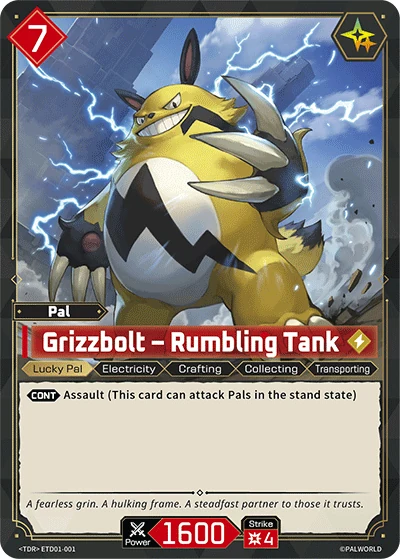
Grizzbolt – Rumbling Tank is the clearest example: Strike 4, 1600 Power, Assault so it can attack standing Pals, one line of text, and it comes in a trial deck. It is also a red card with the Electric element, a reminder that colour and element are separate fields.
All 24 Lucky Pals in the launch pool
Current as of Bushiroad's card database on 2 August 2026. Rarities are the base printing. Twenty-one of the twenty-four also exist in at least one parallel treatment - SR, SP, SSP, OSR, TSR or TSP - and every trial-deck Lucky Pal has a TSR version. Parallels do not change what the card does.
| Card | Colour | Cost | Power / Strike | Rarity (product) |
|---|---|---|---|---|
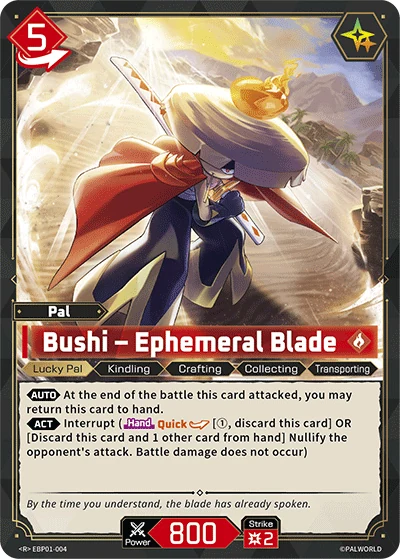
| Bushi – Ephemeral Blade | Red | 5 | 800 / 2 | R (EBP01) |
| Ragnahawk – Emberwing Striker | Red | 6 | 1000 / 2 | U (EBP01) |
| Suzaku – Hellfire Wings | Red | 7 | 1200 / 3 | RR (EBP01) |
| Grizzbolt – Rumbling Tank | Red | 7 | 1600 / 4 | Trial deck (ETD01) |
| Jormuntide Ignis – Savage Lava Dragon | Red | 8 | 1700 / 4 | RR (EBP01) |
| Blazamut – Molten Sovereign | Red | 8 | 1600 / 3 | Trial deck (ETD01) |
| Chillet – Dragon Whisperer | Blue | 5 | 900 / 2 | RR (EBP01) |
| Azurobe – Water Dragon Waltz | Blue | 6 | 1200 / 2 | R (EBP01) |
| Wumpo – Frostpeak Sentinel | Blue | 7 | 1500 / 3 | U (EBP01) |
| Suzaku Aqua – Way of the Current | Blue | 7 | 1200 / 3 | Trial deck (ETD01) |
| Jormuntide – Surging Sea Serpent | Blue | 8 | 1600 / 3 | R (EBP01) |
| Mammorest Cryst – Roar of the Tundra | Blue | 8 | 1700 / 3 | Trial deck (ETD01) |
| Elizabee – Queen of the Flower Garden | Green | 5 | 700 / 2 | R (EBP01) |
| Digtoise – Seismic Drillback | Green | 6 | 900 / 2 | RR (EBP01) |
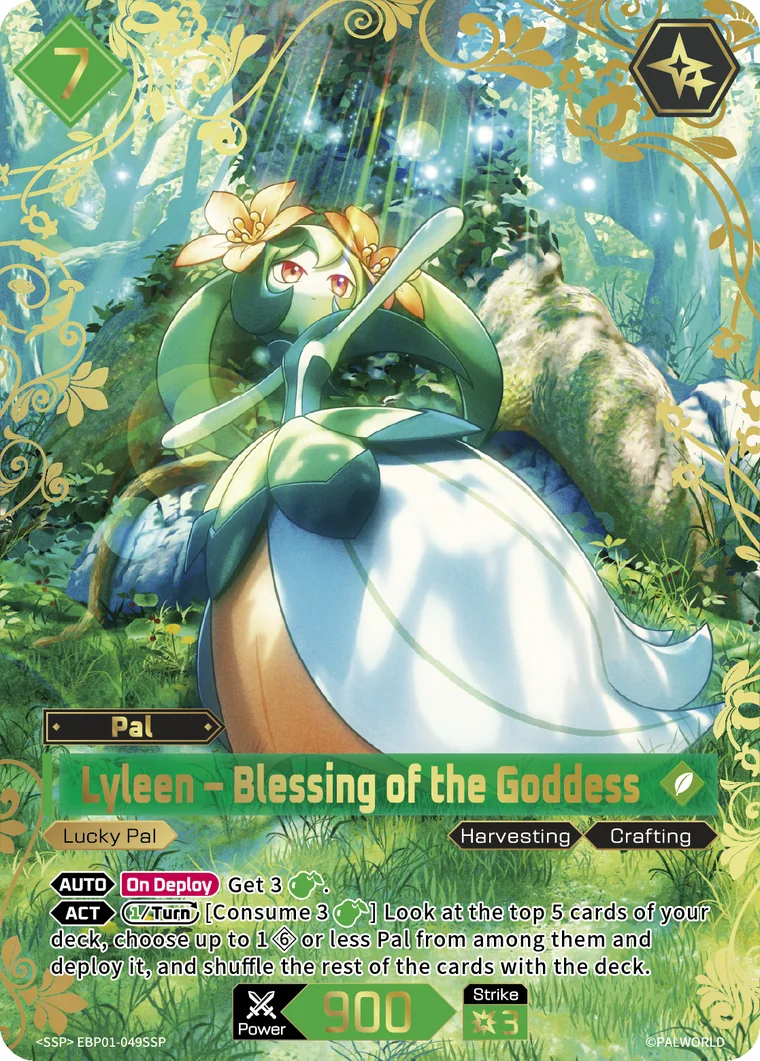
| Lyleen – Blessing of the Goddess | Green | 7 | 900 / 3 | RR / SSP (EBP01) |
| Broncherry – Brimming Adoration | Green | 7 | 1500 / 3 | Trial deck (ETD02) |
| Vaelet – Bewitching Blossom | Green | 8 | 1600 / 3 | U (EBP01) |
| Mammorest – Roar of the Wilds | Green | 8 | 2000 / 4 | Trial deck (ETD02) |
| Menasting – Darkness-Dwelling Scorpion | Purple | 5 | 700 / 2 | U (EBP01) |
| Katress – Abyssal Sorcerer | Purple | 6 | 900 / 2 | R (EBP01) |
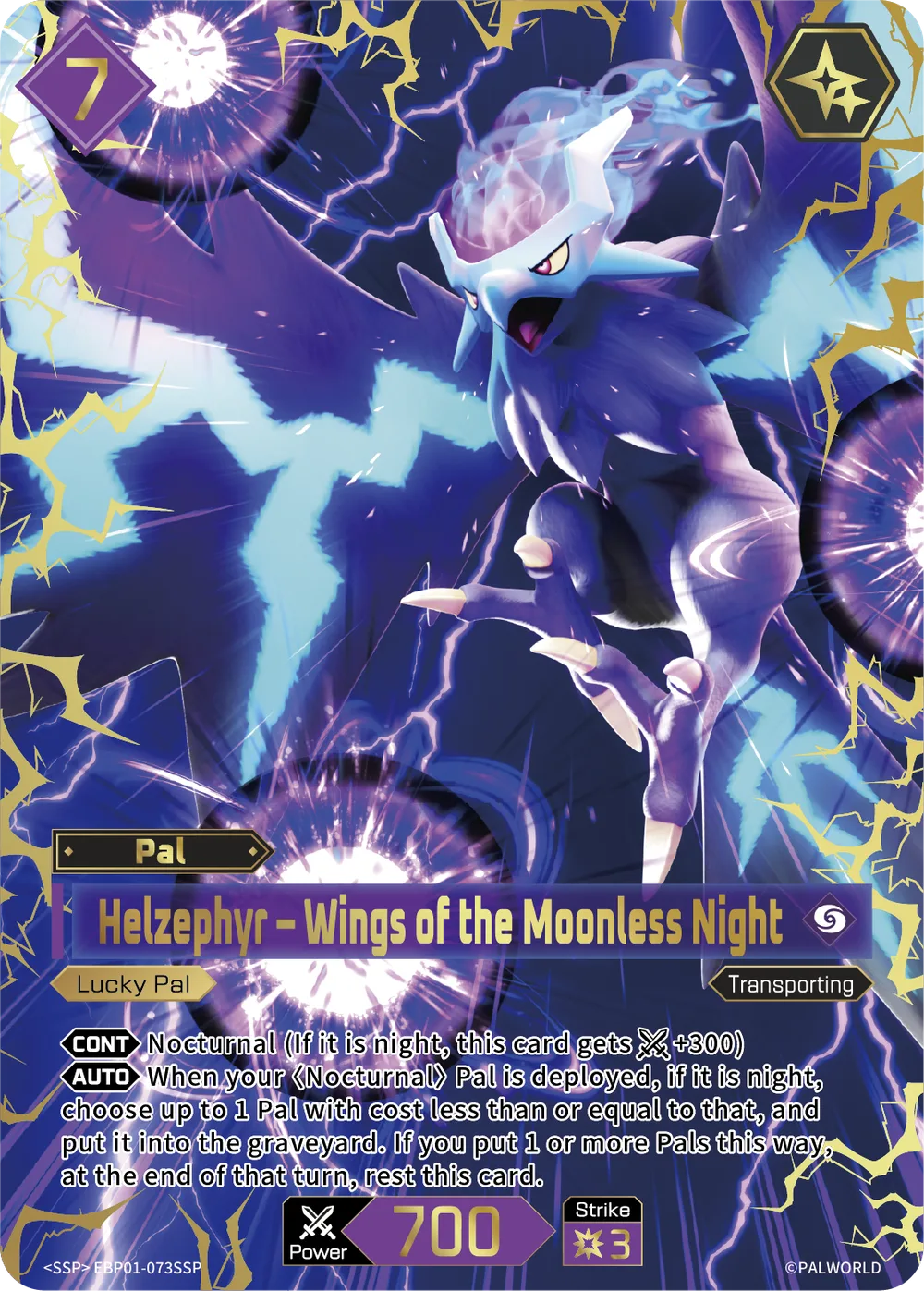
| Helzephyr – Wings of the Moonless Night | Purple | 7 | 700 / 3 | RR (EBP01) |
| Felbat – Lifestealer | Purple | 7 | 1000 / 3 | Trial deck (ETD02) |
| Shadowbeak – Seed of Despair | Purple | 8 | 1300 / 3 | RR (EBP01) |
| Astegon – Aegis Wyvern of Death | Purple | 8 | 1200 / 3 | Trial deck (ETD02) |
The eight I would build around today
There is no tournament data, so treat this as reasoning, not a tier list. What I am weighting is: does the card do a second job on top of being a cancel?
Bushi – Ephemeral Blade (red, 5) is the standout, and it is not close. Nine Pals in the launch pool carry Interrupt - the event Black Marketeer only references the keyword, as a filter on its recursion - and exactly one of the nine is a Lucky Pal. Bushi cancels damage from your deck passively and nullifies an attack outright from your hand. It is the only card in the game that defends from two zones, and it costs 5.
Grizzbolt – Rumbling Tank (red, 7) because Assault plus Strike 4 solves the "standing Pals are untouchable" problem while sitting in a slot you were paying for anyway.
Chillet – Dragon Whisperer (blue, 5) reveals the top card of your deck on deploy and lets you put it straight into play for free if it is a Dragon-element Pal costing 8 or less. If it is not, the card goes to your hand anyway, so it never whiffs completely - and that is a real cost cheat bolted onto your cheapest shield.
Mammorest – Roar of the Wilds (green, 8) is 2000 Power and Strike 4, and hands you 3 Ingredient when it hits the graveyard. There is no bigger body to buy.
Lyleen – Blessing of the Goddess (green, 7) gets you 3 Ingredient on deploy, then spends those same 3 Ingredient to look at the top five cards and deploy a cost-6-or-less Pal from among them.
Shadowbeak – Seed of Despair (purple, 8) turns on night while resting and doubles every one of your Pals' automatic abilities while night is up. That is the most warping continuous ability in the set.
Katress – Abyssal Sorcerer (purple, 6) redeploys a Normal Pal from your graveyard every time one of your Pals is butchered, at exactly one cost lower than the thing you butchered, in the rest state. A repeatable engine bolted to a slot you were spending anyway.
Wumpo – Frostpeak Sentinel (blue, 7) gets its own section, because of what it does to the maths.
The one card that shrinks the tax
Wumpo – Frostpeak Sentinel reads: while this card is in the rest state, all of your opponent's Pals get Strike -1.
Look back at the expected-damage table. Dropping an attacker from Strike 3 to Strike 2 takes their expected life removed from 1.76 to 1.41 per attack - a 20% cut, applied to every attacking Pal your opponent owns, for as long as Wumpo lies sideways. Drop a Strike 2 to Strike 1 and it is a 40% cut.
It is the only repeatable Strike reduction in the launch pool - the trial-deck event Crystal Breath drops one attacker's Strike by 3 for a single turn - and the only effect that multiplies with your Lucky count instead of competing for slots with it. The catch is thematically perfect: it works only while resting, and a resting Pal is a legal attack target. You are volunteering as bait to make every other swing worse.
What nobody can tell you yet
Being straight about the holes, as of 2 August 2026:
- No card in the launch pool references the Lucky Pal icon in its text. I searched every one of the 243 database entries. There is no tutor for a Lucky Pal, no "reveal the top card and cancel", no Lucky-matters payoff. The archetype does not exist yet.
- Not one of Bushiroad's 97 official Q&A rulings mentions the Lucky icon. For a mechanic this central, that is either a very clean rule or a queue that has not filled up.
- No pull rates have been published for any rarity, so nobody can honestly tell you what a box gets you.
- There is no meta and no tournament data. The game has been on sale since 30 July 2026. Everything above is card-pool analysis and probability, and I would rather show you the working than sell you a tier list I invented.
Quick reference
- Cap: up to 8 cards with the Lucky Pal icon in a 50-card main deck. It counts cards, not names.
- Effect: any Lucky Pal revealed during player damage resolution cancels the entire attack. No partial life loss.
- Pool: 24 Lucky Pals exist - 16 in Dawn of Palpagos, 4 in each trial deck. Six per colour.
- Costs: 5, 6, 7, 7, 8, 8 in every colour. Nothing cheaper than 5 exists.
- Cancel odds at 8 Lucky: 16% vs Strike 1, 29.7% vs Strike 2, 41.4% vs Strike 3, 51.4% vs Strike 4.
- Strike is taxed: Strike 4 removes only 1.94 life per attack on average, versus 1.76 for Strike 3.
- The shield is flat. Cancel rate does not decay over the course of a game.
- Quality: all three Strike-4 Pals, the 2000-Power Mammorest, and 7 of the 8 RR Pals in Dawn of Palpagos are Lucky Pals. Zero are Commons.
Run eight. The only argument for fewer is that you cannot afford them, and that is a wallet problem, not a deck-building one.
Frequently Asked Questions
How many Lucky Pals can you have in a Palworld TCG deck?
How many Lucky Pals are there in the Palworld TCG launch pool?
What is the cheapest Lucky Pal in the Palworld TCG?
What are the odds a Lucky Pal cancels an attack?
Do Lucky Pals cancel only part of the damage?
Does the Lucky Pal cancel rate get worse later in the game?
Is Damage Check the official name for this rule?
Are Lucky Pals rarer than normal cards in the Palworld TCG?
Are there any cards that search for or reference Lucky Pals?
Which Lucky Pal is the best in the Palworld TCG?
Keep Reading
Related Guides
Palworld TCG Structures and Assigning, Explained
Assigning a Pal to a structure is the base-building half of the Palworld TCG, and it costs you more than most new players notice. Here is every one of the 26 structures in the launch pool, the exact rules text behind assigning, the eight Work Suitabilities and how little they currently do, and the Material versus Ingredient split - all checked against Comprehensive Rules ver. 1.00 and Bushiroad's official Q&A.
Palworld TCG Recommended Decks: All 4, and Which One Wins
Bushiroad recommends four decks to build from Dawn of Palpagos: Material, Dragon, Ingredient and Nocturnal. Its English site posted all four on 1 October, and on 7 October it posted the first tournament lists played with English cards, from the Grand Challengers Cup at Bushiroad EXPO 2026 in Kuala Lumpur. Here are all four recommended lists, card for card, and what happened when I checked each one against the 49 tournament lists in Bushiroad's own databases.
Palworld TCG Pal Cards - Power and Strike by Cost
Pals are 100 of the 166 distinct cards in the Palworld TCG launch pool, and the two numbers along the bottom of each one are most of what they do. Sorting all 91 unique Pal designs by cost turns up a ladder: Strike is not a design lever at all, it is a straight function of cost, with three exceptions in the whole set. Power is the only stat Bushiroad negotiates, and the textless Pal at each cost sets the price.
Palworld TCG Gear Cards - All 14, and the Attack-Proof Rule
There are 14 gear cards in the Palworld TCG launch pool, and the rules never give your opponent a way to attack one. Rule 9.2.3 lists the legal attack targets - the player, structures, rested Pals - and gear is simply not in the sentence. I read all 14 off the official card database, checked every card in the 166-card pool for an answer to a deployed gear, and found exactly one. Here is what each gear does, when the rules let you use it, and why the safest card type in the game still is not an auto-include.
How to Play the Palworld TCG - Souls, Power vs Strike, and How You Actually Win
Bushiroad's Palworld card game launched 30 July 2026, and its comprehensive rules landed the same day. Here is the full walkthrough - the four colours plus colourless, the soul deck, the Power and Strike split that decides every attack, structures and Pal labour, and the Damage Check that turns your own deck into your life total. Everything here is sourced from the official rules, and I flag what Bushiroad has not published.
Palworld TCG Event Cards - All 17, and the Quick Timing Rule That Costs Games
There are 17 event cards in the Palworld TCG launch pool and exactly five of them carry Quick. Three of those five are trial-deck cards, which means a booster box hands you almost no instant-speed interaction. Worse, there is one moment on your own turn where a Quick card is illegal - and it is the moment you will most want it. Here is all 17, the timing rules from Comprehensive Rules ver. 1.00, and the official rulings that decide the edge cases.