Palworld TCG Event Cards - All 17, and the Quick Timing Rule That Costs Games
There are 17 event cards in the Palworld TCG launch pool and exactly five of them carry Quick. Three of those five are trial-deck cards, which means a booster box hands you almost no instant-speed interaction. Worse, there is one moment on your own turn where a Quick card is illegal - and it is the moment you will most want it. Here is all 17, the timing rules from Comprehensive Rules ver. 1.00, and the official rulings that decide the edge cases.
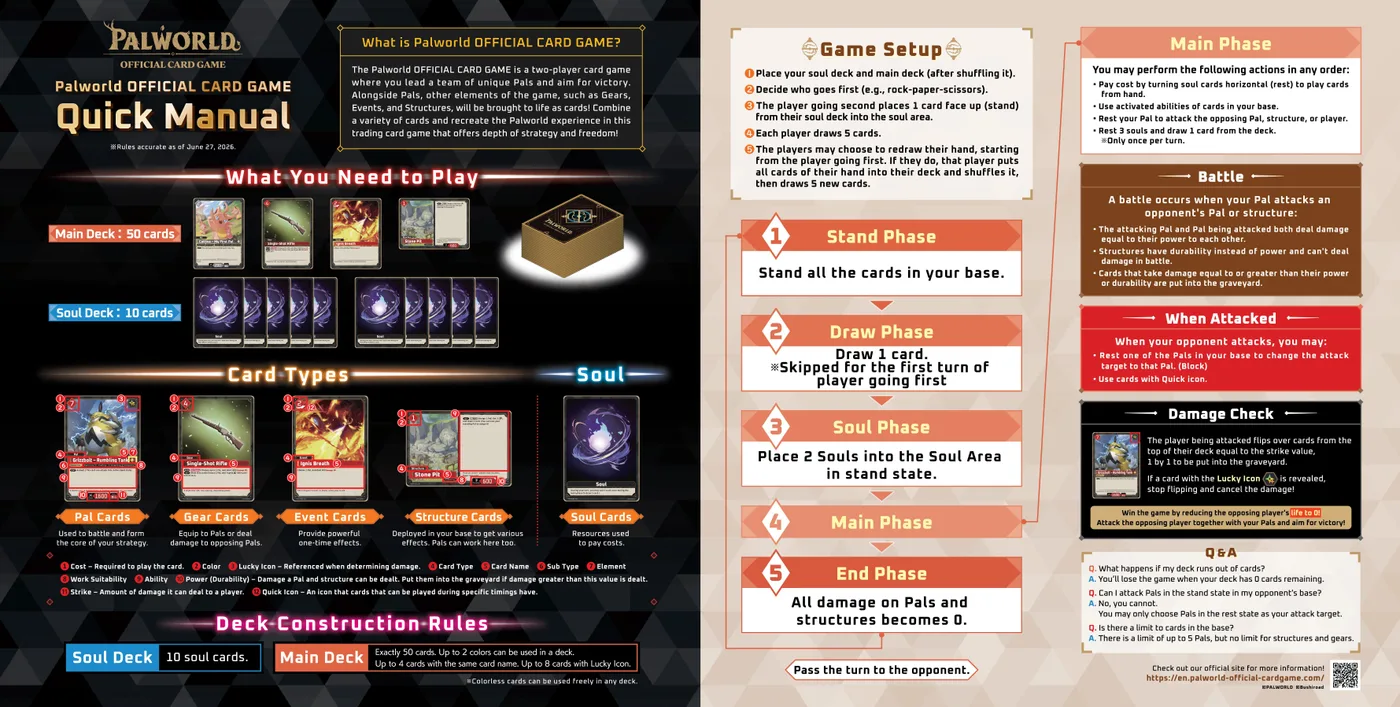
There is a card in the Red・Blue trial deck that says Quick on it in orange letters, and there is exactly one moment on your own turn when you are not allowed to play it: during your own attack.
That is official Q&A #29, published by Bushiroad on launch day and phrased about as bluntly as a rules answer gets - cards with Quick can only be used during battle on the opponent's turn. Not yours. You declare an attack, the trap springs, and the Ignis Breath in your hand is a brick until the battle ends.
Event cards are the card type most likely to get misplayed, because the timing rules attached to them live in three different places. I pulled all 256 rows out of the official card database on 15 August 2026, collapsed the parallel treatments down to base numbers, and read the text on every event in the game. There are 17. Here is what they do and, more usefully, when the rules actually let you play them.
What an event card actually is
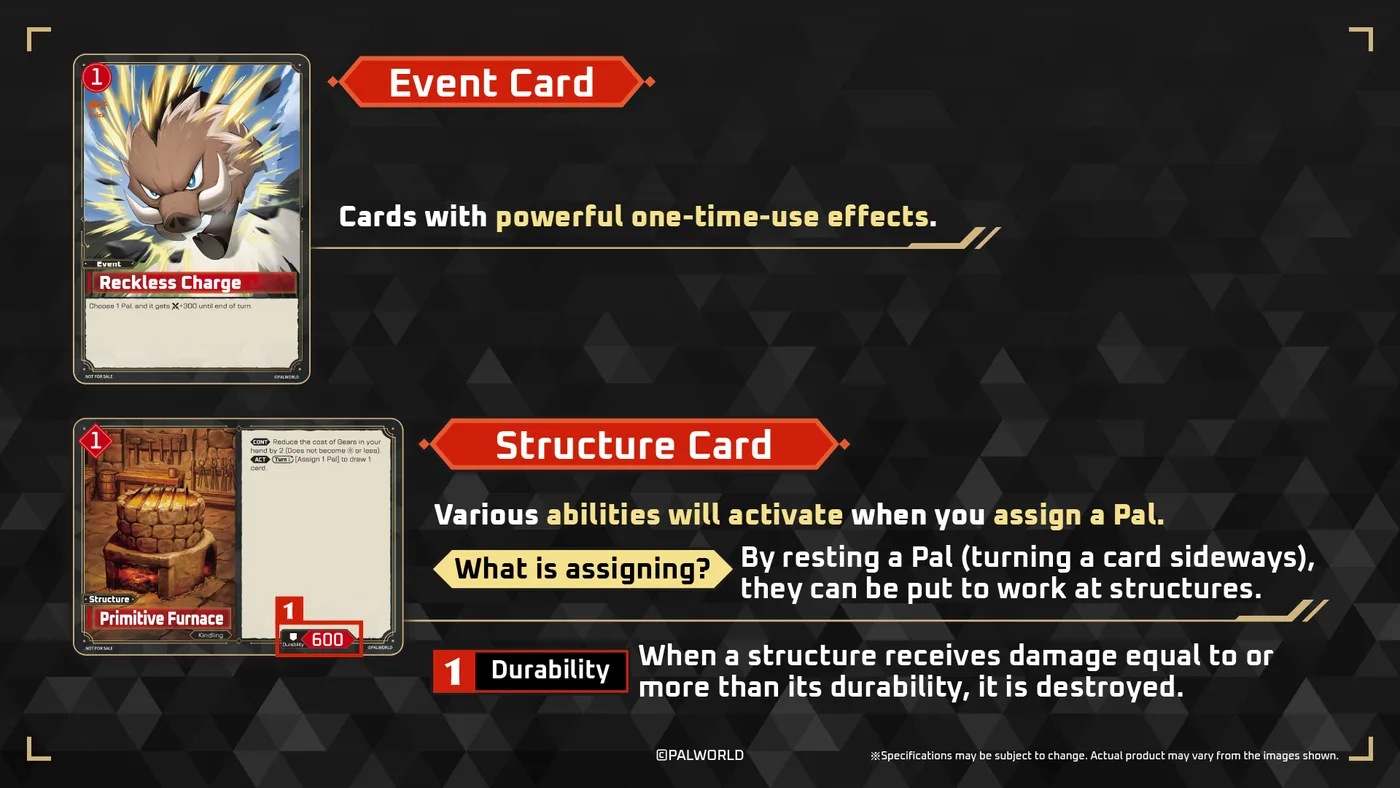
Comprehensive Rules 2.2.2.4 is one line: event cards are single-use cards that generate individual effects. Rule 10.6.2.4.2 supplies the other half - resolve the text, then put the card into its owner's graveyard. There is no board presence, no durability, no rest state. It fires and it is gone.
That makes events the only card type you play that never reaches your base. Rule 10.6.2.4.1 sends a played Pal, structure or gear into its master's base; 10.6.2.4.2 sends an event to the graveyard instead. It passes through the resolution zone and leaves. Nothing to attack, nothing to rest, nothing to remove.
Deck construction does not restrict them either. Official Q&A #3 confirms you may run any number of Pal, gear, structure and event cards in your 50-card main deck. The only caps are the 50-card size, four copies of a card name, and eight Lucky icons - and the two-colour limit from the play guide, which our colours explainer covers in detail. Two colours plus colourless is the entire event pool you are allowed to touch.
All 17 events in the launch pool
Twelve come from Booster Pack "Dawn of Palpagos", two from the Red・Blue trial deck and three from Green・Purple. Sorted by colour, then cost.
| Event | Colour | Cost | Rarity | Quick | What it does |
|---|---|---|---|---|---|
| Ignis Breath | Red | 2 | TD | Yes | Deal 500 damage to 1 Pal |
| Treasure Chest Found! | Red | 2 | C | – | Top 5, take up to 1 red structure or red gear; take none instead for 3 Material |
| Axel's Strategy | Red | 4 | RR | – | Modal: 1500 damage, or stand X Pals, or opposing ◇5+ Pals cannot block |
| Aurora Guide | Blue | 2 | C | Yes | Draw 1, then put up to 1 card from hand on top of the deck |
| Crystal Breath | Blue | 2 | TD | Yes | 1 Pal gets Strike -3, and does not stand in your opponent's next stand phase |
| Victor's Strategy | Blue | 3 | RR | – | Modal: top 5 take 1, or bounce 1 Pal, or draw X |
| Pal Sphere | Blue | 4 | U | – | Draw 3 cards |
| Stone Blast | Green | 2 | TD | Yes | 1 Pal gets Power +500 until end of turn |
| Found an Egg! | Green | 2 | C | – | Top 5, take up to 1 Pal; take none instead for 3 Ingredient |
| Lily's Strategy | Green | 3 | RR | – | Modal: all your Pals +1000 Power, or destroy 1 structure or gear, or increase soul by 1 rested |
| Blessing of the Flower Spirit | Green | 3 | C | – | Gain 1 life, draw 1 card |
| Dark Cannon | Purple | 3 | C | Yes | Put 1 ◇5-or-less Pal into the graveyard |
| Zoe's Strategy | Purple | 3 | RR | – | Modal: strip up to 5 opposing resources, or recur a Pal and force a discard, or butcher for a kill |
| Strike from the Darkness | Purple | 4 | TD | – | Put 1 Pal into the graveyard, no conditions |
| Black Marketeer | Purple | 5 | C | – | Return up to 2 Pals without Interrupt from your graveyard to hand; it becomes night |
| Medical Supplies | Purple | 7 | TD | – | Deploy a ◇8-or-less Pal from your graveyard in the rest state |
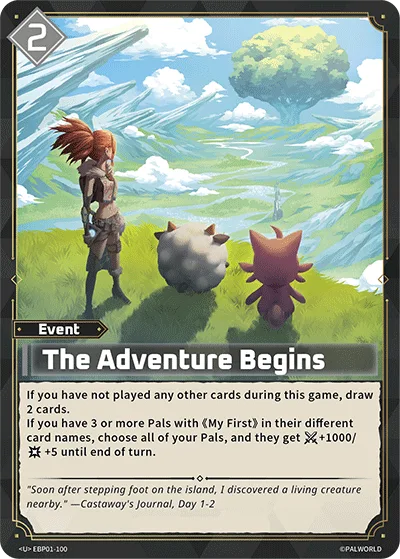
| The Adventure Begins | Colorless | 2 | U | – | Draw 2 if you have played nothing else this game; a《My First》payoff attached |
Purple gets five, Blue and Green four each, Red three, and there is a single colourless event. Seven of the 17 cost two souls and the curve tops out at Medical Supplies on seven.
Set that beside the 26 structures and 14 gear cards and the shape of the format is obvious. Events are the thin slice - 17 of the 150 distinct cards in the launch pool once you strip the 16 PR2026 promos out.
Only five events carry Quick
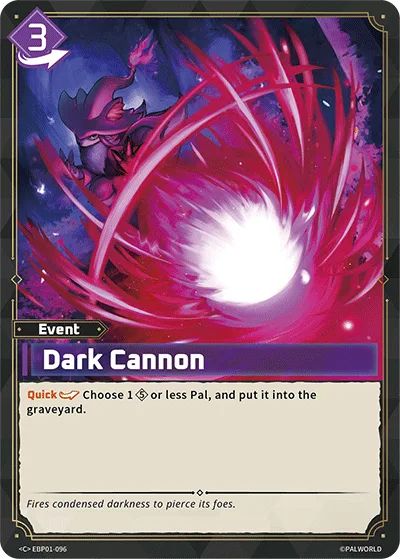
Ignis Breath, Crystal Breath, Stone Blast, Aurora Guide and Dark Cannon. That is the list.
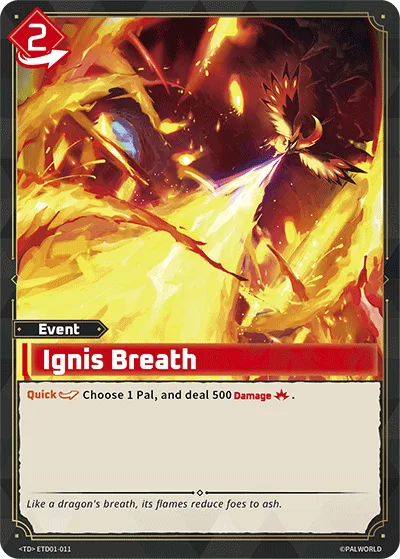
Three of those five are trial-deck cards. Only Aurora Guide and Dark Cannon come out of the booster, and both are Commons.
Nine Pals also carry Quick, and every one of them gets it from the Interrupt keyword rather than a printed Quick ability of its own - four in the trial decks, two per deck, and five in the booster. So the launch pool holds 14 cards that can act on your opponent's turn, and exactly seven of them sit inside the two trial decks. A booster box is where the power lives; the trial decks are where half the interaction lives.
Interrupt is a Quick activated ability, not an event - rule 12.8.2 defines it as resting one soul and discarding the card, or discarding it plus one other card from hand, to nullify an attack - and official Q&A #51 shuts the obvious door: Interrupt can only be activated while the card is in your hand. A Blazehowl sitting in your base is not holding an Interrupt any more.
There is a visual tell worth learning before your first shop tournament. Rule 2.11 lists the Quick icon as its own field on the card, and on the five Quick events it renders as a small white curved arrow inside the cost badge in the top-left corner. Ignis Breath, Dark Cannon and Aurora Guide all have it. Axel's Strategy, Victor's Strategy and The Adventure Begins have a plain diamond. You can read it from across the table.
The two windows the rules allow
Three official rulings, all registered 30 July 2026, define the whole thing:
- Q&A #28 - can I play a Quick card during the main phase of my turn? Yes.
- Q&A #29 - can I play a Quick card during a battle on my turn? No.
- Q&A #25 - can I play cards during the opponent's turn? No, except Quick cards during battle.
Read together, a Quick event is legal in exactly two places. Your own main phase, outside a battle, under rule 8.2.1 - which is the same window every non-Quick event uses. And the quick step of a battle on your opponent's turn, under rule 9.5.2.
Rule 9.5.2.2 is the sentence that makes #29 true: the turn player cannot activate abilities of cards during the quick step. The quick step belongs to the non-turn player and nobody else.
The exit is cleaner than the ruling makes it sound, though. Rule 9.7.4 says that when a battle ends, play returns to the play timing of the turn player's main phase. So the Ignis Breath you could not fire mid-attack is playable again the second the battle closes - and if you have a second attacker, before the next one starts. The restriction is per battle, not per turn.
Attack first, then trick. If you want the 500 damage to matter, spend it in your main phase before you declare, or hold it for your opponent's turn.
Blocks are declared before tricks
The step order in section 9 is attack declaration (9.3), block declaration (9.4), quick step (9.5), damage step (9.6), end of battle (9.7). Blocks come before the quick step.
That ordering is the single most important thing on this page. The defender rests a Pal to redirect the attack under 9.4.2, commits to it, and only then gets the window to play Stone Blast for +500 Power and win a fight they were losing. The attacker sees the block go down before any trick appears, which means the bluff runs entirely in the other direction - you have to guess whether the blocker has backup, not whether the block is coming.
Q&A #30 confirms you can chain them: play one Quick card, resolve it fully, then play another if you still want to. There is no single-trick limit.
Interrupt sits in the same window and does something different in kind. Rule 5.18 says that when an effect instructs you to nullify the attack, you finish resolving that effect and then jump straight to the end of battle step (9.7), skipping the damage step entirely. Nobody deals damage. Which means Interrupt is not a combat trick, it is a cancel - and blocking first and then Interrupting is close to the worst line available, because you rested a Pal to absorb an attack that was about to evaporate anyway.
Crystal Breath rewards reading the text twice. Strike -3 is aimed at Damage Check: Strike is the number of cards a player flips when they take damage, so a Strike 3 attacker with Strike -3 does nothing to your life total at all. The rider - that card does not stand during your opponent's next stand phase - is written from the caster's point of view, so firing it in your own main phase locks the target down for their upcoming turn. Fire it during their battle, after their stand phase has already passed, and the lock lands a full turn cycle later.
The four Strategy cards
Axel's Strategy, Victor's Strategy, Lily's Strategy and Zoe's Strategy. One per colour, all RR, all modal, and they are the only events in the set at RR rarity. They are also the only events with three printings apiece - base, OSR and SP - against a single SR for Pal Sphere and The Adventure Begins and a TSR for the three trial-deck events that got one.
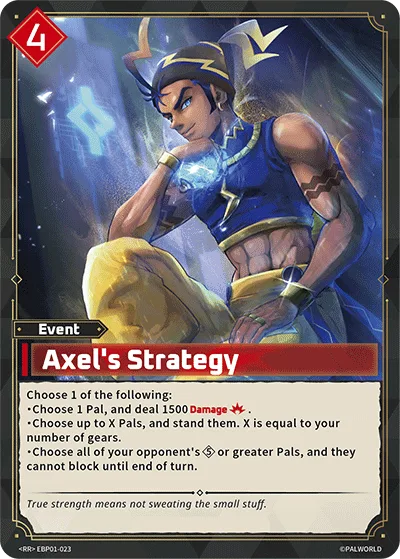
Axel's Strategy is the odd one out on cost: four souls where the other three cost three. It buys the biggest single number in the event pool, 1500 damage. Rule 11.4.1 destroys a card when damage reaches its power, and only eight of the 91 Pals in the launch pool are printed above 1500 - so that mode kills 83 of them outright, including four sitting exactly on 1500.
The modal wording hides a rules distinction that will come up at your table. Rule 10.6.2.2.1 puts the mode choice at the moment you play the card, before you pay for it, and says the options you did not pick are regarded as not being in effect. Rule 10.6.3 puts target selection at resolution. So you announce which of the three lines you are taking, and only then do you pick what it hits.
Q&A #27 nails down the X-counting mode on both Axel's and Victor's Strategy. When a card says "the number of your gears" or "the number of your structures" without naming a zone, it counts cards in the base only - not your hand, not your deck. Victor's third mode draws X where X is your structures, and a base with no structures draws you nothing.
One more from the same file. Q&A #70 asks whether Victor's first mode - look at the top 5, choose 1, add it to hand - can be declined. It cannot. You must take exactly one.
Choose and choose up to are different rules
This is the sharpest edge in the whole card type, and it is three rulings deep.
Rule 10.6.3.1 says that when a number of choices is specified, you must choose as many targets as possible up to that number, and a player who can choose is not allowed to decline. Rule 10.6.3.1.1 carves out the exception: "choose up to" lets you pick anywhere from zero to the maximum. Q&A #34 confirms the practical version - with "choose up to X cards" you may pick zero even when legal targets exist.
Then the flip side. Q&A #36 says an ability that reads "choose all" cannot be trimmed. Lily's Strategy first mode gives all of your Pals Power +1000, and you cannot exclude one of them.
Two of the dig events run on the same distinction and turn it into a floor. Treasure Chest Found! and Found an Egg! both look at the top five and let you take up to one card - and both pay you three resources if you take none. Q&A #59 confirms that whiffing entirely still resolves the rest of the text, and Q&A #38 adds that a deck with fewer than five cards left simply shows you what it has, with a temporary empty deck mid-resolution not costing you the game so long as a card remains when the effect finishes. Q&A #87 extends the same logic to graveyard recursion: Black Marketeer and Zoe's second mode with an empty graveyard choose zero and carry on.
The Adventure Begins is the colourless outlier and the one card here that is genuinely awkward to cast. Its first line only pays if you have played no other cards this game, so it is a turn-one card or a dead one - but Q&A #96 hands you a small out by confirming that resting three souls to draw a card does not count as playing a card. Its second line wants three Pals with 《My First》 in different card names, and Q&A #97 blocks the cheat: adding the name 《Lamball – My First Pal》 to your board with Antique Dresser does not satisfy it.
Purple owns removal, and it is not close
Count the events that put a Pal in the graveyard or damage one, and the colour pie falls out immediately.
| Effect | Cards | Colours |
|---|---|---|
| Unconditional kill | Strike from the Darkness (4) | Purple |
| Conditional kill | Dark Cannon (3, Quick, ◇5 or less), Zoe's Strategy mode 3 | Purple |
| Damage | Axel's Strategy mode 1 (1500), Ignis Breath (2, Quick, 500) | Red |
| Bounce | Victor's Strategy mode 2 | Blue |
| Base removal | Lily's Strategy mode 2 (1 structure or gear) | Green |
Purple holds three of the five kill effects, and all three ignore power entirely. Strike from the Darkness deletes a 2000-power Mammorest for four souls without reading its stats. Dark Cannon does the same to anything costing five or less, for three souls, at instant speed. Three events also pull cards back out of the graveyard - Black Marketeer, Medical Supplies and the second mode of Zoe's Strategy - and all three are Purple. The colour that kills things is the colour that gets them back.
Red's answer is arithmetic - 1500 damage is a big number that still loses to a bigger one. Green does not remove Pals at all; its only destruction mode points at structures and gear. Blue removes nothing permanently and settles for a bounce.
If you are picking a second colour and you want an answer to a Pal you cannot fight through, the launch pool gives you exactly one honest option.
What Bushiroad has not published
- Nothing on Axel's Strategy and X timing. The card counts your gears; the rules put mode selection at play and targeting at resolution, and no ruling states which moment fixes X. Ask your judge.
- No event errata. Bushiroad's errata page still lists exactly one card, ETD01-024TSR Ribbuny – Little Princess, dated 31 July 2026, as our promo cards and organized play breakdown also found. No event has been touched.
- No amendments to the Q&A file. All 97 entries carry a registration date of 30 July 2026, none has an update timestamp, and none is flagged as a rules-revision change. Sixteen days after launch, Bushiroad has not added or corrected a single ruling.
- A naming inconsistency in the Q&A itself. Entry #97 refers to EBP01-100 as "Beginning of the Adventure" in the question text while the card list and the same entry's own card-name field call it "The Adventure Begins". Same card, two English names in one document.
- What Booster Pack "Legends Awaken" does to any of this. 100 new card types land on 30 October 2026. Every count above is a launch-pool count.
Quick reference
- 17 events in the launch pool: 12 in Dawn of Palpagos, 2 in the Red・Blue trial deck, 3 in Green・Purple.
- 5 carry Quick - Ignis Breath, Crystal Breath, Stone Blast, Aurora Guide, Dark Cannon. Three of the five are trial-deck cards.
- Quick is legal in two places: your own main phase outside a battle, and the quick step of a battle on your opponent's turn. Never during your own battle (Q&A #29, rule 9.5.2.2).
- A battle ending returns you to your main phase (9.7.4), so the restriction is per battle, not per turn.
- Blocks are declared before the quick step (9.4 then 9.5). The defender commits the body first and gets the trick second.
- Interrupt is not an event. It is a Quick activated ability, playable only from hand (Q&A #51), and it skips the damage step entirely (rule 5.18).
- Four RR events, one per colour, all named Strategy, all modal, all with OSR and SP parallels.
- Modes are chosen when you play, targets when it resolves (10.6.2.2.1 and 10.6.3).
- "Choose up to" can take zero. "Choose" cannot decline. "Choose all" cannot be trimmed.
- Purple has the removal. Three of the five kill effects, including the only unconditional one.
Seventeen cards is not a lot, and eleven of them are Commons or trial-deck cards - the chase tier here is four RR Strategy cards and two Uncommons. The scarce thing was never the cardboard. It is the window: one step, on somebody else's turn, after the blocks are already down. Learn where it is before you worry about what to put in it.
Frequently Asked Questions
How many event cards are in the Palworld TCG?
When can you play a Quick card in the Palworld TCG?
Which Palworld TCG event cards have Quick?
Do you declare blocks before or after playing Quick cards in the Palworld TCG?
What happens to an event card after it resolves in the Palworld TCG?
What are the four Strategy cards in the Palworld TCG?
What is the difference between "choose" and "choose up to" in the Palworld TCG?
Which colour has the best removal in the Palworld TCG?
Can you use Interrupt from a Pal in your base in the Palworld TCG?
Keep Reading
- Palworld Official Card Game Comprehensive Rules ver. 1.00 (Bushiroad, PDF)
- Palworld Official Card Game - Official Card List
- Palworld Official Card Game - Rules Q&A
- Palworld Official Card Game - Errata
- Palworld Official Card Game - For Beginners and Quick Manual
- Trial Deck "Dawn of Palpagos Red・Blue" - Official Product Page
- Trial Deck "Dawn of Palpagos Green・Purple" - Official Product Page
Related Guides
Palworld TCG Pal Cards - Power and Strike by Cost
Pals are 100 of the 166 distinct cards in the Palworld TCG launch pool, and the two numbers along the bottom of each one are most of what they do. Sorting all 91 unique Pal designs by cost turns up a ladder: Strike is not a design lever at all, it is a straight function of cost, with three exceptions in the whole set. Power is the only stat Bushiroad negotiates, and the textless Pal at each cost sets the price.
Palworld TCG Gear Cards - All 14, and the Attack-Proof Rule
There are 14 gear cards in the Palworld TCG launch pool, and the rules never give your opponent a way to attack one. Rule 9.2.3 lists the legal attack targets - the player, structures, rested Pals - and gear is simply not in the sentence. I read all 14 off the official card database, checked every card in the 166-card pool for an answer to a deployed gear, and found exactly one. Here is what each gear does, when the rules let you use it, and why the safest card type in the game still is not an auto-include.
Palworld TCG Recommended Decks: All 4, and Which One Wins
Bushiroad recommends four decks to build from Dawn of Palpagos: Material, Dragon, Ingredient and Nocturnal. Its English site posted all four on 1 October, and on 7 October it posted the first tournament lists played with English cards, from the Grand Challengers Cup at Bushiroad EXPO 2026 in Kuala Lumpur. Here are all four recommended lists, card for card, and what happened when I checked each one against the 49 tournament lists in Bushiroad's own databases.
Palworld TCG Structures and Assigning, Explained
Assigning a Pal to a structure is the base-building half of the Palworld TCG, and it costs you more than most new players notice. Here is every one of the 26 structures in the launch pool, the exact rules text behind assigning, the eight Work Suitabilities and how little they currently do, and the Material versus Ingredient split - all checked against Comprehensive Rules ver. 1.00 and Bushiroad's official Q&A.
How to Play the Palworld TCG - Souls, Power vs Strike, and How You Actually Win
Bushiroad's Palworld card game launched 30 July 2026, and its comprehensive rules landed the same day. Here is the full walkthrough - the four colours plus colourless, the soul deck, the Power and Strike split that decides every attack, structures and Pal labour, and the Damage Check that turns your own deck into your life total. Everything here is sourced from the official rules, and I flag what Bushiroad has not published.
Palworld TCG Lucky Pals - All 24 in the Launch Pool, and How Many to Run
The Lucky Pal icon is the single most important number in Palworld TCG deck-building, and almost nobody has counted the pool. I pulled every card from Bushiroad's own card database and found 24 Lucky Pals across the three launch products - six per colour, at costs 5, 6, 7, 7, 8 and 8, in all four colours, identically. Not one of them is a Common. Here is the full list, the real cancel probabilities, and why raising your Strike is the worst way to beat them.