Palworld TCG Gear Cards - All 14, and the Attack-Proof Rule
There are 14 gear cards in the Palworld TCG launch pool, and the rules never give your opponent a way to attack one. Rule 9.2.3 lists the legal attack targets - the player, structures, rested Pals - and gear is simply not in the sentence. I read all 14 off the official card database, checked every card in the 166-card pool for an answer to a deployed gear, and found exactly one. Here is what each gear does, when the rules let you use it, and why the safest card type in the game still is not an auto-include.
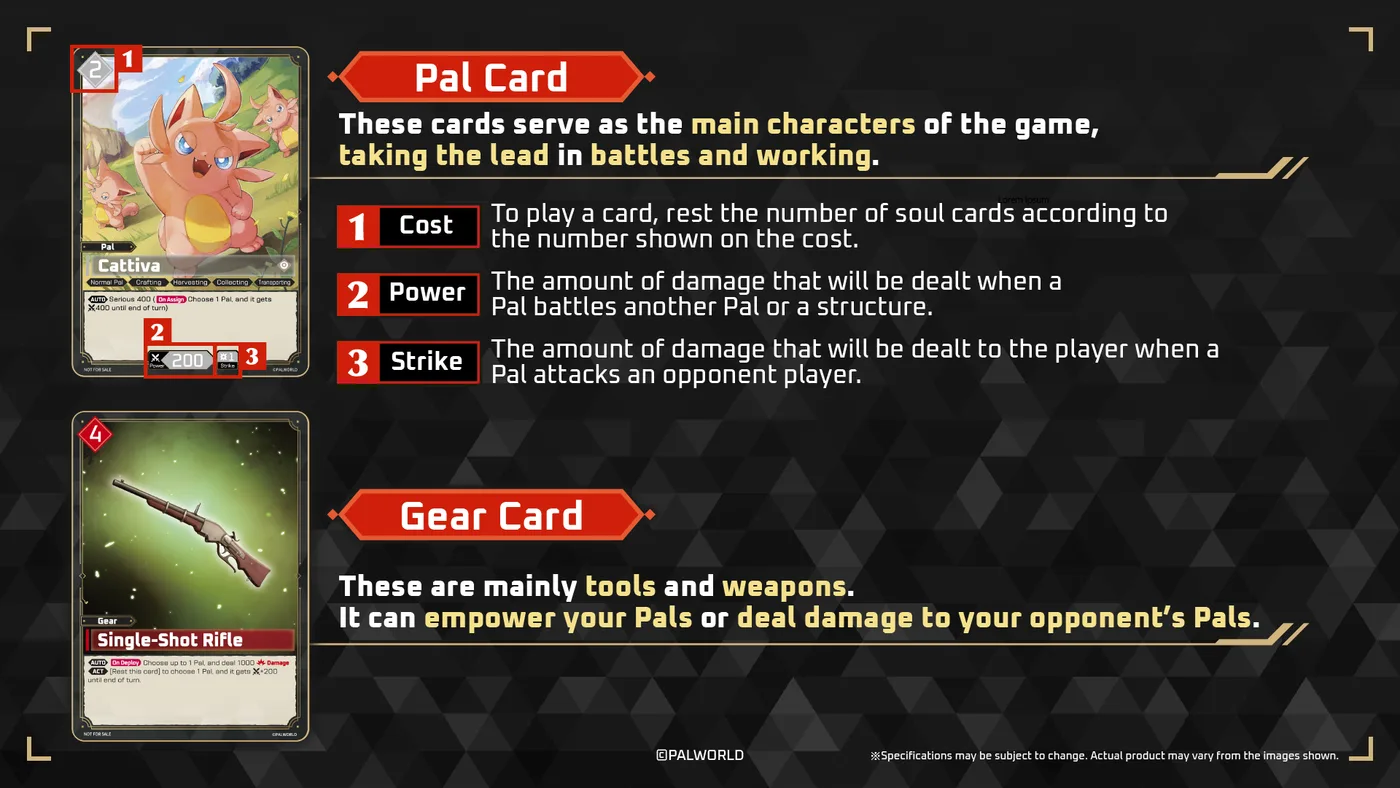
Rule 9.2.3 is one sentence long, and it decides which cards in this game are allowed to die in combat. The legal attack targets are the non-turn player, or one of the structures or resting Pals that the non-turn player is the master of.
Read it again and notice what is missing. Gear is not in the sentence. A rested gear is the one card in your base that turned sideways and became safer for it.
So I pulled all 256 rows out of the official card database on 17 August 2026, collapsed the parallels down to the 166 distinct cards, and read the text on every gear in the game. There are 14. Here is what each one does, the timing rules that decide when you can use them, and the single card in the entire pool that can answer one.
What a gear card actually is
Comprehensive Rules 2.2.2.3 defines gear as cards you can field to assist your Pals. When you play one, rule 10.6.2.4.1 places it in your base, the same destination as a Pal or a structure - and rule 4.4.1 names all three as the card types that live there.
The similarity ends at the doorstep, though, because gear is missing the stat that gets the other two killed. Rule 4.4.4 gives "damage taken" to each Pal and structure at the base - not to gear. Rule 5.14.1 only defines dealing damage to a Pal or a structure. And rule 11.4.1, the lethal-damage check, reads only a Pal's power or a structure's durability. A gear card has no power, no durability, no damage total, and every rule that kills things has nothing on a gear to read.
There is no quantity cap either. Official Q&A #12 confirms you may deploy any number of structures and gears - only Pals are capped, at 5 - and Q&A #3 confirms the 50-card main deck takes any mix of Pal, gear, structure and event cards. The two-colour deck rule is the only fence around your gear options, and one colour of it can be all gear if you want.
All 14 gear cards in the launch pool
Ten come from Booster Pack "Dawn of Palpagos" and two from each trial deck. Sorted by colour, then cost. Every ability shown as "rest: ..." is an activated ability whose cost is resting the gear itself.
| Gear | Colour | Cost | Rarity | Set | What it does |
|---|---|---|---|---|---|
| Makeshift Handgun | Red | 2 | C | Booster | On deploy: 500 damage to up to 1 Pal. Rest: a Pal gets Power +200 |
| Foxparks' Harness | Red | 3 | R | Booster | Rest: a Pal gets Power +200; a 《Foxparks》 also gains an on-attack trigger dealing 700 damage |
| Stone Pickaxe | Red | 3 | C | Booster | Rest: a Pal gets Power +200 and you get 1 Material |
| Single-Shot Rifle | Red | 4 | TD | Trial (Red・Blue) | On deploy: 1500 damage to up to 1 Pal. Rest: a Pal gets Power +200 |
| Pump-Action Shotgun | Red | 7 | R | Booster | On deploy: 1200 damage to ALL opposing Pals. Rest: a Pal gets Power +200 |
| Single-Shot Sphere Launcher | Blue | 3 | TD | Trial (Red・Blue) | On deploy: draw 1. Rest: a Pal gets Power +200 |
| Pengullet Rocket Launcher | Blue | 4 | R | Booster | Rest: a Pal gets Power +200; a 《Pengullet》 instead gets +500 and a self-sacrifice board nuke |
| Grappling Gun | Blue | 5 | U | Booster | Rest: a Pal gets Power +200 and Vigilance until end of turn |
| Digtoise's Headband | Green | 3 | U | Booster | Rest: a Pal gets Power +200; if it is a 《Digtoise》, get 2 Material or 2 Ingredient |
| Farming Hat | Green | 3 | C | Booster | Rest: a Pal gets Power +200 and you get 1 Ingredient |
| Refined Metal Spear | Green | 6 | TD | Trial (Green・Purple) | Rest: a Pal gets Power +900 |
| Meat Cleaver | Purple | 2 | R | Booster | Rest + butcher 1 Pal: reveal top 3, take 1 to hand, rest to graveyard |
| Daedream's Necklace | Purple | 3 | C | Booster | On deploy: deploy up to 1 《Daedream》 from hand. Rest: Power +200 and it becomes night |
| Cawgnito Hat | Purple | 4 | TD | Trial (Green・Purple) | Rest: a Pal gets Power +200 and Stealth until end of turn |
Red gets five, Blue, Green and Purple three each, and there is no colourless gear. Rarity tops out at R - four of them, each with an SR parallel (Foxparks' Harness, Pump-Action Shotgun, Pengullet Rocket Launcher, Meat Cleaver) - so unlike the events, whose chase tier is four RR Strategy cards, gear has no RR at all. And unlike the Pals, gear got no promo printings: the 16-card PR2026 set our promo breakdown covers contains nine Pals and seven Souls, zero gear.
The rule that makes gear attack-proof
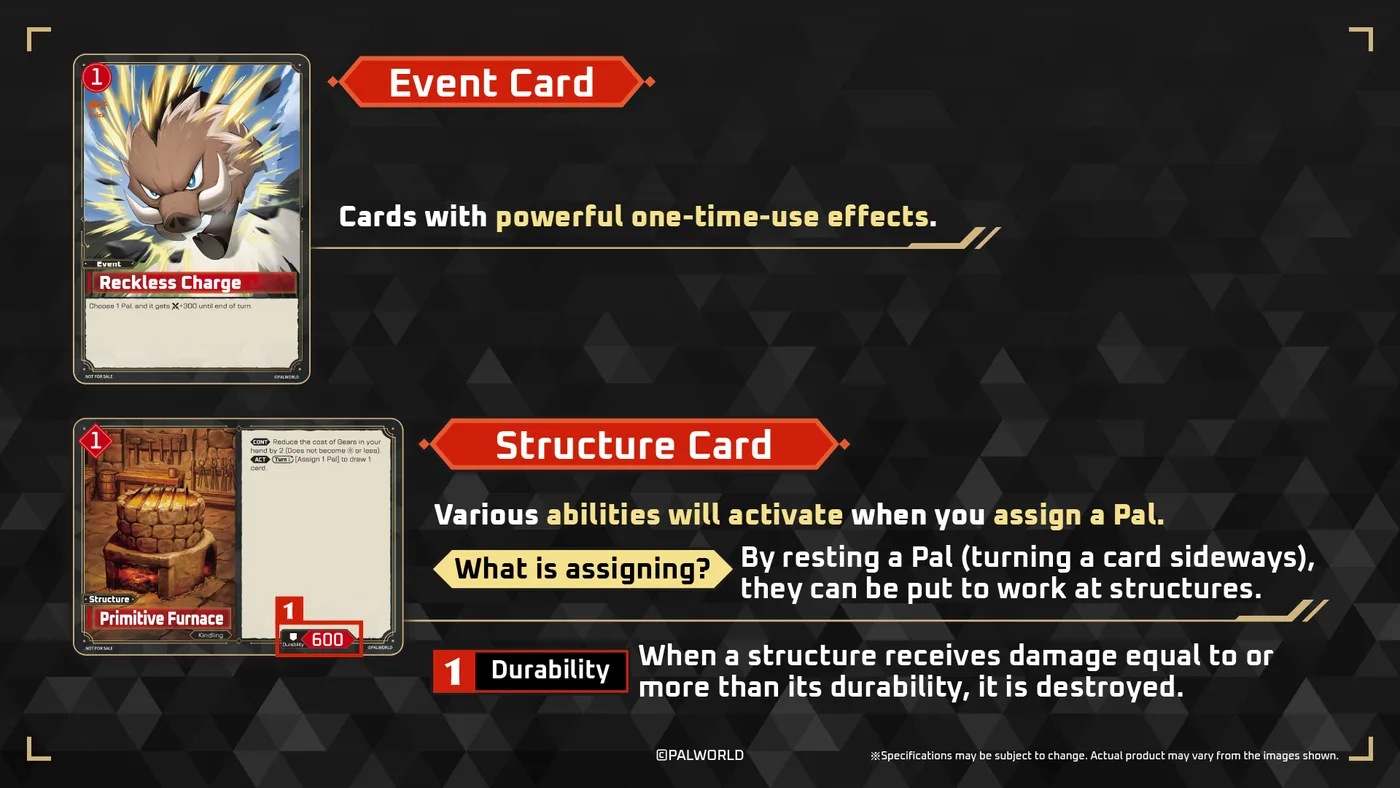
The structures guide walks through what happens to the other permanents. A structure has durability from 300 to 1500 and can be attacked freely, with no damage back. A rested Pal is a legal target under rule 9.2.3. Both die to rule 11.4.1 the moment damage equals their number.
Gear opts out of that entire system twice over. It is not in rule 9.2.3's target list, so an attack can never be declared at it. And because it has no power, no durability and no damage total, effects that deal damage cannot chip it down either - there is no number on the card for the damage to count against.
That is not a loophole; it is the design. The official how-to-play material describes gear as tools and weapons that empower Pals, and the game treats them like equipment in the world of Palworld: you can knock out the Pal holding the spear, but the spear is not a thing you can attack.
The practical consequence shows up the first time you compare engines. Stone Pit hands you 3 Material and a card per turn, and its 600 durability means it dies to essentially any attacker who bothers. Stone Pickaxe hands you 1 Material and a small pump per turn, and there is no "bothers" - your opponent's attack step has no move against it. Slower engine, permanent installation.
One card in 166 can remove a gear
I searched the text of all 166 distinct cards for anything that destroys, bounces, exiles or damages a gear. The complete list of answers to a deployed gear is one card: Lily's Strategy, whose second mode reads "Choose 1 structure or gear, and put it into the graveyard."
That is it. Dark Cannon and Strike from the Darkness kill Pals. Victor's Strategy bounces a Pal. Antique Curtain bounces Pals. Hanging Trap and Viewing Cage exile Pals. Lily's Strategy - a Green RR event, one of the four Strategy cards - is the only card in the game that can touch a gear once it lands, and it has to give up its other two modes to do it.
| Permanent | Can be attacked | Can take damage | Cards that can remove it |
|---|---|---|---|
| Pal (rested) | Yes (9.2.3) | Yes | Attacks, damage events, kill effects, bounce, exile |
| Structure | Yes (9.2.3) | Yes | Attacks, damage effects, Lily's Strategy |
| Gear | No | No | Lily's Strategy, mode 2 - nothing else |
So when you pay 7 souls for Pump-Action Shotgun, you are not making the tempo gamble that a 7-cost structure represents. Short of one mode of one RR in one colour, the card stays until the game ends. That permanence is the real rate you are buying, and it is why the repeatable abilities on gear are priced so much leaner than the ones on structures.
Every gear rests itself, and none of them is Quick
All 14 gears carry an activated ability paid by resting the gear itself, thirteen of them asking nothing else - Meat Cleaver adds a butcher on top. The structures guide covers why that matters for your action economy: a structure rests one of your five Pals to fire, gear rests only its own cardboard, and rule 7.2.1 stands everything in your base again next turn.
What that guide does not cover is the timing, and the timing is the trap.
Zero gear cards carry the Quick icon. An activated ability without Quick follows the default schedule: official Q&A #25 says you cannot play cards or activate abilities on your opponent's turn, with Quick cards during battle as the only exception. Every gear activation therefore happens in your own main phase, outside a battle, full stop.
Chain that to how blocking works and the shape of the game falls out. Blocks happen on your opponent's turn (rule 9.4.2, the non-turn player resting a Pal), which is exactly when your gear is not allowed to fire. So Refined Metal Spear's Power +900 can never save a blocker. Gear pumps are offense only: buff in your main phase, then attack with the buff already showing. Your opponent sees the +900 before deciding whether to block, every single time. The unseen combat trick in this game lives on the 14 cards that carry Quick - five event cards and nine Pals with an 〈Interrupt〉 ability you pay from hand - and never on gear.
One more consequence of the battle rules is worth banking: rule 9.7.4 returns you to your main phase between battles on your own turn. Rest the Spear, attack, and if the battle ends with the turn still going, you may fire a second gear before the next attack. The main-phase window is not one moment at the start of your turn - it is every gap between battles.
The guns, and the biggest number in the game
Five gears carry an on-deploy trigger, and three of those are Red guns that deal damage the moment they land.
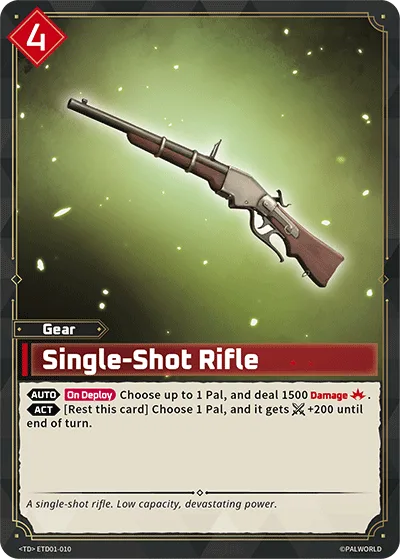
Single-Shot Rifle is the headline. On deploy: choose up to 1 Pal, deal 1500 damage. That is the largest single damage number printed in the launch pool, and exactly one other card reaches it - Axel's Strategy, the Red RR event, whose first mode also deals 1500 for the same 4 souls. Rule 11.4.1 puts a Pal in the graveyard when damage equals or exceeds its power, and 83 of the 91 launch-pool Pals are printed at 1500 power or less. The difference between the two cards is what is left afterwards: Axel's Strategy goes to the graveyard, the Rifle stays in your base as a repeatable +200 pump your opponent cannot attack. And the Rifle is a trial-deck card. The Red・Blue trial deck ships the same top-end damage number as the booster's chase rare.
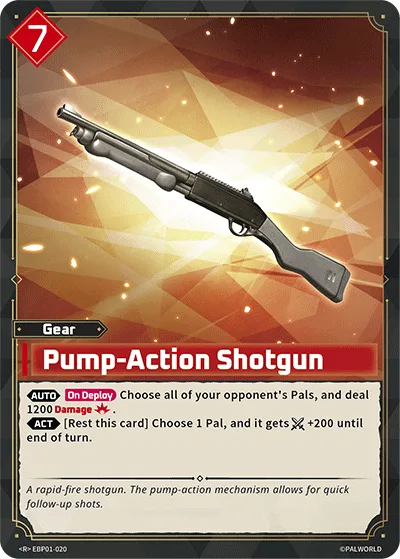
Pump-Action Shotgun scales the idea to the whole board: 1200 damage to all of your opponent's Pals on deploy, which covers 78 of the 91 launch Pals. The wording is "choose all", and official Q&A #36 confirms choose-all cannot be trimmed - which here only means you cannot decline the sweep. Makeshift Handgun is the budget copy at 2 souls for 500 on deploy, and Single-Shot Sphere Launcher is the Blue cousin that draws a card instead of shooting.
The gun package has a payoff card, too. Suzaku - Hellfire Wings, the 7-cost Red Pal, adds +200 to damage your red cards deal outside battle, and official Q&A #53 confirms that applies to damage from structures, gears and events. Under Suzaku, the Rifle deals 1700 - enough for 90 of the 91 launch Pals, everything except the 2000-power Mammorest - and the Shotgun sweeps for 1400.
Four signature gears, one per colour
Four gears name a specific Pal and pay extra when they find it, and the cycle runs one per colour: Foxparks' Harness in Red, Pengullet Rocket Launcher in Blue, Digtoise's Headband in Green, Daedream's Necklace in Purple. All four check the main name - official Q&A #26 defines it as the portion of the card name before the dash - so any 《Foxparks》 printing satisfies its harness.
Each one is a fair +200 pump for anyone, and something else entirely for its partner. The Harness turns a Foxparks attack into 700 bonus damage on an on-attack trigger. The Headband turns a Digtoise into a resource engine, 2 Material or 2 Ingredient per rest - the only card besides Ranch that lets you pick either resource, as the structures guide notes.
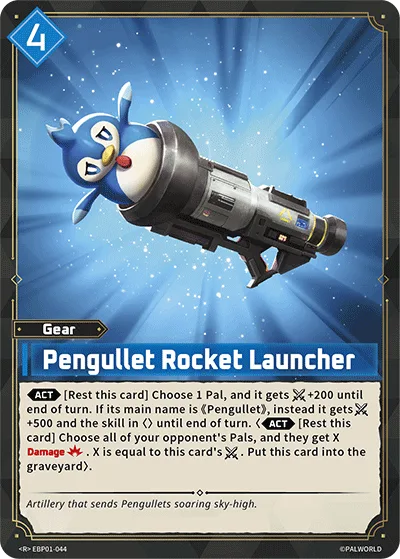
Pengullet Rocket Launcher is the funny one, and the joke is imported straight from the video game. A 《Pengullet》 holding it gets +500 and a granted ability: rest this card, deal damage equal to this card's power to all opposing Pals, then put this card into the graveyard. The Pengullet is the ammunition. It is also the one gear line where your opponent gets a vote, because the nuke is fired by the Pal, not the gear - and a Pal is very much attackable while it waits.
Daedream's Necklace is the sleeper. On deploy it fields a 《Daedream》 straight from your hand - Q&A #95 confirms an empty hand just resolves past it - and its rest ability tacks "it becomes night" onto the +200. Night is the Purple engine's on-switch, and Q&A #94 says the state outlives its source: even if the Necklace somehow leaves, it stays night until the end of your opponent's next turn. A repeatable night button your opponent cannot attack, for 3 souls, is a cheap way into the Nocturnal package the colour is built around.
Meat Cleaver is the odd one out
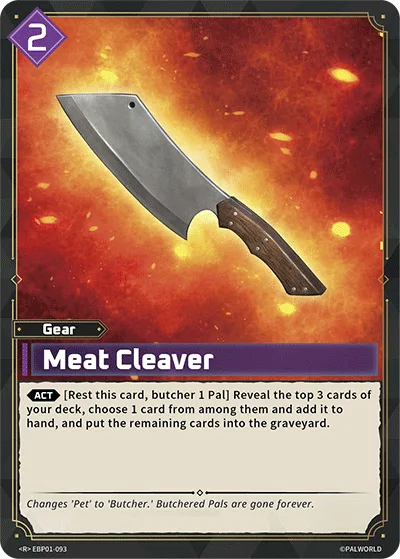
Thirteen gears pump power. Meat Cleaver is the fourteenth, and it never touches a stat. Its ability costs a rest plus butchering one of your Pals - rule 5.16, your Pal goes straight from base to graveyard - and pays you the best card of your top three, with the other two binned.
Three rules interactions decide whether that is a deal:
- The cost is all-or-nothing. Rule 10.4.2.2 forbids paying part of a cost, so with no Pal in your base the Cleaver cannot activate at all.
- Butcher triggers are pending, not interrupting. Official Q&A #90 walks through the exact sequence with Katress - Abyssal Sorcerer on the board: the Cleaver's effect resolves completely first, then Katress reanimates a Pal costing one less than the butchered one. The Cleaver is card selection on its own; next to Katress it is a graveyard engine that mills two cards a turn into the colour that, as the event-card guide showed, owns all three graveyard-recursion events.
- The graveyard is a resource in Purple. Two of the binned cards feed Black Marketeer and Medical Supplies directly.
At 2 souls it is also the cheapest gear in the game, tied with Makeshift Handgun. The price is a body per activation, and in a game where your Pal count is capped at 5, that is the least renewable resource you own.
The cards that care about gear
Six non-gear cards in the launch pool read the word "gear", and every one of them except Lily's Strategy is friendly:
- Axel's Strategy (Red event) - its second mode stands X Pals where X is your number of gears, counting the base only per official Q&A #27. This is the one card that scales with gear count, and it un-rests the Pals your structures just spent.
- Reptyro - Ore Gorger (Red, 8) - consumes 3 Material to dig 5 deep for a gear costing 8 or less and deploy it free.
- Primitive Furnace (Red structure) - converts X Material into an X-soul discount on your next gear from hand.
- Treasure Chest Found! (Red event) - digs 5 for a red structure or red gear.
- Primitive Workbench (Blue structure) - reveals the top card and deploys it free if it is a structure or gear costing 6 or less.
Four of the six are Red, the colour that also holds five of the 14 gears and the Suzaku damage amp. If a gear archetype exists in Dawn of Palpagos, it is Red digging out guns at a discount and firing them the turn they land.
What Bushiroad has not published
- No gear-specific rules section. Comprehensive Rules ver. 1.00 mentions gear eleven times in the whole document, and every one of them is a general rule that happens to list all three base card types - the 2.2.2.3 definition, the base, deploy and play rules (4.4.1, 5.15, 10.6.2.4.1), and a few wording examples. There is no gear equivalent of section 5.17 on assigning. Everything gear does lives in the general rules for activated abilities, which is why the timing analysis above leans on Q&A #25 rather than a dedicated rule.
- Another naming inconsistency in the Q&A. Entry #53 calls EBP01-002 "Suzaku - Wings of Blazing Fire"; the card list calls the same card "Suzaku - Hellfire Wings". Same card, two English names, matching the "Adventure Begins" discrepancy the event-card guide found in entry #97.
- Three gears have no ruling at all. Grappling Gun, Refined Metal Spear and Cawgnito Hat appear in none of the 97 Q&A entries' card references. The other eleven each turn up at least once, and Daedream's Necklace and Foxparks' Harness lead with five apiece.
- What Booster Pack "Legends Awaken" adds. 100 new card types arrive on 30 October 2026. Every count in this guide - 14 gears, one removal answer, 1500 as the ceiling - is a launch-pool count and has a shelf life.
Quick reference
- 14 gear cards in the launch pool: 10 in Booster Pack "Dawn of Palpagos", 2 per trial deck. Five Red, three each Blue, Green, Purple, no colourless.
- Gear cannot be attacked. Rule 9.2.3 permits attacks only on the player, structures and rested Pals - and gear has no power, durability or damage total for effects to work against (4.4.4, 5.14.1, 11.4.1).
- Exactly one card removes a deployed gear: Lily's Strategy, mode 2. Nothing else in the 166-card pool touches one.
- Every gear rests itself to fire - thirteen for free, Meat Cleaver with a butcher on top - and rule 7.2.1 stands it again next turn.
- No gear is Quick. Q&A #25 locks every activation into your own main phase, so gear pumps are visible before blocks and can never protect a blocker.
- Single-Shot Rifle's 1500 on deploy ties Axel's Strategy for the biggest damage number in the pool, kills 83 of 91 launch Pals, and comes from a trial deck.
- Four signature gears, one per colour - Foxparks, Pengullet, Digtoise, Daedream - all keyed to the main name (Q&A #26).
- Gear support is Red: Reptyro, Primitive Furnace, Treasure Chest Found! and the Axel's Strategy gear-count mode.
- No RR gear, no promo gear. The top rarity is R, with four SR parallels.
The safest card type in the game is also the slowest. A gear never dies, never trades and never blocks - it just hands you the same small edge every turn and dares your opponent to find the one card that answers it. Count how many turns your games actually last before you decide how much that is worth.
Frequently Asked Questions
How many gear cards are in the Palworld TCG?
Can gear cards be attacked in the Palworld TCG?
How do you destroy a gear card in the Palworld TCG?
When can you activate a gear ability in the Palworld TCG?
What does Single-Shot Rifle do in the Palworld TCG?
What is the cheapest gear card in the Palworld TCG?
Which Palworld TCG gear cards are tied to specific Pals?
Is there a limit on gear cards in the Palworld TCG?
Keep Reading
- Palworld Official Card Game Comprehensive Rules ver. 1.00 (Bushiroad, PDF)
- Palworld Official Card Game - Official Card List
- Palworld Official Card Game - Rules Q&A
- Trial Deck "Dawn of Palpagos Red・Blue" - Official Product Page
- Trial Deck "Dawn of Palpagos Green・Purple" - Official Product Page
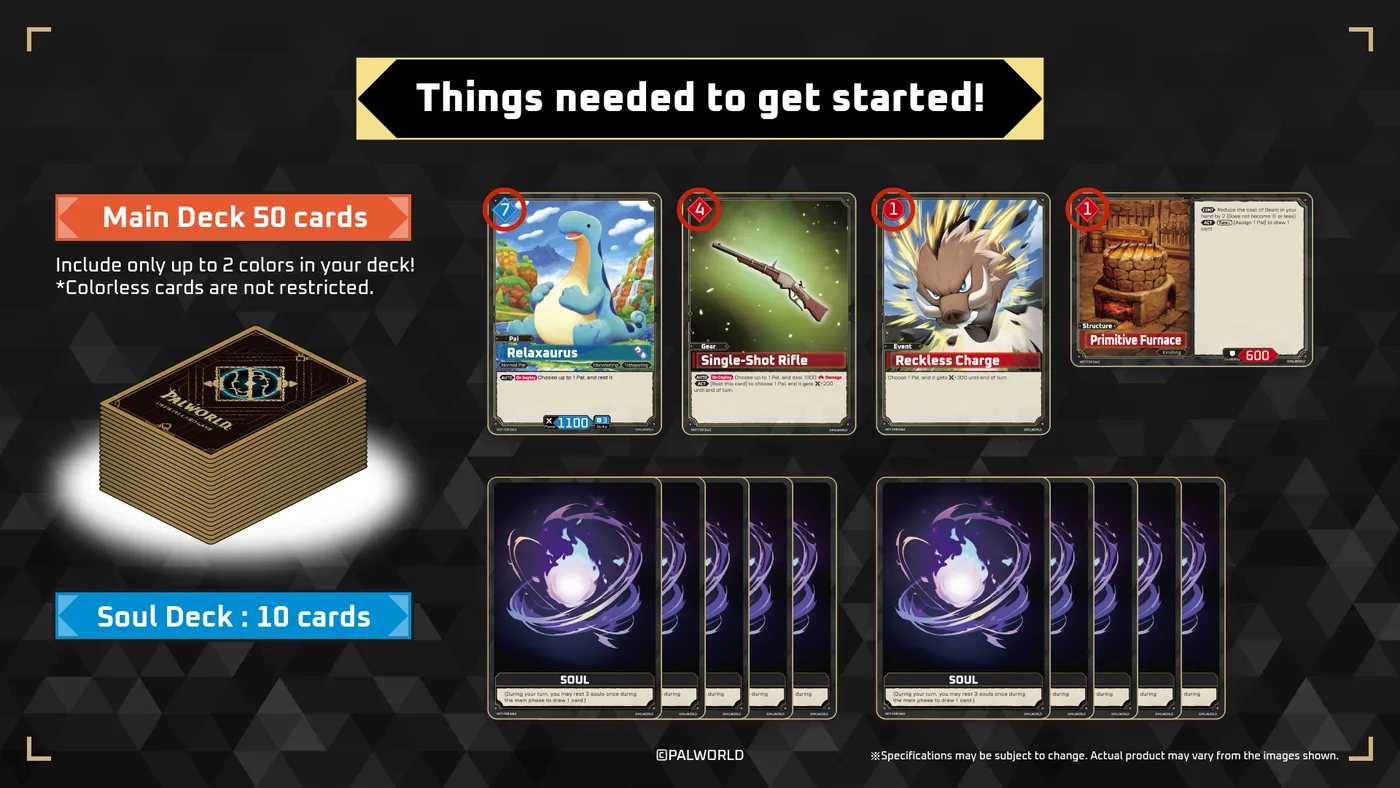
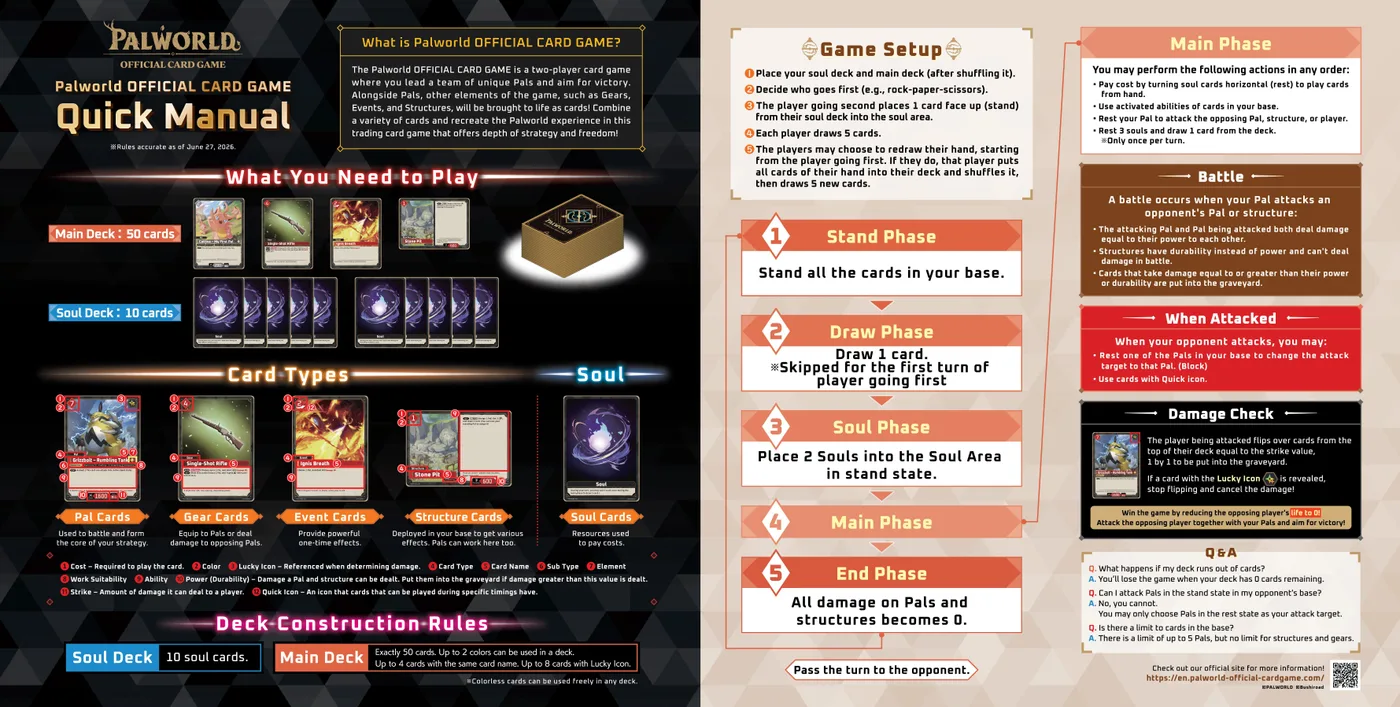
- Palworld Official Card Game - For Beginners and Quick Manual
Related Guides
Palworld TCG Pal Cards - Power and Strike by Cost
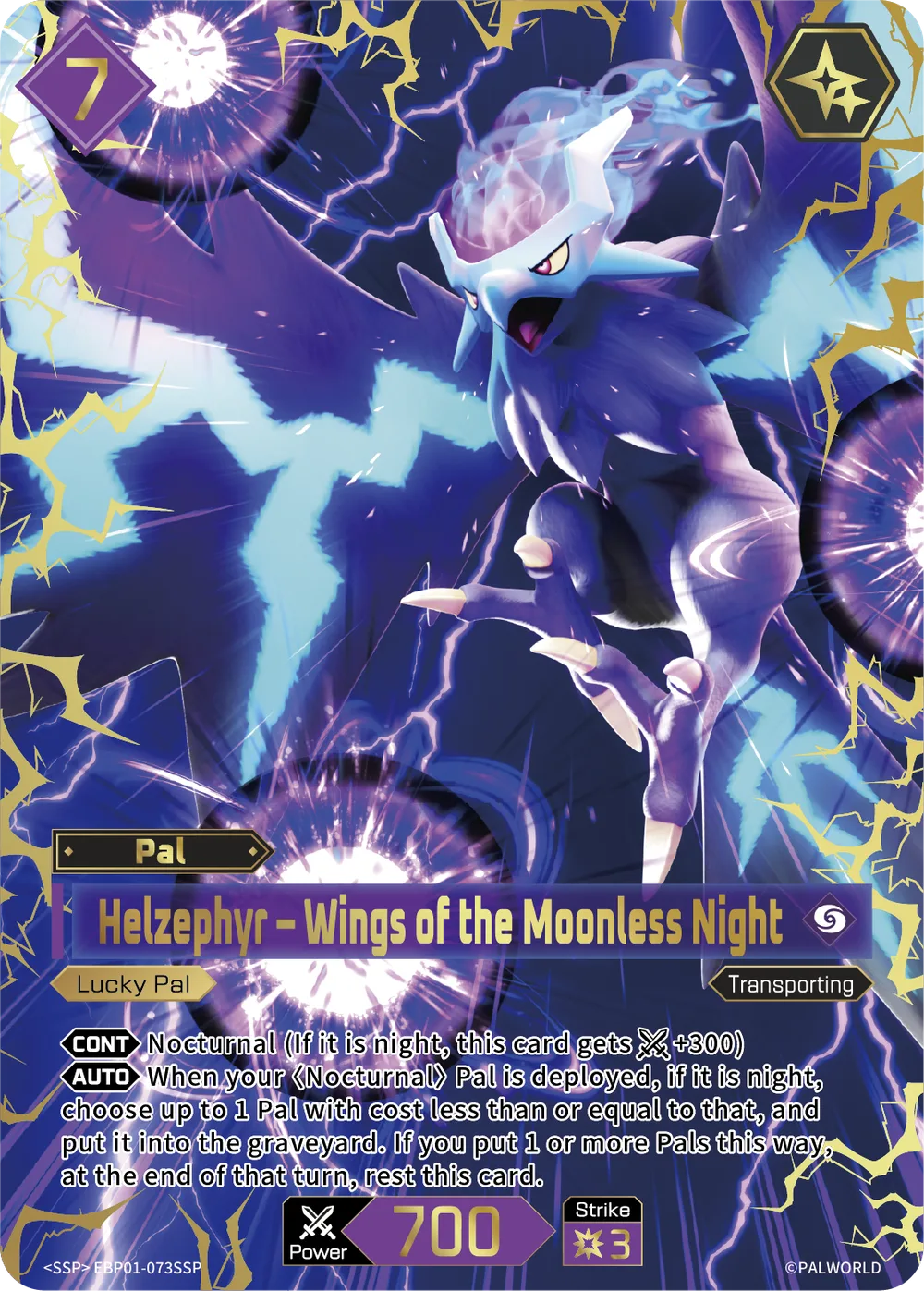
Pals are 100 of the 166 distinct cards in the Palworld TCG launch pool, and the two numbers along the bottom of each one are most of what they do. Sorting all 91 unique Pal designs by cost turns up a ladder: Strike is not a design lever at all, it is a straight function of cost, with three exceptions in the whole set. Power is the only stat Bushiroad negotiates, and the textless Pal at each cost sets the price.
Palworld TCG Event Cards - All 17, and the Quick Timing Rule That Costs Games
There are 17 event cards in the Palworld TCG launch pool and exactly five of them carry Quick. Three of those five are trial-deck cards, which means a booster box hands you almost no instant-speed interaction. Worse, there is one moment on your own turn where a Quick card is illegal - and it is the moment you will most want it. Here is all 17, the timing rules from Comprehensive Rules ver. 1.00, and the official rulings that decide the edge cases.
Palworld TCG Recommended Decks: All 4, and Which One Wins
Bushiroad recommends four decks to build from Dawn of Palpagos: Material, Dragon, Ingredient and Nocturnal. Its English site posted all four on 1 October, and on 7 October it posted the first tournament lists played with English cards, from the Grand Challengers Cup at Bushiroad EXPO 2026 in Kuala Lumpur. Here are all four recommended lists, card for card, and what happened when I checked each one against the 49 tournament lists in Bushiroad's own databases.
Palworld TCG Structures and Assigning, Explained
Assigning a Pal to a structure is the base-building half of the Palworld TCG, and it costs you more than most new players notice. Here is every one of the 26 structures in the launch pool, the exact rules text behind assigning, the eight Work Suitabilities and how little they currently do, and the Material versus Ingredient split - all checked against Comprehensive Rules ver. 1.00 and Bushiroad's official Q&A.

How to Play the Palworld TCG - Souls, Power vs Strike, and How You Actually Win
Bushiroad's Palworld card game launched 30 July 2026, and its comprehensive rules landed the same day. Here is the full walkthrough - the four colours plus colourless, the soul deck, the Power and Strike split that decides every attack, structures and Pal labour, and the Damage Check that turns your own deck into your life total. Everything here is sourced from the official rules, and I flag what Bushiroad has not published.

Palworld TCG Lucky Pals - All 24 in the Launch Pool, and How Many to Run
The Lucky Pal icon is the single most important number in Palworld TCG deck-building, and almost nobody has counted the pool. I pulled every card from Bushiroad's own card database and found 24 Lucky Pals across the three launch products - six per colour, at costs 5, 6, 7, 7, 8 and 8, in all four colours, identically. Not one of them is a Common. Here is the full list, the real cancel probabilities, and why raising your Strike is the worst way to beat them.