Palworld TCG Structures and Assigning, Explained
Assigning a Pal to a structure is the base-building half of the Palworld TCG, and it costs you more than most new players notice. Here is every one of the 26 structures in the launch pool, the exact rules text behind assigning, the eight Work Suitabilities and how little they currently do, and the Material versus Ingredient split - all checked against Comprehensive Rules ver. 1.00 and Bushiroad's official Q&A.
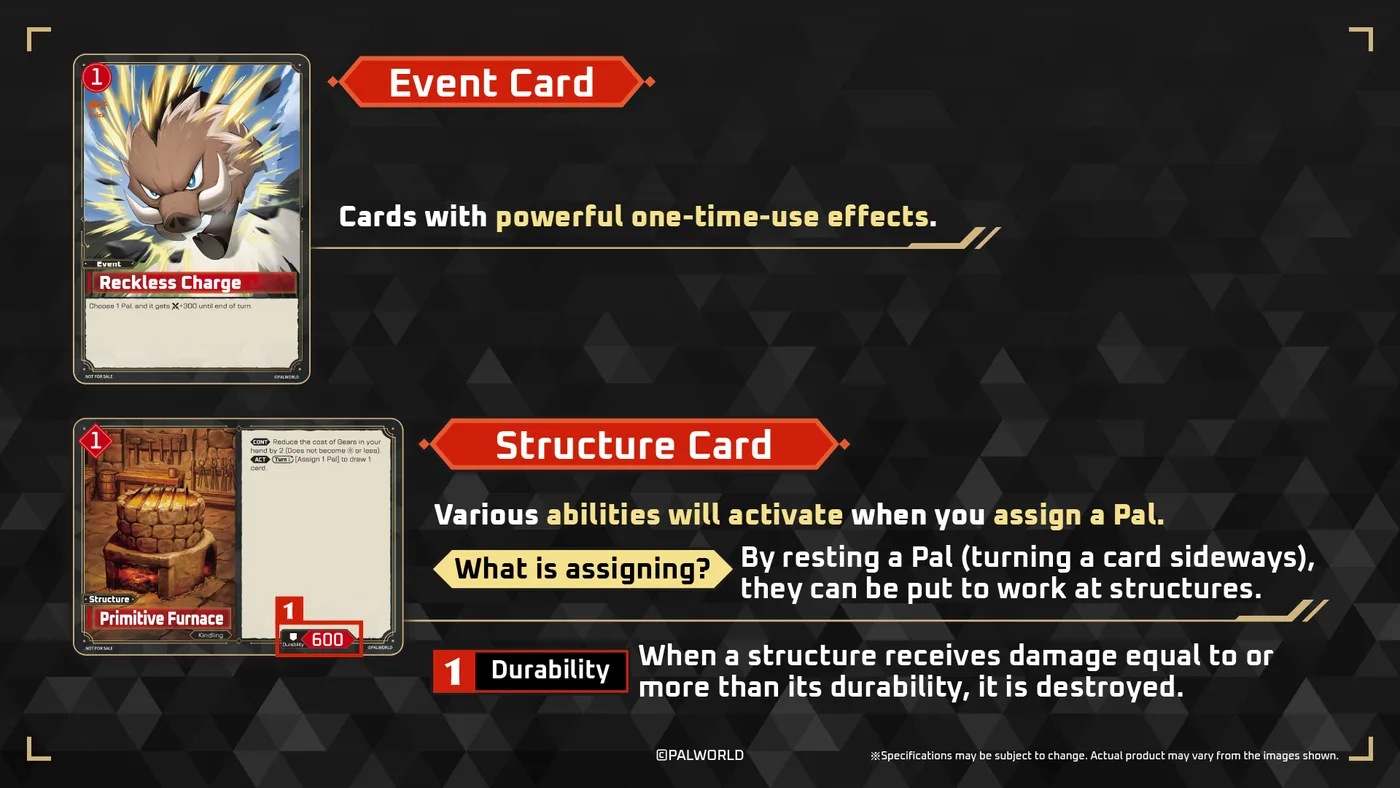
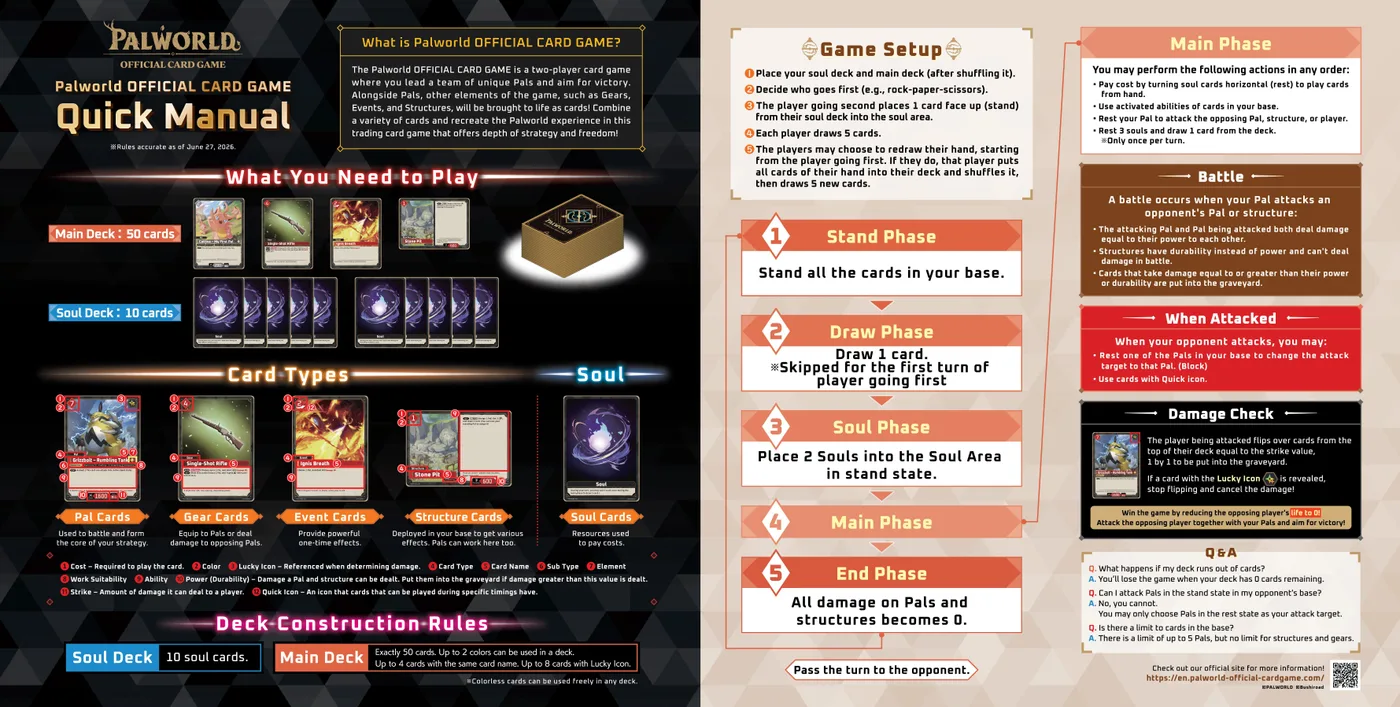
Assign a Pal to Stone Pit and you get 3 Material and a card for a single soul. You also lay that Pal on its side. And a Pal on its side is one of exactly three things in this game your opponent is allowed to attack.
That trade is the whole base-building half of the Palworld TCG. Every structure is a machine that converts your Pals' safety into value, and so far the only real skill in the format is knowing when the exchange rate is worth it.
There are 26 structures in the launch pool. I read the text on all of them off Bushiroad's official card list, checked the mechanics against Comprehensive Rules ver. 1.00, and cross-referenced the 97 entries in the official Q&A. Here is what your base actually does.
What a structure actually is
Rule 2.2.2.2 defines it: a structure is a card you deploy to your base to assist yourself or your Pals. It lives in the base alongside your Pals and your gear, in a public zone, and it is never a Pal for any purpose.
Three consequences land immediately.
Structures have durability, not power. Rule 2.8.3 says the power value is called "durability" when the card type is structure. Same number, same slot on the card, different label. Rule 11.4.1 then removes it identically to a Pal: damage greater than 0 and equal to or above its durability sends it to the owner's graveyard.
There is no structure limit. Your Pals are capped at 5 by rule 4.4.5. Official Q&A #12 asks whether structures and gear are capped too and answers flatly that they are not - deploy as many as you like.
Deck construction does not care either. Official Q&A #3 confirms you may include any number of Pal, gear, structure and event cards in your 50-card main deck. A 50-Pal deck is legal. So is a structure-heavy pile.
The five-Pal ceiling is the only board cap in this game. Everything else is limited by souls and by how many cards you can find.
Assigning is a rest cost, not a job interview
Rule 5.17 is three lines long and worth memorising outright:
- A Pal already in the rest state cannot be assigned (5.17.1.1).
- Assigning puts that Pal into the rest state (5.17.1.2).
- If a structure tells you to assign a Pal without naming one, you choose a standing Pal you own that meets the stated conditions (5.17.2).
Now notice what is not in there. Nothing requires the Pal's Work Suitability to match the structure. Nothing requires the Pal to have been on the board since last turn. Nothing stops you assigning a Pal you deployed thirty seconds ago.
Read 5.17.1.1 backwards and you get the real constraint: a Pal can only work once per turn. After the first assignment it is lying down, and a resting Pal is locked out by rule. Two structures both wanting labour means two standing Pals, or you only fire one of them.
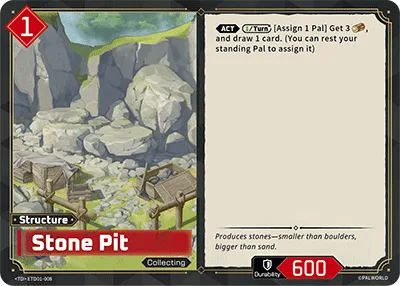
And rule 9.2.3 supplies the punchline. The legal attack targets are the non-turn player, one of their structures, or one of their Pals in the rest state. Every Pal you put to work is a Pal you just made attackable. Stone Pit does not cost you one soul. It costs you one soul and a bodyguard.
Work Suitability does almost nothing yet
All 91 Pals in the launch pool carry at least one Work Suitability, and 65 of them carry more than one. (The card list itself shows more Pal numbers — 100 as of 30 August 2026 — but nine of those are PR2026 promo reprints of cards already in the pool, so the unique count stays 91.) Official Q&A #16 confirms a card with "Kindling" and "Crafting" possesses both individually and can be referenced by either.
Eight suitabilities exist. Here is how they spread across the pool:
| Work Suitability | Pals carrying it | Structures carrying it |
|---|---|---|
| Harvesting | 44 | 1 (Berry Plantation) |
| Collecting | 41 | 1 (Stone Pit) |
| Transporting | 38 | 0 |
| Crafting | 37 | 5 |
| Kindling | 20 | 3 |
| Farming | 12 | 2 (Ranch, Breeding Farm) |
| Cooling | 12 | 0 |
| Electricity | 5 | 0 |
Now the honest part. Almost nothing reads those tags. Three cards in the entire launch pool reference a Work Suitability in their text, and all three reference the same one:
- Mau Cryst – Harbinger of Riches draws a card when it is assigned to a 「Farming」 structure.
- Dumud – Mellow Bounty increases your soul by 1 card in the rest state when assigned to a 「Farming」 structure.
- Beegarde – Knight of the Flower Garden gets Power +500 on deploy if you have a 「Farming」 structure.
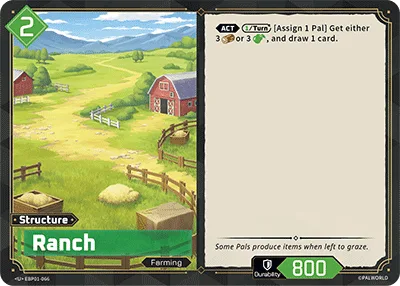
There are exactly two Farming structures in the game. Ranch and Breeding Farm. That is the entire payoff.
Rule 2.5.2 sets the notation - a name inside 「」 corner brackets in card text is a Work Suitability reference - and official Q&A #66 closes the loophole hard. A "Farming" structure means a structure that possesses the Farming Work Suitability. Using Antique Dresser to give a structure the card name Farming Hat does not satisfy it.
So the tags printed on your Pals are, today, flavour with a hook attached for future sets to grab. Do not build around matching them. Do pay attention to the 12 structures that carry a suitability of their own, because that is the side of the relationship the card text actually reads.
All 26 structures in the launch pool
Sorted by colour, then by cost. "Pal needed" means at least one of the card's abilities requires you to assign.
| Structure | Colour | Cost | Durability | Pal needed | What it does |
|---|---|---|---|---|---|
| Stone Pit | Red | 1 | 600 | Yes | Get 3 Material, draw 1 |
| Primitive Furnace | Red | 2 | 800 | Yes | Get 3 Material and draw 1; separately, spend Material to discount your next gear |
| Flame Cauldron | Red | 2 | 900 | No | All your red Pals get Power +200; get 1 Material whenever a red Pal is deployed |
| Alarm Bell | Red | 3 | 1100 | Yes | Stand all Pals assigned this turn; they cannot be assigned again and must attack |
| Weapon Workbench | Red | 3 | 1100 | Yes | Spend 1 Material to deal 800 damage and give all your Pals Strike +1 |
| Mounted Machine Gun | Red | 4 | 1000 | Yes | Spend X Material to deal 500 damage X times |
| Antique Mirror | Blue | 1 | 1000 | No | Draw 1 on deploy |
| Antique Wooden Chair | Blue | 2 | 1200 | No | A Pal gets Power +1000 on deploy |
| Sphere Workbench | Blue | 2 | 900 | Yes | Draw 2, discard 1 |
| Primitive Workbench | Blue | 3 | 1100 | Yes | Reveal the top card; deploy it free if it is a 6-cost-or-less structure or gear, else take it |
| Antique Dresser | Blue | 4 | 1400 | No | Declare a card name and add it to all your cards; or discard X for X Pals at Power +1000 / Strike +1 |
| Antique Curtain | Blue | 5 | 1400 | No | Bounce opposing Pals equal to your distinct Antique structure names |
| Hot Spring | Blue | 6 | 1000 | Yes | Rest up to two 6-cost-or-less Pals; they do not stand next turn |
| Berry Plantation | Green | 1 | 600 | Yes | Get 3 Ingredient, draw 1 |
| Feed Box | Green | 2 | 900 | No | Spend 1 Ingredient to add a rested soul; at 10+ souls, stand 2 instead |
| Ranch | Green | 2 | 800 | Yes | Get either 3 Material or 3 Ingredient, draw 1 |
| Campfire | Green | 3 | 1100 | Yes | Spend 2 Ingredient to gain 1 life and give all your Pals Power +1000 |
| Breeding Farm | Green | 3 | 1100 | Yes | Dig for an 8-cost-or-less Pal; or assign 2 Pals to deploy one from hand |
| No Pals Beyond Sign | Green | 5 | 1100 | Yes | The assigned Pal gains Taunt through your opponent's next turn |
| Cola Vending Machine | Green | 6 | 1500 | Yes | Spend X Ingredient to stand 1 soul, then up to 3X more |
| Hanging Trap | Purple | 2 | 900 | Yes | Exile a Pal for as long as the trap survives |
| Shoddy Bed | Purple | 2 | 700 | No | Mill 3 to make it night; draw if a Nocturnal Pal is resting at end of turn |
| Wooden Wall | Purple | 3 | 300 | No | Taunt; draws you a card when it hits the graveyard |
| Viewing Cage | Purple | 3 | 1300 | Yes | Exile the assigned Pal and one costing up to its cost +2 |
| Lamp | Purple | 4 | 1300 | No | Mill 3 to make it night; all your Pals gain Nocturnal |
| Medieval Medicine Workbench | Purple | 4 | 1300 | Yes | Pay 3 souls and assign to reanimate a Pal costing up to the assigned Pal's cost +2 |
Green and Blue get seven each, Red and Purple six each. Eleven of the 26 cost two souls or fewer, and seven of those eleven draw you a card - eight do across the whole 26, with Wooden Wall the odd three-drop out - which is the quiet reason structures show up in both trial deck lists.
Material and Ingredient are two economies, not one
Rule 3.3.1.2.1 names exactly two resources: Material and Ingredient. Official Q&A #14 is refreshingly blunt about what they are - information belonging to a player, with no inherent abilities of their own, gained and consumed only by card abilities.
Three rules govern them, and all three matter at the table:
- They cannot drop below 0 (3.3.3.1).
- If you own fewer than the amount a cost demands, the consumption cannot be performed at all (3.3.3.2).
- They are public information, and either player may check the counts at any time (3.3.4).
Nothing clears them at end of turn. Rule 7.6 zeroes damage on Pals and structures and switches off until-end-of-turn effects, and it says nothing about resources. They bank indefinitely.
| Material | Ingredient | |
|---|---|---|
| Cards that produce it | 11 | 11 |
| Cards that spend it | 5 | 9 |
| Colour that owns it | Red | Green |
| Structures that produce it | Stone Pit, Primitive Furnace, Flame Cauldron, Ranch | Berry Plantation, Ranch |
| Biggest sink | Mounted Machine Gun - X Material for 500 damage X times | Cola Vending Machine - X Ingredient to stand up to 3X+1 souls |
That five-versus-nine gap is the number to stare at. Material has almost twice as many producers as consumers, and the consumers are five specific cards: Mounted Machine Gun, Primitive Furnace, Weapon Workbench, Reptyro – Ore Gorger and Mossanda Lux – Vanguard Captain. Play Red without at least two of those and your Material is a number you write down and never spend.
Ranch is the only card that produces either resource unconditionally. Assign a Pal, choose 3 Material or 3 Ingredient, draw a card. Digtoise's Headband offers the same choice for 2, but only if the Pal you buffed has the main name 《Digtoise》. In a two-colour Red-Green build Ranch is the glue, and it is a two-drop.
Ingredient sinks are far better distributed - Campfire, Feed Box, Cola Vending Machine, Breeding Farm, Lyleen, Elizabee and both Digtoise printings all want them - which is why Green feels like it has an engine and Red feels like it has a stockpile.
Nine structures that never ask for a Pal
Seventeen of the 26 structures need an assignment somewhere in their text. Nine never do, and those nine are the ones you can run in a deck that wants its Pals standing up and blocking:
- Antique Mirror (Blue, 1) - draws a card on deploy and leaves a 1000-durability body behind.
- Antique Wooden Chair (Blue, 2) - Power +1000 to a Pal on deploy, at instant-speed-adjacent timing on your main phase.
- Flame Cauldron (Red, 2) - a permanent Power +200 to every red Pal, plus Material on each red deploy.
- Feed Box (Green, 2) - converts Ingredient into soul acceleration.
- Shoddy Bed (Purple, 2) - makes it night off your own deck, and pays you a card for it.
- Wooden Wall (Purple, 3) - Taunt.
- Lamp (Purple, 4) - night plus Nocturnal for your entire board.
- Antique Dresser (Blue, 4) - a discard outlet that doubles as a combat trick.
- Antique Curtain (Blue, 5) - mass bounce scaled off your Antique count.
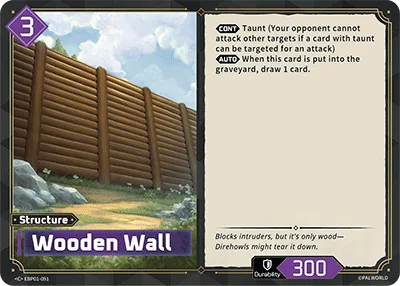
Wooden Wall is the sharpest of the nine and the most misread. Three souls, Taunt, and 300 durability - the lowest durability printed on any structure in the set. Your opponent has to attack it while it is a legal target, and Q&A #40 confirms that when several Taunt cards are up the attacker picks which one, but cannot go around them. Most attackers flatten it in one swing, but not all of them: thirteen Pals are printed under 300 power - Depresso at 100 and twelve more at 200 - and rule 11.4.1 only destroys a card when the damage reaches its durability, so an unbuffed 200-power attacker bounces off and the wall stands. That is the design, not a flaw. You are buying an absorbed attack and a card for three souls, and you are buying it without resting anything.
Structures never hit back, and they heal every turn
Rules 9.6.3.2 and 9.6.3.2.1 read together are brutal: an attacking Pal deals damage equal to its power to the structure it attacked, and the structure deals nothing back. There is no trade. Swinging at a base is completely free.
Two things push against that.
The defender can still block. Rule 9.4.2 lets the non-turn player rest one standing Pal that is not already the attack target and redirect the attack onto it, and nothing restricts that to attacks aimed at players. Q&A #71 confirms a structure attack can be blocked, and pins the timing: an ability triggered by attacking a structure fires at declaration, before blockers are chosen.
Damage on structures wipes clean. Rule 7.6.3 zeroes damage on every Pal and structure in every base during the end phase. Chip damage into a 1400-durability Antique Dresser is thrown away unless you finish it this turn. The same rule that protects a 2000-power Mammorest protects a big structure.
That is why the durability curve looks the way it does. A 600-durability Stone Pit dies to essentially anything and you should expect to replace it. A 1300-to-1500 body in the top half of the table takes a genuine commitment to remove, and if you fall 200 short, you accomplished nothing at all.
Attacking a structure costs you nothing but your attacker's rest. If the opponent is running an engine and you cannot profitably attack their Pals, break the engine - and finish it in one turn.
What to run, and why gear is the cheaper answer
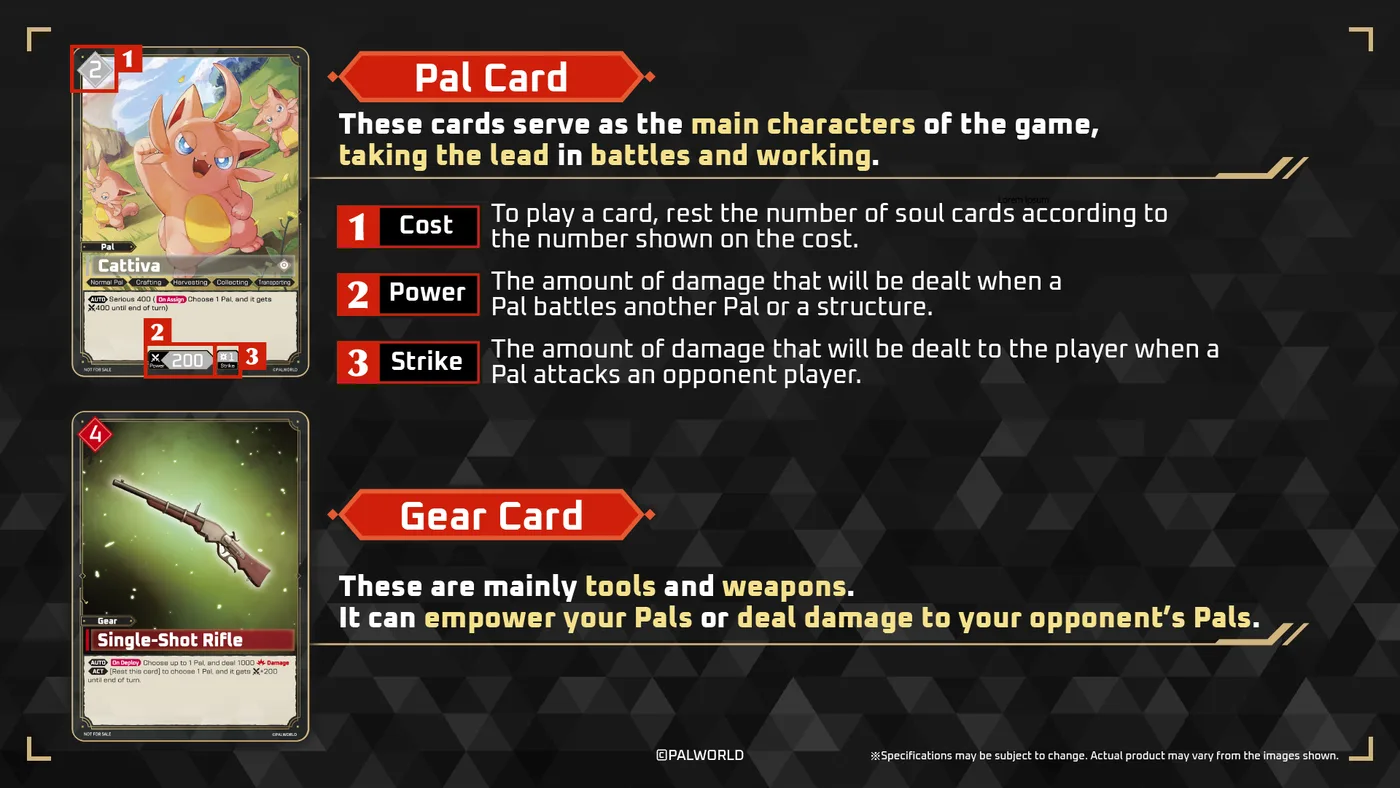
Here is the comparison nobody makes on stream yet. There are 14 gear cards in the launch pool, and I read the cost line on all 14: every one carries an activated ability paid with [Rest this card] - the gear rests itself. Thirteen ask for nothing else. The lone exception is Meat Cleaver (EBP01-093), whose cost is [Rest this card, butcher 1 Pal], so it eats a body on top. Refined Metal Spear hands out Power +900 for resting a piece of cardboard. Farming Hat gives Power +200 and an Ingredient for the same. Stone Pickaxe does it for Material.
Structures rent your Pal. Gear rents itself. Rule 7.2.1 stands every card in your base during your stand phase, so a rested gear is back the following turn at zero cost, while a rested Pal spent a turn as a target.
That does not make structures worse - the raw rates on Stone Pit and Berry Plantation are better than anything gear offers, and gear cannot draw you cards - but it should change how you count. Three structures wanting assignments and a five-Pal ceiling is a board that fires maybe two abilities a turn.
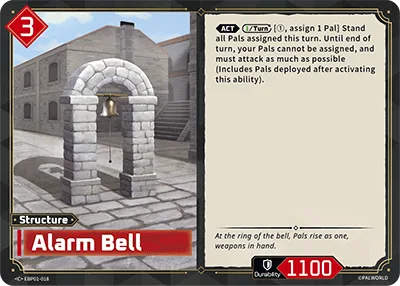
Alarm Bell is the one card that partly buys the rest cost back, and it is worth reading precisely because it is easy to over-read. For 1 soul plus an assignment it stands all Pals assigned this turn - but until end of turn your Pals cannot be assigned, and they must attack as much as possible. It does not let you work a Pal twice. It converts a board of labourers back into a board of attackers and then commits them. Vaelet – Bewitching Blossom does the individual version: discard a card, and if you assigned Vaelet this turn, stand it.
Three practical calls the card pool supports today:
- The 1-drops are the entry point. Stone Pit and Berry Plantation both cost one soul, both hand you 3 resources and a card per turn, and both sit at 600 durability. Deploy them early, expect to lose them, run more than one - Q&A #44 confirms two copies of Stone Pit each get their own once-per-turn activation.
- Match your sinks to your generators before you add a third structure. Material without Weapon Workbench or Mounted Machine Gun is dead weight.
- Count standing Pals, not structures. Your ceiling on abilities per turn is how many Pals you are willing to lay down, and every one you lay down is a target under rule 9.2.3.
What nobody can tell you yet is the right structure count for a competitive list. The game went on sale 30 July 2026, Bushiroad has published no tournament results, and Booster Pack "Legends Awaken" arrives 30 October 2026 with cards nobody outside Bushiroad has read. Anyone quoting you an optimal number this month is guessing.
Quick Action Checklist
- Assign only standing Pals - rule 5.17.1.1 blocks a resting Pal, so each Pal works once per turn at most.
- Check your sinks before your generators. Material has 11 producers and only 5 consumers; Ingredient has 11 and 9.
- Do not build around Work Suitability. Three cards in the whole pool read it, and all three want a 「Farming」 structure - of which there are exactly two.
- Run at least one 1-cost engine. Stone Pit or Berry Plantation, and more than one copy, since each gets its own once-per-turn use.
- Remember structures never deal damage back. Attacking a base is free for your opponent too.
- Finish a structure in one turn - rule 7.6.3 wipes damage on it at end of turn, so half-killing it accomplishes nothing.
- Reach for gear when you cannot spare the bodies. All 14 launch gear cards rest themselves instead of your Pal; only Meat Cleaver also asks you to butcher one.
Frequently Asked Questions
How does assigning a Pal to a structure work in the Palworld TCG?
Does a Pal need matching Work Suitability to be assigned to a structure?
How many structures are there in the Palworld TCG launch pool?
Is there a limit on how many structures you can have in the Palworld TCG?
What is the difference between Material and Ingredient in the Palworld TCG?
Do structures fight back when attacked in the Palworld TCG?
Does damage on a structure carry over between turns?
Keep Reading
Related Guides

Palworld TCG Lucky Pals - All 24 in the Launch Pool, and How Many to Run
The Lucky Pal icon is the single most important number in Palworld TCG deck-building, and almost nobody has counted the pool. I pulled every card from Bushiroad's own card database and found 24 Lucky Pals across the three launch products - six per colour, at costs 5, 6, 7, 7, 8 and 8, in all four colours, identically. Not one of them is a Common. Here is the full list, the real cancel probabilities, and why raising your Strike is the worst way to beat them.

Palworld TCG Recommended Decks: All 4, and Which One Wins
Bushiroad recommends four decks to build from Dawn of Palpagos: Material, Dragon, Ingredient and Nocturnal. Its English site posted all four on 1 October, and on 7 October it posted the first tournament lists played with English cards, from the Grand Challengers Cup at Bushiroad EXPO 2026 in Kuala Lumpur. Here are all four recommended lists, card for card, and what happened when I checked each one against the 49 tournament lists in Bushiroad's own databases.
Palworld TCG Pal Cards - Power and Strike by Cost
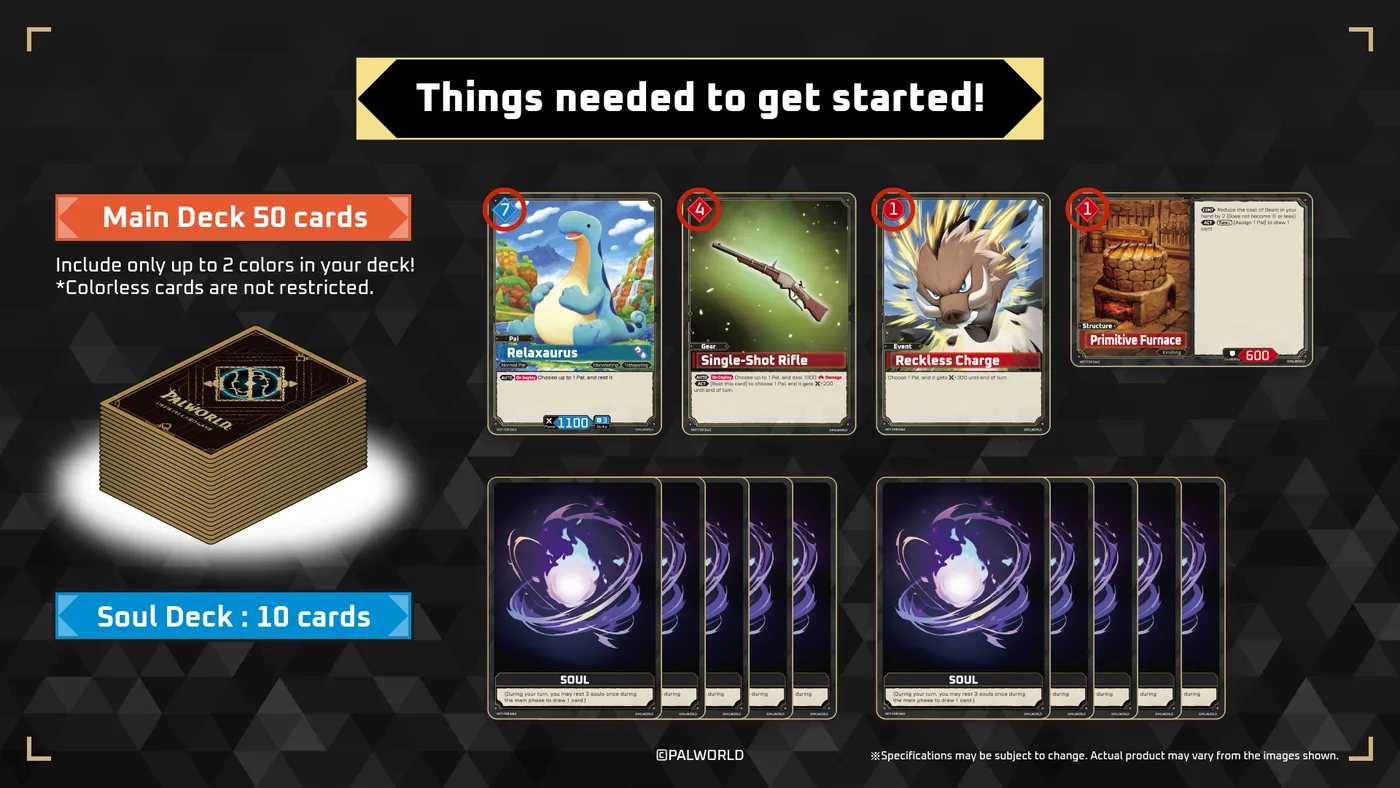
Pals are 100 of the 166 distinct cards in the Palworld TCG launch pool, and the two numbers along the bottom of each one are most of what they do. Sorting all 91 unique Pal designs by cost turns up a ladder: Strike is not a design lever at all, it is a straight function of cost, with three exceptions in the whole set. Power is the only stat Bushiroad negotiates, and the textless Pal at each cost sets the price.
Palworld TCG Gear Cards - All 14, and the Attack-Proof Rule
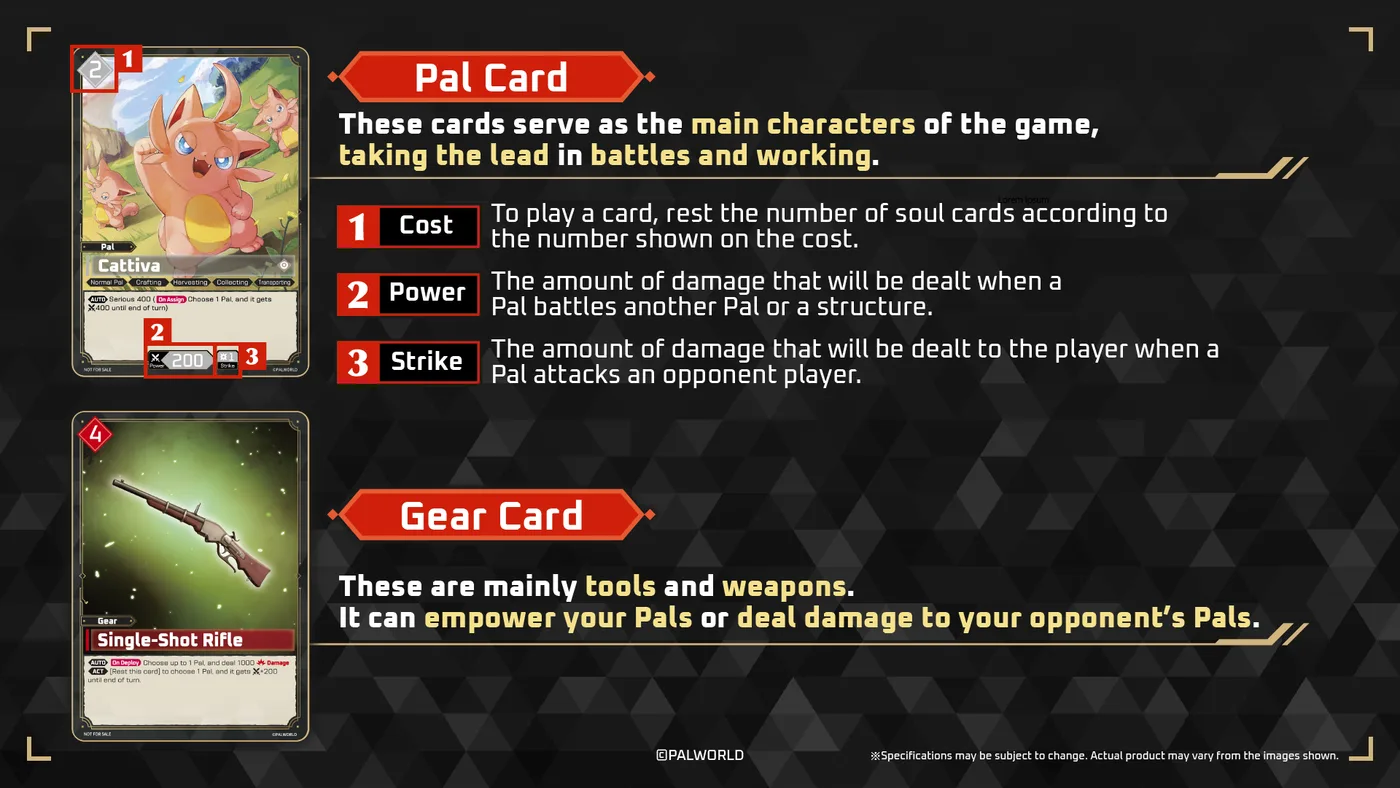
There are 14 gear cards in the Palworld TCG launch pool, and the rules never give your opponent a way to attack one. Rule 9.2.3 lists the legal attack targets - the player, structures, rested Pals - and gear is simply not in the sentence. I read all 14 off the official card database, checked every card in the 166-card pool for an answer to a deployed gear, and found exactly one. Here is what each gear does, when the rules let you use it, and why the safest card type in the game still is not an auto-include.

How to Play the Palworld TCG - Souls, Power vs Strike, and How You Actually Win
Bushiroad's Palworld card game launched 30 July 2026, and its comprehensive rules landed the same day. Here is the full walkthrough - the four colours plus colourless, the soul deck, the Power and Strike split that decides every attack, structures and Pal labour, and the Damage Check that turns your own deck into your life total. Everything here is sourced from the official rules, and I flag what Bushiroad has not published.
Palworld TCG Event Cards - All 17, and the Quick Timing Rule That Costs Games
There are 17 event cards in the Palworld TCG launch pool and exactly five of them carry Quick. Three of those five are trial-deck cards, which means a booster box hands you almost no instant-speed interaction. Worse, there is one moment on your own turn where a Quick card is illegal - and it is the moment you will most want it. Here is all 17, the timing rules from Comprehensive Rules ver. 1.00, and the official rulings that decide the edge cases.