Palworld TCG Colours Explained - What Red, Green, Blue and Purple Actually Do
Bushiroad has published comprehensive rules for the Palworld TCG, but it has not published a colour-identity document - there is no official page telling you what Red or Purple is supposed to do. So I read the rules for what colour legally means, then went through all 150 unique cards in the launch pool and counted. Here is what colour actually is, the single hard rule it imposes, why souls make it cheaper than you think, and what the card pool says each colour was built for.
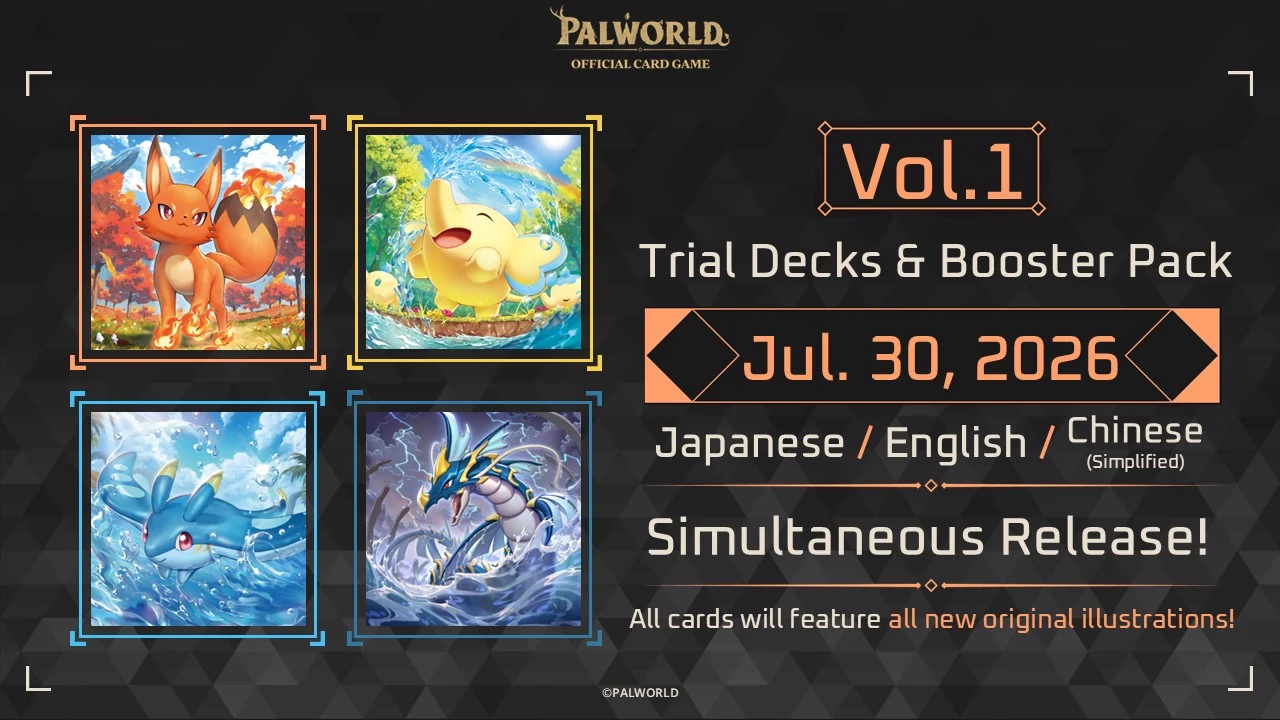
The Palworld TCG went on sale worldwide on 30 July 2026. That was three days ago. Every "colour identity" guide you have seen since then is somebody's first impression dressed up as doctrine, because Bushiroad has not published a document explaining what its four colours are supposed to do. I went looking for one. It does not exist.
What does exist is a set of comprehensive rules dated the day of release, an official play guide, and a searchable card database. So I did the boring version instead: read what the rules say colour legally is, then pulled every card in the launch pool and counted which mechanics live where. The launch pool is 150 unique cards once you collapse every parallel treatment back to its base number - 101 in Booster Pack 01 "Dawn of Palpagos" and 25 in each trial deck, minus one because both decks ship the same soul card, which the database files under each of them - and that is a small enough number to actually check rather than vibe. The PR promo run sits outside that count and keeps growing, so every figure below excludes it.
Here is what holds up.
What colour actually means in the rules
Section 2.6 of the Comprehensive Rules ver. 1.00 is shorter than you would expect. A card's colour "is either red, blue, green or purple", and it is "indicated by the background colour of its cost". That is the whole definition. Colour is a label printed on the cost badge in the top-left corner.
Then 2.6.3 does something worth reading twice: some cards are shown as colorless, and this "means that they have no colors assigned to them and does not mean that they have colorless as their color". Colorless is not a fifth colour. It is the absence of one. That sounds like pedantry until a card starts asking about "your red Pals" and you need to know whether a Colorless Pal counts. It does not.
Note what colour is not in the rules. It is not an element. Elements are a separate printed field with nine values - Neutral, Fire, Water, Electric, Ground, Grass, Ice, Dragon and Dark - and a Pal can have two of them. In the launch pool they happen to line up tightly with colour (every one of the 22 Dark Pals is Purple, all 16 Grass Pals are Green), but they are different fields doing different jobs, and card text targets them separately.
Colour is also not tied to Power or Strike. Power is the big number bottom-centre, the damage a Pal deals to other Pals and structures and the damage it can absorb before it hits the graveyard. Strike is the small number beside it, and it is only the damage that Pal deals to a player. Neither is gated by colour.
The only hard rule colour imposes
There is exactly one, and it is in deck construction. The official play guide states it plainly: a main deck is "Exactly 50 cards. Up to 2 colors can be used in a deck. Up to 4 cards with the same card name. Up to 8 cards with Lucky Icon." Underneath that, in small print: "Colorless cards can be used freely in any deck."
So you pick two of Red, Blue, Green and Purple, and Colorless is free. That is the entire tax. There is no third-colour splash, no off-colour penalty, no colour-screw.
Worth flagging for anyone cross-referencing: the two-colour cap appears in the play guide, not in the deck-construction section of the comprehensive rules, which lists the 50-card size, the 4-copy name limit and the 8-card Lucky Pal cap but not a colour restriction. The play guide is the official rules summary Bushiroad ships in the trial decks and posts on its rules page, so treat two colours as the rule. Just do not be surprised if a future comprehensive rules revision writes it in explicitly.
Souls do not care what colour you are
This is the part that changes how you should think about the whole system, and it is easy to miss if you are coming from Magic.
Your resource is souls. They live in a separate 10-card soul deck, you move two into your soul area every soul phase, and you pay a cost by resting that many standing souls. Soul cards have no colour and no cost printed on them. Every soul is identical and generic.
Which means colour never taxes your mana. A cost of 6 is six souls whether the card is Red, Purple or Colorless. There is no equivalent of double-black in your opening hand with only Forests. Playing two colours costs you nothing at the point of casting - it costs you only deck slots and synergy density.
That is a genuinely different design from most two-colour TCGs, and it is why the colour choice here is a thematic commitment rather than a mechanical one. You are not pairing colours to fix your mana. You are pairing them because their engines feed each other, or because they cover each other's holes.
What Bushiroad has not published
Before the per-colour sections, the honest caveat, because it matters.
There is no official colour-identity statement. Not in the comprehensive rules, not in the play guide, not on the product pages. The closest thing Bushiroad has published is marketing copy on the two trial deck listings: TD01 invites you to "Experience overwhelming power with Red・Blue", and TD02 to "Enjoy strategizing battle tactics with Green・Purple". That is a tagline, not a design brief, and I would not build a deck on it.
So everything below is not "Red is the aggro colour because the publisher said so". It is what the 150 launch cards actually do, counted. If Bushiroad publishes a colour philosophy later and it contradicts this, the cards will still be the cards.
Red: Material, direct damage, and the only mono-colour payoffs
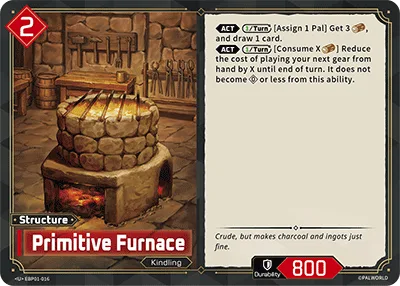
Red owns the Material resource. Of the 15 launch cards that reference Material, 11 are Red - structures like Stone Pit and Primitive Furnace that generate 3 Material and draw a card when you assign a Pal to work them, and payoffs like Weapon Workbench that spend Material to throw 800 damage at a Pal.
Red also has the most direct damage that happens outside of combat, and it is the only colour carrying the Brave keyword (a Pal that gets stronger the moment it attacks).
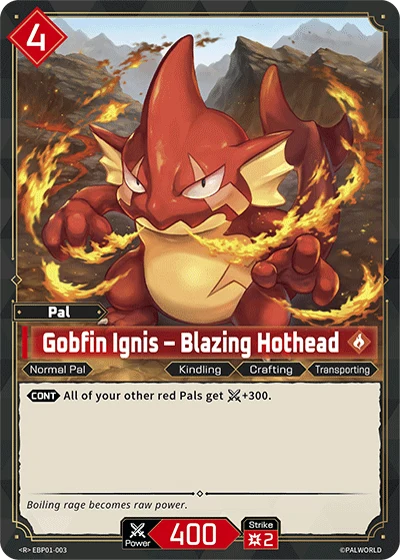
The genuinely distinctive thing about Red, though, is this: it is the only colour in the entire launch pool whose cards care about their own colour. Five Red cards reference the word "red" in their text - Flame Cauldron gives all your red Pals Power +200 and generates Material whenever a red Pal is deployed, Gobfin Ignis pumps your other red Pals, one card gives all your red Pals Power +500 and Strike +1 on attack. Blue, Green and Purple have zero cards that mention their own colour.
That is a real, checkable asymmetry. Red is currently the only colour with a mono-colour reward built in, which is a live argument for running Red-heavy rather than Red-splash.
Green: Ingredients, the biggest bodies, and every soul trick in the set
Green owns Ingredients the way Red owns Material: 18 of the 20 Ingredient-referencing cards are Green. Berry Plantation and Campfire are the trial deck versions - assign a Pal, get 3 Ingredients, or spend 2 to gain a life and give every Pal Power +1000 for the turn.
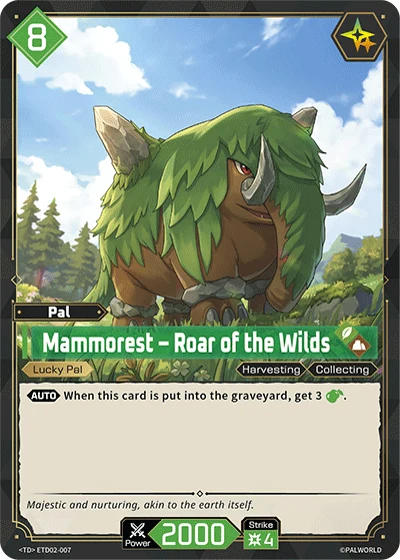
Green also has the largest creatures. It has the only 2000-Power Pal in the set, and the two keywords built around winning combat outright: Breakthrough (both of its printings are Green) and Taunt (4 of the 5).
But the finding that surprised me most is souls. Six colour-bearing cards in the launch pool manipulate souls - standing them early, adding an extra one, rewarding you for holding ten or more. All six are Green. Red, Blue and Purple have none.
Feed Box spends an Ingredient to add a soul in the rest state. Cola Vending Machine stands a soul, then stands up to three times more. Digtoise gets Power +1000 and Strike +1 if you have 10 or more souls. If ramp and soul acceleration turn out to matter in this game, Green is currently the only colour that does it, and that is the single strongest structural claim you can make about colour right now.
Blue: resting, bouncing, and card flow
Blue is the hardest colour to summarise honestly, because it has no exclusive resource. It touches neither Material nor Ingredients - zero cards either way.
What it does have is the most interaction with the rest/stand state, which is this game's tempo axis. Blue structures rest your opponent's Pals and stop them standing during their next stand phase, bounce Pals back to hand, or draw you extra cards. Antique Mirror draws on deploy; Sphere Workbench draws 2 and discards 1; Hot Spring rests two Pals and keeps them down a turn.
Blue is also the only home of Vigilance, the keyword that stands a card back up at the end of your turn - which is exactly the sort of thing a tempo colour wants.
I want to be careful here: "tempo and cards" is my read of a 35-card colour, not a published identity. Blue's average Pal is statistically almost identical to Red's - both average exactly 5 cost, with 829 and 833 average Power respectively. The difference is what the text does, not what the numbers say.
Purple: night, the graveyard, and butchering your own Pals
Purple is the most mechanically distinct colour in the set, and the easiest to describe, because it has three exclusive toys.
Night is entirely Purple. Twelve cards reference night, all Purple, and Nocturnal - the keyword that gives a Pal Power +300 while it is night - has all seven of its printings in Purple. Structures like Lamp and Shoddy Bed mill your own top three cards to make it night until the end of your opponent's next turn.
The graveyard is mostly Purple: 21 of the 30 cards that mention it. Purple recurs Pals from the graveyard, and Medieval Medicine Workbench deploys one back in the rest state.
Purple is also the only colour with Stealth (unblockable, all 3 printings) and Retaliate (its single printing), and it is the colour that butchers its own Pals for value - Katress gets Power +1000 and Strike +1 for eating a friendly Pal.
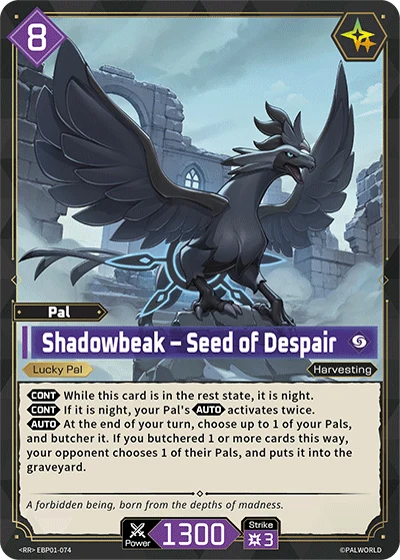
The cost of all this: Purple has the smallest Pals. Its 22 unique Pals average 718 Power against Red's 833, Blue's 829 and Green's 810, at the same average cost of 5. You are paying for the text.
Colorless: seven cards that go in any deck
There are only 7 Colorless cards in the launch pool, and they are small. Six are Pals, and not one of them goes above 4 cost, 600 Power or 2 Strike. The seventh is an Event.
Most of them are the "My First Pal" cycle - Cattiva, Chikipi, Lamball, Ribbuny - two-cost 200-Power bodies with a defensive clause or a small resource payoff on death. Chikipi gives an Ingredient when it dies, Ribbuny gives a Material.
They go in any deck for free. What they will not do is carry one. Treat Colorless as filler and early blockers, not as a third colour.
Colour and your eight Lucky Pal slots
This is where colour choice bites hardest, and almost nobody is talking about it yet.
When a Pal attacks you directly, you resolve Player Damage Resolution: you put cards from the top of your deck into the graveyard one at a time, and if any of them has the Lucky Pal icon, the damage is cancelled outright. Not reduced. Cancelled, and your damage taken is set to 0. Lucky Pals are the only damage prevention in the game.
Your deck may contain at most 8 of them.
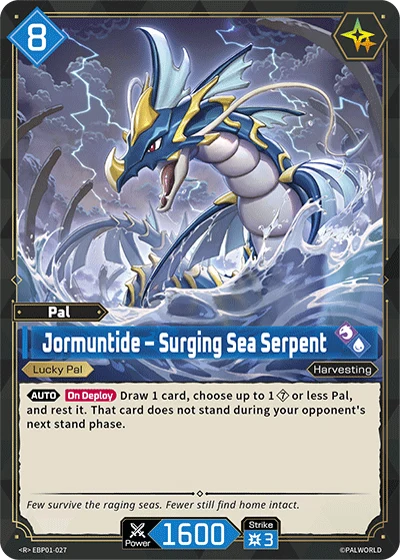
Now the colour part. There are 24 unique Lucky Pals in the launch pool, and they are distributed with suspicious tidiness: exactly 6 in each colour. Zero Colorless Lucky Pals exist. So your 8 Lucky slots must come from your two chosen colours, out of a pool of 12 unique cards.
They are also expensive. Lucky Pals average 6.83 cost and 1225 Power against roughly 5 cost and 800 Power for Pals generally. They are the top end of your curve. Which means the 8-card Lucky cap is simultaneously your defensive package and your finisher package, and your colour pair decides which twelve you get to choose from.
What a second colour actually costs you
Bushiroad's own two trial decks pair Red with Blue and Green with Purple, which is a reasonable read on what pairs cleanly: Red and Blue share nothing resource-wise, so neither dilutes the other, while Green and Purple both want cards in the graveyard for different reasons.
But because souls are colourless, the real cost of a second colour is not castability. It is dilution of your engine. Red's Material payoffs need Material generators. Green's Ingredient sinks need Ingredient generators. Run 25 Red and 25 Green and you have half an engine of each, and Red's own mono-colour bonuses - the only ones in the game - get worse the more non-Red Pals you play.
The colours whose engines don't compete are the ones that pair cheaply. Blue is the obvious partner for anybody, precisely because it has no resource of its own to feed. That is a structural argument from the card pool, not a tested one.
What is still unknown
The game is three days old, so here is the honest ledger.
There is no meta. No tournament results, no tier list, no data on which colour pair wins. Anyone giving you percentages is making them up.
Bushiroad has not published a colour philosophy, so the identities above are inferred from the launch pool and could be contradicted by Booster Pack 02 "Legends Awaken", due 30 October 2026.
Colour distribution at launch is almost perfectly even - Red 35, Blue 35, Green 35, Purple 36 unique cards, with each colour getting 21 or 22 unique Pals at an identical average cost of 5. That is a deliberately mirrored starting point, which means one set is far too little evidence to call any colour stronger.
And Blue's identity in particular is thin. It has no exclusive resource, and one 35-card set is not enough to say whether that is by design or just where the first booster landed.
Check the official card list yourself before you trust anyone, including me. It is searchable by colour, keyword and cost, and it is the only source here that cannot be wrong.
Frequently Asked Questions
How many colours are in the Palworld TCG?
How many colours can you use in a Palworld TCG deck?
Do you need specific colours of souls to pay costs in the Palworld TCG?
Which Palworld TCG colour is the best?
What is the difference between colour and element in the Palworld TCG?
Which colour has the Lucky Pals in the Palworld TCG?
Keep Reading
Related Guides
How to Play the Palworld TCG - Souls, Power vs Strike, and How You Actually Win
Bushiroad's Palworld card game launched 30 July 2026, and its comprehensive rules landed the same day. Here is the full walkthrough - the four colours plus colourless, the soul deck, the Power and Strike split that decides every attack, structures and Pal labour, and the Damage Check that turns your own deck into your life total. Everything here is sourced from the official rules, and I flag what Bushiroad has not published.
Palworld TCG AUTO, CONT and ACT Abilities Explained
Every ability on a Palworld TCG card opens with one of three tags - AUTO, CONT or ACT - and Comprehensive Rules 10.1 makes that tag the most important word in the text box. It decides whether the ability works on your opponent's turn, whether you are allowed to decline it, and whether a [Once Per Turn] clock applies. I counted all 153 printed abilities across the 157 distinct cards in the launch pool and sorted them by category, trigger and cost.
Palworld TCG Keyword Abilities - 10 Counted, 14 in the Rules
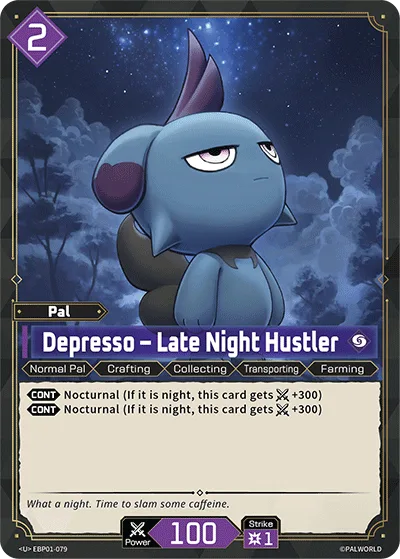
Comprehensive Rules ver. 1.00 defines fourteen keywords in one section, and How to Play the Palworld TCG tables all of them - what Brave does, what Taunt does - and stops there. Nobody has counted how many cards actually carry each one. I pulled every card tagged with one of the ten keyword abilities Bushiroad's official database filters on and cross-referenced all 97 rulings: Interrupt covers nine Pals, Retaliate covers exactly one, and Depresso - Late Night Hustler prints Nocturnal twice on the same card, which the official Q&A confirms stacks to +600 Power.
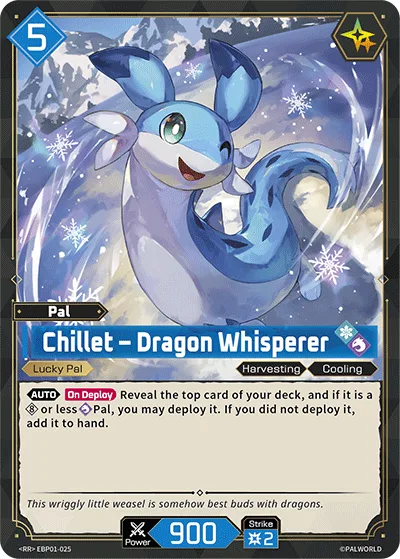
Palworld TCG Elements - All 9, and Why Only 2 Cards Care
Every Pal card in the Palworld TCG carries an element icon, and the video game trained you to expect that icon to decide fights. It does not. Comprehensive Rules ver. 1.00 spends three sub-rules on elements and never mentions them again, and exactly two of the 166 cards in the launch pool have text that reads an element. Here is the full census of all nine across the 100 Pal cards, and the one element that already has support.
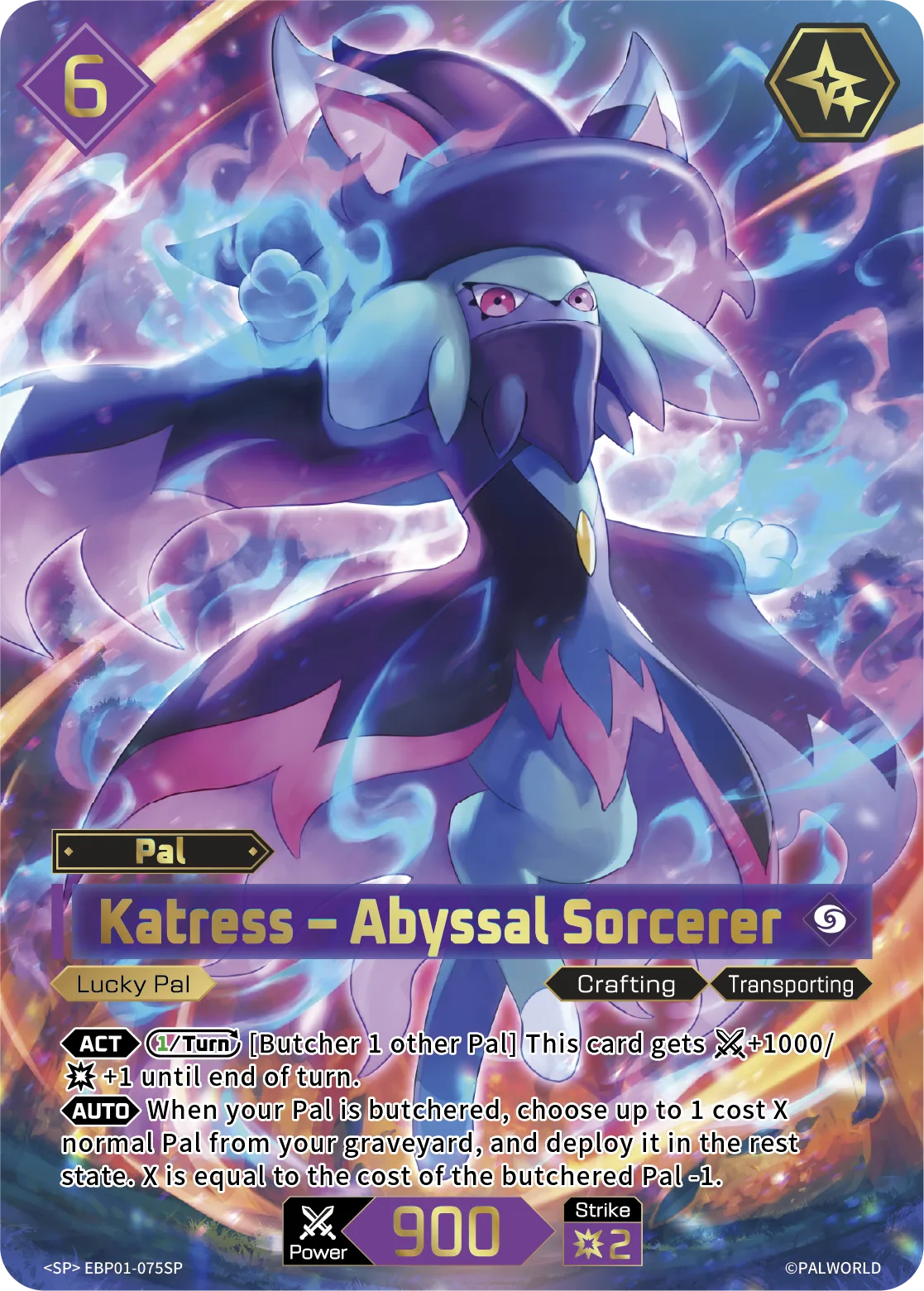
Palworld TCG Rulings - All 97 and the Most-Ruled Cards
The Palworld TCG shipped with an official Q&A of 97 entries and has not added or revised one since. Pulling the whole database and sorting it by card shows where the game is genuinely hard: 45 of the 97 are wording rules that apply to cards nobody has printed yet, only 26 of the 166 cards ever earned a card-specific answer, and four cards account for 16 of the 32 that exist.
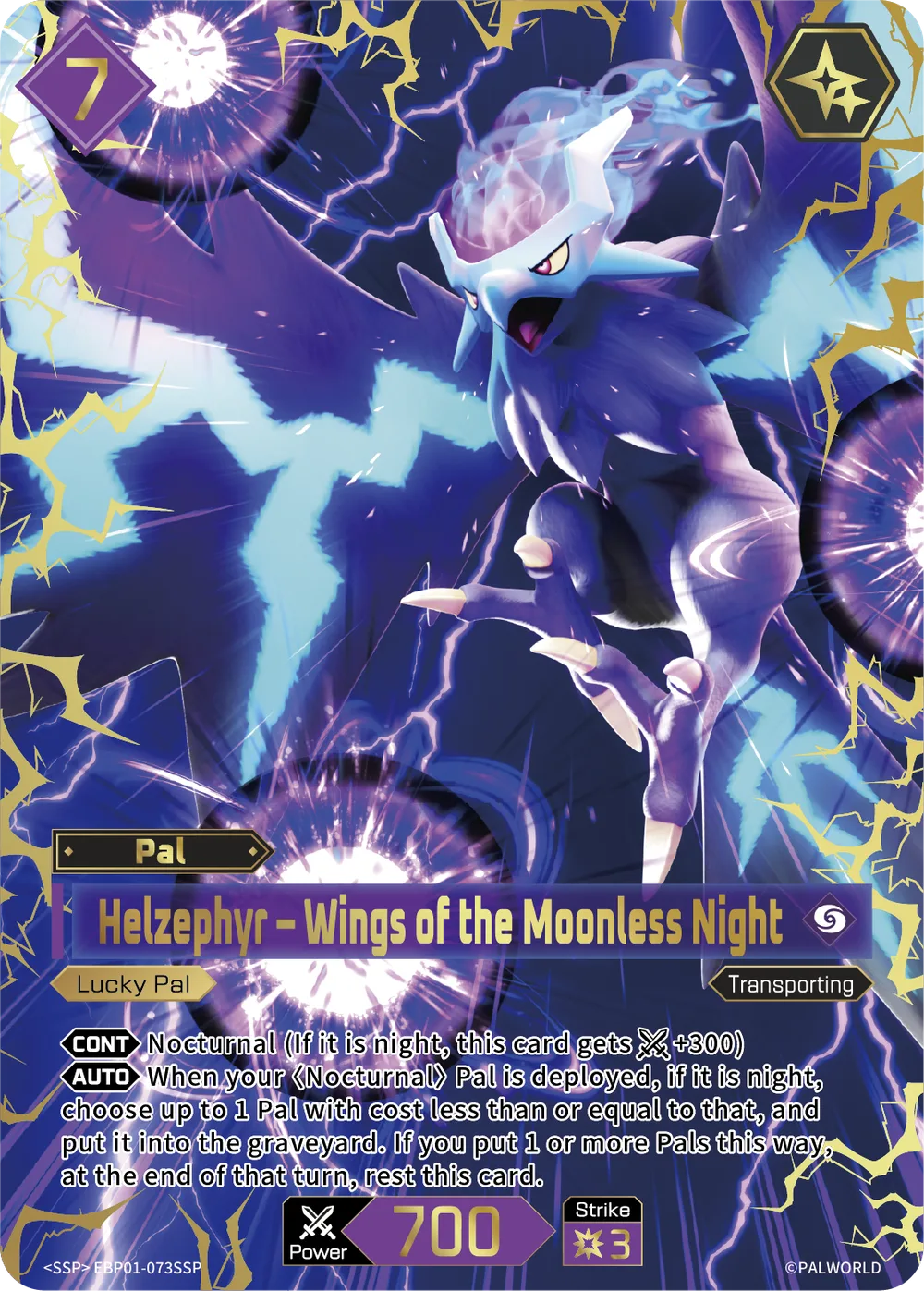
Palworld TCG Recommended Decks: All 4, and Which One Wins
Bushiroad recommends four decks to build from Dawn of Palpagos: Material, Dragon, Ingredient and Nocturnal. Its English site posted all four on 1 October, and on 7 October it posted the first tournament lists played with English cards, from the Grand Challengers Cup at Bushiroad EXPO 2026 in Kuala Lumpur. Here are all four recommended lists, card for card, and what happened when I checked each one against the 49 tournament lists in Bushiroad's own databases.