How to Play the Palworld TCG - Souls, Power vs Strike, and How You Actually Win
Bushiroad's Palworld card game launched 30 July 2026, and its comprehensive rules landed the same day. Here is the full walkthrough - the four colours plus colourless, the soul deck, the Power and Strike split that decides every attack, structures and Pal labour, and the Damage Check that turns your own deck into your life total. Everything here is sourced from the official rules, and I flag what Bushiroad has not published.
Most card games make you wait a turn before your new creature can do anything. The Palworld TCG does not. Rule 9.2.2.3 in Bushiroad's comprehensive rules is one line long and it says a Pal can attack the same turn you deploy it to your base.
That single sentence tells you what kind of game this is. There is no summoning sickness, no drying, no build-up turn where you deploy and pass. You put a Pal down, you swing with it, and the only thing standing between that attack and your opponent's life total is whether they kept a Pal upright to block.
The game went on sale worldwide on 30 July 2026, and Bushiroad published Comprehensive Rules ver. 1.00 the same day. Everything below comes from that document and from the official product pages. Where the official rules are silent, I say so rather than filling the gap.
What Bushiroad actually built
The Palworld Official Card Game is a two-player game published by Bushiroad, based on Pocketpair's Palworld. Two players, always - the comprehensive rules open by stating they do not apply to any player count other than two.
You build a base, deploy Pals into it, put those Pals to work on structures, and send them at the opponent. Both players start on 10 life. Reduce theirs to zero and you win.
If you have played Bushiroad's other games, the DNA is visible: power values in the hundreds, a stand and rest orientation system instead of tap and untap, and a "check timing" resolution loop. If you have not, none of that matters yet.
The 60 cards you bring
You bring two decks, and they are sleeved differently - Bushiroad's floor rules require your main deck and soul deck to use different sleeves so they cannot be confused.
Main deck. Exactly 50 cards. Not "at least" - the rules say the main deck must be constructed of exactly 50 cards. Two further limits apply:
- 4 or fewer cards sharing the same card name.
- Up to 8 cards total carrying the Lucky Pal icon. This is the one people will underbuild or overbuild for months, and I explain why in the Damage Check section.
Soul deck. 10 cards. The rules phrase it as an upper limit: each player's soul limit at the beginning of the game is 10.
So a legal collection of cardboard is 60 pieces, split 50/10. Both trial decks ship exactly that.
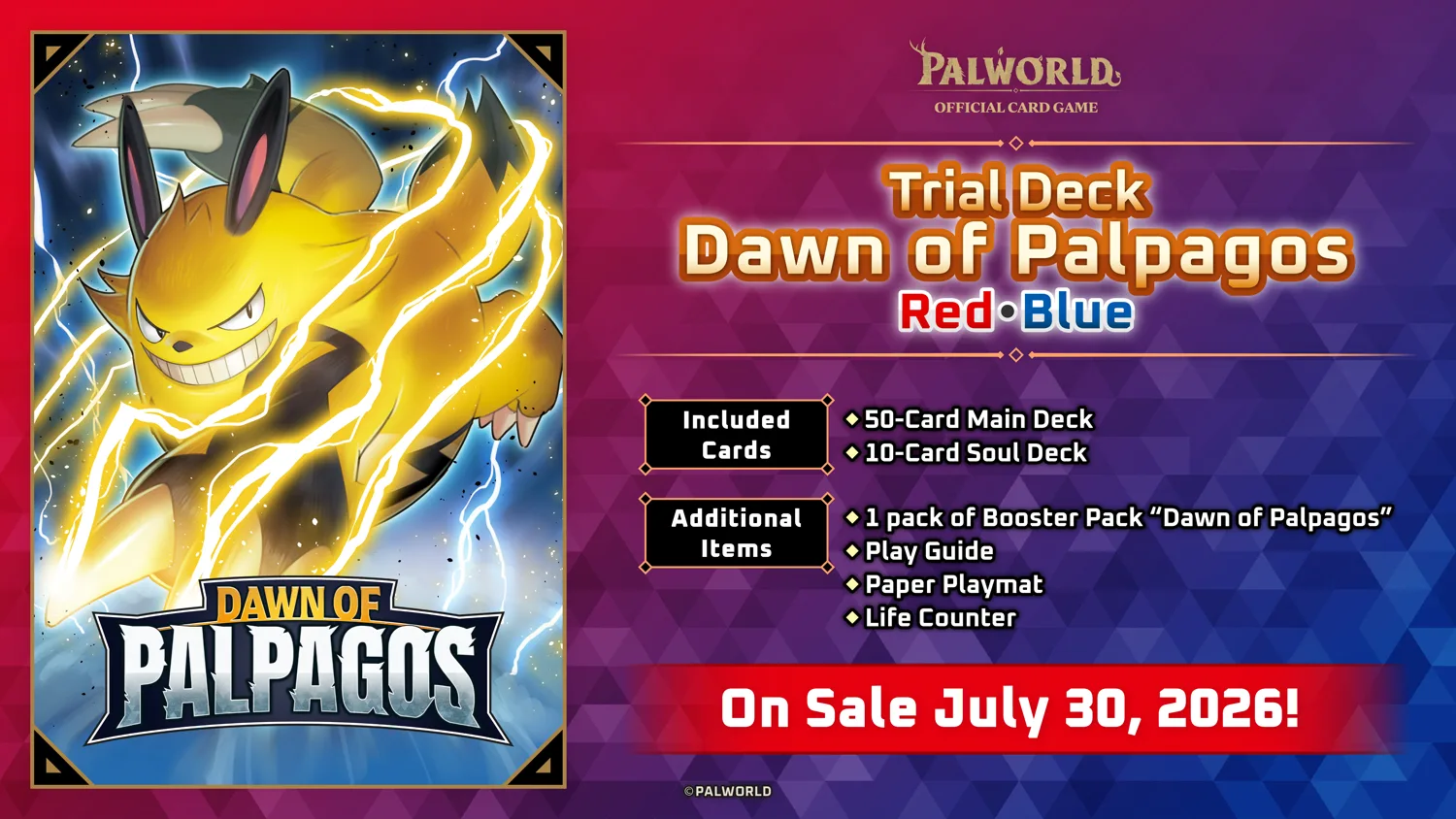
Both launch trial decks - "Dawn of Palpagos Red・Blue" (TD01) and "Dawn of Palpagos Green・Purple" (TD02) - released 30 July 2026 and contain a 50-card main deck, a 10-card soul deck, one booster pack, a play guide, a paper playmat and a life counter. Buy two and two people can play immediately. That is the cheapest honest entry point.
Colours are not elements
This trips people up, so get it straight early. A Palworld card has a colour and, separately, an element. They are different fields doing different jobs.
Colour is one of four: red, blue, green or purple. It is shown by the background colour of the card's cost in the top-left corner. Some cards are colourless, and the rules are pedantic about what that means - a colourless card has no colour assigned to it, and "colorless" is not itself a colour. That matters the moment a card says "when your red card would deal damage", because a colourless card never counts as red.
Element is one of nine, shown as an icon: Neutral, Fire, Water, Grass, Electric, Ground, Ice, Dark and Dragon. Neutral is a real element, not the absence of one - the rules call that out specifically.
So a card can be red with the Fire element, or purple with the Dark element, or colourless with the Neutral element. Deck-building cares about colour. Card effects frequently care about element.
Souls: the resource that stands back up
Souls are how you pay for everything, and the system is closer to Cardfight Vanguard's than to a land or an inkwell.
Your 10 soul cards start in your soul deck. Each turn, during the soul phase, you move souls from your soul deck into your soul area. The number is 2 per turn as standard - the rules state the number of souls to increase set at the beginning of a game is 2. If your soul deck has fewer cards left than that, you move whatever remains.
To pay a cost, you rest that many standing souls in your soul area - turn them sideways. You do not discard them, spend them permanently, or send them anywhere. Then at the start of your next turn, the stand phase stands everything in your base and your soul area back up, and they are available again.
That produces a clean, entirely predictable curve. Turn one you have souls, turn two more, and so on until you have moved all 10 across. There is no mana screw here and no ramp. Everyone gets the same climb, which pushes the skill into what you spend those souls on rather than whether you drew a land.
One extra tap you should know about: during your main phase you may pay 3 souls to draw 1 card, once per turn. It is a rules-level action available to everyone, no card required. Late in a game, when your souls outpace what your hand can spend them on, this is where the extra souls go.
Power vs Strike, and why the split matters
Every Pal carries two combat numbers, and confusing them will lose you games.
| Stat | Where | What it does |
|---|---|---|
| Power | Large number, bottom centre | Damage this Pal deals to other Pals and structures, and how much damage it can absorb before dying |
| Strike | Smaller number, to the right of Power | Damage this Pal deals to a player |
Power is the fighting stat and the survival stat at once - a Pal is removed when damage on it is greater than 0 and equal to or above its power. Power values run in the hundreds and thousands, so a 1200-power Pal beats a 700-power Pal and survives.
Strike is a small number, typically single digits, and it only ever applies to a player. It has nothing to do with fighting other Pals.
Why the split is the best design decision in this game: it lets Bushiroad build a huge, board-dominating Pal that barely threatens your life total, and a fragile Pal that hits like a truck if it connects with your face. In a game with one combat number those two cards cannot exist. Here they do, so "which Pal is better" has no answer without asking what you need it to do.
One more consequence: because damage on Pals and structures resets to 0 during the end phase of every turn, chip damage into a big Pal is wasted unless you finish it this turn. Damage does not carry over. Nothing you did last turn is still sitting on their board.
How to read a Pal card
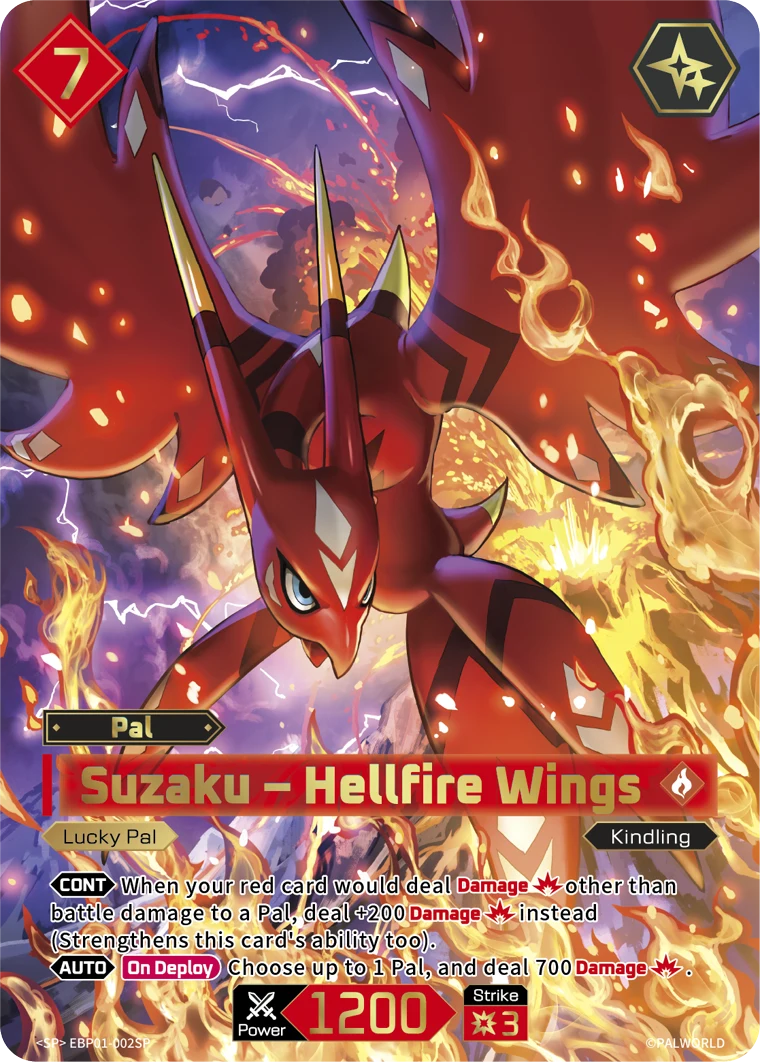
Using the card above, an SP-treatment Suzaku from the launch set, here is every field that matters:
- Cost (top-left, 7). The souls you rest to play it. The diamond's background colour is the card's colour - red here.
- Lucky icon (top-right). The gold sparkle. This is the icon Damage Check looks for. Not every Pal has it.
- Card type ("Pal"). One of five: Pal, Structure, Gear, Event, Soul.
- Name ("Suzaku – Hellfire Wings"). When a name contains a dash with spaces around it, the part before is the main name and the part after is the sub name. Card effects reference main names constantly, and your 4-copy limit counts the full card name.
- Subtype ("Lucky Pal"). Either Normal Pal or Lucky Pal. A Lucky Pal counts as both a Pal and a Lucky Pal at the same time.
- Element icon sits at the right of the name bar - the flame here.
- Work Suitability ("Kindling"). The job tag. Per official rules Q&A #15 it is information a card possesses, referenced by card abilities - it does not by itself restrict which structures a Pal can be assigned to. A card can hold several at once.
- Card text. CONT is a continuous ability, AUTO is an automatic one, and the bracketed part after AUTO is its trigger - On Deploy here.
- Power (1200) and Strike (3) along the bottom.
Setting up your first game
The rules spell out the pre-game sequence in order:
- Show your main deck to your opponent.
- Put your main deck in your deck zone and shuffle it.
- Randomly determine one player, and that player chooses who goes first. (Note the wording - the random winner picks; they are not automatically first.)
- Both players put all their soul cards into the soul deck area.
- The player going second puts 1 soul card into their soul area. This is the on-the-draw compensation, and it is a real one.
- Both players draw 5 cards.
- Starting with the player going first, each player may declare a redraw: put your whole hand back, shuffle, draw 5 fresh. Once per game, all or nothing. There is no card penalty and no partial mulligan.
- Set life to 10, damage taken to 0, resources to 0.
That mulligan is blunt in a way I like. You cannot shave one card off a hand - you either keep it or you throw all five away and take five more, with no cost. A hand you are unsure about is usually a redraw, because the downside is zero.
The five phases of a turn
Stand phase. Stand all cards in your base and soul area. Everything you rested comes back up.
Draw phase. Draw 1 card. The player going first skips this phase entirely on their first turn - combined with the extra soul the second player gets at setup, that is a two-part balance for going first.
Soul phase. Move 2 souls from your soul deck to your soul area.
Main phase. Where the game happens. In any order, any number of times, you may:
- Play a card from hand.
- Play an activated ability.
- Start a battle.
- Pay 3 souls to draw 1 card (once per turn).
End phase. Damage on every Pal and structure in both bases becomes 0, and every "until end of turn" effect stops applying.
Notice what is missing: there is no discard-to-hand-size step in this list. There is also no window for your opponent to act during your main phase - their only interaction is inside a battle, at the quick step.
Your base, and the five-Pal ceiling
The base is your play area. Pals, structures and gear all live there, and it is a public zone - your opponent can see everything in it.
You may have a maximum of 5 Pals in your base. That limit is set at 5 at the start of the game. Go over it and the rules force you to choose which ones survive and send the rest to the graveyard immediately.
The comprehensive rules set a maximum for Pals and no equivalent maximum for structures or gear, so the deployable ceiling is specifically a Pal ceiling.
Five is tighter than it sounds. Every Pal you deploy past five is a Pal you are deleting, so a hand full of cheap bodies is not obviously good, and "go wide" has a hard wall.
Structures, gear, and putting Pals to work
This is the part that makes it feel like Palworld rather than a reskin.
Structures are cards you deploy to your base to help you and your Pals. A structure has durability instead of power - same number, same position, different name because a structure is not going to attack anything.
Assigning is the labour mechanic. To assign a Pal to a structure, you rest that Pal - and a Pal already resting cannot be assigned. The structure's ability then does its thing. Assignment itself is not gated on Work Suitability: the rules impose no matching requirement, and where suitability matters it is because a card ability names it. Note the direction - abilities like "when this card is assigned to a Farming structure" test the structure's suitability, not the Pal's.
That rest cost is the whole tension. A Pal you assign to a structure is a Pal that is now lying sideways, and a resting Pal is one of the three legal attack targets in this game. Working your Pals makes them vulnerable. Palworld players will find that thematically perfect and tactically annoying, which is the correct reaction.
Two resources track what all this labour produces: Material and Ingredient. Both are public information - your opponent can check your counts at any time - and Bushiroad's floor rules list material markers and ingredient markers as required tournament equipment, so you will be tracking these physically at events.
Gear cards are deployed to the base to assist your Pals. Comprehensive Rules ver. 1.00 defines gear as a card type but does not give it a dedicated rules section the way it does for assigning Pals to structures, so the specifics live on the individual cards rather than in a general gear rule.
Battle: five steps, three kinds of target
A battle runs through five steps in fixed order: attack declaration, block declaration, quick step, damage step, end of battle.
Attack declaration. You pick one of your standing Pals and rest it to attack. Again: a Pal deployed this turn can attack. Your legal targets are only these three:
- The opposing player.
- One of their structures.
- One of their Pals that is in the rest state.
Read that third one twice. You cannot attack a standing Pal. An opponent whose board is fully upright is untouchable in combat - you either go at their face or their structures. Pals become targets by resting, which they do by attacking or by being assigned to a structure. The Assault keyword is the exception that lets a card target standing Pals.
Block declaration. The defender may rest one standing Pal that is not already the target, and that Pal becomes the target instead. This is how you protect your life total - and it costs you a Pal standing upright, which means it will be exposed on the following turn.
Quick step. The non-turn player gets a window to play Quick events and Quick abilities from hand. The turn player explicitly cannot activate abilities during the quick step. This is the only interaction the defender gets, and it is where Interrupt lives.
Damage step. Resolution depends on what got hit:
- Pal vs Pal: both deal damage equal to their power to each other, simultaneously. Trades are real and both cards can die.
- Pal vs structure: the attacker deals its power to the structure's durability, and the structure deals nothing back.
- Pal vs player: the attacker deals damage equal to its Strike, and Damage Check begins.
Damage Check and the Lucky Pal lottery
This is the mechanic that will decide your close games, so learn it properly.
When you take damage as a player, you do not simply lose that much life. Instead:
- Put the top card of your deck into your graveyard.
- If that card has the Lucky Pal icon, stop immediately - you lose no life at all from this attack.
- Otherwise, if you have now milled at least as many cards as the damage you took, lose that much life.
- Reset damage taken to 0.
So a Strike 3 hit means you flip up to three cards, and any single Lucky Pal among them cancels the entire attack. Not part of it. All of it.
That is why the 8-card Lucky Pal cap matters so much. Eight out of fifty is a 16% density, and every point of Strike you take is another look at that lottery. Take a Strike 4 hit off a 50-card deck at full Lucky density and you are meaningfully likely to blank it entirely.
It also means your deck is your life total in two directions at once. Every Damage Check mills you, and running out of cards is a loss condition on its own. Cancelling damage with a Lucky Pal still costs you the cards you flipped.
There is a real strategic consequence here that I do not think has been figured out yet this early in the set's life: lots of small Strike hits give the defender many separate chances to hit a Lucky Pal, while one big Strike hit flips more cards at once but only gets cancelled once. Whether wide-and-small or tall-and-big is better is an open question, and anybody claiming a settled answer this early is guessing.
How you actually win
Two loss conditions, both in the rules:
- A player's life is 0 or less. They lose.
- A player has no cards left in their deck. They lose.
There is no third path, no alternate-win card confirmed in the launch set, and no base-destruction victory. Knocking over structures is a means, not an end - you do it to shut off an engine, not to win directly.
Conceding is also allowed at any time, and no card effect can force or prevent it.
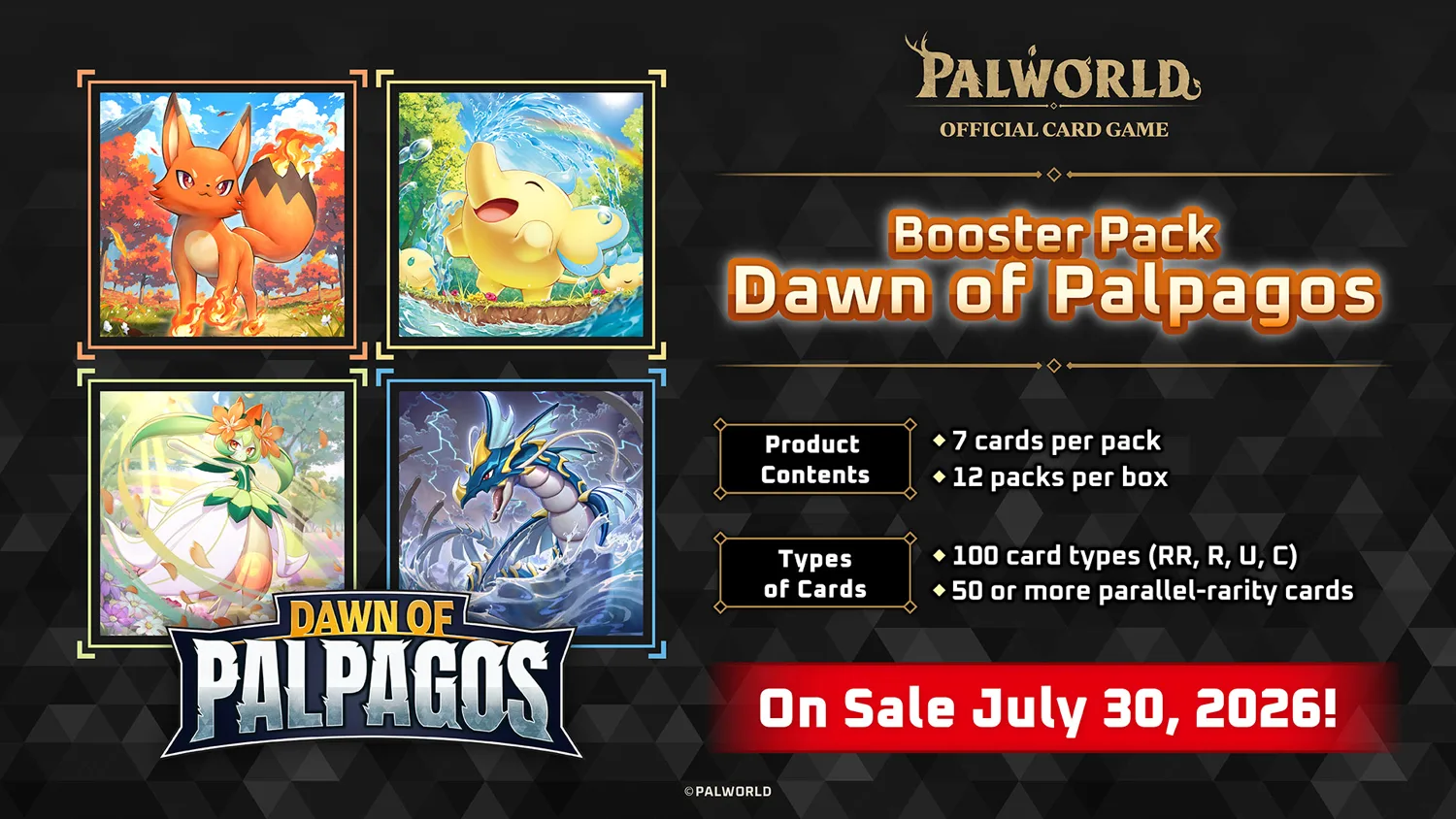
Booster Pack "Dawn of Palpagos" (BP01) also released 30 July 2026, with 7 cards per pack, 12 packs per box, 100 card types across RR, R, U and C rarities, and 50 or more parallel-rarity cards. The second set, Booster Pack "Legends Awaken" (BP02), is dated 30 October 2026.
Keywords you'll meet in game one
Comprehensive Rules ver. 1.00 defines these, and the list is short enough to learn in one sitting:
| Keyword | What it does |
|---|---|
| Quick | Can be played during the quick step |
| On Deploy | Triggers when the card is deployed |
| On Attack | Triggers when the card attacks |
| On Assign | Triggers when assigned to a structure |
| Brave (n) | On Attack, this card's power increases by n until end of turn |
| Serious (n) | On Assign, choose 1 Pal and increase its power by n until end of turn |
| Interrupt | A Quick ability that nullifies the opponent's attack, paid by discarding cards |
| Vigilance | Stands this card at the end of your turn |
| Taunt | The opponent must attack this card if it is a legal target |
| Stealth | This card cannot be blocked |
| Retaliate | If this Pal dies in battle, the opposing battling Pal dies too |
| Nocturnal | If it is night, this card's power increases by 300 |
| Breakthrough | If your attacking Pal kills the defending Pal, deal damage equal to your Strike to its master |
| Assault | This card may choose a standing Pal as an attack target |
Two of those deserve a flag. Nocturnal references "night", which the rules define as a named "specific state" both players reference at once - the only one Comprehensive Rules ver. 1.00 lists - so it lives in the rules engine, not just on one card. And Breakthrough is the answer to the "standing Pals are untouchable" problem: it converts a won fight into face damage, which is exactly the pressure a defensive board needs to fear.
There is also a flavour-accurate action called butcher, which moves one of your own Pals to your graveyard. Yes, really. It is Palworld.
What is not confirmed yet
Being straight about the gaps, as of 9 August 2026:
- The two-colour deck-building limit is confirmed. This entry previously listed it as unconfirmed, because the deck construction section of Comprehensive Rules ver. 1.00 and the Bushiroad floor rules impose no colour restriction - the only main-deck limits either document states are 50 cards, 4 per name, and 8 Lucky Pal cards. The rule lives in a third place: official rules Q&A #17 answers "What is the significance of a card's Color?" with "When constructing a deck, you must build it using up to any two chosen colors plus colorless cards." Treat the cap as a hard rule.
- Gear has no dedicated rules section in ver. 1.00 beyond being defined as a card type deployed to your base to assist Pals.
- There is no structure or gear count limit in the rules. Only Pals are capped, at 5.
- There is no "raid" keyword. Attacking a base is ordinary battle targeting of structures. If you have seen the word raid used for this game, it is describing the fantasy, not a named mechanic.
- There is no meta, no tier list and no tournament data. The game launched 30 July 2026. Anyone publishing a tier list right now made it up.
Quick reference
- 50-card main deck exactly, max 4 per card name, max 8 Lucky Pal cards, up to two chosen colours plus colourless (Q&A #17). Plus a 10-card soul deck in different sleeves.
- Start at 10 life. Lose at 0 life, or when your deck runs out.
- Colours: red, blue, green, purple, plus colourless (which is not a colour). Elements are a separate field, nine of them.
- Souls: +2 per turn from a 10-card soul deck; rest them to pay costs; they stand back up each turn. 3 souls draws a card, once per turn.
- Power hits Pals and structures and keeps you alive. Strike hits players. Structures have durability instead of power.
- Phases: stand, draw (skipped by the player going first), soul, main, end. Damage on Pals and structures resets to 0 every end phase.
- Max 5 Pals in your base. Pals can attack the turn they deploy.
- Attack targets: the player, a structure, or a resting Pal. Standing Pals are safe unless the attacker has Assault.
- Assigning a Pal to a structure rests it, which makes it attackable.
- Damage Check: mill one card per point of Strike; any Lucky Pal cancels the whole attack.
The rules take twenty minutes to learn. Working out whether to hold a Pal upright as a blocker or lay it down on a structure for value is the actual game, and nobody has solved that yet - which is the best possible reason to pick it up this week rather than next year.
Frequently Asked Questions
How do you win the Palworld TCG?
What is the difference between Power and Strike in the Palworld TCG?
How many cards are in a Palworld TCG deck?
How do souls work in the Palworld TCG?
Can a Pal attack the turn you deploy it?
What is Damage Check in the Palworld TCG?
Can you attack any Pal in the Palworld TCG?
Is there a two-colour limit on Palworld TCG decks?
What products launched with the Palworld TCG?
Keep Reading
Related Guides
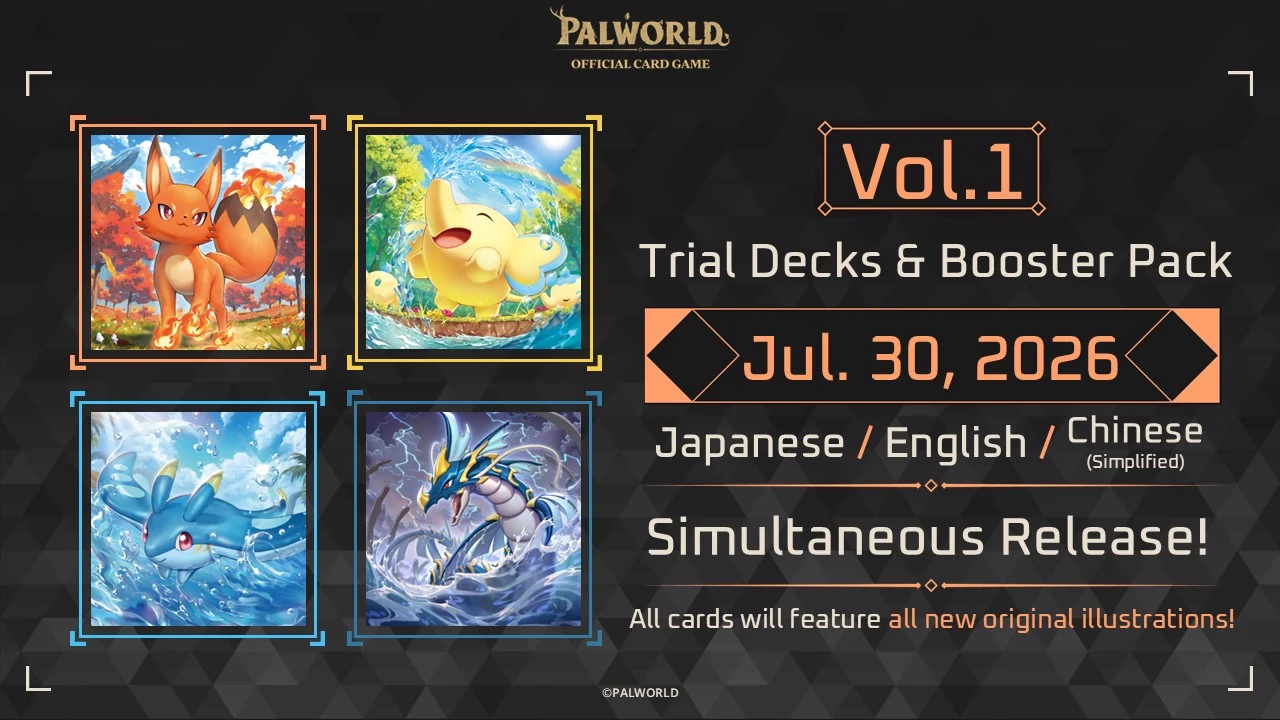
Palworld TCG Colours Explained - What Red, Green, Blue and Purple Actually Do
Bushiroad has published comprehensive rules for the Palworld TCG, but it has not published a colour-identity document - there is no official page telling you what Red or Purple is supposed to do. So I read the rules for what colour legally means, then went through all 150 unique cards in the launch pool and counted. Here is what colour actually is, the single hard rule it imposes, why souls make it cheaper than you think, and what the card pool says each colour was built for.
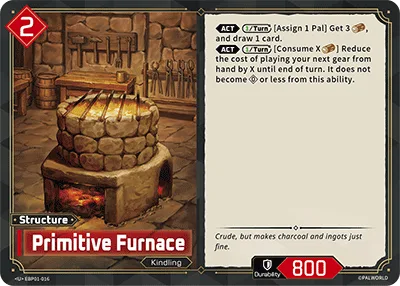
Palworld TCG AUTO, CONT and ACT Abilities Explained
Every ability on a Palworld TCG card opens with one of three tags - AUTO, CONT or ACT - and Comprehensive Rules 10.1 makes that tag the most important word in the text box. It decides whether the ability works on your opponent's turn, whether you are allowed to decline it, and whether a [Once Per Turn] clock applies. I counted all 153 printed abilities across the 157 distinct cards in the launch pool and sorted them by category, trigger and cost.
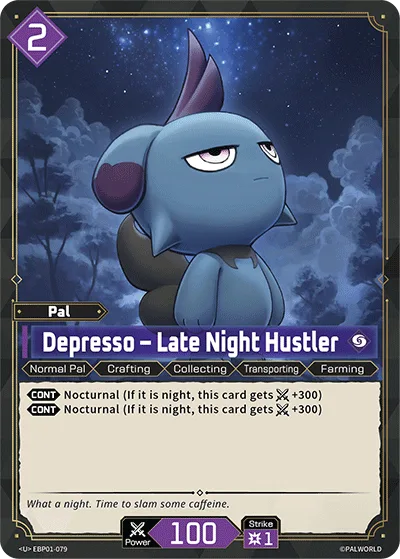
Palworld TCG Keyword Abilities - 10 Counted, 14 in the Rules
Comprehensive Rules ver. 1.00 defines fourteen keywords in one section, and How to Play the Palworld TCG tables all of them - what Brave does, what Taunt does - and stops there. Nobody has counted how many cards actually carry each one. I pulled every card tagged with one of the ten keyword abilities Bushiroad's official database filters on and cross-referenced all 97 rulings: Interrupt covers nine Pals, Retaliate covers exactly one, and Depresso - Late Night Hustler prints Nocturnal twice on the same card, which the official Q&A confirms stacks to +600 Power.

Palworld TCG Elements - All 9, and Why Only 2 Cards Care
Every Pal card in the Palworld TCG carries an element icon, and the video game trained you to expect that icon to decide fights. It does not. Comprehensive Rules ver. 1.00 spends three sub-rules on elements and never mentions them again, and exactly two of the 166 cards in the launch pool have text that reads an element. Here is the full census of all nine across the 100 Pal cards, and the one element that already has support.
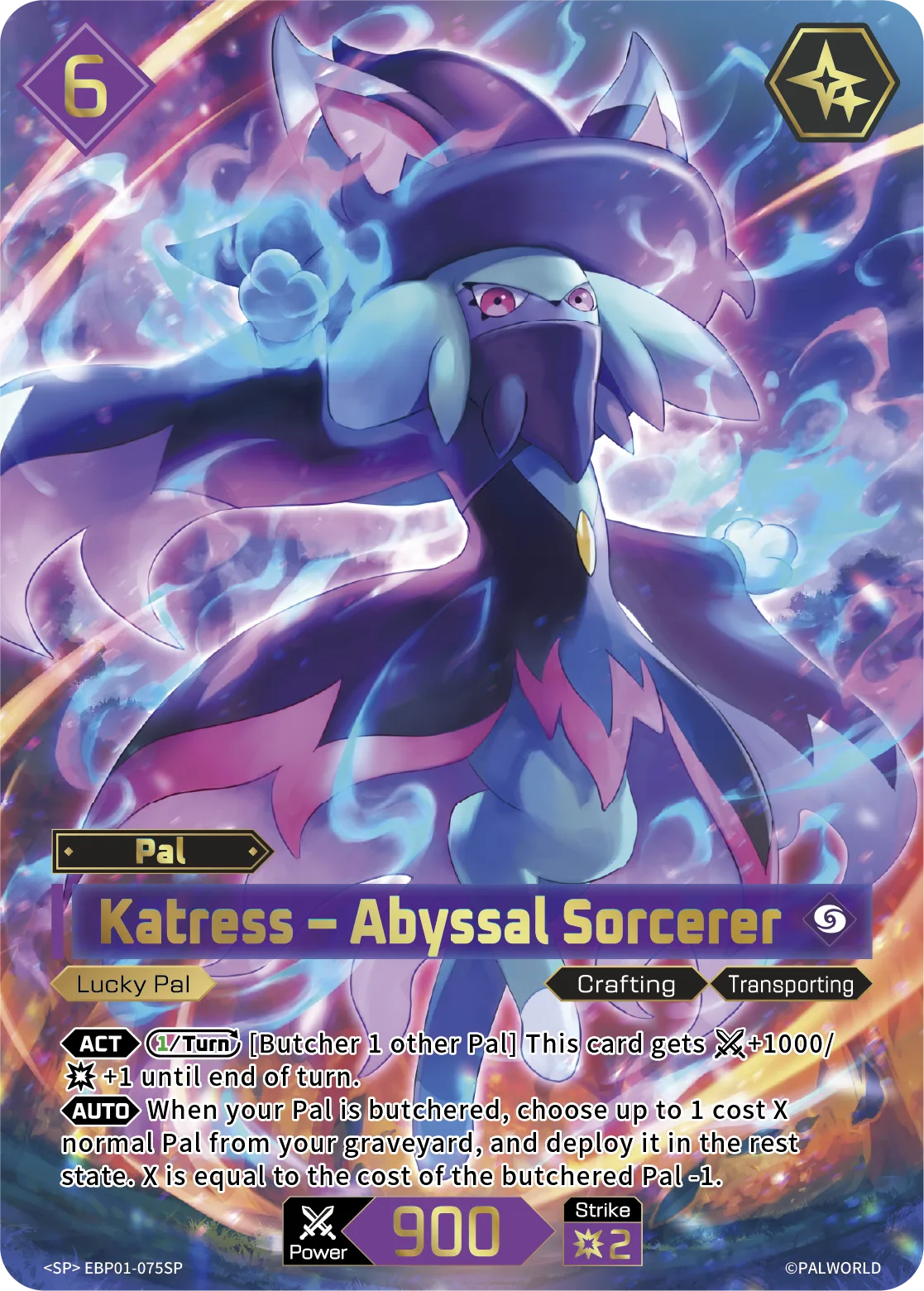
Palworld TCG Rulings - All 97 and the Most-Ruled Cards
The Palworld TCG shipped with an official Q&A of 97 entries and has not added or revised one since. Pulling the whole database and sorting it by card shows where the game is genuinely hard: 45 of the 97 are wording rules that apply to cards nobody has printed yet, only 26 of the 166 cards ever earned a card-specific answer, and four cards account for 16 of the 32 that exist.

Palworld TCG Recommended Decks: All 4, and Which One Wins
Bushiroad recommends four decks to build from Dawn of Palpagos: Material, Dragon, Ingredient and Nocturnal. Its English site posted all four on 1 October, and on 7 October it posted the first tournament lists played with English cards, from the Grand Challengers Cup at Bushiroad EXPO 2026 in Kuala Lumpur. Here are all four recommended lists, card for card, and what happened when I checked each one against the 49 tournament lists in Bushiroad's own databases.