Palworld TCG Launch Products - Both Trial Decks and Dawn of Palpagos, Compared
Bushiroad put three Palworld TCG products on shelves on 30 July 2026: two trial decks and Booster Pack 01 "Dawn of Palpagos". Both decks cost the same and contain the same 60 cards by count, but the official card list shows they answer a big Pal in completely different ways. Here is every confirmed contents line, a card-by-card read on how each deck actually plays, and an honest note on the two misprints Bushiroad has already owned up to.
Green-Purple has a 4-cost event called Strike from the Darkness. The whole card reads: choose 1 Pal, and put it into the graveyard. No power check, no damage number, no conditions.
Red-Blue's hardest answer is Single-Shot Rifle, a 4-cost gear that deals 1500 damage when you deploy it. Bigger number, worse card - because Green-Purple's own Mammorest sits at 2000 power and just walks through it.
That is the real difference between the two Palworld trial decks, and you will not find it on either box. Both boxes list identical contents. Both went on sale on 30 July 2026. Both are, on paper, "a 60-card deck plus accessories." Under the shrinkwrap they want completely different things from you.
I pulled every card in both decks from Bushiroad's official card list and read the text on all 48 of them. Here is what is actually in these boxes.
Three products, one release date
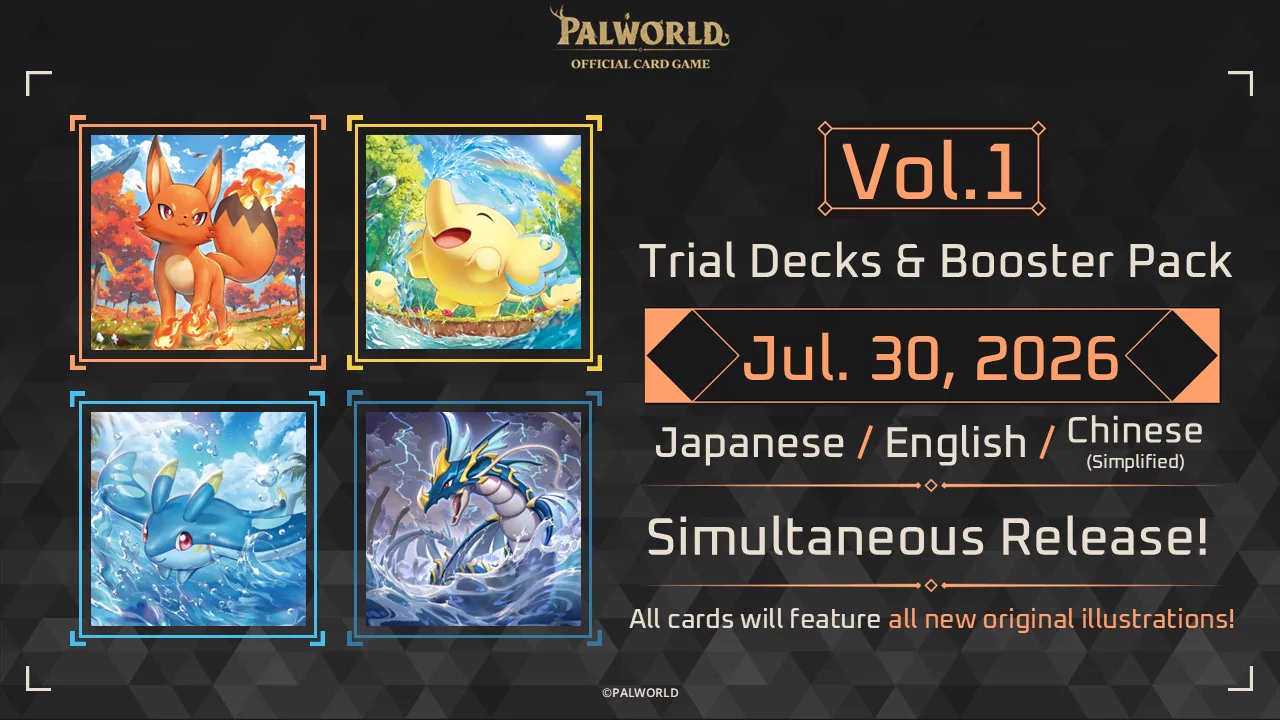
Bushiroad launched the Palworld OFFICIAL CARD GAME with exactly three products, all on 30 July 2026, and all simultaneously in Japanese, English and Simplified Chinese:
| Product | Code | What it is |
|---|---|---|
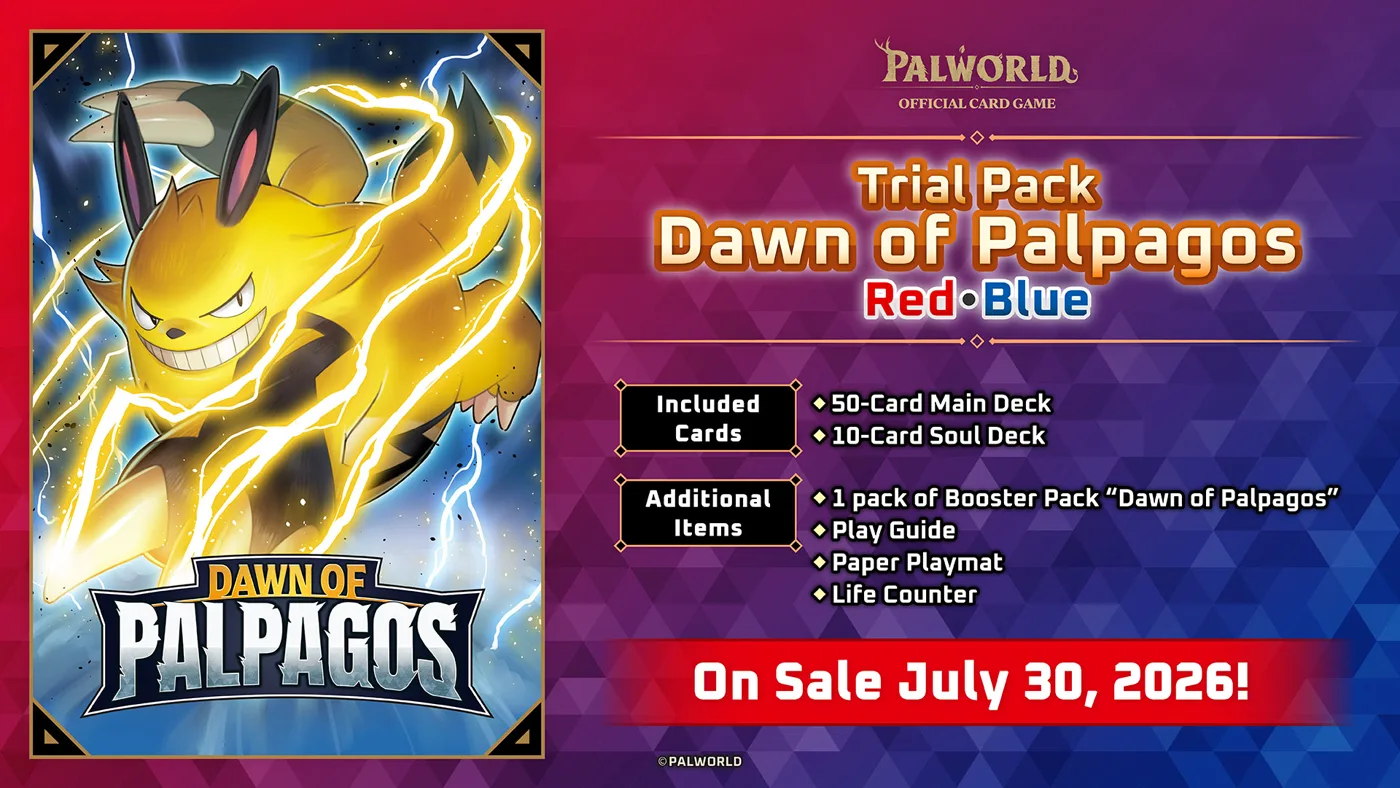
| Trial Deck "Dawn of Palpagos Red・Blue" | ETD01 | Ready-to-play 60-card deck plus accessories |
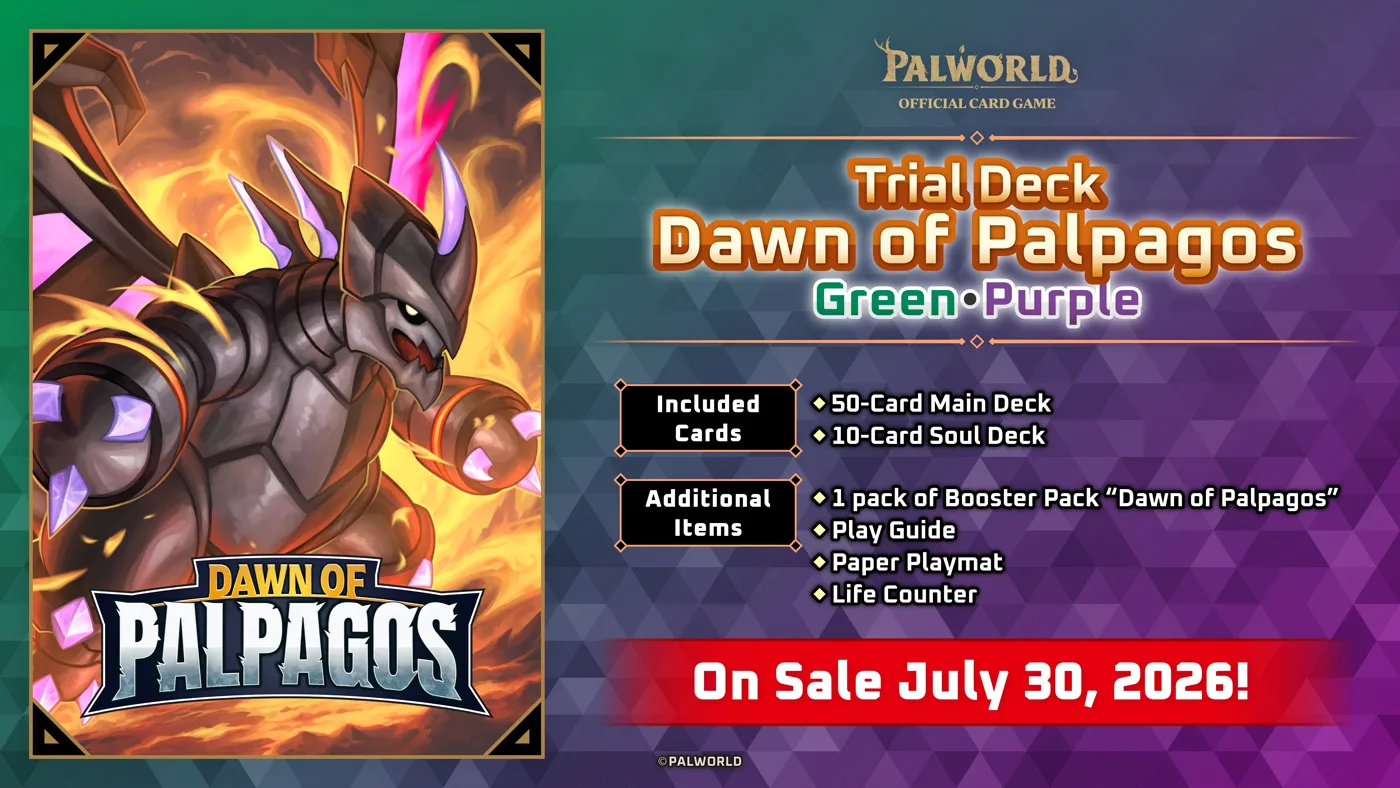
| Trial Deck "Dawn of Palpagos Green・Purple" | ETD02 | Ready-to-play 60-card deck plus accessories |
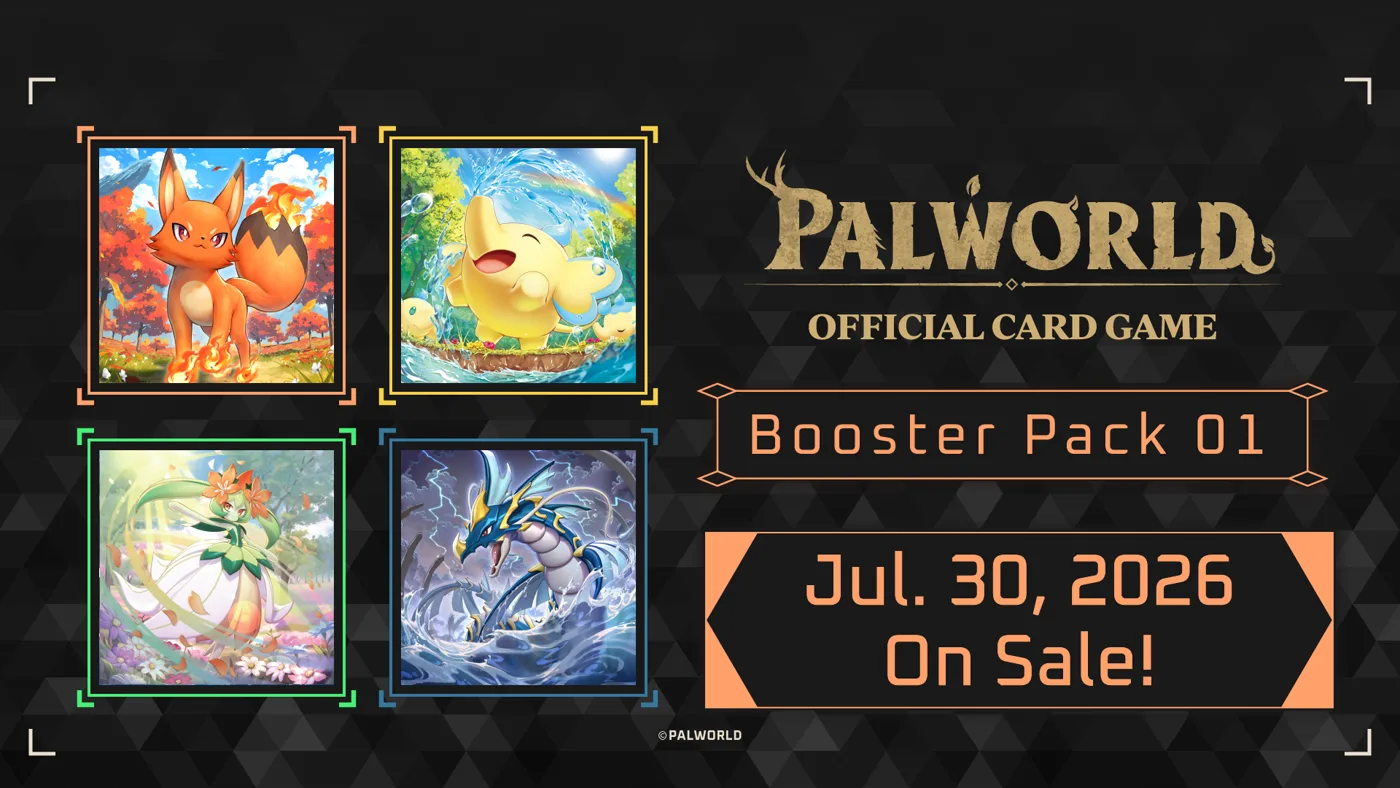
| Booster Pack "Dawn of Palpagos" | EBP01 | 7-card random packs, 12 packs per box |
Two more products were dated on the official site at launch: Sleeve & Card Set Vol.1 (SS01), originally 2 October 2026 and moved to 16 October in a delay Bushiroad announced on 28 August, and Booster Pack "Legends Awaken" (EBP02) on 30 October 2026. Since this guide first ran, Bushiroad has also dated two Trial Decks "Eternal Ascent" for 18 December 2026 and a third booster pack for 29 January 2027.
Both trial decks were also sold early at a run of conventions - Bushiroad Summer Fest Manila, Anime Expo Los Angeles, Sentinel Games Singapore, Japan Expo Paris, SMASH! Sydney and Bushiroad Summer Fest Manchester - with a stated limit of one of each trial deck per transaction. If you have already seen people playing this with sleeved decks, that is why.
What's in a trial deck box
Identical for both decks, straight off Bushiroad's product pages:
- 60 card set - 50-card main deck and 10-card soul deck
- Paper playmat and play guide
- Life counter
- Material and ingredient counter
- 1 pack of Booster Pack "Dawn of Palpagos"
Two details that matter more than they look.
First, one parallel-rarity card is included in every deck, replacing a card from the 50-card main deck. It will be either a Trial Deck Super Rare (TSR) or a Trial Deck Super Parallel (TSP). Bushiroad's card list shows 12 cards per deck have a TSR version and 2 of those also have a TSP version, so there are 14 possible parallels in each box and you get exactly one. Which one, and at what frequency, has not been published - so treat anyone quoting TSP odds this week as guessing.
Second, the included booster pack is not a bonus gimmick. It is a real pack of the same product sold separately. Buy both trial decks and you have two people ready to play, two booster packs, two playmats and two life counters, with no separate purchase required.
That "everything included" framing is also Bushiroad's official line for new players. The site's beginner page says the same thing in plainer words: start with the trial decks, then power them up with cards from the booster pack.
Red-Blue: damage, answers, and card flow
ETD01 is 24 unique cards: 11 red, 11 blue, and 2 colourless. Sixteen of them are Pals, four are structures, two are gear and two are events. Four Pals carry the Lucky Pal icon, which is what your deck flips for during Damage Check - if the mechanics are new to you, start with our Palworld TCG rules walkthrough.
Red's job in this deck is pointing numbers at things:
- Blazamut – Molten Sovereign (8 cost, 1600 power / 3 strike) deals 1000 damage to a Pal on deploy.
- Single-Shot Rifle (4 cost gear) deals 1500 damage on deploy, then sticks around to give a Pal +200 power per turn.
- Weapon Workbench (3 cost structure) deals 800 damage and gives all your Pals Strike +1 for the turn, for 1 material and one assigned Pal.
- Ignis Breath (2 cost event) is a Quick 500 damage, playable inside your opponent's battle.
- Grizzbolt – Rumbling Tank (7 cost, 1600 / 4) has Assault, meaning it can attack Pals in the stand state. In a game where standing Pals are normally untouchable, that is the deck's answer to a defensive board - and Strike 4 ties for the highest in either trial deck.
Blue's job is seeing more cards and buying time:
- Elphidran Aqua – Gentle Ripples (6 cost) draws 2 and puts 1 card back on top.
- Primitive Workbench reveals the top card and lets you deploy it free if it is a 6-cost-or-less structure or gear, or take it to hand if not.
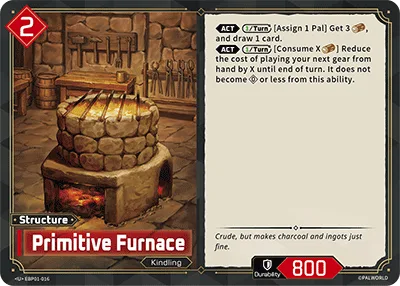
- Stone Pit (1 cost structure) gets 3 material and draws a card every turn for one assigned Pal.
- Crystal Breath (2 cost, Quick) gives a Pal Strike -3 and stops it standing during your opponent's next stand phase. That is a two-turn tempo hit for two souls.
- Mammorest Cryst – Roar of the Tundra (8 cost, 1700 / 3) gets +200 power for each of your structures, and can discard a structure from hand for Strike +1.
Add it up and Red-Blue has four separate card-draw or card-selection effects across 24 cards. Green-Purple has one. That gap shows up in every long game.
The tell for how this deck wants to be played is Mammorest Cryst plus Stone Pit plus Primitive Workbench. Structures make your finisher bigger, structures need Pals assigned to them, and assigning rests a Pal - which makes it a legal attack target. Red-Blue is constantly trading safety for value.
Green-Purple: big bodies and hard removal
ETD02 mirrors the structure exactly - 24 unique cards, 11 green, 11 purple, 2 colourless, 16 Pals, 4 Lucky Pals. The split inside is 3 structures, 2 gear and 3 events, so it trades one structure for one extra event.
Green is the muscle:
- Mammorest – Roar of the Wilds (8 cost, 2000 power / 4 strike) is the single biggest printed body in either trial deck, and it hands you 3 ingredients when it dies.
- Broncherry – Brimming Adoration (7 cost, 1500 / 3) has Taunt, forcing your opponent to attack it if it is a legal target.
- Campfire (3 cost structure) costs 2 ingredients and an assigned Pal to gain 1 life and give all your Pals +1000 power until end of turn. That is a combat trick that turns a bad board into a good one.
- Refined Metal Spear (6 cost gear) hands out +900 power, and Stone Blast (2 cost, Quick) hands out +500.
Purple is the knife:
- Strike from the Darkness (4 cost event) deletes any Pal outright. Power is irrelevant.
- Astegon – Aegis Wyvern of Death (8 cost, 1200 / 3) gives a Pal -1000 power on deploy, then on attack destroys every Pal with 300 power or less - yours included.
- Hanging Trap (2 cost structure) exiles a Pal for as long as the trap survives. Kill the trap and the Pal comes back rested.
- Medical Supplies (7 cost event) redeploys an 8-cost-or-less Pal from your graveyard. That is your Mammorest, twice.
- Felbat – Lifestealer (7 cost, 1000 / 3) has Stealth, cannot be blocked, and gains you 1 life every time it attacks.
Green-Purple also carries the only life gain in either box - Campfire and Felbat. At a starting life total of 10, a single point back is a real percentage.
The numbers, side by side
The symmetry in these two products is deliberate, and it makes the asymmetries easy to spot.
| Red・Blue (ETD01) | Green・Purple (ETD02) | |
|---|---|---|
| Unique cards | 24 | 24 |
| Pals / structures / gear / events | 16 / 4 / 2 / 2 | 16 / 3 / 2 / 3 |
| Colour split | 11 red, 11 blue, 2 colourless | 11 green, 11 purple, 2 colourless |
| Lucky Pals | 4 | 4 |
| Interrupt Pals | 2 (Foxparks, Reindrix) | 2 (Dinossom, Blazehowl Noct) |
| Biggest printed power | 1700 (Mammorest Cryst) | 2000 (Mammorest) |
| Highest strike | 4 (Grizzbolt) | 4 (Mammorest) |
| Draw / selection effects | 4 | 1 |
| Unconditional removal | 0 | 1 (Strike from the Darkness) |
| Graveyard recursion | 0 | 1 (Medical Supplies) |
| Life gain | 0 | 2 (Campfire, Felbat) |
| Resource used | Material | Ingredient |
Both decks even get two colourless 2-cost Pals with mirrored protection clauses. Red-Blue's Lamball – My First Pal cannot be attacked by Pals costing 4 or more. Green-Purple's Cattiva – My First Pal cannot be attacked by Pals costing 3 or less. One hides from the big stuff, the other blanks the small stuff. Whoever designed that pair was having a good day.
Bushiroad's own taglines are "experience overwhelming power" for Red-Blue and "enjoy strategizing battle tactics" for Green-Purple. Having read both lists, I think that is backwards. Green-Purple has the 2000-power body, the free-kill event, the reanimation and the life gain. Red-Blue is the one doing arithmetic, chaining structure assignments and deciding whether 1500 damage is enough this turn. Marketing copy got written before the card text settled, and it happens.
Taunt versus Stealth
If you only remember one mechanical contrast, make it this one, because it decides most games between these two decks.
Green-Purple owns both sides of the blocking question. Taunt, on Broncherry and Eikthyrdeer Terra, forces your opponent to attack that Pal if it is a legal target. Stealth, on Cawgnito and Felbat, means the Pal cannot be blocked at all. There is even a 4-cost gear, Cawgnito Hat, that grants Stealth plus 200 power to a Pal for a turn.
So the same deck can wall your attacks and refuse to let you wall its own. That is a genuinely strong combination for a starter product, and it is the closest thing to an obvious advantage in this pairing.
Red-Blue's answer is not a keyword, it is a stat line. Grizzbolt's Assault ignores the "you cannot attack standing Pals" rule entirely, and Crystal Breath keeps a Pal lying down through your opponent's stand phase, which is functionally a one-card lockdown. Neither is as clean as Stealth. Both are more flexible.
What nobody knows yet - and I want to be blunt about this, because the game is three days old - is which of those two packages is actually better in practice. There is no tournament data, no meta, and no tier list worth the pixels. Anyone publishing one right now made it up.
Which deck suits which player
Concrete, based on what is in the boxes:
Buy Red・Blue if you like doing the maths. Assign a Pal to Stone Pit for material and a card, spend the material on Weapon Workbench to push 800 damage and pump everyone's Strike, count out whether Blazamut's 1000 finishes the job. It rewards sequencing and punishes autopilot. It is also the deck that draws more cards, which usually means it is the deck that gets to make more decisions. If you gravitate to blue-black control shells in Magic or to resource-engine decks generally, this is your side.
Buy Green・Purple if you like a plan you can see. Deploy a big thing, protect it with Taunt, sneak damage through with Stealth, and when something is in your way, delete it with Strike from the Darkness. Fewer moving parts, higher ceiling on individual cards, and life gain as a buffer for when you get it wrong. It is more forgiving of a bad turn, which makes it the better first deck for someone brand new to card games.
Buy both if there is any chance a second person plays. That is what these products are for, and it is the only way to actually learn the game rather than reading about it.
One thing that does not differ: both decks have exactly two Interrupt Pals, which nullify an attack from hand at the cost of discards. Neither side gets a defensive edge there.
Booster Pack 01: Dawn of Palpagos
Officially: 100 card types (RR, R, U, C) plus 61 parallel types, 7 cards per pack, 12 packs per box, every card with a brand-new original illustration.
I went through the official card list for all 100 base cards, EBP01-001 through EBP01-100, and counted:
- 59 Pals - which confirms Bushiroad's "more than 50 types of Pal cards" claim
- 19 structures
- 12 events
- 10 gear
- Colour spread: 25 purple, 24 red, 24 blue, 24 green, 3 colourless
- 16 of the 100 base cards carry the Lucky Pal subtype
That last number is the one deck-builders should stare at. Your main deck is capped at 8 Lucky Pal cards, and Damage Check is decided by them, so 16 of the 100 is the pool you build that package from.
The set is also not just Pals. Human characters Zoe and Lily appear as cards, and the non-Pal card names are pure Palworld: Pal Sphere, Breeding Farm, Ranch, Hot Spring, Cola Vending Machine, Grappling Gun, Pump-Action Shotgun, Treasure Chest Found!, and a structure literally named No Pals Beyond Sign. If you were worried the survival-crafting half of the game got lost in translation, it did not.
Two official misprints worth knowing about
Bushiroad has publicly disclosed two production errors on the launch products, and both are on the official product pages rather than buried.
Booster Pack "Dawn of Palpagos" packaging. The word "Palworld" is misspelled on the packs and the box. Bushiroad has apologised and says it will be adjusted in future reprints. It is cosmetic and affects the wrapper, not the cards.
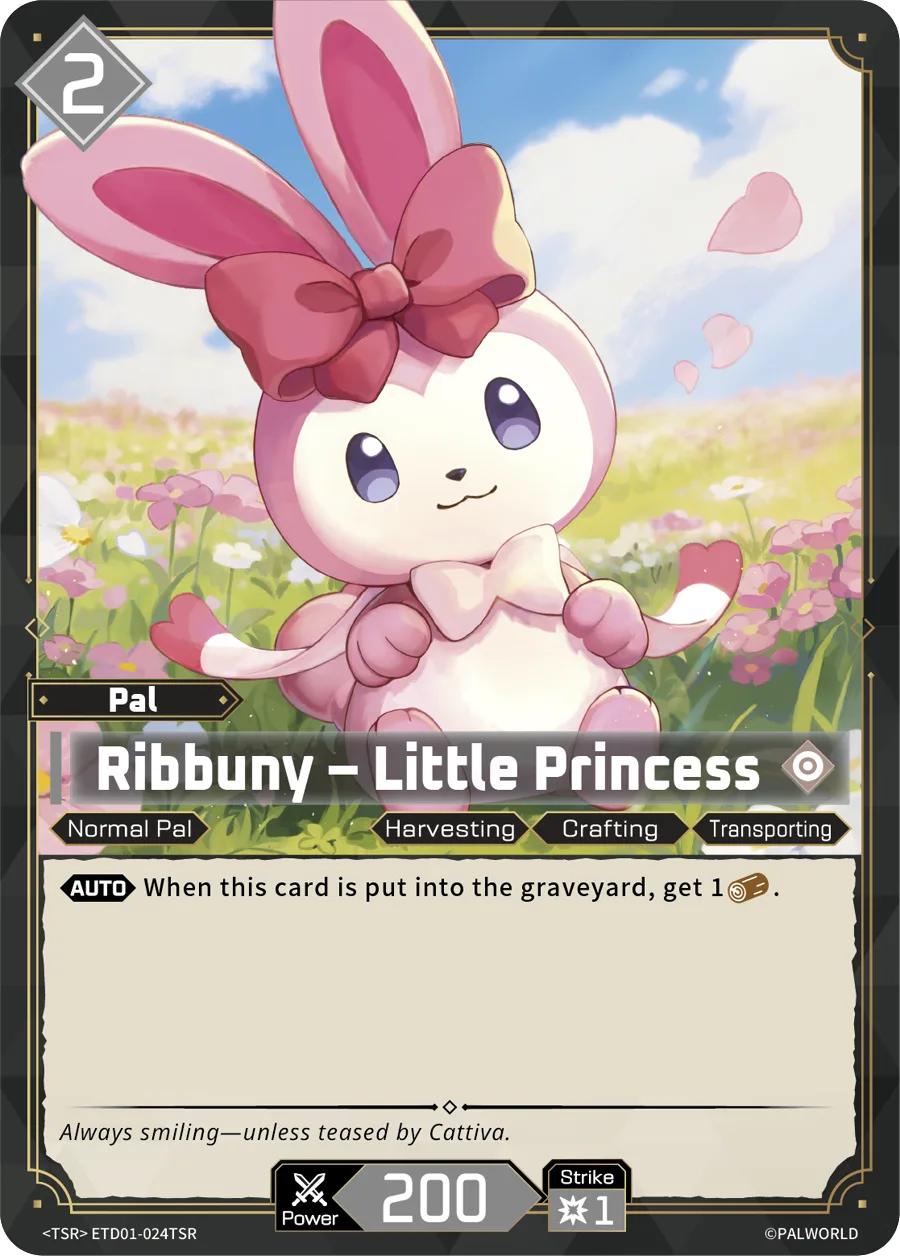
Trial Deck Red・Blue errata. The TD01 product page carries an errata notice illustrated with ETD01-024TSR - the Trial Deck Super Rare printing of Ribbuny – Little Princess. The Strike text was omitted from the card. Bushiroad's statement is unambiguous: the card remains fully legal at all levels of competitive play, including official sanctioned tournaments, and functions as if it has the correct Strike text. Ribbuny's correct line is 200 power and Strike 1.
Neither of these should change what you buy. Publishers that post their own misprints on their own product pages three days into a launch are doing the right thing, and I would rather have that than a quiet reprint six months later.
What to buy first
If you are one person with no opponent yet: one trial deck, whichever colours you prefer looking at. You get a playable deck, a playmat, a life counter, a play guide and a booster pack in one box, and the game is legal to play straight out of it.
If you want to actually learn it: both trial decks. Two decks means two players, and the two decks are different enough that swapping sides teaches you something. This is also the cheapest route to two booster packs.
If you already own a deck and want more cards: booster packs, not another trial deck. The trial decks are 24 unique cards each; the booster is 100. Bushiroad's own beginner guidance is trial deck first, boosters second, and there is no reason to argue with it.
What I will not do is quote you a price. Bushiroad has not published an MSRP for any of the three launch products on the English site, and street prices three days into a launch are noise, not information. Check your local game store, and if a listing is wildly above what the shop down the road charges, wait - Booster Pack "Legends Awaken" lands 30 October and supply on a set this new moves fast.
What Bushiroad has not published
Being straight about the gaps, as of 1 August 2026:
- No official MSRP for the trial decks or the booster on the English site.
- No pull rates. Nothing published on parallel frequency in boosters, and nothing on which of the 14 possible TSR/TSP cards you get in a trial deck.
- No decklist breakdown. Each trial deck is 24 unique cards filling 50 main-deck slots, so there are obviously multiples, but Bushiroad has not published the per-card counts on the English product pages. I am not going to invent them.
- No packs-per-carton or display figures for the trial decks.
- No meta, no tier list, no tournament results. The game has existed for three days.
For everything about how souls, Power, Strike and Damage Check actually work at the table, read the full Palworld TCG rules guide next - the trial decks are built to teach exactly those systems, and knowing them turns the box you bought into a deck you understand.
Frequently Asked Questions
What products launched with the Palworld TCG?
What comes in a Palworld TCG trial deck?
Which Palworld TCG trial deck should I buy first?
How many cards are in the Palworld TCG trial decks?
What is in Booster Pack 01 "Dawn of Palpagos"?
How much do the Palworld TCG trial decks cost?
Is there a misprint in the Palworld TCG launch products?
Do the Palworld TCG trial decks include a booster pack?
Is there a Palworld TCG tier list or meta yet?
Keep Reading
- Trial Deck "Dawn of Palpagos Red・Blue" - Official Product Page
- Trial Deck "Dawn of Palpagos Green・Purple" - Official Product Page
- Booster Pack "Dawn of Palpagos" - Official Product Page
- Palworld Official Card Game - Official Card List
- Trial Decks and Booster Pack on sale July 30, 2026 - Official News
- Palworld Official Card Game - For Beginners
Related Guides
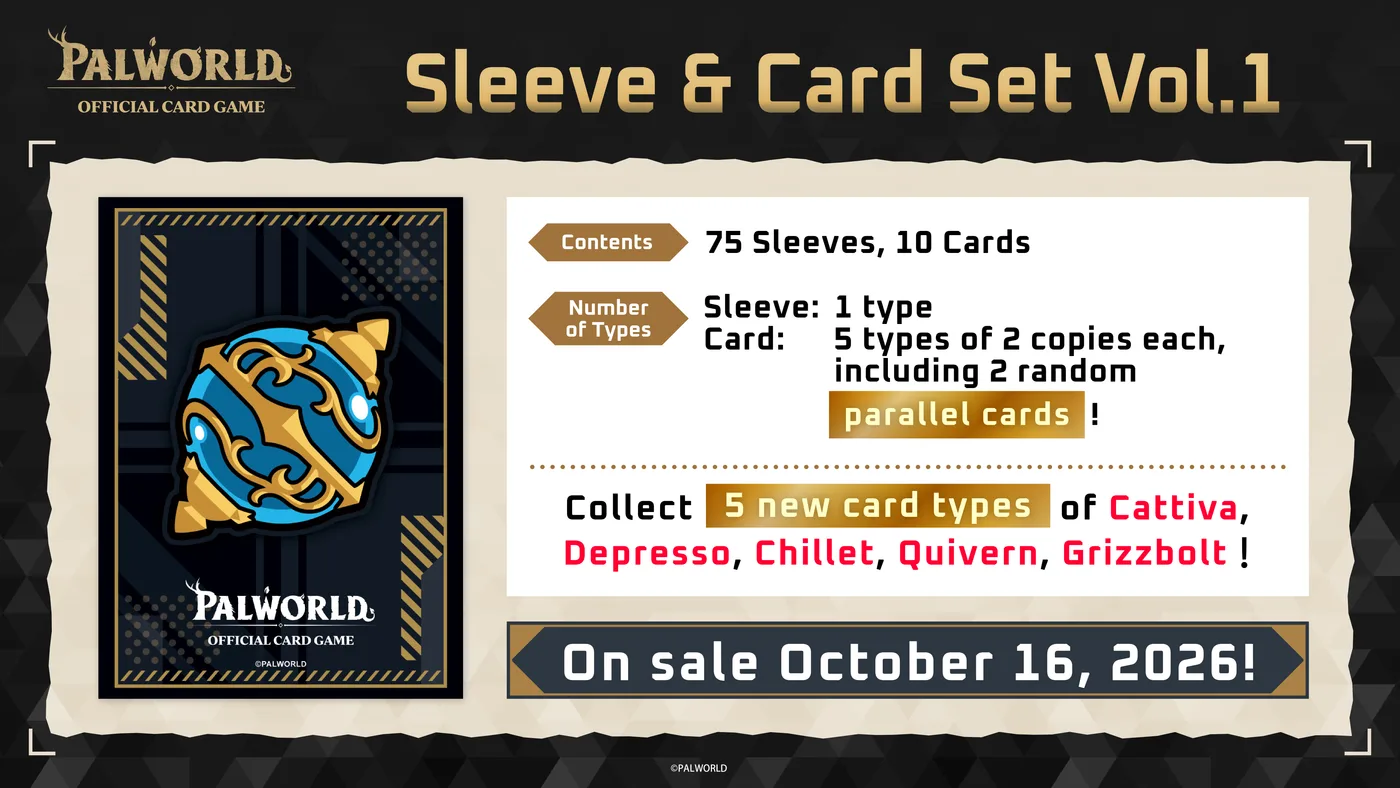
Palworld TCG Sleeve & Card Set Vol.1 - All 5 New Cards
Every promo Pal in the English Palworld TCG database is a reprint of a launch card. The five cards in Sleeve & Card Set Vol.1 are the first new card text since 30 July, and they landed in the English database this week, two weeks before the 16 October English release. One of them is the game's first Colorless Lucky Pal, and it is the biggest cost-6 Pal in the pool. Here is what all five do, the three Japanese rulings already published for them, and when you can play them.
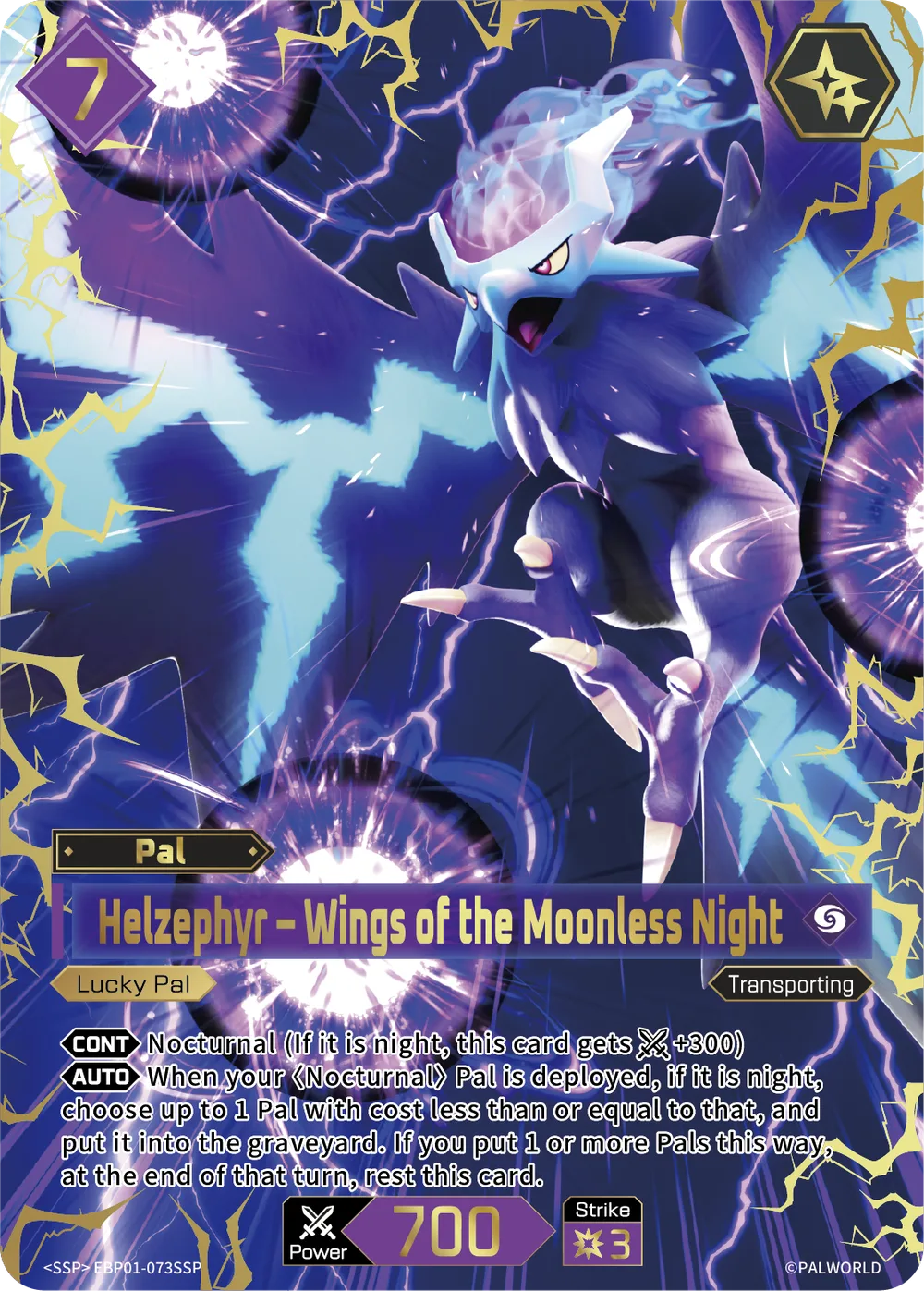
Palworld TCG Recommended Decks: All 4, and Which One Wins
Bushiroad recommends four decks to build from Dawn of Palpagos: Material, Dragon, Ingredient and Nocturnal. Its English site posted all four on 1 October, and on 7 October it posted the first tournament lists played with English cards, from the Grand Challengers Cup at Bushiroad EXPO 2026 in Kuala Lumpur. Here are all four recommended lists, card for card, and what happened when I checked each one against the 49 tournament lists in Bushiroad's own databases.
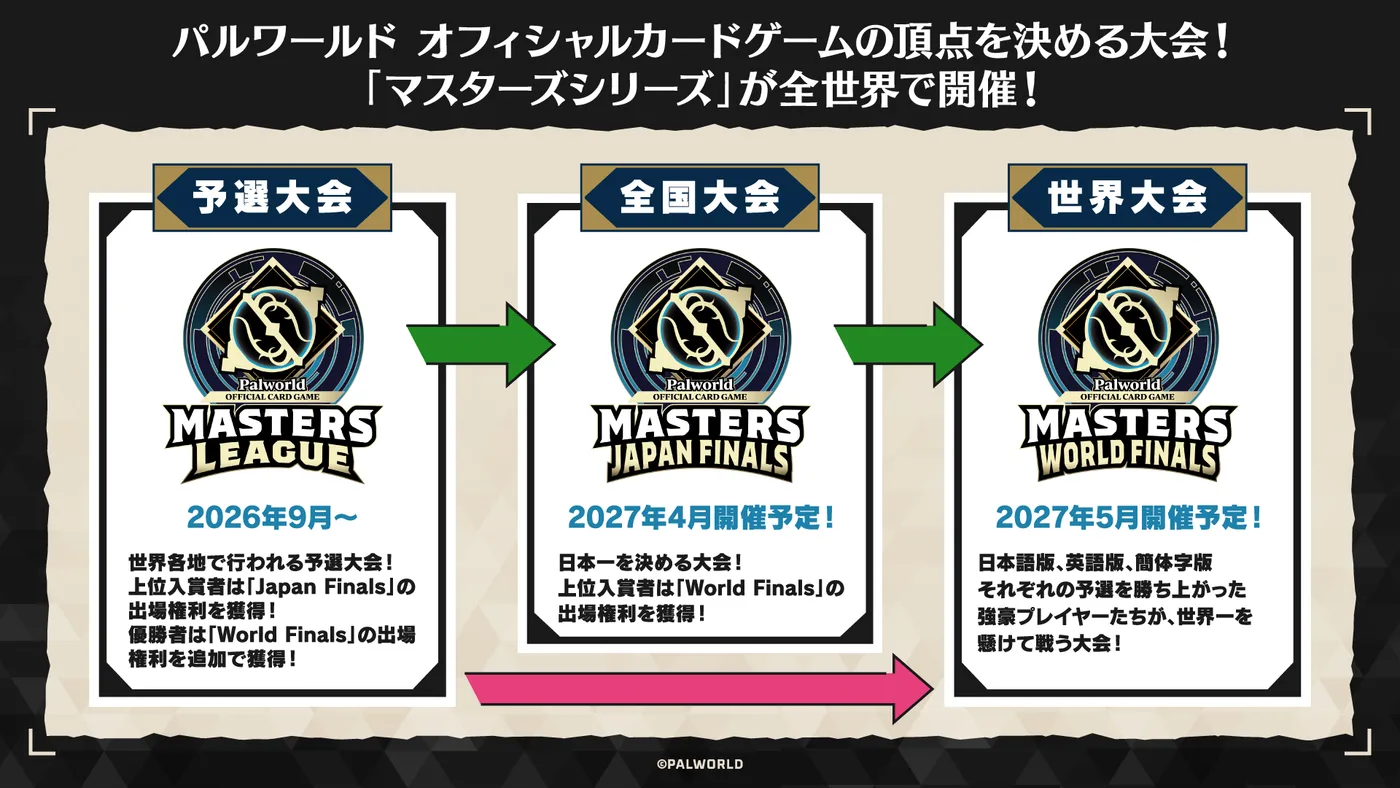
Palworld TCG Meta: What Won the Kyoto Masters League
Bushiroad has published the decks that finished first, second and third in all four blocks of Japan's first Masters League 26-27 qualifier, held in Kyoto on 22 September 2026. Every card in them has an English printing, so this is the first Masters League data for the Dawn of Palpagos format English players are about to take into October's Grand Challengers Cups. Eight of the 12 are Blue-Purple, ten run four Chillet, all 12 run exactly eight Lucky Pals, and not one contains a Green card.
Palworld TCG AUTO, CONT and ACT Abilities Explained
Every ability on a Palworld TCG card opens with one of three tags - AUTO, CONT or ACT - and Comprehensive Rules 10.1 makes that tag the most important word in the text box. It decides whether the ability works on your opponent's turn, whether you are allowed to decline it, and whether a [Once Per Turn] clock applies. I counted all 153 printed abilities across the 157 distinct cards in the launch pool and sorted them by category, trigger and cost.
How to Play the Palworld TCG - Souls, Power vs Strike, and How You Actually Win
Bushiroad's Palworld card game launched 30 July 2026, and its comprehensive rules landed the same day. Here is the full walkthrough - the four colours plus colourless, the soul deck, the Power and Strike split that decides every attack, structures and Pal labour, and the Damage Check that turns your own deck into your life total. Everything here is sourced from the official rules, and I flag what Bushiroad has not published.
Palworld TCG Keyword Abilities - 10 Counted, 14 in the Rules
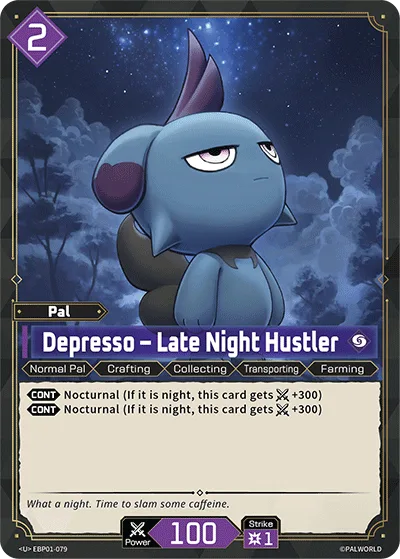
Comprehensive Rules ver. 1.00 defines fourteen keywords in one section, and How to Play the Palworld TCG tables all of them - what Brave does, what Taunt does - and stops there. Nobody has counted how many cards actually carry each one. I pulled every card tagged with one of the ten keyword abilities Bushiroad's official database filters on and cross-referenced all 97 rulings: Interrupt covers nine Pals, Retaliate covers exactly one, and Depresso - Late Night Hustler prints Nocturnal twice on the same card, which the official Q&A confirms stacks to +600 Power.