Pokémon TCG Energy Explained: Basic vs Special, Attack Costs, and the One-Per-Turn Rule
Attacking never spends your Energy. Retreating does. There are exactly nine basic Energy cards in the game's history and two Pokemon types that never got one. Here is how Energy actually works, straight from the rulebook and the card database — attack costs, the one-per-turn attachment rule, every legal way around it, and why Special Energy is a target painted on your attacker.
Here is the sentence that fixes more new-player games than any other: attacking never spends your Energy.
If you came from Magic or Lorcana, you have spent years tapping lands or exerting ink and watching the resource vanish the moment you use it. Pokémon does not work like that. Energy attaches to a Pokémon, sits there permanently, and pays for that Pokémon's attack every turn until something removes it. You do not spend it. You park it — and the whole strategic weight of the game lives in the fact that you can park exactly one card a turn, on one Pokémon, and it dies with that Pokémon.
Everything below is checked against the official Pokémon Trading Card Game Rules PDF from The Pokémon Company, and every card, count, and piece of text comes from live queries against the Pokémon TCG API rather than memory.
What Energy actually does in this game
Energy is one of the three card types, alongside Pokémon and Trainers. The rulebook is blunt about the job: "Most of the time, Pokémon can't attack without Energy cards!"
In practice it does exactly three things.
- It pays attack costs — by being attached, not by being discarded.
- It pays retreat costs — by being discarded. This is the one place Energy actually gets spent.
- On Special Energy, it carries rules text, which is a whole economy of its own and gets its own section below.
Notice what is missing. Energy does not draw cards, does not search your deck, and does nothing at all sitting in your hand. It is the only card type that is completely dead until attached, and the only one whose attachment rate is capped by the rules.
The nine basic Energy cards, and the two types that never got one
Query the full English card database for basic Energy and you get 183 printings across exactly nine distinct names: Grass, Fire, Water, Lightning, Psychic, Fighting, Darkness, Metal, and Fairy.
That is the entire history. Fairy stopped appearing on new cards when the Sword & Shield era began — the rulebook flags it directly, noting there are no Fairy-type Pokémon cards in that series — which leaves eight basic Energy types in the current game. You can verify the number off a single product: the Scarlet & Violet Energies set is 16 cards, eight types with two artworks each.
The Pokémon TCG has ten Pokémon types in the current era. Count the basic Energy list again and two of them are missing: there has never been a Colorless Energy card, and there has never been a Dragon Energy card. Not rotated out. Never printed.
Colorless Pokémon do not care, because their attacks cost Colorless symbols that any Energy pays. Dragons do care, and the fix is deliberately awkward: Dragon-type attacks demand two different typed Energy. Goodra in Chaos Rising costs one Water and one Psychic for its 160-damage Dragon Pulse. Mega Dragalge ex from the same set wants Water and Darkness for Pernicious Poison. A Dragon deck is structurally a two-type deck, every time, which is why Dragons are the rarest type on the board — 27 printings across the entire Mega Evolution era against 115 for Psychic.
One more thing that makes basic Energy special before you ever read a card: it is the only card in the game exempt from the four-copy deck limit. The rulebook: "except for basic Energy, you can only have 4 cards with the same name in your deck." Run twelve Basic Fire Energy if you want. Nothing stops you.
How to read an attack cost
The symbols to the left of an attack name are the cost. Two rules cover almost everything:
- Count the symbols. That total is how many Energy cards must be attached to that Pokémon. Not a specific number of each — the total.
- A typed symbol demands that type. The Colorless star accepts anything.
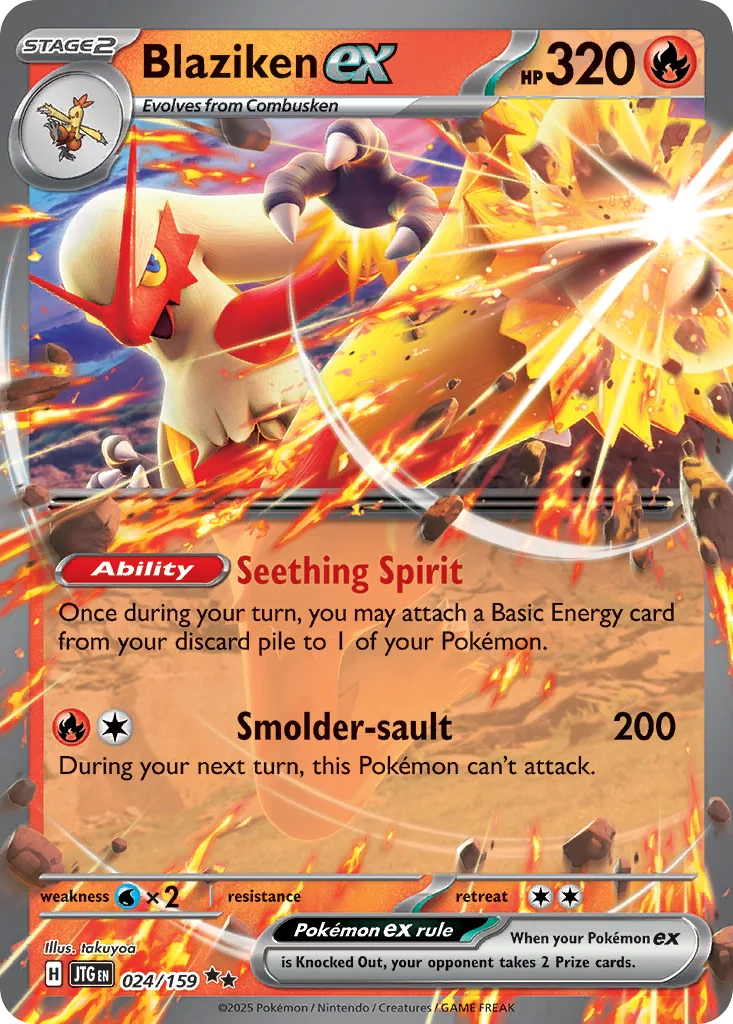
Blaziken ex from Journey Together is a clean worked example. Smolder-sault costs one Fire and one Colorless for 200 damage: two Energy cards total, at least one of which must be Fire, and the second can be literally any Energy in the game.
Two details that trip people up:
- Costs are minimums, not exact amounts. Four Energy on a Pokémon whose attack costs two is completely legal. The extra ones just sit there.
- A blank cost means zero. The rulebook calls it out directly: some attacks "have a cost of 0, and you can use it without any Energy attached."
Energy type is not the same as Pokemon type
This is the most common rules misunderstanding in the game. Weakness and Resistance key off the attacking Pokémon's printed type, never off the Energy attached to it — the rulebook's damage sequence says to increase damage "if it has Weakness to your Active Pokémon's type."
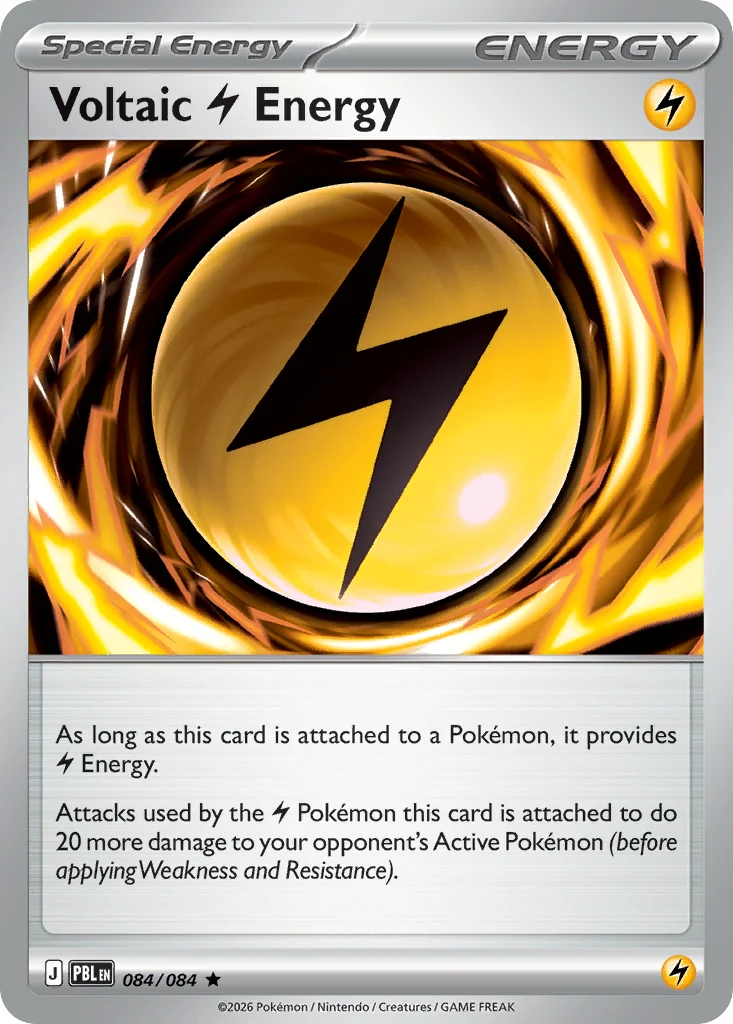
So a Fire Pokémon paying a Colorless symbol with a Water Energy is still a Fire Pokémon dealing Fire damage. Attaching Water Energy does not let you hit Fire Weakness. That rider on Voltaic Lightning Energy in the hero image is not making anything Lightning-type either — it adds flat damage to a Lightning Pokémon's attacks, before Weakness and Resistance, which means Weakness then multiplies it.
The numbers behind this are unusually tidy right now. Across the six English Mega Evolution-era sets there are 788 Pokémon printings. Of those:
| Stat | Count | Share |
|---|---|---|
| Print a Weakness | 761 | 96.6% |
| Print a Resistance | 166 | 21.1% |
| Weakness value is anything other than ×2 | 0 | 0% |
| Resistance value is anything other than −30 | 0 | 0% |
In this era, doubling is the only Weakness math you will ever do, Resistance shows up on about one card in five, and neither applies to Benched Pokémon at all. Better still, the eight types that appear as Weakness — Fighting, Fire, Grass, Lightning, Darkness, Water, Metal, Psychic — are exactly the eight basic Energy types. Nothing in the modern game is Weak to Colorless or Dragon. (Fair caveat: those are printings, so alternate arts count more than once, and this is English-language data only.)
One attachment per turn, and every legal way around it
The rule, verbatim:
"Take an Energy card from your hand and put it under your Active Pokémon or one of your Benched Pokémon to indicate that this is Energy it can use. You can attach Energy just once each turn!"
Two things about that sentence. It says from your hand, and it caps the action, not the card type. Basic or Special makes no difference — one manual attachment per turn, full stop.
Which is why the most valuable text in the entire game is any card that attaches Energy some other way. Card effects are a separate permission from your turn action, and they stack on top of it. Blaziken ex's Seething Spirit Ability reads: "Once during your turn, you may attach a Basic Energy card from your discard pile to 1 of your Pokémon." That is a second attachment in the same turn, off the discard pile, on top of your normal one. Team Rocket's Spidops in Destined Rivals does the same thing to itself with Charging Up.
Read those two cards carefully and you will spot the guardrail: both say Basic Energy. Acceleration overwhelmingly moves basic Energy only, which is the balancing lever that keeps Special Energy from being free.
The tempo math is why this matters more than raw damage. With no acceleration, a three-Energy attack is a turn-three attack at the absolute earliest, and only if you drew all three and never needed the attachment elsewhere. Every extra symbol in a cost is a turn of not attacking — the real constraint behind the deck ratios any competitive list is built on.
Energy is also your retreat budget
The other half of Energy's job gets forgotten constantly, and it is the half that actually consumes cards. To retreat you discard one Energy from the retreating Pokémon for each Colorless symbol in its Retreat Cost. Type does not matter — any Energy pays. If no symbols are printed, retreating is free.
Blaziken ex has a Retreat Cost of two, so walking it out of the Active Spot costs two of the Energy you spent two turns attaching. Retreat is the most expensive verb in the game and it does not look like it, because the cost is printed in the bottom corner in the same grey as the artist credit.
Three consequences worth internalizing:
- A high-retreat attacker is a commitment. Once it is Active with Energy on it, repositioning means dismantling your own setup.
- Asleep and Paralyzed block retreating outright, per the Special Conditions rules, and no amount of Energy buys your way out.
- A switch effect is not a retreat. It moves your Active to the Bench for free, keeps every Energy attached, and works through Asleep and Paralyzed.
Special Energy: what you get and what it costs you
Special Energy is an Energy card with rules text on it. It attaches with the same once-per-turn action, counts as Energy for attack costs, and is bought with three separate taxes.
There are 211 Special Energy printings in the English database against 183 basic — more than half of all Energy cards ever printed carry text. Filter to the H, I, and J regulation marks that define the current Standard pool and only 18 distinct Special Energy names survive. Rotation is brutal on this category specifically.
Tax one: the four-copy limit applies. Basic Energy's exemption does not extend to Special Energy. Four copies, maximum, same as any Trainer.
Tax two: what it actually provides is usually conditional.
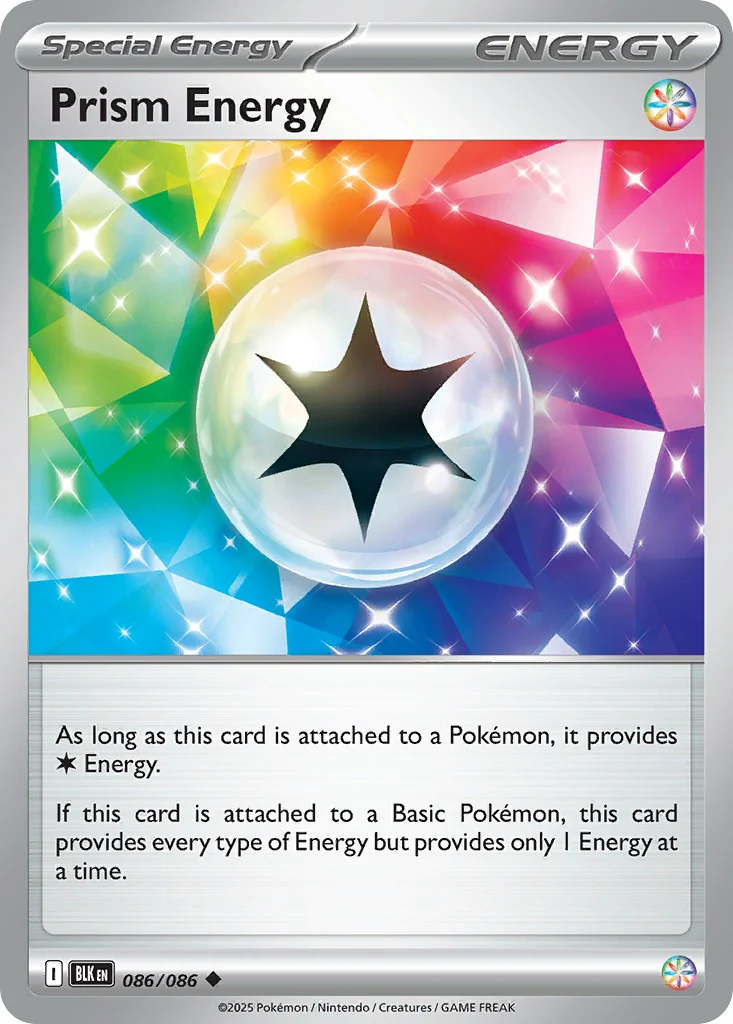
Prism Energy from Black Bolt is the textbook case: "As long as this card is attached to a Pokémon, it provides Colorless Energy. If this card is attached to a Basic Pokémon, this card provides every type of Energy but provides only 1 Energy at a time." On a Basic, it is a wildcard. On a Stage 2, it is Colorless and nothing else — which means it cannot pay the Fire symbol in Blaziken ex's attack cost at all. Luminous Energy has the same shape from a different angle: it provides every type, unless another Special Energy is attached to the same Pokémon, at which point it downgrades to Colorless.
Tax three: it is a target, and basic Energy is not.
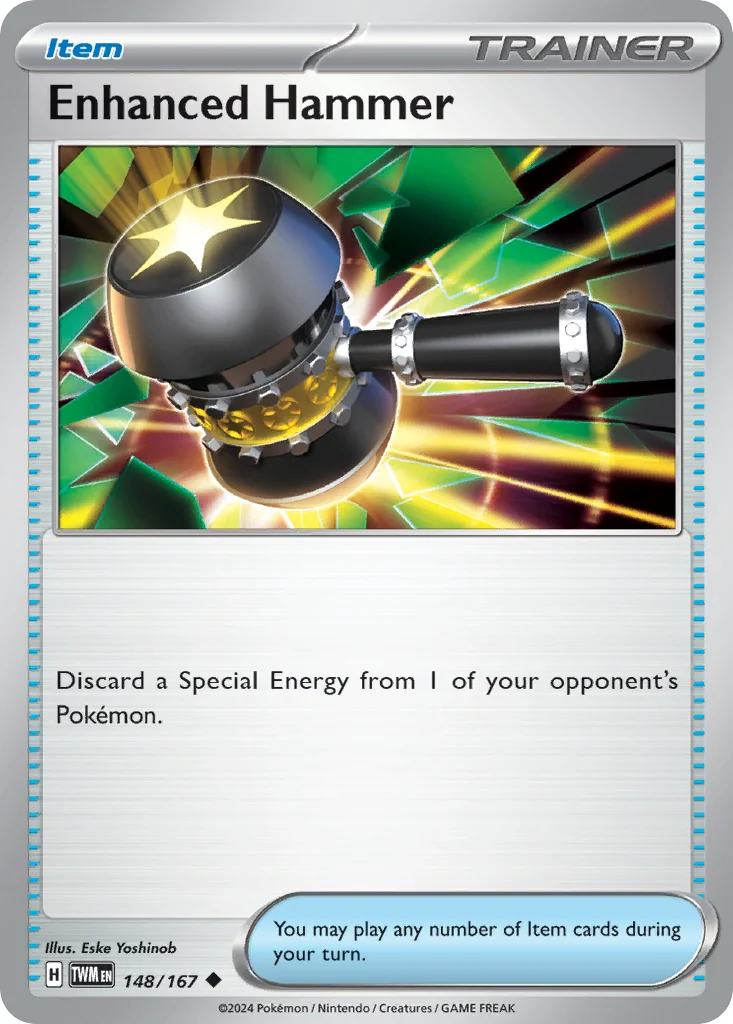
Four Trainers in the current regulation-mark pool name Special Energy in their text, and all four exist to delete it:
| Card | Set | Type | Effect |
|---|---|---|---|
| Enhanced Hammer | Twilight Masquerade | Item | Discard a Special Energy from 1 of your opponent's Pokémon |
| Ruffian | Journey Together | Supporter | Discard a Tool and a Special Energy from 1 of your opponent's Pokémon |
| Blowtorch | Phantasmal Flames | Item | Discard a Tool, a Special Energy, or a Stadium — costs a Basic Fire Energy from hand |
| Megaton Blower | Surging Sparks | ACE SPEC Item | Discard all Tools and Special Energy from all of your opponent's Pokémon, and a Stadium |
None of them can touch a basic Energy card. Enhanced Hammer is an uncommon Item that trades one card for one card and a turn of your opponent's attachment — that is the price of admission for every Special Energy in your list.
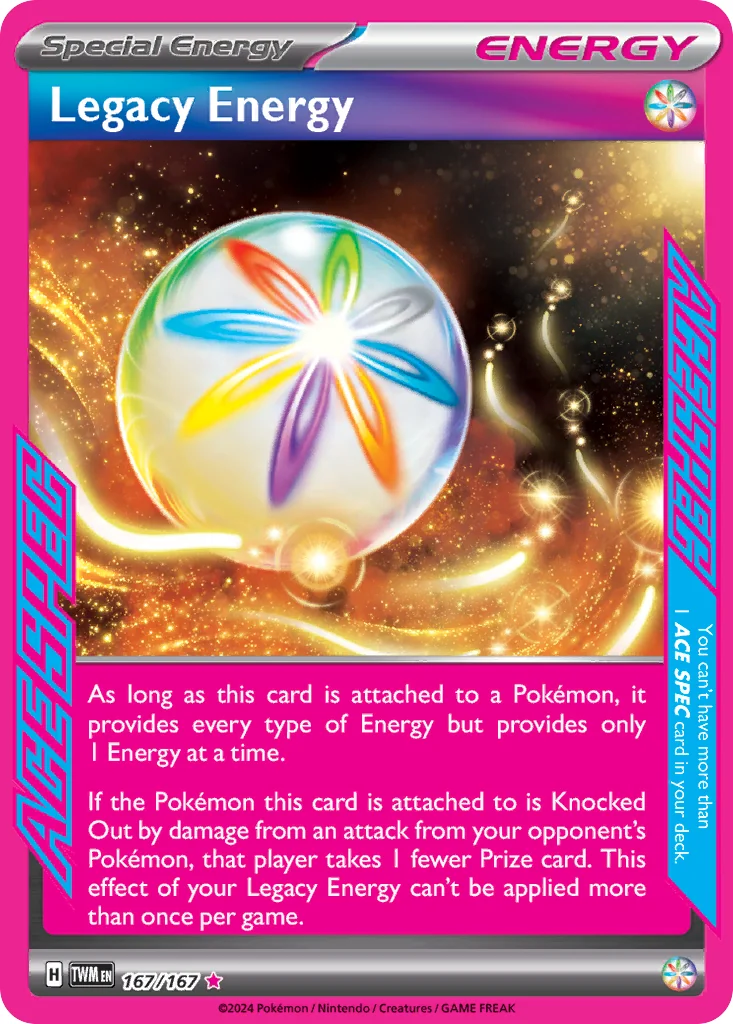
At the top of the category sit the ACE SPEC Energy cards, and Legacy Energy is the one that changes games: "If the Pokémon this card is attached to is Knocked Out by damage from an attack from your opponent's Pokémon, that player takes 1 fewer Prize card. This effect of your Legacy Energy can't be applied more than once per game." A two-Prize Pokémon ex becomes a one-Prize trade, once. And like every ACE SPEC it is a single copy in the whole deck — see the ACE SPEC rules in our Trainer card guide for how that limit is shared across every ACE SPEC card, not per card name.
The Mega Evolution era printed a complete type cycle
Across three consecutive sets, the Mega Evolution era has quietly printed a full eight-card cycle of type-locked Special Energy — one for every basic Energy type, no gaps.
| Card | Set | Provides | Rider |
|---|---|---|---|
| Growing Grass Energy | Perfect Order | Grass | The Grass Pokémon gets +20 HP |
| Rocky Fighting Energy | Perfect Order | Fighting | Prevents all effects of your opponent's attacks on the Fighting Pokémon |
| Telepathic Psychic Energy | Perfect Order | Psychic | On attach from hand, search your deck for up to 2 Basic Psychic Pokémon and Bench them |
| Bubbly Water Energy | Chaos Rising | Water | The Water Pokémon recovers from and cannot be affected by Special Conditions |
| Magnetic Metal Energy | Chaos Rising | Metal | The Metal Pokémon has no Retreat Cost |
| Nitro Fire Energy | Chaos Rising | Fire | If discarded by the Fire Pokémon's own attack, return it to your hand |
| Shadowy Darkness Energy | Pitch Black | Darkness | While the Darkness Pokémon is Benched, prevent all damage to it from attacks |
| Voltaic Lightning Energy | Pitch Black | Lightning | The Lightning Pokémon's attacks do 20 more to the Active, before Weakness and Resistance |
Three sets, split three-three-two, all carrying the J regulation mark that went live with the 2026 sets.
Mechanically, each of these is a Pokémon Tool bolted onto an Energy card, which dodges the one-Tool-per-Pokémon limit entirely — you get a Tool and the rider. The catch is the type lock: each provides only its own type, so it fits exactly one deck and is dead in every other.
The sleeper is Magnetic Metal Energy. Read the retreat section again: a card that zeroes the Retreat Cost on your Metal attacker converts the most expensive action in the game into a free one, permanently, for an Energy slot you were filling anyway.
Where Energy goes when things die
Four transitions, and only two of them cost you cards:
| Event | What happens to attached Energy |
|---|---|
| Pokémon is Knocked Out | Everything attached goes to the discard pile with it |
| Pokémon retreats | You discard Energy equal to the Retreat Cost |
| Pokémon evolves | Kept. "When a Pokémon evolves, it keeps all attached cards" |
| Pokémon is switched or gusted to the Bench | Kept — only Special Conditions and attack effects fall off |
The Knock Out line is the one that decides games. When your three-Energy attacker goes down, the opponent takes their Prize card and you lose three turns of attachment in one hit. That asymmetry is why the game rewards charging a Benched backup that is ready when the front line falls.
The counterplay is recursion: Blaziken ex pulls basic Energy back out of the discard, and Nitro Fire Energy returns itself to your hand when its own Pokémon's attack discards it. Neither is common, which tells you how highly the game rates the resource.
Quick Action Checklist
- Attacking never discards Energy. Retreating does, and a Knock Out takes everything attached with it.
- Count the symbols in an attack cost for the number of Energy cards required. Typed symbols demand that type, the Colorless star takes anything, a blank cost is zero, and costs are minimums.
- One manual attachment per turn, from your hand. Card effects that attach are extra, and almost all of them specify Basic Energy.
- Weakness and Resistance read the Pokémon's type, not the Energy attached. In the Mega Evolution era every Weakness is ×2 and every Resistance is −30.
- Nine basic Energy cards exist in the game's history; eight are current. There is no Colorless Energy and no Dragon Energy, so Dragon attacks cost two different types.
- Basic Energy ignores the four-copy limit. Special Energy does not — and Special Energy is the only kind Enhanced Hammer, Ruffian, Blowtorch, and Megaton Blower can delete.
- Read a Special Energy's conditional before you sleeve it. One that provides Colorless on the Pokémon you need it on is a blank card.
- A switch effect keeps every Energy attached and works while Asleep or Paralyzed. Retreating does neither.
Frequently Asked Questions
How many Energy cards can you attach per turn in the Pokémon TCG?
What is the difference between basic Energy and Special Energy?
Does attacking discard the Energy attached to a Pokémon?
What does the Colorless symbol mean in a Pokémon TCG attack cost?
How many Energy types are there in the Pokémon TCG?
Does the Energy attached to a Pokémon change what it is Weak to?
How does the retreat cost work in the Pokémon TCG?
What happens to Energy when a Pokémon is Knocked Out?
Keep Reading
- The Pokémon Company — official Pokémon Trading Card Game Rules (PDF): Energy Types, attaching Energy, retreating, and deck building
- The Pokémon Company — Pokémon TCG rules hub
- Pokémon TCG API — card text, Energy printings, and Weakness/Resistance data
- Play! Pokémon — 2026 Standard format rotation announcement (regulation marks H, I, J)
- Bulbapedia — Energy card
- Bulbapedia — Special Energy card
Related Guides
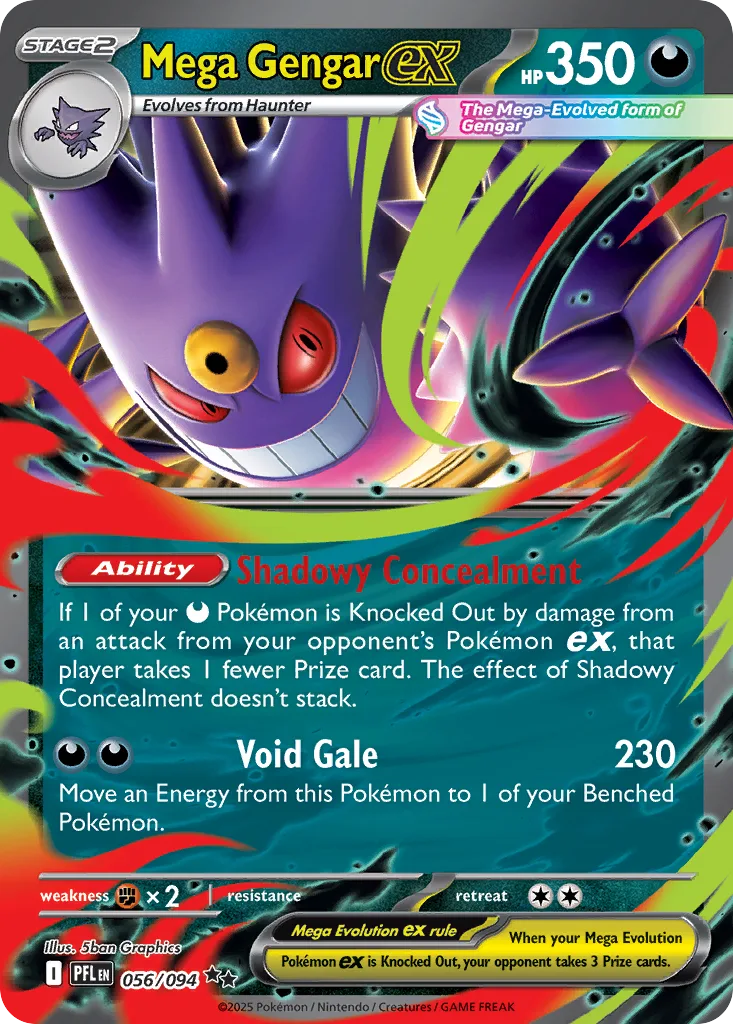
Pokémon TCG Prize Cards Explained: 1, 2, and 3-Prizers
The Prize count is the only score the Pokémon TCG keeps. Here is what each Pokémon actually costs you when it goes down — one, two or three — measured across all 2,947 Standard-legal printings, plus the 44 Standard-legal card names whose text reads the Prize count or changes what a Knock Out pays.
Pokémon TCG Prerelease: Build & Battle Box, 40-Card Decks
A Prerelease is the one Pokémon TCG event where the entry fee is the deck. It is also a different game to the one on the Championship Series circuit: 40 cards, no copy limit, four Prize cards. Here is what the Tournament Handbook and the Play! Pokémon organizer guide actually say about Limited play, and what the maths does when you cut two Prizes out of the game.
Pokémon TCG Tournament Rules: Deck Lists, the Clock, and Penalties
The rules that decide your first League Cup are not in the rulebook. They are in three separate Play! Pokémon documents, revised on a quarterly cycle, and they cover sleeve colour, how a die has to be numbered, what happens to your match when the clock hits zero, and the two penalties that exist in the Pokémon TCG and nowhere else in the program.
Pokémon TCG Abilities Explained: Triggers, Ability Lock, and Damage Math
An Ability is not an attack, and almost every rules argument about Abilities comes from someone forgetting that one line. Here is what the 2026 Web Rulebook says about when Abilities fire, where they work from, why a Paralyzed Pokémon still uses them, and what the parenthetical at the end of a damage-reduction Ability is really telling you.
How to Play the Pokémon TCG — Full Rules and Turn Structure (2026)
Two players, 60 cards each, six face-down Prize cards, and a coin flip. That is the whole skeleton of the Pokémon TCG. Here is every rule that actually matters on turn one, from setup through the three ways to win.
Pokémon TCG Evolution Explained: Stages, Rare Candy, Mega
Evolving looks like the simplest action in the Pokémon TCG until you count the restrictions — there are three, plus two more that get treated as restrictions and are not. Here is what the rulebook actually says about stages, timing, and what survives an evolution, plus how the 2025-26 Mega Evolution era quietly rewrote the whole mechanic for the second time.