Pokémon TCG Prerelease: Build & Battle Box, 40-Card Decks
A Prerelease is the one Pokémon TCG event where the entry fee is the deck. It is also a different game to the one on the Championship Series circuit: 40 cards, no copy limit, four Prize cards. Here is what the Tournament Handbook and the Play! Pokémon organizer guide actually say about Limited play, and what the maths does when you cut two Prizes out of the game.
A League Cup asks you to turn up with a deck. A Prerelease hands you one at the door, in pieces, out of a set that is not on general sale yet — and then gives you half an hour at the outside to make it work.
It is also, mechanically, a different game to the one on the circuit. Not "a casual version of." Different deck size, different copy rules, different Prize count, and a knock-on effect on card text that The Pokémon Company writes about openly. Here is what the rulebooks actually say.
A Prerelease is a Limited event, not a preview party
Play! Pokémon's own organizer documentation is blunt about the category. The League Challenges, League Cups, and Prerelease Guide states it in one flat sentence: "Prereleases are run using Limited tournament formats." The same guide describes the purpose as getting new sets "into the hands of your players up to two weeks prior to an official release," and confirms that Prereleases "can be scheduled over a designated two-week period."
So a Prerelease is not its own format. It is a Limited event, and Limited is a fully sanctioned branch of the rules that sits alongside Constructed rather than beneath it — while the same organizer guide specifies that League Challenges and League Cups "are run using the Standard format." Our formats guide covers the three Constructed pools; this is the other half, sections 4 and 5 of the handbook.
What's in the box, and what's in the store's kit
There are two levels of packaging here and it is worth separating them, because store-side allocation is what decides whether your local even runs one.
| Contents | Source | |
|---|---|---|
| Build & Battle Box (per player) | 40-card ready-to-play deck, 1 of 4 alternate-art promo cards, 4 booster packs, 1 deck-building tip sheet | Play! Pokémon, Prerelease Kit Contents |
| Prerelease Kit (per store) | 1 Build & Battle Box Display of 10 boxes, plus 1 Booster Display of 36 packs for prizing and Judge support | Play! Pokémon, Prerelease Kit Contents |
One kit covers ten players, so seat counts move in blocks of ten. That is the unit stores order in, and Play! Pokémon allocates kits against a League's reporting history — new Leagues start on a fixed allocation that can grow, and a League has to report a Prerelease for at least one of the two most recent Prereleases it was eligible for to keep the eligibility.
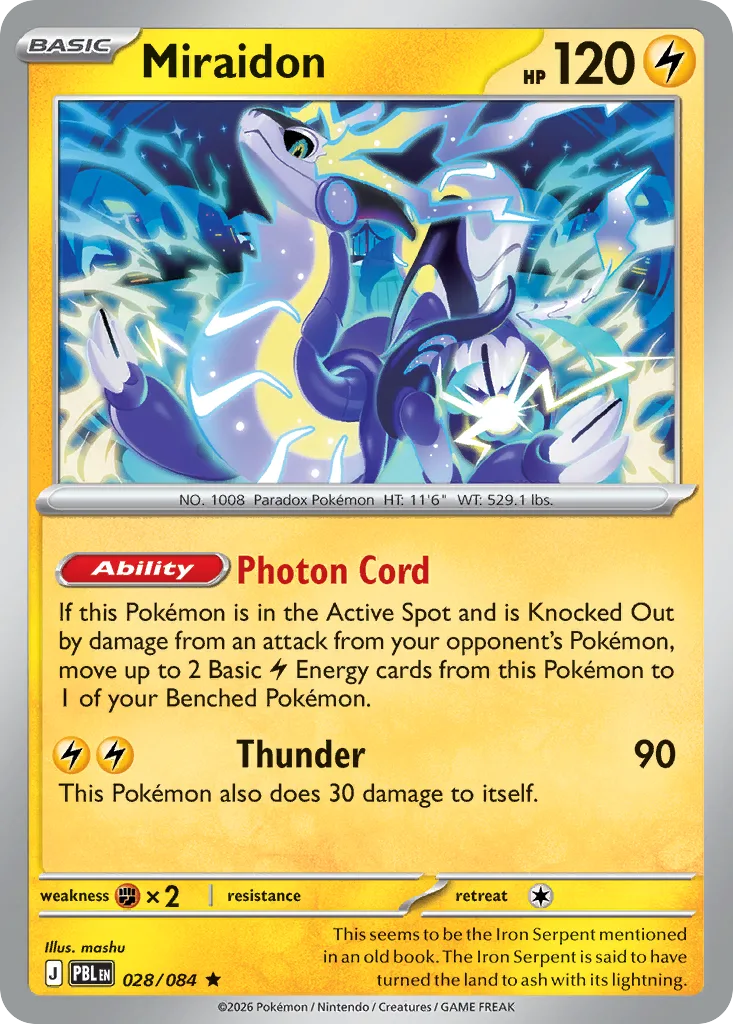
The promo in the box is one of four alternate-art cards, per that same kit-contents page. For Mega Evolution—Pitch Black, The Pokémon Company's own early-access announcement named the four foil promos as Miraidon, Slowbro, Dhelmise and Bastiodon.
There is a hard rule attached to that product that explains why you cannot simply buy a Build & Battle Box on the Monday and skip the event. The organizer guide: "All Organizers may freely sell this material on and after the advertised release date of the expansion. Prior to this date, this material may only be sold for the purposes of participation in a sanctioned Prerelease event." Stores in the Early Release program get one narrow exception — they may sell Prerelease Kit product starting the Monday before the expansion's street date.
The three Limited formats, side by side
Section 5 of the TCG Tournament Handbook (revised 21 May 2026) sanctions exactly three Limited formats. Only two of them can be a Prerelease.
That restriction is easy to miss, because it does not live in the rules handbook at all — it lives on the form. Section 3.4 of the organizer guide sets out the exact values a store enters when it sanctions the tournament in Play! Tools, and the TCG Format field reads "Sealed or Build & Battle Draft." Booster Draft is a fully legal Limited format. It is not a legal Prerelease. The same table fixes Tournament Format at "Swiss only or Swiss + Single Elimination" and Match Structure at "Single game or best-of-three."
So if you are walking into a Prerelease, you are in one of the first two columns below. The third is here for contrast, because the differences between the three are not cosmetic.
| Sealed (§5.1) | Build & Battle Draft (§5.3) | Booster Draft (§5.2) | |
|---|---|---|---|
| Can be a Prerelease | Yes | Yes | No |
| What you receive | A Build & Battle Box, or a set number of boosters — "usually between four and six" | A Build & Battle Box | Boosters only; four to six per player recommended |
| Seating | No groups required | Groups of four, seated in a circle | Equal-sized groups, max 8 per group, seated in a circle |
| Card selection | Open everything, keep everything | One card per pass, rest passed face down, direction alternating each pack; you also keep the Live code card and the non-foil Basic Energy with each pick | One card per pass, rest passed face down, direction alternating each pack |
| The 40-card deck | Counts toward your pool | Opened and reviewed first, then returned to the box until deck construction | No preconstructed deck exists |
| Build time | 30 minutes | 20 minutes | 30 minutes |
Two details in that table matter more than they look. First, a selected card in a draft is locked: the handbook says once a card is placed in your stack or box "it is considered selected and cannot be returned to the pack in exchange for another card." Second, Build & Battle Draft is the only one of the three where you see a preconstructed 40-card deck before you draft — Sealed has no draft, and Booster Draft has no preconstructed deck. It also hands you a minute of review between packs, and then ten fewer minutes to build. Twenty, from a pool you have already looked through once.
The four deck rules that change
Constructed deck construction is three rules you already know. Limited replaces all three and adds a fourth thing that is not a rule so much as a gift.
| Constructed (§4) | Limited (§5) | |
|---|---|---|
| Deck size | Exactly 60 | Exactly 40 |
| Copies of one name | Maximum 4, Basic Energy excepted | No limit, unless the card text says otherwise |
| Prize cards | 6 | 4 |
| Basic Energy | You provide it | "Any Basic Energy cards provided by the Organizer" |
That last row quietly removes the hardest part of building from an unfamiliar pool. You are not rationing Energy out of what you opened — the organizer's box of Basic Energy is part of your legal card pool, so the Energy count is a pure design decision rather than a supply problem. Everything else in the deck has to come out of the product you were handed.
The no-copy-limit rule reads generously and mostly is not. You may run nine copies of a card if you open nine, and four booster packs plus a fixed 40-card deck rarely hands you nine of anything. Where it genuinely bites is the middle of the curve: if the preconstructed deck runs two copies of a good Item and your packs cough up two more, all four go in, and nothing in the rules would stop a fifth.
Four Prizes rewrites the arithmetic
The Pokémon Company flags this one itself, which saves me having to assert it. Its own Phantasmal Flames Build & Battle article puts it plainly: "A unique quirk of the Prerelease format is that many cards with conditions based on Prize cards interact differently than if they were played in the Standard format."
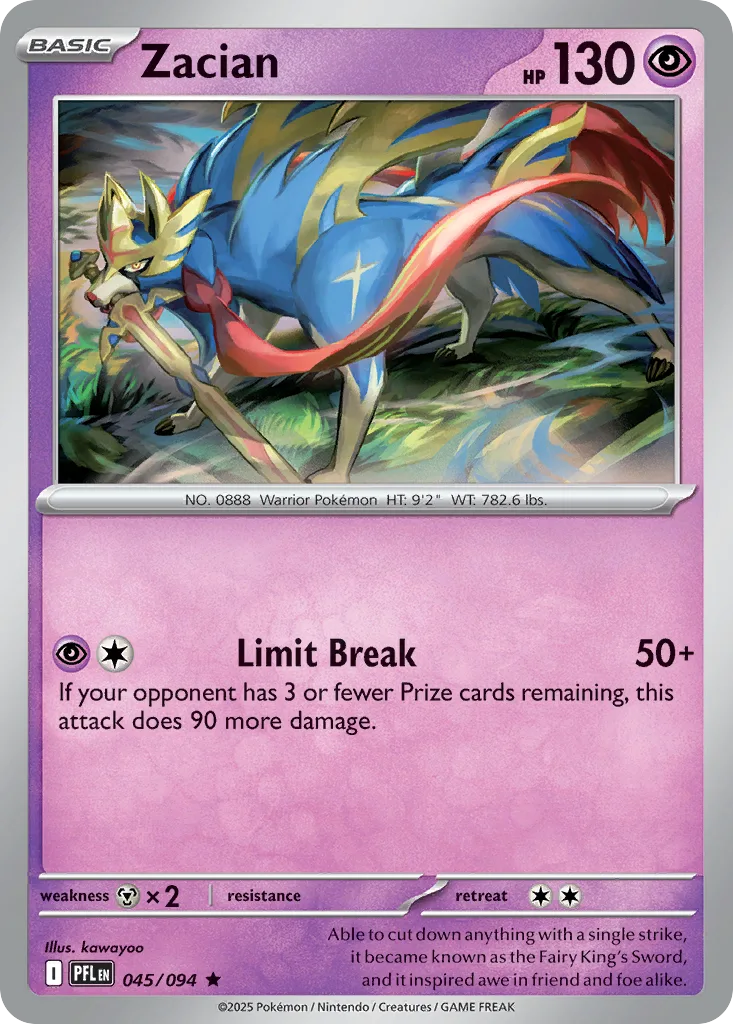
Their example is Zacian, one of that set's four promos. Its Limit Break attack reads "50+ — If your opponent has 3 or fewer Prize cards remaining, this attack does 90 more damage," per the card data on the Pokémon TCG API. In Standard, three-or-fewer means your opponent has already taken three Prizes and the game is half over. In a four-Prize game, three-or-fewer arrives the moment they take a single Prize. A 50-damage attack becomes a 140-damage attack one Knock Out into the match.
Cards whose text keys off a Prize count shift with it, in one direction or the other — the publisher's own word for how many is "many," not all. So does the cost of losing a multi-Prize Pokémon:
| Card type | Prizes given up | Share of a 6-Prize game | Share of a 4-Prize game |
|---|---|---|---|
| Ordinary Pokémon | 1 | 17% | 25% |
| Pokémon ex | 2 | 33% | 50% |
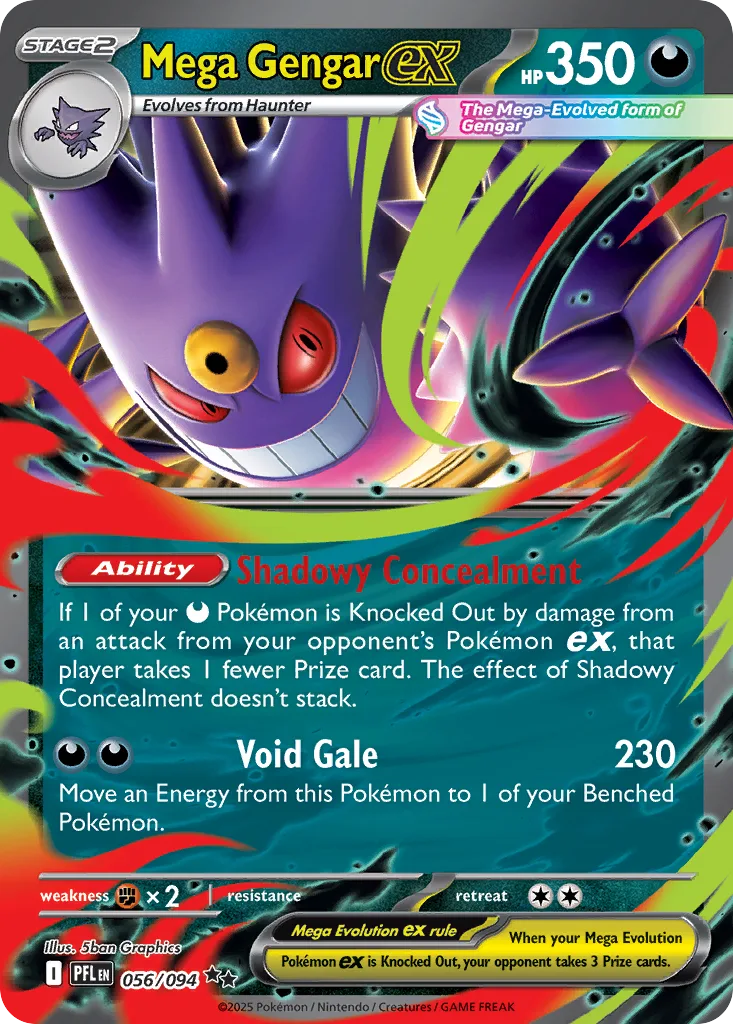
| Mega Evolution Pokémon ex | 3 | 50% | 75% |
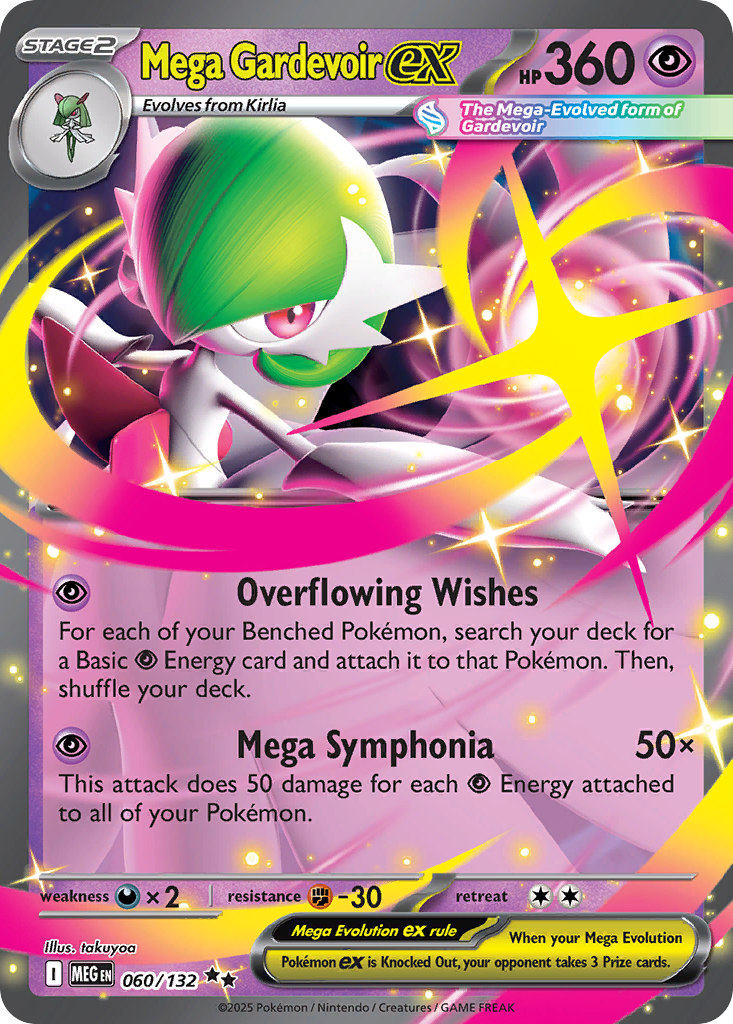
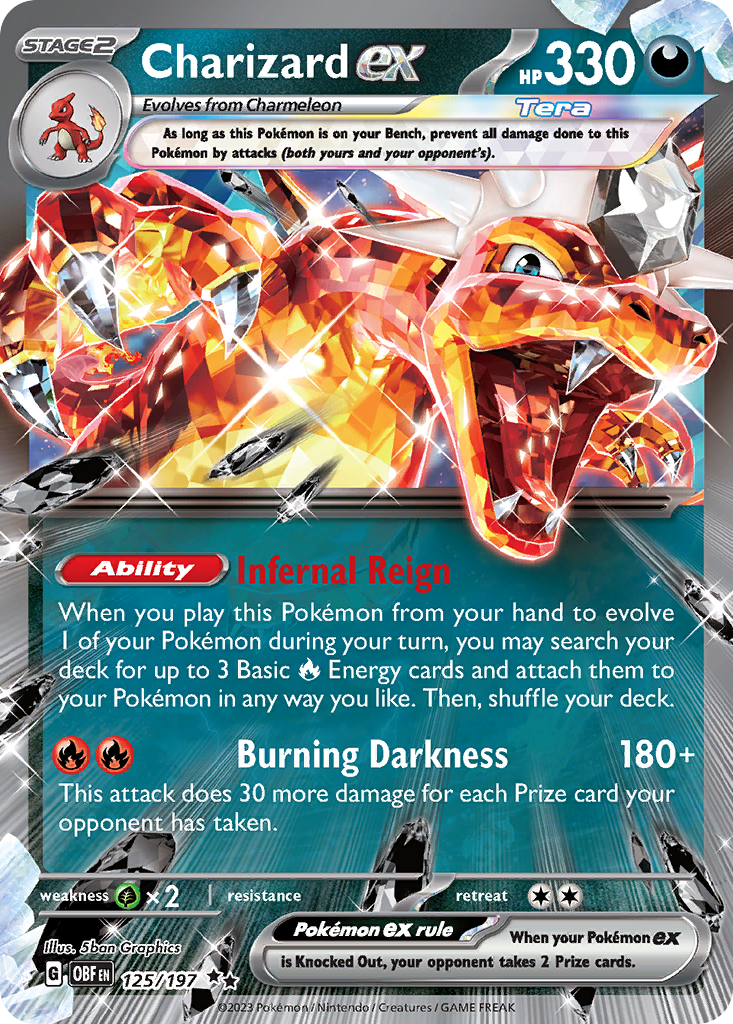
The rule text is printed on the cards themselves — "Pokémon ex rule: When your Pokémon ex is Knocked Out, your opponent takes 2 Prize cards," and "Mega Evolution ex Rule: When your Mega Evolution Pokémon ex is Knocked Out, your opponent takes 3 Prize cards." Those percentages are just division, but they are the ones that decide what you sleeve. A Mega Evolution ex in Standard is a big swing. The same card in a Prerelease is three-quarters of the game riding on one Pokémon.
One more piece of arithmetic worth having. Prizes take the same 10% bite out of either deck — four from forty, six from sixty. But an opening hand does not scale: seven cards is 17.5% of a 40-card deck against 11.7% of a 60-card one. You see more of your deck, sooner, with fewer copies of anything in it. That is a variance trade, not a strictly better one.
The window is thirteen days
The organizer guide caps the Prerelease window at "up to two weeks prior to an official release." In practice The Pokémon Company has been publishing the same gap over and over. Here are seven expansions between March 2025 and July 2026 — every Build & Battle Box announcement I could find in that window — with the dates read off the publisher's own articles:
| Expansion | Build & Battle Box on sale | Expansion releases | Gap |
|---|---|---|---|
| Scarlet & Violet—Journey Together | March 15, 2025 | March 28, 2025 | 13 days |
| Scarlet & Violet—Destined Rivals | May 17, 2025 | May 30, 2025 | 13 days |
| Mega Evolution | September 13, 2025 | September 26, 2025 | 13 days |
| Mega Evolution—Phantasmal Flames | November 1, 2025 | November 14, 2025 | 13 days |
| Mega Evolution—Perfect Order | March 14, 2026 | March 27, 2026 | 13 days |
| Mega Evolution—Chaos Rising | May 9, 2026 | May 22, 2026 | 13 days |
| Mega Evolution—Pitch Black | July 4, 2026 | July 17, 2026 | 13 days |
That is not every expansion released in the window — those are the seven I found announcements for, and I am not claiming the list is exhaustive. But all seven put the Build & Battle Box on sale on the second Saturday before a Friday street date, without exception. That is not a published rule and I am not going to pretend it is one — if you are trying to work out roughly when a Prerelease weekend lands, though, the second weekend before release is where all seven of these went.
Worth keeping straight: the Prerelease window is when you can play with the cards, not when they become tournament-legal. Handbook §4.1.2 puts legality at "the second Friday following that product or expansion's US market release date" — a separate clock, running from street date, not from the Prerelease. Cards you open at a Prerelease sit in a gap where they are legal in that Limited event and nowhere else. The one exception the May 2026 revision added: reprints. Section 4.1.3 now says "reprinted cards obtained during a new expansion's Prerelease window may also be played immediately in their currently playable format." A new printing of a card already legal in Standard is legal the moment you pull it.
Packs, not points
A Prerelease pays in cardboard. The organizer guide's recommendation is that "all players who complete an event receive 3 additional booster packs from the booster display included in Prerelease Kits as a participation prize after the tournament," and it explicitly floats alternative structures — its own example is a four-round event where every player gets one pack for showing up and one more per win. Additional prizing beyond the packs Play! Pokémon supplies is at the store's discretion.
What it does not pay is Championship Points. The Tournament Rules Handbook files Prereleases alongside Friendly Tournaments as "entry-style events," separate from the Championship Series, and the organizer guide draws the same line: Prereleases get sets into players' hands, while League Challenges and Cups "start members in your community on their path toward our World Championships by offering Championship Points." If you are chasing an invite, our Championship Points guide is the relevant document; a Prerelease is not on that road.
Two practical consequences of that classification. Prereleases are not required to be sanctioned 14 days in advance the way Championship Series events are, so listings can appear late — check the Event Locator more than once. And because they are not Championship Series events, the deck-list requirement in §3.1 of the TCG handbook, which applies to Championship Series events, does not reach them; a Prerelease is a build clock and a handshake, with nothing to register.
Round count is the organizer's call, inside the bounds the sanctioning form sets: Swiss only or Swiss plus a single-elimination top cut, single game or best-of-three. The Tournament Rules Handbook requires Organizers to notify competitors of the tournament type, format, number of rounds, minutes per round and match format, with the round count and round length announced before the first round begins. The guide also warns organizers that Prereleases "often last fewer rounds than would be necessary to determine a clear winner" — which is the honest reason the default prize structure pays everyone rather than a winner.
The 30th Celebration question
One live caveat, because a Prerelease needs a Build & Battle Box and not every set has one.
Pokémon TCG: 30th Celebration releases September 16, 2026 — the first Pokémon expansion with a simultaneous worldwide release. The Pokémon Company's product showcase for the set enumerates fourteen products across September, October and November: a Tech Sticker Collection, a 2-Pack Blister, a Knock Out Collection, a Poster Collection, a Pokémon ex Box, an Elite Trainer Box, a Pokémon Center Elite Trainer Box, a Binder Collection, a Booster Bundle, Mini Tins, a Battle Deck pair, a Ditto Premium Collection, an Ultra-Premium Collection and a Figure Collection. None of the fourteen is a Build & Battle Box, and as of this writing I could not find a Build & Battle Box early-access article for the set on pokemon.com of the kind published for the five expansions in the table above.
That is an absence of evidence, not a statement from the publisher, and the showcase does not claim to be a complete forever-list. Treat it as a reason to check the Event Locator rather than to assume, and do not make travel plans around a Prerelease weekend that has not been announced.
Quick Action Checklist
- A Prerelease is a Limited event. 40-card deck, no limit on copies of a name, matches played for 4 Prize cards.
- Your Build & Battle Box is the whole pool: a 40-card ready-to-play deck, 1 of 4 alternate-art promos, 4 boosters, and a tip sheet.
- Basic Energy is supplied by the organizer and counts as part of your legal pool. Build your Energy line to the deck, not to what you opened.
- A Prerelease is sanctioned as Sealed or Build & Battle Draft, never Booster Draft. Sealed gives you 30 minutes to build; Build & Battle Draft gives you 20.
- Re-read every card that mentions Prize cards. At four Prizes, "3 or fewer" triggers after one Knock Out.
- A Mega Evolution Pokémon ex costs you three of four Prizes if it goes down. Weigh that before you sleeve it.
- All seven expansions I checked, March 2025 to July 2026, put the box on sale 13 days before street date. Not a rule — a pattern.
- You are playing for packs, not Championship Points. Three boosters for finishing is the recommended baseline.
Frequently Asked Questions
What is a Pokémon TCG Prerelease?
How many cards are in a Pokémon TCG Prerelease deck?
What is in a Pokémon TCG Build & Battle Box?
What are the three Limited formats in the Pokémon TCG?
Do Pokémon TCG Prereleases award Championship Points?
Are cards from a Prerelease legal in the Standard format straight away?
How far before a Pokémon TCG set release is the Prerelease?
Keep Reading
- The Pokémon Company — TCG Tournament Handbook (PDF, revised 21 May 2026): Limited deck construction and the three Limited formats §5, Sealed §5.1, Booster Draft §5.2, Build & Battle Draft §5.3, release and legality schedule §4.1.2, Prerelease-window reprints §4.1.3, deck registration §3.1
- Play! Pokémon — League Challenges, League Cups, and Prerelease Guide: Prereleases run Limited formats §1.3, the two-week window and Build & Battle Box contents §3, Prerelease Kit materials §3.2, prizing §3.3, and the tournament sanctioning values §3.4 that restrict a Prerelease to Sealed or Build & Battle Draft
- Play! Pokémon Support — Prerelease Kit Contents: one Build & Battle Box Display of 10 boxes, one booster display of 36 packs, 10 players per kit, and the per-box contents
- Play! Pokémon — Tournament Rules Handbook (PDF, revised 21 May 2026): Prereleases as entry-style events §4.1.2, League sanctioning timelines §4.1.2.3, required tournament announcements, Championship Series round structure §5.5.6
- The Pokémon Company — Get a Pokémon TCG: Mega Evolution—Phantasmal Flames Build & Battle Box Early: the November 1 / November 14, 2025 dates, and the publisher's own worked example of how Prize-count conditions change at four Prizes
- The Pokémon Company — Get a Pokémon TCG: Mega Evolution—Pitch Black Build & Battle Box Early: July 4 / July 17, 2026 dates and the four foil promos (Miraidon, Slowbro, Dhelmise, Bastiodon)
- The Pokémon Company — Get a Pokémon TCG: Mega Evolution—Perfect Order Build & Battle Box Early: March 14 / March 27, 2026 dates
- The Pokémon Company — Get a Pokémon TCG: Mega Evolution—Chaos Rising Build & Battle Box Early: May 9 / May 22, 2026 dates
- The Pokémon Company — Get the Pokémon TCG: Scarlet & Violet—Journey Together Build & Battle Box Early: March 15 / March 28, 2025 dates
- The Pokémon Company — Play at a Pokémon TCG: Scarlet & Violet—Destined Rivals Prerelease Event: Build & Battle Box on sale May 17, 2025, expansion released May 30, 2025
- The Pokémon Company — Play at a Pokémon TCG: Mega Evolution Prerelease Event: Build & Battle Box on sale September 13, 2025, expansion released September 26, 2025
- The Pokémon Company — Pokémon TCG: 30th Celebration Product Showcase: the fourteen announced products and their September 16, October 2, October 30 and November 6, 2026 availability dates
- Pokémon TCG API — Zacian, Mega Evolution—Phantasmal Flames 45/094: Limit Break reads 50+ with 90 more damage if the opponent has 3 or fewer Prize cards remaining
Related Guides
Pokémon TCG Energy Explained: Basic vs Special, Attack Costs, and the One-Per-Turn Rule
Attacking never spends your Energy. Retreating does. There are exactly nine basic Energy cards in the game's history and two Pokemon types that never got one. Here is how Energy actually works, straight from the rulebook and the card database — attack costs, the one-per-turn attachment rule, every legal way around it, and why Special Energy is a target painted on your attacker.
Pokémon TCG Trainer Cards Explained: Item, Supporter, Stadium, Tool, and ACE SPEC Rules
You can play seven Items in a turn and nobody blinks, but a second Supporter gets you stopped mid-motion. Every Trainer subtype carries its own play rule, printed right on the card, and the differences decide how modern decks are built. Here is what the official rulebook actually says about Items, Supporters, Stadiums, Pokémon Tools, and the one-per-deck ACE SPEC rule.
How to Play the Pokémon TCG — Full Rules and Turn Structure (2026)
Two players, 60 cards each, six face-down Prize cards, and a coin flip. That is the whole skeleton of the Pokémon TCG. Here is every rule that actually matters on turn one, from setup through the three ways to win.
Pokémon TCG Prize Cards Explained: 1, 2, and 3-Prizers
The Prize count is the only score the Pokémon TCG keeps. Here is what each Pokémon actually costs you when it goes down — one, two or three — measured across all 2,947 Standard-legal printings, plus the 44 Standard-legal card names whose text reads the Prize count or changes what a Knock Out pays.
Pokémon TCG Formats Explained: Standard, Expanded, Unlimited
Play! Pokémon sanctions three Constructed formats, and Standard is the one the circuit runs on. Here is what the other two actually are: the Expanded card pool the Tournament Handbook enumerates set by set, the 27-card ban list that trims it, the Unlimited format with no bans at all, and the awkward truth about where you can still sit down and play any of it.
Pokémon TCG Tournament Rules: Deck Lists, the Clock, and Penalties
The rules that decide your first League Cup are not in the rulebook. They are in three separate Play! Pokémon documents, revised on a quarterly cycle, and they cover sleeve colour, how a die has to be numbered, what happens to your match when the clock hits zero, and the two penalties that exist in the Pokémon TCG and nowhere else in the program.