Pokémon TCG Trainer Cards Explained: Item, Supporter, Stadium, Tool, and ACE SPEC Rules
You can play seven Items in a turn and nobody blinks, but a second Supporter gets you stopped mid-motion. Every Trainer subtype carries its own play rule, printed right on the card, and the differences decide how modern decks are built. Here is what the official rulebook actually says about Items, Supporters, Stadiums, Pokémon Tools, and the one-per-deck ACE SPEC rule.
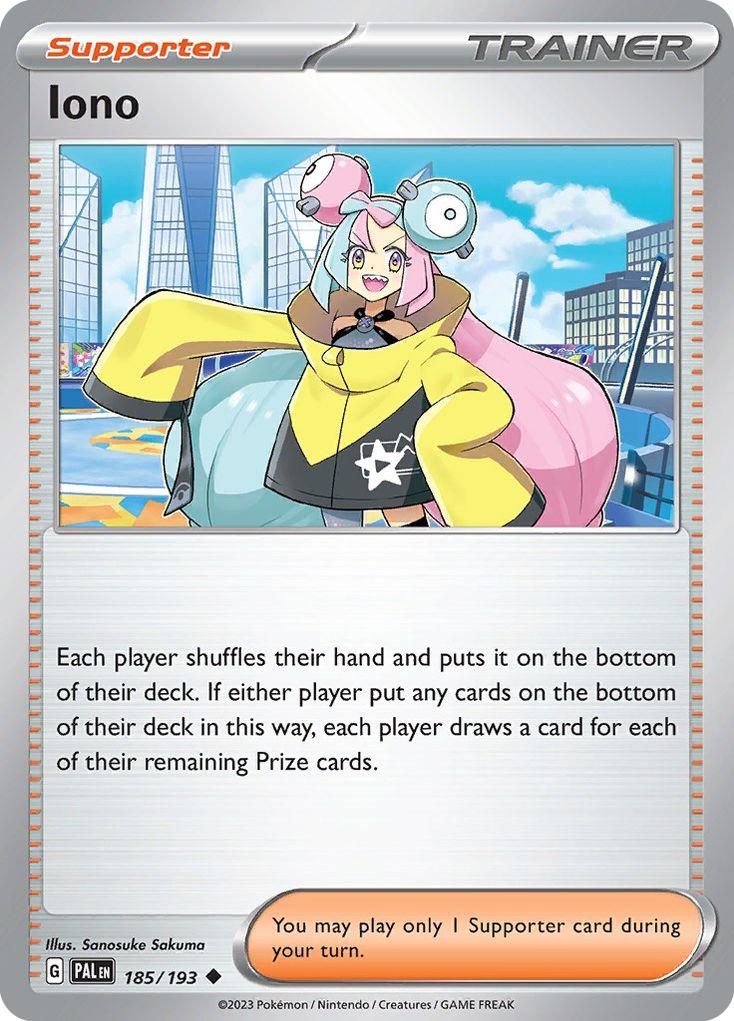
Play Iono, watch both hands vanish under both decks, draw to your Prize count — and then reach for a second Supporter and watch your opponent stop your hand mid-air. The one-Supporter-per-turn rule is usually the first Trainer rule anyone learns, and usually the hard way. Meanwhile the same player just chained four Item cards in a row and nobody said a word, because that is completely legal.
That asymmetry is not trivia. The four Trainer subtypes — Item, Supporter, Stadium, and Pokémon Tool — each carry a different play restriction, and those restrictions are the skeleton that every competitive deck is built on. The nice part: the game does not make you memorize any of this. Every Trainer card prints its own subtype in the header and its own play rule in a box along the bottom. The rules are on the cards. This guide is about what those rules actually mean, where they interact, and the two or three places the details genuinely surprise people.
Everything below is checked against the official Pokémon Trading Card Game Rules PDF from The Pokémon Company — the Trainer Cards entry in the card-types section on page 6, the Play Trainer cards step under Turn Actions on pages 11-12, the ACE SPEC appendix on page 33, and the glossary. Card text comes from the Pokémon TCG API, and every card pictured here was pulled from that database.
The four Trainer subtypes at a glance
The rulebook's one-line summary of the category, from the card-types section: Trainer cards represent the Items, Supporters, and Stadiums a Trainer can use in battle. Add Pokémon Tools — which the glossary handles separately — and the whole system fits in one table:
| Subtype | How many per turn | Where it goes | Example |
|---|---|---|---|
| Item | As many as you want | Discard pile, immediately | Buddy-Buddy Poffin |
| Supporter | One | Discard pile, immediately | Iono |
| Stadium | One | Stays in play until replaced | Artazon |
| Pokémon Tool | No per-turn cap, but one per Pokémon | Stays attached | Bravery Charm |
ACE SPEC is not a fifth row. It is a tag stacked on top of a subtype — Prime Catcher is an Item and an ACE SPEC at the same time — and it restricts deck building, not the turn: one ACE SPEC card total per deck.
One shared rule covers all of them, from the Item entry in the glossary: follow the instructions on the card, then discard it. Trainers are one-shot effects unless the subtype says otherwise, and only Stadiums and Tools say otherwise.
What the rulebook actually says about playing Trainers
The Turn Actions section spells the whole thing out in step D:
"When you play any Trainer card, do what it says and obey the rule at the bottom of the card, and then put it in the discard pile. You can play as many Item cards as you like. Supporter cards are played like Item cards, but you can play only one Supporter card each turn."
Directly under it sits a boxed callout that still catches returning players:
"RULE CHANGE: Starting with the Sword & Shield Series, the player who goes first cannot play a Supporter card on their first turn."
That restriction is real and current, and it only hits the going-first player, and only their Supporters. Items and Stadiums are fine on turn one. It also stacks with the two other first-turn rules from the same section of the rulebook: the starting player skips the attack step entirely, and neither player can evolve a Pokémon on that player's first turn. Going first buys you tempo on Energy and evolutions; the trade is a turn with no attack and no Iono.
The phrase worth underlining is "obey the rule at the bottom of the card." Look at any modern Trainer and the play restriction is literally printed there — Iono's bottom box reads that you may play only 1 Supporter card during your turn, and Artazon's green box carries the full Stadium rule. If you ever blank on a subtype rule mid-game, the card in your hand is the rulebook.
Items: the cards with no limit
The glossary definition is two sentences: an Item is a type of Trainer card; follow the instructions on the card and then discard it. No cap, no timing restriction beyond it being your turn. The printed rule on every modern Item says the quiet part out loud: you may play any number of Item cards during your turn.
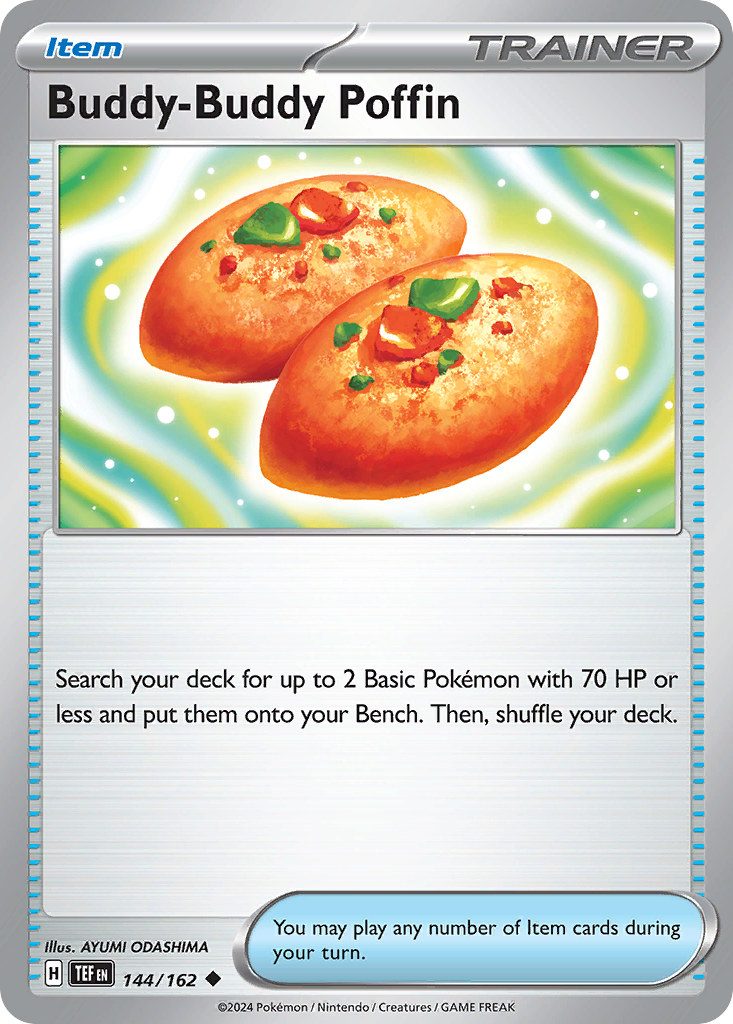
Buddy-Buddy Poffin from Temporal Forces is the modern archetype: search your deck for up to 2 Basic Pokémon with 70 HP or less and put them onto your Bench, then shuffle. One card, two board pieces, zero cost. Because Items are unlimited, they chain — Poffin fills the Bench, a ball card finds the evolution, a switching Item repositions, all in the same turn, all before you have spent your one Supporter or your one attack.
That is why Items are the consistency engine of the game. A turn's power comes from its Supporter and its attack; a turn's reliability comes from how many Items you can fire off around them. The rulebook's own deck-building advice on page 22 points the same direction — its suggested starting split runs around 20 to 25 Trainer cards in a 60-card deck, and in practice the bulk of those end up being Items precisely because nothing stops you from playing your whole hand of them.
Supporters: one per turn, and usually the whole turn
The glossary keeps it blunt: a Supporter is a Trainer card similar to an Item card, and you can play only one Supporter card each turn. That single sentence does more to shape how Pokémon TCG turns feel than any other Trainer rule.
Look at what the effects are allowed to do because of that cap. Iono — the hero card up top — shuffles both players' hands to the bottom of their decks, then each player draws a card for each of their remaining Prize cards. Early game it is a fresh hand of six; late game it strips a winning opponent down to one or two cards. An effect that swings that hard would be broken at Item speed. At one per turn, it is a fair, brutal decision: is this the turn for disruption, for raw draw, or for a gust effect that drags something out of hiding?
That is the practical skill with Supporters — not learning the rule, but budgeting it. Every turn you spend your Supporter slot on the wrong job is a turn the deck underperforms, which is why deck building guides treat the Supporter line as the engine of the deck rather than seasoning. And it is why the going-first restriction from the rule change above actually matters: the game decided that a full Supporter turn was too much value to hand to the player who also gets the first Energy attachment.
Stadiums: the only Trainer that stays on the table
Stadiums get their own bullet list in the Turn Actions section, and all four bullets are load-bearing:
"A Stadium stays in play when you play it. Only one Stadium can be in play at a time — if a new one comes into play, discard the old one and end its effects. You can't play a Stadium card if a Stadium with the same name is already in play. You can play only one Stadium card each turn."
Two consequences fall out of those bullets that new players consistently miss.
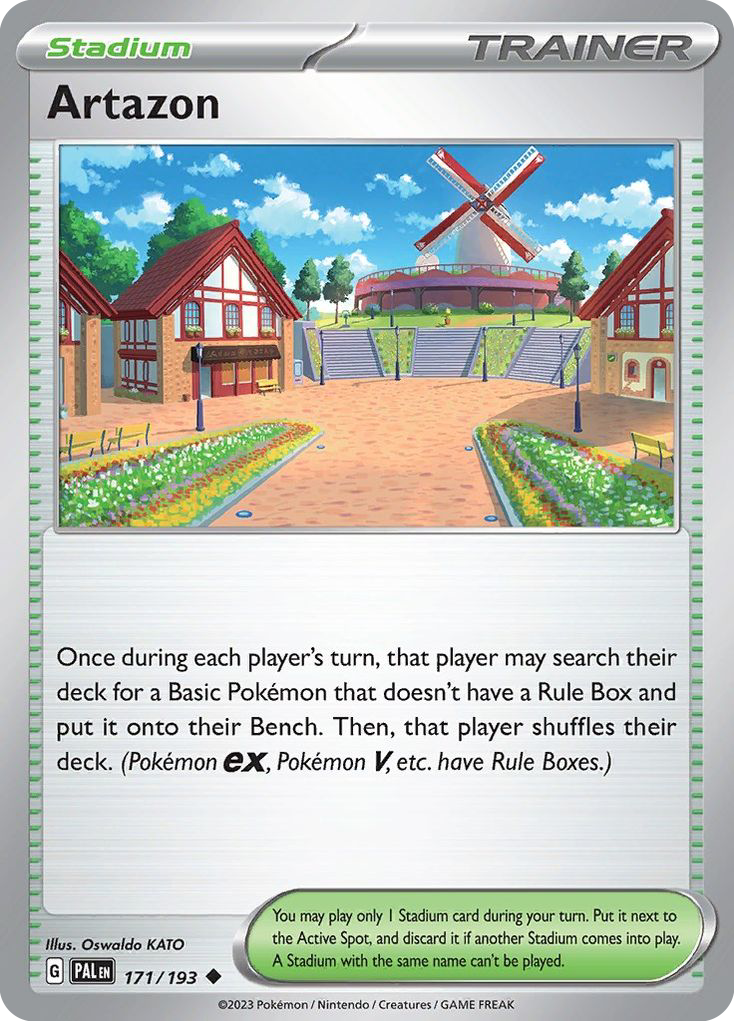
First, Stadiums are symmetric unless their text says otherwise. Artazon reads: once during each player's turn, that player may search their deck for a Basic Pokémon that doesn't have a Rule Box and put it onto their Bench. Each player. Your opponent gets to use your Artazon on their turn. You play a symmetric Stadium because your deck exploits it harder or more often, not because it is private.
Second, the replacement rule makes every Stadium in your deck double as removal. Your opponent's annoying Stadium does not need a dedicated answer card — any Stadium of your own overwrites it, discards it, and ends its effects. The only thing you cannot do is replace an Artazon with another Artazon; the same-name rule blocks it. This is why even decks that barely care about Stadium effects still run one or two: the slot is contested by default.
The one-per-turn cap applies here too, so a Stadium war is a war of attrition — each turn you can overwrite exactly once, and whoever runs out of Stadiums first cedes the slot.
Tools: the Trainer you attach instead of play
Pokémon Tools break the play-and-discard pattern entirely. The rulebook glossary describes a Tool as a special kind of Trainer card you can attach to your Pokémon to help you, with each Pokémon limited to 1 Pokémon Tool attached at any time.
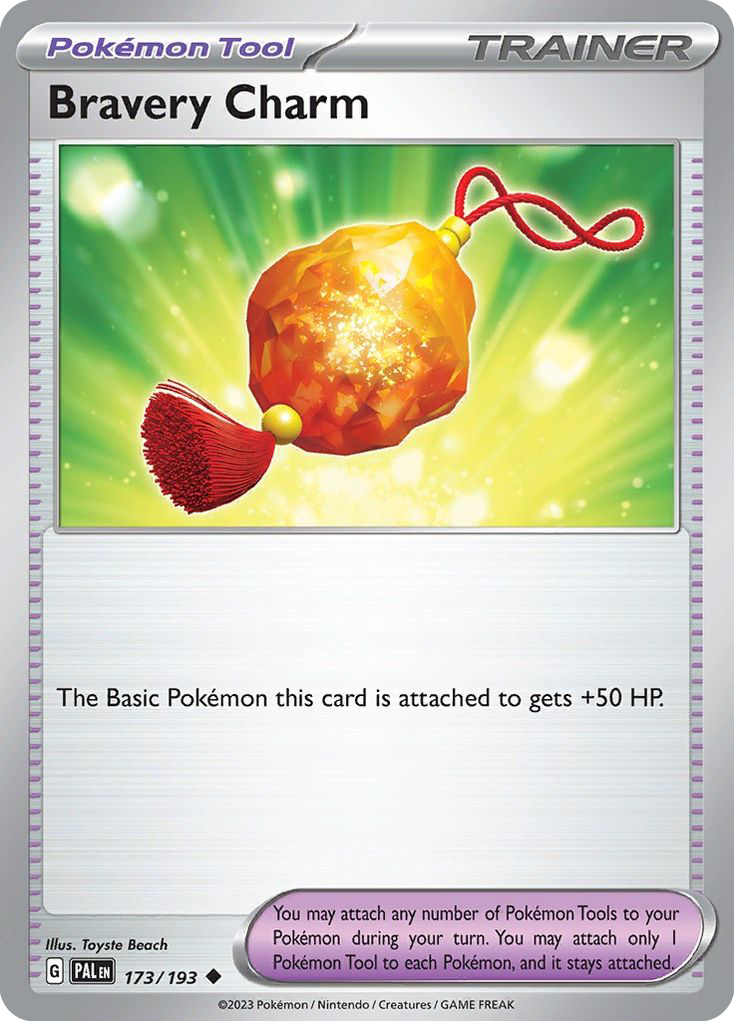
There is a wrinkle here worth knowing because it changed mid-era. The rulebook PDF linked below is from the Sword & Shield period, and its glossary files Tools as a kind of Item — and SWSH-era Tool cards like Air Balloon from the Sword & Shield base set literally carry the Item rule line in their bottom box. When Scarlet & Violet launched, Tools became their own subtype. Compare the printed cards: Air Balloon's header says its rules the Item way, while Bravery Charm's header reads Pokémon Tool, full stop, and its bottom box carries a self-contained rule: you may attach any number of Pokémon Tools to your Pokémon during your turn, you may attach only 1 Pokémon Tool to each Pokémon, and it stays attached.
Read that printed rule closely and three details pop:
- No per-turn cap. Unlike Energy, which attaches once per turn, you can attach Tools to as many different Pokémon as you like in one turn. The limit is per Pokémon, not per turn.
- It stays attached. There is no un-equip action. The Tool sits there until an effect removes it or the Pokémon leaves play — and when a Pokémon is Knocked Out, the rulebook's glossary confirms it goes to the discard pile along with all cards attached to it, Tool included.
- The effect can be conditional. Bravery Charm gives +50 HP, but only to a Basic Pokémon. Attach it to an evolved Pokémon and it does nothing — legal, just pointless.
Tools are the closest thing Trainers have to a permanent buff, which is why the strong ones get priced carefully: 50 extra HP on a Basic changes the Prize-trade math on every attack aimed at it.
ACE SPEC: one card in the whole deck
Appendix R of the rulebook handles ACE SPEC Trainer cards in three sentences, and the middle one is the rule everyone misquotes:
"ACE SPEC Trainer cards are so powerful that you can only have one in your deck. And that's not one of each: that's only one ACE SPEC card total in your deck."
Not one copy of each ACE SPEC. One ACE SPEC card, period, across the whole 60. That is a deck-building constraint layered on top of the normal subtype rules — an ACE SPEC Item is still an Item when you play it, unlimited alongside your other Items that turn. The scarcity is entirely in construction.
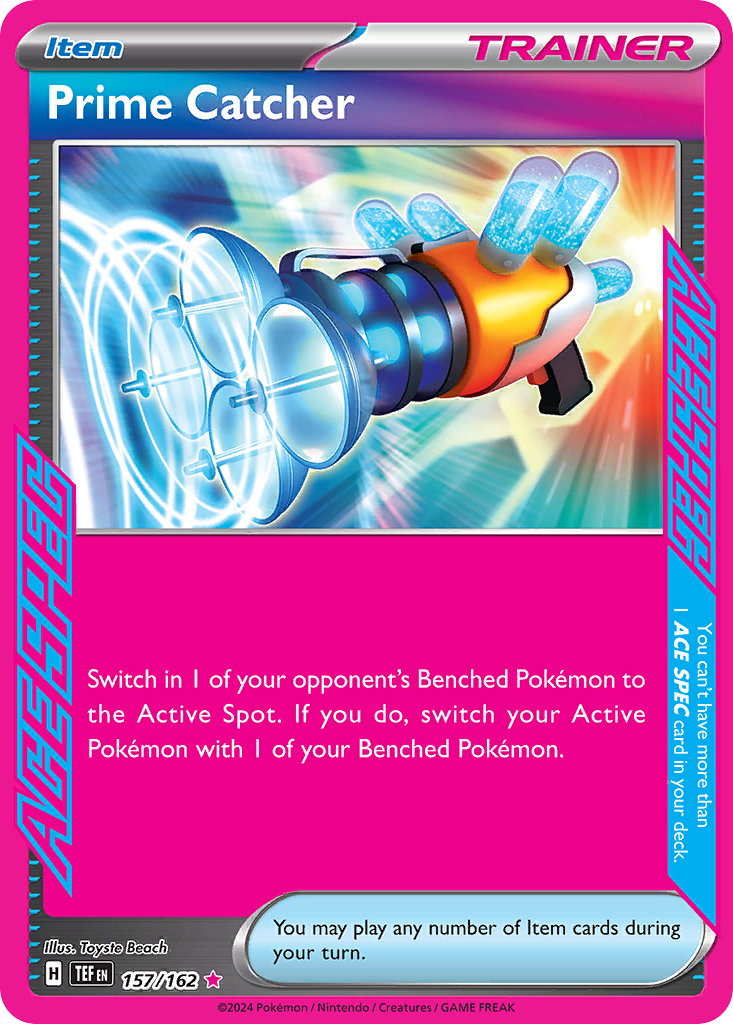
Prime Catcher from Temporal Forces shows why the fence exists. The text: switch in 1 of your opponent's Benched Pokémon to the Active Spot; if you do, switch your Active Pokémon with 1 of your Benched Pokémon. That is a double gust-and-pivot on an Item — no Supporter slot spent, playable alongside your Iono, stapled to a turn that still gets its full attack. Effects at that power level are exactly what the one-per-deck rule is fencing in, and the bright pink frame with ACE SPEC banners down both sides exists so neither player can miss it on the table.
Choosing your one ACE SPEC is a real deck-building decision: a gust effect, a recovery effect, a draw engine, a Tool — you get one, and the right answer depends on what your deck's worst turns look like.
What the card database says about the four subtypes
Here is the falsifiable part. Counting Trainer printings by subtype in the Scarlet & Violet series of the English-language Pokémon TCG API database gives this split:
| Subtype | Printings in the SV series |
|---|---|
| Supporter | 269 |
| Item | 109 |
| Pokémon Tool | 60 |
| Stadium | 39 |
| ACE SPEC (Trainer only) | 30 |
Honest caveats before anyone quotes these: they are printings, not unique cards — every full-art and special-art reprint counts separately — the database is English-only, and the ACE SPEC row overlaps the Item and Tool rows because ACE SPEC cards carry both subtypes.
Read with those caveats, the table still says something real. Supporters outnumber Items nearly 2.5 to 1 in print, yet any game you watch will see far more Items hit the table than Supporters. The gap is the collector economy: Supporters depict characters, characters get full-art and special-art treatments in every set's secret-rare slots, and each treatment is another printing. Items are mostly unlimited utility with one printing each. The count measures what gets printed for pull excitement, not what gets played — a distinction worth keeping in mind any time card-count claims get thrown around, and one we dug into from the other side in the card rarities guide.
How the subtype rules shape deck building
Each play restriction converts directly into a deck-building principle:
- Items are unlimited, so count them for burst. Multiple copies of the same search or switch effect are fine — dead copies are rare because you can always fire them off.
- Supporters are one per turn, so count them for frequency. The question is not how many effects you want in a game but whether you draw exactly one good Supporter every single turn. Miss a turn's Supporter and the deck stalls; that is the failure mode the whole draw engine exists to prevent.
- Stadiums are a contested slot. Even a deck with no Stadium synergy usually wants a couple, purely because overwriting is the cheapest Stadium removal in the game.
- Tools are per-Pokémon, so match the count to the targets. Bravery Charm only works on Basics; run it in proportion to the Basics that actually want 50 HP.
- The ACE SPEC is a single flex slot. Pick it against your deck's weakest pattern, not its strongest.
All of it stays inside the frame from the rulebook's deck-building section: exactly 60 cards, at most 4 with the same name except basic Energy, and at least one Basic Pokémon. If you are starting from zero, the full deck-building guide walks the ratios; if the turn structure itself is still new, start with how a turn actually flows and come back.
Quick Action Checklist
- Items: unlimited per turn, resolved and discarded immediately.
- Supporters: exactly one per turn — and the player who goes first cannot play one on their first turn at all.
- Stadiums: one played per turn, one in play total. A new Stadium discards the old one and ends its effects; you cannot play a Stadium with the same name as the one already down.
- Tools: no per-turn cap, but one per Pokémon, and they stay attached until something removes them or the Pokémon leaves play.
- ACE SPEC: one card total per deck — not one of each.
- Every Trainer card prints its own rule in the bottom box. When in doubt mid-game, read the card, not your memory.
- Symmetric Stadiums help your opponent too. Play them because your deck abuses them harder, not because they are yours.
- Standard deck frame: exactly 60 cards, max 4 per name except basic Energy, at least one Basic Pokémon.
Frequently Asked Questions
How many Trainer cards can you play per turn in the Pokémon TCG?
Can you play a Supporter card on the first turn of a Pokémon TCG game?
What is the difference between an Item and a Supporter in the Pokémon TCG?
How do Stadium cards work in the Pokémon TCG?
How many Pokémon Tools can a Pokémon have attached?
Are Pokémon Tools considered Item cards?
What does ACE SPEC mean in the Pokémon TCG?
How many Trainer cards should a Pokémon TCG deck run?
Keep Reading
Related Guides
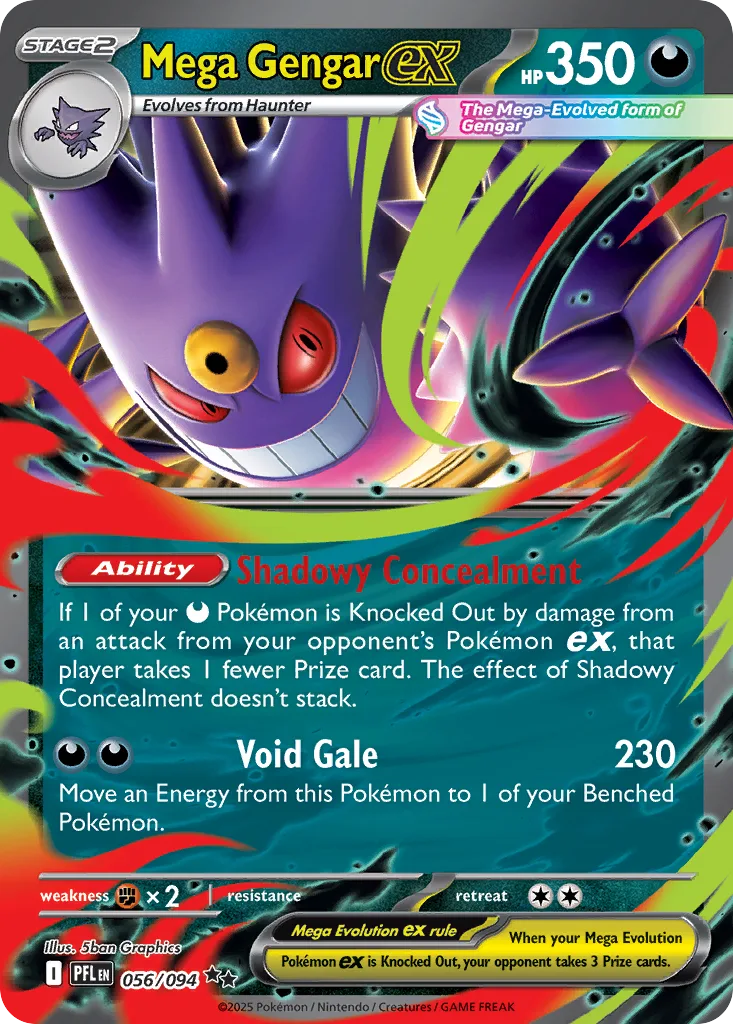
Pokémon TCG Prize Cards Explained: 1, 2, and 3-Prizers
The Prize count is the only score the Pokémon TCG keeps. Here is what each Pokémon actually costs you when it goes down — one, two or three — measured across all 2,947 Standard-legal printings, plus the 44 Standard-legal card names whose text reads the Prize count or changes what a Knock Out pays.
Pokémon TCG Prerelease: Build & Battle Box, 40-Card Decks
A Prerelease is the one Pokémon TCG event where the entry fee is the deck. It is also a different game to the one on the Championship Series circuit: 40 cards, no copy limit, four Prize cards. Here is what the Tournament Handbook and the Play! Pokémon organizer guide actually say about Limited play, and what the maths does when you cut two Prizes out of the game.
Pokémon TCG Tournament Rules: Deck Lists, the Clock, and Penalties
The rules that decide your first League Cup are not in the rulebook. They are in three separate Play! Pokémon documents, revised on a quarterly cycle, and they cover sleeve colour, how a die has to be numbered, what happens to your match when the clock hits zero, and the two penalties that exist in the Pokémon TCG and nowhere else in the program.
Pokémon TCG Abilities Explained: Triggers, Ability Lock, and Damage Math
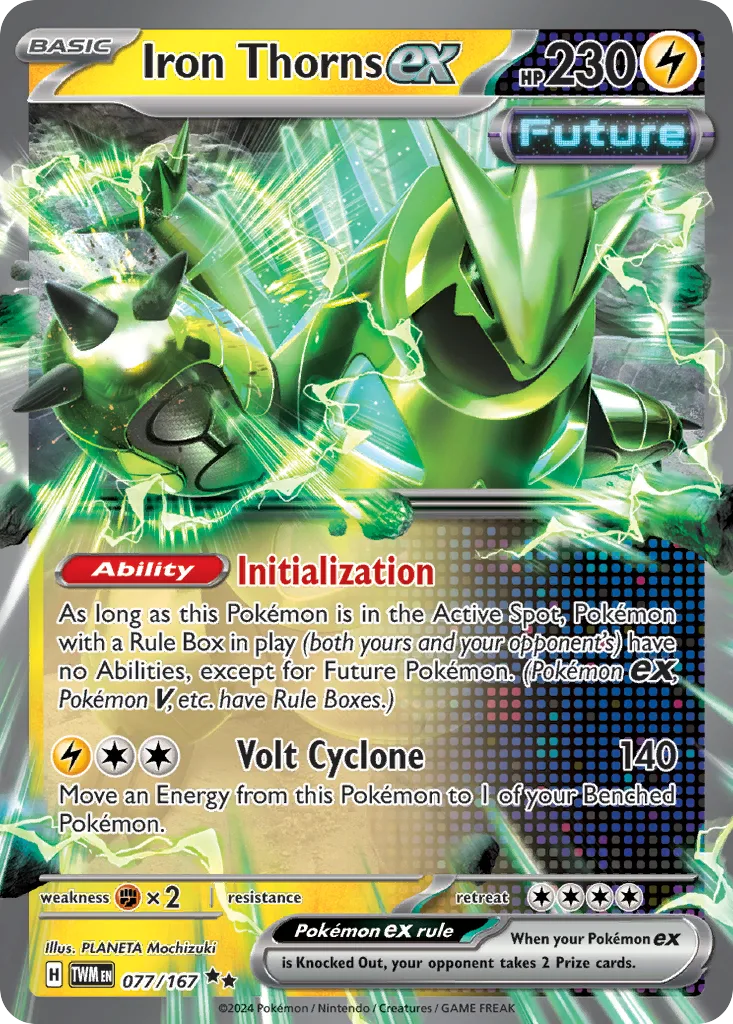
An Ability is not an attack, and almost every rules argument about Abilities comes from someone forgetting that one line. Here is what the 2026 Web Rulebook says about when Abilities fire, where they work from, why a Paralyzed Pokémon still uses them, and what the parenthetical at the end of a damage-reduction Ability is really telling you.
How to Play the Pokémon TCG — Full Rules and Turn Structure (2026)
Two players, 60 cards each, six face-down Prize cards, and a coin flip. That is the whole skeleton of the Pokémon TCG. Here is every rule that actually matters on turn one, from setup through the three ways to win.
Pokémon TCG Evolution Explained: Stages, Rare Candy, Mega
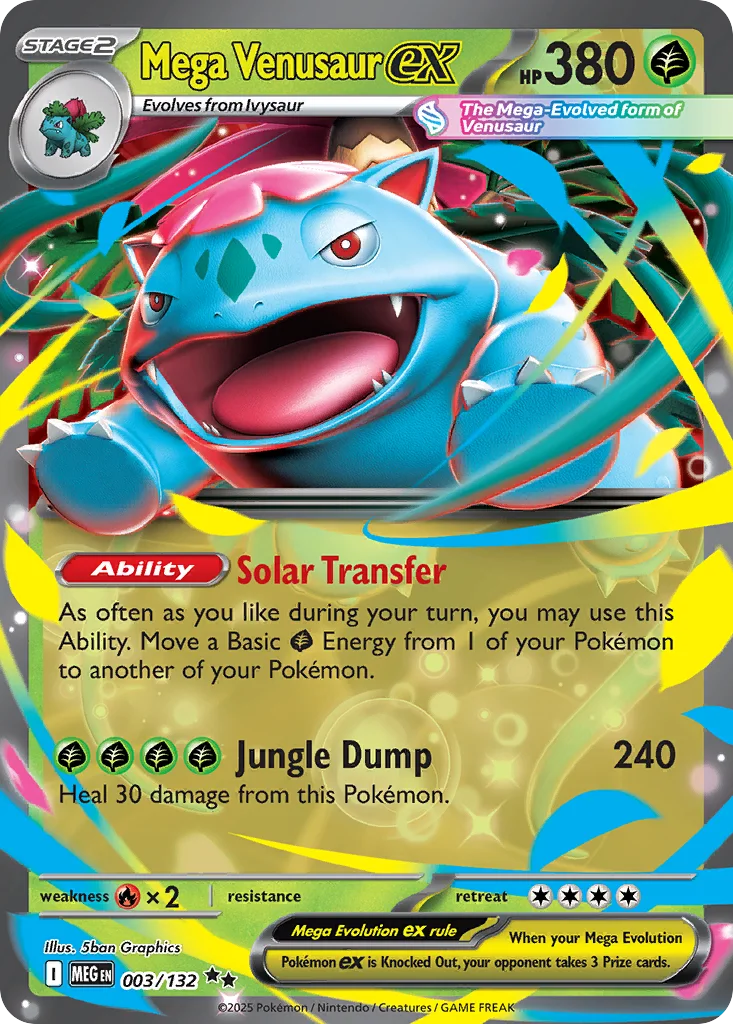
Evolving looks like the simplest action in the Pokémon TCG until you count the restrictions — there are three, plus two more that get treated as restrictions and are not. Here is what the rulebook actually says about stages, timing, and what survives an evolution, plus how the 2025-26 Mega Evolution era quietly rewrote the whole mechanic for the second time.