Pokémon TCG Tournament Rules: Deck Lists, the Clock, and Penalties
The rules that decide your first League Cup are not in the rulebook. They are in three separate Play! Pokémon documents, revised on a quarterly cycle, and they cover sleeve colour, how a die has to be numbered, what happens to your match when the clock hits zero, and the two penalties that exist in the Pokémon TCG and nowhere else in the program.
The TCG Tournament Handbook is 27 pages long and not one of them teaches you to play Pokémon. It says so in its own introduction: "This is not a guide on how to learn to play the Pokémon TCG. This handbook is specifically about legalities, game management, tournament policies, and formats."
That is the gap between knowing the game and being ready for the room. Knowing how to play tells you nothing about the fact that your sleeves have a colour rule, that a Japanese card counts as marked, that the clock keeps running for fifteen minutes after it hits zero, or that arriving eleven minutes late removes you from the event rather than just costing you a game. Everything below comes out of the three Play! Pokémon documents that govern a sanctioned event, all three last revised on 21 May 2026.
Three documents run the room, and none of them is about the game
The rules you play by and the rules you compete under live in different files, and they are not the same length or the same authority.
| Document | Length | What it governs |
|---|---|---|
| Play! Pokémon Tournament Rules Handbook | 49 pages | Program-wide: age divisions, round counts, pairings, standings, drops, byes |
| TCG Tournament Handbook | 27 pages | Card and deck legality, formats, play-area management, match and turn definitions |
| Play! Pokémon Penalty Guidelines | 37 pages | Infractions, severities, and the penalty attached to each |
The ordering matters when they disagree. Both handbooks carry a short penalty summary, and both say the same thing about it: the Penalty Guidelines supersede whatever the summary says. That is not a hypothetical. The TCG handbook describes the Double Prize Card penalty as "a competitor needs to take two less Prize cards to win their game," which leaves out who. The Penalty Guidelines spell it out — it is the offending competitor's opponent who needs two fewer. Read the shorter document and you can get that exactly backwards.
All three are reviewed quarterly. The current issue is dated 21 May 2026; the one before it was 7 April 2026. If you are quoting a policy you read last season, check the date on the file first.
Card legality is decided per printing, not per set
The 2026 rotation took effect for in-person play on 10 April 2026, and on 26 March 2026 for Pokémon TCG Live. Cards with the G regulation mark left Standard; H, I and J stayed. The announcement is blunt about where legality lives: "A card's legality status is not based on which expansion it's from."
Pulled from the Pokémon TCG API today, 2,947 printings carry a Standard-legal regulation mark — 1,302 with H, 1,226 with I, and 419 with J. Which expansions those marks actually map onto is laid out in our breakdown of the post-rotation set landscape.
Then there is the rule that saves your old binder. Section 4.1.3 of the TCG handbook: any version of a card may be played if the name is identical to the current legal printing and all printed text is functionally identical. One of the rotation announcement's own worked examples is Boss's Orders from Sword & Shield—Rebel Clash, which carries a D mark that rotated out years ago, and is still playable because the Mega Evolution printing carries an I.
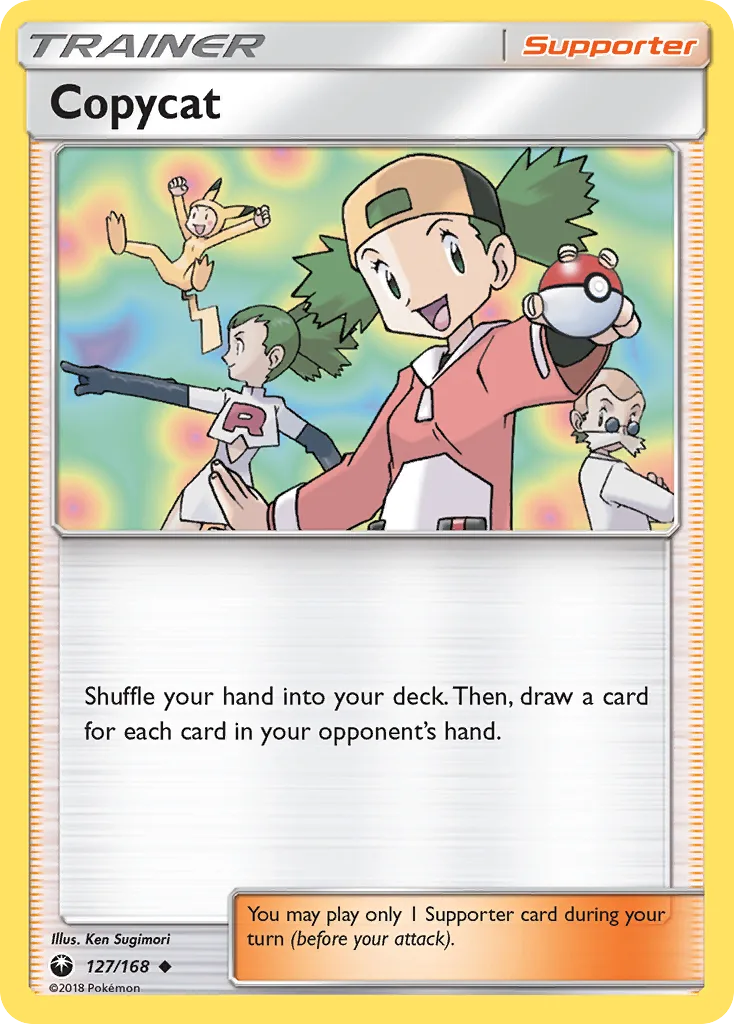
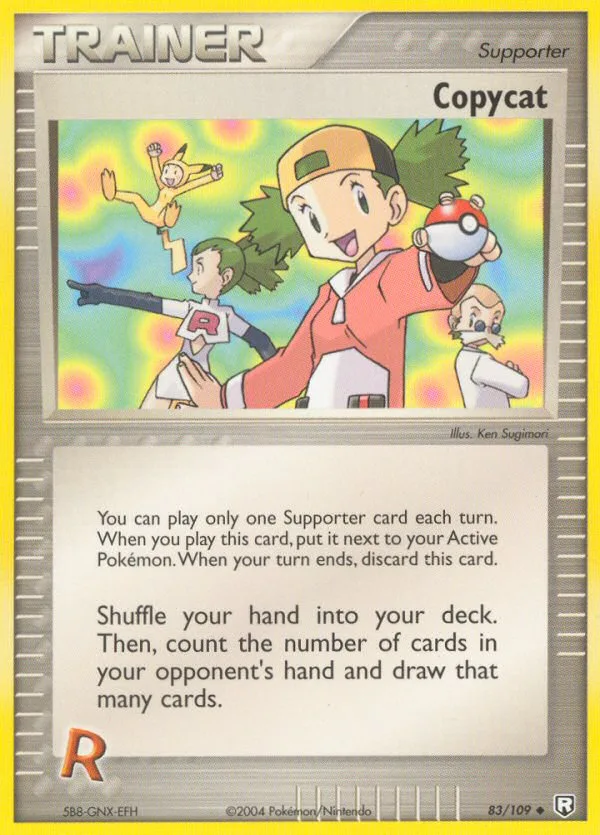
The handbook picks two cards to draw the line, and live card text backs both up. Copycat from Celestial Storm reads "Shuffle your hand into your deck. Then, draw a card for each card in your opponent's hand." Copycat from Team Rocket Returns, printed in 2004, reads "Shuffle your hand into your deck. Then, count the number of cards in your opponent's hand and draw that many cards." Different words, same effect. Functionally identical.
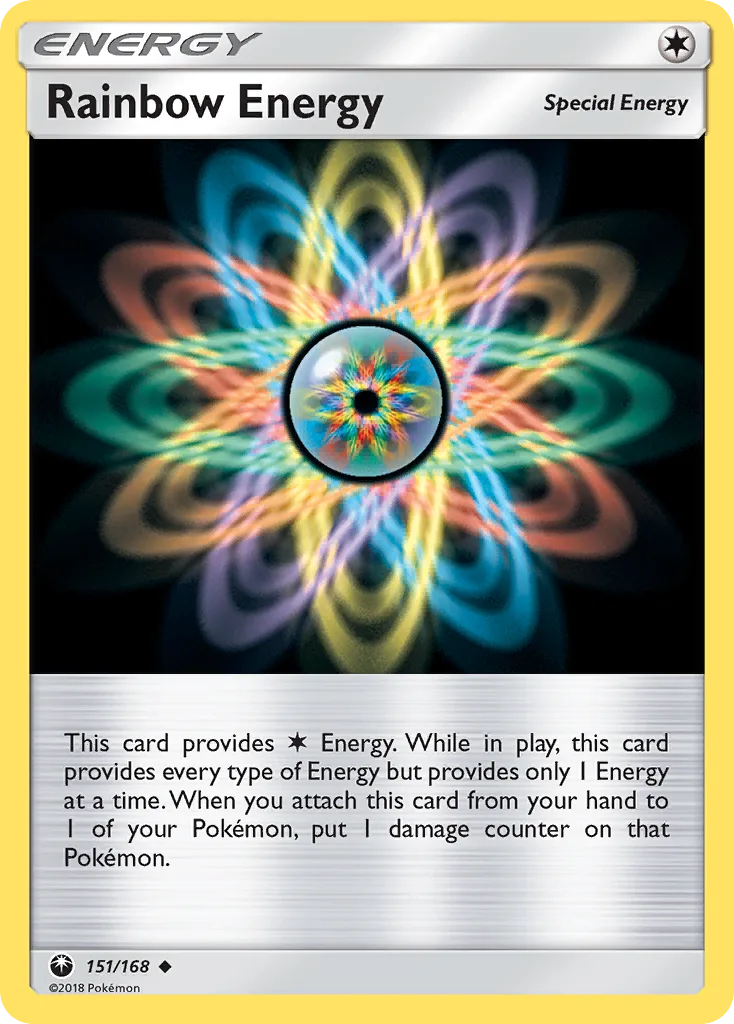
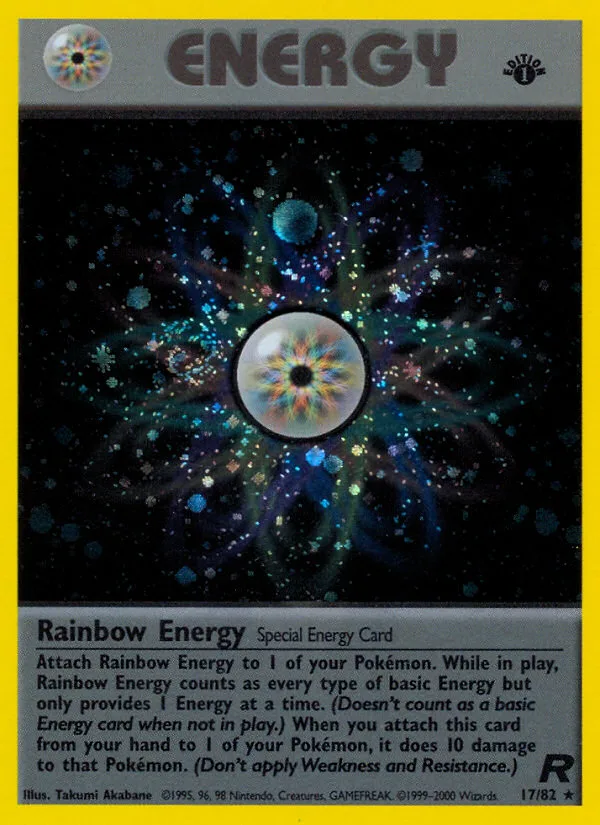
Rainbow Energy is the counter-example, and it is a good one because the two cards look interchangeable. The Celestial Storm printing says to "put 1 damage counter on that Pokémon" when you attach it. The original Team Rocket printing, which landed in English in April 2000, says it "does 10 damage to that Pokémon." The handbook's ruling: not functionally identical, because damage counters and damage are separate mechanics in this game and cannot be swapped for each other.
Do not settle this with the API. The Pokémon TCG API exposes a legalities field and it is not maintained against the current format. Every G-mark card I sampled from Scarlet & Violet still reports standard: Legal four months after G rotated, and the 2004 Team Rocket Returns Copycat above is reported as standard: Legal too. The field is also internally inconsistent — the Celestial Storm Rainbow Energy is correctly excluded from Standard in the same dataset. Ride the regulation mark printed on the card and the reprint rule, not a database field.
One timing rule to hold onto: new cards become legal on the second Friday following the US market release date, against a release cadence the handbook describes as averaging six expansions a year.
And Standard is not the whole board. Play! Pokémon sanctions three Constructed formats — Standard, Expanded and Unlimited — plus three Limited formats. Constructed is the 60-card, four-copy, six-Prize game covered in deck building basics. Limited is a different game: 40 cards, no copy limit, and matches played for four Prizes.
Your sleeves are part of your deck
This is the section with the least to do with card knowledge, and it is checked as closely as anything else. To be legal, every sleeve in your deck must:
- enclose a single card in its entirety
- match the others in colour/design, condition, size and texture
- have every edge in a single solid colour — artwork must not run to the sleeve edge
- be either a plain solid colour or an officially licensed Pokémon design
- not be reflective enough to read a card face off the surface
That fourth bullet has a trap printed directly under it: officially licensed Pokémon designs that do not have a single solid colour border are not allowed. A licensed sleeve is not automatically a legal sleeve. Inner sleeves and over-sleeves are fine as long as the criteria still hold and your opponent can still shuffle the deck without help.
Marked is defined by outcome, not intent: a card is marked "if some aspect of the card makes it possible to identify it without seeing its face." Scratches, tears, discolouration, bends. Two consequences follow that are easy to miss:
- Japanese cards are marked by definition. The backs differ from every other Pokémon card, so they cannot go in a deck at an English-language event. Mixed-language decks are otherwise fine, provided the backs are consistent.
- Autographs and alters kill the card. Post-production alteration is disallowed outright. Official TPCi stamps — League promos, Staff cards — are the carve-out, because they were applied by the publisher.
Play! Pokémon "strongly recommends" opaque-backed sleeves and warns that clear sleeves, or no sleeves, expose imperfections on the card back and can get the card ruled marked.
If a card gets damaged during the tournament, a Judge can issue a proxy that stands in for it for the rest of the event, and you keep the damaged original as the reference. The handbook calls that "the only situation in which a 'non-genuine' Pokémon card may be used during tournament play." Anything else claiming to be a proxy is treated as a counterfeit.
Language legality is set by rating zone — English in the US, Canada and Oceania, six languages across Europe — and at Regionals and above you may always add anything legal in your home country. Interpretation staff are only guaranteed at Worlds.
The deck list beats the deck
Deck lists are required at every Championship Series event, which includes League Challenges and League Cups, not just the big ones. Deck checks are mandatory and the program expects at least 10 percent of decks to be checked, at any point from registration through the final round.
A check verifies four things: the list is complete and legible, the deck is format-legal, the contents match the list exactly, and nothing in the deck or sleeves reads as marked.
The rule that decides the argument: the deck list takes priority over the physical deck. Any discrepancy is fixed by changing your cards, never your list. If your list comes in under 60 cards, or has entries that cannot be identified, staff make it legal by adding Basic Energy of your choice — and then your physical deck gets edited to match that. A sloppy list does not get you a re-do; it gets you Basic Energy.
Where the severity lands:
| Severity | Starting penalty | Handbook example |
|---|---|---|
| Minor | Warning | Four Clodsire with no collector number listed, but only one Clodsire exists in that set |
| Minor | Warning | Ordinary sleeve wear producing scratches spread across the whole deck |
| Major | Game Loss | Deck or list is not 60 cards |
| Major | Game Loss | List says two Ultra Ball and three Max Elixir; deck has three and two |
| Major | Game Loss | Special Energy sleeves slightly longer than the rest of the deck |
| Severe | Disqualification | Clear indicators that key cards were marked intentionally |
Note where the line falls. Transposing the counts of two cards is a Game Loss, not a warning, because the ambiguity creates room for advantage. Being flagged for marked cards more than once in an event escalates to disqualification.
Open deck lists can be used at Regionals and above, announced at registration. During asymmetrical top cut, Masters players exchange printed lists and read their opponent's while both decks are being randomised — no notes allowed, lists away before either player draws an opening hand, and the whole exchange has to fit inside the three minutes the handbook allots for game start.
The clock: 50 minutes, then three more turns
Championship Series rounds have published minimums:
- Single game: 30 minutes
- Best-of-three: 50 minutes
Best-of-three is strongly recommended at Regionals and above, and it is mandatory for the single-elimination rounds of any Swiss-plus-top-cut event. In best-of-three, the loser of the previous game chooses who goes first in the next one instead of flipping. In top cut, the higher seed makes that choice for game one.
Time being called does not end your game. It starts overtime:
- The round timer counts down to zero.
- At zero, time is called and everyone gets 15 additional minutes to complete three more turns.
- The round ends for everyone when those 15 minutes elapse.
No new timer starts, and overtime is not per-table — it begins simultaneously across the hall. One edge case is spelled out: if time is called during Pokémon Checkup there is no active player, so the next player's turn counts as the first of the +3.
Judges can add time on top of that to cover a ruling, but at Regionals and above time extensions cannot exceed 16 minutes in total for a round, whether that is one long ruling or several short ones.
When time is called, the result is on a table
There is no judgement call here. Once overtime expires, the outcome is looked up.
| Best-of-three, Swiss | Result |
|---|---|
| Time called during game 1 | Tie |
| Between games 1 and 2 | Winner of game 1 wins the match |
| During game 2 | Winner of game 1 wins the match |
| Between games 2 and 3 | Tie |
| During game 3 | Tie |
| Best-of-three, single elimination | Result |
|---|---|
| During game 1 | Fewest Prize cards remaining wins |
| Between games 1 and 2 | Winner of game 1 wins the match |
| During game 2 | Winner of game 1 wins the match |
| Between games 2 and 3 | Winner of a tiebreaker game wins the match |
| During game 3 | Fewest Prize cards remaining wins |
Read the Swiss table again and notice what it does to your game two. If you win game one and time is called at any point during game two, you take the match. If you drop game one, win game two, and time is called anywhere in game three — or even between games two and three — it is a tie. Winning game one is worth more than it looks.
A tiebreaker game, where single elimination demands a winner, is a fresh setup: six Prize cards, a coin flip for turn order, and the winner is the first player to gain a Prize card advantage rather than to take all six. If a tiebreaker is still unresolved after its own +3 turns, that game stays incomplete.
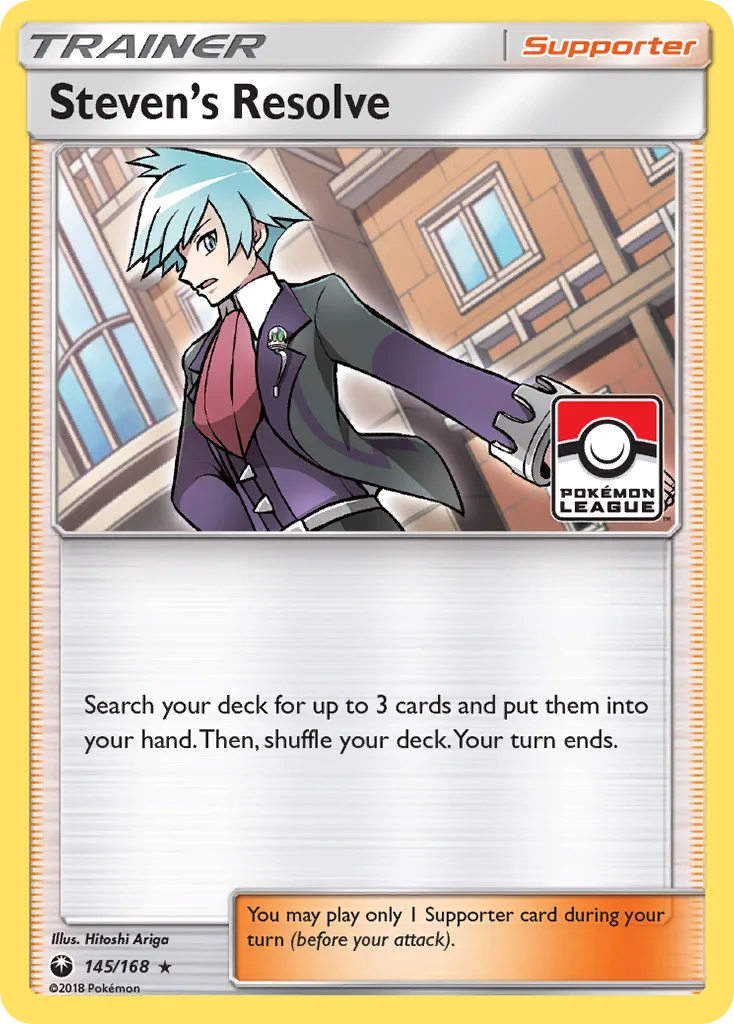
Turn boundaries matter more in overtime than they ever do in a casual game, so the handbook defines them precisely. A turn starts when the active player draws a card into their hand as their first action, and ends when they complete a valid attack, pass, or resolve any effect that says their turn ends immediately — the handbook's cited example is Steven's Resolve.
The tardiness cliff at ten minutes
Tardiness accrues from the moment the round begins, and it is one of the few penalties with hard numeric brackets:
| How late | Penalty |
|---|---|
| Under 5 minutes | Warning |
| 5 to 10 minutes | Game Loss |
| Over 10 minutes | Match Loss, dropped from the event, opponent gets a match win |
That third row is the one to internalise. Past ten minutes you are not just losing the round — you are out of the tournament. You can get back in only if the next round has not been paired yet and you confirm with the Organiser. Once pairings go up, you are done.
There is a second, quieter version of this. The Tardiness Clause is the primary tiebreaker for any match still unresolved when overtime ends: if you were late to that match, or away from it without a Judge's permission at any point in the round, you lose it outright, regardless of the board. Being up five prizes does not save you.
Pace of play is a published stopwatch
Slow play is not judged on vibes. Play! Pokémon publishes suggested times per action:
| Game action | Suggested reasonable time |
|---|---|
| Shuffle and set up at game start | 3 minutes |
| Shuffle and deck search, first of the game | 45 seconds |
| Shuffle and deck search, mid-game | 15 seconds |
| Perform the actions of a card or attack | 15 seconds |
| Consider the position before playing a card | 10 seconds |
| Start your turn after your opponent says "end of turn" | 5 seconds |
These are guidelines, not a shot clock, and a Judge weighs them against how complex the board actually is. But the handbook closes the obvious loophole in one sentence: players who "compartmentalise their turn in order to consistently use every second of the time allowed for these actions" get penalised for stalling. Pace of play starts at a Warning and escalates to a Double Prize Card penalty for sustained problems.
The two penalties labelled Pokemon TCG Only
The full ladder runs Caution, Warning, Double Prize Card, Quadruple Prize Card, Game Loss, Match Loss, Disqualification. The Penalty Guidelines are a single document covering the TCG, VGC, Pokémon GO and UNITE, and the two Prize Card penalties are the only entries on that ladder tagged "(Pokémon TCG Only)" — the Prize race is what makes them possible.
| Penalty | What actually changes |
|---|---|
| Double Prize Card | Your opponent needs 4 Prize cards instead of 6. If they already have 4, they win immediately |
| Quadruple Prize Card | Your opponent needs 2 instead of 6. If they already have 2, they win immediately |
Both leave all six Prize cards physically on the table. Only the target changes.
They exist to fill the gap between "warn them" and "kill the game." A Judge reaches for them when a mistake has genuinely bent the game state and there is no clean way to rewind it, but a Game Loss would be disproportionate. Gameplay errors in the TCG start at Warning for minor, Double Prize Card for major, and Game Loss for severe — with published examples that are worth reading as a list of things not to do:
- Minor: declaring an attack without the Energy attached; failing to set up Prize cards
- Major: drawing an extra card; taking a Prize card without a Knock Out; using an Ability that a card in play was switching off; attaching a second Energy in a turn
- Severe: shuffling your hand, Prizes or discard pile into your deck with no card effect telling you to; packing up your cards before the match slip is signed
Read that last bullet twice. The match is not over when the game is over; it is over when both players agree on the result and sign the slip.
Dice, coins, notes, and the shape of the table
A pile of small rules with no equivalent at the kitchen table, all of them enforceable.
Randomisers. Dice must be transparent or translucent, cube-shaped with well-rounded corners, and numbered so opposite faces sum to 7. Even numbers are heads, odd are tails. Coins get flipped from shoulder height with at least three full rotations, and any flip that leaves the play area is invalid and re-flipped — but once a Judge rules a result conclusive, it stands.
Notes. You may take written notes during a match and refer to them freely. Your note sheet must be completely blank at the start of each match, you may not consult notes from a previous round while the tournament is running, and you may not hand notes to anyone else. Codes, ciphers and abbreviations that obscure meaning are prohibited, because a Judge can demand to read your notes mid-match — and demand a translation if you wrote them in a language the staff do not read. Turn trackers are explicitly not treated as pre-written aids and are legal. Pre-written information — a turn sequence, a type chart, last round's notes, physical or digital — is not. Neither are headphones, unless you are in a video game event with them plugged into your own system.
The table. Prize cards have to be spread out so both players and staff can count them at a glance, and they sit on the opposite side of your play space from your deck and discard pile. One discard pile only. The Lost Zone goes directly above your Prizes. Stadiums go between the two Active Pokémon. Sleeve openings face your opponent.
And the rule that ends "wait, I didn't mean to play that": a card is considered played the moment you physically release it into the play area. If you are not sure, do not let go.
How many rounds you are actually signing up for
Round counts are published as tables keyed to attendance per age division, so a 60-person League Cup that splits across divisions is not a 60-person bracket.
| Event | Attendance in your division | Structure |
|---|---|---|
| League Challenge (Swiss only) | 9–16 | 4 Swiss rounds, no cut |
| League Challenge (Swiss only) | 65–128 | 7 Swiss rounds, no cut |
| League Cup (single day) | 13–20 | 5 Swiss + 2 single-elimination |
| League Cup (single day) | 33–64 | 6 Swiss + 3 single-elimination |
| League Cup (single day) | 410+ | 10 Swiss + 3 single-elimination |
| Regional / International (two-phase) | 257–512 | 8 Swiss, then 16 match points to advance, then 3 more Swiss, then an asymmetrical Top 8 |
An asymmetrical top cut caps at 16 competitors. Match points are the familiar 3 for a win, 1 for a tie, 0 for a loss — a 4/3/1 record is 13 points, and so is 3/1/4.
Age divisions for the 2026 Championship Season are set by birth year: Junior is 2014 or later, Senior is 2010 through 2013 inclusive, Masters is 2009 or earlier. If a division has fewer than six players, it gets merged into an adjacent one for Swiss pairings only — standings and top cut stay separated by division.
Two structural rules round it out: a tournament needs at least three full rounds against valid opponents to count at all, and no player receives more than one bye over an event.
Quick Action Checklist
- Check the regulation mark on the card, not the set, and not a database. H, I and J are Standard. The API's legality field still calls G-mark cards Standard-legal.
- An old printing is legal only if the text is functionally identical. Different wording is fine; different mechanics are not.
- Audit your sleeves the night before. Solid edges, matching condition, opaque backs, and no licensed design that runs colour to the edge.
- Proofread the list, then count the deck against it. The list wins every discrepancy, and a two-card transposition starts at a Game Loss.
- Win game one. In Swiss best-of-three, taking game one means time called during game two hands you the match; time called in game three is a tie either way.
- Be at the table before the round starts. Under five minutes is a Warning, five to ten is a Game Loss, eleven drops you from the event.
- Blank your note sheet between matches, and leave the type chart at home.
- Do not pack up until the slip is signed. Clearing the board early is a severe gameplay error.
Frequently Asked Questions
How long is a round in a Pokémon TCG tournament?
What happens if time is called during a Pokémon TCG match?
What are the sleeve rules at Pokémon TCG tournaments?
Can you play Japanese cards in a Pokémon TCG tournament?
What is a Double Prize Card penalty in the Pokémon TCG?
What happens if my deck does not match my deck list?
How late can you be for a Pokémon TCG match?
What are the Pokémon TCG age divisions for the 2026 season?
Keep Reading
- The Pokémon Company — TCG Tournament Handbook (PDF, revised 21 May 2026): card and deck legality §2–3, Constructed and Limited formats §4–5, gameplay management §6, tournament play and end-of-round process §7, penalties §8
- The Pokémon Company — Play! Pokémon Tournament Rules Handbook (PDF, revised 21 May 2026): age divisions §5.1.3, match points §5.3.2, tournament structures and round tables §5.5.4, round times §5.5.6, byes §5.6.1, drops §5.7
- The Pokémon Company — Play! Pokémon Penalty Guidelines (PDF, revised 21 May 2026): penalty definitions §3, time extensions §4.4, tardiness §5.2, gameplay error §5.5.1, deck legality §5.6.1, pace of play §5.7
- The Pokémon Company — 2026 Pokémon TCG Standard Format Rotation Announcement: G rotated, H/I/J legal, 10 April 2026 in person and 26 March 2026 on Pokémon TCG Live
- Pokémon TCG API — regulation-mark printing counts (H 1,302 / I 1,226 / J 419) and live card text for Copycat, Rainbow Energy and Steven's Resolve
Related Guides
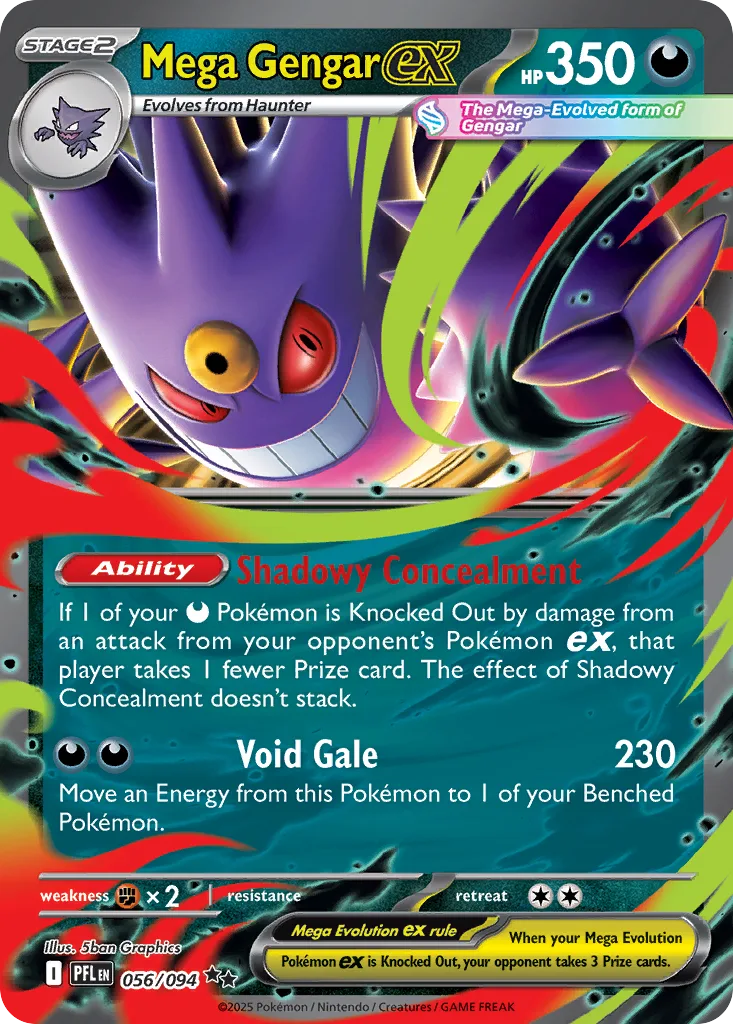
Pokémon TCG Prize Cards Explained: 1, 2, and 3-Prizers
The Prize count is the only score the Pokémon TCG keeps. Here is what each Pokémon actually costs you when it goes down — one, two or three — measured across all 2,947 Standard-legal printings, plus the 44 Standard-legal card names whose text reads the Prize count or changes what a Knock Out pays.
Pokémon TCG Formats Explained: Standard, Expanded, Unlimited
Play! Pokémon sanctions three Constructed formats, and Standard is the one the circuit runs on. Here is what the other two actually are: the Expanded card pool the Tournament Handbook enumerates set by set, the 27-card ban list that trims it, the Unlimited format with no bans at all, and the awkward truth about where you can still sit down and play any of it.
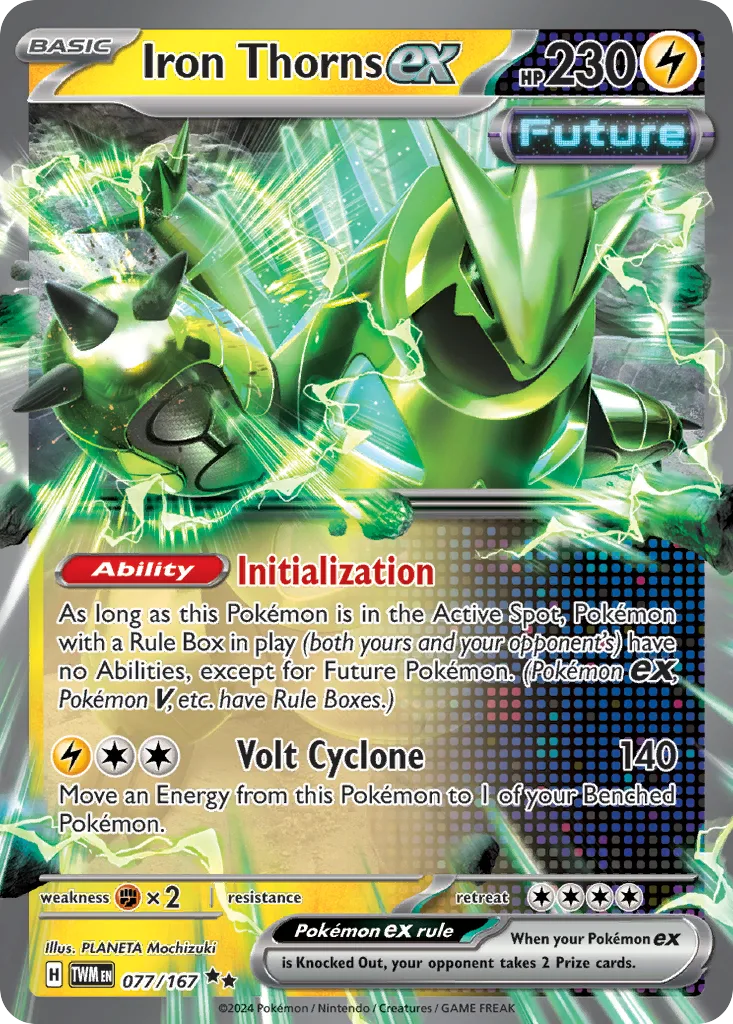
Pokémon TCG Abilities Explained: Triggers, Ability Lock, and Damage Math
An Ability is not an attack, and almost every rules argument about Abilities comes from someone forgetting that one line. Here is what the 2026 Web Rulebook says about when Abilities fire, where they work from, why a Paralyzed Pokémon still uses them, and what the parenthetical at the end of a damage-reduction Ability is really telling you.
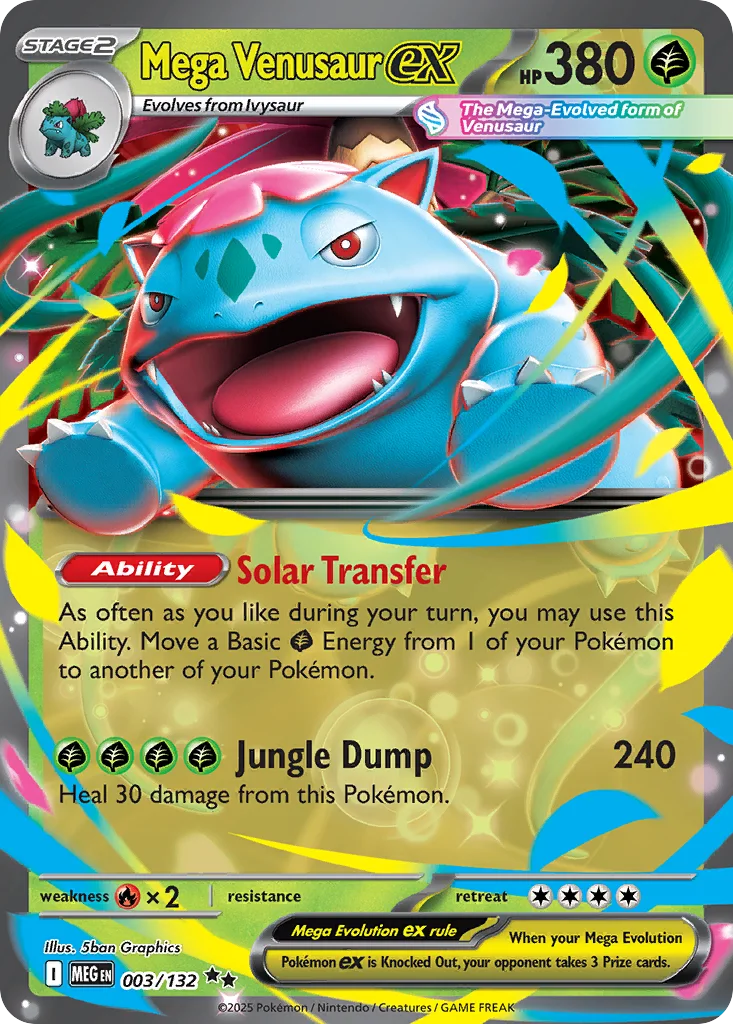
Pokémon TCG Evolution Explained: Stages, Rare Candy, Mega
Evolving looks like the simplest action in the Pokémon TCG until you count the restrictions — there are three, plus two more that get treated as restrictions and are not. Here is what the rulebook actually says about stages, timing, and what survives an evolution, plus how the 2025-26 Mega Evolution era quietly rewrote the whole mechanic for the second time.
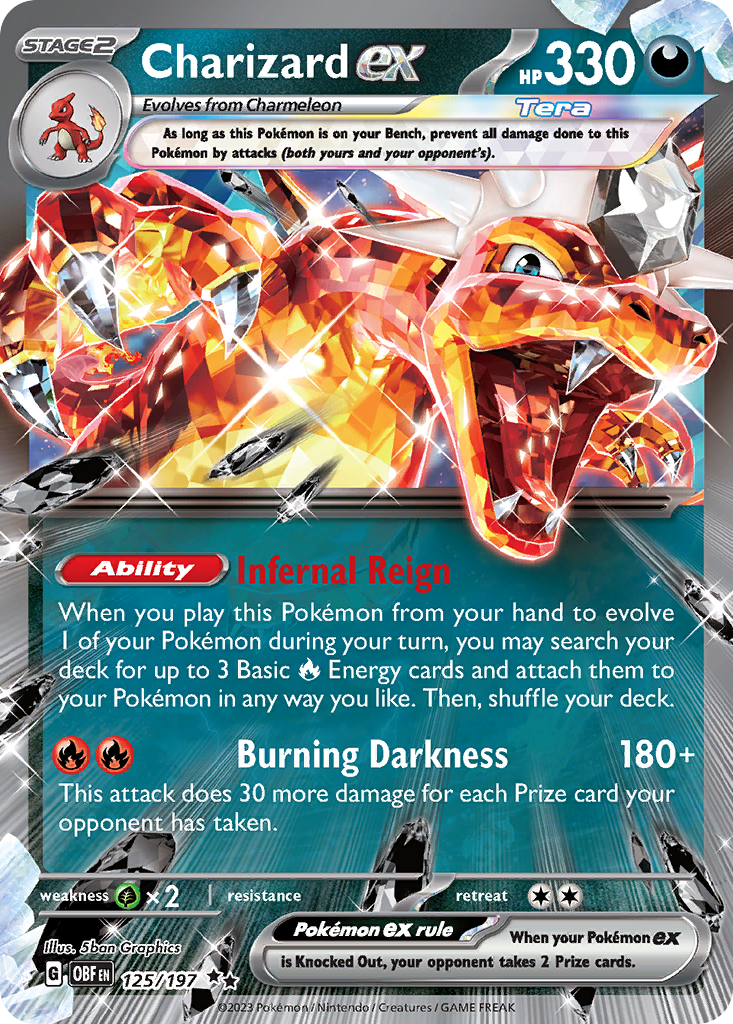
How to Play the Pokémon TCG — Full Rules and Turn Structure (2026)
Two players, 60 cards each, six face-down Prize cards, and a coin flip. That is the whole skeleton of the Pokémon TCG. Here is every rule that actually matters on turn one, from setup through the three ways to win.
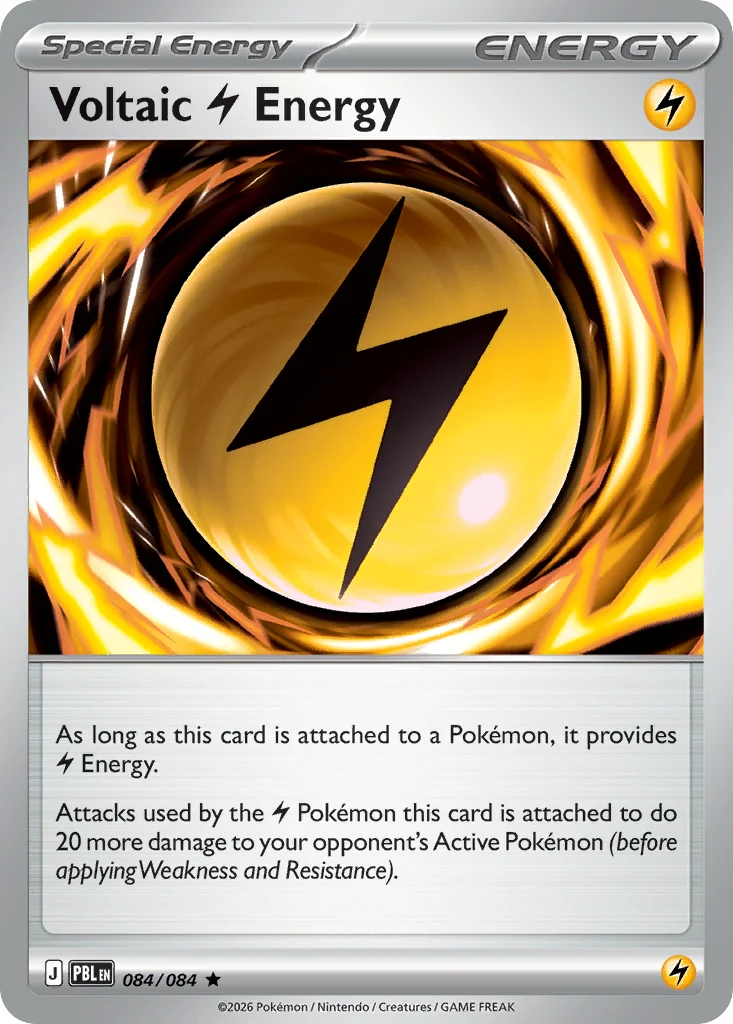
Pokémon TCG Energy Explained: Basic vs Special, Attack Costs, and the One-Per-Turn Rule
Attacking never spends your Energy. Retreating does. There are exactly nine basic Energy cards in the game's history and two Pokemon types that never got one. Here is how Energy actually works, straight from the rulebook and the card database — attack costs, the one-per-turn attachment rule, every legal way around it, and why Special Energy is a target painted on your attacker.