Pokémon TCG Prize Cards Explained: 1, 2, and 3-Prizers
The Prize count is the only score the Pokémon TCG keeps. Here is what each Pokémon actually costs you when it goes down — one, two or three — measured across all 2,947 Standard-legal printings, plus the 44 Standard-legal card names whose text reads the Prize count or changes what a Knock Out pays.
There is no life total in the Pokémon TCG. There is a stack of six face-down cards set off to the side, and the whole game is a race to move them into your hand. That makes the Prize count the only running score — and it is also a variable card text can read.
I pulled every regulation-mark H, I and J printing out of the Pokémon TCG API on 2 September 2026 — 2,947 cards, the whole Standard-legal pool — and searched for the words "Prize card" outside the two rule boxes. 44 card names came back. Twenty-eight of them read the count — eleven scale off it continuously, seventeen use it as an on/off switch. Ten change how many Prizes a Knock Out is worth. Two take a Prize with no Knock Out at all, four reach into the Prize pile itself, and one skips the last Prize entirely. (Briar does two jobs, which is why those numbers total 45 rather than 44.)
Which means "how many Prizes is that worth?" is not a beginner question. It is the question.
Six cards, four in Limited, and nothing else is the score
The 2026 Web Rulebook sets it up on page 8, step seven: "Put the top 6 cards of your deck off to the side face down as your Prize cards." Step one of How to Win is "Take all of your Prize cards."
Play! Pokémon's TCG Tournament Handbook (last revised 1 September 2026) attaches the number to the format rather than the game. Section 4, Constructed: "Matches are played for 6 Prize cards." Section 5, Limited: "Matches are played for 4 Prize cards." Same rules, two-thirds of the runway — which is the whole reason a Prerelease plays like a different game.
The handbook also makes the count public property. Section 6.3.1 lists "the number of Prize cards a competitor has remaining" as Public Information, alongside hand size and damage counters. You may ask at any point, and refusing to answer is a Judge call.
One, two or three: what a Pokemon costs you
Default is one. Two rule boxes override it, and both are printed on the card in plain English.
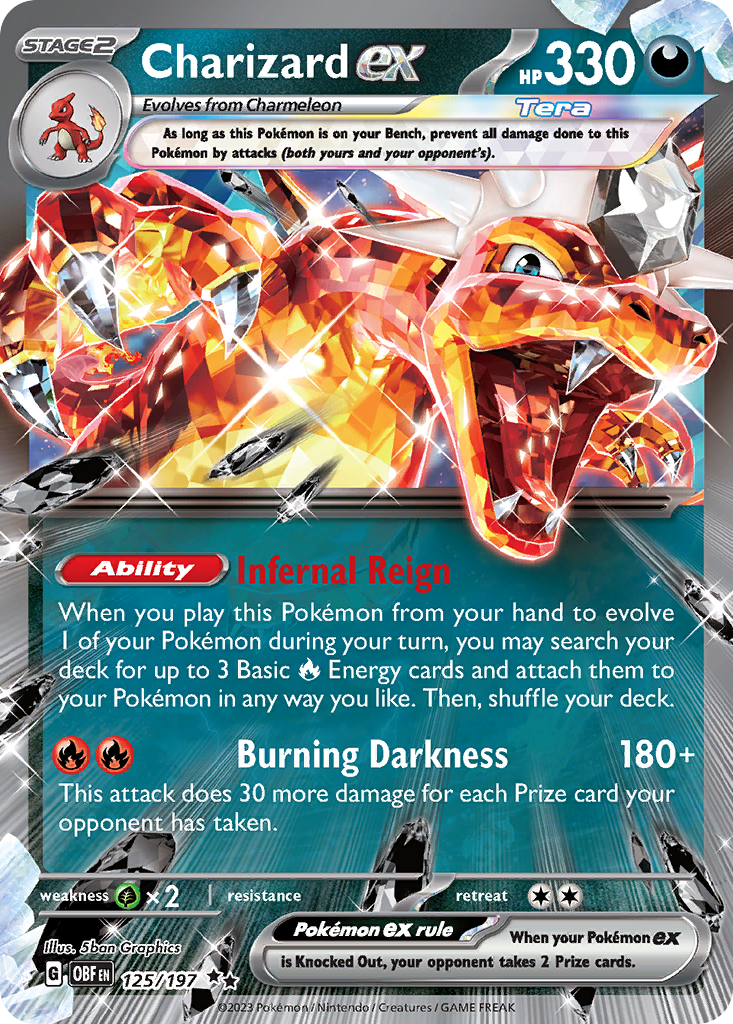
- Pokémon ex rule: "When your Pokémon ex is Knocked Out, your opponent takes 2 Prize cards."
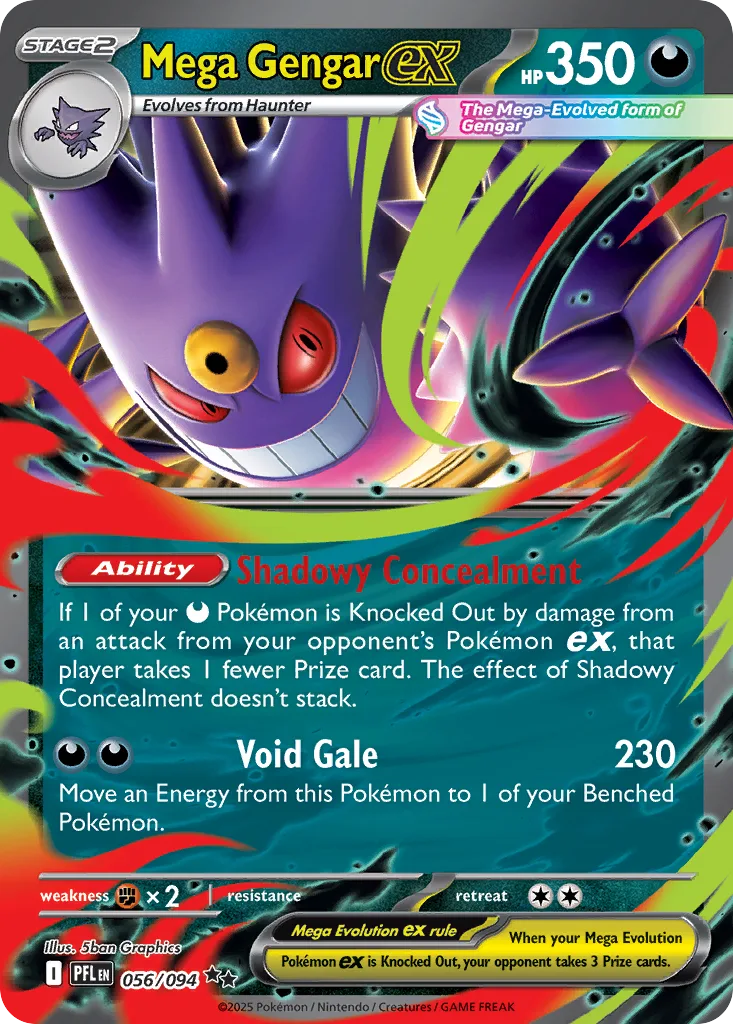
- Mega Evolution ex Rule: "When your Mega Evolution Pokémon ex is Knocked Out, your opponent takes 3 Prize cards."
Here is the whole Standard-legal pool, split by liability. Counts are Pokémon printings carrying regulation marks H, I and J — 2,481 Pokémon printings inside the 2,947 Standard-legal cards in the Pokémon TCG API, counted 2 September 2026.
| Prize liability | Printings | Unique card names | HP range | Median HP |
|---|---|---|---|---|
| 1 Prize (everything else) | 1,946 | 945 | 30–240 | 100 |
| 2 Prizes (Pokémon ex) | 421 | 154 | 160–380 | 240 |
| 3 Prizes (Mega Evolution Pokémon ex) | 114 | 41 | 250–380 | 330 |
A third of your game sits on 154 card names. Half of it sits on 41.
The rulebook closes the obvious loophole in Appendix 1 on page 23: "Mega Evolution Pokémon ex are considered to be Pokémon ex, so any card effects that affect Pokémon ex also affect Mega Evolution Pokémon ex." They are not a separate category that dodges anti-ex tech. They are Pokémon ex that cost one extra Prize. The evolution guide covers how they get into play; this is what happens when they leave it.
The HP you buy per Prize
Divide the median HP of each tier by what it hands over and the curve does something you would not guess from the HP numbers alone.
| Tier | Median HP | Prizes | Median HP per Prize |
|---|---|---|---|
| 1 Prize | 100 | 1 | 100 |
| 2 Prizes | 240 | 2 | 120 |
| 3 Prizes | 330 | 3 | 110 |
The two-Prize tier is the efficient one. The three-Prize tier has the highest floor in the format — nothing below 250 HP, on Mega Floette ex and Mega Hawlucha ex — and tops out at 380 on Mega Venusaur ex and Mega Emboar ex, a number matched among two-Prizers only by Wailord ex. But on the median it buys you less durability per Prize than an ordinary Pokémon ex does. You are paying the third Prize for the attack line and the ceiling, not for the HP. Weigh that in deck building before you run three of them.
The Prize goes to the owner's opponent, not the attacker
The rulebook's wording on page 14 is pointedly not "the attacker takes a Prize":
If a player's Pokémon is Knocked Out, that player puts it and all cards attached to it in the discard pile. That player's opponent takes 1 of their own Prize cards and puts it into their hand.
The award is tied to whose Pokémon died, not to who caused it. So when Zekrom ex uses Voltage Burst — "This Pokémon also does 30 damage to itself" — and finishes itself off, your opponent takes two Prizes for it. Same for a Kingambit that swings Double-Edged Slash for 180 and takes 50 back.
The same logic runs through Pokémon Checkup. Page 15: "any Pokémon that has no HP remaining is Knocked Out. (The player moves a new Pokémon into the Active Spot, and the opponent takes a Prize card.)" A Pokémon that dies to Poison damage between turns pays out exactly like one that dies to an attack. Our Special Conditions guide has the Checkup order in full.
Five cards that make a Knock Out pay less
Searching every rule, attack and Ability line across the 2,947 Standard-legal printings turns up exactly five effects that reduce what your Pokémon is worth when it goes down.
| Card | Set | Reduction | Condition |
|---|---|---|---|
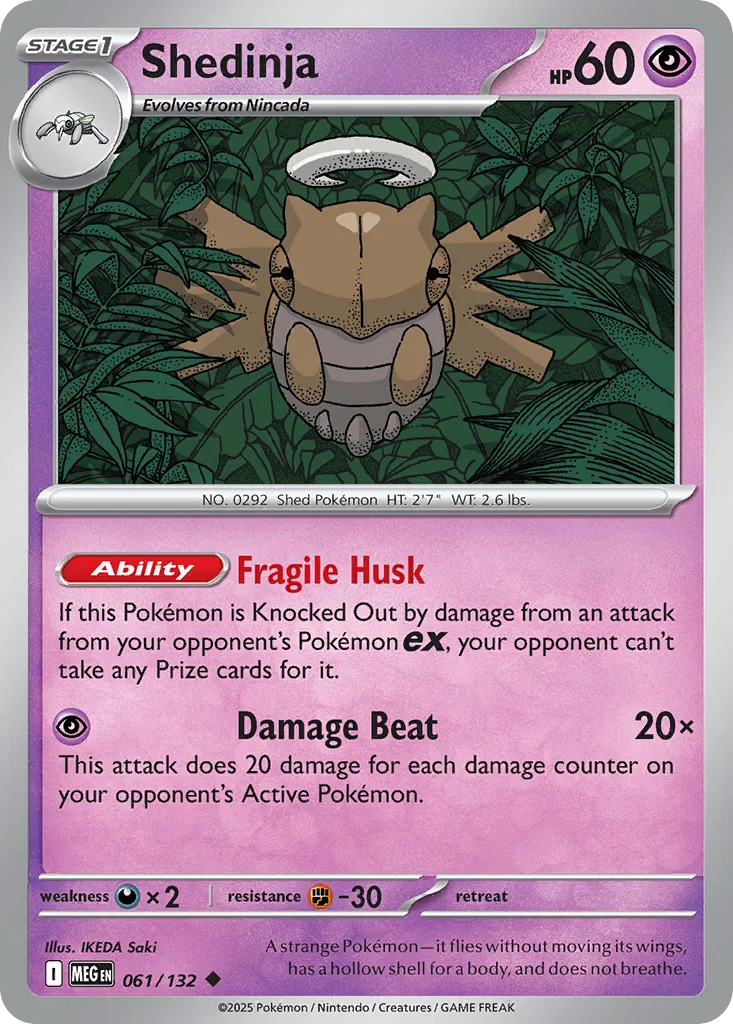
| Shedinja (Fragile Husk) | Mega Evolution 61/132 | To zero | Only if Knocked Out by damage from an attack from your opponent's Pokémon ex |
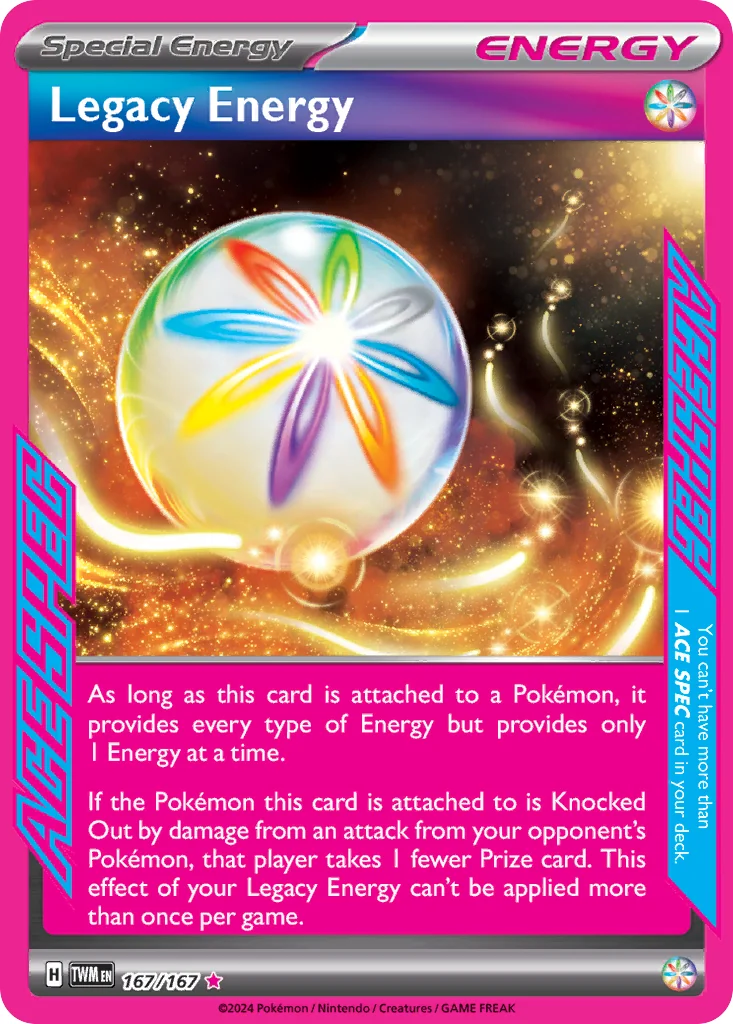
| Legacy Energy | Twilight Masquerade 167/167 | 1 fewer | ACE SPEC; once per game, and only against an attack |
| Lillie's Pearl | Journey Together 151/159 | 1 fewer | Pokémon Tool, attached to a Lillie's Pokémon |
| Munkidori ex (Oh No You Don't) | Shrouded Fable 37/64 | 1 fewer | You must have a Pecharunt ex in play |
| Mega Gengar ex (Shadowy Concealment) | Phantasmal Flames 56/94 | 1 fewer | Your Darkness Pokémon, Knocked Out by an opponent's Pokémon ex; does not stack |
Shedinja is the outlier and the only one of the five that zeroes the award outright: 60 HP, one Prize on paper, and nothing at all if the thing that killed it was a Pokémon ex. Against a board built on Pokémon ex, it is a 60 HP Stage 1 that pays nothing for its own Knock Out — and note the qualifier: the attack has to come from a Pokémon ex for the Ability to apply at all.
Every one of the five carries a qualifier worth reading twice, and they share the biggest one: all five say "Knocked Out by damage from an attack," so damage placed by an Ability or a Trainer card slips past every one of them. Legacy Energy adds a second lock on top — "This effect of your Legacy Energy can't be applied more than once per game" — and as an ACE SPEC it competes for the single ACE SPEC slot the whole deck is allowed, which the Trainer card guide covers.
Seven that hand out extra Prizes
The same sweep finds seven going the other way — five that inflate a Knock Out, and two that take a Prize with no Knock Out at all.
| Card | Set | Extra Prizes | Trigger |
|---|---|---|---|
| Anthea & Concordia | Ascended Heroes 182/217 | +3 | Supporter; needs N's Darmanitan, N's Zoroark ex, N's Vanilluxe, N's Klinklang, N's Reshiram and N's Zekrom all in play, and the Knock Out must come from an N's Pokémon's attack |
| Ribombee (Plentiful Pollen) | Temporal Forces 76/162 | +2 | The Defending Pokémon must be Knocked Out during your next turn |
| Togekiss (Wonder Kiss) | Surging Sparks 72/191 | +1 | Coin flip on each Knock Out of the opponent's Active; does not stack |
| Hydreigon ex (Greedy Eater) | White Flare 67/86 | +1 | Only when the Pokémon Knocked Out is a Basic, by this Pokémon's attack |
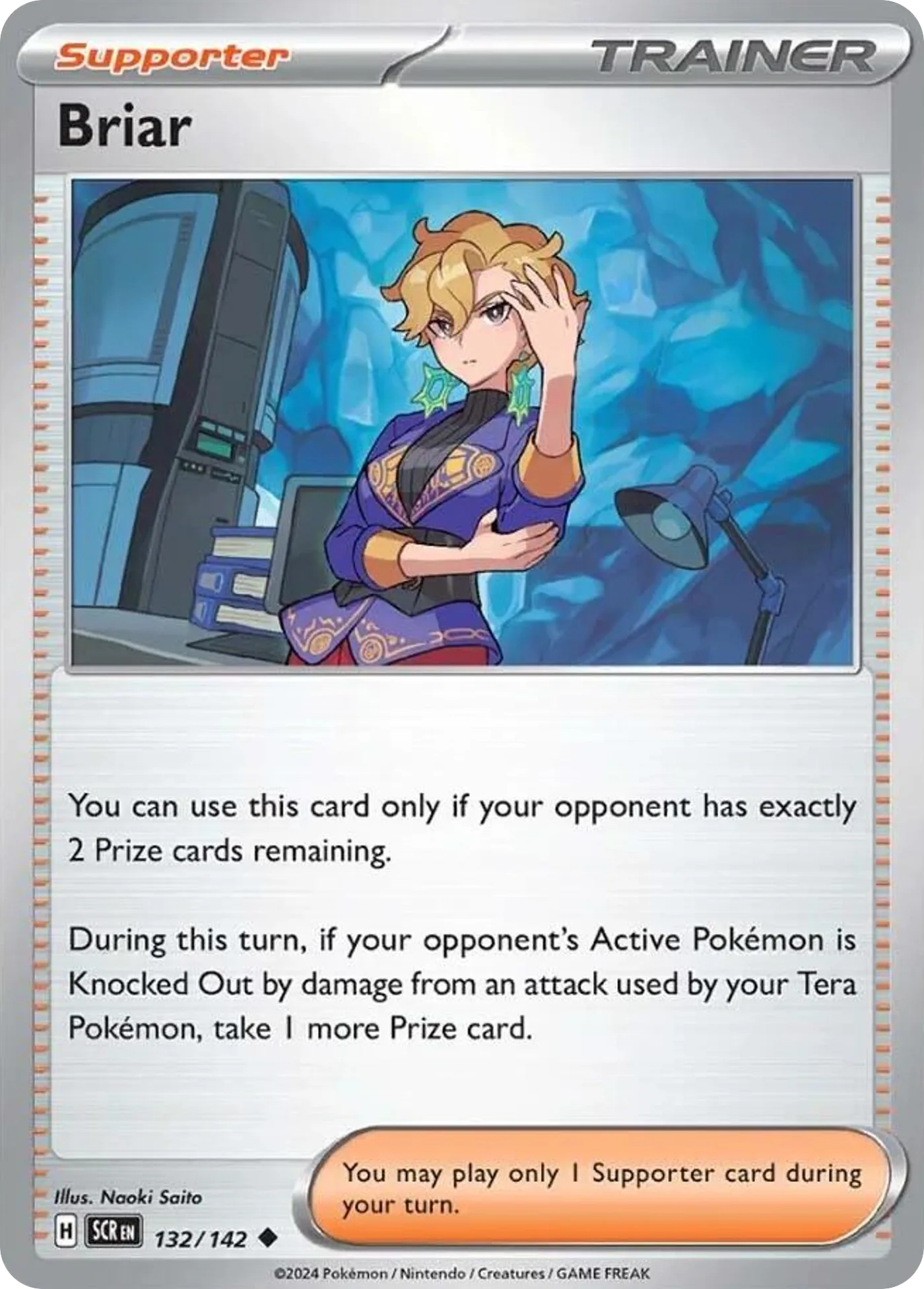
| Briar | Stellar Crown 132/142 | +1 | Opponent must have exactly 2 Prizes remaining, and a Tera Pokémon must land the Knock Out |
| Umbreon ex (Onyx) | Prismatic Evolutions 60/131 | Takes 1 | An attack, not a bonus — discard all Energy from this Pokémon and take a Prize card |
| Lt. Surge's Bargain | Mega Evolution 120/132 | Takes 1 each | Ask your opponent if each player may take a Prize; if they say no, you draw 4 cards instead |
Briar is the cleanest illustration of why Prize thresholds matter more than Prize totals. It only turns on when the opponent is sitting on exactly two, and it converts a two-Prize Tera Knock Out into three — half a Constructed game in one attack. Two, and only two.
Lt. Surge's Bargain is stranger still: a Supporter whose entire text is a question put to the opponent. Yes and both players advance a Prize; no and you draw four cards. It is the only one of the 44 that hands the decision to the other side of the table.
Eleven cards that read the scoreboard
Because a Prize count is a number both players can see, card text can scale off it. Eleven of the twenty-eight do it continuously — a bigger number for every Prize on the board — and they split cleanly into "I am losing" and "I am winning." (The other seventeen are the on/off cards in the next section.)
The ceiling on all of these is five, not six: taking a sixth Prize ends the game, so the largest count your opponent can be sitting on while you are still attacking is five. (In Limited, it is three.)
| Card | Attack or Ability | Printed | Per Prize | At the ceiling |
|---|---|---|---|---|
| Reshiram ex | Blazing Burst | 130+ | +50 per Prize your opponent has taken | 380 |
| Zekrom ex | Voltage Burst | 130+ | +50 per Prize your opponent has taken | 380 |
| Pecharunt ex | Irritated Outburst | 60× | 60 per Prize your opponent has taken | 300 |
| Durant ex | Vengeful Crush | 120+ | +30 per Prize your opponent has taken | 270 |
| Kingambit | Supreme Overlord (Ability) | 180 base attack | +30 per Prize your opponent has taken | 330 |
| Kyurem ex | Blizzard Burst | 130 | +10 to each Benched Pokémon per Prize | 130, plus 50 to each Benched |
| Brambleghast | Resilient Soul (Ability) | 100 HP | +50 HP per Prize your opponent has taken | 350 HP |
| Bloodmoon Ursaluna ex | Seasoned Skill (Ability) | Blood Moon costs 5 Colorless | 1 Colorless cheaper per Prize | Free at five |
| Mega Mawile ex | Gobble Down | 80× | 80 per Prize you have taken | 400 |
| Luxray | Incessant Onslaught | 70× | 70 per Prize you have taken | 350 |
| Okidogi | Settle the Score | 80+ | +60 per Prize your opponent took during their last turn | 260 if they took three |
Two directions, two different jobs. Eight of the eleven count Prizes your opponent has taken, so they pay you for being behind — Reshiram ex and Zekrom ex both top out at 380, which is exactly the HP of the biggest Mega Evolution ex in the format. Two of them, Mega Mawile ex and Luxray, count Prizes you have taken and pay you for being ahead, which makes them closers rather than comeback cards.
The eleventh, Okidogi, is the only one of them that reads a swing rather than a total: it counts what the opponent took on their last turn specifically, so it rewards giving up a three-Prize Mega and taking the board back immediately. And Kingambit's Ability carries the parenthetical that decides where in the damage sequence the bonus lands — "before applying Weakness and Resistance" — which is worth double against ×2 Weakness, for the reasons laid out in the Abilities guide.
The thresholds that flip a card on and off
The other seventeen do not scale. They check the count once and either work or do not, which is what makes them change character in Limited: at four Prizes, "3 or fewer" is true after a single Knock Out.
| Card | Condition | Effect |
|---|---|---|
| Steelix (Welcoming Tail) | You have exactly 6 Prizes remaining | 40 becomes 240 |
| Lillie's Determination | You have exactly 6 Prizes remaining | Draw 8 instead of 6 |
| Gouging Fire (Blazing Charge) | Opponent has 4 or fewer | 100 becomes 170 |
| Zacian (Limit Break) | Opponent has 3 or fewer | 50 becomes 140 |
| Lacey | Opponent has 3 or fewer | Draw 8 instead of 4 |
| Emcee's Hype | Opponent has 3 or fewer | Draw 4 instead of 2 |
| Special Red Card | Opponent has 3 or fewer | Opponent shuffles their hand to the bottom and draws 3 |
| Hop's Cramorant (Fickle Spitting) | Opponent has exactly 3 or 4 | 120, or the attack does nothing at all |
| Carbink (Counter Jewel) | Opponent has 2 or fewer | 70 becomes 170 |
| Acerola's Mischief | Opponent has 2 or fewer | Locks one of your Pokémon out of damage and effects from Pokémon ex for a turn |
| Briar | Opponent has exactly 2 | +1 Prize on a Tera Knock Out |
| Palafin (Knuckle Justice) | Opponent has exactly 1 | 80 becomes 280 |
| Togedemaru (Electrifying Chance) | You have exactly 1 remaining | Also Paralyzes the opponent's Active |
| Counter Gain | You have more remaining than your opponent | Attacks cost 1 Colorless less |
| Hawlucha (Prize Count) | You have more remaining than your opponent | 50 becomes 140 |
| Tapu Koko (Prize Count) | You have more remaining than your opponent | 90 becomes 180 |
| Rosa's Encouragement | You have more remaining than your opponent | Attach up to 2 Basic Energy from the discard to a Stage 2 |
Steelix and Lillie's Determination are the two "exactly 6" cards, which is a polite way of saying they work before anything has happened and are dead the moment a single Prize is taken.
Your Prizes are not in play — and four cards that reach them anyway
The rulebook glossary is explicit on page 42: "Your deck, your discard pile, and your Prize cards are not in play, but your Benched Pokémon are." Anything that says in play cannot see the Prize pile. Four cards get at it by name instead.
| Card | Set | What it does to the pile |
|---|---|---|
| Team Rocket's Blipbug (Searching Eyes) | Destined Rivals 15/182 | Look at 1 of your opponent's face-down Prize cards |
| Team Rocket's Bother-Bot | Destined Rivals 172/182 | Turn 1 of the opponent's Prizes face up, then optionally swap it with a random card from their hand — that Prize stays face up for the game |
| Cresselia (Crescent Purge) | Shrouded Fable 21/64 | Turn 1 of your own Prizes face up for +80 damage, permanently revealed |
| Redeemable Ticket | Journey Together 156/159 | Count your Prizes, shuffle them into the bottom of your deck, and set the same number of fresh ones from the top |
Redeemable Ticket is the reset button for the situation any deck can run into: the card you need is sitting in the Prize pile and no amount of drawing will find it. It does not tell you what you Prized. It just re-rolls.
The one card that skips the last Prize
Of the 2,947 Standard-legal printings, exactly one wins the game with card text rather than a Knock Out. N's Sigilyph, Journey Together 64/159, a 110 HP Basic at Common rarity: "Victory Symbol — If you use this attack when you have exactly 1 Prize card remaining, you win this game."
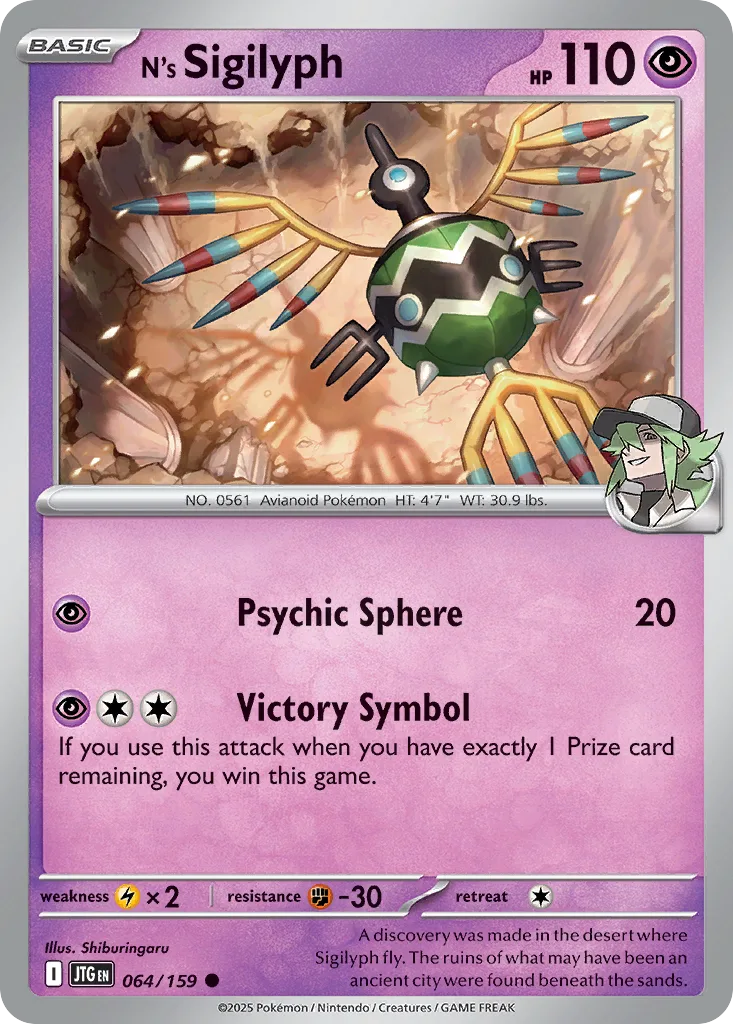
Three Energy for a win that would otherwise need a final Knock Out. It does not skip the work of getting to one Prize; it skips the last, hardest step, at a moment when the opponent knows exactly what they have to prevent.
That is the whole shape of the Prize card as a design space. It is a score, a clock, a public number, a cost printed on the biggest attackers, and — once in the whole pool — a win button.
Quick Action Checklist
- Read the rule box before you sleeve it. 2 Prizes for a Pokémon ex, 3 for a Mega Evolution Pokémon ex, 1 for everything else. 41 card names in Standard cost you half the game.
- Median HP per Prize is 100 / 120 / 110 across the 1-, 2- and 3-Prize tiers. The three-Prize tier is not the durable one.
- A Pokémon that kills itself still pays your opponent. The rulebook awards the Prize to the owner's opponent, whoever caused the Knock Out.
- Poison and Burn Knock Outs at Pokémon Checkup award Prizes normally. Count them before you pass.
- All five Prize-reduction effects only fire against attacks. Every one says "Knocked Out by damage from an attack" — Ability and Trainer damage goes straight past them.
- In Limited, "3 or fewer Prize cards remaining" is true after one Knock Out. Re-read every threshold card at a Prerelease.
- Ask for the count. Prizes remaining is Public Information under section 6.3.1 of the Tournament Handbook.
Frequently Asked Questions
How many Prize cards are there in the Pokémon TCG?
How many Prize cards does a Pokémon ex give up?
Are Mega Evolution Pokémon ex also Pokémon ex?
Who takes the Prize card if you Knock Out your own Pokémon?
Can a Pokémon be Knocked Out without giving up a Prize card?
What does "if your opponent has 3 or fewer Prize cards remaining" mean in Limited?
Is the number of Prize cards remaining public information in a Pokémon TCG tournament?
Keep Reading
- The Pokémon Company — Pokémon Trading Card Game Web Rulebook, 2026 edition (PDF): Prize cards zone p. 7, setup and the three win conditions p. 8, Knock Out and Prize award p. 14, Pokémon Checkup Knock Outs p. 15, simultaneous wins and the tiebreaker game p. 21, Appendix 1 Mega Evolution Pokémon ex p. 23, glossary "in play" p. 42 and "Prize cards" p. 43
- Play! Pokémon — TCG Tournament Handbook (PDF, last revised 1 September 2026): Constructed matches played for 6 Prize cards §4, Limited matches played for 4 Prize cards §5, play space and Prize card visibility §6.1.1, Prize count as Public Information §6.3.1
- Pokémon TCG API — every regulation-mark H, I and J printing (2,947 cards, of which 2,481 are Pokémon), queried 2 September 2026 for rule-box text, HP, Prize-count card text and set numbering
Related Guides
Pokémon TCG Tournament Rules: Deck Lists, the Clock, and Penalties
The rules that decide your first League Cup are not in the rulebook. They are in three separate Play! Pokémon documents, revised on a quarterly cycle, and they cover sleeve colour, how a die has to be numbered, what happens to your match when the clock hits zero, and the two penalties that exist in the Pokémon TCG and nowhere else in the program.
Pokémon TCG Abilities Explained: Triggers, Ability Lock, and Damage Math
An Ability is not an attack, and almost every rules argument about Abilities comes from someone forgetting that one line. Here is what the 2026 Web Rulebook says about when Abilities fire, where they work from, why a Paralyzed Pokémon still uses them, and what the parenthetical at the end of a damage-reduction Ability is really telling you.
Pokémon TCG Evolution Explained: Stages, Rare Candy, Mega
Evolving looks like the simplest action in the Pokémon TCG until you count the restrictions — there are three, plus two more that get treated as restrictions and are not. Here is what the rulebook actually says about stages, timing, and what survives an evolution, plus how the 2025-26 Mega Evolution era quietly rewrote the whole mechanic for the second time.
Pokémon TCG Energy Explained: Basic vs Special, Attack Costs, and the One-Per-Turn Rule
Attacking never spends your Energy. Retreating does. There are exactly nine basic Energy cards in the game's history and two Pokemon types that never got one. Here is how Energy actually works, straight from the rulebook and the card database — attack costs, the one-per-turn attachment rule, every legal way around it, and why Special Energy is a target painted on your attacker.
How to Play the Pokémon TCG — Full Rules and Turn Structure (2026)
Two players, 60 cards each, six face-down Prize cards, and a coin flip. That is the whole skeleton of the Pokémon TCG. Here is every rule that actually matters on turn one, from setup through the three ways to win.
Pokémon TCG Trainer Cards Explained: Item, Supporter, Stadium, Tool, and ACE SPEC Rules
You can play seven Items in a turn and nobody blinks, but a second Supporter gets you stopped mid-motion. Every Trainer subtype carries its own play rule, printed right on the card, and the differences decide how modern decks are built. Here is what the official rulebook actually says about Items, Supporters, Stadiums, Pokémon Tools, and the one-per-deck ACE SPEC rule.