PUBG Blue Zone Timings: Every Phase in Normal and Ranked
Update 42.1 retimed PUBG's blue zone separately for Normal Match and Ranked, and made its damage depend on how long you stay in the blue rather than how far out you are. Here is every phase as a table, built from KRAFTON's own charts.
If your picture of the PUBG blue zone still includes "it hurts more the further out you are," it's out of date. Update 42.1 (live 17 June 2026 on PC, 25 June on console) removed distance-based blue zone damage from all modes and maps, replaced it with damage that grows the longer you stay outside the safe zone, and retimed Normal Match and Ranked in opposite directions. KRAFTON's Blue Zone Revamp dev letter says the ruleset it replaced had "remained unchanged since April 2023."
KRAFTON published the new phase timings as two bar charts, and the 42.1 patch notes give only the totals. Below, both charts are turned into tables with the match clock added up, followed by what the damage change does to the way you use the blue. The blue zone rotation guide covers when and how to rotate. This is the timetable underneath it, checked against the patch notes from 42.1 through 43.1, the latest as of 2 October 2026. None of 42.2, 42.3 or 43.1 retimes a phase.
What 42.1 changed, in one table
| Normal Match | Ranked and Esports | |
|---|---|---|
| Match length | 28:50, unchanged | 32:50 down to 30:10 |
| Phase timings | From Phase 2: shorter waits, longer shrinks | Phase 1, Phase 2's wait and the final shrink cut; Phases 3 to 8 unchanged |
| Safe zone size | Smaller early, larger from Phase 4 | Smaller overall |
| Zone placement | Brought in line with Ranked; late zones slightly closer to the centre | "Land-priority" adjustment removed; zone-centering weakened |
| Special zones | Red, Blizzard and EMP Zones start earlier | Red, Blizzard and EMP Zones start earlier and run shorter; Sandstorm shorter and slightly faster |
| Damage | Rises with time spent in the blue, not distance | Same |
Two more lines sit above those two columns in the notes. The new Normal and Ranked rulesets "apply to all 8x8 maps", which KRAFTON's map selection dev letter lists as Erangel, Miramar, Taego, Deston, Rondo and Vikendi. And the dynamic blue zone, which adjusted to the remaining player count, is gone from Normal Match on Sanhok and Karakin.
Normal Match: every phase on the clock
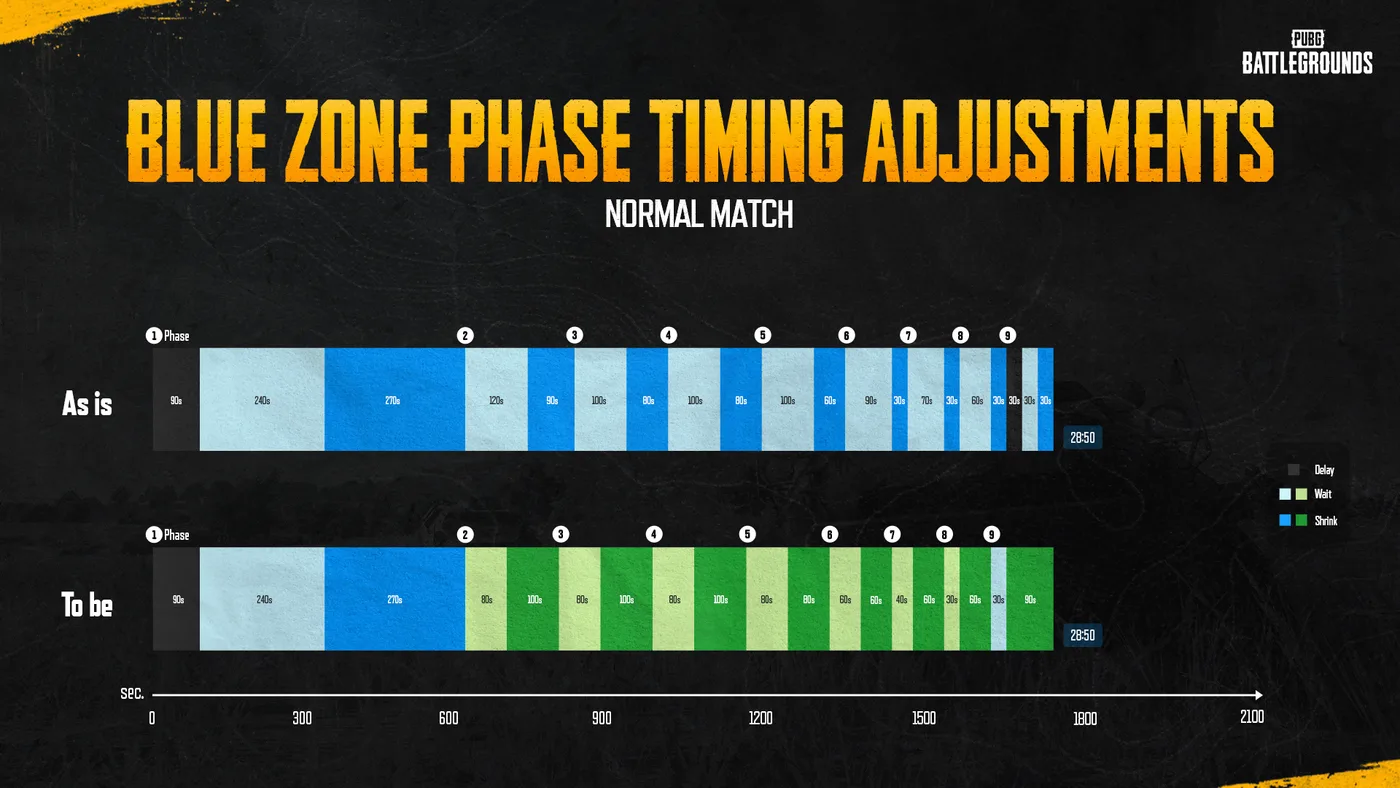
KRAFTON's charts split each phase into a wait, the warning period while the wall holds still, and a shrink, while it moves. The clock columns are my arithmetic: the chart's segments added up from 0:00, starting with a 90-second delay before Phase 1. They land exactly on the 28:50 the patch notes give.
| Phase | Wait | Shrink | Wall moves at | Phase ends at | Before 42.1 (wait / shrink) |
|---|---|---|---|---|---|
| 1 | 240 s | 270 s | 5:30 | 10:00 | 240 s / 270 s |
| 2 | 80 s | 100 s | 11:20 | 13:00 | 120 s / 90 s |
| 3 | 80 s | 100 s | 14:20 | 16:00 | 100 s / 80 s |
| 4 | 80 s | 100 s | 17:20 | 19:00 | 100 s / 80 s |
| 5 | 80 s | 80 s | 20:20 | 21:40 | 100 s / 60 s |
| 6 | 60 s | 60 s | 22:40 | 23:40 | 90 s / 30 s |
| 7 | 40 s | 60 s | 24:20 | 25:20 | 70 s / 30 s |
| 8 | 30 s | 60 s | 25:50 | 26:50 | 60 s / 30 s |
| 9 | 30 s | 90 s | 27:20 | 28:50 | 30 s delay, then 30 s / 30 s |
Phase 1 is untouched: four minutes of wait, four and a half of shrink, done at 10:00. Everything after it trades wait for shrink, and the late game is where it shows. The shrinks in Phases 6, 7 and 8 doubled from 30 to 60 seconds, and the final shrink tripled from 30 to 90. Added up, the wall now spends 920 seconds of the match moving, against 700 before, and the waits fell from 910 seconds to 720.
The catch is at the other end of each phase. Phase 7 gives you 40 seconds of warning and Phases 8 and 9 give you 30, so you have less time to read a new circle before the wall starts and more time to cover ground once it does. KRAFTON's stated aim is "to slow the overall pace of Blue Zone movement and provide more space for late-game engagements."
Ranked and Esports: a shorter clock
The same arithmetic on KRAFTON's Ranked & Esports chart, which ends at the 30:10 in the notes:
| Phase | Wait | Shrink | Wall moves at | Phase ends at | Before 42.1 (wait / shrink) |
|---|---|---|---|---|---|
| 1 | 180 s | 240 s | 4:30 | 8:30 | 240 s / 270 s |
| 2 | 60 s | 120 s | 9:30 | 11:30 | 90 s / 120 s |
| 3 | 60 s | 120 s | 12:30 | 14:30 | Unchanged |
| 4 | 60 s | 120 s | 15:30 | 17:30 | Unchanged |
| 5 | 60 s | 120 s | 18:30 | 20:30 | Unchanged |
| 6 | 60 s | 120 s | 21:30 | 23:30 | Unchanged |
| 7 | 60 s | 90 s | 24:30 | 26:00 | Unchanged |
| 8 | 60 s | 60 s | 27:00 | 28:00 | Unchanged |
| 9 | About 10 s | 120 s | 28:10 | 30:10 | About 10 s / 160 s |
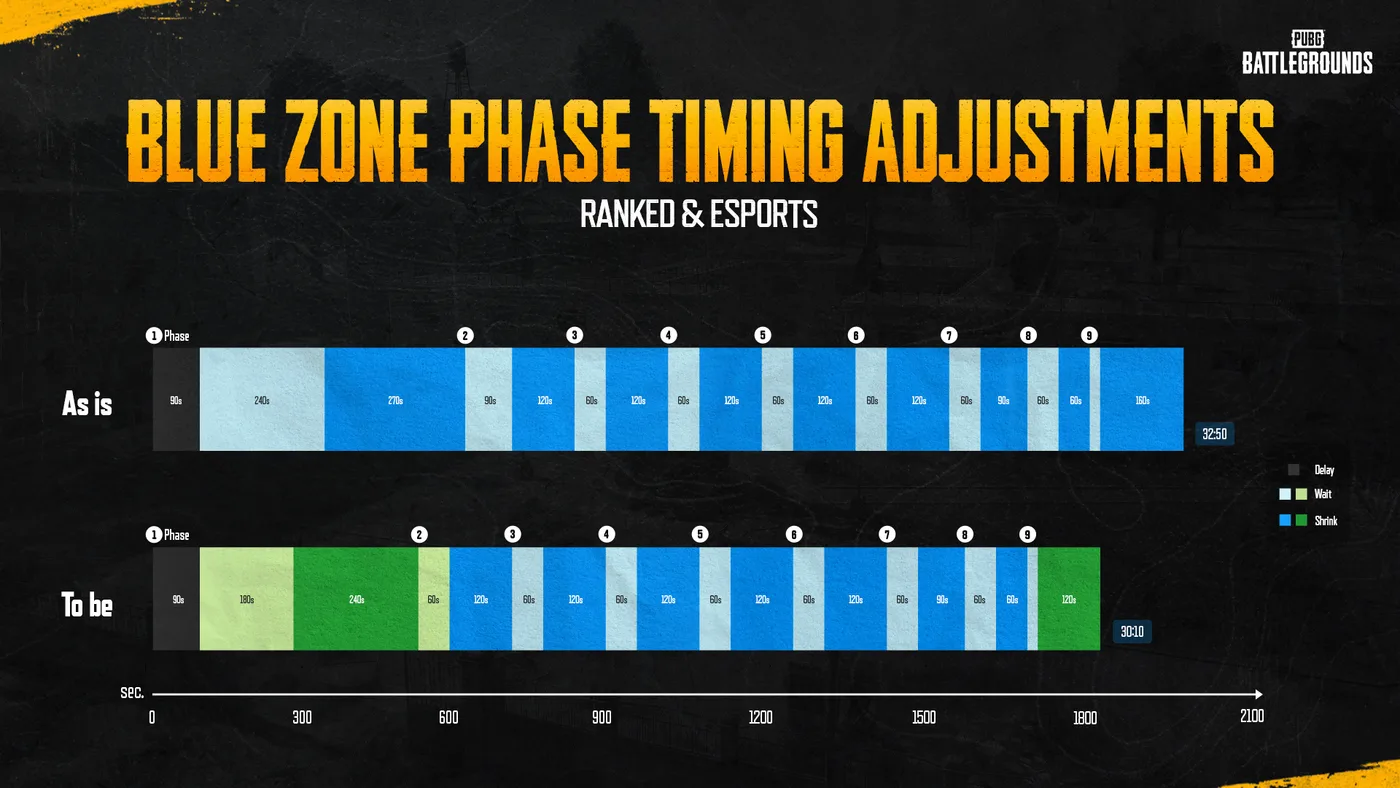
The whole 2:40 cut sits in four places: 60 seconds off Phase 1's wait, 30 off its shrink, 30 off Phase 2's wait and 40 off the final shrink. Phases 3 to 8 are the same lengths as before. They just start two minutes earlier. The first wall now moves at 4:30 instead of 5:30, and Phase 1 is over at 8:30 instead of 10:00.
The Phase 9 wait is an unlabelled sliver on both of KRAFTON's Ranked bars. The labelled segments add up to exactly 10 seconds short of each stated total, so it's about 10 seconds.
That table covers every Ranked match this season. KRAFTON's Map Service Report for 43.1 puts Season 43 Ranked on Erangel, Miramar, Taego and Rondo at 25% each, all four of them 8x8 maps. The Ranked guide covers how placement turns into RP.
Why the two modes went opposite ways
KRAFTON's dev letter says the pace of play and combat had become "significantly faster over time" while the ruleset stayed put, and that Normal and Ranked had developed separate gameplay identities the shared ruleset no longer reflected. Rather than one shared ruleset, each mode got the fix for its own problem.
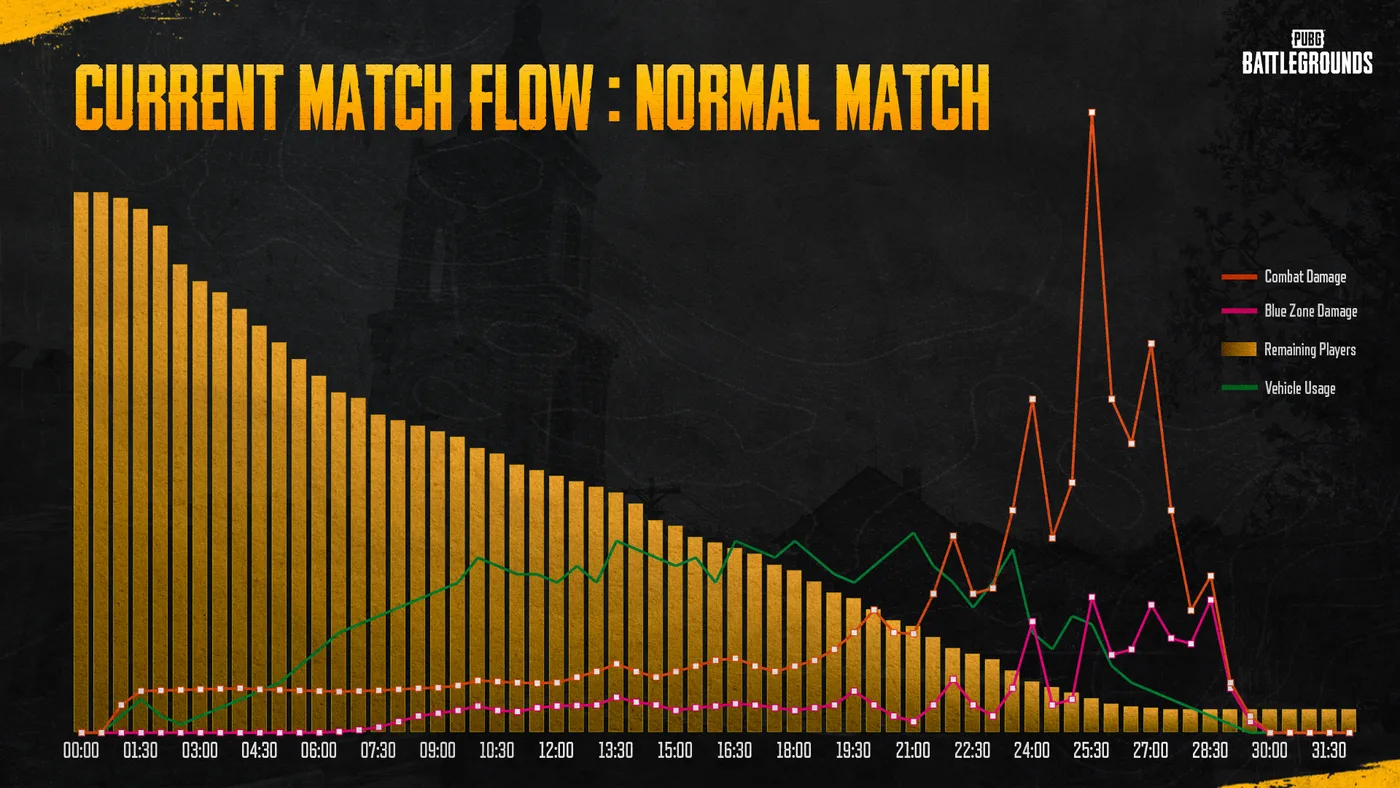
Normal Match was too chaotic late. In KRAFTON's words: "Around Phases 5 and 6 in particular, chaotic combat frequently occurred within much smaller play spaces, even when survivor counts were comparable to those seen in Ranked." Players delayed their rotations until just before the wall moved, the fast wall then forced "rushed entries into the safe zone", vehicle dependency stayed high into the late game, and multiple teams "frequently converged on the same locations." The fix is a slower wall and bigger late circles.
Ranked had a stagnant stretch. Survival-minded teams set up inside the zone early, which left a lull "after looting and initial rotations were completed but before meaningful engagements began." Late safe zones stayed fairly large, and strong zone-centering made future circles "easier to predict." The fix is shorter early phases, smaller zones and weaker centering, with a limit KRAFTON states outright: "some zone-centering adjustments will remain in place to ensure that late-game circles continue to form in fair and playable locations."
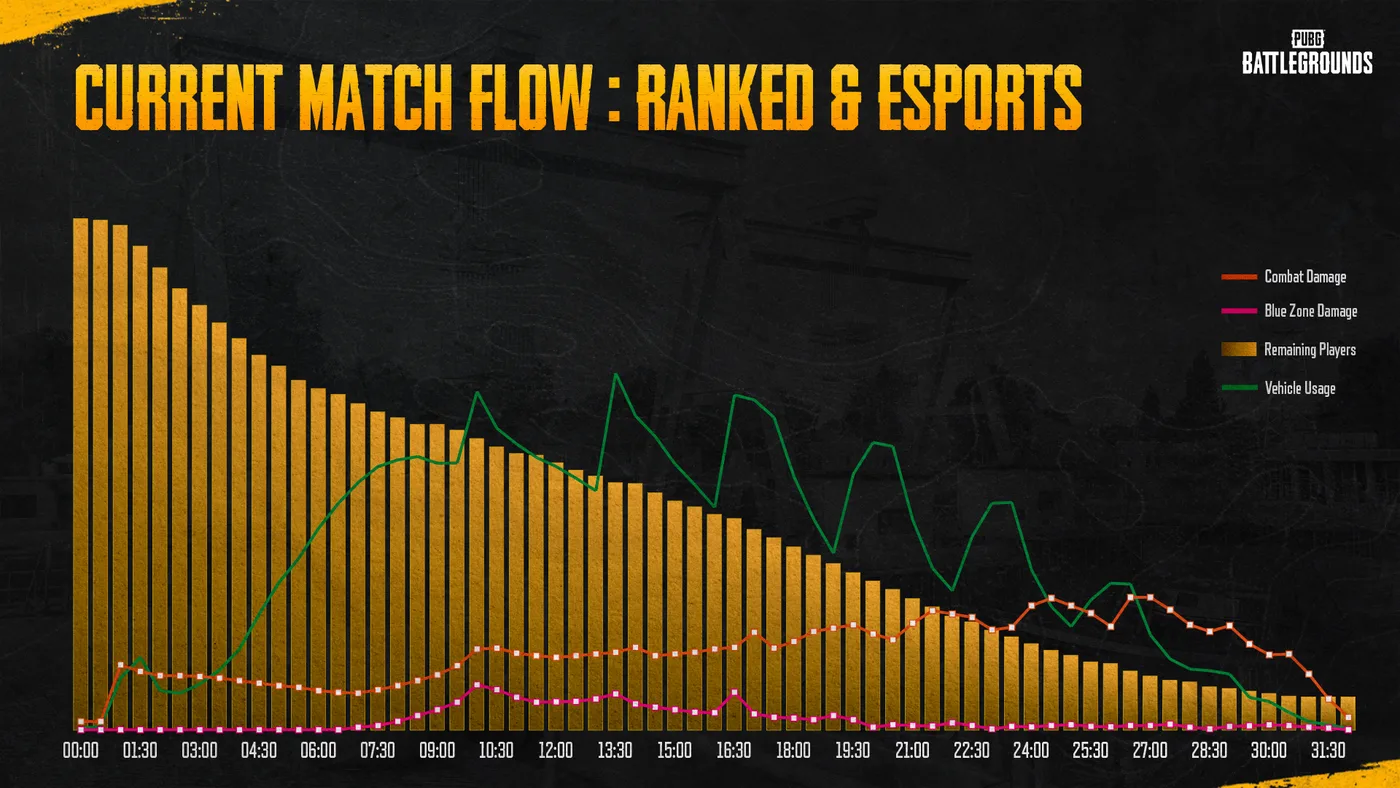
Both flow charts show the pre-42.1 game. They're KRAFTON's evidence for the change, not a measurement of the result, and KRAFTON hasn't published an after picture.
Damage is charged by the second now
Before 42.1, blue zone damage scaled with your distance from the safe zone. KRAFTON's own criticism of that model is that it mostly mattered "where players were far outside the safe zone" and made it hard to tell "when and how damage values would increase."
The replacement, from the patch notes: damage "now increases based on how long players remain inside the Blue Zone," and "the previous distance-based system has been removed from all modes and maps." It applies to Normal Match, Ranked, and both the Normal and Esports modes of Custom Match. The notes add that "Blue Zone timing and damage values have been adjusted across all modes", so the per-phase numbers moved too.
What that changes in practice, as I read it:
- Standing just outside the line stopped being cheap. Under the distance model, the player one step outside the circle took the least damage, so lingering near the edge of the blue was cheap. KRAFTON names the long stay as the target: "strategies that rely on remaining in the Blue Zone for extended periods, such as healing items through the damage while setting up flanking opportunities, will become considerably more difficult."
- Seconds are the price, not metres. A long run back from deep in the blue still hurts, but because it takes a long time, not because you're far out. Whatever cuts the seconds, a vehicle or a straight line to the edge, is the lever.
- The early game is still forgiving. KRAFTON: "players will still be able to make slower rotations into the safe zone during the early stages of a match. However, as the match progresses, the effects of prolonged Blue Zone exposure will become increasingly significant."
The same patch made healing quicker, which matters for the HP you bring back across the line. Bandages now heal 12 (was 10) with a 3-second use time (was 4), and a Med Kit takes 6 seconds (was 8). The Jammer Pack still absorbs blue zone damage, and the utility items guide covers its three levels.
Where the circle lands now
The patch notes change placement differently in each mode:
- Normal Match: early safe zones are smaller and, from Phase 4, larger. Placement behaviour now matches Ranked, and "late-game safe zones will appear slightly closer to the center compared to before."
- Ranked and Esports: safe zones are smaller overall, and "the land-priority safe zone placement adjustment has been removed." The notes don't say what that adjustment did. The dev letter adds that zone-centering was weakened "to introduce greater variability in future circle locations."
- Update 42.3 (August): "The areas where Blue Zone centers can be generated have also been refined across maps," excluding hard-to-reach or unfair spots and adding "certain low-impact areas." The same patch rescaled the Custom Match spread setting, which the Playgrounds guide covers for creators.
So expect a Normal late game that leans a little more central than it used to and a Ranked late game that's a little harder to call. Neither change makes the next circle predictable. The zone prediction guide is about playing the odds instead of guessing the centre.
Sanhok, Karakin and the special zones
Sanhok and Karakin used a dynamic blue zone in Normal Match, one "based on remaining player count." 42.1 removed it on both maps. KRAFTON hasn't published the timetable that replaced it, and the 8x8 tables above don't cover the small maps, which the map selection dev letter lists as Sanhok, Paramo and Karakin.
The map hazards moved with the new clocks. In Normal Match, Red Zones, Blizzard Zones and EMP Zones "begin earlier based on the updated timeline." In Ranked they begin earlier and "have shorter overall durations," and the Sandstorm's total and per-occurrence durations were cut while its movement speed went up slightly. The red zone guide covers surviving a bombardment once one lands.
What KRAFTON hasn't published
These are open questions, not things I'm leaving out. Treat a confident number for any of them as a player's test:
- Damage figures. No per-second figure for any phase, and no rate for the ramp. A percentage-per-phase table from before June 2026 predates both the time-based model and 42.1's damage-value changes.
- Whether the exposure clock resets. Neither the patch notes nor the dev letter says whether stepping back into the safe zone resets the timer, or whether it carries from one phase into the next.
- Safe zone diameters. The notes say smaller or larger, never how big.
- Small-map timetables for Sanhok, Karakin and Paramo.
- How the Jammer Pack's absorption interacts with the time-based ramp.
- The exact Ranked Phase 9 wait, unlabelled on KRAFTON's chart and about 10 seconds by arithmetic.
How to play the new clock
This is my read from the timetables and KRAFTON's stated intent. The dev letter promises to keep watching survivor counts and "whether players are taking more Blue Zone damage than intended," but it publishes no after data.
- Ranked: the opening is 90 seconds shorter. Phase 1 used to end at 10:00 and now ends at 8:30. A loot route that relied on that extra time needs trimming. The early game guide covers what to cut.
- Normal: decide fast late, then move steadily. The last three warnings are 40, 30 and 30 seconds, but the walls behind them take 60 to 90 seconds to close.
- Heal inside the line, not outside it. Every second you spend healing in the blue is a second of exposure, and exposure is now the thing that costs you.
- Don't plan a flank through the blue. Healing in the blue while setting up a flank is the example KRAFTON gives of a play the damage change makes harder.
- Bin old damage tables. They predate the time-based model, and 42.1 adjusted damage values across all modes.
For the decisions that sit on top of the clock, holding ground through Phases 2 to 5 is in the mid-game guide and the final circles are in the endgame guide.
Quick Action Checklist
- Normal Match on 8x8 maps: 28:50 total, first wall at 5:30, Phase 1 done at 10:00
- Ranked and Esports: 30:10 total, first wall at 4:30, Phase 1 done at 8:30
- Normal Phases 2 to 4 are 80 s of wait plus 100 s of shrink; Ranked Phases 2 to 6 are 60 s plus 120 s
- In Normal Phases 7 to 9, expect 40, 30 and 30 s of warning before the wall moves
- Blue zone damage rises with time spent in the blue, not distance from the circle, in all modes and maps since 42.1
- Don't sit just outside the circle to heal or flank; time in the blue is what's charged
- Heal after you cross the line, not while you're crossing it
- Expect slightly more central late circles in Normal and less predictable ones in Ranked
- Sanhok and Karakin no longer use the player-count-based dynamic blue zone in Normal Match
- Ignore any percentage-per-phase damage table from before June 2026
Frequently Asked Questions
How long is each blue zone phase in PUBG?
Does blue zone damage depend on distance in PUBG?
What is the difference between the Normal and Ranked blue zone in PUBG?
How many blue zone phases are there in PUBG?
Does Sanhok still have a dynamic blue zone in PUBG?
When does the first blue zone start moving in PUBG?
Keep Reading
- PUBG: BATTLEGROUNDS — [Dev Letter] Blue Zone Revamp (16 June 2026): ruleset unchanged since April 2023, Normal and Ranked phase timing charts, match-flow charts, time-based damage, zone-centering
- PUBG: BATTLEGROUNDS — Patch Notes, Update 42.1 (16 June 2026; live PC 17 June, console 25 June): Blue Zone Revamp (28m 50s Normal, 32m 50s to 30m 10s Ranked, sizes, placement, special zones, dynamic zone removed on Sanhok and Karakin, distance-based damage removed) and Healing Item Rebalance
- PUBG: BATTLEGROUNDS — Patch Notes, Update 42.3 (11 August 2026): Blue Zone Placement Improvements, refined areas where Blue Zone centres can generate and the 0-1 Custom Match spread scale
- PUBG: BATTLEGROUNDS — [Dev Letter] Adjustment to the Map Selection System (11 August 2026): large 8x8 maps (Erangel, Miramar, Taego, Deston, Rondo, Vikendi) and small maps (Sanhok, Paramo, Karakin)
- PUBG: BATTLEGROUNDS — Map Service Report, Update 43.1: Season 43 Ranked pool of Erangel, Miramar, Taego and Rondo at 25% each
- PUBG: BATTLEGROUNDS — Patch Notes, Update 43.1 (9 September 2026): latest patch notes as of 2 October 2026, with no Blue Zone timing changes
- PUBG: BATTLEGROUNDS patch notes index — checked 2 October 2026; Update 43.1 remains the most recent patch notes entry
Related Guides
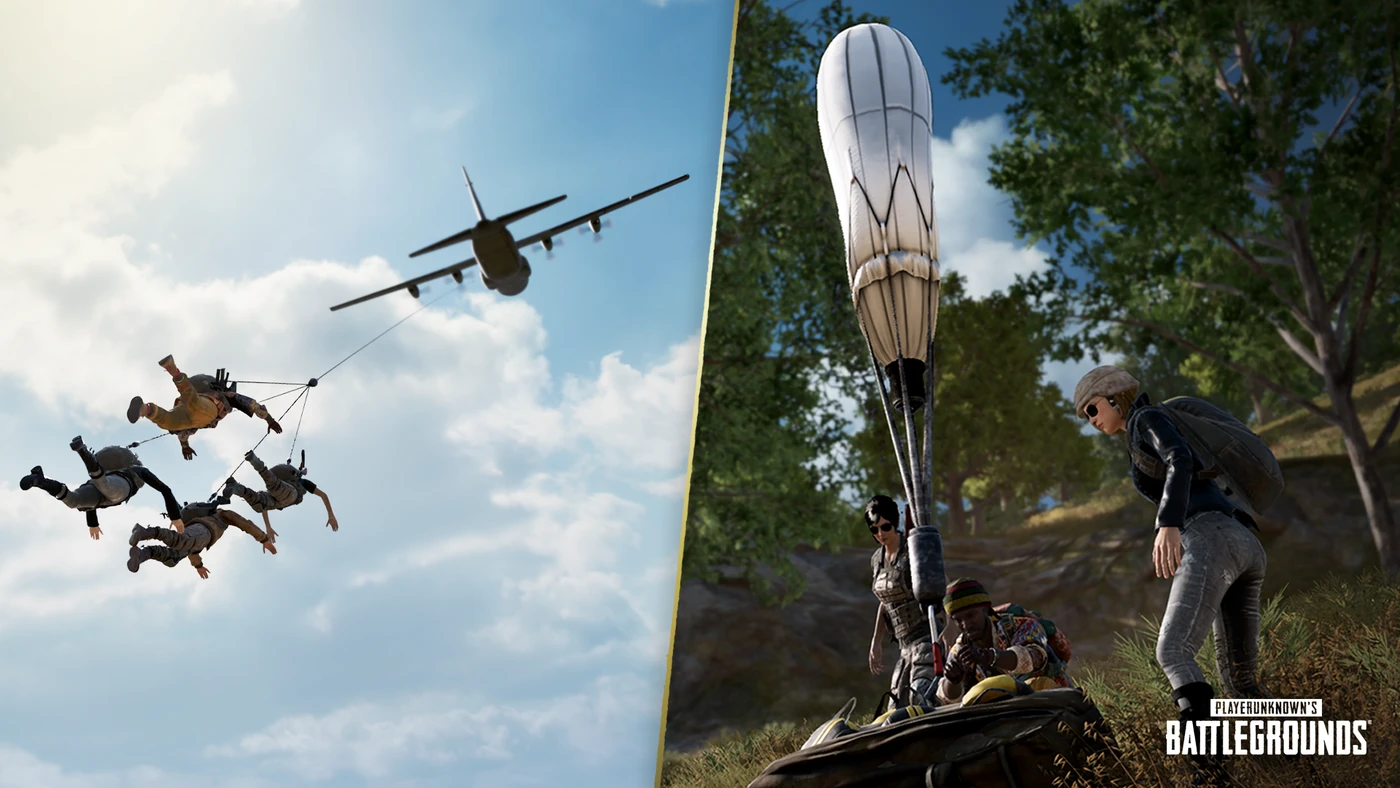
PUBG Emergency Pickup Guide: Fly Out of Trouble
It looks like a party balloon and it saves games. The Emergency Pickup fultons your squad across the map to the safe zone, but it has strict rules and it hangs you in the open air. Here is how to use it without turning into target practice.
PUBG Blue Zone & Rotation Guide: Beat the Circle
The blue zone kills more players than enemies do, and almost all of those deaths are avoidable. Here's how circle damage ramps every phase, when to move versus hold, and how to play the edge without ever eating the wall.
PUBG Endgame Guide: How to Win the Final Circles
Reaching the top 10 is easy. Converting it into a chicken dinner is where most players choke. Here's how to read the zone, rotate before everyone else, hold real cover, and win the third-party war in the last three circles.
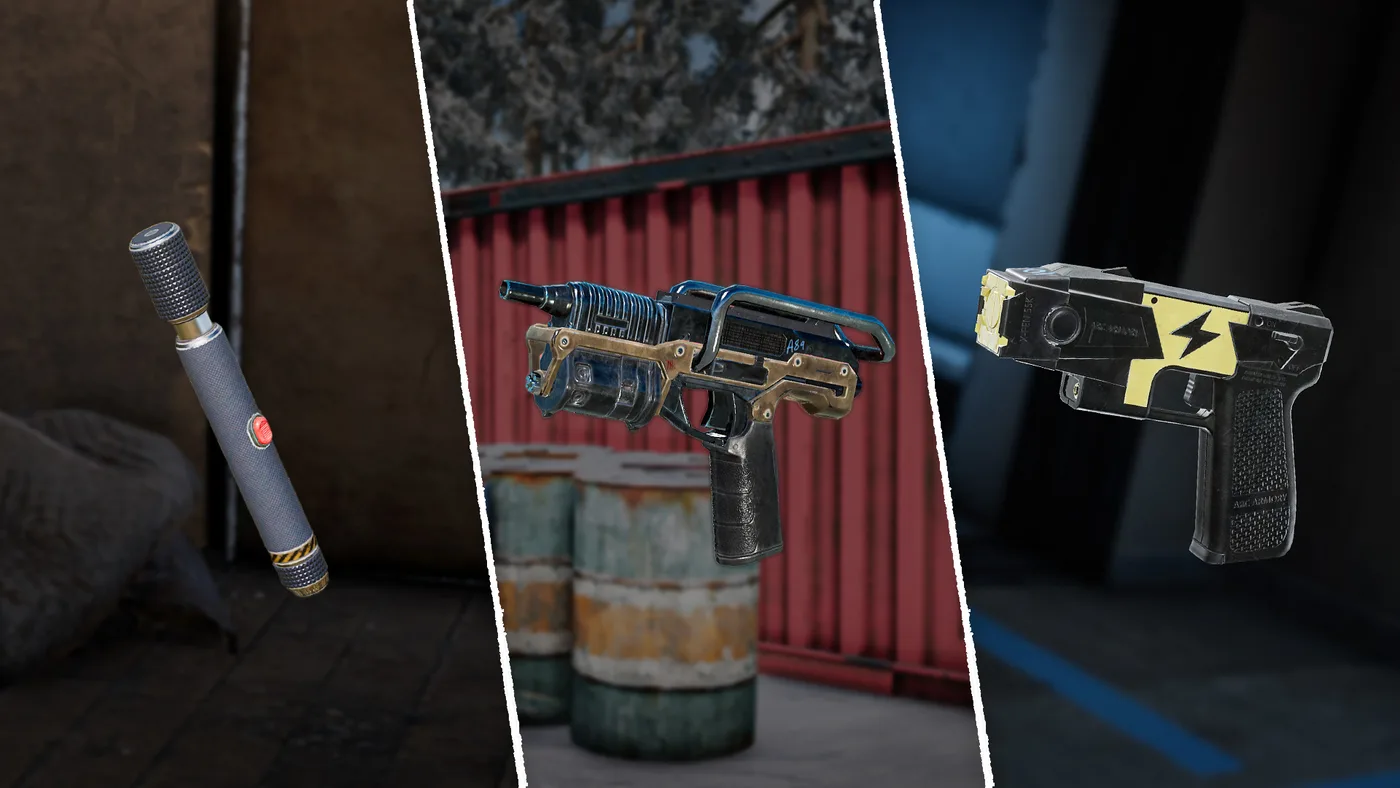
PUBG Utility Items: Folded Shield, Zipline Gun & More
PUBG's loot pool has a whole layer of kit that isn't a gun, armour, a heal or a grenade. Here are nine of those items: what each one does, what slot and weight it costs you, where it spawns as of Update 43.1, and which patch changed the rules on it.
Best Weapons in PUBG: Tier List
Every PUBG tier list is out of date the moment a balance patch drops. So here's the list, ranked by role, plus the durable logic to re-tier any gun yourself when the next patch shakes things up.
Best PUBG Loadouts & Attachments
A naked M416 and a fully kitted M416 are basically two different guns. Here's how to build the strongest two-gun loadouts in PUBG and the attachment priority that turns loot into recoil control.