Tetris Effect Modes Explained: SS Grades and What to Play
The Effect Modes menu sorts fifteen modes into four groups by mood rather than difficulty, and each one grades you against a published threshold. Ultra wants 35,000 points in three minutes for an SS. Sprint wants 40 lines in 1:10. Master wants 150 lines at 20G.
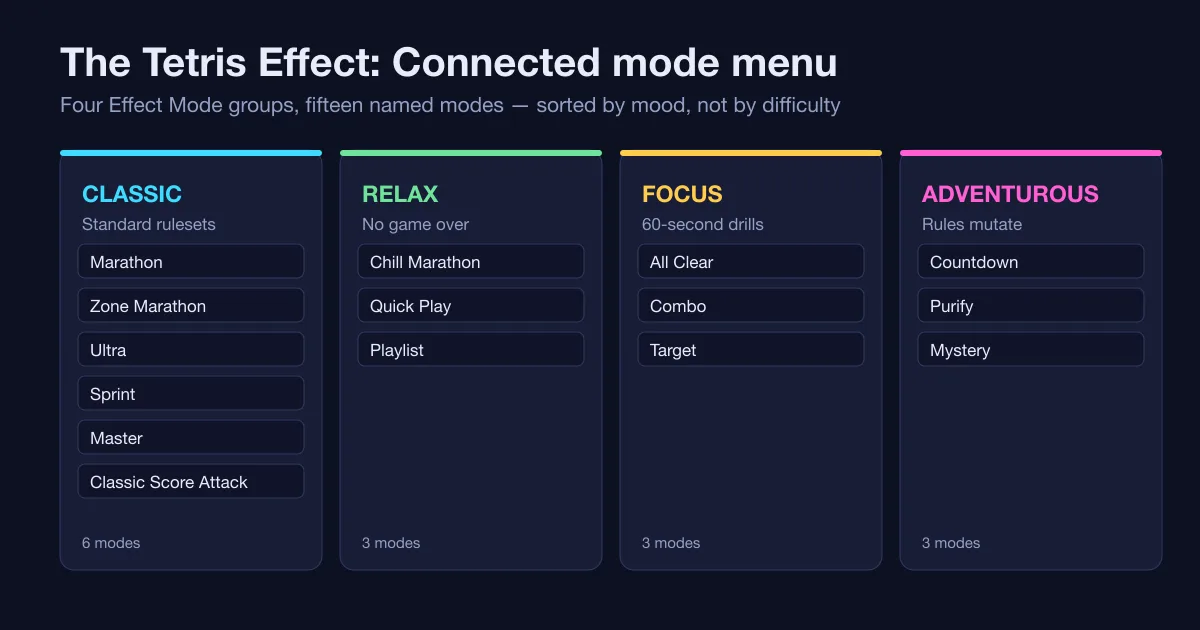
Tetris Effect: Connected keeps most of its single-player game behind one menu tile. Under EFFECT MODES sit four groups of modes, each with a published grade ladder that states exactly what a good run looks like. The letter is read off your final score, time or count once the run is over.
Here is the whole menu, what each mode is measuring, and the threshold you have to beat for an SS in every one of them.
A note on the count before anything else. Enhance's own site advertises 17 Effect Modes, and tetris.wiki opens its Effect Modes section with that same figure — then lists 15 named modes across four groups. The Fandom Tetris wiki says fifteen and enumerates the same fifteen. So one of the two sources contradicts itself, and two of the advertised seventeen are unaccounted for on either mode list. Rather than guess at them, this guide covers the fifteen that are documented — count the rows in the table below yourself.
The menu sorts by mood, not by difficulty
The four groups are Classic, Relax, Focus and Adventurous, and the thing that separates them is not speed. Every group can be played at a high level. What changes between groups is the failure rule and the shape of the session.
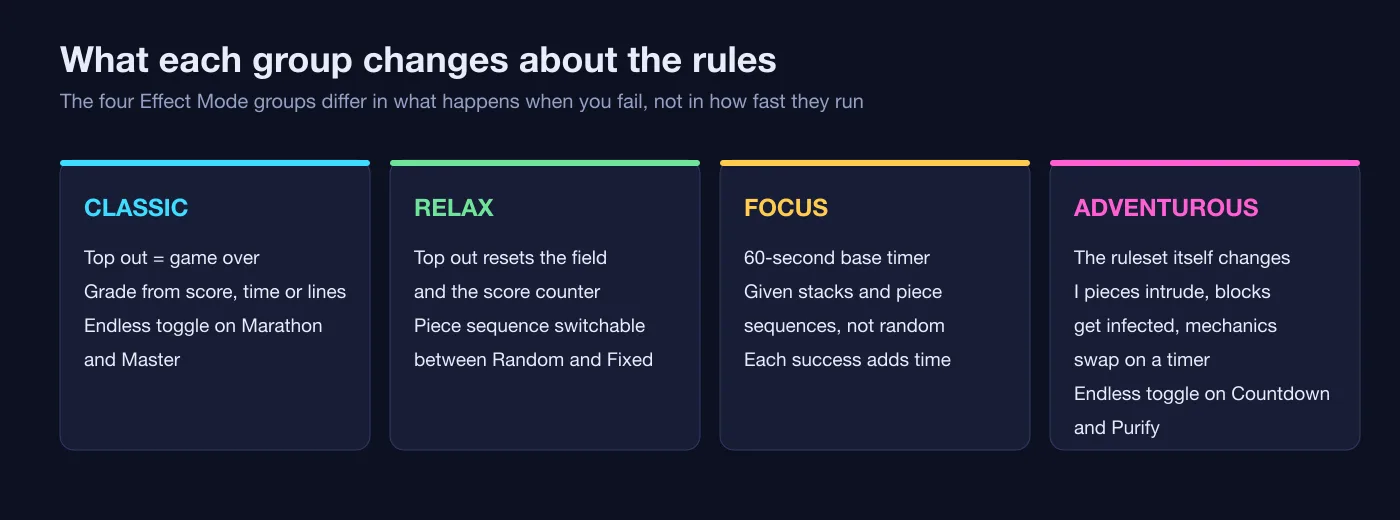
- Classic plays it straight: top out and the run is over.
- Relax removes the game over entirely. Topping out resets the playfield and the score counter instead of ending the run, and you can switch the piece sequence between Random and Fixed — Fixed repeats the initial seven-piece sequence for the whole session.
- Focus is three timed drills built on given stacks rather than a random bag, each on a one-minute base timer that every success extends.
- Adventurous keeps the Guideline rules but interferes with them: pieces intrude, blocks get infected, mechanics swap out mid-run.
That framing matters because it tells you which group to open. If you want a leaderboard number, Classic. If you want to sit in a stage for an hour, Relax. If you want to drill one specific skill, Focus.
The fifteen modes and what each one asks
| Group | Mode | What it asks of you |
|---|---|---|
| Classic | Marathon | Fixed-goal Marathon; clear at least 150 lines. Endless toggle, starting level up to 15 |
| Classic | Zone Marathon | The same 150-line Marathon with the Zone mechanic added; meter fills a quarter per 8 clears |
| Classic | Ultra | Score as much as possible in 3 minutes |
| Classic | Sprint | Clear 40 lines as fast as possible |
| Classic | Master | 20G across 30 speed levels with shrinking lock and line clear delays |
| Classic | Classic Score Attack | NES mechanics and visuals; selectable start level and NTSC or PAL frame timings |
| Relax | Chill Marathon | Marathon with no instant game over; line goal adjustable from 150 to 600 in steps of 30 |
| Relax | Quick Play | One stage at a fixed level you pick, with a line goal from 30 to 600 in steps of 30 |
| Relax | Playlist | Four themed stages back to back — Sea, Wind or World |
| Focus | All Clear | As many perfect clears as possible on a 1-minute base timer; each one adds time |
| Focus | Combo | As many combos as possible on a 1-minute base timer; each one adds time |
| Focus | Target | Clear as many stacks containing gem blocks as possible on a 1-minute base timer |
| Adventurous | Countdown | Score as much as possible in 5 minutes while I pieces drop into the stack |
| Adventurous | Purify | Clear as much grey garbage and violet infected material as possible in 3 minutes |
| Adventurous | Mystery | Marathon with random mechanics switching on for stretches at a time |
Fifteen rows. Six of them are in Classic, and the other three groups hold three each.
The SS thresholds in one table
Grades run from E up to SS, and in most modes the grade is read off your final score; the exceptions grade you on lines, time, or a count of completed objectives instead.
| Mode | Graded on | SS | S | A | B | C |
|---|---|---|---|---|---|---|
| Marathon | Score | 500,000 + 150 lines | 400,000 | 300,000 | 150,000 | 60,000 |
| Zone Marathon | Score | 1,000,000 + 150 lines | 800,000 | 500,000 | 250,000 | 60,000 |
| Ultra | Score | 35,000 | 30,000 | 20,000 | 10,000 | 5,000 |
| Sprint | Time | under 1:10 | under 1:20 | under 1:40 | under 2:20 | under 3:20 |
| Master | Lines | 150 | 130 | 100 | 50 | 20 |
| Classic Score Attack | Score | 250,000 | 200,000 | 150,000 | 80,000 | 30,000 |
| Chill Marathon | Score | 300,000 | 200,000 | 150,000 | 100,000 | 50,000 |
| Quick Play | Score | 10,000 | 8,000 | 6,000 | 5,000 | 3,000 |
| Playlist | Score | 40,000 | 32,000 | 24,000 | 20,000 | 12,000 |
| All Clear | Missions | 30 | 26 | 20 | 15 | 10 |
| Combo | Combos | 120 | 100 | 80 | 50 | 25 |
| Target | Missions | 30 | 26 | 20 | 15 | 10 |
| Countdown | Score | 55,000 | 42,000 | 30,000 | 15,000 | 6,000 |
| Purify | Blocks purified | 450 | 400 | 300 | 150 | 100 |
| Mystery | Score | 400,000 + 150 lines | 300,000 | 200,000 | 120,000 | 50,000 |
Two of those numbers are worth staring at.
Quick Play's 10,000 is not a small number. The grade there is calculated per 30 lines and per level, which means the target scales with the run you configured. tetris.wiki spells out the consequence: starting at level 5 and setting a 150-line goal requires 25 times as much score for the same letter. Several modes let you set the starting level — Marathon, Zone Marathon, Chill Marathon and Master all do — but Quick Play is the one whose grade table tetris.wiki documents as scaling with that choice.
Zone Marathon's SS is double Marathon's — 1,000,000 against 500,000 over the same 150 lines. That is the game's own price on the Zone — the same 150 lines for twice the score — and it is why the mode carries its own grade table rather than sharing Marathon's. How to actually earn that multiplier is the subject of our Tetris Effect Zone guide.
Classic is the part that answers to normal skill
If you have played any Guideline game, four of the six Classic modes need no explanation: Marathon, Ultra and Sprint are the standard trio, and Classic Score Attack swaps in Nintendo's NES rules and look, with a selectable start level and a toggle between NTSC and PAL frame timings. That PAL toggle is not decoration — tetris.wiki describes it as switching the mode to the frame timings of the PAL version of Nintendo's NES release, and PAL and NTSC hardware do not run at the same rate. Our NES DAS, hypertapping and rolling guide covers what those timings do to your inputs.
Sprint deserves one specific callout, because its ladder is the one that travels: SS is a sub-1:10 forty lines, S is sub-1:20, A is sub-1:40. Those map cleanly onto the benchmarks in our 40-line sprint guide, and unlike a score threshold they transfer directly to TETR.IO and Jstris.
Master mode is two clocks shrinking
Master is the one Classic mode that is genuinely its own game. Gravity is 20G from the start — pieces arrive already on the stack — and the difficulty then comes from thirty M-levels of shrinking timers rather than from any further gravity increase. There is nowhere left for gravity to go.
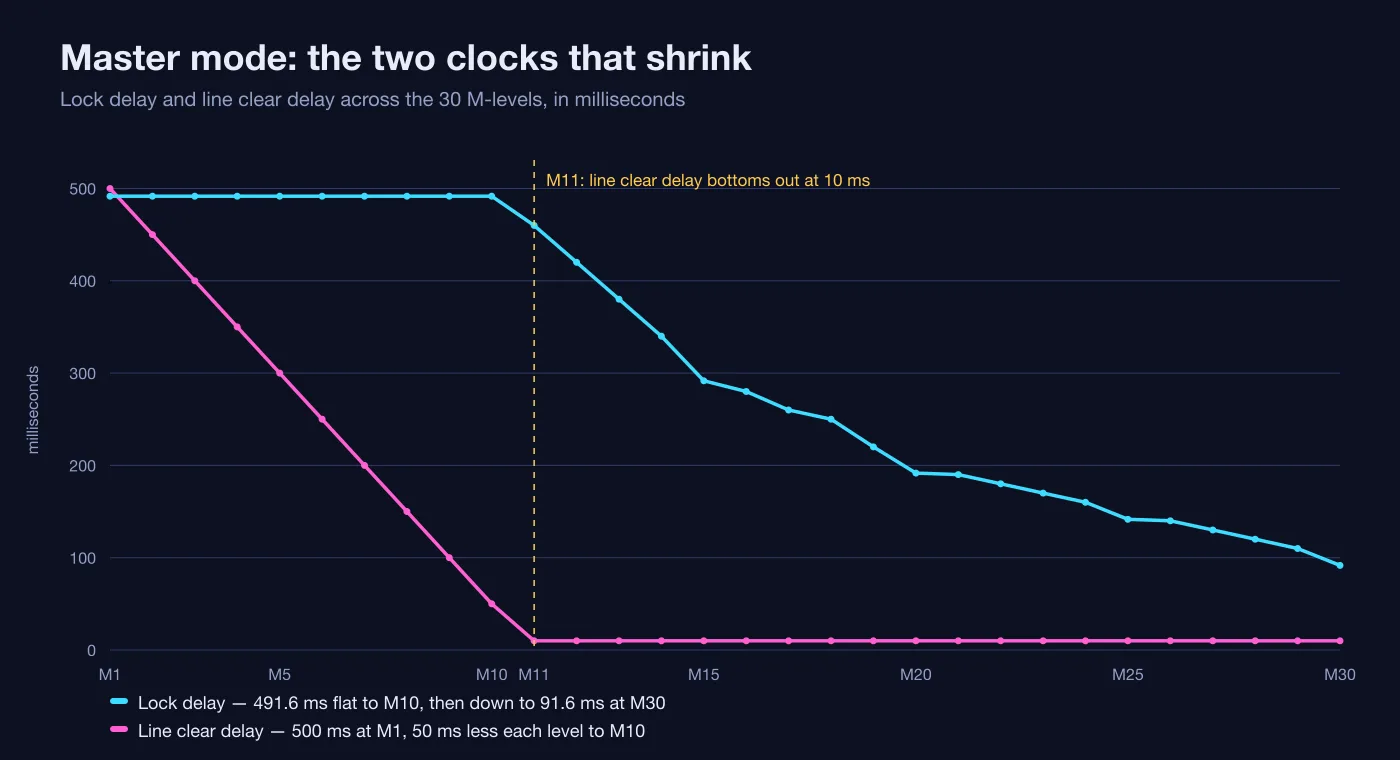
The two timers move in sequence, not together. From M1 to M10 the lock delay sits flat at 491.6 ms while the line clear delay falls by 50 ms a level, from 500 ms down to 50 ms. At M11 the line clear delay drops to 10 ms and stays there for the remaining twenty levels — and only then does the lock delay start moving, sliding from 460 ms at M11 to 91.6 ms at M30.
| M-level | Lock delay | Line clear delay |
|---|---|---|
| M1 | 491.6 ms (29.5f) | 500 ms (30f) |
| M5 | 491.6 ms (29.5f) | 300 ms (18f) |
| M10 | 491.6 ms (29.5f) | 50 ms (3f) |
| M11 | 460 ms (27.6f) | 10 ms (0.6f) |
| M15 | 291.6 ms (17.5f) | 10 ms (0.6f) |
| M20 | 191.6 ms (11.5f) | 10 ms (0.6f) |
| M25 | 141.6 ms (8.5f) | 10 ms (0.6f) |
| M30 | 91.6 ms (5.5f) | 10 ms (0.6f) |
Read that as two separate difficulty phases. The first ten levels compress the gap between placements — the line clear animation, which is dead time you cannot stack through. The next twenty compress the time you have on the piece itself, ending at a lock delay under a tenth of a second. Half a second of lock delay is what most Guideline games give you; M30 gives you 91.6 ms. Our gravity and lock delay guide covers why that timer, not gravity, is the number that actually kills runs.
One caveat on Master, stated plainly because both wikis carry it and neither resolves it: the mode description says you must clear at least 300 lines to complete it, while the grade table awards SS at 150 lines. Those are different bars, and I could not verify which governs the ending screen. Take the 150 as the SS threshold and treat 300 as the completion goal.
Relax takes the game over away
The Relax group's rule is a single sentence with large consequences: topping out resets the playfield and the score counter rather than ending the run. You cannot lose. You can only start the scoring over, which is a meaningfully different kind of pressure — a bad stack costs you the whole score you have banked, but not the session.
The three modes then differ in how much of the run you configure:
- Chill Marathon is Marathon with a selectable start level and a line goal you dial anywhere from 150 to 600 lines in multiples of 30.
- Quick Play lets you fix the level and set a goal from 30 to 600 lines, again in multiples of 30. This is the mode to open if you want to sit inside one specific stage.
- Playlist runs four themed stages back to back, and there are three of them: Sea (The Deep, Dolphin Surf, Mermaid Cove, Jellyfish Chorus), Wind (Da Vinci, Balloon High, Deserted, Sunset Breeze) and World (Prayer Circles, Zen Blossoms, Jeweled Veil, Karma Wheel). You can change the background music before you start.
The Fixed piece-sequence option in this group is the sleeper feature. It repeats the initial seven-piece sequence for the entire run, which turns a Relax mode into a deterministic practice field — the same bag order, every time, for as long as you want to drill a shape.
Focus is three one-minute drills
All three Focus modes run the same structure: a one-minute base timer, given stacks rather than a random field, and a time bonus for every success. All Clear and Combo are additionally documented as supplying the piece sequences. Your grade is a count of completed objectives, not a score.
- All Clear hands you stacks that can be perfect-cleared and asks how many you can finish. SS is 30. If you have worked through our perfect clear guide, this is the mode that tests it under a clock.
- Combo asks for combos, and its SS is 120 — four times what All Clear and Target want, which tells you how short each individual objective is.
- Target asks you to clear stacks containing gem blocks, with SS again at 30.
Because the stacks are given rather than random, a failed attempt is a repeatable puzzle rather than a bad bag. That is exactly what makes them good drills.
Adventurous changes the rules under you
- Countdown is a five-minute score attack with sabotage: one or more I pieces drop into a random column of your stack every 2, 5, 8 or 10 piece drops. The interval is the difficulty dial. Endless can be toggled on, and the mode ends when you top out.
- Purify gives you three minutes to clear as much grey garbage and violet "infected" material as you can. New infected blocks are pushed in at the bottom after a set number of clears, or when you fail to clear infected blocks at certain intervals. It is a downstacking exam with a timer — see our downstacking guide for the technique it is grading.
- Mystery is Marathon with random mechanics switching on for stretches: giant pieces, bombs, no hold, and others. Its SS of 400,000 plus 150 lines sits below Marathon's 500,000, which is the game acknowledging that you are not fully in control of the run.
The stages are bolted to the modes
Seven stages exist only inside a specific mode, which is worth knowing if you are hunting for one you have heard and cannot find in the menus.
| Stage | Only appears in |
|---|---|
| Space Sprint | Sprint |
| Gilded Horizon | Ultra |
| Space Race | Master |
| 2020 | Classic Score Attack |
| Mandala | All Clear, Combo and Target |
| Rose Horizon | Countdown |
| Rebirth | Purify |
Free stage choice is narrower than it looks. Marathon, Chill Marathon, Quick Play and Mystery let you pick from the main or hidden stages; Zone Marathon can pick from the main stages but cannot use the hidden 1984 and 1989 stages; every other mode is locked to its own.
The two hidden stages have their own routes. 1989 unlocks permanently at XP Level 50, or temporarily through the Weekend Ritual. 1984 is a code: on the title screen, with a controller, enter UUDDLRLRBA — up, up, down, down, left, right, left, right, Back, Select. That drops you into an Electronika 60 homage where you type 06061984 on a keyboard and press Enter.
The Weekend Ritual picks your group for you
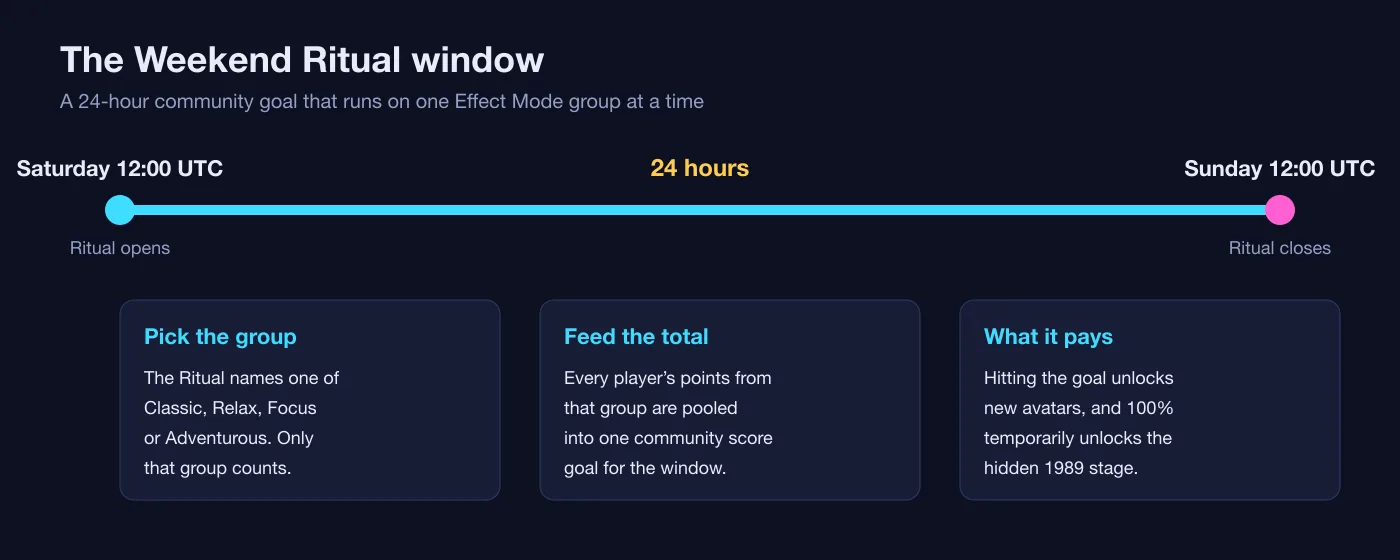
Every weekend the game runs a 24-hour community event from Saturday 12:00 UTC to Sunday 12:00 UTC. It names one of the four Effect Mode groups, and every participating player's points from modes in that group are pooled toward a single community score goal. Clear the goal before the window closes and participating players unlock new avatars; reaching the 100% community goal also unlocks the 1989 stage temporarily for participants.
The practical read: the Ritual is a scheduled reason to open a group you would otherwise ignore. If you only ever play Classic, a Focus weekend is the shove.
Which mode fixes which weakness
Grades are more useful as diagnostics than as trophies. Map your worst letter to the skill it is actually measuring:
| If you want to fix | Open | Because it measures |
|---|---|---|
| Raw speed | Sprint | 40 lines against a clock, with no scoring to hide behind |
| Efficiency under a fixed time | Ultra | Points per second across exactly 3 minutes |
| Reading a stack at 20G | Master | Placement with no falling phase and a shrinking lock delay |
| Perfect clear execution | All Clear | Completed PCs per minute on given stacks |
| Combo chaining | Combo | Uninterrupted clears, 120 of them for SS |
| Digging | Purify | Garbage and infected blocks removed in 3 minutes |
| Playing calm | Chill Marathon | Long-form stacking with the game over removed |
The one honest warning: SS in Quick Play is not the same achievement as SS in Sprint, because you chose Quick Play's difficulty and you did not choose Sprint's. Compare your letters across modes only when you know what each one is scaled against.
Quick Action Checklist
- The Effect Modes menu holds 15 documented modes in four groups — Classic (6), Relax (3), Focus (3), Adventurous (3).
- Sprint SS is sub-1:10 on 40 lines; S is sub-1:20. It is the benchmark that transfers to other Tetris clients.
- Ultra SS is 35,000 in three minutes. Marathon SS is 500,000 plus the 150-line clear; Zone Marathon's is double at 1,000,000.
- Master is 20G from M1. Line clear delay shrinks first (500 ms to 50 ms across M1–M10), lock delay second (460 ms to 91.6 ms across M11–M30).
- Relax modes cannot end your run — a top out resets the field and the score, not the session. Switch the piece sequence to Fixed to drill against a repeating bag.
- Focus modes all run a 1-minute base timer with a time bonus per success; grades are counts — 30 for All Clear and Target, 120 for Combo.
- Quick Play's grade scales with the level and line goal you picked — level 5 at 150 lines needs 25x the score.
- Weekend Ritual runs Saturday 12:00 UTC to Sunday 12:00 UTC on one group at a time, and pays out avatars plus a temporary 1989 stage unlock.
Frequently Asked Questions
How many Effect Modes are in Tetris Effect: Connected?
What score do you need for an SS grade in Tetris Effect?
What is Master mode in Tetris Effect?
What happens when you top out in a Tetris Effect Relax mode?
When is the Weekend Ritual in Tetris Effect?
Keep Reading
- tetris.wiki — Tetris Effect: the Effect Modes list, per-mode grade tables, Master mode lock and line clear delay data, stage list and Weekend Ritual
- Tetris Wiki (Fandom) — Tetris Effect: an independent enumeration of the same 15 Effect Modes and their grade thresholds
- Tetris Effect: Connected official site — "17 Effect Modes", the Weekend Ritual's 24-hour Saturday-noon-UTC window, and the multiplayer mode descriptions
- Steam — Tetris Effect: Connected store page: publisher mode descriptions for Connected, Zone Battle, Score Attack and Classic Score Attack
Related Guides
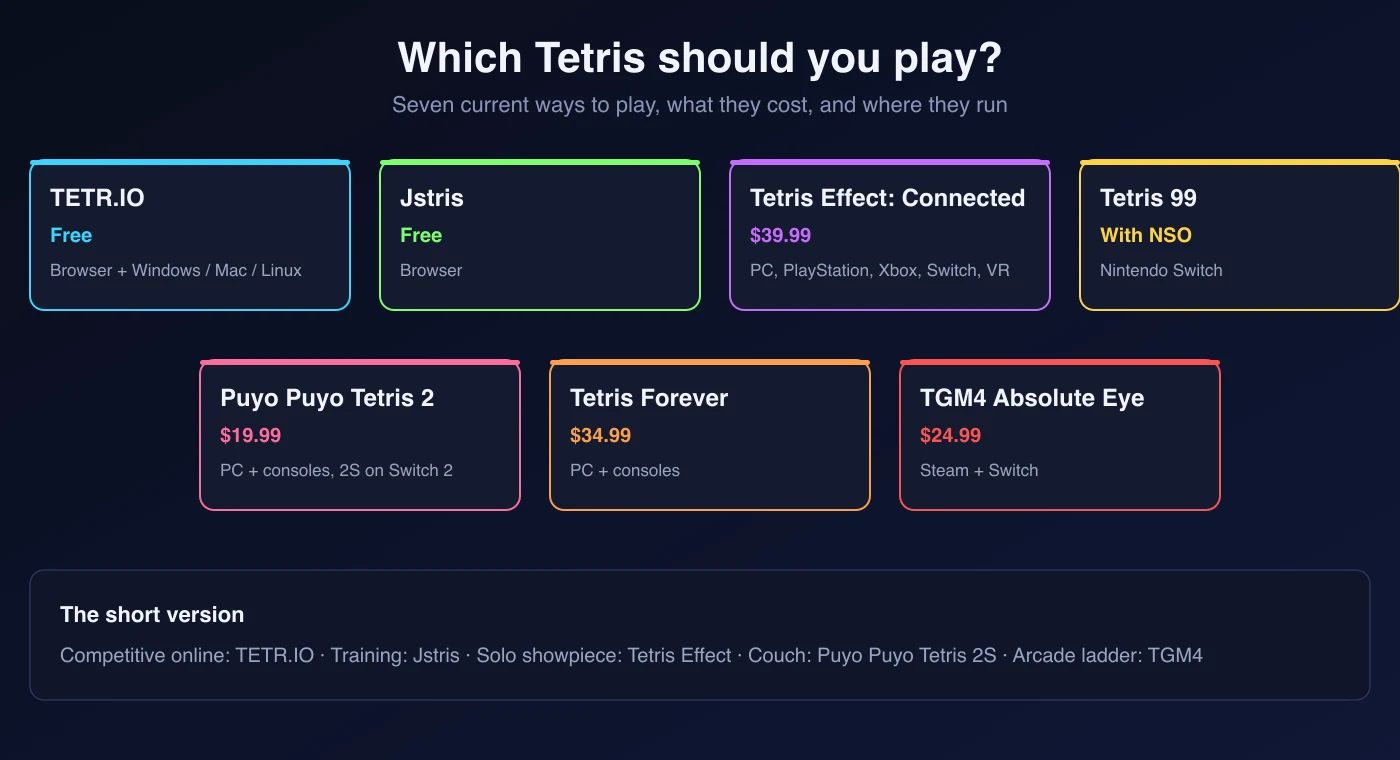
Which Tetris Should You Play? TETR.IO to Tetris Effect
There are at least seven current, maintained ways to play Tetris, and they are not interchangeable — two are free in a browser, one costs $39.99 and works in VR, and one is an arcade grading ladder that came back after twenty years. Here is which one to actually install.
The Tetris Effect Zone Guide: Ultimatris, the Attack Table, and When to Press It
Zone is sold as a get-out-of-jail button, and used as one it pays a fraction of what it could. The published Zone Bonus Attack table says the same lines can be worth 40 garbage rows or 80, depending only on when you pressed it.
Game Boy Tetris Explained: How It Differs From NES
Game Boy Tetris and NES Tetris share a points table, but the handheld game stops speeding up at level 20, pays a level-up Tetris at the old rate, deals the L about 10.7% of the time, and makes a held direction wait 23 frames.
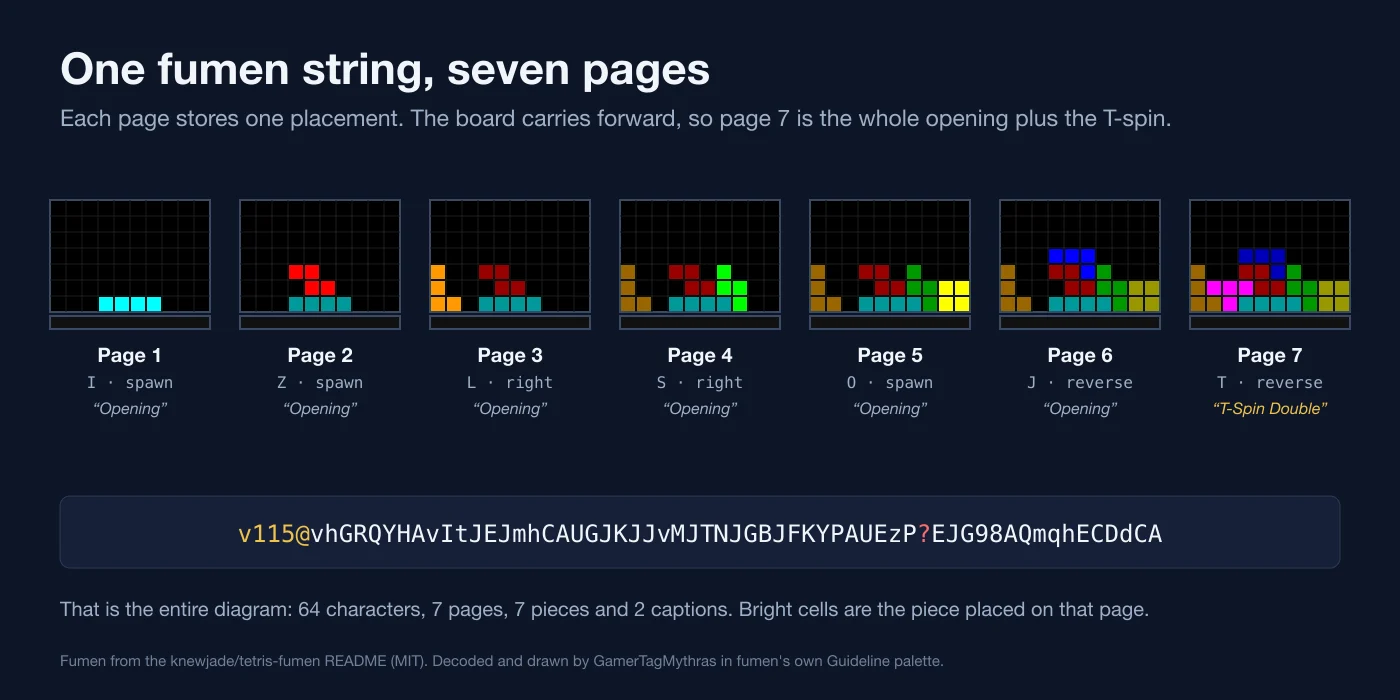
Tetris Fumen Explained: Read, Make and Share Diagrams
The v115@ string attached to Tetris setups is a whole multi-page board packed into a link. Here is what is inside it, which editor to open it in, what Lock, Rise and Mirror do, and where numbers like 84.64% come from.

Tetris Stacking Fundamentals: Build a Board That Wins
Most players do not lose to speed. They lose to a board they built themselves three minutes earlier. Here is how stacking actually works in modern Guideline Tetris, and the habits that stop you from burying your own well.
TGM4 Absolute Eye Modes Explained: Where to Start
Arika's first Grand Master in twenty years is not one game. It is six modes, four unlockable variants behind Normal, two control types that change the randomizer, and a 2,600-level Master mode that freezes your own stack. Here is what each one asks and where to start.