Baldur's Gate 3 Stealth: Where You Stand Beats the Roll
Baldur's Gate 3 only rolls a hiding character's Stealth in one of its three obscurity states; the other two decide whether you are found before Dexterity gets a vote. Here is how obscurity and darkvision work, why Fog and Darkness are different tools, what breaks Hiding, and the gear that switches on in the dark.
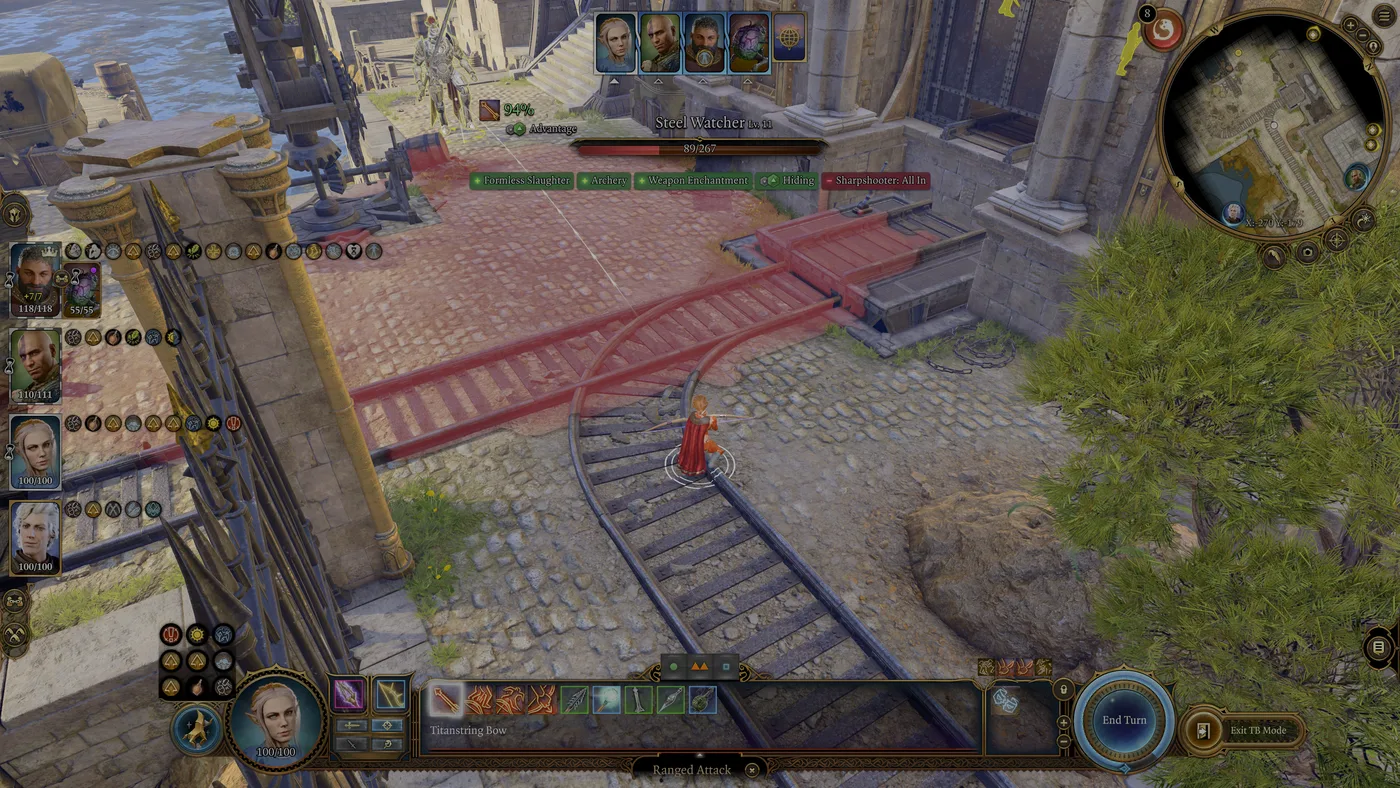
A Rogue with Stealth expertise and Pass Without Trace running is spotted the instant they step into a lit doorway an enemy is looking at. A Wizard with 8 Dexterity hiding inside a Fog Cloud cannot be spotted by anything without Devil's Sight or Born into Darkness, as long as nothing walks into melee range. Neither outcome involves a die.
Baldur's Gate 3 only rolls a hiding character's Stealth in one of its three obscurity states, as the watcher sees them. The other two settle the question before Dexterity gets a vote, which makes hiding in this game a positioning skill first and a Stealth score second. Below is how obscurity decides detection, what darkvision does to it, why Fog and Darkness are different tools, what breaks Hiding, and the gear that only switches on in the shadows. The rules come from bg3.wiki's Hide, Stealth, Obscurity, Sight mechanics and Darkvision mechanics pages, plus the spell, feature and item pages listed at the bottom, checked on 2 October 2026. Where I have done arithmetic on top of them, I say so.
Surprise rounds, and stealth attacks fired from outside every vision cone, are covered in our initiative and surprise guide. This one is about staying unseen once you are already in the room.
Three kinds of ground, and only one of them rolls
Hiding starts with the Hide action, which costs an action for most characters. Rogues (Cunning Action, level 2), Gloom Stalker Rangers (level 3) and Way of Shadow Monks (level 3) each get a bonus-action version. A successful Hide applies the Hiding condition, and from then on, whenever you are in the line of sight of a non-allied creature, the game asks one question: how obscured is the spot you are standing on?
| Where you are standing | What happens when a non-allied creature has line of sight on you |
|---|---|
| Clear Area, or within melee range of the watcher | Spotted immediately. No Stealth check |
| Lightly Obscured | A Stealth check against the watcher's passive Perception, repeated every turn (every 6 seconds outside turn-based mode) for each non-allied creature with line of sight on you |
| Heavily Obscured | No check. Sight lines of creatures without darkvision do not reach into it |
| Outside every line of sight | No check until you enter one |
Four rules sit on top of that table:
- Shadows only conceal someone who is hiding. bg3.wiki's Obscurity page is explicit that a character who has not used Hide gets no protection from line-of-sight detection, whatever the lighting. The Clear Area, Lightly Obscured and Heavily Obscured conditions themselves only apply after a successful Hide.
- Melee range counts as a Clear Area. Get within melee range of the watcher and you are spotted on sight, however dark it is.
- A natural 1 on the check is a critical failure and gets you spotted on the spot, per the Stealth page.
- The DC is the watcher's passive Perception: 10 plus its Wisdom modifier, plus its proficiency bonus if it is proficient in Perception, plus a flat 5 for advantage or minus 5 for disadvantage, per bg3.wiki's Passive checks page.
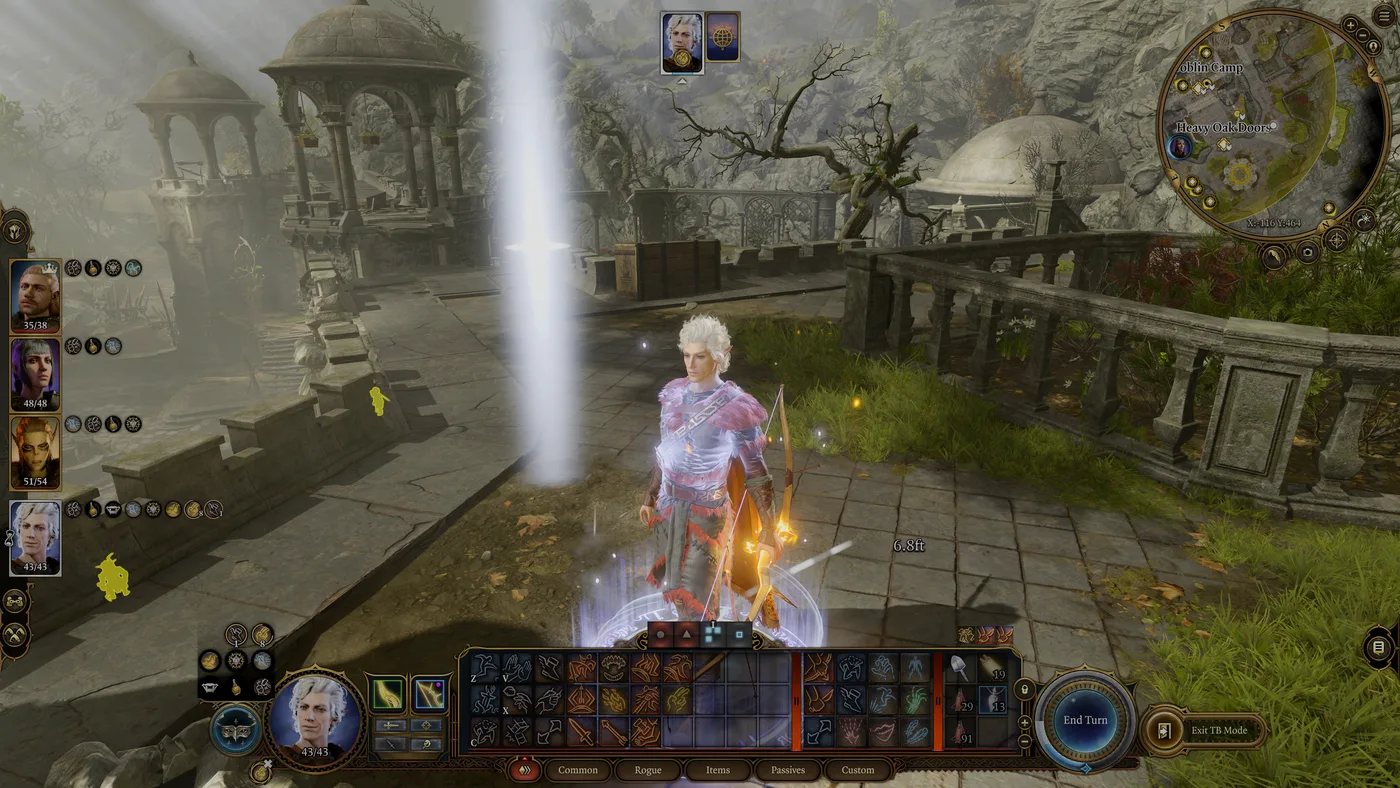
Holding Show Sneak Cones (Left Shift by default) draws enemy sight lines; while the selected character is hiding they appear as a red overlay on the ground, which is what is tinting the cobbles in the screenshot at the top of this page.
Dim light is a slow leak
Lightly Obscured is the only state where your Stealth bonus matters to staying hidden, and it matters less than it looks because the check keeps coming back. Two watchers over three turns is six checks, and you have to pass all six. Working the rules through — my arithmetic, not the wiki's:
| Your Stealth bonus minus their passive Perception | One check | 4 checks in a row | 10 checks in a row |
|---|---|---|---|
| -10 | 55% | 9.2% | 0.3% |
| -8 | 65% | 17.9% | 1.3% |
| -5 | 80% | 41.0% | 10.7% |
| -2 or better | 95% | 81.5% | 59.9% |
| -2 or better, with Halfling Luck | 99.75% | 99.0% | 97.5% |
The 95% row is the ceiling for most characters, because the natural 1 fails whatever your bonus is. Past that point, more Stealth buys nothing against that watcher. Three things lift the ceiling:
- Advantage on the Stealth check. Both dice have to land on 1 to fail, which by my arithmetic is 1 in 400. The Stealth page lists advantage from the Lightfoot Halfling and Deep Gnome races, Elegant Studded Leather and Cat's Grace, among other sources.
- Halfling Luck rerolls a natural 1 once. bg3.wiki's Halfling Luck page puts the failure chance on a roll that only fails on a 1 at 1 in 400.
- Reliable Talent, the Rogue's level 11 feature, treats any die result under 10 as a 10 on a check with a proficient skill, natural 1 included, which its page says removes the chance to critically fail. A proficient Rogue whose Stealth bonus plus 10 meets the watcher's passive Perception passes that check automatically.
Reaching the 95% row is what Pass Without Trace is for: +10 to Stealth for you and allies within 9 m for as long as you concentrate — tied for the largest flat bonus on bg3.wiki's Stealth list. Druids learn it at level 3, Rangers at 5, Trickery Clerics get it as a domain spell, Way of Shadow Monks have it through Shadow Arts, and anyone can cast it once per long rest from the Ring of Shadows, which Oliver gives you for playing both rounds of his hide-and-seek in the House in Deep Shadows. Pass Without Trace is not on the list of actions that keep you hidden (covered below), so cast it before you Hide, not after.
Armour that taxes the roll
Per the Stealth page, every heavy armour and every variant of Scale Mail and Half Plate gives disadvantage on Stealth checks — except six named pieces: Armour of Agility, Helldusk Armour, Protective Plate, Unwanted Masterwork Scalemail, Yuan-Ti Scale Mail and the Sharpened Snare Cuirass. Disadvantage means both dice have to clear the number, so by my arithmetic the 95% row above drops to about 90% per check and the 80% row to 64%. Our best armour guide covers the Exotic Material pieces on that list.
The small Stealth bonuses are cheap to collect: the Smuggler's Ring gives +2 Stealth and +2 Sleight of Hand for -1 Charisma, from a skeleton hidden in a bush on the Risen Road, and the Gloomstrand Shield adds +1.
Darkvision moves you one step into the light
Creatures with darkvision do not see the dark the way you hope they do. Within their darkvision range, per bg3.wiki's Darkvision and Stealth pages:
- Lightly Obscured counts as a Clear Area. You are spotted on sight.
- Heavily Obscured counts as Lightly Obscured. You are back to rolling.
- Inside a Fog Cloud or Darkness, you still count as Heavily Obscured.
The standard ranges are 12 m for Darkvision and 24 m for Superior Darkvision, though the Darkvision mechanics page notes that creatures can carry custom ranges. The Stealth page adds that many creatures have a hidden 2 m darkvision on top, so an enemy with no listed darkvision can still downgrade your cover once you are that close. Sarevok's Horned Helmet and the Assassin of Bhaal Cowl give their wearer functional darkvision out to 5 m.
That is the case against relying on dim light in Act One. bg3.wiki lists the Darkvision passive on the Goblin Warrior, so inside its darkvision range a dim corner of a goblin camp is a Clear Area as far as detection goes.
Devil's Sight and the Born into Darkness passive go a step further: to a creature with either, Fog and Darkness count as only Lightly Obscured. The Born into Darkness page lists it on Sharrans in and around the House of Grief and the Cloister of Sombre Embrace, and the Devil's Sight page lists it on Raphael, Helsik, Sceleritas Fel and a run of imps, among others. Your own cloud is a Stealth check against them, not a guarantee.
For which playable races carry which kind of darkvision, our races guide covers it. The Darkvision mechanics page's short version: Dragonborn, Githyanki, Halflings and Humans have none, and full Drow (not Drow half-elves), Duergar and Deep Gnomes have the 24 m kind.
The dark changes the attack roll too
Obscurity is not only a detection system. bg3.wiki's Sight mechanics page names two attack-roll effects:
- Too dark. Attack rolls against a Heavily Obscured target have disadvantage when the attacker lacks darkvision or the target is beyond its range.
- Attacking from shadows. Attack rolls have advantage when the attacker is Heavily Obscured from the target's point of view — in the Darkvision mechanics page's terms, the attacker's darkvision covers the target and the target's does not cover the attacker. That page marks this rule as still needing verification, so treat its edge cases as unconfirmed.
Hiding adds a third source: the Hiding condition gives advantage on all attack rolls. The catch is on the Hide page — attacking ends Hiding. Anything gated on the Hiding condition is one attack per Hide, which is the real value of the bonus-action version: a Rogue, Gloom Stalker or Shadow Monk who can find a spot to re-hide can Hide and attack in the same turn.
Fog and Darkness are not the same cloud

Both clouds Heavily Obscure and Blind everything inside them, and per the Hide page, hiding inside either one is an automatic success against anything without Devil's Sight or Born into Darkness. After that they part ways, and the difference is projectiles.
| Fog Cloud | Darkness | |
|---|---|---|
| Spell level | 1st | 2nd |
| Radius | 4.5 m, larger when upcast | 5 m |
| Duration | 10 turns, concentration | 10 turns, concentration |
| Blocks sight and targeted spells through it | Yes | Yes |
| Blocks arrows and projectile spells | No | Yes, into and out of it |
| What darkvision does against it | Removes the penalty for shooting in and the advantage for shooting out | Cannot help anyone attack in, though it still denies a shooter inside the cloud its advantage |
| Can you cast it without ending Hiding? | No | Yes — it carries the Stealth spell flag |
| Who can see through it | Devil's Sight and Born into Darkness, through a documented bug | Devil's Sight, the Eyes of the Dark condition, the Eversight Ring, Shar's Spear of Evening, the Steelwatcher Helmet and Born into Darkness |
The Sight mechanics page splits targeted spells such as Sacred Flame, Sleep and Misty Step, which need line of sight, from projectile actions such as weapon shots, Fire Bolt, Fireball and Magic Missile, which only need a clear path. Fog stops the first kind and lets the second through. Darkness stops both. That produces three practical readings:
- Fog hides you; it does not shield you. Projectiles still fly through it, and the Sight mechanics page says enemies typically fire into Fog or walk inside. Everyone inside is Blinded, which per the Blinded condition page means disadvantage on attack rolls and attack and spell range cut to 3 m.
- Darkness is a wall. Nothing shoots in or out unless it can see through magical darkness. The same page says enemies are discouraged from entering, prefer throwing items from outside, and otherwise simply end their turn.
- Lost enemies come looking. When a creature loses a hidden or invisible party member, the Sight mechanics page says it sweeps its vision cone over your last known position, then tries Sense Hidden Presence within 3 m of it; the Detecting Presence condition that applies searches for Invisible creatures within 3 m, who must pass a Dexterity save or be Revealed. The page adds that enemies which cannot reach that spot and act in the same turn tend to do nothing at all, which it describes as a reliable way to make them skip turns.
The Darkness spell is learned at level 3 by Sorcerers, Warlocks and Wizards, at level 5 once per long rest by Drow, Drow half-elves and Asmodeus tieflings, by Eldritch Knights at 7 and Arcane Tricksters at 8, and Way of Shadow Monks get Shadow Arts: Darkness for 2 ki. If you would rather not spend concentration on Fog, the Hammergrim Mist Amulet casts Fog Cloud once per long rest without concentration; it sits in a locked chest in a ruined house east of the tollhouse in the Shadow-Cursed Lands.
Darkness plus Devil's Sight

Devil's Sight is a Warlock Eldritch Invocation available from level 2: you see normally in darkness, magical included, out to 24 m, and you are immune to being Blinded by Darkness — though not by Blindness, Fog Cloud or Hunger of Hadar, per its page. Stand in your own Darkness with it and the Darkness page says your ranged attacks out of the cloud get advantage, tagged "Attacking from shadows", while anything without the same sight cannot shoot back in.
Three caveats from the same pages:
- A target with darkvision spoils it. If the target has darkvision and you are inside its range, you get no advantage. The Darkvision page files that as a bug, since darkvision cannot actually see into magical darkness.
- Enemies with Devil's Sight are not locked out. They treat your cloud as Lightly Obscured, so they get a Stealth check against you.
- Shadow Magic Sorcerers get the same trick without the invocation, but only one way. Casting Eyes of the Dark: Darkness for 2 sorcery points gives the caster sight in the cloud for its duration. Per the Eyes of the Dark condition page, a Darkness cast with a spell slot, or by anyone else in the party, still Blinds them. Our Patch 8 subclasses guide has the rest of that subclass.
What keeps you hidden, and what does not
Hiding ends on the first action that lacks the Stealth spell flag. bg3.wiki's Stealth (spell flag) page says it plainly: a hidden character performing any action without the flag ends stealth and is detected by enemies in range. The common entries on the flagged list:
- Hide in every version, Dash (including Cunning Action: Dash and Step of the Wind: Dash), Jump and Enhanced Jump
- Dip — you can coat your weapon without breaking cover
- Minor Illusion and Meow, the distractions the Hide page names for turning enemy vision cones away from you
- Darkness, Shadow Arts: Darkness and the spear-granted Shar's Darkness
- Patient Defence, Cloak of Shadows, One with Shadows and Hide in Plain Sight
Ordinary attacks are not on it, and neither are Disengage, Pass Without Trace or most spells. One exception for casters: bg3.wiki's Subtle Spell page notes that a Sorcerer casting with Subtle Spell while sneaking keeps their concealment and rolls a Stealth check instead, as if under Greater Invisibility.
Hiding is not Invisible
The two get used interchangeably and they are different conditions with different exits.
| Hiding | Invisible | Greater Invisibility | |
|---|---|---|---|
| Where it comes from | The Hide action | Invisibility, Potion of Invisibility, class features | 4th-level spell, concentration |
| Your attack rolls | Advantage | Advantage | Advantage |
| Attack rolls against you | — | Disadvantage | Disadvantage |
| What ends it | Being spotted, or any action without the Stealth flag | Attacking, casting, interacting with an object, becoming Wet, taking an action or bonus action, or taking damage | Failing a Stealth check when you attack, cast or interact with an item |
The Wet line matters for your own party. bg3.wiki's Wet page says becoming Wet breaks normal Invisibility immediately, which is why our status effects guide warns against Create Water near your own scout; the Greater Invisibility condition lists no such exit.
Greater Invisibility's climbing DC
Greater Invisibility does not end when you act; it asks for a Stealth check, and the DC rises with every success. Per the Greater Invisibility and Stealth pages, the DC is 15 plus the number of previous successful checks outside Honour Mode, and 15 plus that number squared in Honour. Working the formula:
| Previous successful checks | DC outside Honour | DC in Honour |
|---|---|---|
| 0 | 15 | 15 |
| 1 | 16 | 16 |
| 2 | 17 | 19 |
| 3 | 18 | 24 |
| 4 | 19 | 31 |
| 5 | 20 | 40 |
Actions with the Invisible spell flag — Jump, Dash and the Arrow of Darkness among them — skip the check and do not raise the DC. By my arithmetic, a character with +10 Stealth passes the first check 80% of the time and, in an Honour Mode run, the fourth (DC 24) 35% of the time. (The Stealth page's prose describes the second step as DC 17, which disagrees with the formula printed on both pages; the table follows the formula.)
Features that turn you invisible in the dark

A handful of class features turn you invisible or move you between shadows, most of them only from Lightly or Heavily Obscured ground, and they are a large part of what the Way of Shadow Monk and the Gloom Stalker are built around.
| Feature | Who gets it | Cost | What it does |
|---|---|---|---|
| Umbral Shroud | Gloom Stalker, level 3 | Action, once per short rest | Invisible for 10 turns if you are obscured |
| One with Shadows | Warlock invocation, level 2+ | Action | Invisible until long rest while you stand still in dim light or darkness |
| Cloak of Shadows | Way of Shadow, level 5 | Action | Invisible for 10 turns while obscured; lost on entering a Clear Area |
| Shadow Step | Way of Shadow, level 6 | Bonus action | Teleport from an obscured spot to another obscured spot, then advantage on your next melee attack |
| Hide in Plain Sight | Ranger, level 10 | Action, outside combat only | Invisible and +10 Stealth while you stand still; its page lists no obscurity requirement |
| Channel Divinity: Cloak of Shadows | Trickery Domain Cleric, level 6 | Action and a Channel Divinity charge | Invisible for 2 turns |
The pages carry three wrinkles:
- Cloak of Shadows drops if you cross from Lightly to Heavily Obscured ground, or back, because of a coding bug its page documents. Stay in one kind of shadow.
- One with Shadows survives some movement. Its page says movement actions with the Invisible flag, such as Fly (Illithid Power) or Brutal Leap, do not break it — but the basic Jump and Fly (class action) are specifically coded to remove it.
- The Trickery Cleric's version does not need the dark. Its page says it borrows Cloak of Shadows' description but does not actually check for obscurity, so it works in bright light.
Gear that switches on in the dark
The Obscurity page draws the line that matters here. An item that triggers while you are obscured works as long as you are standing in a Lightly or Heavily Obscured space — you do not need to Hide. An item that triggers while you are Hiding needs the condition, and gives it up on your first ordinary attack. A third group cares whether the target is obscured, which makes them payoffs for your own Darkness and Fog rather than stealth gear.
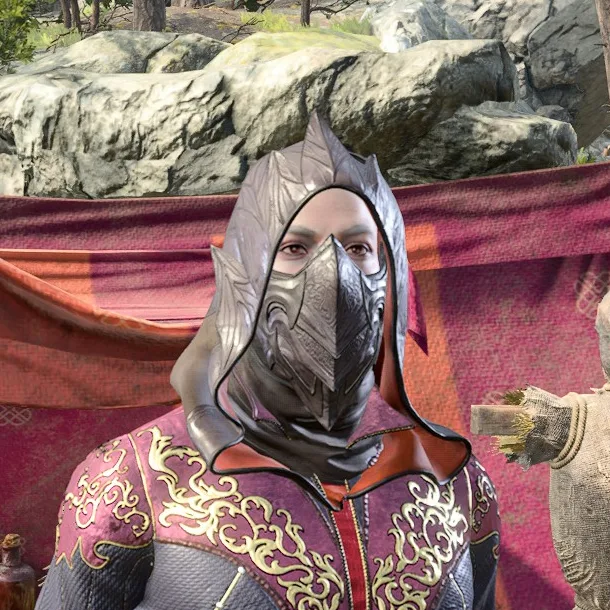
| Item | Triggers when | Effect | Where |
|---|---|---|---|
| Covert Cowl (uncommon helmet, light armour proficiency) | You are obscured | Crits on a roll 1 lower; +1 Dexterity saves | Carried by a Meenlock in the Last Light Inn cellar |
| The Shadespell Circlet (uncommon helmet) | You are obscured | +1 spell save DC | Sold by Omeluum after Help Omeluum Investigate the Parasite |
| Penumbral Armour (rare light armour, 12 AC) | You are obscured | +3 Stealth | Locked opulent chest in the abandoned house by the river east of the Last Light Inn |
| Shadeclinger Armour (rare light armour, 12 AC) | You are obscured | Advantage on saving throws (its +1 Stealth applies everywhere) | Sold by Quartermaster Talli near the Last Light Inn waypoint |
| Ring of Twilight (rare ring) | You are obscured | +1 AC | Traveller's chest behind pots in a ruined tower, Ruined Battlefield |
| Least Expected (rare +2 shortbow) | You are obscured | +1d4 to ranged weapon attack rolls | Gilded chest beyond the locked puzzle door, Gauntlet of Shar |
| Shade-Slayer Cloak (very rare cloak) | You are Hiding | Crits on a roll 1 lower | Sold by Sticky Dondo at the Guildhall |
| Dread Iron Dagger (rare +1 dagger) | You are Hiding | +1d6 Necrotic damage | Sold by the Echo of Abazigal, only to a character who accepts becoming an Unholy Assassin |
| Hellfire Hand Crossbow (very rare +2) | You are Hiding or Invisible | Chance to inflict Burning, DC 15 Constitution save | Carried by Yurgir in the Gauntlet of Shar |
| Shadow-Cloaked Ring (uncommon ring) | The target is obscured | +1d4 weapon and unarmed damage | Carried by the Shadow Mastiff Alpha at a cursed camp north of the ruined pottery; destroy the everburning torches to make it appear |
| Knife of the Undermountain King (very rare +2 shortsword) | The target is obscured | Advantage on melee weapon attack rolls | Sold by A'jak'nir Jeera in Crèche Y'llek |
| Shadow Blade (2nd-level spell, or the Shadow Blade Ring) | The target is in dim light or darkness | Advantage on attack rolls with the conjured blade | The ring is Arabella's reward for Find Arabella's Parents |
| Shar's Spear of Evening (legendary +3 spear) | You, or the target, are obscured | Advantage on saves while obscured; +1d6 damage to obscured creatures; immune to Blinded; casts Shar's Darkness once per turn | Shar's reward to Shadowheart for killing Nightsong |
Nine of those thirteen come from Act Two. The item and passive-feature pages add the fine print:
- Several are buggier than their tooltips. Viconia's Priestess Robe and both Dark Justiciar Half-Plates promise advantage on Stealth "while obscured", but the Stealth page says all three apply it everywhere, Clear Area included. Shar's Spear's save advantage only works on Dexterity saves, and its bonus d6 lands on any weapon attack against an obscured creature, not just the spear's. Dread Iron Ambush likewise adds its d6 to every weapon attack its wielder makes while hidden.
- Some leave their buff behind. Shadeclinger's Clinging Shadows, the Shade-Slayer Cloak's Skilled Skullduggery and the Dread Iron Dagger's Lethal Concealment all stay on the character after the item is unequipped. Shadeclinger's page notes you can pass its condition to the whole active party by having each member equip and remove it in turn.
- Least Expected switches on late. Equip it while already obscured and Darkveil Precision does not apply until you step into a Clear Area and back, or Hide.
- The Shadow Blade only wants the target in the dark. Patch 8 Hotfix 1 limited the passive to melee weapon attacks, and the ring's page says that since Patch 8 the spell needs no concentration and the blade lasts until long rest, so the ring can make one blade per short rest.
- The Cloak of Cunning Brume, sold by Mattis at the Last Light Inn, drops a 2 m fog cloud for one turn whenever you Disengage — a portable Heavily Obscured patch to Hide in.
Covert Cowl and Shade-Slayer Cloak also sit in our critical hits guide's threshold table, and they stack with the other reductions there.
Quick reference
- Hide first, or the shadows will not conceal you. Obscurity only protects a character with the Hiding condition from being spotted. Hide is an action, or a bonus action for Rogues, Gloom Stalkers and Way of Shadow Monks.
- Clear Area or melee range: spotted on sight. Lightly Obscured: Stealth against passive Perception, every turn, per watcher. Heavily Obscured: no check. A natural 1 on the check gets you spotted.
- In dim light the natural 1 caps most characters at 95% per check, which by my arithmetic is about 60% over ten checks. Advantage on Stealth, Halfling Luck and Reliable Talent are the ways past it; Pass Without Trace's +10 is the usual way to reach it.
- Darkvision steps your cover down one level inside its range: Lightly Obscured becomes Clear, Heavily becomes Lightly. Fog and Darkness still count as Heavily Obscured against it.
- Attacks against a Heavily Obscured target are at disadvantage without darkvision; Hiding gives advantage on attack rolls, and attacking ends Hiding.
- Fog blocks sight but not projectiles. Darkness blocks both, and can be cast without breaking Hiding.
- Devil's Sight in your own Darkness gives advantage on ranged attacks out, unless the target has darkvision and you are inside its range.
- Hiding ends on any action without the Stealth flag. Dash, Jump, Dip, Minor Illusion and Darkness keep you hidden; attacks, Disengage and Pass Without Trace do not.
- Greater Invisibility's Stealth DC is 15 plus your previous successes, or plus their square in Honour Mode.
- "While obscured" gear works without hiding; "while Hiding" gear needs the condition; Shadow Blade, the Knife of the Undermountain King and the Shadow-Cloaked Ring want the target in the dark.
Frequently Asked Questions
How does hiding work in Baldur's Gate 3?
What is the difference between Lightly and Heavily Obscured in BG3?
Does darkvision help enemies find you in Baldur's Gate 3?
Can you attack out of a Darkness spell in Baldur's Gate 3?
Does attacking from hiding give advantage in BG3?
What actions can you take without breaking stealth in Baldur's Gate 3?
What gear works when you are obscured in Baldur's Gate 3?
Keep Reading
- BG3 Wiki — Hide: action cost, detection by obscurity, attacking ends hiding, red sight-cone overlay, Fog and Darkness as automatic successes
- BG3 Wiki — Stealth: hiding checks, darkvision and Devil's Sight adjustments, natural 1, Greater Invisibility DC, bonus and penalty items, armour with Stealth disadvantage
- BG3 Wiki — Obscurity: Clear, Lightly and Heavily Obscured, obscured-triggered items, and no protection without hiding
- BG3 Wiki — Sight mechanics: line of sight, target vs projectile actions, Fog vs Darkness, Too dark and Attacking from shadows, enemy search behaviour
- BG3 Wiki — Darkvision mechanics: ranges, the 2 m minimum, 5 m item sources, racial darkvision table, attack effects
- BG3 Wiki — Darkvision: obscurity step-down and the Darkness advantage bug
- BG3 Wiki — Superior Darkvision: 24 m range and obscurity step-down
- BG3 Wiki — Passive checks: the passive Perception formula used as the hiding DC
- BG3 Wiki — Hiding condition: advantage on all attack rolls
- BG3 Wiki — Stealth spell flag: the list of actions that keep you hidden
- BG3 Wiki — Invisible spell flag: actions that do not break Invisibility or trigger Greater Invisibility checks
- BG3 Wiki — Invisible condition: advantage, disadvantage against you, and what ends it
- BG3 Wiki — Wet condition: becoming Wet breaks normal Invisibility immediately
- BG3 Wiki — Greater Invisibility condition: advantage, disadvantage against, and Stealth checks to keep it
- BG3 Wiki — Greater Invisibility: the Stealth check DC formula, linear and Honour Mode quadratic
- BG3 Wiki — Metamagic: Subtle Spell: casting while sneaking without breaking concealment
- BG3 Wiki — Halfling Luck: rerolling a natural 1, 1-in-400 failure on rolls that only fail on a 1
- BG3 Wiki — Reliable Talent: minimum 10 on proficient skill checks, no critical failures
- BG3 Wiki — Pass Without Trace: +10 Stealth, 9 m aura, concentration, who learns it
- BG3 Wiki — Ring of Shadows: Pass Without Trace once per long rest, Oliver's reward
- BG3 Wiki — Smuggler's Ring: +2 Stealth and Sleight of Hand, -1 Charisma, Risen Road
- BG3 Wiki — Gloomstrand Shield: +1 Stealth
- BG3 Wiki — Goblin Warrior: carries the Darkvision passive
- BG3 Wiki — Devil's Sight: 24 m sight in magical darkness, Blinded immunity limits, creatures that have it
- BG3 Wiki — Born into Darkness: Sharrans who see through magical darkness and Fog
- BG3 Wiki — Fog Cloud: 1st level, 4.5 m radius, concentration, upcast radius
- BG3 Wiki — Fog cloud area: Heavily Obscures and Blinds, the IgnoreSurfaceCover bug
- BG3 Wiki — Darkness: 2nd level, 5 m radius, blocks ranged attacks, Stealth flag, who sees through it, Attacking from shadows
- BG3 Wiki — Eyes of the Dark: Darkness: the Shadow Magic Sorcerer's 2-sorcery-point Darkness
- BG3 Wiki — Eyes of the Dark condition: only the sorcery-point version grants sight in Darkness
- BG3 Wiki — Blinded: disadvantage on attack rolls and 3 m range
- BG3 Wiki — Detecting Presence: searching within 3 m, Dexterity save or Revealed
- BG3 Wiki — Minor Illusion: cast while hidden to turn and lure enemies
- BG3 Wiki — Hammergrim Mist Amulet: Fog Cloud without concentration, Shadow-Cursed Lands
- BG3 Wiki — Cunning Action: Hide: Rogue level 2 bonus-action Hide
- BG3 Wiki — Dread Ambusher: Hide: Gloom Stalker level 3 bonus-action Hide
- BG3 Wiki — Shadow Arts: Hide: Way of Shadow level 3 bonus-action Hide
- BG3 Wiki — Umbral Shroud: Gloom Stalker invisibility while obscured
- BG3 Wiki — One with Shadows: Warlock invocation, invisible while still in the dark
- BG3 Wiki — Cloak of Shadows: Way of Shadow level 5, and the obscurity-transition bug
- BG3 Wiki — Shadow Step: Way of Shadow level 6 teleport between obscured spots
- BG3 Wiki — Hide in Plain Sight: Ranger level 10, +10 Stealth, out of combat only
- BG3 Wiki — Channel Divinity: Cloak of Shadows: Trickery Cleric, works without obscurity
- BG3 Wiki — Obscured set: equipment that benefits from obscurity
- BG3 Wiki — Hiding set: equipment that benefits from the Hiding condition
- BG3 Wiki — Covert Cowl: Covert Critical while obscured, Last Light Inn cellar
- BG3 Wiki — The Shadespell Circlet: +1 spell save DC while obscured, sold by Omeluum
- BG3 Wiki — Penumbral Armour: +3 Stealth while obscured
- BG3 Wiki — Shadeclinger Armour: advantage on saves while obscured, and the lingering-condition bug
- BG3 Wiki — Ring of Twilight: +1 AC while obscured
- BG3 Wiki — Least Expected: Darkveil Precision, Gauntlet of Shar
- BG3 Wiki — Darkveil Precision: +1d4 ranged weapon attack rolls while obscured, and the equip bug
- BG3 Wiki — Shade-Slayer Cloak: Stealthy Critical while hiding, sold by Sticky Dondo
- BG3 Wiki — Dread Iron Dagger: Dread Iron Ambush while hidden, Echo of Abazigal
- BG3 Wiki — Hellfire Hand Crossbow: Hellstalker Burning while hiding or invisible, carried by Yurgir
- BG3 Wiki — Shadow-Cloaked Ring: Shadowthief +1d4 against obscured creatures
- BG3 Wiki — Knife of the Undermountain King: Shadow Blade passive, sold by A'jak'nir Jeera
- BG3 Wiki — Shadow Blade passive: advantage against obscured targets, limited to melee weapon attacks since Patch 8 Hotfix 1
- BG3 Wiki — Shadow Blade Ring: Arabella's reward, no concentration since Patch 8
- BG3 Wiki — Shar's Spear of Evening: Shar's Blessing, Blind immunity and Shar's Darkness
- BG3 Wiki — Shar's Blessing: obscured save advantage and bonus damage, with both documented bugs
- BG3 Wiki — Shar's Umbrae: Stealth advantage that ignores obscurity
- BG3 Wiki — Dread Iron Ambush: 1d6 Necrotic while hidden, applies to all weapon attacks, Lethal Concealment lingers after unequipping
- BG3 Wiki — Stealthy Critical: crit threshold -1 while Hiding, Skilled Skullduggery lingers after unequipping
- BG3 Wiki — Hellstalker: Burning while Hiding or Invisible, DC 15 Constitution save
- BG3 Wiki — Cunning Brume: 2 m fog cloud for 1 turn on Disengage
- BG3 Wiki — Cloak of Cunning Brume: fog on Disengage, sold by Mattis
Related Guides
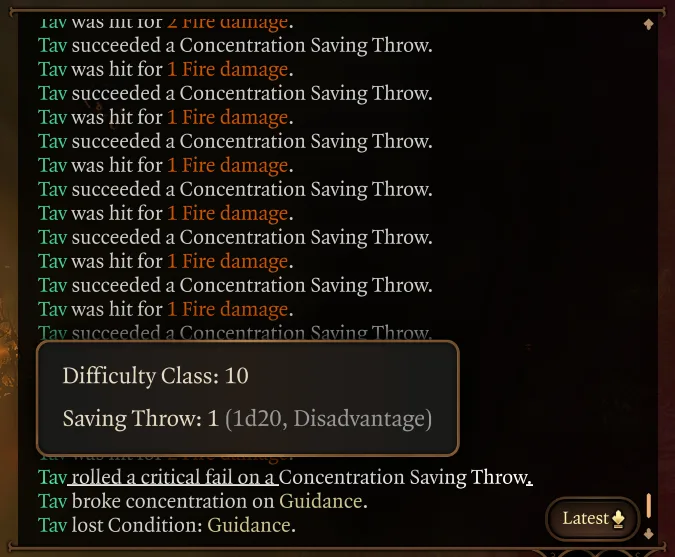
Baldur's Gate 3 Concentration: Why Your Spell Dropped
Baldur's Gate 3 ends concentration in more ways than the tabletop rules do: a natural 1 fails the save whatever your bonus, falling Prone ends it with no roll, and casting a second concentration spell after Haste on yourself costs you both. Here is what breaks it, temporary hit points and Rage included, the gear and feats that hold it, and the spells BG3 stopped making you concentrate on.
Baldur's Gate 3 Death Saves: What Actually Kills You
Baldur's Gate 3 keeps the tabletop shape of death saving throws and rewrites the details: no massive-damage deaths, no natural-20 comebacks, and failures that survive stabilising. Here is what kills a Downed character, what stops it, and what each way back from the dead costs.
Baldur's Gate 3 Initiative and Surprise: How to Go First
Tabletop D&D rolls initiative on a d20. Baldur's Gate 3 rolls it on a d4, which turns a +5 from Alert from a nudge into something close to a guarantee. Here is how turn order is built, what Surprised takes away, and the line-of-sight rule that decides whether your ambush gets a surprise round at all.
Baldur's Gate 3 Wild Shape: It Can Kill You With No Save
An Owlbear form shows 65 hit points on a bar that looks nothing like your character sheet. That number is a mask, not a shield — bg3.wiki's own Wild Shape page spells out exactly what happens when it runs out, and it is not a knockdown. Here is the charge economy, what carries over and what shuts off, and the overflow rule that can end a character with no down-and-dying phase at all.

Baldur's Gate 3 Beginner Guide: What Nobody Tells You
The tutorial teaches you to move and attack. It does not teach you that advantage is worth more than any weapon you will find in Act 1, or that Withers will rebuild your entire character for 100 gold. Here is the actual onboarding.
Baldur's Gate 3 Critical Hits: What Actually Doubles
A natural 20 doubles your damage in Baldur's Gate 3 — but "doubled" hides real nuance: which half of that number actually doubles, which of the game's dozen crit-threshold sources stack together, and how "immune to critical hits" still lets a natural 20 miss outright. bg3.wiki's own combat-log breakdown settles all three.