Baldur's Gate 3 Concentration: Why Your Spell Dropped
Baldur's Gate 3 ends concentration in more ways than the tabletop rules do: a natural 1 fails the save whatever your bonus, falling Prone ends it with no roll, and casting a second concentration spell after Haste on yourself costs you both. Here is what breaks it, temporary hit points and Rage included, the gear and feats that hold it, and the spells BG3 stopped making you concentrate on.
Cast Haste on your own Wizard, then cast Hold Person while Haste is still running. First, Haste ends, because a caster holds one concentration spell at a time and the new one evicts the old. That leaves your Wizard Lethargic: no movement, no actions, no bonus actions, no reactions. Then, per bg3.wiki's Haste page, the Hold Person you were in the middle of casting ends too, taking its spell slot with it. Nothing hit you. You did that to yourself.
Concentration is Baldur's Gate 3's one-spell budget, and the game has more ways to end it than the tabletop rules it is built on. A damaged caster rolls to keep it. A caster knocked Prone, put to sleep, Held or sent into a Rage loses it with no roll at all. And a natural 1 on the save fails however big the bonus is. Below is how it breaks, what holds it, and which spells BG3 stopped making you concentrate on. The rules come from bg3.wiki's Concentration, Dice rolls, Hit points and D&D 5e spell changes pages plus the spell, condition, feat and item pages listed at the bottom, checked on 10 October 2026. Where I have done arithmetic on top of them, I say so.
One spell at a time, and it starts on its own
Any spell with the Concentration tag needs its caster to keep focusing on it, and per the Concentration page that focus starts automatically when you cast it. You can hold one at a time. Cast a second and the first ends.

The spell you are holding shows as a small icon beside the caster's portrait. Clicking the X on that icon ends it; on Xbox and PlayStation the wiki says to open the action wheel and hold Y or Triangle. The game also ends it for you in three situations that have nothing to do with a fight going badly:
- A long rest ends most spells, which ends their concentration with them.
- Dismissing a companion from the party drops whatever they were concentrating on.
- The Flee Combat button breaks it. Walking far enough away that the game leaves turn-based mode on its own does not.
Two more things the tag covers that are easy to miss. It is not only spells: class actions such as the Trickery Cleric's Blessing of the Trickster carry the same concentration flag, which matters for the Rage rule further down. And it is a big slice of the spellbook. Of the 213 entries in the cantrip-to-6th-level sections of bg3.wiki's list of all spells, 91 carry a concentration flag on their own spell page — 43%, by my count.
The damage save is DC 10 for any hit up to 20
Take damage while concentrating and you make a Constitution saving throw against a DC of 10 or half the damage taken, whichever is higher. Fail it and the spell ends. Any hit of 20 damage or less is a flat DC 10. It takes a 30-damage hit to reach DC 15 and a 40-damage hit to reach DC 20.
Because it is a Constitution save, anything that helps Constitution saves helps it: proficiency, advantage, flat bonuses. Three rules from the Concentration and Dice rolls pages make it behave differently from the other saves you roll in combat:
- A natural 1 fails. The Concentration page calls it a critical failure that almost always breaks concentration, whatever your bonus would have added. Most saving throws in Baldur's Gate 3 do not fail automatically on a 1; the Dice rolls page names saves to maintain concentration and saves made in dialogue as the exceptions.
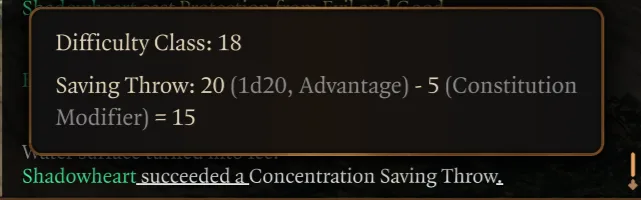
- A natural 20 succeeds, the same exception in the other direction. In the screenshot below, a die showing 20 totals only 15 against DC 18 after a −5 Constitution modifier, and the log still reports a successful concentration save.
- Damage reduced to zero triggers no save at all. That is the one way damage reduction protects concentration outright. Heavy Armour Master's flat 3-point reduction, which bg3.wiki's Feats page says applies to all Slashing, Bludgeoning and Piercing damage while you wear heavy armour, turns a 3-damage hit into no roll at all.
Reactions cannot touch any of it. As our reactions guide covers, the reaction system ignores concentration saves entirely, so Cutting Words cannot sink an enemy's and Bend Luck cannot rescue yours.
What the roll looks like, hit after hit
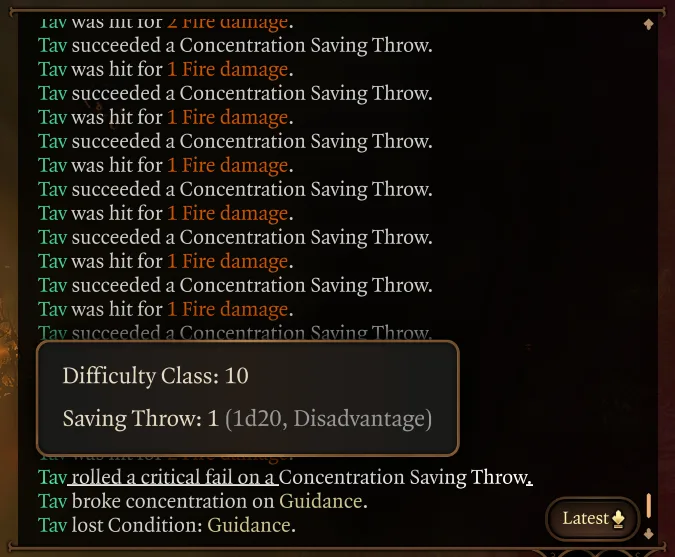
The screenshot at the top of this page is the cost of small hits: Tav takes 1 or 2 Fire damage again and again, rolls a concentration save after each hit, and keeps Guidance right up until a 1 comes up. Each roll is a fresh DC 10, so the real question is not whether you pass one but whether you pass all of them. Working it through, with the natural 1 always failing — my arithmetic, not the wiki's:
| Constitution save bonus | One hit | With advantage | With disadvantage | Three hits in a row | Three hits, with advantage |
|---|---|---|---|---|---|
| +0 | 55% | 79.75% | 30.25% | 16.6% | 50.7% |
| +2 | 65% | 87.75% | 42.25% | 27.5% | 67.6% |
| +4 | 75% | 93.75% | 56.25% | 42.2% | 82.4% |
| +5 | 80% | 96% | 64% | 51.2% | 88.5% |
| +6 | 85% | 97.75% | 72.25% | 61.4% | 93.4% |
| +8 or more | 95% | 99.75% | 90.25% | 85.7% | 99.3% |
The +2 row is a Wizard with 14 Constitution and no proficiency in Constitution saves: a little better than a one-in-four chance that the spell survives three hits. The bottom row is the ceiling. Past +8, extra bonus buys nothing against DC 10, because the natural 1 still fails 5% of the time. Two things lift that ceiling: advantage, since both dice then have to land on 1, and Halfling Luck, which rerolls a natural 1 and which the Concentration page says typically lets halflings avoid the critical failure.
Temporary hit points do not protect it
bg3.wiki's Hit points page is explicit: while concentrating, damage that lands on temporary hit points still causes a concentration check, even if none of it reaches your real hit points. False Life and Armour of Agathys keep you alive. They do not keep your spell up.
Damage you deal to yourself counts as well. The Transfuse Health page notes that its self-damage can break concentration, and our illithid powers guide already warns against running Psionic Overload, which deals 1d4 psychic to you every turn, on a concentration caster.
The second spell is the one that dies

Casting a concentration spell while you hold another ends the first one, and the Concentration page adds the detail that matters: the new spell only goes off after the old one breaks. Most of the time that ordering is invisible. With Haste it is the trap from the top of this page:
- Haste on yourself, then any concentration spell. Haste ends, you become Lethargic, and the Haste page says the new spell ends as well, costing you its spell slot or scroll. Lethargic lasts 1 turn and blocks movement, actions, bonus actions and reactions.
- Haste on an ally, then a concentration spell. The Concentration page ties the failure to the caster being Haste's own target. Here the Lethargic turn lands on the ally, and the rule as written does not stop your new spell, so you have traded their extra action for it.
- Lethargic does not break concentration, per its condition page. An ally who goes Lethargic keeps whatever they were concentrating on.
If you want Haste on your own caster without the hangover, Gontr Mael grants Celestial Haste once per long rest. It is still concentration, it lasts 5 turns instead of 10, and per its page it does not leave you Lethargic when it ends.
The eviction rule reaches spells that leave something on the battlefield, too. The Spike Growth page notes that casting another concentration spell, its example being Hunter's Mark, removes the spikes.
What ends it with no roll at all
Some conditions end concentration on contact, with no save offered. The Concentration page lists Prone, Downed, Banished, Sleeping, Incapacitated, entering a Rage, and anything in the game's Incapacitated status group. Checking the condition pages against that group gives the practical list:
| Condition | Where it usually comes from | What its page says |
|---|---|---|
| Prone | Grease, Ice surfaces, Topple, Backbreaker | Falling Prone immediately ends concentration |
| Downed | Dropping to 0 hit points | In the Incapacitated status group |
| Sleeping | The Sleep spell | Removed by damage, becoming Wet, Help or a Shove |
| Banished | Banishment, Banishing Smite | In the Incapacitated status group |
| Hold Person and Hold Monster | Those two spells | Both conditions are in the Incapacitated status group |
| Stricken with Crawler Mucus | The Crawler Mucus coating | Poisoned and Paralysed; in the Incapacitated status group |
| Hypnotised | Hypnotic Pattern | In the Incapacitated status group; removed by damage, a Shove or Help |
| Frozen | Being made Chilled, then Wet | In the Incapacitated status group; the reverse order does not work |
| Stunned | Stunning effects | Breaks the target's concentration when applied |
| Petrified | Flesh to Stone | Lists losing concentration |
| Rage | A Barbarian entering Rage | Ends concentration from all sources; no casting or concentrating on spells while raging |
Most of that list is covered elsewhere on this site. Prone is in our status effects guide and our weapon actions guide, Downed in our death saves guide, and the paralysing coatings in our coatings guide. What the table adds is the other half of each of those: the same Hold Person that takes an enemy's turn also strips the spell it was holding.
The Rage row has a wrinkle. The Rage page says concentration from non-spell sources can still be started mid-Rage, naming Blessing of the Trickster and Mantle of Majesty: Command. A Barbarian multiclass holding Hunter's Mark loses it the moment they rage.
Oddities the wiki documents
- Blink breaks your concentration when you vanish. The Blink page files it as a bug: the spell is meant to skip the effect that ends concentration, but a status-group error ends it anyway. The wiki's spell-changes table gives the example of a Haste or Invisibility the Blinker was holding on someone else ending when they go ethereal.
- Moonbeam on blighted ground in the Shadow-Cursed Lands costs you concentration and dispels the beam, though its damage still lands. The Moonbeam page dates this to Patch 6.
- Sanctuary ends Spirit Guardians. Per the Spirit Guardians page, the spell ends immediately if Sanctuary is applied to its caster, and that caster cannot turn Invisible while holding it.
- Unpreparing a spell can end it. bg3.wiki's rule-changes page says some spells with an ongoing effect end when the caster unprepares them and others do not, and that it is not clear the inconsistency is intentional. The Enhance Ability page, in a note it marks as still needing verification, names that spell as one that survives being unprepared. If you swap prepared spells between fights, check the concentration icon afterwards.
Holding it: what actually helps

Anything that improves a Constitution save improves a concentration save, which makes the list much longer than the War Caster feat. The rows below come from bg3.wiki's Constitution page, its list of features and items that affect saving throws, and each item's own page.
| Source | What it does for the save | How you get it |
|---|---|---|
| War Caster (feat) | Advantage on concentration saves | Any feat level |
| Elixir of Peerless Focus | Advantage on concentration saves until your next long rest | Brewed from Sublimate of Belladonna and any Ashes; base value 20 |
| Gibus of the Worshipful Servant (rare hat) | Advantage on concentration saves | Given to the Dark Urge by Helsik at the Devil's Fee, or carried by Sceleritas Fel if the Dark Urge refuses Bhaal's gift after defeating Orin |
| Amulet of Greater Health (very rare) | Constitution set to 23, plus advantage on Constitution saves | The House of Hope's Archive |
| Barkskin Armour (rare medium armour) | Advantage on Constitution saves; sets AC to 16 | Sold by Quartermaster Talli near the Last Light Inn waypoint |
| Spidersilk Armour (rare light armour) | Advantage on Constitution saves | Worn by Minthara |
| Steel Watcher Helmet (rare, medium armour proficiency) | Advantage on Constitution saves | On a table on the ground floor of the Steel Watch Foundry, near the east entrance |
| Moon Devotion Robe (very rare clothing) | Advantage on Constitution saves | Worn by Isobel after the Nightsong is dealt with, before the assault on Moonrise Towers |
| Armour of Landfall (very rare light armour) | Advantage on Constitution saves | Sold at Sorcerous Sundries by Lorroakan's Projection or Rolan |
| Resilient: Constitution (feat) | Proficiency in Constitution saves, plus 1 Constitution | Any feat level |
| Barbarian, Fighter or Sorcerer | Proficiency in Constitution saves | Only when it is the class you take at level 1 |
| Elixir of Dwarven Resilience | Adds your proficiency bonus to saves until you succeed on 3 of them or long rest | Araj Oblodra, for dwarven or duergar blood |
| Bladesong | +2 to Constitution saves, +3 at Wizard level 5, +4 at level 9 | Bladesinging Wizard; not in medium or heavy armour or with a shield |
| Robe of Supreme Defences (very rare clothing) | Adds your spellcasting modifier to saves while you concentrate on a spell | Ferg Drogher's special stock near the Requisitioned Barn, behind a Persuasion check |
| Starry Form: Dragon | A roll of 9 or lower on a concentration save counts as 10 | Circle of the Stars Druid, level 2 |
| Aura of Protection | Your Charisma modifier added to saves for you and allies within 3 m | Paladin, level 6 |
Three catches hide in and around that table. The Gibus's confirmed sources all run through the Dark Urge, which our Dark Urge guide does not cover; its page also places a copy on Helsik's desk in runs without the Urge as origin, but flags that location as still needing verification. The level 1 class rule follows from the one in our multiclassing guide, that multiclassing never grants saving throw proficiencies: a Fighter 1 / Wizard keeps Constitution save proficiency, a Wizard 1 / Fighter does not. And Bless and the Resistance cantrip both add 1d4 to saves, but both are concentration spells themselves, so that bonus has to come from somebody else's concentration.
Things on the wrong side of the ledger count too. bg3.wiki's Constitution page lists Heavily Encumbered among the conditions that give disadvantage on Constitution saves, and our accessories guide already flags the Risky Ring's disadvantage on every save. Load your caster up with the party's loot until they are Heavily Encumbered and their concentration saves pick up disadvantage.
Advantage does not stack, so pick one
Per bg3.wiki's Advantage page, you either have advantage or you do not. Three sources roll the same two dice as one, and a single source of disadvantage cancels any number of them. So War Caster plus the Elixir plus a Barkskin Armour is one advantage and two wasted resources. The efficient build is one advantage source plus flat bonuses, and the Amulet of Greater Health is both at once: Constitution 23 is a +6 modifier, and with advantage, by my arithmetic, a caster with no save proficiency holds through a DC 10 hit 97.75% of the time.
Two more stacking notes:
- Araj's elixirs stack with other elixirs. The Elixir of Dwarven Resilience page says they function independently of other elixirs, so its proficiency and Peerless Focus's advantage can run together. Dwarven Resilience ends after three successful saves of any kind, though. Our elixirs guide covers the one-elixir rule it gets around.
- Starry Form: Dragon mostly makes advantage irrelevant against small hits. With a Constitution save bonus of +0 or better, a floor of 10 meets DC 10 on paper every time. Its page does not say whether a natural 1 still counts as a critical failure in that form, so treat that corner as unconfirmed. Our Patch 8 subclasses guide has the rest of the subclass.
Breaking an enemy's concentration
The rules run the other way too. The tools that tilt an enemy's save, from their wiki pages:
- Mage Slayer says enemies you hit have disadvantage on concentration saves. bg3.wiki's page for that passive says the actual effect is stronger: after a melee hit from a Mage Slayer, the target still rolls its save, without disadvantage, and loses concentration whatever the result.
- Wizardsbane Oil gives disadvantage on concentration saves for 2 turns per hit, and the Arrow of Arcane Interference breaks concentration outright. Both are in our coatings guide.
- Bleeding and Chest Trauma give disadvantage on Constitution saves, which covers concentration saves. Lacerate and Heartstopper apply them.
- Sleet Storm forces spellcasters inside it to make concentration saves. Its page notes that the DC uses the spellcasting modifier of the caster's most recently acquired spellcasting class, not the one they cast it with.
- Shatter Psyche, a full-illithid power, adds disadvantage on concentration saves to its −6 AC and −5 to all saves.
- And the no-roll list above: Prone, Hold Person, Hypnotic Pattern, Banishment and Sleep all end the spell without asking.
Spells BG3 stopped making you concentrate on
Baldur's Gate 3 removed concentration from a handful of spells that need it at the table, and added it to Planar Binding. Every row here is listed as a change on bg3.wiki's D&D 5e spell changes page; where the spell is in the 5e System Reference Document, its SRD entry confirms the tabletop side.
| Spell | Tabletop (2014 rules) | Baldur's Gate 3 |
|---|---|---|
| Hail of Thorns | Concentration | No concentration; does not work with Extra Attack |
| Thunderous Smite | Concentration | No concentration; the push always happens on a hit |
| Blinding Smite | Concentration | No concentration needed to keep the Blinded rider |
| Lightning Arrow | Concentration | No concentration and no bonus action; instantaneous |
| Gust of Wind | Concentration, up to 1 minute | Instantaneous |
| Shadow Blade | Concentration | No concentration; the blade lasts until long rest |
| Conjure Minor Elemental | Concentration, up to 1 hour | No concentration; until long rest |
| Conjure Woodland Being | Concentration, up to 1 hour | No concentration; until long rest |
| Conjure Elemental | Concentration, up to 1 hour | No concentration; until long rest |
| Planar Binding | No concentration, 24 hours | Concentration, 10 turns |
The summoning rows are part of a general rule on the same page: summoning spells that last more than a minute need no concentration and last until long rest, and one character can have several summons out at once as long as each came from a different spell. At the table, concentration caps you at one Conjure spell at a time; here it does not.
Flame Blade is a muddle. Its spell page lists no concentration flag and a 10-turn blade, while the spell-changes table still says it lasts until long rest with concentration. Check the tooltip before you plan around it.
The all-day concentration spells
The same page stretches a run of concentration spells to last until long rest, and the spell pages agree for these: Shield of Faith, Barkskin, Magic Weapon, Pass Without Trace, Protection from Evil and Good, Expeditious Retreat, Detect Thoughts, Gaseous Form and Stoneskin. Hunter's Mark's Quarry condition also lasts until long rest, and the Hex page says that spell lasts until your concentration breaks.
That turns concentration into a resource you carry between fights. Walk into the next encounter still holding Hunter's Mark from the last one and the first hit you take puts it at risk. It is also where the free recasts live. Per the Hex page, if the cursed target dies or is knocked out while you hold concentration, you get Reapply Hex — a bonus action that moves the curse with no spell slot — and Hunter's Mark has the same Reapply option when its target dies. Move Moonbeam and Reapply Heat Metal work the same way. Drop concentration and every one of those goes back to costing a slot.
Where the tabletop rules changed
For anyone arriving from the table, the left column is the 2014 Basic Rules on D&D Beyond; the right is bg3.wiki's Concentration, Dice rolls and spell-changes pages.
| Rule | Tabletop 5e (2014) | Baldur's Gate 3 |
|---|---|---|
| What ends it | Casting another concentration spell, failing the damage save, being incapacitated or killed | All of those, plus falling Prone, the Flee Combat button and being dismissed from the party |
| Natural 1 on the save | No automatic failure; the roll-a-1-or-20 rule is written for attack rolls | Automatic failure |
| Natural 20 on the save | No automatic success | Automatic success |
| Ending it yourself | At any time, no action needed | The X on the concentration icon by the caster's portrait |
| Long-lasting summons | The Conjure spells need concentration | No concentration, until long rest |
| Durations | The spell's listed time | Many concentration spells last until long rest |
The Prone row is the one that changes how fights go. bg3.wiki's spell-changes page points out that because Prone ends concentration with no save, knocking a caster over is often a more reliable way to break their spell than damaging them. That cuts both ways, so keep your own concentration caster off your own Grease and Ice.
Quick reference
- One concentration spell at a time, and it starts automatically. End it with the X on the icon by the portrait, or the action wheel on console.
- The damage save is a Constitution save against DC 10 or half the damage, whichever is higher. A natural 1 fails it whatever your bonus and a natural 20 passes it; damage reduced to zero triggers no save.
- Damage to temporary hit points still triggers the save. So does damage you deal to yourself.
- Past +8 to Constitution saves, bonus stops helping against DC 10 because of the natural 1. Advantage and Halfling Luck are the ways past that.
- Never Haste yourself and then cast another concentration spell. Haste ends, you go Lethargic for a turn, and the new spell fails along with its slot.
- Prone, Downed, Sleeping, Banished, Hold Person, Hypnotised, Frozen, Stunned, Petrified and entering a Rage end it with no roll. So do the Flee Combat button and being dismissed from the party.
- War Caster, the Elixir of Peerless Focus and the Gibus give advantage on concentration saves; the Amulet of Greater Health, Barkskin, Spidersilk and several other pieces give advantage on all Constitution saves. Advantage does not stack, so take one source and add flat bonuses.
- The usual routes to Constitution save proficiency are Resilient, or Barbarian, Fighter or Sorcerer taken at level 1.
- Mage Slayer's melee hits break concentration outright, per its passive's page; Wizardsbane Oil and Bleeding give disadvantage; the Arrow of Arcane Interference breaks it.
- Hail of Thorns, Thunderous Smite, Blinding Smite, Lightning Arrow, Shadow Blade and the long summons need no concentration in BG3; Planar Binding needs it here and not at the table.
- Many concentration spells last until long rest, and Hex and Hunter's Mark move to a new target for free only while you keep concentration.
Frequently Asked Questions
What breaks concentration in Baldur's Gate 3?
What is the concentration saving throw DC in BG3?
Does a natural 1 always fail a concentration save in Baldur's Gate 3?
Why did Haste and my next spell both end in BG3?
How do you keep concentration in Baldur's Gate 3?
Does damage to temporary hit points break concentration in BG3?
Which spells need concentration in D&D 5e but not in Baldur's Gate 3?
How do you end concentration manually in BG3?
Keep Reading
- Mythras blog
- Baldur's Gate 3 coverage hub
- Baldur's Gate 3 reactions guide
- Baldur's Gate 3 illithid powers guide
- Baldur's Gate 3 status effects guide
- Baldur's Gate 3 weapon actions guide
- Baldur's Gate 3 death saves guide
- Baldur's Gate 3 coatings, grenades and arrows guide
- Baldur's Gate 3 Dark Urge guide
- Baldur's Gate 3 multiclassing guide
- Baldur's Gate 3 accessories guide
- Baldur's Gate 3 elixirs and potions guide
- Baldur's Gate 3 Patch 8 subclasses guide
- BG3 Wiki — Concentration: one spell at a time, the X icon and console control, long rest, casting a second concentration spell and the Haste example, the DC 10 or half-damage save, zero damage, natural 1 and 20, Halfling Luck, leaving the party, Flee Combat, and the conditions that end it with no save
- BG3 Wiki — Dice rolls: saving throws do not automatically fail or succeed on a natural 1 or 20 except to maintain concentration or in dialogue
- BG3 Wiki — Hit points: damage to temporary hit points still causes a concentration check
- BG3 Wiki — List of all spells, cantrips through 6th level, cross-checked against each spell page's concentration flag
- BG3 Wiki — Haste: casting another concentration spell after hasting yourself causes Lethargic and ends the new spell, losing its slot or scroll; Lethargic lasts 1 turn
- BG3 Wiki — Lethargic: no movement, actions, bonus actions or reactions; does not break concentration
- BG3 Wiki — Celestial Haste: Gontr Mael's 5-turn concentration Haste with no Lethargic
- BG3 Wiki — Spike Growth: casting another concentration spell removes the surface
- BG3 Wiki — Rage: entering a rage ends concentration from all sources; non-spell concentration can still be started
- BG3 Wiki — Prone: falling Prone immediately ends concentration
- BG3 Wiki — Incapacitated status group
- BG3 Wiki — Hold Person condition: in the Incapacitated and Paralysed status groups
- BG3 Wiki — Hypnotised: in the Incapacitated status group; removed by damage, a Shove or Help
- BG3 Wiki — Frozen: Incapacitated; inflicted by Chilled then Wet, not the reverse
- BG3 Wiki — Stunned: breaks the target's concentration when applied
- BG3 Wiki — Sleeping: removed by damage, Wet, Help or a Shove
- BG3 Wiki — Blink: a status-group bug breaks concentration when the caster vanishes
- BG3 Wiki — Moonbeam: casting it on blighted ground in the Shadow-Cursed Lands loses concentration since Patch 6
- BG3 Wiki — Spirit Guardians: ends if Sanctuary is applied to the caster; caster cannot become Invisible while concentrating
- BG3 Wiki — D&D 5e rule changes: some ongoing spells end when unprepared, others do not
- BG3 Wiki — D&D 5e spell changes: summons without concentration, Prone breaking concentration, and the per-spell concentration and duration changes
- BG3 Wiki — Feats: War Caster, Resilient and Heavy Armour Master
- BG3 Wiki — Constitution: sources of Constitution save proficiency, bonuses and advantage, concentration-save sources, and conditions that give disadvantage
- BG3 Wiki — List of features and items that affect saving throws
- BG3 Wiki — Advantage: multiple sources do not stack, and advantage and disadvantage cancel
- BG3 Wiki — Elixir of Peerless Focus: advantage on concentration saves; Sublimate of Belladonna and any Ashes
- BG3 Wiki — Gibus of the Worshipful Servant: advantage on concentration saves; given to the Dark Urge by Helsik, or carried by Sceleritas Fel if the Dark Urge refuses Bhaal's gift
- BG3 Wiki — Amulet of Greater Health: Constitution 23 and advantage on Constitution saves
- BG3 Wiki — Barkskin Armour: AC 16 and advantage on Constitution saves; sold by Quartermaster Talli
- BG3 Wiki — Spidersilk Armour: advantage on Constitution saves; worn by Minthara
- BG3 Wiki — Steel Watcher Helmet: advantage on Constitution saves; Steel Watch Foundry
- BG3 Wiki — Moon Devotion Robe: advantage on Constitution saves; worn by Isobel
- BG3 Wiki — Armour of Landfall: advantage on Constitution saves; Sorcerous Sundries
- BG3 Wiki — Robe of Supreme Defences: spellcasting modifier added to saves while concentrating; Ferg Drogher
- BG3 Wiki — Elixir of Dwarven Resilience: proficiency bonus to saves until three successes; stacks with other elixirs
- BG3 Wiki — Bladesong: +2, +3 and +4 to Constitution saves; armour and shield restrictions
- BG3 Wiki — Starry Form: Dragon: concentration-save rolls of 9 or lower count as 10
- BG3 Wiki — Aura of Protection: Charisma modifier to saves within 3 m, Paladin level 6
- BG3 Wiki — Mage Slayer: Break Concentration: melee hits guarantee the target loses concentration
- BG3 Wiki — Wizardsbane Oil condition: disadvantage on concentration saves
- BG3 Wiki — Arrow of Arcane Interference: breaks the target's concentration
- BG3 Wiki — Sleet Storm: forces concentration saves; DC uses the most recently acquired spellcasting class
- BG3 Wiki — Shatter Psyche: −6 AC, −5 to saves and disadvantage on concentration saves
- BG3 Wiki — Transfuse Health: self-damage can break concentration
- BG3 Wiki — Hex: lasts until concentration breaks; Reapply Hex after the target dies or is knocked out
- BG3 Wiki — Hunter's Mark: Quarry lasts until long rest; Reapply Hunter's Mark when the target dies
- BG3 Wiki — Flame Blade: no concentration flag, 10-turn blade
- BG3 Wiki — Planar Binding: concentration, 10 turns
- D&D Beyond — 2014 Basic Rules, Spellcasting: concentration, what breaks it, and the damage save
- D&D Beyond — 2014 Basic Rules, Combat: the rolling a 1 or 20 rule applies to attack rolls
- D&D 5e SRD API — Gust of Wind: concentration, up to 1 minute
- D&D 5e SRD API — Conjure Elemental: concentration, up to 1 hour
- D&D 5e SRD API — Conjure Minor Elementals: concentration, up to 1 hour
- D&D 5e SRD API — Conjure Woodland Beings: concentration, up to 1 hour
- D&D 5e SRD API — Planar Binding: 24 hours, no concentration
Related Guides
Baldur's Gate 3 Stealth: Where You Stand Beats the Roll
Baldur's Gate 3 only rolls a hiding character's Stealth in one of its three obscurity states; the other two decide whether you are found before Dexterity gets a vote. Here is how obscurity and darkvision work, why Fog and Darkness are different tools, what breaks Hiding, and the gear that switches on in the dark.

Baldur's Gate 3 Death Saves: What Actually Kills You
Baldur's Gate 3 keeps the tabletop shape of death saving throws and rewrites the details: no massive-damage deaths, no natural-20 comebacks, and failures that survive stabilising. Here is what kills a Downed character, what stops it, and what each way back from the dead costs.

Baldur's Gate 3 Initiative and Surprise: How to Go First
Tabletop D&D rolls initiative on a d20. Baldur's Gate 3 rolls it on a d4, which turns a +5 from Alert from a nudge into something close to a guarantee. Here is how turn order is built, what Surprised takes away, and the line-of-sight rule that decides whether your ambush gets a surprise round at all.

Baldur's Gate 3 Wild Shape: It Can Kill You With No Save
An Owlbear form shows 65 hit points on a bar that looks nothing like your character sheet. That number is a mask, not a shield — bg3.wiki's own Wild Shape page spells out exactly what happens when it runs out, and it is not a knockdown. Here is the charge economy, what carries over and what shuts off, and the overflow rule that can end a character with no down-and-dying phase at all.
Baldur's Gate 3 Beginner Guide: What Nobody Tells You
The tutorial teaches you to move and attack. It does not teach you that advantage is worth more than any weapon you will find in Act 1, or that Withers will rebuild your entire character for 100 gold. Here is the actual onboarding.
Baldur's Gate 3 Critical Hits: What Actually Doubles
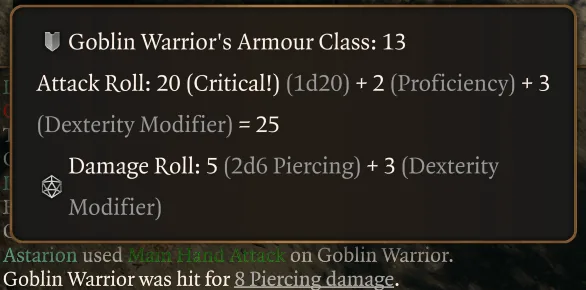
A natural 20 doubles your damage in Baldur's Gate 3 — but "doubled" hides real nuance: which half of that number actually doubles, which of the game's dozen crit-threshold sources stack together, and how "immune to critical hits" still lets a natural 20 miss outright. bg3.wiki's own combat-log breakdown settles all three.