Best Green Cards in Cookie Run: Braverse, Ranked
Green is the resource color: build a fat support area, out-ramp the table, then bury people in value. Here are the real Green cards worth building a ramp deck around, ranked top to bottom.
Green doesn't beat you on turn three. It beats you on turn eight, after you've spent the whole game wondering why your opponent has twice as many resources as you and a board you can't profitably attack into. Where Red is a stopwatch and Blue is a held breath, Green in Cookie Run: Braverse is a slow tightening of the screws: ramp ahead on the support area, convert that lead into bigger bodies and repeatable removal, and win the long game by simply having more of everything.
This is a ranked tour of the real Green cards worth building around, pulled from the official card database, plus the framework for evaluating any Green card that drops next set. Stats below - cost, HP, and effect text - are quoted from the official listings; the {G} symbol is a single Green resource and {N} is any color, so a cost like "two Green, one any" is what a card actually demands. If you're brand new, read the five colors explained and deck archetypes first - Green is the most forgiving of the five to pilot, which is exactly why it's a great place to learn the resource game.
What makes a Green card good
Color identity is the lens, and Green's identity is resource generation, the support area, and grinding value. Braverse ramps slowly by default - you add one Support card per turn - and Green's entire edge is breaking that rule. The best Green cards put extra cards into your support area, refill it, or get paid for having a fat one. A Green card is good when it either grows your resource lead or cashes that lead into board advantage. Concretely, the best Green cards tend to do one of these:
- Ramp the support area. Effects that place cards from your deck, hand, or trash into the support area let you spend ahead of curve - the single most important thing Green does.
- Reuse what you've already spent. Setting rested support cards back to active, or returning them to refire, turns one resource into two. That's how Green out-grinds everyone.
- Get paid for going wide. Several Green cards check whether your support area is large enough and reward you with damage, draw, or extra ramp. The bigger your engine, the harder they hit.
- Control the board cheaply. Green removal tends to be efficient and repeatable rather than explosive - bounce, attack-reduction, and chip damage that keeps a slower deck alive to its payoff.
The ramp test: a Green card earns its slot if it makes your engine bigger or your engine pays off. Generic stats with no support-area interaction belong in someone else's deck.
A card that's "fine" beatdown in a Red shell can be a trap in Green, because Green isn't racing - it's accumulating. Resource advantage and inevitability are the currency, not tempo.
How to read this list
We're grouping by role, not by raw power, because role is what survives a meta shift - but within each role the picks are ranked, real cards with their actual numbers. The buckets are: ramp engines, support-area payoffs, removal/control pieces, and the Cookies a Green deck actually wants on the board. Costs and effects are quoted from the official database; the named cards span several sets (BRAVE BEGINNING through Land of Fire & Ruin), so a few will rotate in relevance as new sets land. Treat the ranking as a snapshot of the current pool, not a "run exactly these" decklist.
The ramp engines
This is the slot that makes Green, Green. The whole color is built on having more resources online than your opponent and spending them faster than the one-per-turn rule should allow. Ranked top to bottom:
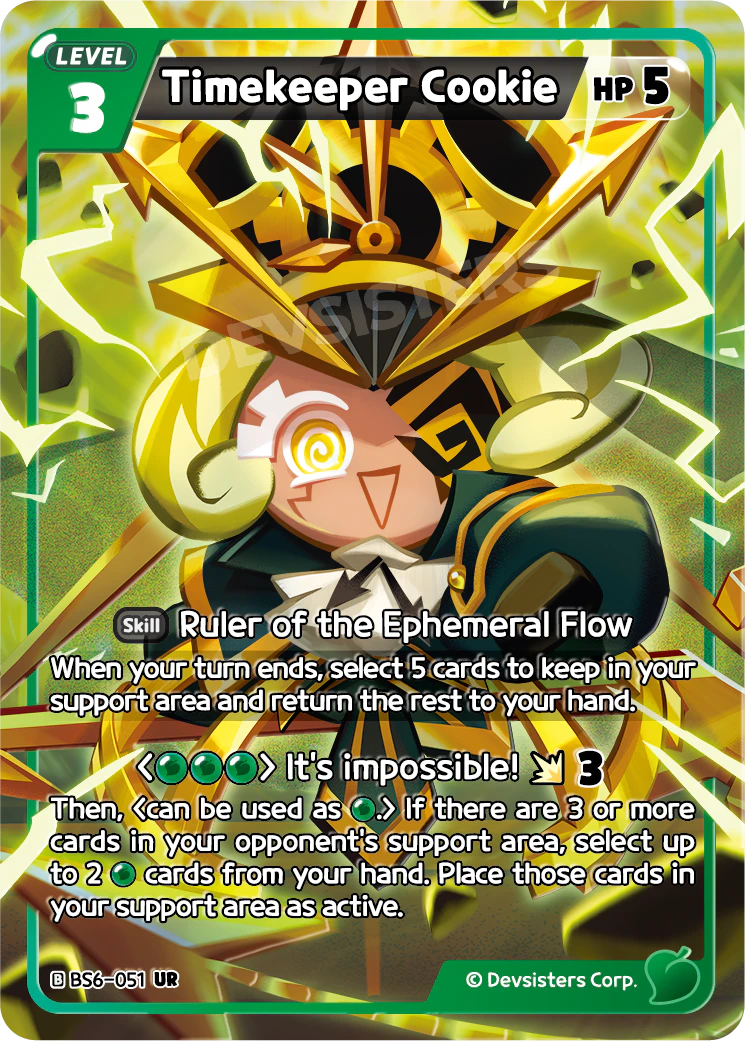
- Timekeeper Cookie (BS6-051, Ultra Rare, LV.3, 5 HP). The premier Green engine. Its skill, "When your turn ends, select 5 cards to keep in your support area and return the rest to your hand," lets you reload your hand with the resources you over-committed, and its three-cost attack deals 2, then - if your opponent's support area is large - lets you slam up to 2 {G} cards from hand straight into play. It's a body, a reload, and a ramp burst on one card.
- Cloud Haetae Cookie (BS8-052, Super Rare, LV.1, 2 HP). A one-cost catch-up engine: when you're behind on the support area by 2+ cards, sacrifice it to place up to 2 {G} cards from hand into your support area as rested. Cheap, early, and exactly the kind of explosive ramp that closes a deficit in a single turn.
- Aloe Cookie (ST3-010, Super Rare, LV.1, 3 HP). The clean, repeatable starter ramp - pay two Green to place the top card of your deck into your support area as active, every turn it's up. Nothing flashy, just the steady drip that makes everything above curve.
What you're looking for in this slot, set after set, is the best ramp-per-resource you can find, and Timekeeper is the current benchmark. The discipline is that ramp without a payoff is just a bigger pile of unspent cards, so every engine has to be pointed at something to do with the resources.
A Green deck wants to be adding more than one card to its support area on as many turns as it can. If you're only ever placing your one free Support, you're not playing Green - you're playing a green-colored midrange deck.
The support area payoffs

Ramping is half of it; the other half is making that lead matter. These are the cards that check how big your engine is and reward you for it. Ranked:
- Longan Dragon Cookie (BS5-056, Ultra Rare, LV.3, 5 HP). The confirmed Green Dragon and the cleanest payoff in the color. Its skill: "When your turn ends, if there are 3 active cards or more in your support area, this card can be used as {G}, select up to 1 of your opponent's Cookies, that Cookie receives 2 damage." Free repeatable removal for being ahead on resources, and its attack deals 2 and re-activates a support card on your end step - so it feeds the very condition it needs. A ramp deck's dream top end.
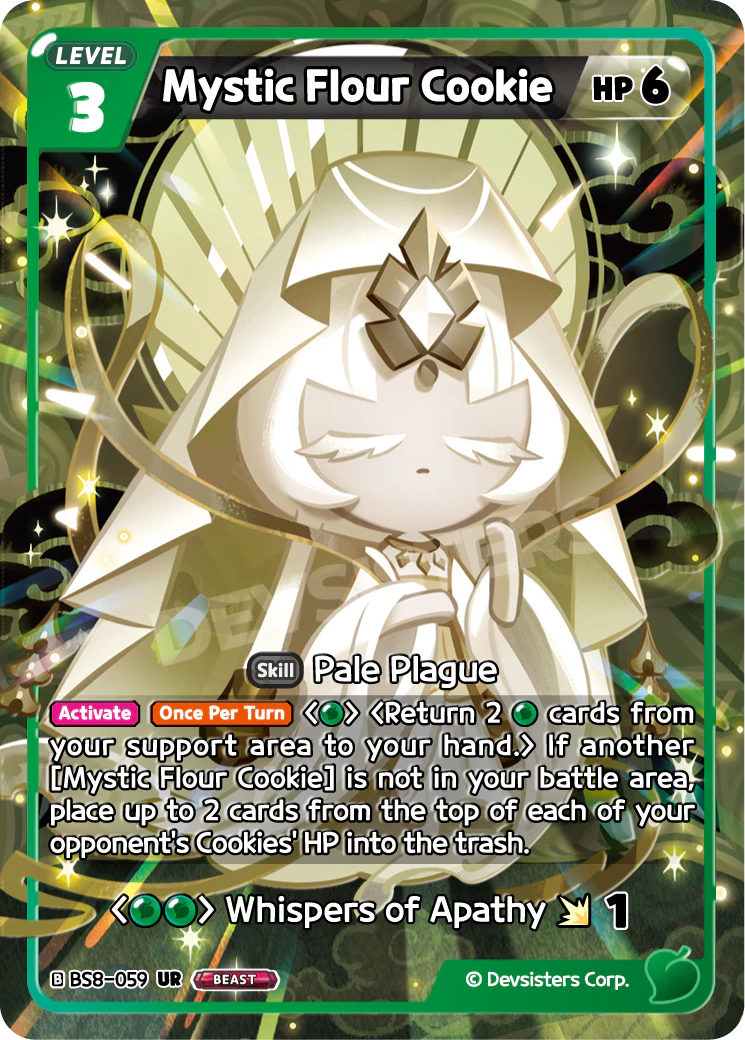
- Mystic Flour Cookie (BS8-059, Ultra Rare, LV.3, 6 HP). The BEAST payoff. Once per turn, for one Green and returning two {G} support cards to hand, if no other copy is out, it mills the top HP card off every opposing Cookie. On a six-HP body that's a recurring, board-wide grind that a control deck simply cannot out-attrition. It's the hero of this list because it converts your resource lead into a clock the opponent can't answer.
- Matcha Cookie (BS3-050, Super Rare, LV.2, 4 HP). The threshold ping: once per turn, if your support area is 7+ cards, pay one Green to deal 1 damage to a Cookie. It's a tax that only a true ramp deck can pay, and the kind of cheap, repeatable reach that closes games Green would otherwise stall out of.
The best payoffs scale with the work you've put in - the recurring "if your support area is large enough" clauses mean these reward the ramp you've already done. The risk is real: stumble on ramp and these are blank, so you have to commit to the engine for the payoffs to fire.
If you can't point to the card that punishes the opponent for letting you ramp, you don't have a ramp deck - you have a value engine that never cashes out. Build the payoff alongside the engine, not after it.
The removal and control pieces
Green isn't a removal color the way Yellow is, but it has efficient, repeatable answers that keep a slower deck alive to its payoff turn. Ranked:
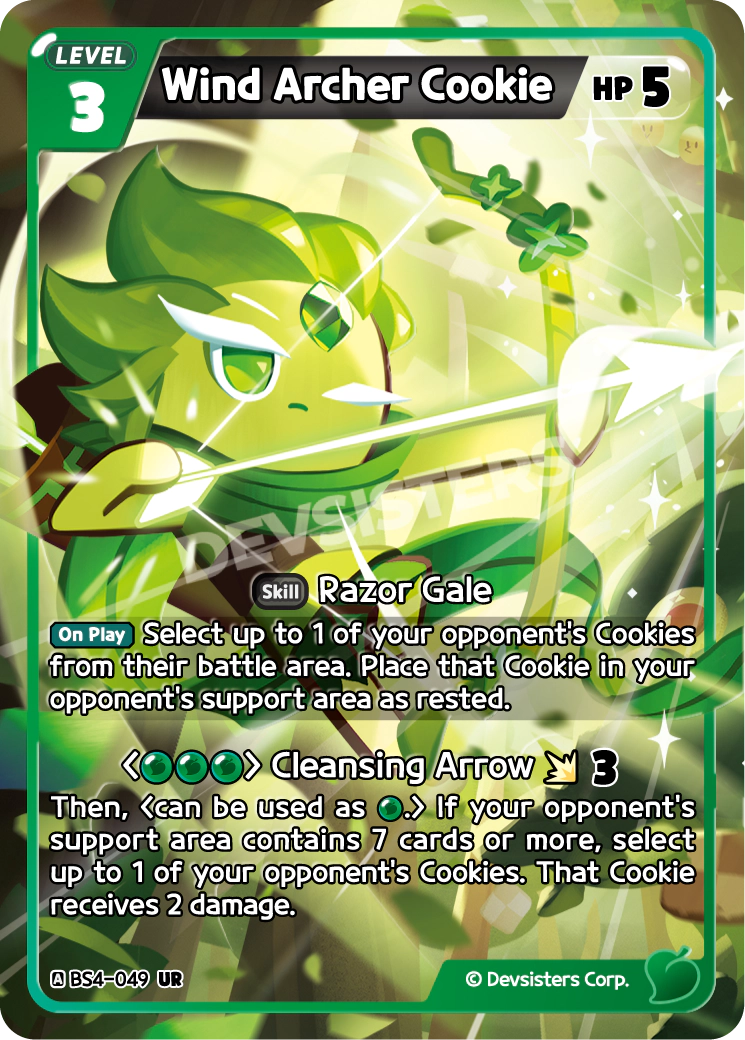
- Wind Archer Cookie (BS4-049, Ultra Rare, LV.3, 5 HP). The best Green tempo answer. Its skill bounces an opponent's Cookie from their battle area back to their support area as rested - a clean removal-and-tax in one - and its three-cost attack deals 3, then pings another Cookie for 1 if the opponent's support area is flooded. A body that removes a threat and slows their engine at once.
- Snake Fruit Cookie (BS5-054, Ultra Rare, LV.3, 4 HP). The defensive tax: once per turn, when your opponent's Cookie attacks, trash a support card to give that Cookie -2 attack damage this turn. Against Red especially, that's the difference between trading and dying while you set up.
- Choco Drizzle Cookie (BS7-059, Ultra Rare, LV.3, 6 HP). The proactive removal body - when played from the support area it deals 2 damage to a Cookie, and its attack deals 3 on a six-HP frame. Run it when your support-area ramp is reliably putting Cookies into play from there.
Green removal is rarely a hard answer; it's a soft one repeated. The discipline is to lean on bounce, attack-reduction, and chip - the effects that buy you the turns your engine needs - rather than expecting Green to blow up a board in one card.
The Cookies Green actually wants
Green is a resource-first color, but it still has to put bodies on the board that either feed the engine or carry the payoffs. Here's what to look for, with the real cards that fill each lane:
| Card role | Real example | Why it matters |
|---|---|---|
| Cheap ramp bodies | Cloud Haetae Cookie (BS8-052, SR) | Early engine that closes resource deficits fast |
| Engine anchors | Timekeeper Cookie (BS6-051, UR) | Reloads your hand and ramps in one body |
| Resource payoffs | Longan Dragon Cookie (BS5-056, UR) | Free removal for being ahead on the support area |
| Recursion / reuse | Moon Rabbit Cookie (BS1-056, SR) | Bounces your own small Cookies back to refire them |
The single best Green Cookie for enabling the whole plan is Timekeeper Cookie (BS6-051), because the end-of-turn reload lets you over-commit ramp without going hellbent. Moon Rabbit Cookie (BS1-056, Super Rare, LV.1, 3 HP) is the value glue: for two Green it returns one of your other LV.2-or-lower Cookies to the support area as active, letting you refire an on-play ramp or removal trigger and recover a resource at the same time. And the marquee top end stays Mystic Flour Cookie (BS8-059) - the BEAST that turns a fat support area into a board-wide grind. The discipline across all of these is the same: a Cookie earns its slot in Green if it grows the engine, reuses the engine, or is the payoff.
Cards that look good but underperform
A few archetypes of card consistently fool new Green players:
- Ramp with no payoff. Stacking Aloe Cookie and Cloud Haetae feels productive, but if your deck has no Longan Dragon or Mystic Flour to punish the opponent for it, you've just built the world's most elaborate way to lose slowly. Ramp is a means, not the plan.
- Expensive bombs that don't interact with the support area. A big generic five-cost body that ignores the engine is a worse Red card. Green's top end should reward ramp (Longan Dragon, Mystic Flour), not just be large.
- Pure defensive stalling with no clock. Snake Fruit and friends buy time, but a deck that's all -2 attack reductions and no win condition just durdles until it decks out. Defense is to protect the payoff, not to replace it.
Deckbuilding tip: when in doubt, cut the third stall card for another payoff or ramp piece. The most common reason a Green deck loses is that it ramped to a huge lead and then had nothing to do with it - inevitability fixes that, a fourth defensive tool doesn't.
How many of each to run
A clean Green ramp shell, role by role, looks roughly like this. Treat it as a starting skeleton you tune, not gospel - and remember a legal deck is exactly 60 cards with up to four copies of any card number, at least one Cookie, and up to 16 FLIP cards.
| Role | Rough share of the deck | Anchor cards |
|---|---|---|
| Ramp engines | A large core block | Timekeeper, Aloe, Cloud Haetae |
| Support-area payoffs | A solid secondary block | Longan Dragon, Mystic Flour, Matcha |
| Removal / control pieces | A focused package | Wind Archer, Snake Fruit |
| Recursion / reuse Cookies | A small, deliberate set | Moon Rabbit |
| FLIP cards | Up to the 16-card cap | Green FLIP draws that buy ramp time |
The 60-card, four-copy, and 16-FLIP figures are the standard deck-construction limits; confirm them against the official rulebook before a sanctioned event. For the full rules on ratios and curve, see deck-building basics, and for a cheaper way into the color, our budget deck guide.
Quick Action Checklist
- Commit to the engine. Decide that your Green deck is a ramp deck and build the support area aggressively - Timekeeper, Aloe, Cloud Haetae - rather than hedging into midrange.
- Always have a payoff. Longan Dragon and Mystic Flour are why you ramp; never build the engine without the cards that punish the opponent for letting you.
- Use threshold cards. Matcha and Longan Dragon reward a large support area - lean into the "7 cards or more" and "3 active or more" clauses instead of dribbling resources.
- Keep soft removal for survival. Wind Archer's bounce and Snake Fruit's -2 attack buy the turns your engine needs against faster colors.
- Reuse your triggers. Moon Rabbit turns one on-play effect into two and recovers a resource - one of the highest-value loops in the color.
- Don't over-ramp. A support area you never spend is just a slow loss; tune enough payoff so the lead actually cashes out.
- Mulligan engineless hands. A Green opener with no early ramp is a mulligan - the whole deck is built to start the snowball on turn one or two.
Frequently Asked Questions
What are the best Green cards in Cookie Run: Braverse?
What makes a card good for a Braverse ramp deck?
Is Green good for beginners in Braverse?
How many ramp engines should a Green deck run?
Are Dragon Cookies good in Green ramp?
Why does my Green deck keep stalling out without winning?
Keep Reading
Related Guides

Best Cookie Run: Braverse Cards for Beginners
You don't need chase rares to play real Braverse. These are the cheap, easy-to-use cards across all five colors that punch above their cost - the staples a new player should actually prioritize.
Best Trap Cards in Cookie Run: Braverse, Ranked
Braverse has 120 different Trap cards and 115 of them are Uncommons. There is not a single Ultra Rare Trap in the game. That means the entire interaction layer - the cards that decide close games - is fully available to anyone who owns a starter deck and a fistful of bulk.
Best Draw and Search Cards in Cookie Run: Braverse
Search the official Braverse database for skills that draw two or more cards and you get 61 hits. Sixty of them charge you something - a discard, a mill, a hand-size cap, a body that has to die first. Exactly one doesn't, and it's a Common. Here's the full draw and search pool, color by color.

Best FLIP Cards in Cookie Run: Braverse, Ranked
FLIP is the signature Braverse mechanic where your own hit points punch back, and here is the strange part: the best FLIP cards are all cheap. Not one is above Rare. These are the standout FLIP Cookies ranked by color and role, with the exact flip text off the official database.

How to Play Cookie Run: Braverse - A Complete Beginner Guide
Cookie Run: Braverse is the rare TCG you can teach in a single match. This guide covers everything a first-time player needs: card types, setup, turn structure, how you pay for cards, the FLIP mechanic, and how to win.

Cookie Run: Braverse Meta Tier List — Best Decks & Archetypes Ranked
Which Cookie Run: Braverse decks are actually carrying right now? Here's a meta tier list of the strongest archetypes - the real cards that anchor each one, why they rank where they do, and what's overrated.