Cookie Run: Braverse 2-on-2 Rules and Winning Team Decks
Braverse's standard rulebook says it doesn't cover games with more than two players, so the official 2-on-2 format runs on two separate documents - and they change more than you'd think. One loss counter for two Break Areas, a four-copy limit that belongs to the team, and board wipes that hit your partner. Here are the rules, read off the source, plus what all five Asian 2-on-2 champion teams with published lists actually brought.
Cookie Run: Braverse's standard Comprehensive Rules say, in their very first numbered rule, that they don't cover games with more than two players. So when Devsisters wanted a team format, it wrote a second rulebook - two documents, in fact - and the game they describe is not a normal Braverse match with a partner bolted on. Two Break Areas feed one loss counter. The four-copy limit belongs to the team, not the deck. And a board wipe doesn't care which side of the table your partner is sitting on.
This is the official 2-on-2 format, read straight off those documents, plus the one thing the rules can't tell you: what the teams that actually won with it brought. Devsisters has published both players' decklists for five champion teams from its 2026 Asia 2-ON-2 Event series, and the ten lists agree on more than you'd expect.
Where the 2-on-2 rules live
The source is a notice titled Official English Special Format Rules, filed under Rules on the official notice board, posted April 4, 2026 and last updated April 20. It links two files, both marked Ver. 1.0 and "Last updated: April 3, 2026":
- 2-on-2 Format Rules - six pages covering only what differs from a normal game.
- 2-on-2 Comprehensive Rules - 24 pages, the full comprehensive rules rewritten for four players.
The Asia notice board carries the same two files under its own copy of the notice. Nothing else is in there: as our Organized Play guide already noted, the Special Format notice covers 2-on-2 only, not the themed formats like Pauper or Singleton.
Why you need them at all: rule 1-1-1 of the standard Comprehensive Rules (Ver. 1.8, July 27, 2026) says the game is "designed to be played by two players" and that the current rules do "not cover games played with a different number of players." At a four-player table, these two files are the rules.
Seats, turn order and the first four turns
Each team sends one player to rock-paper-scissors. One player from the winning team becomes Player ①, the opponent sitting across from them is Player ②, ①'s teammate is Player ③, and the last seat - across from ③ - is Player ④. Turns run ① → ② → ③ → ④ and loop, so the teams alternate. In a two-player game, the rock-paper-scissors winner chooses whether to go first; the 2-on-2 documents give the winning team no such choice - one of its players simply becomes Player ①.
Setup is the familiar one, times four: draw 6, choose a Cookie to place face-down, and take mulligans in seat order starting with ①. The mulligan penalty scales with the table. If any player mulligans twice or more, the rules say "the opponent players may each draw up to 1 card" - both opponents, not one.
Then come the first-turn restrictions, which is where 2-on-2 departs hardest from the normal game:
| Seat | Team | Draws on their first turn? | Can attack on their first turn? |
|---|---|---|---|
| Player ① | Won rock-paper-scissors | No | No |
| Player ② | Lost rock-paper-scissors | No | No |
| Player ③ | Won rock-paper-scissors | No | No |
| Player ④ | Lost rock-paper-scissors | No | Yes |
No player draws on their own first turn, and Players ①, ② and ③ cannot declare attacks on theirs. In a two-player game, both restrictions fall only on whoever goes first. Here it means the first attack of the game can come no earlier than turn 4, and only from Player ④ - a seat on the team that lost the throw. The winning team's first chance to swing is turn 5, Player ①'s second turn. Winning rock-paper-scissors gets your team on the board first and hands the other team the first hit.
What changes from a normal game
Here is the full side-by-side, the standard rules against the 2-on-2 documents:
| Rule | Two-player game (Comprehensive Rules Ver. 1.8) | 2-on-2 (Ver. 1.0) |
|---|---|---|
| Break Area loss | Your Break Area reaches LV.10 or more | Your team's two Break Areas reach LV.15 combined |
| Empty-board loss | You have no Cookie in play and none to play | Neither teammate has a Cookie in play or one to play |
| Refresh loss | You Refresh with no Cookie in your trash | Any player on your team does |
| Cards drawn each Draw Phase | 2 | 2 |
| First-turn draw | Only the first player skips it | Every player skips it |
| First-turn attack | Only the first player is barred | Players ①, ② and ③ are barred |
| Copies per card number | 4 per deck, Extra deck included | 4 across both teammates' decks and Extra decks |
| Restricted (Limited) cards | 1 copy per deck | 1 copy per team |
| Attack targets | A Cookie in the opponent's Battle Area | A Cookie in either opponent's Battle Area |
| Trap Step response | The attacked player may make one | One player on the attacked team may make one |
| Cookies in the Battle Area | Up to 2 | Up to 2 per player, 4 per team |
| Paying costs | From your own Support Area (or whatever other cost a card names) | The same, but never from your partner's Support Area or with cards from their hand |
One loss counter, two Break Areas
The headline number is 15. Each player keeps their own Break Area, but the lose condition reads the combined LV. sum of both teammates' Break Areas, and the team loses when it reaches 15. In a two-player game the threshold is 10 per player.
Run that the other way and it's a squeeze. Two players in two separate games each go down at 10, so it takes 20 Levels of fainted Cookies to knock out both. A 2-on-2 team goes down at 15 - three-quarters of that, shared.
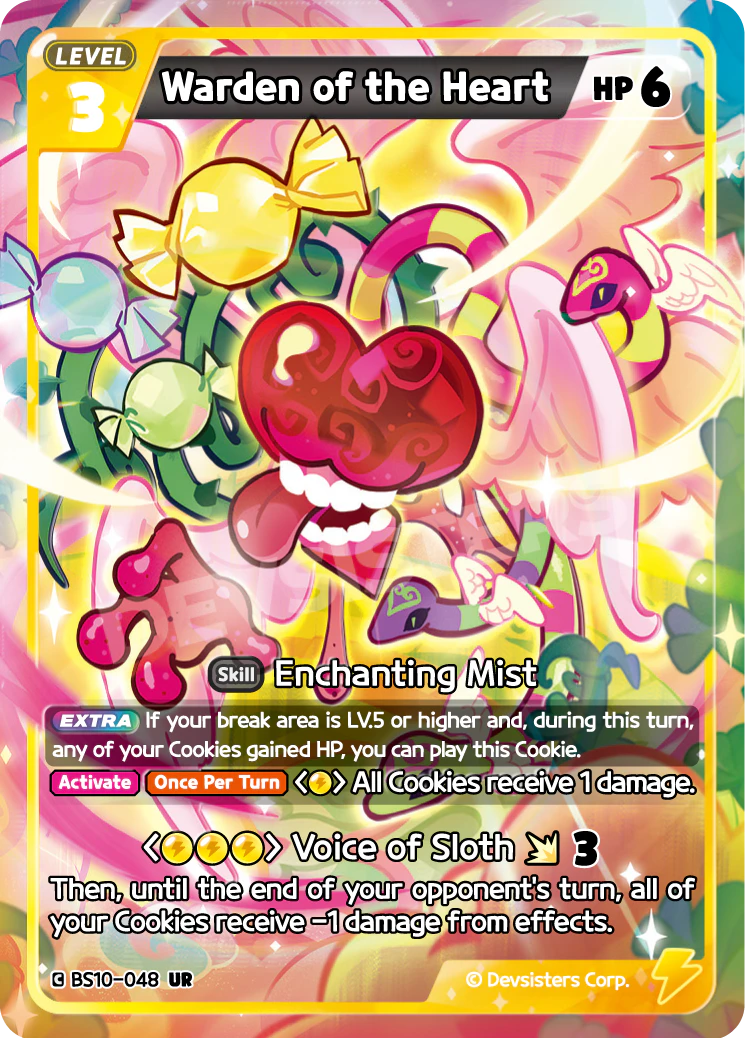
The split matters for card text. Per the Format Rules, effects that check "your Break Area" read only your personal pile; only the loss check adds the two together. So Warden of the Heart's EXTRA condition - "If your break area is LV.5 or higher" - looks at your pile alone, even when your team as a whole is sitting at 12.
The other two losses are team-wide as well:
- Empty board. If your own Battle Area drops to zero Cookies, you don't have to play a replacement as long as your partner still has one in play, and not doing so is not a loss. If both Battle Areas on a team are empty, one player on that team must play a Cookie; if neither can, the team loses.
- Refresh. In the official rules, Refresh is what happens when your deck runs out: you place a LV.1-or-higher Cookie from your trash into your Break Area, then shuffle the rest of the trash into a new deck. (It is not the untap step - the rules call that the Active Phase.) If any player on a team has to Refresh with no Cookie in their trash, the whole team loses. And because every Refresh drops a Cookie into a Break Area, a partner who decks out adds at least one Level to the team's count on the way through.
The four-copy limit belongs to the team
Every player still builds a normal deck: 60 cards, an Extra deck of up to 6, at least one Cookie, and no more than 16 cards with FLIP. What changes is who owns the playset. The Format Rules put it in one line: "Each team can only use a total of 4 copies of a card with the same Card Number across their decks and 【Extra】 decks."
Two more team-level caps sit beside it: only one copy of a Limited card across all of a team's decks, and no Forbidden cards at all. The 2-on-2 documents don't name those cards. The list lives in the English Banned & Restricted policy - which, per Devsisters, governs both Asia and North America - where the one-copy tier is called Restricted. Our Banned & Restricted breakdown walks through all sixteen cards.
The cap runs on card numbers, not names, and that leaves room. Two printings that share a name but carry different numbers are different cards: the Philippines champion team below ran four Kumiho Cookie BS1-002@2 in its Red list and four Kumiho Cookie BS4-024 in its Yellow list. Eight Kumihos, fully legal, because BS1-002 and BS4-024 are different card numbers - one a Red Level 3 FLIP card, the other a Yellow Level 1 with an unrelated skill. Our card numbers guide covers why Braverse has so many same-name cards.
The practical upshot is blunt: two teammates on the same color are drawing from one playset. That single rule explains most of what the decklists further down look like.
How card text reads with four players
Braverse cards were written for two players, and the Format Rules re-read the four kinds of wording that break at a four-player table:
- Attack effects only touch the players in that battle. An attack's "then, all of your opponent's Cookies receive 1 damage" becomes all Cookies in the Battle Area of the opponent involved in this battle. The other opponent is untouched.
- Untargeted "all Cookies" effects hit all four players. "【On Play】 All Cookies receive 1 damage" becomes all Cookies of all players, resolved starting with the player who activated it and then clockwise, with each player ordering their own Cookies. That is friendly fire, by the book. Warden of the Heart's Activate skill ("All Cookies receive 1 damage") pings your partner's board every time you use it, and so do Land of Fire & Ruin (BS8-024) and Poison Mushroom Cookie (BS1-058).
- Targeted effects pick a player first. You choose which opponent, and the effect - plus any condition attached to it - applies to that player only. The documents' example turns "if there are 15 cards or more in your opponent's trash" into a check against the one opponent you selected.
- Continuous effects apply to everyone. Timekeeper Cookie (BS6-010) reads "your opponent cannot use effects to move either player's Cookies from the battle area"; in 2-on-2, neither player on the opposing team can move Cookies out of any Battle Area. Sherbet Cookie (BS8-084)'s rested discard tax becomes a tax on any opponent who attacks the player controlling it.
Two more rules shape how a team plays together. You cannot pay costs from your partner's Support Area or with cards from their hand. And you are explicitly allowed to share information about the cards in your hand and to discuss strategy and decisions during play. Table talk is legal. Use it.
Taunts, loops and the question the rules skip
Every attack in 2-on-2 can target a Cookie in either opponent's Battle Area, which makes "can only attack this Cookie" effects - taunts - much stronger than they look on the card. The Format Rules' own example proves it.
The example is BS9-082 Animatronic of Deceit: "If [Shadow Milk Cookie] is in your battle area, your opponent's Cookies can only attack this Cookie." The rules note that if both players on one team have Animatronic and Shadow Milk in play, "the opponents cannot declare attacks on any Cookie." That deadlock only happens if each taunt restricts both opponents' attacks across the whole table. If each Animatronic merely protected its own owner, the opponents could still attack each one, and there would be no deadlock. So a single taunt covers your partner's board too.
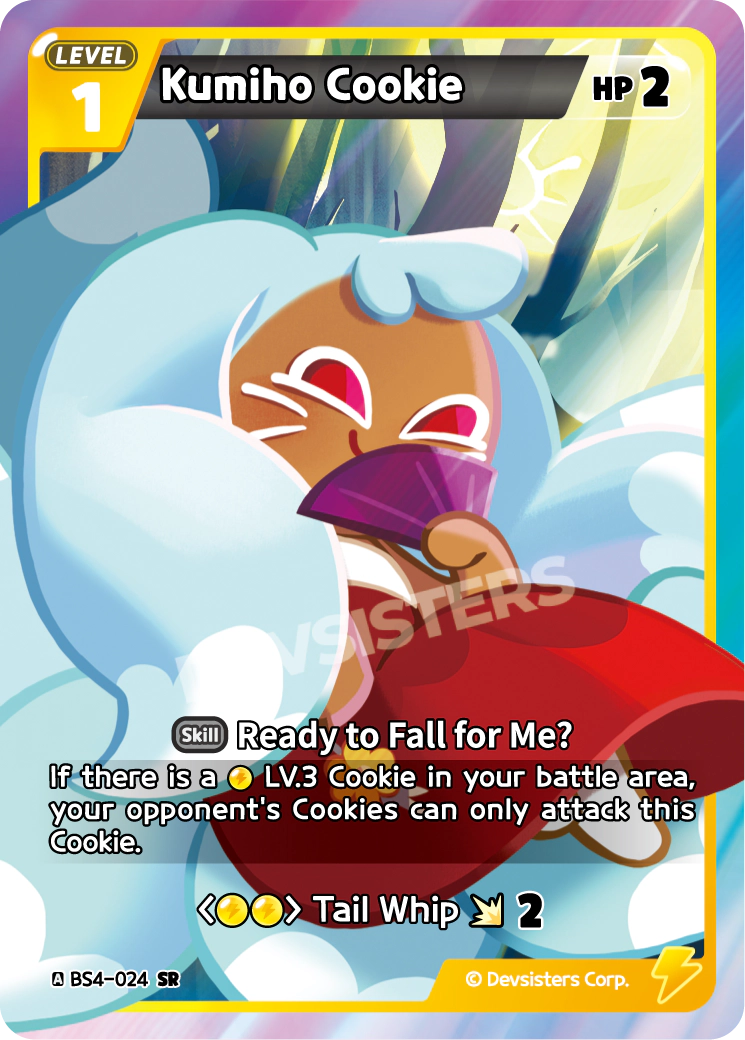
Kumiho Cookie (BS4-024) is a taunt that turned up in two winning lists: "If there is a {Y} LV.3 Cookie in your battle area, your opponent's Cookies can only attack this Cookie." The Philippines champion team's Yellow deck ran four, and Vietnam's Yellow deck ran three.
When two taunts deadlock, or any interaction produces an endless loop, the fix is blunt: every card causing the problem has its effects negated and the game moves on. Once the situation is resolved, those effects apply again.
The question neither document answers: can your Blocker take a hit meant for your partner? The 2-on-2 Comprehensive Rules define 【Blocker】 as usable "when one of your Cookie Cards other than the 【Blocker】 card is attacked," and the Format Rules define "your Cookies" as your own, with your partner's labelled "your ally's Cookies." Read literally, that is a no. Neither document addresses it head-on, so get the ruling from the head judge before round one, not mid-game. Related, and spelled out: when an opponent attacks, only one player on your team can respond in the Trap Step with a Trap Card or a "when your opponent's Cookie attacks" effect. You get one answer per attack between you, not one each.
What the champion teams actually brought
Devsisters ran 2-on-2 as its own event series in Asia. The event notice scheduled the Philippines, Singapore, Indonesia, Malaysia and Taiwan, with Thailand and Vietnam marked "Coming Soon"; the format was Best-of-1 Swiss with no extra turns into Best-of-1 single elimination, with deck recipes submitted in advance. The event report, last updated July 15, covers six countries (Taiwan's July 19 date came after it), and the official Asia winner-deck archive carries both players' lists for five champion teams. Singapore's aren't posted.
| Event | Date | Champion team | List 1 | List 2 | Restricted cards on the team |
|---|---|---|---|---|---|
| Philippines | April 26, 2026* | Froi & Ruyet Team | Red | Yellow | Rebel Cookie (Red list), Stormbringer Cookie (Yellow list) |
| Thailand | May 23, 2026 | Kaeokao & Kunanon Team | Blue | Green, plus 4 colorless | Peak of Apathy, Soul Jam: Light of Apathy, Banana, Bellflower, Salt and Ninja Cookie (all in the Green list) |
| Vietnam | June 6, 2026 | Nguyễn Tiến Linh & Mizuno Haruka Team | Yellow | Green | Stormbringer Cookie (Yellow list) |
| Indonesia | June 14, 2026 | Team BlueYellow | Yellow | Blue | Stormbringer Cookie (Yellow list) |
| Malaysia | June 20, 2026 | Team CoconutLatte | Blue | Green, plus a Purple and a Red Shadow Milk Cookie in the Extra deck | Peak of Apathy (Green list) |
*Devsisters' event schedule and event report both date the Philippines event April 26; its two decklist entries say April 25.
What the ten lists say, checked card by card against the official English card database:
- All ten lists are built around one main color. Eight are that color and nothing else. The two exceptions: Thailand's Green list adds four colorless Level 1 Cookies, and Malaysia's Green Extra deck carries a Purple (BS9-102) and a Red (BS9-010) Shadow Milk Cookie next to its Green one.
- All five teams split two different colors. No champion team doubled up. Blue, Green and Yellow are each a main color on three teams, Red on one, Purple on none.
- Teammates shared zero card numbers. Not one card number appears in both lists of any of the five teams, so the team four-copy cap never had anything to bite on. Splitting colors is the cheapest way to hand both players a full playset.
- Every restricted card went to one player. Each restricted card on these teams appears exactly once. Thailand's Green player took four of the five restricted colorless 4-HP Level 1 Cookies - cards any color can play - which, under the one-copy-per-team rule, means the Blue partner couldn't have run any of them.
- Friendly-fire sweepers still made the cut. Indonesia's and Vietnam's Yellow players each packed three Warden of the Heart in their Extra decks, next to Blue and Green partners whose Cookies that sweep also hits.
Five teams is a small sample, and these are winners' lists only - nothing Devsisters has published says how many teams tried a same-color pair and lost with it. But on the evidence that exists, every published winner split.
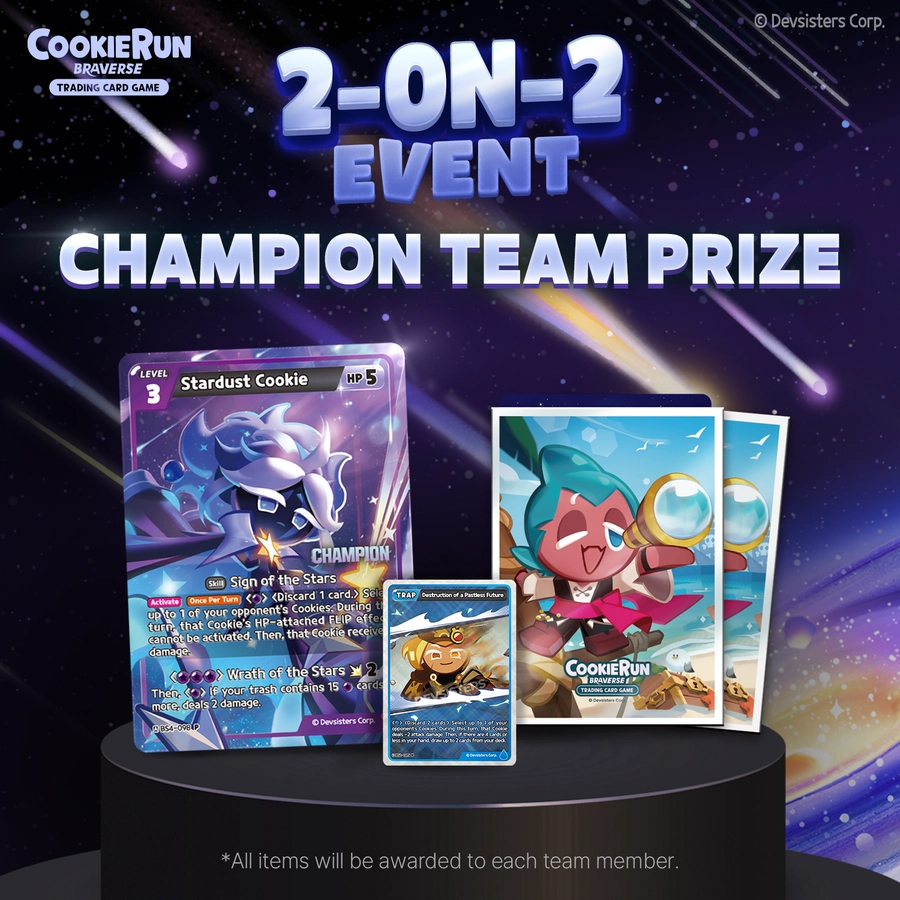
The prizes are in the card database too. It files three Stardust Cookie printings (BS4-098@2 to @4) and one Destruction of a Pastless Future (BS6-085@1) under a "2-ON-2 Event" product, which lines up with the event notice's Champion, Runner-Up and Finalist promo cards plus its participation promo. Our promo cards guide tracks where the rest come from.
The documents are older than the rulebook
Both 2-on-2 files are Ver. 1.0, dated April 3, 2026. The standard Comprehensive Rules have moved twice since - revisions dated May 19 and July 27, 2026, the second producing Ver. 1.8 - on top of a separate rule-update notice that took effect April 13. The 2-on-2 files haven't followed, and you can see the seams:
- The 2-on-2 Comprehensive Rules still carry an End Battle Step rule (7-1-4-4) that lets the team whose Cookie left the Battle Area play replacements from hand, up to the number that left. Ver. 1.8 of the standard rules deleted that section in July and moved replacement plays into rule processing (9-6).
- The 2-on-2 deck rule asks for at least one Cookie Card. Ver. 1.8 now asks for at least one Cookie without 【Special Play】.
- Inside the 2-on-2 Comprehensive Rules, rule 5-1-1-4 repeats the two-player "4 copies" deck wording, while its own rule 2-11-2 and the Format Rules make the limit a team total. The Format Rules are the explicit one.
Neither document says which wins when they disagree. If a ruling turns on any of these, ask before the round starts.
Playing 2-on-2 in North America
North America's taste of the format so far has been a side event. Devsisters' 1st Anniversary Cup notice linked a 2-on-2 registration that TopDeck lists as "2-on-2 @ Pro-Play Summit: Dallas": July 5, 2026, at the Will Rogers Memorial Center in Fort Worth, capped at 16 teams (32 players), $40 per team, Best-of-1 Swiss with 30-minute rounds. The listing shows it at capacity.
One line on that listing is worth reading twice. Its deck rules say "Up to 1 restricted card may be included in a deck" - per deck. Devsisters' 2-on-2 rules cap each Limited card at one copy per team. Under the listing's wording, both teammates could each bring a copy of the same restricted card; under Devsisters', only one of you can. If you sign up for a 2-on-2 side event, ask the organizer which version they enforce.
No North American 2-on-2 decklists have been published: as of September 28, 2026, the English site's winner-deck archive has no entries, and no 2-on-2 report has appeared on the English notice board. The World Championship 26-27 announcement promises side events without listing them, so there is no word yet on whether 2-on-2 will be one.
Quick checklist
- The team loses at LV.15 combined across both Break Areas, or when neither of you has a Cookie to keep in play, or when either of you Refreshes with no Cookie in the trash.
- Four copies per card number per team, and one copy of each Restricted (Limited) card per team - not per deck.
- Nobody draws on their first turn, and only Player ④ can attack on theirs. The first possible attack is turn 4.
- "All Cookies" means all four boards, your partner's included. Attack effects touch only the opponent in that battle.
- One Trap Step answer per attack per team, and no paying costs from your partner's Support Area or hand.
- Split your colors. All five champion teams with published lists did, and it keeps the shared copy limit out of your way.
- Confirm the grey areas first - Blocker for your partner, and anything where the April 2-on-2 documents and the July standard rules disagree.
Frequently Asked Questions
How do you win a Cookie Run: Braverse 2-on-2 game?
Can both teammates run four copies of the same card in Cookie Run: Braverse 2-on-2?
Who goes first and who can attack first in Cookie Run: Braverse 2-on-2?
Do Cookie Run: Braverse cards that damage all Cookies hit your teammate in 2-on-2?
Can you use your teammate's cards to pay costs in Cookie Run: Braverse 2-on-2?
What decks won Cookie Run: Braverse 2-on-2 events?
Keep Reading
- Devsisters - Official English Special Format Rules (posted April 4, 2026; updated April 20, 2026)
- Devsisters - 2-on-2 Format Rules Ver. 1.0 (last updated April 3, 2026)
- Devsisters - 2-on-2 Comprehensive Rules Ver. 1.0 (last updated April 3, 2026)
- Devsisters - CookieRun: Braverse TCG Comprehensive Rules Ver. 1.8 (July 27, 2026)
- Devsisters - Cookie Party Online Season 3 (Themed Events: Pauper, Singleton and others)
- Devsisters - Official English Rulebook notice (27 July 2026 updated)
- Devsisters - Notice of Rule Update (effective April 13, 2026)
- Devsisters - 2-ON-2 Event (Asia schedule, format and prizes)
- Devsisters - 2-ON-2 Event Report (15 July 2026 updated)
- Devsisters - Asia winner deck recipes (2-ON-2 Event champion lists)
- Devsisters - [NA] Banned & Restricted Policy (June 11 Updated)
- Devsisters - [ASIA] Banned & Restricted Policy (13 Feb 2026 Updated)
- Devsisters - 1st Anniversary Cup Event Guide (with 2-on-2 side event)
- TopDeck.gg - CookieRun: Braverse TCG 2-on-2 @ Pro-Play Summit: Dallas (July 5, 2026)
- Official CookieRun: Braverse English card database (JSON)
Related Guides
Cookie Run: Braverse Battle Rules: How an Attack Resolves
Rule 7-1-3-1-1 settles FLIP timing in a single sentence, and it sits inside a four-step battle procedure. Here is every step of a Cookie Run: Braverse attack, read straight off the Comprehensive Rules Ver. 1.8, plus the March 2026 rule update that locked the damage number mid-resolution and moved multipliers to the end.
Cookie Run: Braverse Errata List - All 29 Corrected Cards
Devsisters has published corrections to the printed text of 29 Cookie Run: Braverse cards. One of them changes an Item into a Trap. Another turns a card that could only trash your own Cookie into one that can trash theirs. And on 24 of the 29, the official card database still serves the wording that was corrected.
Cookie Run: Braverse Turn Structure & Phases Explained
Most Braverse misplays aren't bad cards - they're a phase mistake. Here's the full turn flow, Refresh to End, what you're allowed to do in each window, and the first-turn rules that trip up every new player.
Cookie Run: Braverse Energy & Leveling Explained
Energy is the engine that runs every Cookie Run: Braverse turn. Here's how energy types and color costs work, how the Support Area pays for your cards, and how leveling from LV.1 to LV.3 gates the whole game.

How to Play Cookie Run: Braverse - A Complete Beginner Guide
Cookie Run: Braverse is the rare TCG you can teach in a single match. This guide covers everything a first-time player needs: card types, setup, turn structure, how you pay for cards, the FLIP mechanic, and how to win.
Cookie Run: Braverse Meta Tier List — Best Decks & Archetypes Ranked
Which Cookie Run: Braverse decks are actually carrying right now? Here's a meta tier list of the strongest archetypes - the real cards that anchor each one, why they rank where they do, and what's overrated.