Cookie Run: Braverse Battle Rules: How an Attack Resolves
Rule 7-1-3-1-1 settles FLIP timing in a single sentence, and it sits inside a four-step battle procedure. Here is every step of a Cookie Run: Braverse attack, read straight off the Comprehensive Rules Ver. 1.8, plus the March 2026 rule update that locked the damage number mid-resolution and moved multipliers to the end.
One sentence in rule 7-1-3-1-1 of the Cookie Run: Braverse Comprehensive Rules settles when a FLIP card fires during an attack: if a revealed HP card has a FLIP effect, the attacked player "may choose to immediately activate" it. Rule 4-6-2 takes damage off a Cookie one HP card at a time, so the defending player can fire that FLIP before the next card comes off.
That sentence sits inside a four-step battle procedure: Attack Step, Trap Step, Damage Step, End Battle Step. This post walks through all four. The rules below come from Devsisters' Comprehensive Rules Ver. 1.8 (dated July 27, 2026), the March 2026 Notice of Rule Update that changed how attack damage is calculated, and card text from the official English card database. Rule numbers are included so you can point a judge at the page instead of quoting us.
The attack in one table
Every attack follows the same four-step procedure (rule 7-1), with two early exits covered below.
| Step | Who acts | What happens | Rules |
|---|---|---|---|
| Attack Step | Attacker | Rest an active Cookie, pay the attack cost, declare the attack, choose one Cookie in the opponent's battle area | 7-1-1 |
| Trap Step | Defender | One response: a Trap played from hand, or a Cookie's "when your opponent attacks" effect. Blocker is also activated here | 7-1-2, 10-1-1 |
| Damage Step | Defender resolves | Damage comes off one HP card at a time, each card to the trash; a revealed FLIP may fire immediately; 0 HP means fainted | 7-1-3, 4-6 |
| End Battle Step | Both | "During this battle" effects end; play returns to the Main Phase | 7-1-4 |
The two exits both skip ahead to the End Battle Step. If the attacking Cookie or its target has moved to another zone by the end of the Attack Step, the Trap Step is skipped (7-1-1-3). If either one has moved by the end of the Trap Step, the Damage Step never happens (7-1-2-2).
That second exit is worth knowing as a defender. Hidden Warpgate (ST5-021), a two-Purple Trap, reads: "Place 1 of your opponent's Cookies whose remaining HP is 2 or less into the trash." Play it in the Trap Step on an attacker sitting at 2 HP or less and the attacker is gone before any damage is dealt. The battle simply ends.
Before you swing
Four rules shape who can attack, and when:
- The first player cannot start a battle on their first turn (6-5-4-1). The second player can.
- A Cookie can attack on the turn it is played (3-5-4), unless a card says otherwise. There is no summoning sickness.
- Only an active Cookie can attack, because resting it is part of declaring the attack (7-1-1-1). The rules stand your rested cards back up in your own Active Phase, at the start of your turn (6-2-2), so a Cookie that attacked stays rested through your opponent's turn unless an effect stands it up.
- Your battle area holds at most two Cookies (3-5-6).
One more rule shapes sequencing: the Main Phase has no fixed order. Rule 6-5-1 lets you play cards, activate effects and start battles "as many times as you wish, in any order," and when a battle ends, play returns to the Main Phase (7-1-4-4). Building your board before you attack is often right, but it is a choice, not a rule. Attacking first lets you see what your opponent spent to stop the hit before you commit the rest of your hand.
Attack Step: rest, pay, pick a Cookie
Rule 7-1-1-1 sets the order: rest an active Cookie, pay the attack's cost, declare the attack. Then you choose the target, and the only legal target is one Cookie in your opponent's battle area (7-1-1-2). Rule 7-1 frames every attack as an attack on a Cookie, so there is no attacking the player directly. Attacks matter because of the Levels of the Cookies that faint: a player whose break area reaches LV.10 or more is defeated (1-2-1-1-1). That is one of three defeat conditions in rule 1-2-1-1, and our win conditions guide covers racing toward it.
Effects worded "when (...) attacks" trigger here, at the declaration (10-2-2-1).
If you are worried about a Blocker, deal with it before you declare. Raspberry Cookie (BS7-003) is one tool for that: its On Play stops your opponent from activating Blocker for the rest of the turn, as long as another Arena Cookie is in your battle area.
Trap Step: the defender gets one answer
Now the attacked player gets a window, and it is a narrow one. Rule 7-1-2-1 says they may take one of two actions:
- Play a Trap from their hand: put it in the trash, pay its cost, and activate it (7-1-2-1-1).
- Activate a "when your opponent attacks" effect on a Cookie in their battle area (7-1-2-1-2). Snake Fruit Cookie (BS5-054) is an example: once per turn, when your opponent's Cookie attacks, you pay one Green and trash a card from your support area to give an opposing Cookie -2 attack damage for the turn.
Read option 1 again: the Trap comes from your hand. Rule 2-2-5 defines Trap cards as "cards that can be activated from your hand by placing them in the trash when your opponent declares an attack." Nothing is set face-down in advance. The zone list in rule 3-1-1 (deck, EXTRA deck, hand, trash, battle area, support area, stage area, break area) has no Trap zone. What your opponent is really holding over you is their hand and the active cards in their support area, because rule 2-5-3 makes a Trap cost real support cards: reveal it, rest that many active support cards, trash it, activate it.
That makes support cards the defender's real constraint. Unless a card effect says otherwise, they only stand back up in your own Active Phase (6-2-2), so whatever you rest on your turn stays rested through your opponent's. A Trap you can't pay for is a dead card in your hand. Tasty First Aid Kit (BS1-077) softens that a little: for three Green it gives an opposing Cookie -3 attack damage for the turn, then lets you set up to one of your support cards active again.
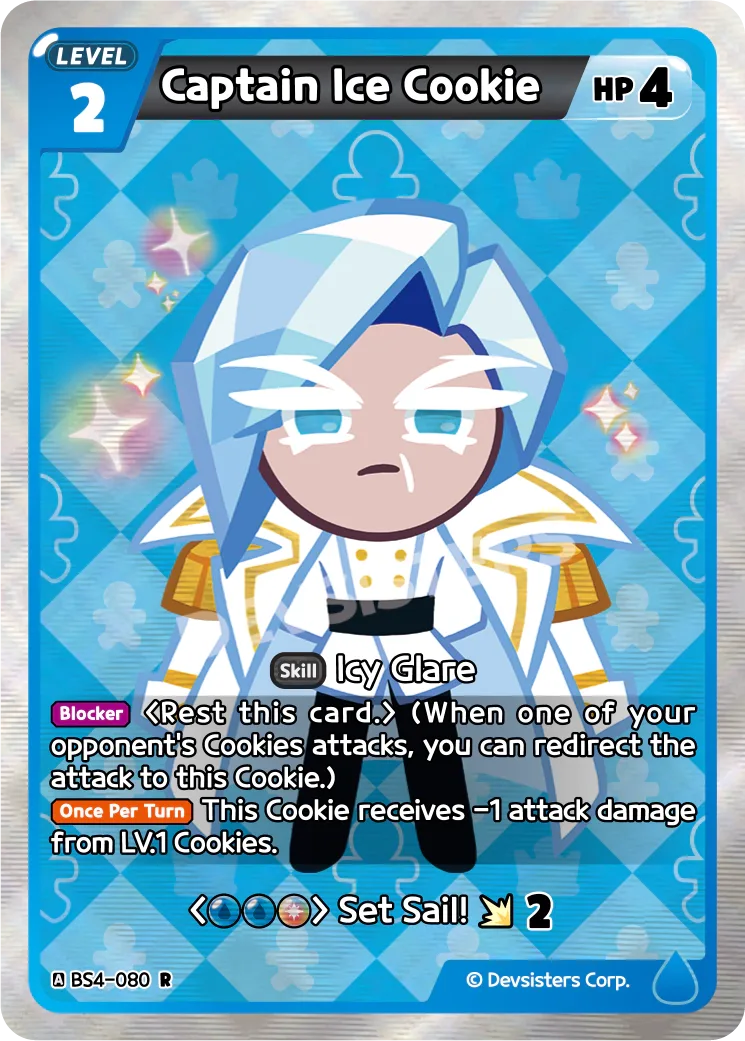
Blocker lives in this step too. Under rule 10-1-1-1, when one of your Cookies other than the Blocker is attacked, you can pay the activation cost printed on the Blocker card during the Trap Step and change the attack's target to the Blocker. That cost varies from card to card:
| Card | Blocker cost |
|---|---|
| Captain Ice Cookie (BS4-080, Blue) | Rest this card |
| Affogato Cookie (BS1-009, Red) | One Red |
| Pudding Cookie (BS12-081, Purple) | Discard one Purple Arena card from your hand |
The rest-this-card kind comes with a catch. Rule 8-2-1-2 says that if any part of a cost cannot be performed, you cannot pay it, and a Cookie that is already rested has nothing left to rest. Attack with Captain Ice on your turn and it is still rested on your opponent's turn, so by that reading it cannot block.
One question the rules leave open: does Blocker use up the defender's one Trap Step action? Rule 7-1-2-1 names only Traps and "when your opponent attacks" effects as that action. Rule 10-1-1-1 places Blocker in the same step without saying whether it counts. That rule and the keyword list in 4-1-2 are the only places Ver. 1.8 mentions Blocker, and neither answers the question. If you plan to Block and play a Trap against the same attack, ask the head judge before the round. Our keywords guide covers the rest of the ability words.
Damage Step: HP leaves one card at a time
The attacked Cookie takes damage equal to the attack's number (7-1-3-1). Rule 4-6-2 then runs a loop once per point of damage: the defending player flips the Cookie's top HP card face up, reveals it and moves it to the trash. Two damage runs the loop twice. Zero damage does nothing.
Rule 7-1-3-1-1 adds the timing. If a revealed HP card has a FLIP effect, the attacked player "may choose to immediately activate the FLIP effect." Rule 4-6-3 places that choice "during this time," inside the loop. So a FLIP the defender fires resolves as that card is revealed, before the next HP card comes off. FLIP is also optional (10-1-2-2), so nothing forces a defender to fire one that would hurt them.
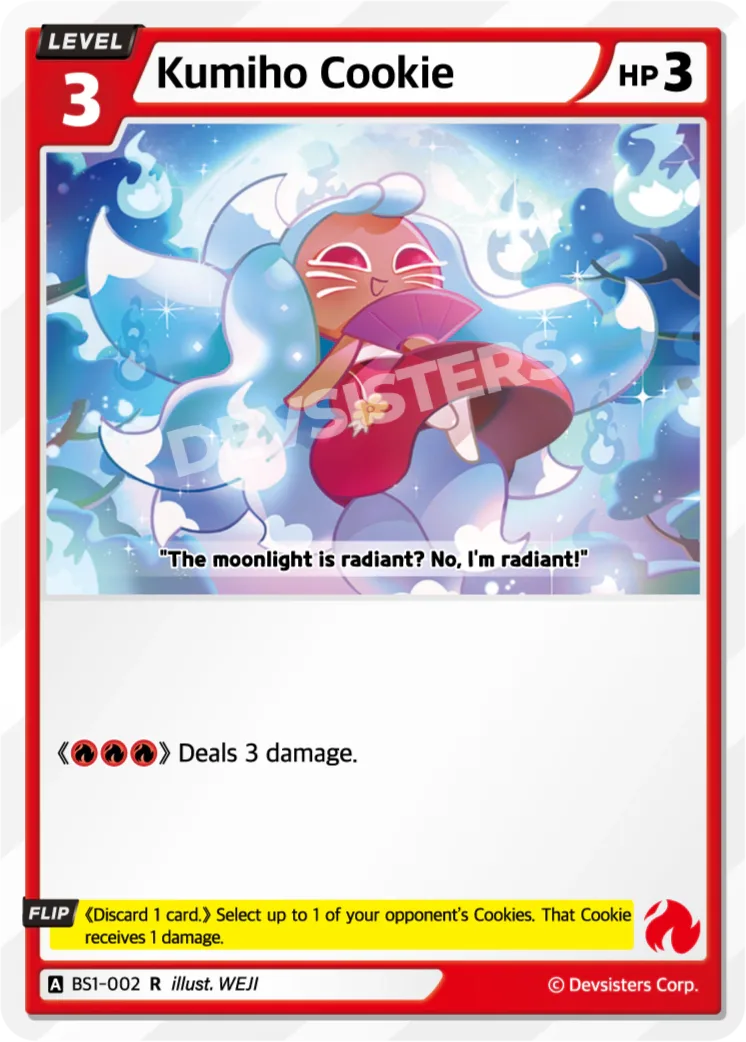
That timing matters in practice. Kumiho Cookie (BS1-002), a Red FLIP card, has a FLIP strip that reads: discard a card, then "Select up to 1 of your opponent's Cookies. That Cookie receives 1 damage." Revealed from the defender's HP stack in the middle of an attack, it can hit the attacker right away. Rule 4-6-2 applies to any action that deals damage, so that 1 damage flips the attacker's own top HP card too, and that card could be a FLIP of the attacker's own.
The same loop has two more consequences:
- HP cards go to the trash, not the break area (4-6-2-1, 3-4-1). From an attack, the break area gets the Cookie itself, when it faints. So every point of damage your Cookie takes puts one card in your trash. Counting each card number once and skipping alternate-art parallels, the official card database has 30 Purple cards that check whether a trash holds 15 or more cards, and 24 of them count only your own. If you are the one playing those cards, your opponent's attacks are helping fill your trash. Our best Purple cards ranking covers that engine.
- Normally, nobody knows what a hit will reveal. HP cards are dealt face-down one at a time from the top of the deck when the Cookie is played (3-10-1-1). Neither player may look at them or change their order, and they leave from the top down (3-10-3). The exception is an effect that turns an HP card face up (3-10-3-1).
When HP reaches 0, the Cookie has fainted (7-1-3-2). It goes to its owner's break area (10-2-1-1), where its Level counts toward the LV.10 defeat (1-2-1-1-1). Our FLIP mechanic guide covers building a deck around those triggers.
Then effects, fainting and replacement Cookies
Plenty of attacks carry a second clause that starts with "Then,". Rule 7-1-3-2-1 puts that clause into the Standby State as the battle moves into the Damage Step, and 7-1-3-2-2 lets it activate only after the damage has finished resolving. So a "Then" rider never interrupts the HP loop, and it always comes after any FLIP the defender fired during that loop. If the "Then" clause has its own cost, paying it is optional (10-2-4-2).
If the attack makes a Cookie faint, rule 9-6-1 sets the order for everything that follows:
- The attacking Cookie's "Then" effect resolves.
- The turn player's other Standby effects from that battle resolve.
- The non-turn player's Standby effects from that battle resolve.
- The turn player may play a new Cookie from hand for each of their Cookies that left the battle area, and its On Play effects resolve immediately.
- The non-turn player may do the same.
Steps 4 and 5 trace back to the March 2026 rule update. Before it, the rules played all the Cookies first and resolved the On Play effects afterwards. Devsisters said that made it unclear whether one Cookie's On Play could affect a Cookie played later in the same process. Now each Cookie's On Play resolves as soon as it is played, turn player first. The notice dates that change to April 13, 2026. One result for defenders: a replacement Cookie you play after a faint enters during your opponent's turn, and its On Play resolves right then.
The damage number locks when it resolves
The same notice changed a second rule, and this one can decide whether a Cookie survives. Once damage is being resolved, a condition that becomes true partway through does not change the damage. That applies to bonuses and reductions alike. Devsisters' own examples:
| Situation | Ruling |
|---|---|
| Wildberry Cookie (BS1-012) attacks for 4. Its skill adds +2 attack damage "if your break area is LV.9," and your break area reaches LV.9 while the attack is resolving | No +2. The damage is already being resolved |
| A Dragon Cookie at 4 HP equipped with Wrath of the Dragons (BS5-111) attacks, and the defender's Kumiho Cookie (BS1-002) FLIP knocks it to 3 HP mid-resolution | No +1, even though the Equip's "3 or less" condition is now met |
| A Dragon Cookie at 5 HP equipped with Wrath of the Dragons takes a 4-damage attack and drops past 3 HP during the resolution | No -1. It takes all 4 |
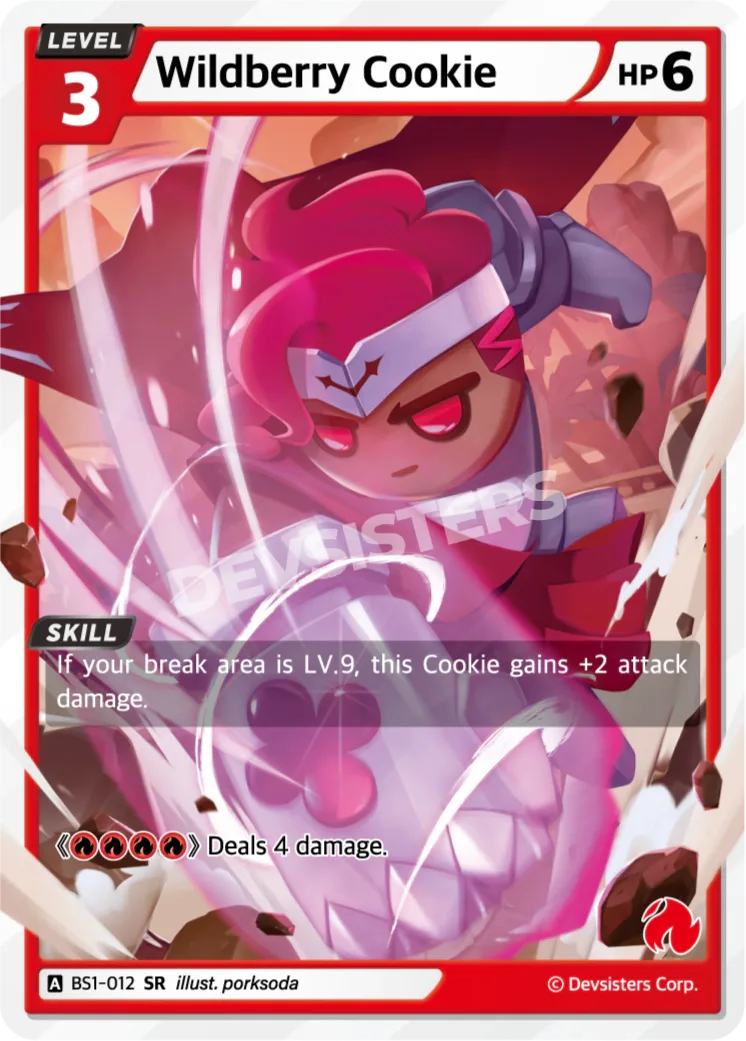
The lesson is about sequencing: any conditional bonus or reduction has to be true before the damage starts resolving. If you want Wildberry's +2, your break area has to be at LV.9 before the hit lands, which is one Level short of losing. Wrath of the Dragons works the same way. A Dragon wearing it has to already be at 3 HP or less when an attack starts resolving to get either half of the effect.
Multipliers always go last
The third change in the notice cleaned up an ordering problem. Before the update, attack damage increases from Items and Stages were applied before a multiplier, but reductions from Traps were applied after it. Now, in the notice's words, "Attack Damage multipliers will always be applied at the end."
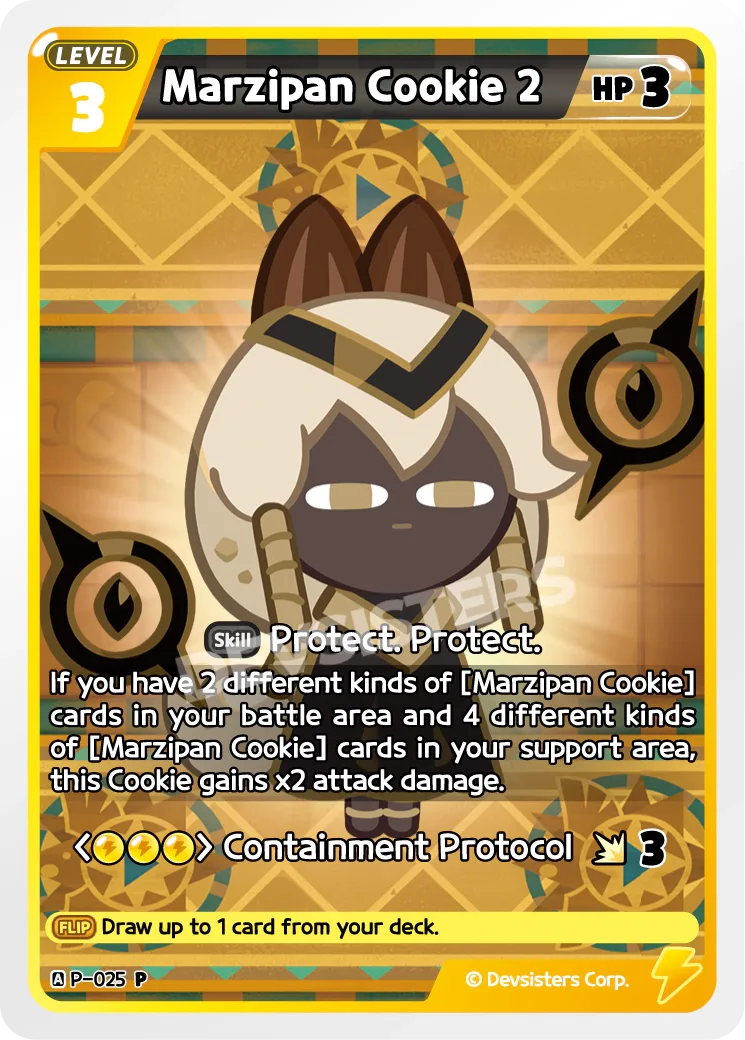
Devsisters' example is Marzipan Cookie 2 (P-025), a Yellow promo FLIP card whose attack deals 3 damage. Its skill gives it "x2 attack damage" when you have two different kinds of Marzipan Cookie in your battle area and four different kinds in your support area. With that condition met:
| Marzipan Cookie 2 plus | Old ordering | Current rule |
|---|---|---|
| Nothing | 3 x 2 = 6 | 3 x 2 = 6 |
| Spicy Power Juice (BS1-023), +2 attack damage | (3 + 2) x 2 = 10 | 10, per Devsisters' ruling |
| Tasty First Aid Kit (BS1-077), -3 attack damage | 3 x 2 - 3 = 3 | 0, per Devsisters' ruling |
| Both | (3 + 2) x 2 - 3 = 7 | (3 + 2 - 3) x 2 = 4 |
The two bold cells are Devsisters' official answers. The rest is our arithmetic, applying the old and new orderings as the notice describes them.
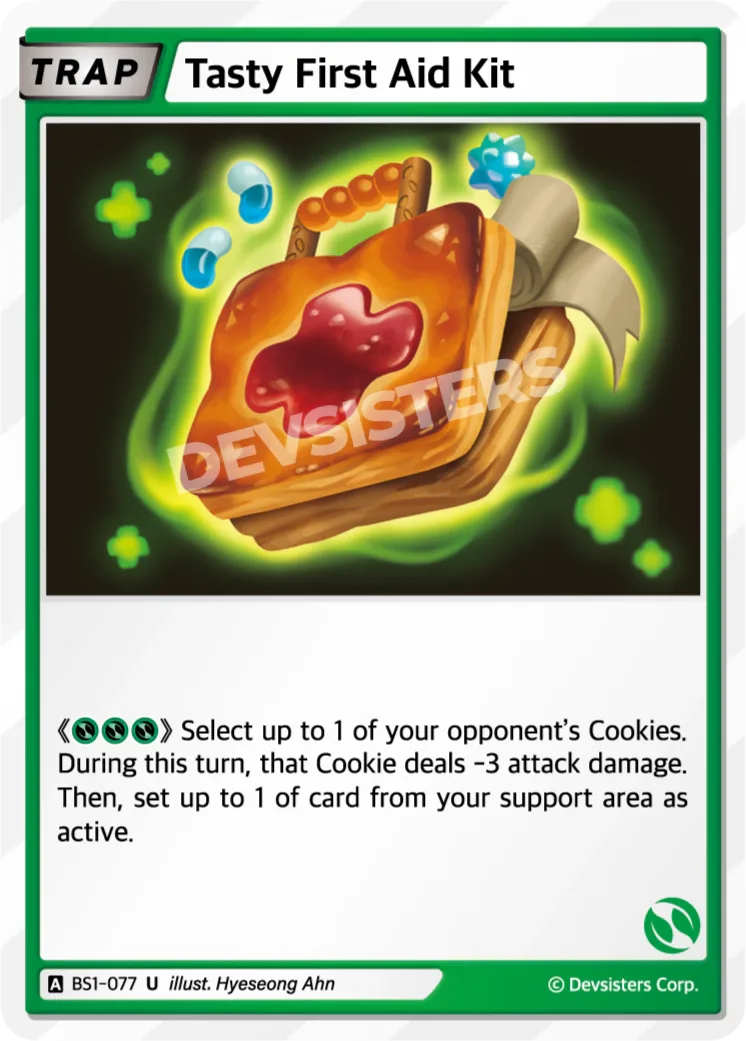
This matters most for the defender. Under the current rule, a -3 Trap against a doubled attack doesn't take 3 off the total, it takes 6, because the reduction happens before the doubling. An x2 multiplier makes every reduction count twice. If you want to know which Traps carry the biggest reductions, our best Trap cards ranking lists them.
End Battle Step, then back to Main
The last step tidies up. Effects that last "during this battle" end, the turn player's first and then the non-turn player's (7-1-4-2, 7-1-4-3), and play returns to the Main Phase (7-1-4-4).
"During this battle" and "during this turn" are different timers. Divine Light Crystal (ST3-020) says the chosen Cookie's "HP cannot reach 0 during this battle," so it covers one attack. Tasty First Aid Kit's -3 lasts "during this turn," so it stays on that Cookie until the End Phase clears turn-length effects (6-6-1-4, 6-6-1-5).
Back in the Main Phase you can play more cards, activate more effects or attack with your other Cookie (6-5-1). For the team version of all this, where one player on the attacked team gets the Trap Step answer, see our 2-on-2 rules guide.
Three things the rules settle
Three points are worth stating plainly, because Ver. 1.8 settles each one:
- Traps are not set. They are played from your hand when your opponent declares an attack (2-2-5, 7-1-2-1-1), and their cost is paid by resting active support cards (2-5-3).
- Attacking does not end your Main Phase. You return to it after every battle (7-1-4-4) and can keep playing cards in any order (6-5-1).
- FLIP timing is not ambiguous. HP cards come off one at a time, and a revealed FLIP may be activated immediately, while the damage is still coming off (4-6-2, 4-6-3, 7-1-3-1-1). Our break area guide covers what happens to the Cookie once the last card is gone.
Quick checklist
- Four steps, every attack: Attack, Trap, Damage, End Battle (7-1).
- The defender gets one Trap Step answer: a Trap from hand, or one "when your opponent attacks" Cookie effect (7-1-2-1). Blocker also activates in that step; whether it counts as the one answer is a judge call.
- Remove the attacker in the Trap Step and the Damage Step never happens (7-1-2-2).
- Damage is one HP card at a time, each to the trash. A revealed FLIP may fire immediately, and firing it is optional.
- "Then" waits until all of the damage has resolved.
- Conditions lock once damage starts resolving. Wildberry's LV.9 or a Wrath of the Dragons threshold has to be true before then.
- Multipliers apply last, so a reduction against a doubled attack counts double.
- A Cookie can attack the turn it is played, and you return to the Main Phase after every battle.
Frequently Asked Questions
How does attacking work in Cookie Run: Braverse?
Are Traps set face down in Cookie Run: Braverse?
When do FLIP effects trigger in Cookie Run: Braverse?
Can you play cards after attacking in Cookie Run: Braverse?
How are attack damage multipliers calculated in Cookie Run: Braverse?
Does a damage bonus apply if its condition is met during the attack in Cookie Run: Braverse?
How does Blocker work in Cookie Run: Braverse?
Keep Reading
- Devsisters - CookieRun: Braverse TCG Comprehensive Rules Ver. 1.8 (July 27, 2026)
- Devsisters - Official English Rulebook notice (27 July 2026 updated), linking the Comprehensive Rules
- Devsisters - Notice of Rule Update (Updated on 03/30/26): simultaneous Cookie plays, damage during the Damage Step, and multiplier order
- Official CookieRun: Braverse English card database (JSON)
- Devsisters - CookieRun: Braverse 2-on-2 Format Rules Ver. 1.0 (April 3, 2026)
Related Guides

Cookie Run: Braverse 2-on-2 Rules and Winning Team Decks
Braverse's standard rulebook says it doesn't cover games with more than two players, so the official 2-on-2 format runs on two separate documents - and they change more than you'd think. One loss counter for two Break Areas, a four-copy limit that belongs to the team, and board wipes that hit your partner. Here are the rules, read off the source, plus what all five Asian 2-on-2 champion teams with published lists actually brought.
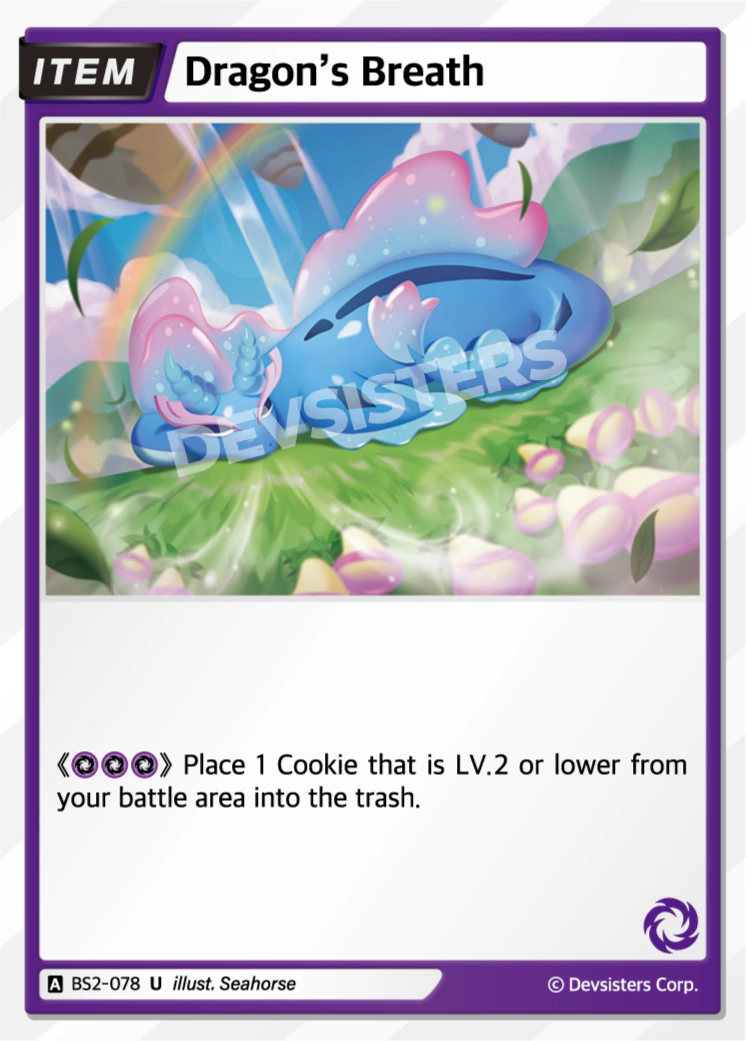
Cookie Run: Braverse Errata List - All 29 Corrected Cards
Devsisters has published corrections to the printed text of 29 Cookie Run: Braverse cards. One of them changes an Item into a Trap. Another turns a card that could only trash your own Cookie into one that can trash theirs. And on 24 of the 29, the official card database still serves the wording that was corrected.
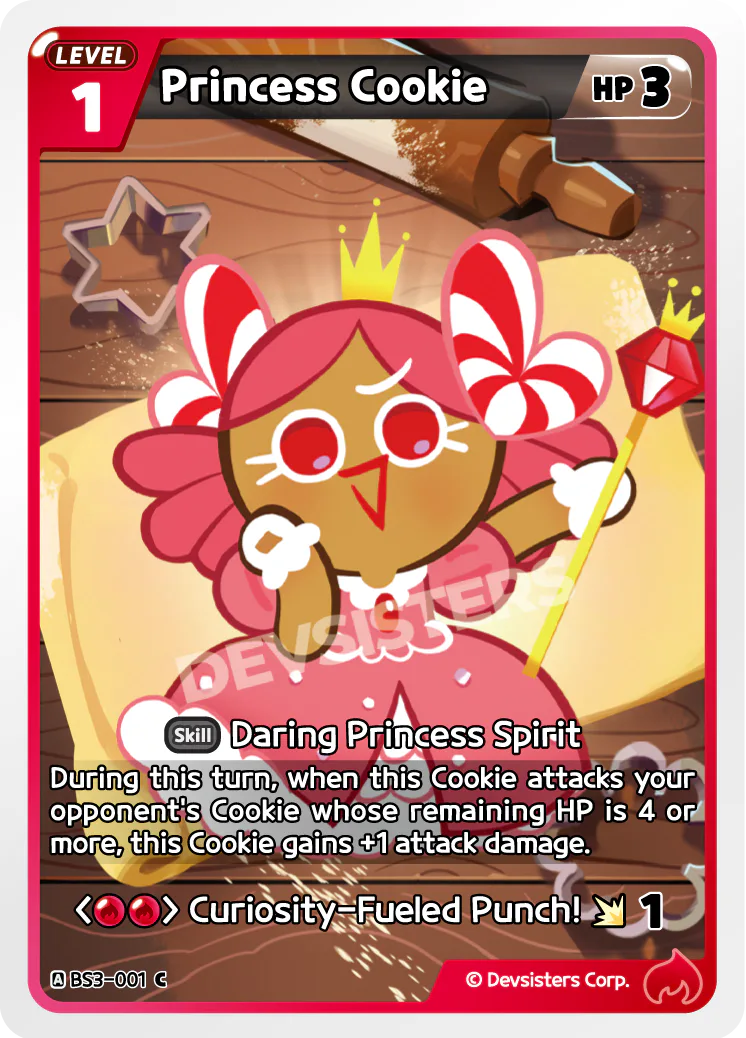
Cookie Run: Braverse Turn Structure & Phases Explained
Most Braverse misplays aren't bad cards - they're a phase mistake. Here's the full turn flow, Refresh to End, what you're allowed to do in each window, and the first-turn rules that trip up every new player.
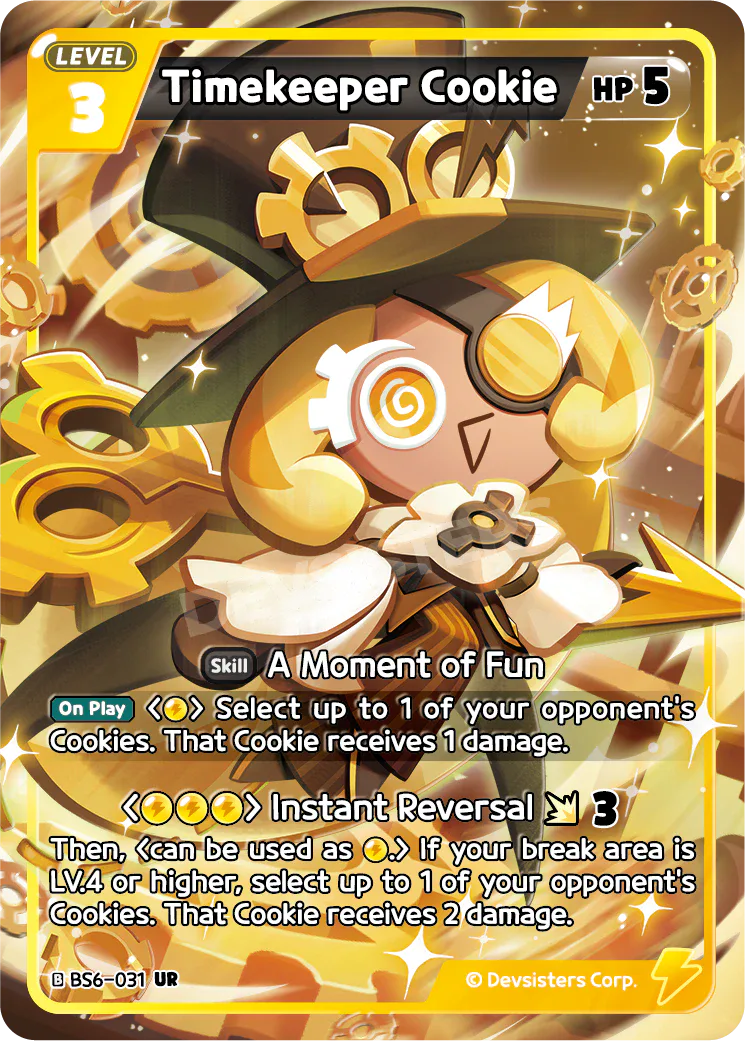
Cookie Run: Braverse Energy & Leveling Explained
Energy is the engine that runs every Cookie Run: Braverse turn. Here's how energy types and color costs work, how the Support Area pays for your cards, and how leveling from LV.1 to LV.3 gates the whole game.

How to Play Cookie Run: Braverse - A Complete Beginner Guide
Cookie Run: Braverse is the rare TCG you can teach in a single match. This guide covers everything a first-time player needs: card types, setup, turn structure, how you pay for cards, the FLIP mechanic, and how to win.
Cookie Run: Braverse Meta Tier List — Best Decks & Archetypes Ranked
Which Cookie Run: Braverse decks are actually carrying right now? Here's a meta tier list of the strongest archetypes - the real cards that anchor each one, why they rank where they do, and what's overrated.