The FLIP Mechanic in Cookie Run: Braverse, Explained
FLIP is the mechanic that makes Braverse feel unlike any other TCG: a Cookie's HP can fight back. Here's exactly what FLIP is, when it triggers, and the misplays that lose games.
Most trading card games make defense a passive thing - your creature blocks, takes damage, maybe dies. Cookie Run: Braverse looked at that and decided your hit points should be able to punch back. That's FLIP, the game's signature mechanic, and it's the single biggest reason Braverse plays differently from every TCG it gets compared to. Once you understand FLIP, you stop seeing combat as "can I win this trade?" and start seeing it as "what is this Cookie's HP hiding, and can I afford to find out?"
This is a deep dive on FLIP: what it is, exactly when and how it triggers, why it reshapes the whole game, and the misplays that cost new players matches. We'll stay consistent with the broader rules in our card types explained guide. One honest caveat up front: Braverse is a young game, and a few of FLIP's edge-case rules - especially the precise timing of when a flip triggers - aren't pinned down consistently across community sources. We'll flag exactly where that matters and tell you what to confirm against the official rulebook before a sanctioned event.
What FLIP actually is
Here's the thing that trips people up, and it's worth getting precise: in Braverse, "FLIP" wears two hats. It's both a card type and an ability - and understanding that split is the whole key to the mechanic.
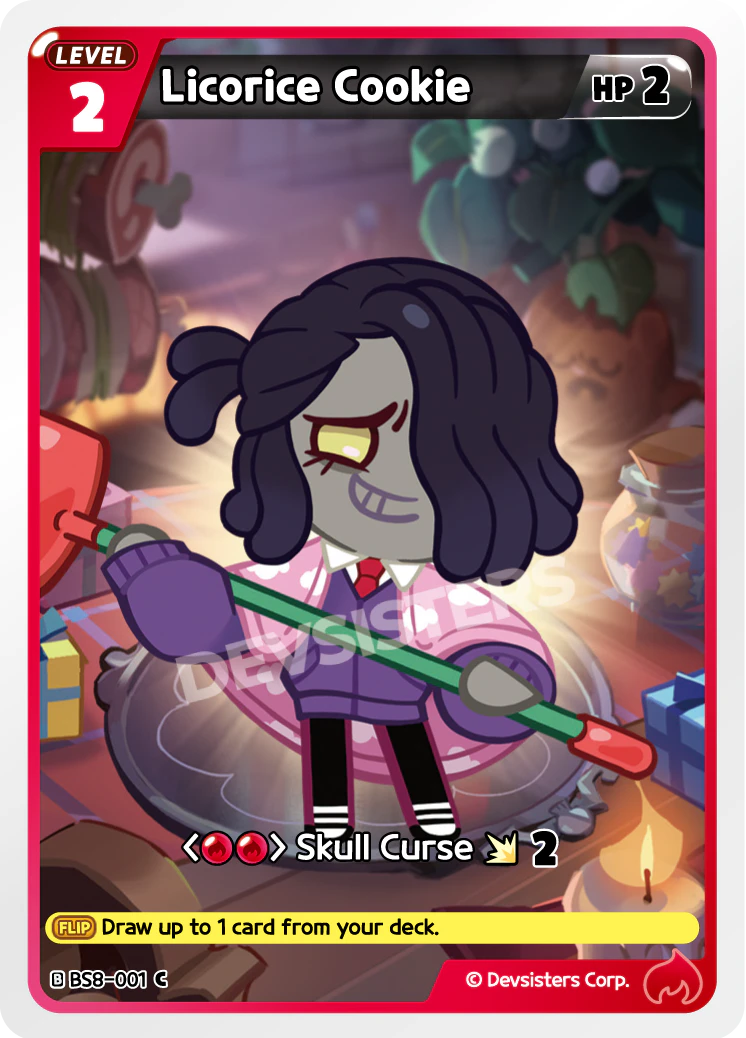
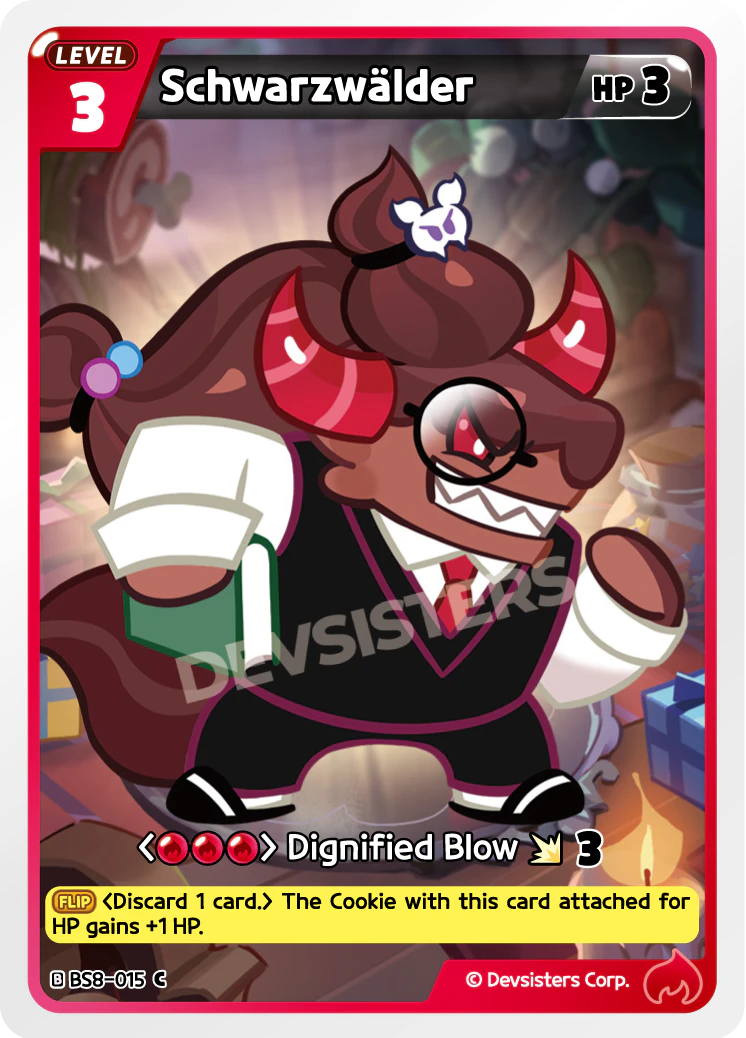
On one hand, FLIP is a dedicated card type, sitting right alongside Cookie, Item, Trap, Stage, and the others - the official card database lists over 240 cards whose type literally is FLIP. These are cards built specifically to live in an HP stack: a card like Licorice Cookie (a FLIP-type card) carries the FLIP ability "Draw up to 1 card from your deck," and Schwarzwälder (also a FLIP type) carries "Discard 1 card. The Cookie with this card attached for HP gains +1 HP." They have an attack line too, but their reason to exist is the effect that fires from the HP stack.
On the other hand, FLIP is also an ability that some regular Cookies carry on top of being a Cookie. The clearest example is Sorbet Shark Cookie (a Cookie, not a FLIP-type card) which still carries the flip ability "Draw up to 1 card from your deck." So a Cookie can do its normal Cookie things on the board and fire a flip effect if it ends up buried face-down in someone's HP stack. That's why "what card type is this?" is only half the question in Braverse. The other half is "does it carry a FLIP ability, and where is it right now?"
The unifying idea, whether it's a FLIP-type card or a Cookie with a flip ability: the flip effect is a triggered effect that fires when the card gets flipped face-up from one specific place - a Cookie's HP stack. Sitting in your hand or attacking on the board, the card behaves normally. Tucked face-down beneath a Cookie as one of its hit points, it's a hidden landmine, and when damage flips it face-up, the effect goes off. That dual nature - type and ability - is the whole trick.
How an HP stack works
To get FLIP, you have to get HP, because the two are the same system. In Braverse, a Cookie's hit points aren't a number on the card - they're a physical stack of cards placed face-down beneath the Cookie from your deck. That stack is the Cookie's health.
Here's the chain of events that matters:
- A Cookie comes down with a face-down HP stack beneath it.
- As the Cookie takes damage, cards in that stack flip face-up one at a time.
- When the stack is exhausted - all its cards flipped - the Cookie faints and goes to the Break Area, where its Level counts toward the opponent's win.
The key consequence: because the HP stack is built from cards in your deck, some of those face-down HP cards are FLIP cards. Neither player knows for certain which ones until they flip. A Cookie's health isn't just a buffer - it's a face-down deck of potential surprises, and every point of damage you deal turns one of them face-up.
The mental model: damage doesn't just chip away a number, it reveals cards. Attacking a Cookie is the act of flipping its HP stack one card at a time - and you don't know what you're flipping until it's face-up.
When and how FLIP triggers
This is the part to get exactly right, because it's where the strategy lives. A FLIP effect triggers at the moment a FLIP card in an HP stack is flipped face-up by damage. The trigger isn't "when you play the card" or "when the Cookie dies" - it's the flip itself, mid-combat, the instant the damage turns that specific card over.
Walk through a single attack:
- Your Cookie attacks a defending Cookie.
- Damage is applied, and the defender flips the corresponding number of HP cards face-up.
- If any flipped card is a FLIP card, its FLIP effect triggers right then.
That third step is the gut-punch. The FLIP that fires belongs to the defender - the player whose Cookie just took the hit. So the attacker can be the one who sets off the defender's tucked-away effect, by the simple act of attacking. You went looking for a clean trade and instead you handed your opponent a free trigger.
The most important nuance - and the one most worth confirming - is the precise timing of that trigger relative to the rest of combat: whether the FLIP resolves before or after damage finishes, how multiple flips in one hit are ordered, and how a FLIP interacts with other effects already on the stack. This is the single most-cited rules ambiguity in the game. The existence of the trigger-on-flip is well established; the exact ordering is what you should confirm against the official rulebook before a sanctioned event, rather than quoting an edge-case ruling from memory.
Why FLIP changes the whole game
Plenty of TCGs have "morph" or face-down cards. What makes FLIP special is that it welds the surprise mechanic directly onto the HP system, so it touches every attack in the game. A few things fall out of that:
- Defense fights back. You can't swing freely. Attacking into a Cookie risks triggering a FLIP that punishes you - a counter-attack, a removal effect, a card-draw for the defender. Combat stops being a clean math problem.
- HP carries hidden information. A higher-Level Cookie has a bigger HP stack, which means more face-down cards and more potential FLIP triggers waiting inside it. A high-Level Dragon Cookie's beefy stack isn't just more health - it's more unknowns.
- It rewards deckbuilding. You get to decide how dangerous your Cookies are to attack, by loading your deck with FLIP cards up to a cap of 16. A deck near that cap turns every HP stack into a minefield; a deck with few FLIP cards has predictable, safe-to-attack Cookies.
- Bluffing becomes real. Because nobody knows which HP cards are FLIP cards, your opponent has to play around effects that might not be there - which slows their attacks down even when your stack is harmless.
The net effect is that Braverse combat has a built-in risk layer no amount of board math fully removes. You're always, on some level, gambling against the defender's hidden HP.
Building with FLIP cards
FLIP isn't just something that happens to you - it's a deckbuilding axis you control. The rule to anchor on: a deck can run up to 16 cards with a FLIP ability. That count includes both dedicated FLIP-type cards (like Licorice Cookie or Schwarzwälder) and the regular Cookies that happen to carry a flip ability (like Sorbet Shark Cookie), so the cap is about how many of your cards can fire from an HP stack - not a separate deck slot you have to find room for.
How to think about it by archetype:
| Archetype | FLIP approach | Why |
|---|---|---|
| Red aggro | A lean set of early-relevant FLIP cards | Aggro can't afford dead defense; it wants flips that still help the clock |
| Yellow control | More FLIP cards that punish attackers | Control wants attacking it to hurt, buying time for the late game |
| Blue combo | FLIP cards that draw or stall | Anything that buys time or fuels the combo while defending |
| Purple disruption | FLIP cards that remove or recur | Doubles down on making the opponent's turn miserable |
The discipline is the same everywhere: a FLIP card earns its slot if the effect is something you're happy to have fire defensively, on the opponent's terms, when they choose to attack. A FLIP effect you only want on your own turn is a worse FLIP card than one that's genuinely scary to trigger. Which specific cards carry the FLIP property in the current pool - and exactly what their effects do - is worth confirming against the official card database before you build around them.
Practical takeaway: load FLIP cards that you'd be glad to see flip up at the worst possible moment for your opponent. The best FLIP card makes the opponent hesitate to attack at all.
Common FLIP misplays
These are the mistakes that cost new players games, in rough order of how often they happen:
- Attacking into a fat HP stack on autopilot. A high-Level defender with a deep stack - think a Dragon Cookie or Dark Cacao Cookie - is exactly where a punishing FLIP is most likely to be hiding. Throwing attackers at it without a plan is how you hand the defender free triggers.
- Forgetting the FLIP belongs to the defender. New players sometimes attack expecting their FLIP to do something. The flip fires for whoever's Cookie took the damage. If you want your FLIP to fire, your Cookie has to be the one getting hit.
- Over-stuffing the 16-FLIP cap with bad triggers. Hitting 16 FLIP cards with effects that don't actually scare an attacker is wasted potential. Quality of the trigger beats quantity.
- Ignoring FLIP when sequencing damage. If you have multiple attackers, the order you attack in can change which Cookie eats a FLIP trigger and when. Spraying damage randomly throws away free information and tempo.
- Treating a bluff as nothing. On the flip side, assuming an opponent's stack is harmless and committing everything into it. Sometimes the smart play is to develop your board for a turn rather than walk into an unknown stack.
The through-line: respect the stack. Both the attacker and the defender are playing an information game, and the player who remembers FLIP exists - on both sides of the table - makes better combat decisions than the one who treats HP as a plain number.
The one rule to confirm before a tournament
If you take one thing to a judge, make it this: the precise timing and ordering of FLIP triggers. The community broadly agrees that a FLIP effect fires when the card is flipped face-up by damage, and that decks cap at 16 FLIP cards. What's not consistently reported is the fine timing - whether a FLIP resolves before damage fully applies, how simultaneous flips are ordered, and how FLIP stacks with other triggered effects. That ambiguity is harmless in casual play and match-defining in a close tournament game. Confirm it against the current official rulebook before you sit down at a sanctioned event, and don't build a combo that depends on a specific resolution order until you've verified that order is correct.
Quick Action Checklist
- Remember FLIP is both a card type and an ability. There are dedicated FLIP-type cards (Licorice, Schwarzwälder) and regular Cookies that also carry a flip ability (Sorbet Shark); either fires when flipped face-up from an HP stack.
- Treat damage as revealing cards, not subtracting a number. Every hit flips an HP card, and some of those are FLIP cards.
- Know whose FLIP fires. The defender's - the player whose Cookie took the hit. Attacking can set off your opponent's trigger.
- Respect deep HP stacks. High-Level Cookies hide more potential FLIP triggers. Don't autopilot attacks into them.
- Build FLIP cards you'd love to see fire defensively. A scary on-flip effect is worth more than a convenient one.
- Mind the 16-FLIP cap. It counts every card with a flip ability - dedicated FLIP-type cards and flip-carrying Cookies alike; favor quality triggers over hitting the number.
- Confirm FLIP timing before a tournament. The trigger-on-flip is established; the exact ordering is the game's biggest rules ambiguity - check the official rulebook.
Frequently Asked Questions
What is the FLIP mechanic in Cookie Run: Braverse?
When does a FLIP card trigger in Braverse?
How does HP work in Cookie Run: Braverse?
Who does a FLIP effect belong to - the attacker or the defender?
How many FLIP cards can a Braverse deck run?
What are the most common FLIP misplays?
Keep Reading
Related Guides

Cookie Run: Braverse Glossary: Every Term Explained
Every Cookie Run: Braverse term in one place, defined plainly and consistently with our rules guides. Play areas, the card types, FLIP, the five colors, energy, Level, rarities, and keywords like Arena, Ancient, Beast, and Dragon.
Cookie Run: Braverse Card Types Explained
The how-to-play guide gives you the speed-run. This is the deep dive: the four card types the rulebook defines, the seven labels the official database files cards under, what each one actually does, and how to think about each in your deck.
Cookie Run: Braverse Win Conditions Explained
Braverse has two ways to win, and most new players only play toward one. Here's how the Break Area Level-10 path and the no-Cookie-to-deploy path actually work, how to build a deck that threatens both, and the on-board signs that tell you which one you're winning.
How to Read a Cookie Run: Braverse Card
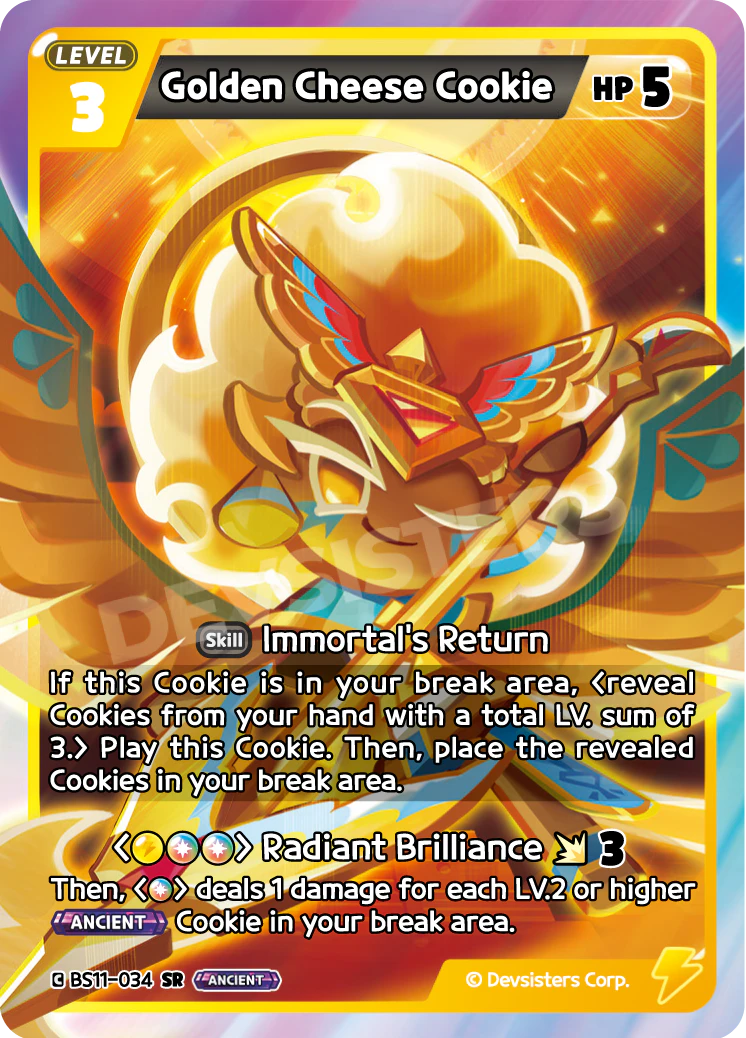
Almost every element printed on a Braverse card face maps to a field in the official database. Here is the whole card decoded - the Level badge, the colored keyword pills, the attack line, the regulation letter - checked against all 2,093 entries.
How to Play Cookie Run: Braverse - A Complete Beginner Guide
Cookie Run: Braverse is the rare TCG you can teach in a single match. This guide covers everything a first-time player needs: card types, setup, turn structure, how you pay for cards, the FLIP mechanic, and how to win.
Cookie Run: Braverse Meta Tier List — Best Decks & Archetypes Ranked
Which Cookie Run: Braverse decks are actually carrying right now? Here's a meta tier list of the strongest archetypes - the real cards that anchor each one, why they rank where they do, and what's overrated.