Cookie Run: Braverse Glossary: Every Term Explained
Every Cookie Run: Braverse term in one place, defined plainly and consistently with our rules guides. Play areas, the card types, FLIP, the five colors, energy, Level, rarities, and keywords like Arena, Ancient, Beast, and Dragon.

Every trading card game builds its own private dictionary, and Cookie Run: Braverse is no exception. The first time someone tells you to "rest two Support to pay the cost, then watch the FLIP in their Break Area math," it can sound like a foreign language. It isn't. The vocabulary is small once it's laid out in one place, and that's exactly what this page is: a plain-English glossary of every term you'll actually run into, grouped so the related ones sit together.
This is a reference, not a tutorial. If you want the full walkthrough, start with how to play Cookie Run: Braverse and come back here when a word trips you up. Everything below stays consistent with our rules guides, and where Braverse is still a young game with edge-case rulings that aren't pinned down, the term says so rather than pretending the answer is settled.
How to use this glossary
The terms are grouped by what they describe: the zones on the table, the card types, the FLIP mechanic, the colors, the energy and cost system, the board numbers (Level and HP), the turn structure, the keywords printed on cards, and the collecting rarities. Each section is short and skimmable. If you only learn three terms before your first game, make them Support Area (how you pay for things), Break Area (the main scoreboard), and FLIP (the surprise mechanic) - everything else clicks once those do.
A standing note for the whole page: Braverse's English-language rules are still settling, and a few specifics - FLIP trigger timing, exact Trap setup, color-cost rules - aren't reported consistently across community sources. Where that's true, we flag it and point you at the official rulebook for sanctioned play.
The play areas (zones)
Your side of the table is split into named zones. Knowing what lives where is half of learning the game.
| Term | What it is |
|---|---|
| Battle Area | Where your active Cookies stand and fight. The main stage; the only place Cookies attack from. |
| Support Area | Where you place cards that get rested (tapped) to pay costs and to activate Items and Traps. Your resource engine. |
| Break Area | The running pile of defeated Cookies, and the zone that drives the main win condition. The scoreboard. |
| Trash | The discard pile for spent Items, Traps, and other used cards. Some Purple strategies treat it as fuel. |
| Deck Area | Your face-down 60-card deck. It also feeds the face-down HP stacks placed under your Cookies. |
| Hand | The cards only you can see, played during your turn. |
The two zones beginners trip over are the Support Area (your engine) and the Break Area (your scoreboard). Keep one eye on each all game. For how the zones interact in a full turn, see how to play Braverse.
The card types
The Comprehensive Rules define four card types - Cookie, Item, Trap, and Stage (section 2-2-2) - while the official card database files cards under seven labels: those four plus FLIP (which the rules classify as card text, not a type), EXTRA, and NPC. All seven labels are worth knowing, because the database is how you'll browse cards. Five are the everyday core; two (EXTRA and NPC) show up far less often.
| Card type | What it does |
|---|---|
| Cookie | Your fighters. The only cards that attack, hold HP, and win the game. Each carries a Level, an HP value, a cost, an attack, and usually a skill. |
| FLIP | Cards built to live inside a Cookie's HP stack and fire a surprise effect when damage flips them face-up. A database label (the rules file FLIP under card text) and an ability some Cookies carry. |
| Item | One-shot effects you play for an immediate impact, then they're done. The "spell" layer. |
| Trap | Reactive cards set face-down ahead of time that trigger on a condition, often on the opponent's turn. |
| Stage | Persistent battlefield effects that apply continuously while in play, rather than resolving once. |
| EXTRA | High-impact Cookies kept in the separate EXTRA deck, gated behind a board-state condition you have to meet to play them. |
| NPC | A database-only label - three cards exist, and the term appears nowhere in the Comprehensive Rules. Trivia, not a deckbuilding pillar. |
The full breakdown of each label, with example cards and deck ratios, lives in card types explained. The one term that needs its own section is FLIP, because it's both a card category and a mechanic.
FLIP: the signature term
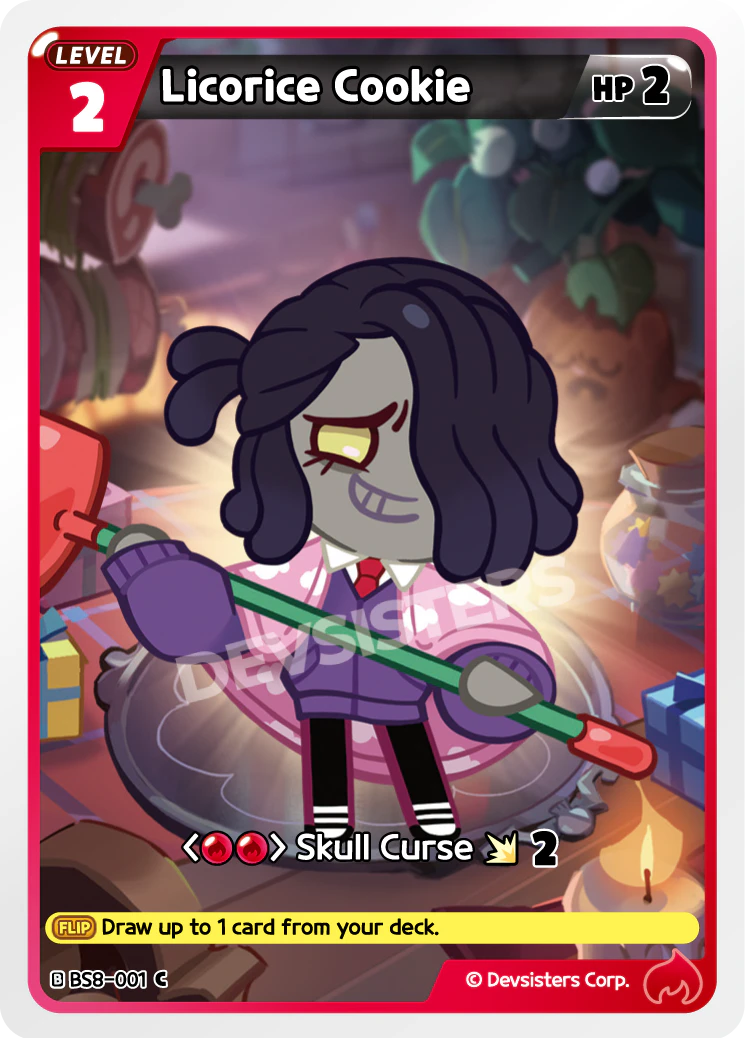
FLIP is the term you'll hear most, and it means two things at once:
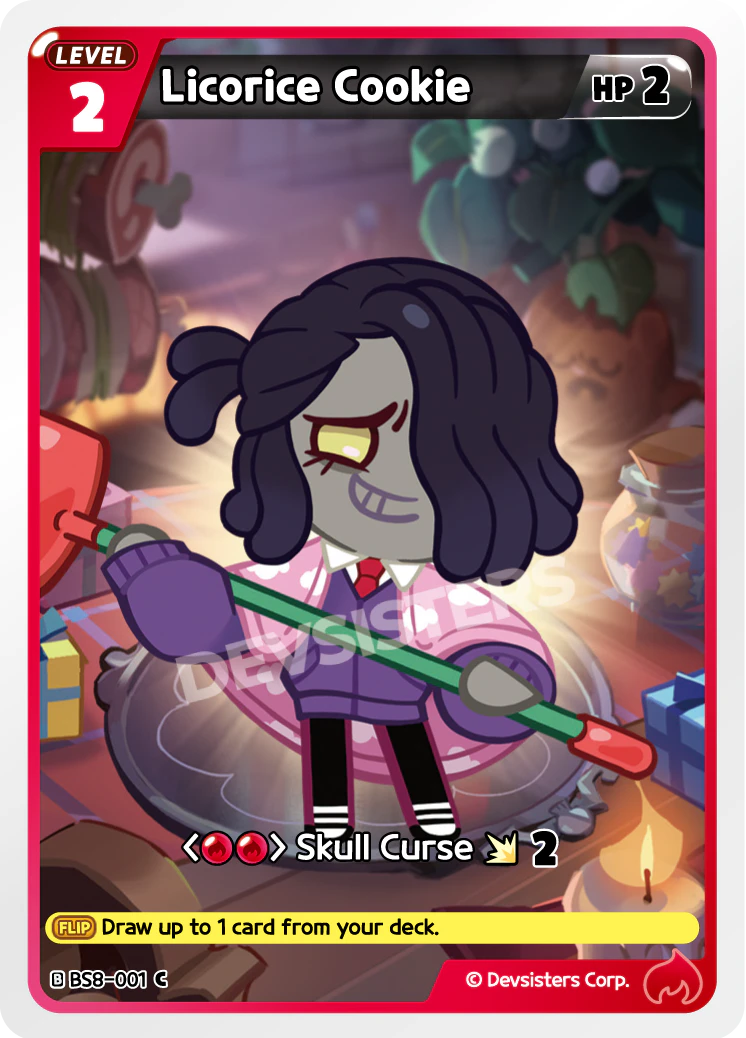
- FLIP (card category). A database label covering over 240 dedicated cards built to sit face-down in a Cookie's HP stack — the rulebook files FLIP under card text rather than making it a card type. Licorice Cookie (BS8-001) is a dedicated FLIP card whose flip effect is "Draw up to 1 card from your deck."
- Flip (ability). A property that some ordinary Cookies also carry. Sorbet Shark Cookie (BS5-074) is a Blue Cookie that attacks and holds HP normally but also fires a flip effect if it ends up buried in an HP stack.
The unifying idea: a flip effect is a triggered effect that fires the moment the card is flipped face-up by damage, from one specific place - a Cookie's HP stack - and the trigger belongs to the defender, the player whose Cookie took the hit. That's why attacking carries risk: you can set off your opponent's hidden effect just by swinging.
Two more FLIP-adjacent terms:
- HP stack. The face-down pile of cards beneath a Cookie that is its hit points (see below). Some of those cards are FLIP cards.
- The 16-FLIP cap. A deck can run up to 16 cards with a flip ability - counting both dedicated FLIP-type cards and flip-carrying Cookies. The exact timing of a flip trigger relative to the rest of combat is the most-cited rules ambiguity in the game, so confirm it against the official rulebook before a sanctioned event. The deep dive is in the FLIP mechanic explained.
The five colors (plus two)
Braverse uses five colors, each a full playstyle. They're the foundation of every Starter Deck.
| Color | Identity | Plays like |
|---|---|---|
| Red | Aggro | Fast damage and board pressure. The most beginner-friendly. |
| Yellow | Control | Grindy late game and Break Area math. |
| Green | Ramp | Builds resources and snowballs. |
| Blue | Combo | Card cycling and explosive turns. Highest skill floor. |
| Purple | Disruption | Resource denial and recursion; home of trash-based strategies. |
Two more tags show up in the color filter that aren't colors in the normal sense:
- Black. A self-contained villain faction built around Dark Enchantress Cookie, running on its own {K} energy symbol rather than one of the five colors.
- Pure. A small set of universal "specials" that cost generic or rainbow energy and splash into any deck.
The full color breakdown is in the five colors explained, and the two extras get their own piece in Black and Pure cards explained.
Energy and paying costs
Here's the system that surprises players from other TCGs: Braverse has no mana cards and no energy pool. You pay by resting cards you've already committed.
- Energy / cost. The price printed on a card, shown with color symbols like {R} (Red), {Y} (Yellow), {G}, {B}, {P}, plus {N} for generic "any color" and {K} for Black. You pay it by resting that many Support cards.
- Support card. A card you place into the Support Area to grow your resource base. You may add one per turn, so your economy ramps slowly and steadily.
- Rest (tap). To turn a card sideways to pay a cost or activate an effect. Rested Support cards can't pay again until they refresh.
- Refresh / stand / un-rest. At the start of your turn, your rested Support cards stand back up, ready to pay again.
Because you only add one Support card per turn, early tempo matters: a cheaper Cookie hits the board sooner. One detail community guides describe inconsistently is whether costs require color-matched Support or any rested Support card, so confirm the exact color rules against the official rulebook before you rely on them in a tournament.
Level, HP, and the board
These are the numbers and board states you track constantly.
- Level. A Cookie's rank: 1, 2, or 3. Level feeds your curve and the main win condition - a fainted Cookie's Level counts toward its owner's loss.
- HP (hit points). Not a number on the card but a face-down stack of cards placed beneath a Cookie from your deck, equal to its HP value. As the Cookie takes damage, those cards flip face-up one at a time.
- Faint. What happens when a Cookie's HP stack is exhausted. The Cookie goes to its owner's Break Area, and its Level counts toward the opponent's win.
- Attack / skill. A Cookie's offensive line and its special ability text. Many costs (attacks, skills, Items) are paid by resting Support.
- Break Area Level total. The combined Level of the Cookies sitting in a player's Break Area. When yours reaches the threshold, you lose.
For how Level math actually decides games, see win conditions explained.
Turn and gameplay terms
The rhythm of a turn, in the order it happens.
| Term | Meaning |
|---|---|
| Refresh phase | Stand up your rested Support cards so they can pay again. |
| Draw phase | Draw a card. (The first player skips this on turn 1.) |
| Main phase | The meat of the turn: play Cookies, add one Support card, drop a Stage, set Traps, use Items, and attack. |
| End phase | Resolve end-of-turn effects and pass to your opponent. |
| Mulligan | Adjusting a bad opening hand before the game starts. See our mulligan guide. |
| First-player tax | The rule that the player who goes first cannot draw or attack on turn 1 - the balancing cost of going first. |
Some community guides label the phases slightly differently, so if a precise phase name matters for a ruling, check it against the official rulebook.
Keywords: Arena, Ancient, Beast, Dragon
Beyond the colors and types, some cards carry a printed keyword that ties them to a theme or sub-archetype. These are the four you'll see most in the current pool.
- Arena. The largest keyword group by far. Arena cards are tied to the Arena of Glory set's competitive theme and tend to reward an aggressive, board-focused game plan.
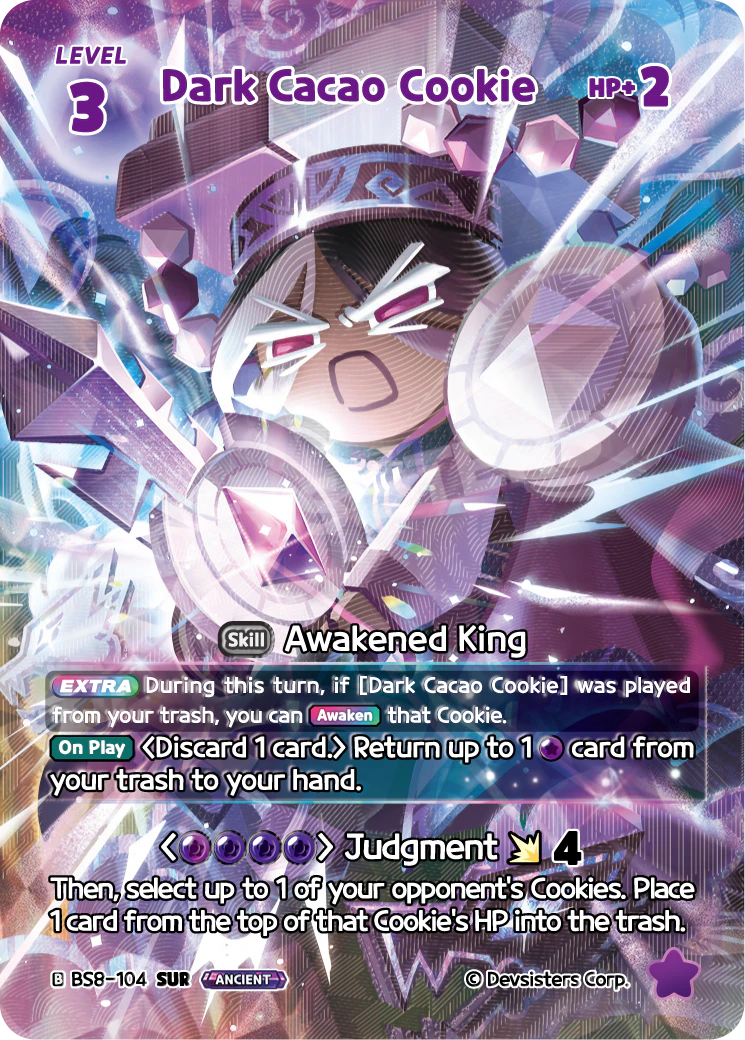
- Ancient. The keyword on the game's legendary "Ancient Hero" Cookies - high-impact, often high-Level threats. Dark Cacao Cookie (BS8-104) is an Ancient-keyworded EXTRA, for example.
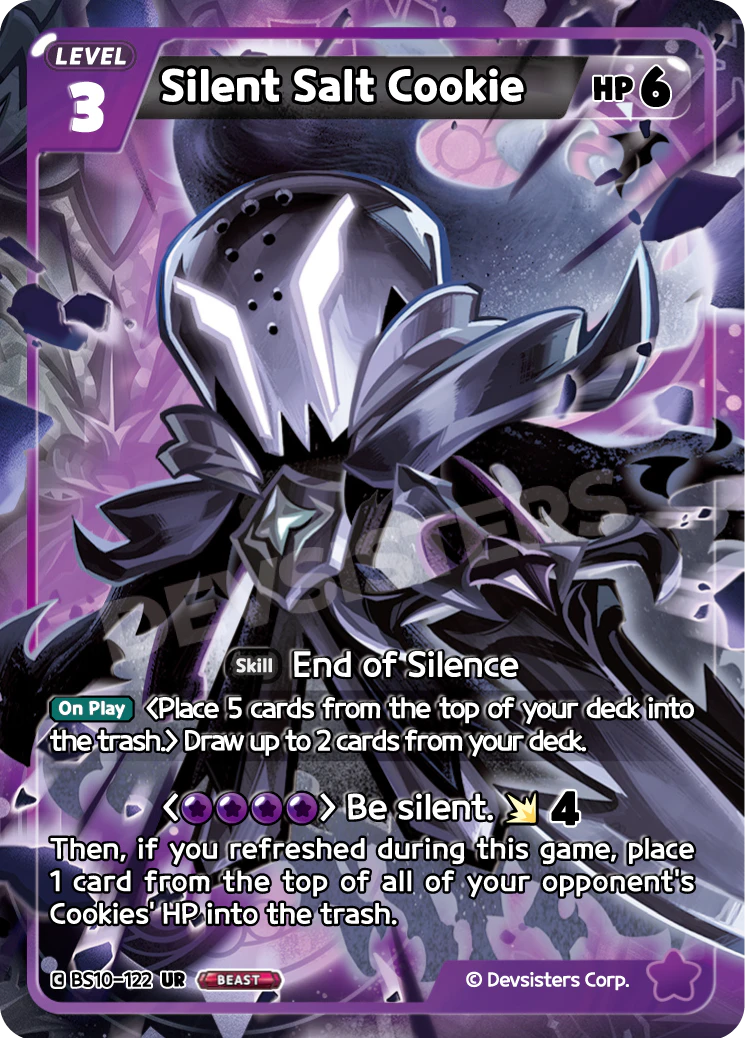
- Beast. The keyword on the powerful "Beast" Cookies (think the menacing late-game finishers), a smaller but high-ceiling group.
- Dragon. The keyword shared by the Dragon Cookies - a Cookie variant like Pitaya Dragon, Longan Dragon, and Lotus Dragon. Dragon Cookies follow normal Cookie rules but carry extra mechanics; the specifics are worth confirming against the official rulebook before a sanctioned event.
A keyword isn't a separate card type - a card is still a Cookie (or FLIP, etc.) that also has a keyword. We cover each group's best cards in our keyword guides, like best Ancient cards and best Dragon cards.
Rarities and collecting terms
The little symbol on each card tells you how rare it is. This is the collecting vocabulary.
| Tier | Abbreviation |
|---|---|
| Common | C |
| Uncommon | U |
| Rare | R |
| Super Rare | SR |
| Ultra Rare | UR |
| Secret Rare | SEC |
| Secret Super Rare | SSR |
| Secret Ultra Rare | SUR |
| Extra Rare | EXR |
| Genesis Extra Rare | GXR |
| Promotion | P |
A few notes: EXR and GXR aren't part of the regular base ladder - they're special chase rarities, and GXR is so exclusive that exactly one card in the whole game carries it. Promotion (P) cards come from events and product bundles, not booster packs. And hidden cards is the term for the premium/alt-art pool that sits on top of a set's base checklist. Rarity is not the same as power - plenty of Commons are deck staples. The full ladder and a sane collecting plan are in the rarities and collecting guide.
Quick Action Checklist
- Learn the zones first: Battle Area (fight), Support Area (pay), Break Area (scoreboard), plus Trash, Deck Area, and Hand.
- Memorize the four rulebook card types (Cookie, Item, Trap, Stage) and the database's three extra labels (FLIP, EXTRA, NPC). Cookie, FLIP, Item, Trap, and Stage are the everyday core.
- Treat FLIP as both a card type and an ability; the effect fires for the defender when damage flips a card in an HP stack.
- Know the five colors - Red, Yellow, Green, Blue, Purple - plus the special Black faction and Pure specials.
- Remember there's no mana: add one Support card per turn and rest cards to pay costs; they refresh next turn.
- Track Level (1-3) and HP (a face-down stack of cards), because Level drives the Break Area win.
- Recognize the big keywords - Arena, Ancient, Beast, Dragon - as themes layered on top of a card's type.
- Read rarities (C through GXR, plus P) as a collecting ladder, not a power ranking.
Frequently Asked Questions
What is the Break Area in Cookie Run: Braverse?
What does FLIP mean in Cookie Run: Braverse?
What is the difference between the Support Area and the Break Area?
How many colors are in Cookie Run: Braverse?
What do the keywords Arena, Ancient, Beast, and Dragon mean?
What does it mean to rest a card in Braverse?
Keep Reading
Related Guides
The FLIP Mechanic in Cookie Run: Braverse, Explained
FLIP is the mechanic that makes Braverse feel unlike any other TCG: a Cookie's HP can fight back. Here's exactly what FLIP is, when it triggers, and the misplays that lose games.
Cookie Run: Braverse Card Types Explained
The how-to-play guide gives you the speed-run. This is the deep dive: the four card types the rulebook defines, the seven labels the official database files cards under, what each one actually does, and how to think about each in your deck.
Cookie Run: Braverse Win Conditions Explained
Braverse has two ways to win, and most new players only play toward one. Here's how the Break Area Level-10 path and the no-Cookie-to-deploy path actually work, how to build a deck that threatens both, and the on-board signs that tell you which one you're winning.
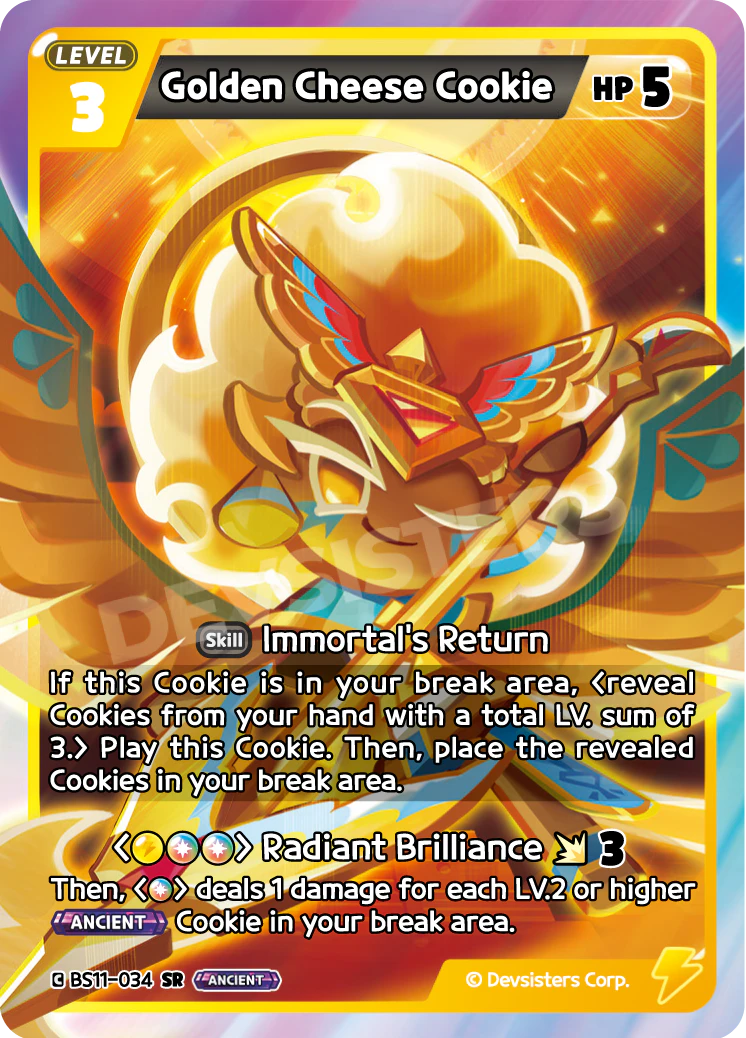
How to Read a Cookie Run: Braverse Card
Almost every element printed on a Braverse card face maps to a field in the official database. Here is the whole card decoded - the Level badge, the colored keyword pills, the attack line, the regulation letter - checked against all 2,093 entries.
How to Play Cookie Run: Braverse - A Complete Beginner Guide
Cookie Run: Braverse is the rare TCG you can teach in a single match. This guide covers everything a first-time player needs: card types, setup, turn structure, how you pay for cards, the FLIP mechanic, and how to win.
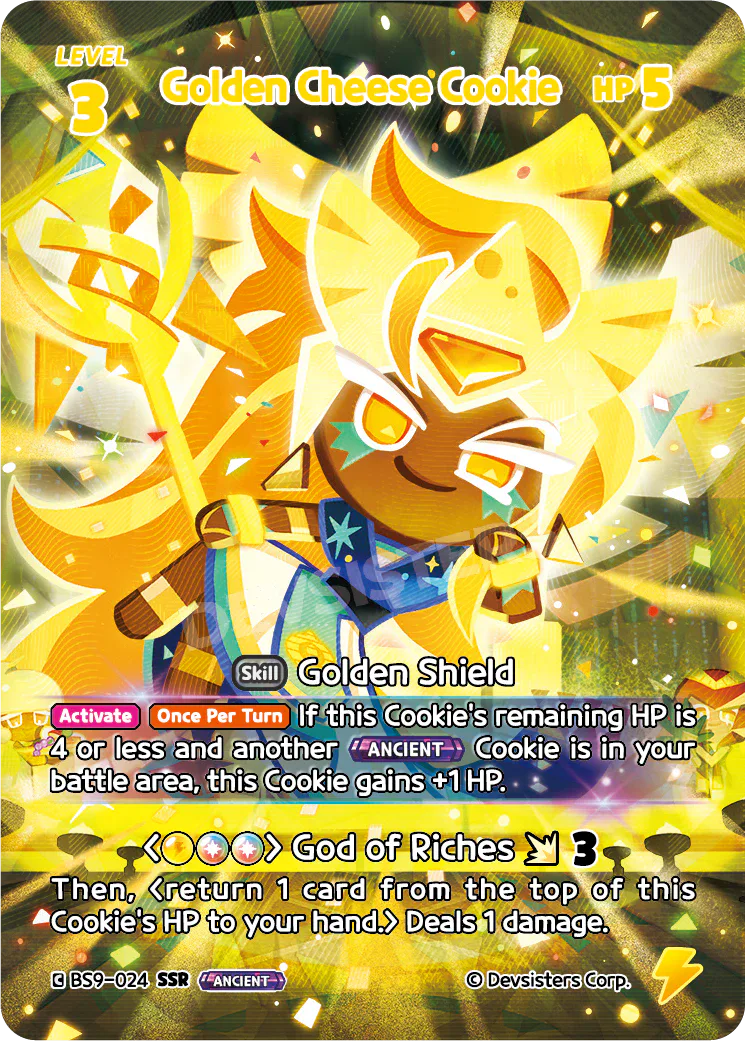
Cookie Run: Braverse Meta Tier List — Best Decks & Archetypes Ranked
Which Cookie Run: Braverse decks are actually carrying right now? Here's a meta tier list of the strongest archetypes - the real cards that anchor each one, why they rank where they do, and what's overrated.