How to Read a Cookie Run: Braverse Card
Almost every element printed on a Braverse card face maps to a field in the official database. Here is the whole card decoded - the Level badge, the colored keyword pills, the attack line, the regulation letter - checked against all 2,093 entries.
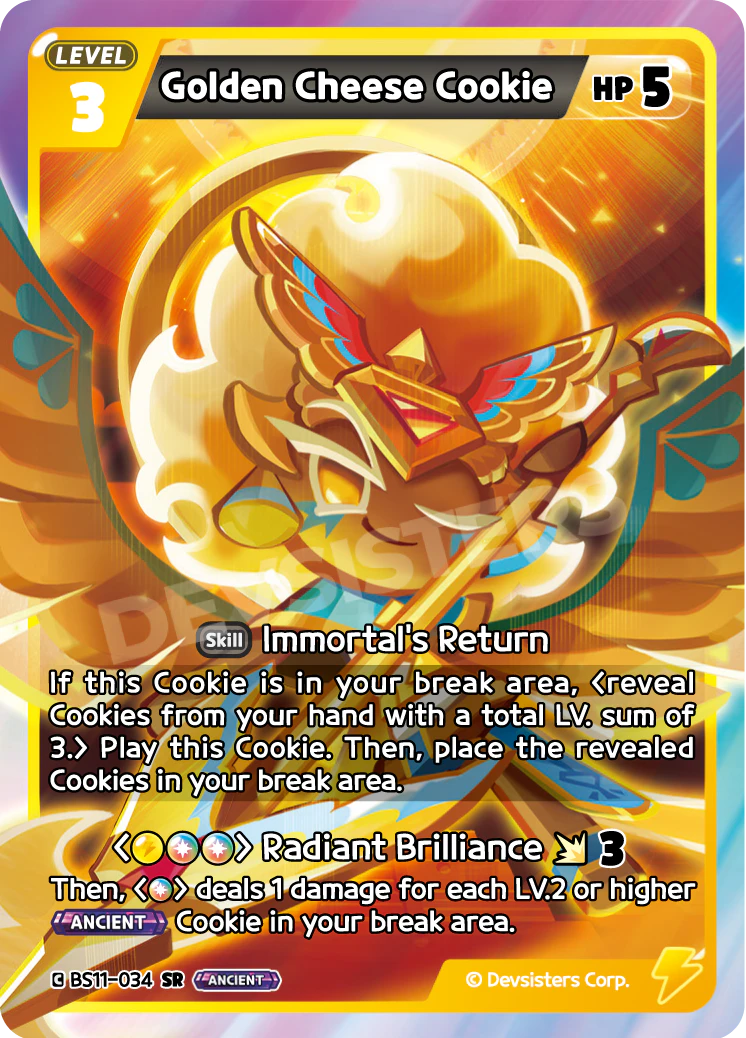
There is exactly one thing printed on the front of a Cookie Run: Braverse card that the official card database does not carry as a field. It is a boxed letter sitting next to the card number, most players have never noticed it, and it tells you which print era the card came from.
Everything else on that card face maps to something you can look up. Most new players learn the face by osmosis - they figure out the big number top-left is Level, they eventually work out that the little colored blob before the attack name is what it costs, and they guess at the rest. That guessing is where games get lost, because two of the pills in the skill box are timing restrictions and one of them is the difference between a Cookie that blocks and a Cookie that dies.
Here is the whole card, top to bottom, cross-checked against all 2,093 entries in the official card list.
The top strip: level, name, HP
Every Cookie card leads with the same three things in the same three places.
Top-left, in an angled badge: LEVEL. One, two or three on nearly every card in the game. This is not a cost - you do not pay it. It is the rung the Cookie sits on, and it is what your Break Area counts when a Cookie faints. It also gates a huge amount of card text: skills all over the game read "select up to 1 of your opponent's LV.1 Cookies," which means a Level 1 body is a legal target for effects that a Level 3 body simply ignores.
Top-center, in a black banner: the name. This is the least useful thing printed on the card. Braverse has 1,401 Cookie cards under only 435 distinct names, so "run four Mint Choco" tells you almost nothing on its own. The number in the bottom corner is the real identity, and the card numbers guide covers why that matters when you are buying singles.
Top-right, in a white box: HP. The number of cards stacked underneath this Cookie when it comes down. HP in Braverse is a physical pile, not a counter you track - which is why the energy and leveling guide treats HP as a resource rather than a stat.
Five card numbers break the format. Their HP box prints a plus sign - HP+2 rather than HP 2 - because that number is added to a Cookie already standing on the board instead of starting a fresh stack.
| Card | Name | Level | HP box |
|---|---|---|---|
| BS8-027 | Golden Cheese Cookie | 3 | +2 |
| BS8-104 | Dark Cacao Cookie | 3 | +2 |
| BS10-024 | Hollyberry Cookie | 3 | +1 |
| BS10-073 | White Lily Cookie | 3 | +1 |
| BS11-116 | Dark Enchantress Cookie | 5 | +2 |
Four of the five sit at Level 3, so a plus sign is not a tell for the Level 5 Awaken card. It is a tell for something simpler: the box is an increment, not a starting pile. Read it as "add this much," never "this Cookie arrives with this much."
Every pill in the skill box, decoded
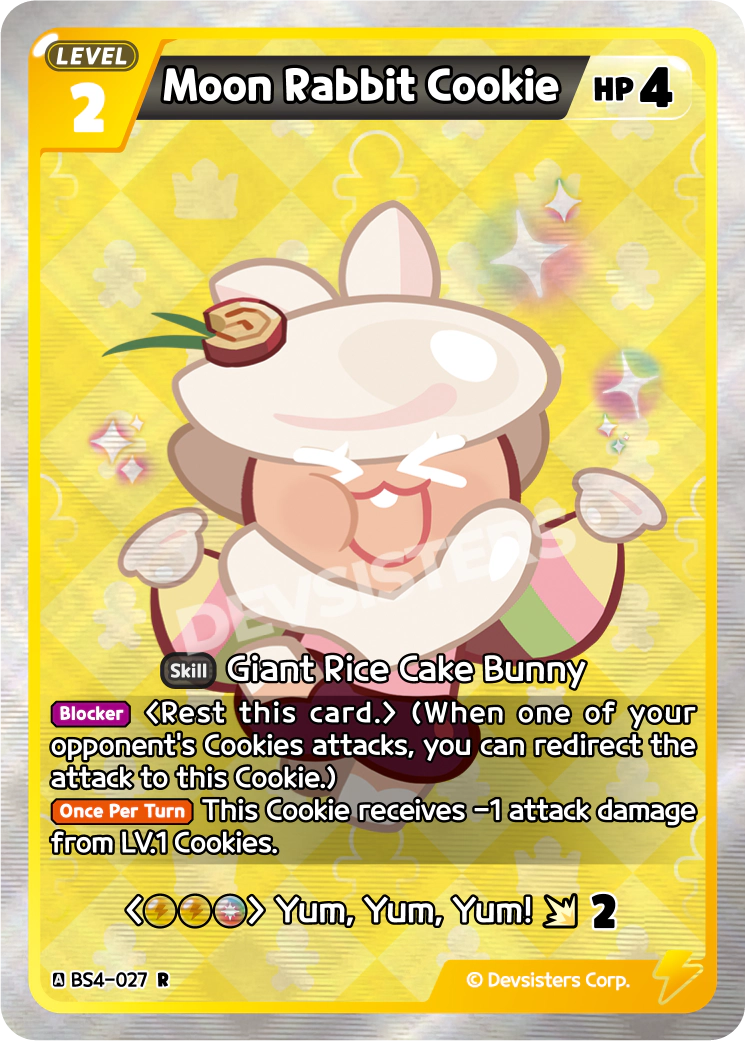
Below the art sits the skill box. It opens with a grey Skill pill and the skill's flavor name - "Immortal's Return," "Devilish Pact," "Giant Rice Cake Bunny" - and that name does nothing. It is a title. What matters is the colored pills that follow it on the next line.
There are five, and each one is a rule:
| Pill | Color | What it does | Cards carrying it |
|---|---|---|---|
| Activate | Magenta | You choose to use it, on your turn, by paying the cost that follows | 487 |
| On Play | Teal | Fires once, automatically, the moment the card hits the board | 359 |
| Once Per Turn | Orange | Hard cap - the skill is usable a single time per turn | 306 |
| Blocker | Pink | You may rest this card to redirect an incoming attack to it | 39 |
| Your Turn | Blue | The skill only exists during your own turn | 35 |
Those counts come with a catch that will bite you the first time you query the official JSON yourself: the database encodes these pills two different ways. Every entry from BS5 onward spells them out in brackets, but BS1 through BS4, the five color starter decks and 18 promos use short icon tokens instead - and the early sets mix both conventions inside a single product. On the printed card the two forms are the identical pill. Filter for the bracket form alone and you silently drop 281 cards carrying 363 of these abilities.
The two pills that decide games are Once Per Turn and Your Turn. Both are restrictions, both are easy to skim past, and both are what your opponent will point at when you try to use a skill twice.
Beyond those five, cards also carry trait pills - Arena on 163 cards, Ancient on 58, Beast on 41, Dragon on 19 - plus rarer mechanic tags like EXTRA, Awaken, Special Play and Equip. Traits do nothing by themselves; they exist so other cards can check for them. The full behaviour of each is in the keywords guide.
The other thing to internalise: anything inside angle brackets is a cost you pay, not an effect you get. "⟨Rest this card.⟩" and "⟨Discard 1 card.⟩" read like abilities and are actually the price.
The attack line reads left to right
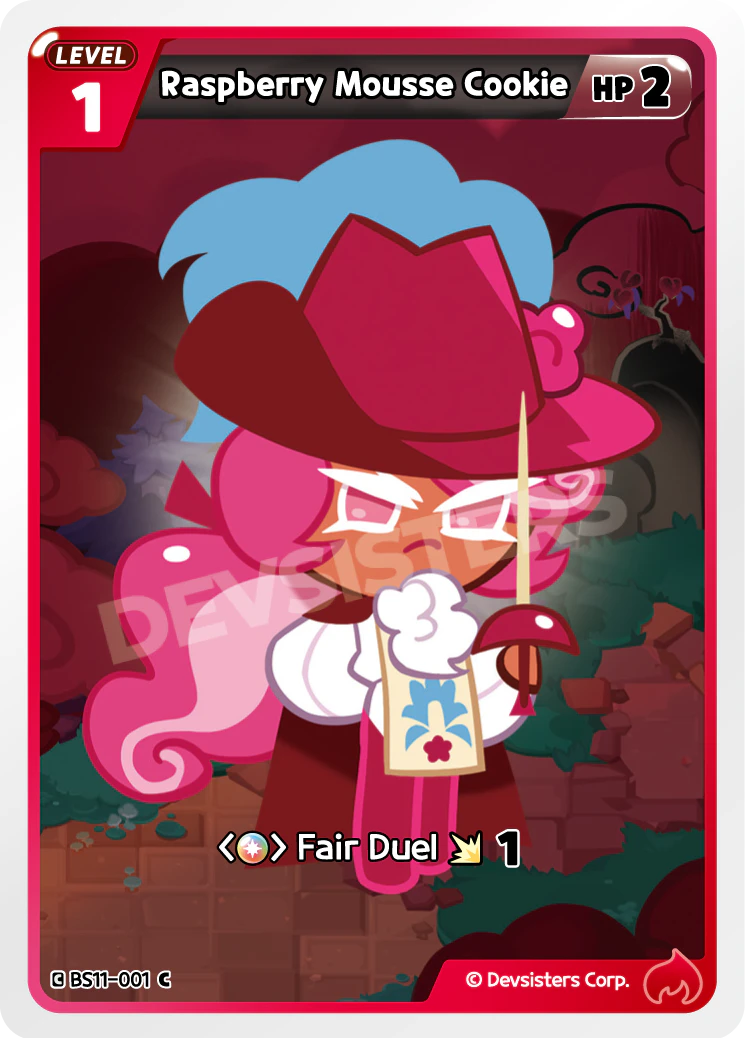
Under the skill box, centered, is the attack. It has exactly four parts in a fixed order:
- The cost, in angle brackets, as colored orbs. One orb equals one energy card rested in your support area.
- The attack name. Flavor. Ignore it.
- The impact icon, a small yellow burst. It means "damage follows."
- The damage number.
Raspberry Mousse Cookie (BS11-001) is the minimum version of this: one generic orb, "Fair Duel," 1 damage, and no skill box at all. 393 of the 1,401 Cookie cards in the game - 28 percent - have no skill text whatsoever. A blank lower half is not a misprint, it is a vanilla body.
The orbs come in one flavor per color plus a rainbow one. The rainbow orb is generic: any color pays for it. That single icon is the entire multicolor system, and it lines up almost perfectly with a field in the database. Of the 301 Cookies whose energy type is listed as some color plus MIX, 297 have at least one rainbow orb in their attack cost. Of the 870 single-color Cookies, only 25 do. So "MIX" in a card listing is shorthand for "part of this cost is colorless" - which is exactly the information you need when you are deciding whether a card can be splashed into a second color.
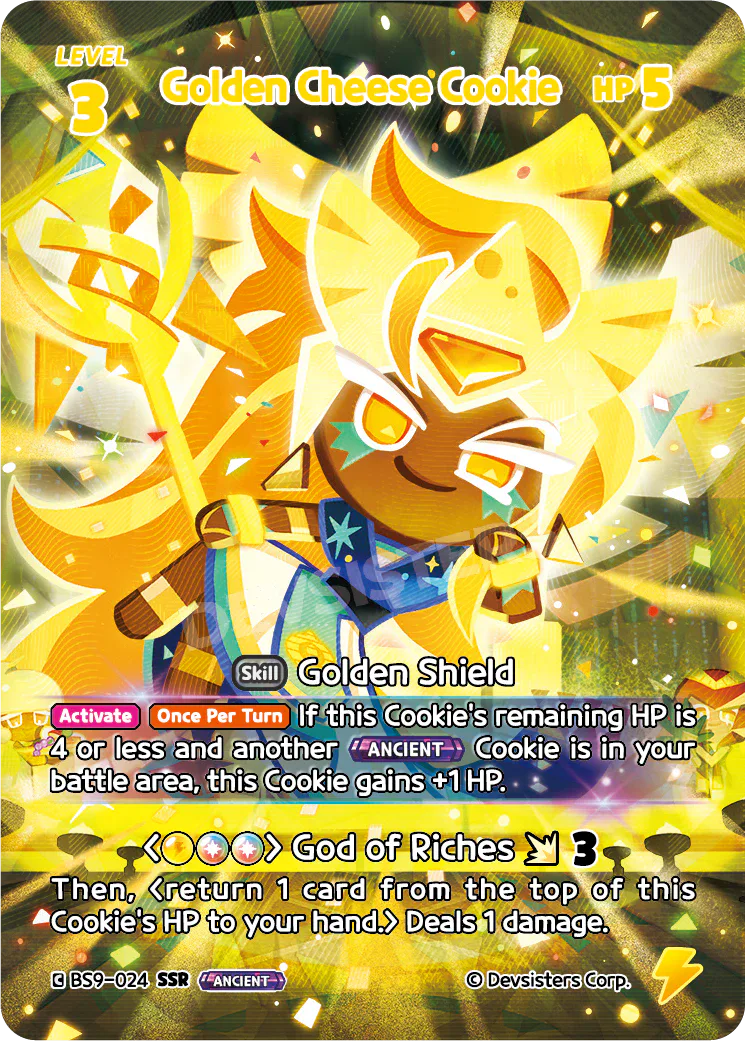
Some attacks continue with a line starting "Then," followed by another bracketed cost. That is a second, optional effect bolted onto the same attack, and it is billed separately. Golden Cheese Cookie BS11-034 attacks for 3 with one yellow and two generic, then offers: pay one more generic and deal 1 extra damage for each Level 2 or higher Ancient Cookie in your break area. You can take the first half and skip the second. New players routinely miss that the "Then" clause is optional and separately priced.
What Level and HP actually promise
Level is not just a rung on a ladder, it is a reliable prediction of how much HP the card will have. Across every Cookie in the game with a plain numeric HP value:
| Level | Cookie cards | HP range | Most common HP |
|---|---|---|---|
| 1 | 542 | 1 to 4 | 2 (292 cards) |
| 2 | 528 | 1 to 5 | 4 (239 cards) |
| 3 | 327 | 0 to 6 | 5 (209 cards) |
So the default expectations are 2 HP at Level 1, 4 HP at Level 2, 5 HP at Level 3. Anything above the line is paying for it somewhere else in its text, and anything below the line is buying you something - the three Level 3 Cookies printed at 0 HP are all cards that come down through an alternate route with their stack supplied by something else.
The practical read: when you see a Level 2 with 5 HP, check the skill box before you assume it is just a good card. Something is being traded. The stat curve breakdown works through where those trades usually land.
What each energy pip buys you
The number of orbs in an attack cost predicts the damage almost as tightly as Level predicts HP:
| Orbs in cost | Attacks | Average damage | Highest printed |
|---|---|---|---|
| 1 | 110 | 1.07 | 4 |
| 2 | 452 | 1.62 | 3 |
| 3 | 413 | 2.67 | 4 |
| 4 | 73 | 3.63 | 7 |
| 5 | 2 | 5.00 | 5 |
Two things fall out of that table. First, the game is built around the two- and three-orb band: 865 of the 1,050 attacks with a printed cost sit there. Second, the ceiling moves faster than the average. A two-orb attack has never been printed above 3 damage, but four-orb attacks reach 7 - the Level 5 Dark Enchantress Cookie's Fornacem Accende, which costs four black orbs.
If a two-orb attack on a card you are evaluating deals 3 damage, that is the maximum the game has ever printed at that cost. Treat it as a premium card and look for the drawback.
The bottom line: mark, number, rarity, trait
The strip along the bottom-left carries four things in this order: a boxed letter, the card number, the rarity code, and any trait tag.
The boxed letter is a regulation mark and it tracks print era rather than anything about the card. Read one card off each booster prefix and each starter deck and the pattern is clean:
| Mark | Sets |
|---|---|
| A | BS1, BS2, BS3, BS4 and the ST1 to ST5 color starters |
| B | BS5, BS6, BS7, BS8 |
| C | BS9, BS10, BS11 and the ST6 to ST10 named starter decks |
Promo cards sit outside that grid, because they were printed across the whole run: a P- number carries the mark of its own print date, so P-001 reads A, P-060 reads B and P-140 reads C. Reprints keep the mark that goes with their number - Golden Cheese Cookie BS8-027 still reads B in the Kingdom Battle promo pack. The letter is about when a card was made, not which box it came out of.
That letter appears nowhere in the official JSON. Every other printed element on the face maps to a database field; this one you can only read off the card.
The rarity code sits right after the number - C, U, R, SR, SSR, UR, SUR and SEC on regular printings, P on the 332 promo cards, plus 11 EXR and a single GXR, the Genesis Extra Rare treatment of Dark Enchantress Cookie BS11-115. It affects price and finish, never gameplay, and the rarities guide covers which tiers are actually worth chasing.
One quiet detail worth knowing if you collect: the illustrator credit only exists on launch-wave cards. 331 cards print an "illust." line naming one of 28 artists - InHyuk Lee on BS1-001, Seahorse on BS2-001, Kenji Watanabe on ST1-001 - and every one of them comes from BS1, BS2, the ST1 to ST5 starters, or 17 promos. From BS3 onward the credit line reads only "© Devsisters Corp." If a card names its artist, it is from the first wave.
Bottom-right, opposite the copyright, sits the color symbol: a flame for Red, a lightning bolt for Yellow, and one apiece for the rest. It is the fastest way to sort a pile face-up without reading anything.
Item, Trap and Stage cards drop half the layout
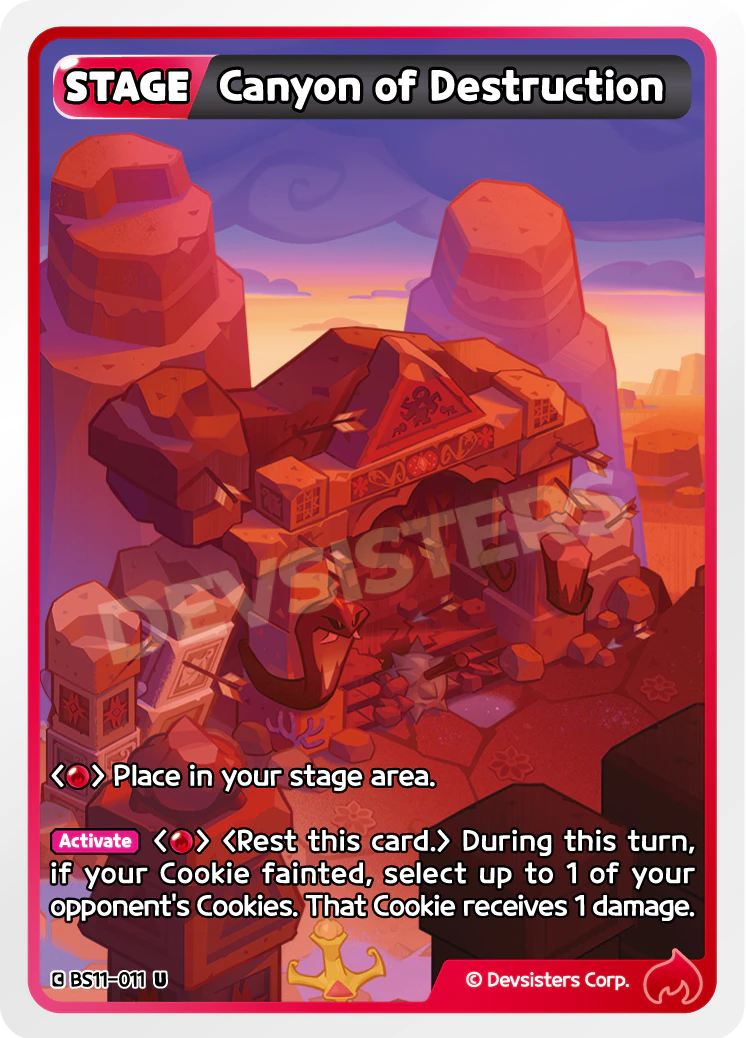
The 407 Item, Trap and Stage cards use a stripped frame. The Level badge is replaced by a type banner reading ITEM, TRAP or STAGE, there is no HP box, and there is no attack line at all.
Their cost moves into the text. Canyon of Destruction (BS11-011) opens with "⟨one red orb⟩ Place in your stage area" - that leading bracket is the play cost, and everything after it is what the card does once it lands. Stages then carry a second, separate Activate line for the ability you use while it sits on the table.
| Card type | Level badge | HP box | Attack line | Cards |
|---|---|---|---|---|
| Cookie | Yes | Yes | Yes | 1,401 |
| FLIP | Yes | Yes | Yes, plus a FLIP strip | 255 |
| Item | Type banner | No | No | 167 |
| Trap | Type banner | No | No | 147 |
| Stage | Type banner | No | No | 93 |
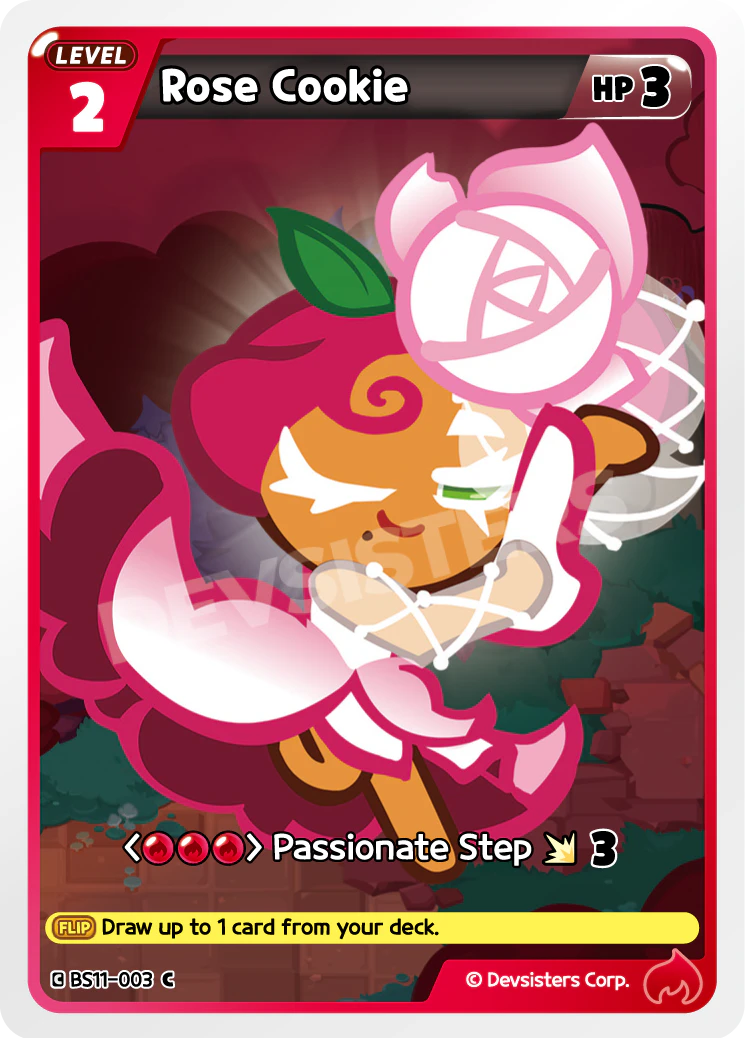
FLIP cards are the odd ones. They keep the full Cookie frame - Level badge, HP box, attack line - and add a yellow strip across the very bottom with a FLIP tag and one line of text. Rose Cookie (BS11-003) reads "Draw up to 1 card from your deck." That strip is the only part of the card that functions while it is buried in an HP stack, which is why a FLIP card is really two cards in one frame and why the FLIP mechanic is the first thing to learn after the turn structure.
When you are sleeving a deck, read the bottom strip of every FLIP card once. Half of them do the same thing - discard a card, add 1 HP - and the half that do not are the ones you actually want buried under your key Cookie.
Quick Action Checklist
- Read the pills before the sentence. Once Per Turn and Your Turn are restrictions, and skipping them is the most common rules error at a table.
- Treat angle brackets as a price tag. ⟨Rest this card.⟩ and ⟨Discard 1 card.⟩ are costs, not effects.
- Count the orbs, then look at the damage. Two orbs should buy you around 1.6 damage; anything at 3 is premium and has a catch.
- Use the default HP line. 2 at Level 1, 4 at Level 2, 5 at Level 3 - deviations mean the card is trading something.
- A "Then," clause is optional and separately paid. You can attack and decline the rider.
- Buy by the number in the bottom corner, never the name in the banner.
- If a card credits its illustrator, it is from BS1, BS2, an ST1 to ST5 starter, or one of 17 early promos.
Frequently Asked Questions
What do the numbers in the corners of a Cookie Run: Braverse card mean?
What do the colored pills in a Braverse skill box mean?
What does the rainbow energy orb on a Braverse card mean?
How much HP should a Braverse Cookie have for its Level?
What is the boxed letter next to a Braverse card number?
Why do some Braverse cards have no text in the lower half?
How do Item, Trap and Stage cards differ from Cookie cards on the card face?
Keep Reading
Related Guides

Cookie Run: Braverse FAQ: Common Questions Answered
Everything a new player actually asks about Cookie Run: Braverse, answered straight: how you win, deck size and copy limits, where to buy, whether it's like MTG or Pokemon, how FLIP works, how many colors there are, and whether it's pay-to-win.
Cookie Run: Braverse Glossary: Every Term Explained
Every Cookie Run: Braverse term in one place, defined plainly and consistently with our rules guides. Play areas, the card types, FLIP, the five colors, energy, Level, rarities, and keywords like Arena, Ancient, Beast, and Dragon.
The FLIP Mechanic in Cookie Run: Braverse, Explained
FLIP is the mechanic that makes Braverse feel unlike any other TCG: a Cookie's HP can fight back. Here's exactly what FLIP is, when it triggers, and the misplays that lose games.
Cookie Run: Braverse Card Types Explained
The how-to-play guide gives you the speed-run. This is the deep dive: the four card types the rulebook defines, the seven labels the official database files cards under, what each one actually does, and how to think about each in your deck.
How to Play Cookie Run: Braverse - A Complete Beginner Guide
Cookie Run: Braverse is the rare TCG you can teach in a single match. This guide covers everything a first-time player needs: card types, setup, turn structure, how you pay for cards, the FLIP mechanic, and how to win.
Cookie Run: Braverse Meta Tier List — Best Decks & Archetypes Ranked
Which Cookie Run: Braverse decks are actually carrying right now? Here's a meta tier list of the strongest archetypes - the real cards that anchor each one, why they rank where they do, and what's overrated.