Cookie Run: Braverse Keywords & Abilities Explained
Braverse card text leans on a small set of keywords that mean the same thing on every card they appear on. Learn the ability words - On Play, Activate, Blocker, Equip - and the trait words - Ancient, Dragon, Beast, Arena - and the whole game reads cleaner.
Pick up almost any Cookie Run: Braverse card and you'll see a word in brackets at the front of a line - On Play, Activate, Blocker - followed by an instruction. Those bracketed words are keywords, and the whole point of a keyword is that it means the exact same thing on every card it ever appears on. Learn the dozen or so that matter and you stop re-reading rules text and start reading cards at a glance. Get one of them wrong - especially the timing words - and you'll misplay a trade you thought you'd won.
This is the plain-English glossary of Braverse's keywords and abilities, split into the two kinds that exist and grounded in real cards from the official database. We'll keep it consistent with the deeper dives: the full breakdown of the seven card types lives in card types explained, the signature HP mechanic gets its own FLIP deep dive, and every term you might bump into is in the Braverse glossary. One symbol note up front: on the cards, {R} is a Red resource, {N} is any color, and {da} reads as "deals damage," so a cost written "two Red, one any" is what the card actually demands.
Two kinds of keyword: abilities and traits
The single most useful thing to understand is that Braverse keywords come in two flavors, and they do completely different jobs:
- Ability keywords tell you when or how an effect works. On Play, Activate, Once Per Turn, Blocker, Equip, EXTRA - these gate the effect's timing or cost. They appear in the card's text box, in brackets, right before the instruction they govern.
- Trait keywords tell you what a card is. Ancient, Dragon, Beast, Arena - these are subtypes that don't do anything by themselves, but other cards reference them. A card that "checks for another Arena Cookie" only cares about the Arena trait.
The official card database backs this split cleanly: it files the timing words (On Play, Activate, Blocker, Once Per Turn, Equip) under a "skill" category, and files Ancient, Dragon, Arena, and Beast under a separate "keyword" category that's really the game's trait list. Keep the two buckets straight and the rest is easy.
The fast test: if a keyword tells you when something happens, it's an ability. If it tells you what the card is, it's a trait. Abilities do; traits get referenced.
How to read a card's text
Before the keywords, the layout. A Braverse Cookie has two text zones, and knowing which is which keeps the timing straight:
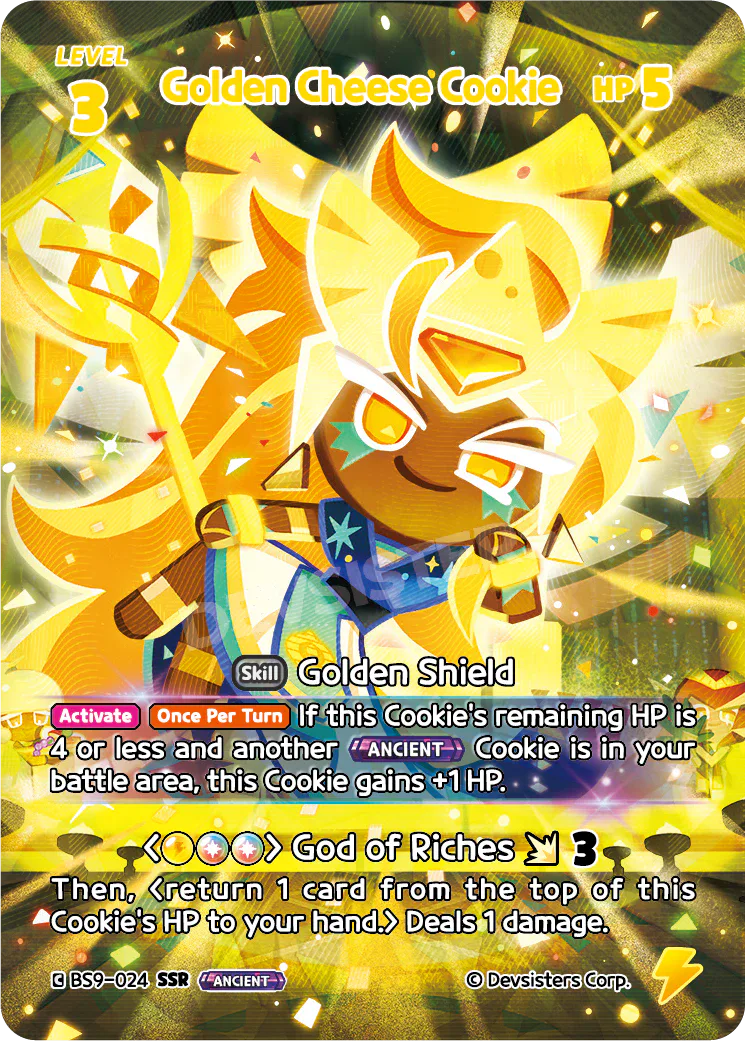
- The skill line is the Cookie's standing ability - often gated by a keyword like On Play or Activate. It's the effect the Cookie brings beyond just attacking.
- The attack line is what happens when the Cookie attacks: a cost in pointed brackets, the attack's name, and the damage, sometimes followed by a "Then," clause that triggers extra effects.
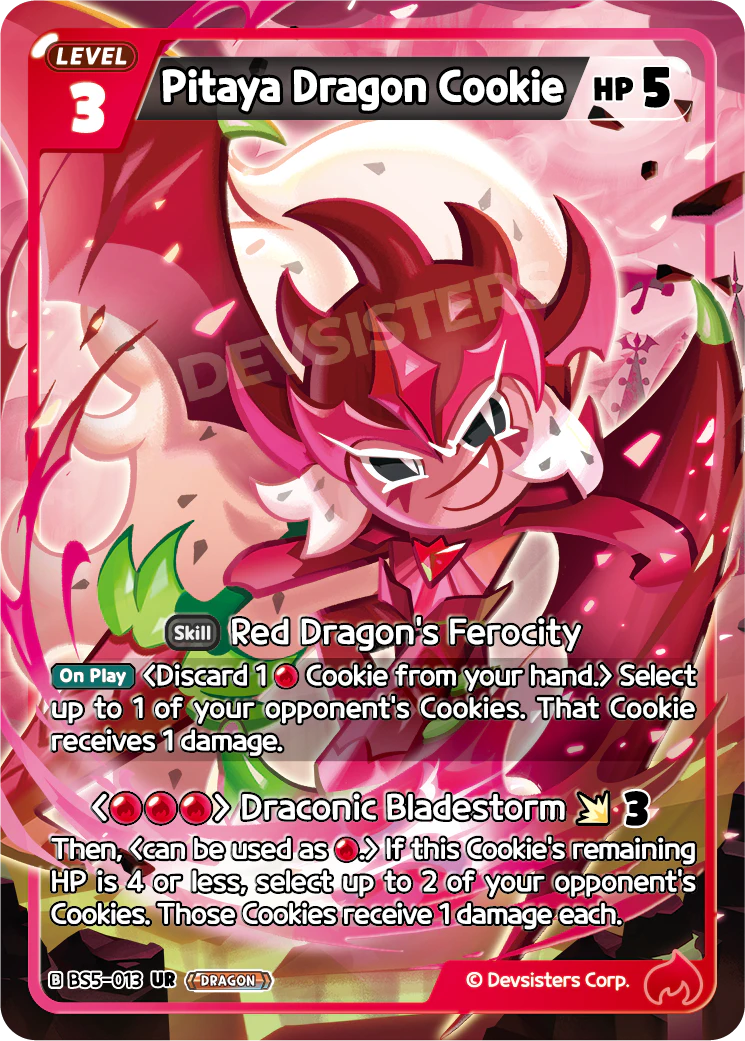
So when you read Pitaya Dragon Cookie (BS5-013, Ultra Rare, Red Dragon, LV.3, 5 HP), the skill line carries an On Play effect - discard a Red Cookie to deal 1 to an opposing Cookie - and the attack line swings for 3 with a follow-up clause. Two zones, two timing windows. New players blur them together and then wonder why an effect didn't fire; it's almost always a "this was a skill, not an attack effect" mix-up.
The ability keywords
These are the workhorses - the words that decide when an effect happens. Here's each one in plain English with a real card.
- On Play. The effect fires once, the moment the card is played. Strawberry Cookie (BS9-003) reads "On Play: select up to 1 of your Cookies; during this turn, that Cookie gains +1 attack damage." Play it, the effect resolves, done. No repeat.
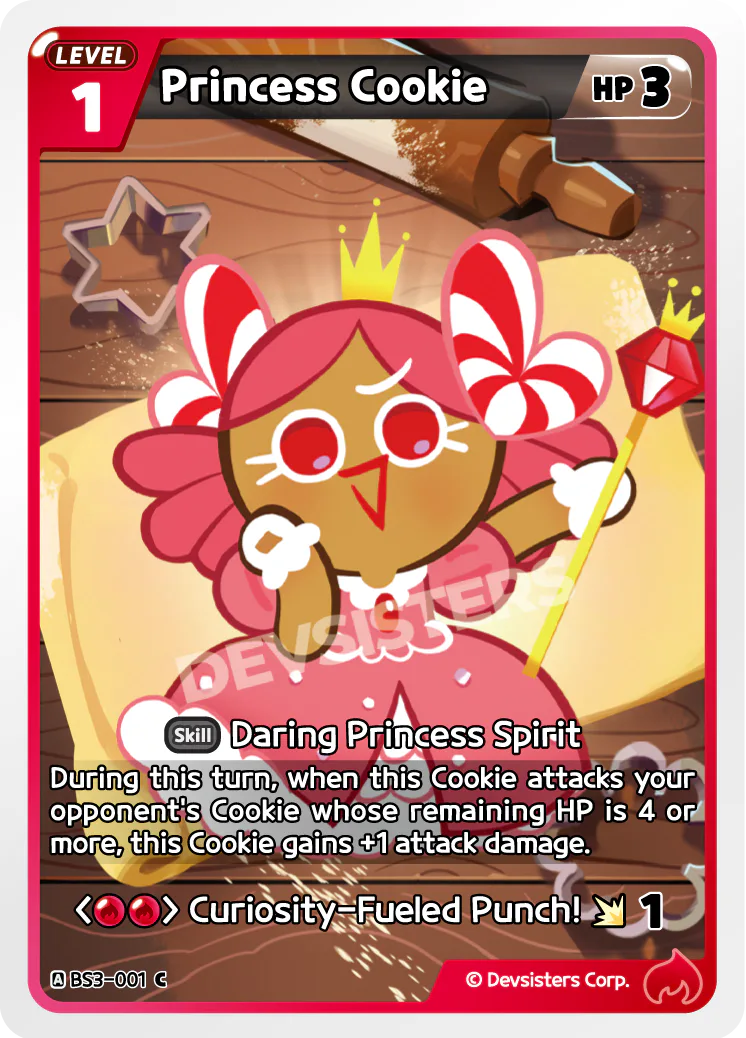
- Activate. A skill you choose to use, usually with a cost in pointed brackets you pay to fire it. It's optional and repeatable unless something else limits it. Princess Cookie (BS9-002) carries an Activate skill that buffs its own attack under a condition.
- Once Per Turn. A limiter that pairs with other keywords - it caps a repeatable ability to one use each turn. Princess Cookie's skill is "Activate, Once Per Turn," meaning you can fire it, but only once between your draws.
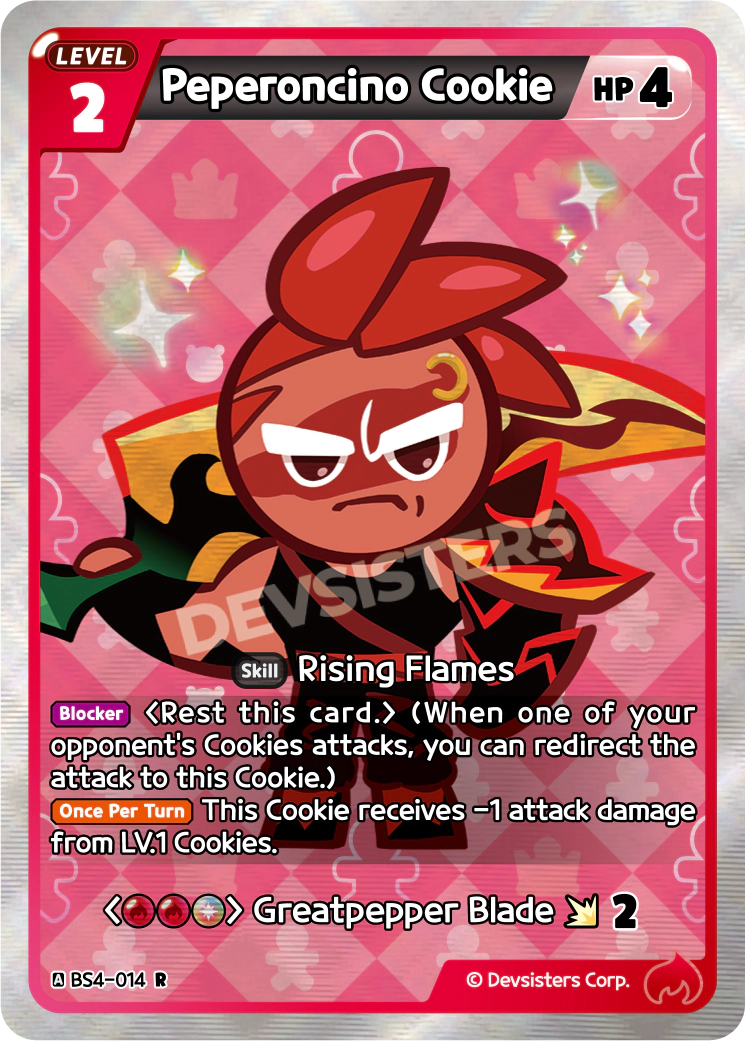
- Blocker. A defensive redirect. The official reminder text spells it out: "(When one of your opponent's Cookies attacks, you can redirect the attack to this Cookie.)" Peperoncino Cookie (BS4-014) and Poison Mushroom Cookie (BS8-008) both carry it - rest the card, and it pulls an incoming attack onto itself to protect a more valuable Cookie. Some cards (mostly Arena pieces) can even shut your Blocker off, so it's not airtight.
- Equip. Attaches a card to a Cookie rather than playing it on its own. The Soul Jam Items are the headline case - Soul Jam: Light of Deceit (BS9-092) does its effect and then lets you Equip it to a specific Cookie for an ongoing bonus. Equipped cards stay attached until something removes them.
- EXTRA. An alternate or additional play condition that unlocks a powerful card when you meet a requirement, often tied to the EXTRA card type. Shadow Milk Cookie (BS9-010) can be played "if 2 or more of your Red LV.1 Cookies fainted during your opponent's previous turn" - a payoff for the board state you've already built, not a card you hard-cast on curve.
The pattern to internalize: an ability keyword is a when. On Play is "on entry," Activate is "when you choose and pay," Once Per Turn is "but only once," Blocker is "when attacked," Equip is "as an attachment," and EXTRA is "once you've met the condition."
FLIP, the signature mechanic
FLIP earns its own section because it's the one keyword that's both a card type and an ability - and it's what makes Braverse play differently from every TCG it gets compared to. The short version: in Braverse a Cookie's HP is a face-down stack of cards from your deck, and some of those cards carry a FLIP ability that triggers the instant damage turns them face-up.
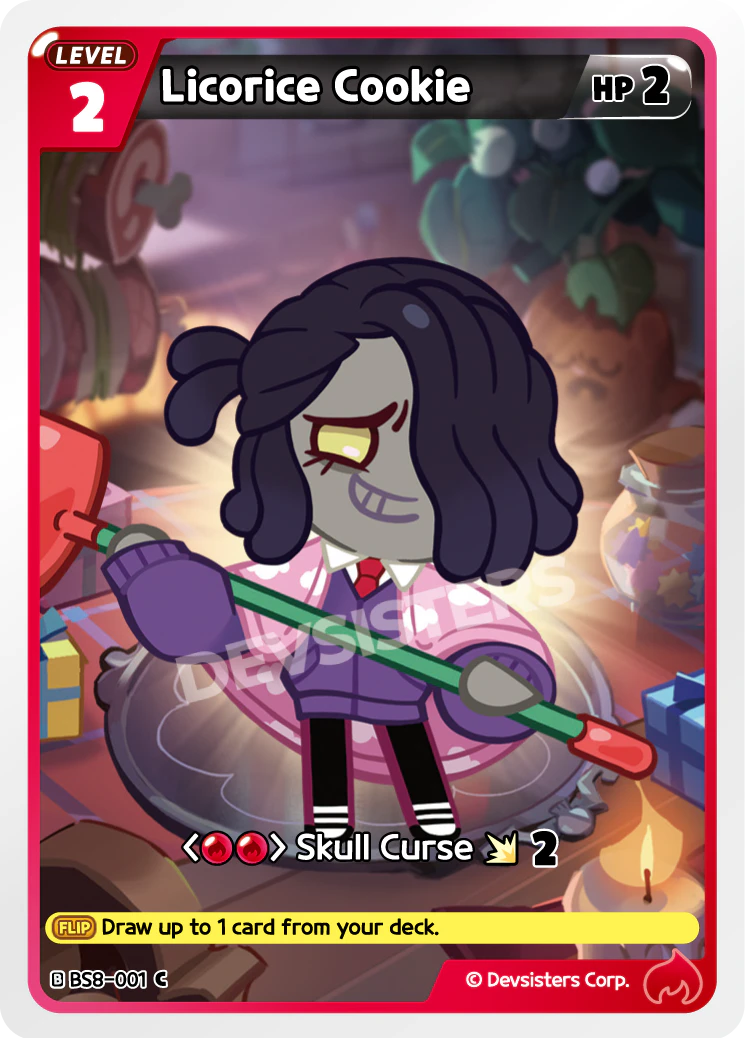
- As a card type, FLIP is a dedicated category - the database lists well over 200 FLIP-type cards - built to live in an HP stack. Licorice Cookie (BS8-001) is a FLIP card whose ability is simply "Draw up to 1 card from your deck": bury it under a Cookie, and when an attacker flips it, you draw.
- As an ability, some regular Cookies also carry a flip effect, so they behave normally on the board but spring a surprise if they end up in someone's HP stack.
The strategic kicker: the FLIP that fires belongs to the defender, so attacking can hand your opponent a free trigger. A deck can run up to 16 FLIP cards, turning every HP stack into a potential minefield. Because this is the deepest mechanic in the game - and a couple of its edge-case timing rules aren't fully pinned down across community sources - we keep the full treatment in the dedicated FLIP mechanic guide. For keyword purposes, just remember: FLIP is the only one that's a type and an ability at the same time.
The trait keywords
Traits don't do anything on their own - they're labels other cards care about. There are four, and the official database tracks each one in its keyword filter:
| Trait | Roughly how many cards | What it means |
|---|---|---|
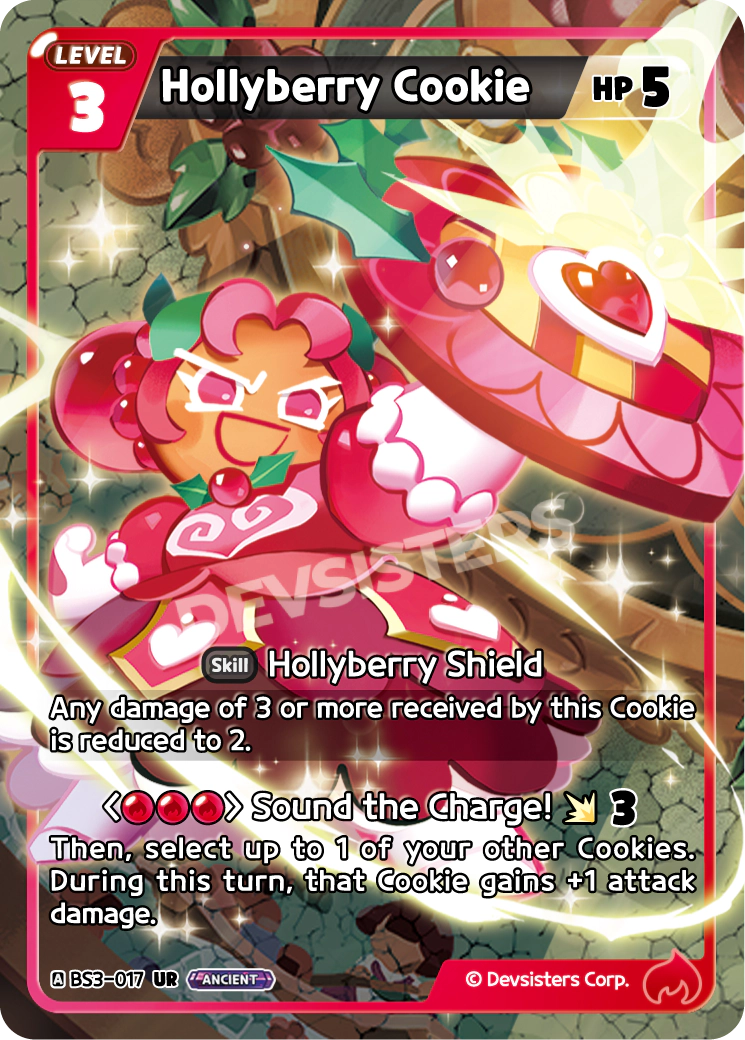
| Ancient | The largest legendary group | The seven Ancient Cookies - Braverse's biggest, most iconic legends, like Hollyberry Cookie (BS3-017) |
| Arena | The widest trait by far | The tribal-synergy subtype that spans all five colors and rewards going wide |
| Beast | A focused mid-sized group | The "Beast" Cookies - powerful bodies often gated behind EXTRA play conditions |
| Dragon | The smallest, rarest group | The Dragon Cookies - a handful of premium LV.3 threats, like Pitaya Dragon Cookie (BS5-013) |
Why they matter: trait keywords are the glue for tribal decks. An Arena Cookie that reads "if there is another Arena Cookie in your battle area" only counts cards carrying the Arena trait, which is exactly why the best Arena cards form their own go-wide archetype. The same goes for the dedicated best Ancient cards, best Dragon cards, and best Beast cards - each guide is built around what its trait keyword unlocks. A trait alone is a non-event; a trait plus a card that references it is a deck.
One honest note: the Ancient line is special. The lore frames the Ancients as exactly seven Cookies, but the database lists more than seven cards with the Ancient keyword because a single Cookie can have several printings across sets. Seven Cookies, more than seven cards - both are true.
Where keywords trip new players up
A handful of recurring mistakes, and the fix for each:
- Confusing the skill line with the attack line. An On Play skill fires when you play the Cookie; an attack's "Then," clause fires when it attacks. They are different windows. Read which zone the effect sits in before you assume it triggered.
- Forgetting Once Per Turn. A juicy Activate ability feels like you can chain it - you can't, if it's tagged Once Per Turn. Plan the turn around a single use.
- Treating Blocker as a wall. Blocker redirects one attack when you rest the card; it doesn't make a Cookie unkillable, and some Arena cards can switch it off entirely. It buys a turn, not immunity.
- Reading a trait as an ability. Seeing "Dragon" or "Ancient" on a card and expecting it to do something. It doesn't - it's a label. The effect only matters if another card references that trait.
- Hard-casting EXTRA cards. EXTRA Cookies want a board state met first. If you're trying to slam one on turn two with no setup, you've misread the keyword.
The throughline: abilities are timing and cost; traits are identity. Once you sort every bracketed word into one of those two buckets, Braverse card text reads like plain English.
Quick Action Checklist
- Sort every keyword into ability or trait. Ability = when/how (On Play, Activate, Blocker, Equip, EXTRA); trait = what it is (Ancient, Dragon, Beast, Arena).
- Read the two zones separately. Skill line and attack line are different timing windows - don't blur them.
- Respect Once Per Turn. It caps a repeatable Activate ability to one use; build the turn around that single trigger.
- Use Blocker to buy a turn, not to win one. It redirects a single attack and can be shut off - protect your key Cookie, don't rely on it as armor.
- Match traits to payoffs. A trait is dead weight until you run the cards that reference it - that's the whole point of a tribal deck.
- Set up EXTRA cards. Meet their board condition before you try to play them; they're payoffs, not curve plays.
- Send FLIP to the deep dive. It's the only type-and-ability keyword - learn the HP-stack mechanic in full before you tune your FLIP count.
Frequently Asked Questions
What are the keywords in Cookie Run: Braverse?
What is the difference between an ability keyword and a trait keyword?
What does Blocker do in Cookie Run: Braverse?
Is FLIP a keyword, a card type, or an ability?
What do the Ancient, Dragon, Beast, and Arena keywords mean?
Keep Reading
Related Guides
Cookie Run: Braverse Turn Structure & Phases Explained
Most Braverse misplays aren't bad cards - they're a phase mistake. Here's the full turn flow, Refresh to End, what you're allowed to do in each window, and the first-turn rules that trip up every new player.
Cookie Run: Braverse Energy & Leveling Explained
Energy is the engine that runs every Cookie Run: Braverse turn. Here's how energy types and color costs work, how the Support Area pays for your cards, and how leveling from LV.1 to LV.3 gates the whole game.
Cookie Run: Braverse Battle Rules: How an Attack Resolves
Rule 7-1-3-1-1 settles FLIP timing in a single sentence, and it sits inside a four-step battle procedure. Here is every step of a Cookie Run: Braverse attack, read straight off the Comprehensive Rules Ver. 1.8, plus the March 2026 rule update that locked the damage number mid-resolution and moved multipliers to the end.
Cookie Run: Braverse 2-on-2 Rules and Winning Team Decks
Braverse's standard rulebook says it doesn't cover games with more than two players, so the official 2-on-2 format runs on two separate documents - and they change more than you'd think. One loss counter for two Break Areas, a four-copy limit that belongs to the team, and board wipes that hit your partner. Here are the rules, read off the source, plus what all five Asian 2-on-2 champion teams with published lists actually brought.

How to Play Cookie Run: Braverse - A Complete Beginner Guide
Cookie Run: Braverse is the rare TCG you can teach in a single match. This guide covers everything a first-time player needs: card types, setup, turn structure, how you pay for cards, the FLIP mechanic, and how to win.
Cookie Run: Braverse Meta Tier List — Best Decks & Archetypes Ranked
Which Cookie Run: Braverse decks are actually carrying right now? Here's a meta tier list of the strongest archetypes - the real cards that anchor each one, why they rank where they do, and what's overrated.