10 Cookie Run: Braverse Beginner Mistakes (and How to Fix Them)
Most new Braverse losses come from the same handful of avoidable mistakes. Here are the 10 that cost beginners the most games, and the simple fix for each.

Cookie Run: Braverse is easy to learn and genuinely hard to master, which means almost every early loss traces back to the same short list of avoidable mistakes. The good news: once someone points them out, they're easy to stop making. Here are the ten that cost beginners the most games, grouped by where they happen, with a concrete fix for each - and then two things most guides skip: a fully worked example of the game's win-condition math, and a pre-turn checklist you can run in your head until the good habits stick.
If any of the mechanics below are unfamiliar, keep how to play Braverse open in another tab - this guide assumes you know the basic turn flow. One quick notation note: the {R}/{Y}/{G}/{B}/{P} symbols you'll see below are each color's resource, and {N} means any color. All card names, Levels, and HP values cited here are pulled straight from the official card database.
Rules slips that quietly lose games
1. Forgetting the first player skips their turn-1 draw and attack. This is the single most common rules slip. The player who goes first cannot draw or attack on turn one - it's the tax for the first-turn advantage. New players forget it, draw an extra card or swing illegally, and either cheat by accident or get confused when corrected. Fix: say it out loud at the start of game one - "first player, no draw, no attack." After a few games it's automatic.
2. Ignoring the Break Area math. The main way to win is filling your opponent's Break Area to a combined Cookie Level of 10. Beginners play like the goal is "kill all their Cookies" and lose track of the actual number. That number matters because Level isn't evenly distributed: most decks are built from Level 1, Level 2, and Level 3 Cookies, so a single Level 3 knockout is worth as much as three Level 1 knockouts. Fix: every time a Cookie falls, glance at both Break Areas and do the running total. Knowing you're at 7 versus 10 completely changes whether you should push or play safe this turn.
Resource and tempo mistakes
3. Tapping out your Support every turn. Because you pay costs by resting Support cards, it's tempting to rest everything and dump your whole turn. The problem: if you run Traps or reactive Items, you need active Support on your opponent's turn to pay for them. A Trap you can't afford is a dead card. Concretely: a defensive Trap like Flame's Protection (BS11-010) costs a single {R} to knock an incoming attacker's damage down by 1 - but only if you left one Red Support standing. Rest that last card to squeeze in an extra point of development and the Trap sits in your hand doing nothing while you eat the hit. Fix: before you fully tap out, ask "do I want to hold up a Trap or trick?" Leave one or two Support cards standing when the answer is yes.
4. Playing too passively. The opposite error: hoarding resources, never committing, and waiting for the "perfect" turn that never comes. Braverse rewards pressure - the deck that's developing and attacking usually dictates the game. There's a structural reason for this: because the first player can't attack on turn one, tempo is scarce, and whoever spends it first tends to keep forcing the other player to react. If you sit back "to be safe," you're effectively giving your opponent the first-player advantage a second time. Fix: unless you have a specific reason to wait (a known Trap, a combo turn coming), develop your board and make your opponent answer you. Passive players hand control to the opponent.
Combat mistakes

5. Swinging into a healthy Cookie without respecting FLIP. Remember that a Cookie's HP is a stack of cards, and some of those are FLIP cards that trigger when damage flips them. Attacking blindly into a fresh Cookie can walk your attacker straight into a punishing FLIP. FLIP is not a rare corner case, either - it's a core pillar of the game, with hundreds of FLIP cards across the sets, and starter decks are seeded with them from day one (the Red starter alone runs Adventurer Cookie, Carrot Cookie, Princess Cookie, and Pistachio Cookie as FLIPs). Fix: treat unknown HP stacks as potential traps. Lead with attacks you're happy to "spend" into a possible FLIP, and save your key Cookie's swing for when the risk is lower or the reward is worth it.
6. Making bad trades. Two sides to this. First, feeding a big, expensive Cookie into a chump trade wastes it. Second - and bigger - a high-Level Cookie that falls gives your opponent a big chunk toward their 10-Level win. Beginners often protect their small Cookies and throw their Level 3s into bad fights. Fix: think in Level math. Trading your Level 1 to take down their Level 3 is usually fantastic; sacrificing your Level 3 into a small Cookie is usually a disaster. Let the scoreboard guide your trades - more on exactly how to run that math in a moment.
Deck and collection mistakes

7. Running too few Cookies. If your Battle Area empties and you have no Cookie in hand to deploy, you lose - full stop. New deck-builders cut Cookies for flashy support cards and then drop games to an empty board. It's worth knowing that the game's design leans Cookie-heavy: across the whole card pool, Cookies vastly outnumber Items, Traps, and Stages combined, and the tuned Starter Decks are built at roughly half Cookies (the Red starter runs 11 Cookies plus 4 FLIP Cookies out of 22 cards). Fix: keep a healthy Cookie count - somewhere around half your deck is a good starting point - and don't dip toward the one-Cookie minimum. See deck-building basics for ratios.
8. Going greedy multicolor too early. Multicolor decks are legal and powerful, but jamming three colors of your favorite cards wrecks your consistency, since your resources have to fuel everything. The database even flags this reality: plenty of Cookies carry a "MIX" energy type that lets them play across colors, but leaning on those before you understand your curve just means you draw the wrong resource at the wrong time. Each color also wants to do a specific thing - Red pushes aggression, Blue leans on card advantage, and so on - and a three-color pile usually ends up doing all of them badly instead of one of them well. Fix: learn the game in one color first. Splash a second color only once you know exactly what your deck is missing, and read the five colors explained before you commit to a pairing.

9. Brewing from scratch instead of upgrading a Starter. A Starter Deck is a tuned, internally consistent list. Building a deck from a fresh box of singles before you understand the format usually produces a beautiful pile that loses. The Red Starter, for instance, hands you a ready-made game plan: cheap Cookies to hold the board, FLIP cards to punish attackers, and two Super Rare Level 3 finishers - Espresso Cookie (ST1-009, HP 5) and Peperoncino Cookie (ST1-014, HP 6) - to close. That's a coherent deck out of the box. Fix: play your Starter as-is for several games, identify the cards that feel dead, then make small, targeted swaps. Patch a known-good deck instead of designing in a vacuum.
10. Confusing rarity with power. That shiny Secret Rare is not automatically better in your 60 than a Common that fits your plan. Here's the part that surprises new players: in Braverse, a Secret card is almost always a fancy alternate-art printing of a card that also exists at normal rarity, with identical stats and text. The Common and the Secret Rare play exactly the same. Fix: build around what a card does. Rarity is a collecting concern - covered in our rarities guide - not a deck-building one.
A worked example: the Break Area race

The single fastest way to level up is to stop thinking "am I winning fights?" and start thinking "who's closer to 10 Levels in the Break Area?" Here's how that changes a real decision.
Say your opponent has a Level 3 Cookie on the board and you're holding a Level 1 body like GingerBrave (BS1-013, Red, HP 1) plus a couple of chip attacks. GingerBrave will never trade one-for-one with a Level 3 on its own - the Level 3 has far more HP. But that's not the question. The question is: if you can gang up and knock that Level 3 into the Break Area this turn, you hand yourself 3 Levels of progress while risking only your 1-Level GingerBrave in return. That is a fantastic exchange even though the individual "fight" looks lopsided.
Now flip it. You're at 6 Levels taken, your opponent is at 8. If you throw your own Level 3 into a messy attack and it dies to a FLIP or a Trap, you didn't just lose a good Cookie - you handed your opponent a huge swing and possibly the game, because a fallen Level 3 rockets their total from 8 toward the 10 they need. When the scoreboard is close, your big Cookies should be the last thing you risk, not the first.
The habit to build: every time any Cookie falls, restate both totals out loud - "I'm at 6, they're at 8." Once you're narrating the race, questions like "should I attack or hold?" answer themselves. If you're behind on the race and ahead on board, you can afford to grind. If you're ahead on the race, stop taking coin-flip trades and make your opponent come to you.
Your pre-turn checklist
Until the reads become instinct, run this quick mental checklist at the start of every turn. It directly heads off the mistakes above:
- What's the Break Area score? Say both totals. This frames every other decision.
- Do I need to hold up Support? If you have a reactive Trap or Item, decide before you spend which Support cards stay standing (mistake 3).
- Which of their HP stacks are unknown? Assume the fresh ones hide a FLIP and plan your attacks so your key Cookie isn't the one that walks into it (mistake 5).
- What's the best Level trade available? Look for chances to knock a big Cookie down cheaply, and refuse trades that feed your own Level 3s (mistakes 2 and 6).
- Can I still deploy next turn? Glance at your Cookie count in hand and on board so you never get caught with an empty Battle Area (mistake 7).
It sounds like a lot, but after a handful of games it collapses into a two-second glance. That glance is most of the gap between a new player and a solid one.
How to improve fastest
If you only change three habits, make them these:
- Track the Break Area Level race every turn. It turns vague "I'm doing well" feelings into actual decisions.
- Respect FLIP before you attack. A moment of "what could be hiding in that HP stack?" prevents the worst blowouts.
- Play more games before you tinker. Reps teach you faster than theory. Five games with a stock Starter will fix more mistakes than five hours of deck-brewing.
When you're ready to go deeper on how to win rather than how not to lose, our deck archetypes guide covers the strategies behind each color, the five colors explained helps you understand what your deck wants to do, and if you're still shopping for your first deck, our best starter deck ranking points you at the strongest place to begin.
Frequently Asked Questions
What's the most common Cookie Run: Braverse beginner mistake?
How do I stop losing to FLIP cards in Braverse?
Why do I keep losing with an empty board in Braverse?
Should beginners build their own Braverse deck or upgrade a Starter?
Does a rarer Braverse card make my deck better?
Keep Reading
Related Guides
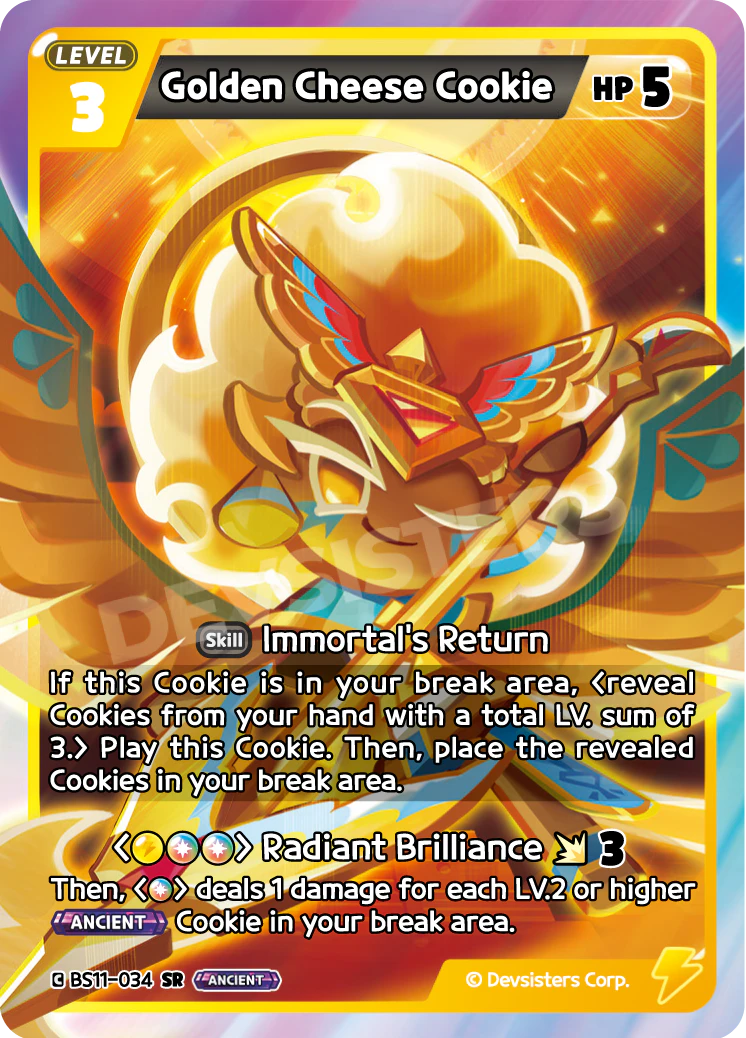
How to Read a Cookie Run: Braverse Card
Almost every element printed on a Braverse card face maps to a field in the official database. Here is the whole card decoded - the Level badge, the colored keyword pills, the attack line, the regulation letter - checked against all 2,093 entries.
Cookie Run: Braverse Glossary: Every Term Explained
Every Cookie Run: Braverse term in one place, defined plainly and consistently with our rules guides. Play areas, the card types, FLIP, the five colors, energy, Level, rarities, and keywords like Arena, Ancient, Beast, and Dragon.
Cookie Run: Braverse FAQ: Common Questions Answered
Everything a new player actually asks about Cookie Run: Braverse, answered straight: how you win, deck size and copy limits, where to buy, whether it's like MTG or Pokemon, how FLIP works, how many colors there are, and whether it's pay-to-win.
The FLIP Mechanic in Cookie Run: Braverse, Explained
FLIP is the mechanic that makes Braverse feel unlike any other TCG: a Cookie's HP can fight back. Here's exactly what FLIP is, when it triggers, and the misplays that lose games.
How to Play Cookie Run: Braverse - A Complete Beginner Guide
Cookie Run: Braverse is the rare TCG you can teach in a single match. This guide covers everything a first-time player needs: card types, setup, turn structure, how you pay for cards, the FLIP mechanic, and how to win.
Cookie Run: Braverse Meta Tier List — Best Decks & Archetypes Ranked
Which Cookie Run: Braverse decks are actually carrying right now? Here's a meta tier list of the strongest archetypes - the real cards that anchor each one, why they rank where they do, and what's overrated.