The Break Area Is a Resource, Not a Graveyard (Braverse)
Most players treat the break area like a graveyard pile and forget it exists. It has a number attached to it, 81 cards read that number, and Yellow decks are quietly built to inflate it on purpose.
You are three turns into a game. Two of your Cookies have fainted, and there is a pile of dead Cookies sitting off to the side of your play mat that you have not looked at once. Your opponent has looked at it four times.
That pile is the break area, and it is the most consistently ignored piece of information in Cookie Run: Braverse. It is not a discard pile you sweep aside. It has a running numeric value, that value is a condition on a large chunk of the card pool, and there are decks built specifically to inflate it. Search the text of all 2,052 cards in the official database and 236 of them mention the break area by name. That is roughly one card in nine.
If you are still fuzzy on where a Cookie goes when it dies, start with how to play Cookie Run: Braverse and the turn structure guide. This one assumes you know what a battle area is.
The pile with a number attached
The mechanic in one sentence: your break area has a LV. total equal to the combined levels of the Cookies in it, and cards check that number.
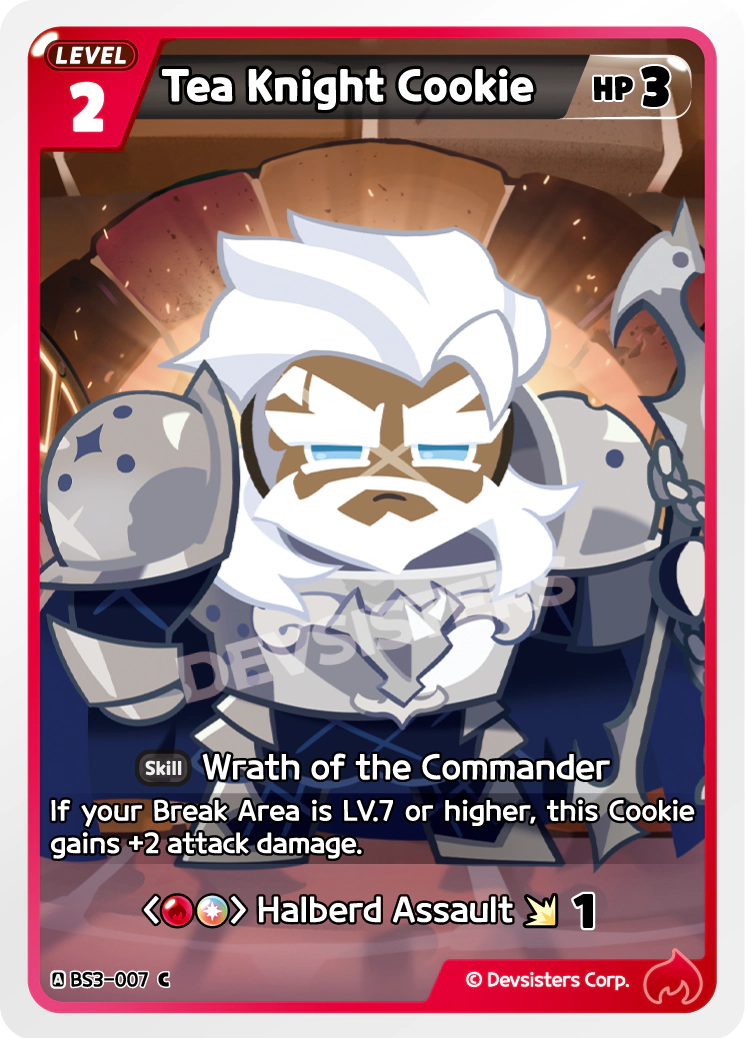
Tea Knight Cookie (BS3-007, Red, LV.2, 3 HP, Common) is the cleanest example. Its skill, Wrath of the Commander, reads: "If your Break Area is LV.7 or higher, this Cookie gains +2 attack damage." A common LV.2 Cookie with a base attack of 1 becomes a 3-damage attacker for no additional cost, purely because you have lost enough Cookies.
The consequence most players never internalize: losing Cookies is not purely a cost here. In most card games a growing graveyard is a scoreboard of your failures. In Braverse it is a resource meter, and a real slice of the pool pays you for filling it. If your deck has zero break area payoffs, the pile really is just a graveyard. If it has six, count it every turn — yours and theirs.
Break area is not the trash
This is the most common rules confusion in the game, and getting it wrong will make you misread half the cards below.
Braverse has two separate discard zones: the break area and the trash. Cards distinguish between them constantly — 544 reference the trash, 236 the break area, and plenty reference both in one effect. The proof is on a card that moves a body between them. Golden Cheese Cookie's EXTRA printing (BS8-027, Yellow, LV.3) reads, in part: "If this Cookie is in your break area, select 1 Golden Cheese Cookie in your trash. Place this Cookie in the trash. Then, place that Cookie in the break area." That sentence is unwriteable if the zones are the same pile.
The practical takeaway: effects that ship cards from break area to trash shrink your total. The promo Black and White Cake Hound (P-086, Purple, LV.1, 1 HP) has a faint trigger costing "place this Cookie from the break area into the trash" — it dies into the break area, then paying its own trigger moves it out and drops your LV. by 1. Sitting on exactly LV.6 with a payoff that needs LV.6, that switches your payoff off mid-turn.
How cards actually get there
Three routes fill the break area, and only one is obvious.
Cookies that faint. The default, and dictated by combat — which means largely dictated by your opponent.
Deliberate placement as a cost. This is what separates a real break area deck from an accidental one. 38 cards use "place ... into your break area" as an activation cost. Spinach Cookie (BS6-032, Yellow): place 1 Cookie from hand into your break area, draw up to 2. Dark Fondue Cookie (BS6-023, Yellow) pays the same cost on play to deal 1 damage to every opposing Cookie. Financier Cookie (BS7-039, Yellow, LV.3, 5 HP) pays it once per turn for +1 HP. All of them convert hand cards into break area LV. while paying you an effect, and let you choose the level pitched — a LV.3 moves the counter three points instead of one.
Refresh. When your deck runs out and you refresh, Cookies go into your break area. Two cards prove it by modifying the rule: Nosy Wizard (BS9-096, Purple, LV.1, 3 HP) means "you do not need to place Cookies in your break area when refreshing," and Everything Pie Cookie (BS9-111, Purple, LV.2, 3 HP) forces your opponent to place 2.
The thresholds that matter
Search for "break area is LV.X or higher" and you get 81 hits. The distribution tells you how to build:
| Threshold | Cards that check it |
|---|---|
| LV.2 or higher | 6 |
| LV.3 or higher | 15 |
| LV.4 or higher | 9 |
| LV.5 or higher | 21 |
| LV.6 or higher | 22 |
| LV.7 or higher | 3 |
| LV.8 or higher | 3 |
| LV.9 or higher | 2 |
LV5 and LV6 are the real lines
43 of the 81 threshold cards — 53 percent — sit at LV.5 or LV.6. That is your build target, and it is a lower bar than it sounds: two dead LV.3 Cookies gets you there, comfortably by turn four.
Above LV.7 is a different design space — only 8 cards in the whole pool check LV.7, LV.8 or LV.9. Inescapable Sweetness (BS10-039, Yellow, Trap) needs LV.8 to deal one point of damage for one Yellow energy; the effect is cheap precisely because the condition is brutal. Do not build for LV.8. Build for LV.6 and treat anything past it as gravy.
The comparative checks
A sharper category checks your break area against theirs. Scovilsky Manuscript (BS7-020, Red, Item, Uncommon) reads: "If your break area's LV. is 2 or more levels higher than your opponent's break area LV., select up to 1 of your opponent's LV.1 Cookies. That Cookie receives 3 damage." Arena of Glory (BS7-108, Pure, Trap) needs a 3-level lead to strip 2 attack damage from a LV.3 Cookie.
These are quietly excellent because they reward the player losing the attrition war. If your board is getting shredded and theirs is not, these become free removal. Read them as comeback cards, not value engines — they pair naturally with our control deck guide.
Why Yellow owns this zone
The claim I would put money on: Yellow is not merely the best break area color, it is functionally the only one. Of the 236 cards that mention the break area, 183 are Yellow — 78 percent. Red is second at 25. Purple has 9, Blue 6, Green 4.
That is a design mandate, not a color lean. If you want to build around this zone rather than splash a payoff, you are playing Yellow, and everything in our color pairs guide applies with your first color already locked.
The recursion loop
Yellow's grip is hardest on recursion, which no other color meaningfully gets. Cocoa Cookie (BS3-038, Yellow, LV.2, 2 HP, Common) is the template: "Place 1 LV.2 or higher Cookie from your hand into your break area: Return up to 1 Yellow LV.2 or lower Cookie from your break area to your hand."
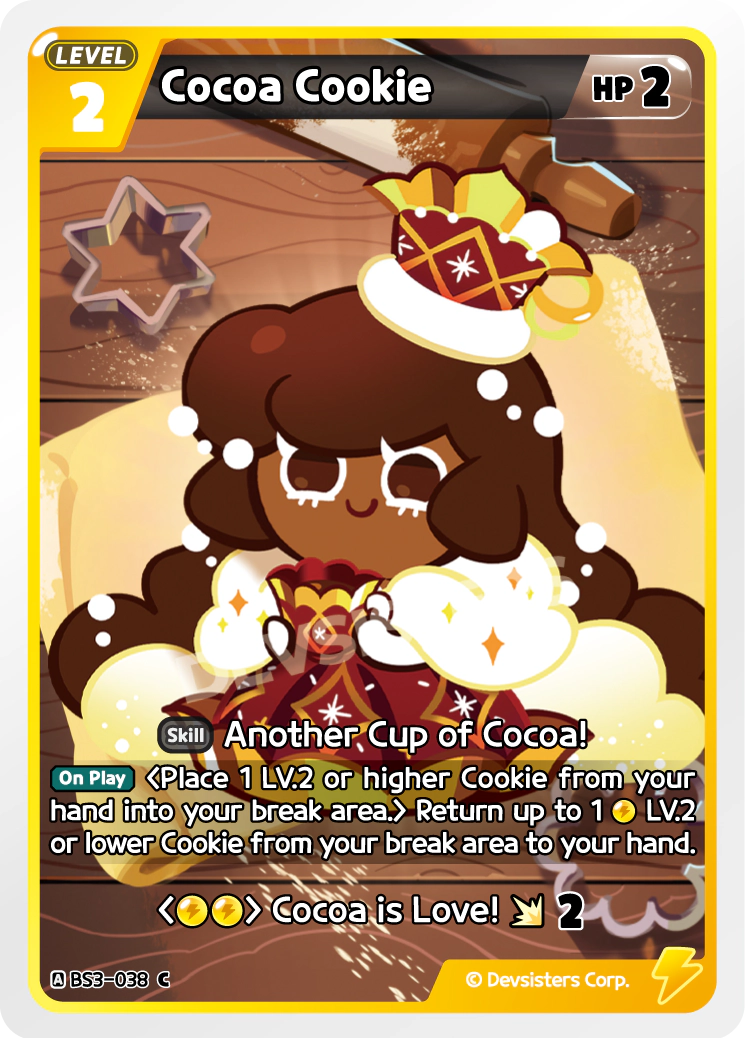
Card-for-card that trade is even, but your break area LV. goes up — in goes a body worth at least 2, out comes one worth at most 2. Pitching a LV.3 to retrieve a LV.1 nets +2 on the counter while rebuying your best cheap threat.
Cheesepad Tablet (BS3-044, Yellow, Item) is the same effect without needing a body on board, and Millennial Tree Cookie (BS11-035, Yellow, LV.3, 6 HP) is the premium modern printing — the same pitch-and-return as an On Play, stapled to the highest HP value printed on a Cookie in the game. DJ Cookie (BS5-026, Yellow) inverts it: when it faints, pitch a Yellow LV.2-or-lower Cookie to return DJ Cookie itself to hand.
Cards that come back swinging
The most dramatic payoff is not a threshold. It is playing Cookies straight out of the pile.
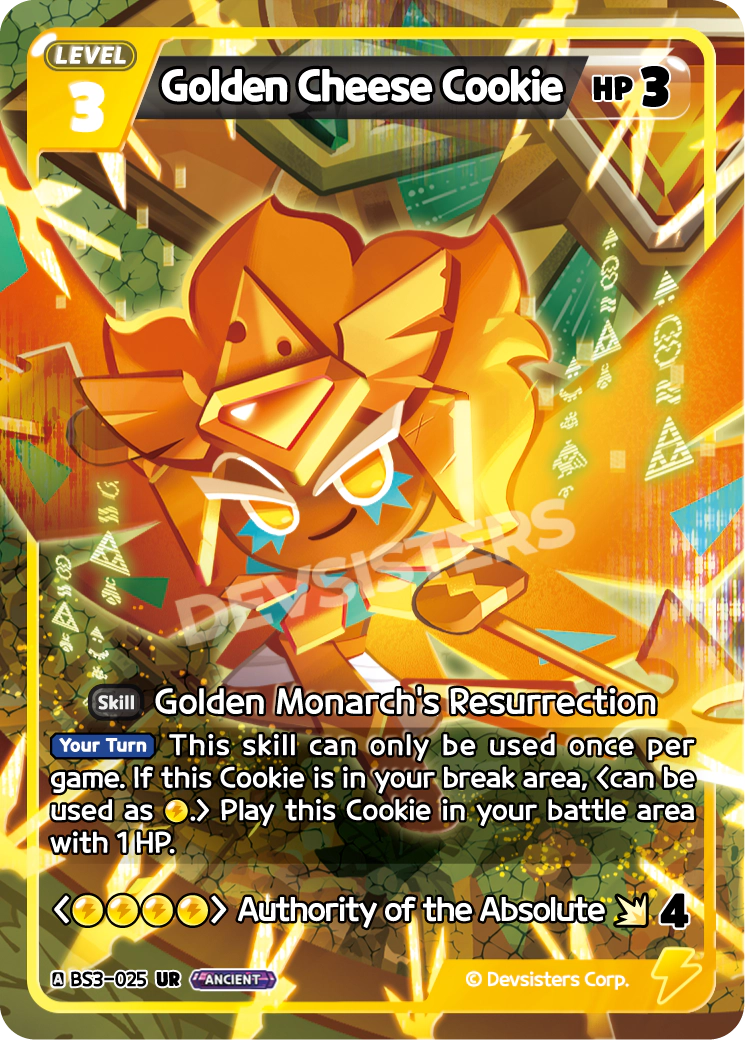
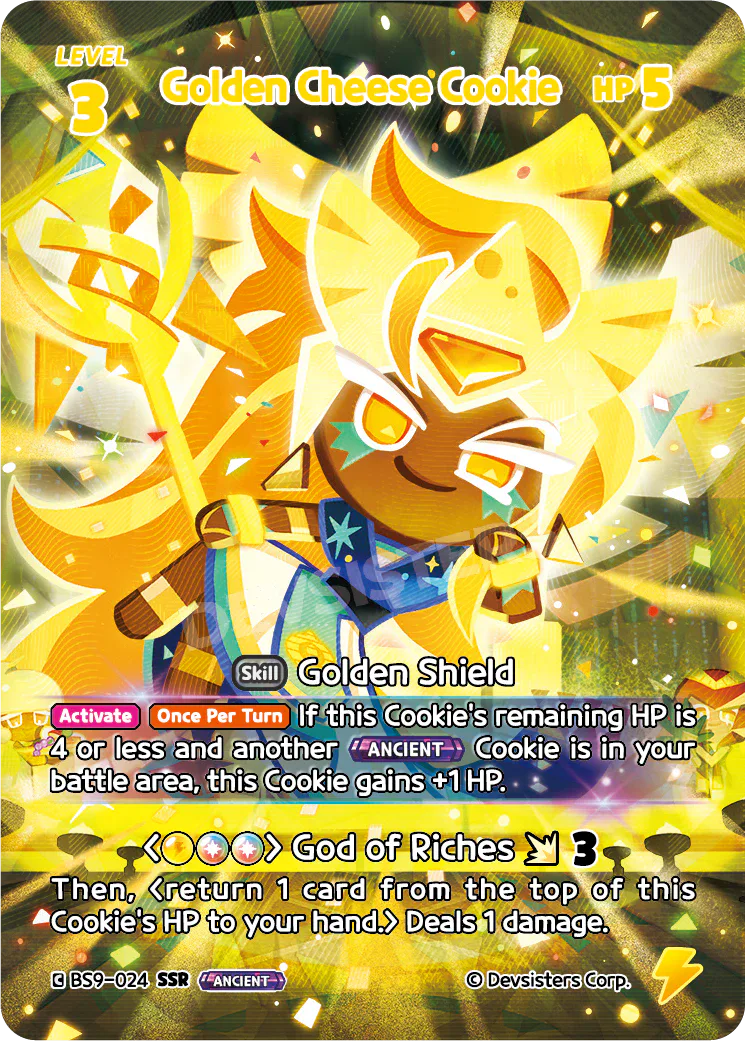
Golden Cheese Cookie (BS3-025, Yellow, LV.3, 3 HP, UR) started it: "This skill can only be used once per game. If this Cookie is in your break area, play this Cookie in your battle area with 1 HP." One HP is thin, but Authority of the Absolute deals 4 damage for four Yellow energy, and your opponent has to answer a body they already killed.
The BS11 printing pushes it. Golden Cheese Cookie (BS11-034, Yellow Mix, LV.3, 5 HP, Ancient) reads: "If this Cookie is in your break area, reveal Cookies from your hand with a total LV. sum of 3. Play this Cookie. Then, place the revealed Cookies in your break area." No once-per-game clause, and the revealed Cookies go into the break area — the resurrection pays its own threshold cost forward. Her attack, Radiant Brilliance, deals 3 and then 1 more for each LV.2-or-higher Ancient Cookie in your break area. A payoff scaling off the pile it just fed.
Red, Blue and the payoff splash
If you are not on a Yellow shell, you are splashing thresholds.
Red's are aggressive. Marshmallow Cookie (BS5-006, Red, LV.3, 5 HP) attacks for 3 and pings for 1 more at LV.6. Essence of Conflagration (BS4-020, Red, Item, SR) at LV.6 gives a Red LV.3 Cookie +3 attack damage for the turn — a genuine reach card that converts a stalled board into lethal, and a natural fit for our aggro deck guide.
Blue's are about cards. Frost Queen Cookie (BS2-034, Blue, FLIP) draws up to 2 at LV.4 from an HP stack, which makes it free — see the FLIP mechanic guide. Gumball Cookie (BS5-072, Blue, LV.2, 2 HP) draws 2 when it faints if your break area is LV.6 or higher, so the Cookie dying both pushes you over the line and cashes in.
The pattern in both colors: the payoff is the second half of a card that was acceptable anyway. You collect it, you do not build for it.
Purple plays the other side
Purple attacks the mechanic instead of using it, through refresh.
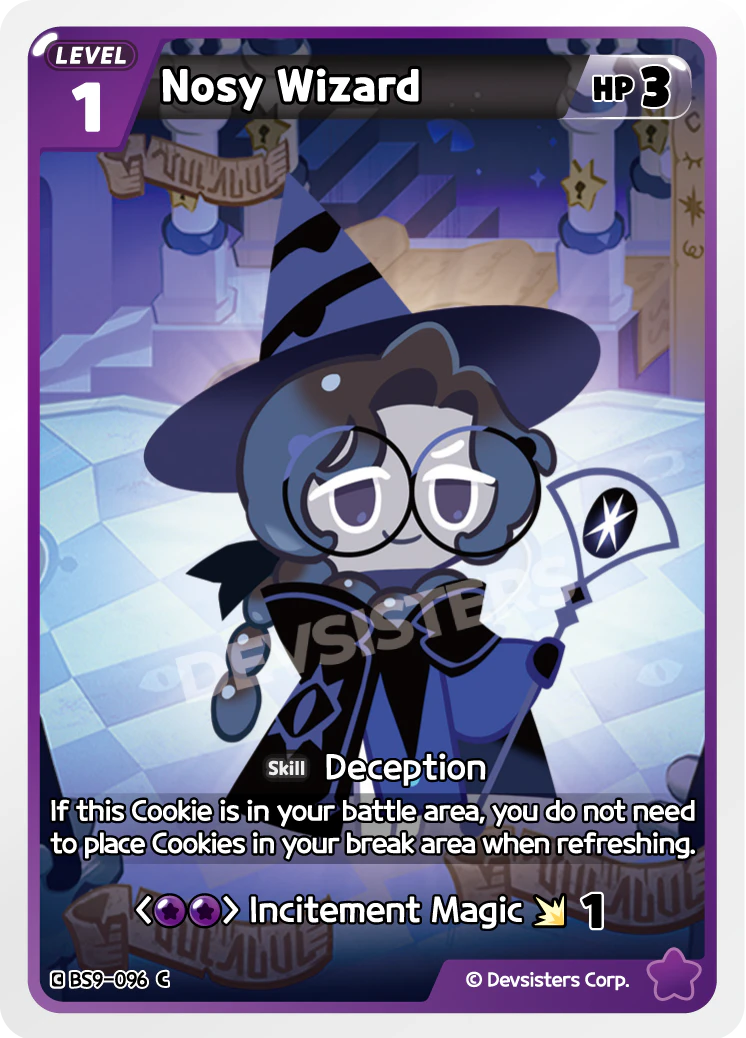
Nosy Wizard exempts you from placing Cookies on refresh. Everything Pie Cookie forces your opponent to place 2 extra. Run both and you get a real asymmetry: their counter climbs faster than yours.
Purple also pays itself for refreshing at all. Truffle Cookie (BS10-105) gains +1 attack damage if you refreshed this game. White Ghost Cookie (BS10-107) draws up to 2 and strips a card from their hand. Banner of the Solitary Oath (BS11-080) wants you to have refreshed twice.
That is a full sub-archetype, and its shell overlaps heavily with our mill deck guide — anything that accelerates decking accelerates the refresh triggers.
The symmetric checks nobody plans for
Two BS11 cards check break areas as a game state rather than a personal resource.
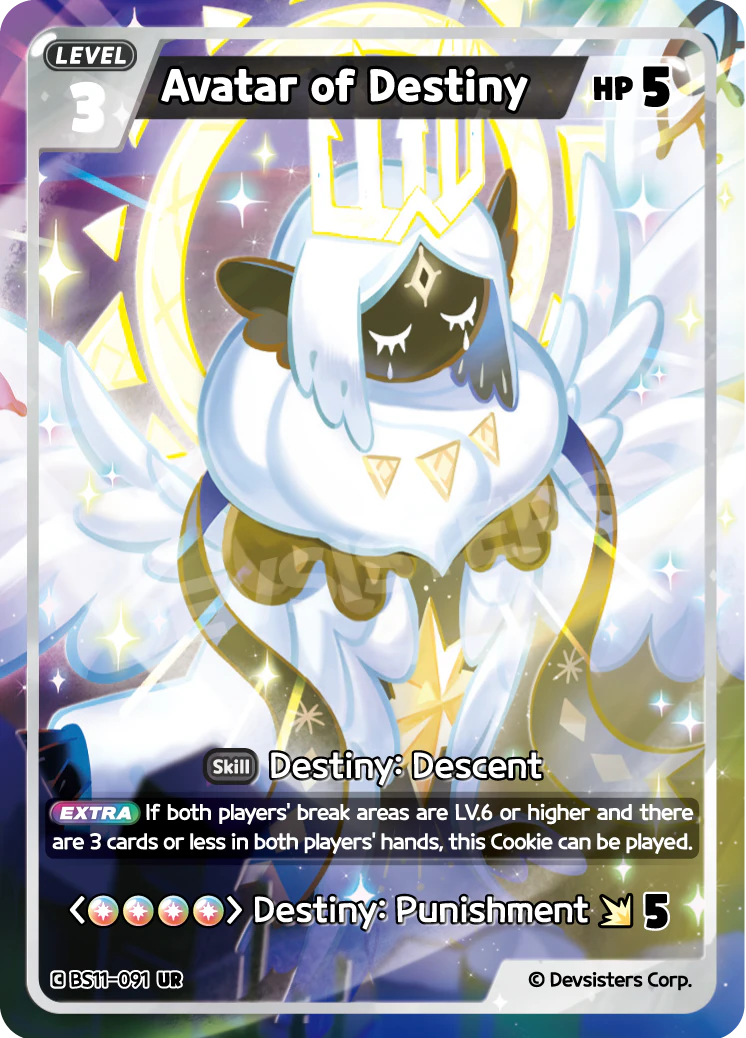
Avatar of Destiny (BS11-091, Pure, EXTRA, LV.3, 5 HP, UR) reads: "If both players' break areas are LV.6 or higher and there are 3 cards or less in both players' hands, this Cookie can be played." Destiny: Punishment deals 5 for four colorless energy — no color commitment, but only in a grindy state where both players are out of gas. It lives in your extra deck, so holding it costs nothing.
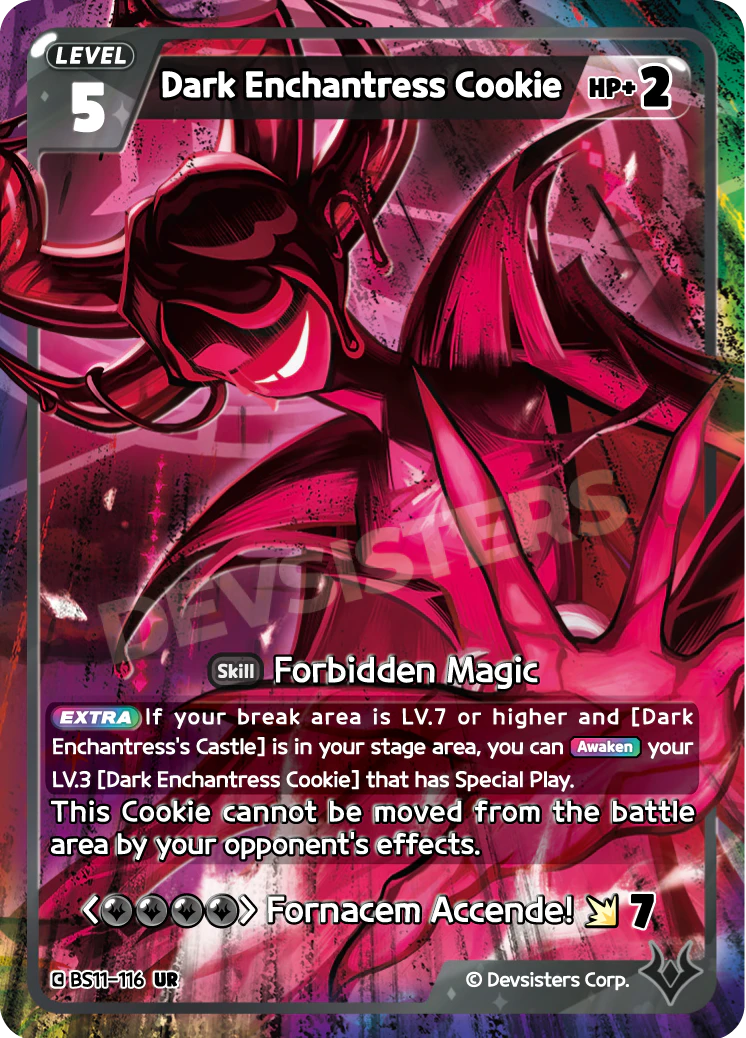
Dark Enchantress Cookie (BS11-116, Black, EXTRA, LV.5, UR) needs your break area at LV.7 or higher and Dark Enchantress's Castle in your stage area to Awaken your LV.3 Dark Enchantress Cookie. Fornacem Accende deals 7 for four Black energy and she cannot be moved from the battle area by opposing effects — the highest attack value here, behind the hardest condition in the game.
Building a break area deck on purpose
Lock Yellow as your primary. 78 percent of the relevant cards are one color. That is arithmetic, not a decision.
Target LV.6 by turn four, and do not rely on combat to get you there — that fill is your opponent's decision, not yours.
Run four to six deliberate pitch outlets. Spinach, Dark Fondue and Financier all convert hand into counter while doing something useful.
Pitch high, retrieve low. Every Yellow recursion effect reads "place LV.2 or higher, return LV.2 or lower." Always pitch the biggest legal Cookie — same card economy, strictly more counter.
Mistakes that cost games
Confusing the break area with the trash. Effects that ship cards to the trash lower your total and can switch off a threshold you were counting on.
Paying a break-area-to-trash cost while sitting exactly on a threshold. LV.6 minus a LV.1 Cookie is LV.5. Check before you pay.
Pitching your lowest Cookie. Habit from other games. The pitch cost usually reads "LV.2 or higher," so pitch the LV.3.
Ignoring your opponent's break area. If they are Yellow and sitting at LV.6, assume every payoff in their deck is on.
Treating lost Cookies as pure downside. In a break area deck an unfavorable trade can still be correct. This is not license to throw Cookies away — see beginner mistakes for how that goes wrong.
Splashing thresholds into a deck with no fill. A Red aggro list that wins on turn five never sees LV.6, so those clauses are blank text. Match payoffs to your real game length, the way our deck archetypes breakdown lays out.
Quick Action Checklist
- Count both break areas at the start of every one of your turns — yours for thresholds, theirs for the comparative cards.
- Build toward LV.6, not LV.8. 43 of 81 threshold cards sit at LV.5 or LV.6.
- If you are building around this zone, play Yellow. 183 of 236 relevant cards are Yellow.
- Run four to six cards that pitch from hand into the break area as a cost.
- Always pitch the highest-level legal Cookie, never the cheapest.
- Before paying any cost that moves a card from break area to trash, check whether it drops you below a threshold.
- Keep the two piles physically separate on the mat. They are different zones and cards care.
- If your deck wins before turn five, cut the break area payoffs entirely.
Frequently Asked Questions
What is the break area in Cookie Run: Braverse?
Is the break area the same as the trash in Braverse?
What break area LV. should I build toward?
Which color is best for a break area deck?
Can you play Cookies out of the break area?
Keep Reading
Related Guides
Cookie Run: Braverse Extra Deck Guide — All 17 Cards
The Extra Deck is six free cards that most Braverse players fill wrong. Here is how the zone actually works, all 17 EXTRA cards broken down by their printed conditions, and the build rule that decides whether your slots ever fire.
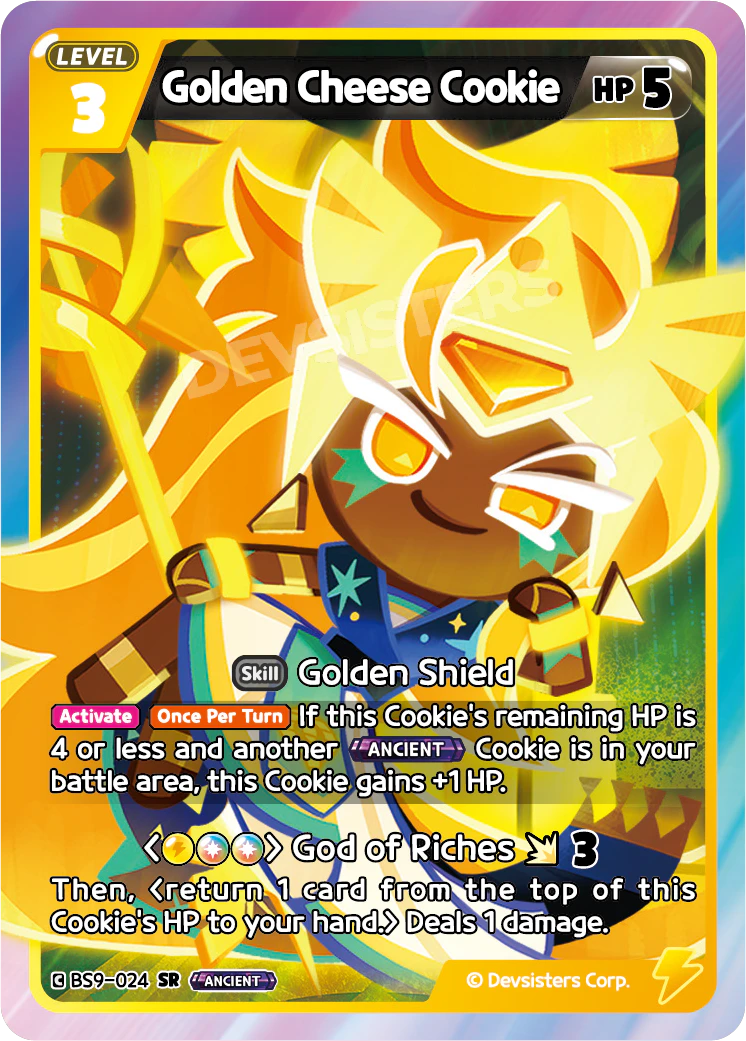
Cookie Run: Braverse Color Pairs Guide: Which Two-Color Decks Actually Work
Two-color decks in Braverse aren't just 'jam your favorite cards together.' The generic-energy system decides which splashes hold up and which ones brick your Support Area. Here's what actually works.
Cookie Run: Braverse Sideboard Guide — Tech Without One
Braverse locks your deck at registration - there's no sideboard to hide behind. This guide covers the tech binder system, flex-slot math, and database-verified swaps for aggro, control, mill, and midrange, so your 60 is already right before round one.
Cookie Run: Braverse Tech Cards Guide (Flex Slots That Win Games)
Tech cards are the flex slots that answer the deck your list has no plan for. Here's which Braverse answer traps, removal, bounce, and hate cards are worth running - all verified against the official database - plus how many slots to give them.

How to Play Cookie Run: Braverse - A Complete Beginner Guide
Cookie Run: Braverse is the rare TCG you can teach in a single match. This guide covers everything a first-time player needs: card types, setup, turn structure, how you pay for cards, the FLIP mechanic, and how to win.
Cookie Run: Braverse Meta Tier List — Best Decks & Archetypes Ranked
Which Cookie Run: Braverse decks are actually carrying right now? Here's a meta tier list of the strongest archetypes - the real cards that anchor each one, why they rank where they do, and what's overrated.