Cookie Run: Braverse Sideboard Guide — Tech Without One
Braverse locks your deck at registration - there's no sideboard to hide behind. This guide covers the tech binder system, flex-slot math, and database-verified swaps for aggro, control, mill, and midrange, so your 60 is already right before round one.
You just dropped game one to a Purple mill deck that dumped your whole library into the trash, and your hands are already reaching for the deck box - the reflex every Magic and Pokemon player has burned in. Swap the dead cards, bring in the graveyard hate, shuffle up for game two. Except in Cookie Run: Braverse, there's nothing to reach for. The official tournament rules require your deck recipe to be submitted before the event and locked once it starts - no changes between games, no changes between rounds, no 15-card safety net. The 60 cards you registered (plus up to 6 Extra Deck cards) are the 60 cards you die with.
So a "sideboard guide" for Braverse is really a guide to a different skill: getting the teching done before registration. That skill has three parts - a tech binder you maintain between events, a flex-slot budget inside your 60, and a swap map of verified answers for each archetype. Every card named below is quoted from the official card database, and most of them cost you an uncommon, not a chase rare.
Braverse has no sideboard and that changes everything
Nail down the rules reality first. Braverse tournament play - now run through TopDeck.gg for organized play in North America - uses a registered deck list: exactly 60 cards in the main deck, up to 6 in the Extra Deck, no banned or restricted cards, submitted in advance. Once the tournament begins, the list is frozen. Plenty of locals run best-of-1 with a 35-minute round timer; even when an event runs best-of-3, there is no sideboarding step between games.
Two consequences follow, and they're both bigger than they look.
First, your 60 has to beat the whole room, not one opponent. In Magic, a maindeck can be 70% of your strategy because the sideboard patches the other 30% after game one. In Braverse, there is no patch. If the room is half aggro and you registered zero defensive Traps, you signed up to lose those matchups twice each. That's why tech cards matter more here than their raw stats suggest - a narrow answer in the maindeck is the only answer you get.
Second, the Extra Deck is not a loophole. Those 6 slots hold EXTRA-type Cookies like the Shadow Milk Beasts - an in-game zone, like a Yu-Gi-Oh extra deck, not a swap pool. Extra cards only arrive through their printed EXTRA conditions, and you can't move one into your main 60 between games. Registering six of them gives you a top-end, not six flex answers.
If you're shaky on deck legality or the zones themselves, run through the deck building basics first - this guide assumes you know what a support area is.
The tech binder: your sideboard that lives at home
Here's the reframe that makes the whole thing click: Braverse absolutely has a sideboard. You just board between events, not between games. Your sideboard is a binder page - 9 to 18 sleeved cards that never travel inside the deck box but get audited before every registration.
The binder page has three rules:
- Every card on it must answer a named deck. Not "this seems good" - "this beats the Latte Cookie mill deck that top-8'd last week." Can't name the matchup? It's a cut, not a tech.
- Every card on it stays playable in a vacuum. Because you can't board it out, either. The best Braverse tech cards are mostly-fine cards with a spike matchup, and that's not an accident.
- It gets one honest review per event. Which binder card did I wish was in the 60? Which registered card never left my hand? Those two answers are next week's swap.
This is also where budget players quietly win: almost every card in the swap map below is a common, uncommon, or rare. The budget upgrades guide covers the economics, but the short version is that answers cost cents while threats cost twenties.
The flex-slot framework
You can't rebuild 60 cards every week, and you shouldn't. A tuned Braverse list splits into a core and a flex band:
- Core (roughly 52-54 cards): your energy base, your curve of Cookies, your win condition, your draw engine. This is the deck's identity. It only changes when the meta tier list shifts under it.
- Flex band (roughly 6-8 cards): two to three effect groups of 2-3 copies each. These are the slots you re-register between events based on what you expect to face.
Why 2-3 copies and not singletons? Consistency math. In a 60-card deck with no tutors and no sideboard, a single copy is a card you see in well under half your games - a lottery ticket, not a plan. If a matchup is worth teching for, it's worth 2 slots; if it isn't worth 2 slots, it isn't worth teching for. That discipline caps you at two or three tech packages per event, which means the real skill is prediction, not deck-box origami.
The swap map: what to bring against each archetype
Everything below is verified against the official database at cookierunbraverse.com. Costs use the standard notation from our energy guide: {R}/{Y}/{G}/{B}/{P}/{K} for colored energy, {N} for any. For how each matchup actually plays out once the cards are locked, pair this section with the matchup guide.
Against aggro
Aggro punishes greedy curves, so the tech is damage denial - Traps that turn their lethal swing into a whiff.
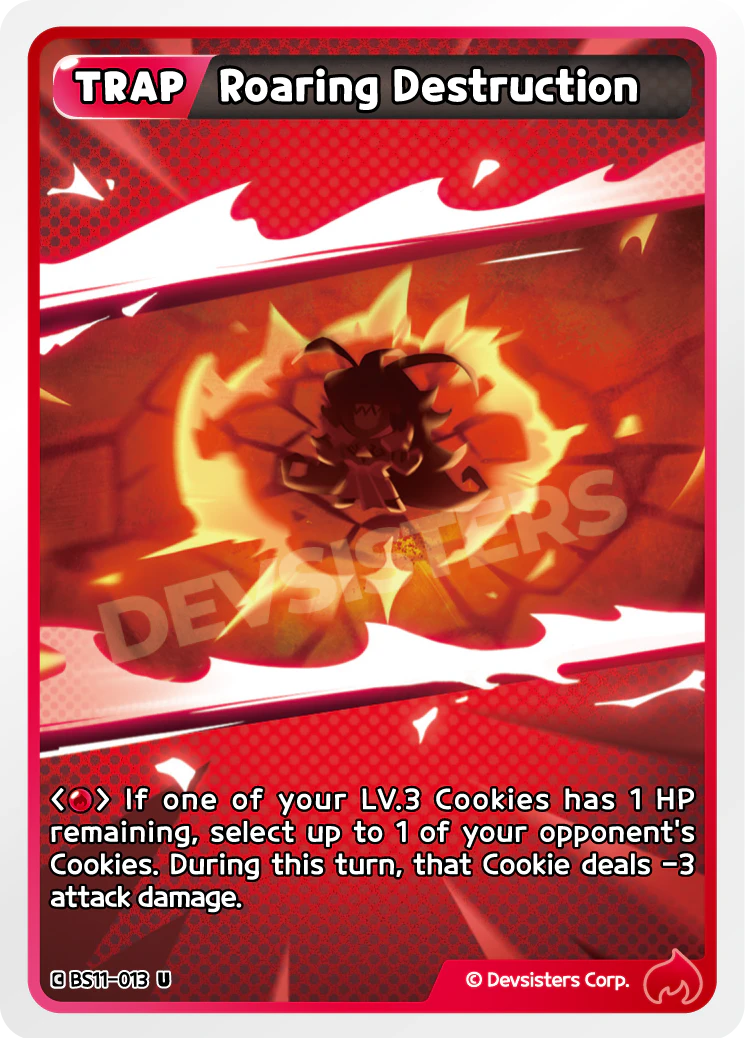
- Roaring Destruction (BS11-013, Red Trap, uncommon). For {R}, if one of your LV.3 Cookies has exactly 1 HP remaining, an opposing Cookie deals -3 attack damage this turn. That's a full attack negated for one energy, and the "1 HP remaining" condition is precisely the spot aggro puts you in. The swing in tempo when this fires is the biggest of any uncommon in the game.
- Awakened Apathy (BS11-046, Green Trap, uncommon). {G}{G} for a flat -2 attack damage, with an extra -1 if your support area has 2 or more cards fewer than your opponent's. No setup condition on the base mode, which makes it the more reliable copy in slower Green shells.
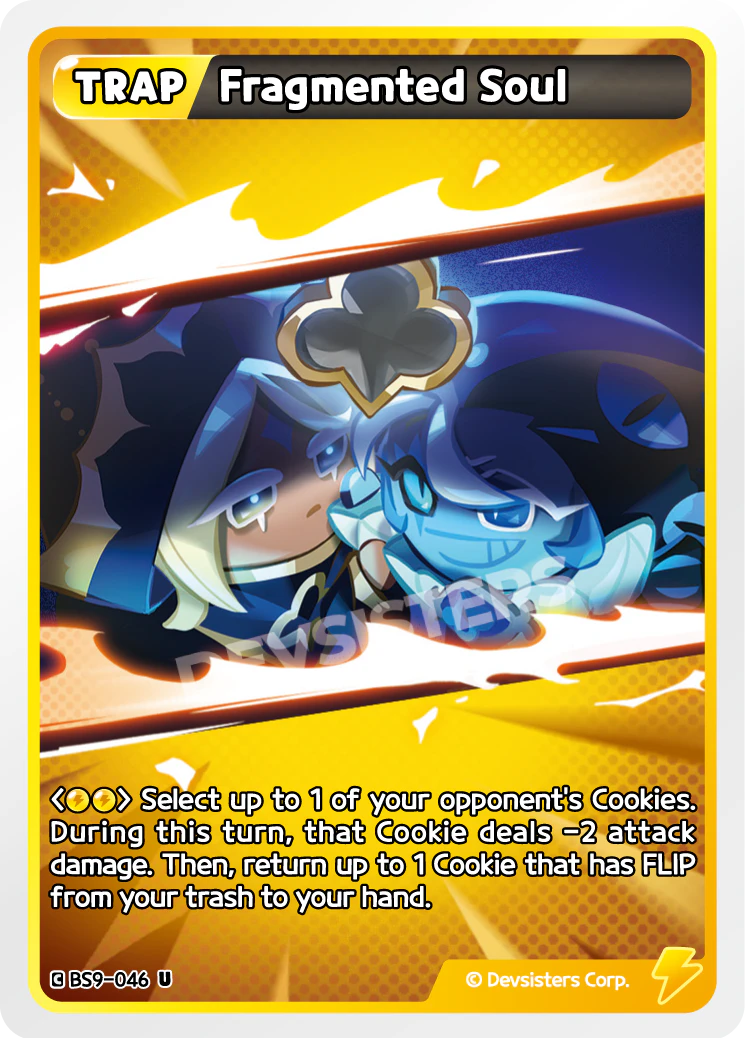
- Fragmented Soul (BS9-046, Yellow Trap, uncommon). {Y}{Y} for -2 attack damage and it returns a FLIP Cookie from your trash to hand. In a Yellow FLIP deck this is a two-for-one - defense stapled to engine fuel.
The pattern: each color has its own damage-reduction Trap, and they're all cheap. Against an aggro-heavy room, moving from zero defensive Traps to 3-4 is the single highest-impact registration change you can make.
Against control
Control decks sit back, accumulate cards, and answer your threats one-for-one. The tech attacks the resource they hoard: their hand.
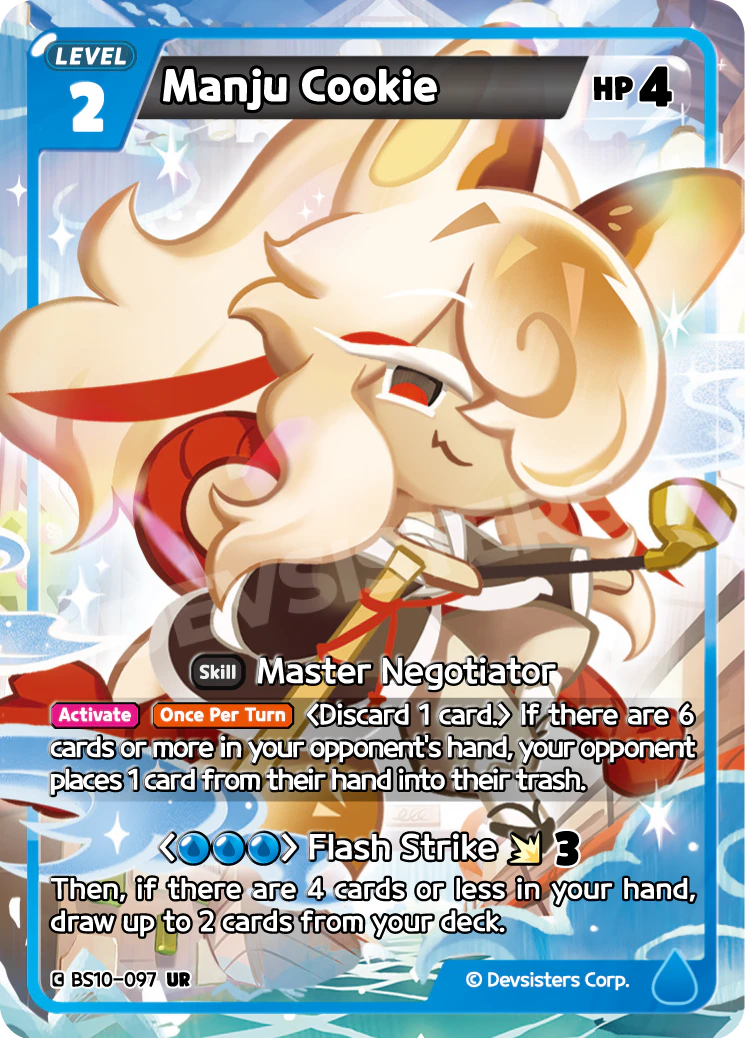
- Manju Cookie (BS10-097, Blue, Ultra Rare, LV.2, 4 HP). Once per turn, discard 1 card: if your opponent has 6 or more cards in hand, they place one in their trash. That's a repeating tax aimed squarely at draw-go decks - and the attack, Flash Strike ({B}{B}{B} for 3), refills you with up to 2 draws when your own hand is at 4 or fewer. This is the one swap on the map that costs real money, and it earns it.
- Top of the Spire of Deceit (BS11-062, Blue Stage, uncommon). {B}{B} to place, then cash it in later to view your opponent's entire hand. Against control, information is removal - knowing which Trap they're holding decides whether you commit the second attacker or wait.
- Pom-pom Dough Cookie (BS11-112, Black, Rare, LV.2, 4 HP). Its attack rider shuts off your opponent's On Play skills for LV.2-or-higher Cookies for the turn. Control decks lean on On Play value to stabilize; this makes their catch-up turn miss.
Against mill and trash decks
The Purple trash engines - Latte Cookie (BS9-098) sacrificing itself to mill you 3, Black Sapphire Cookie (BS9-100) hitting both decks for 5 on play - want the game to be about trash counts. One uncommon un-asks the question:
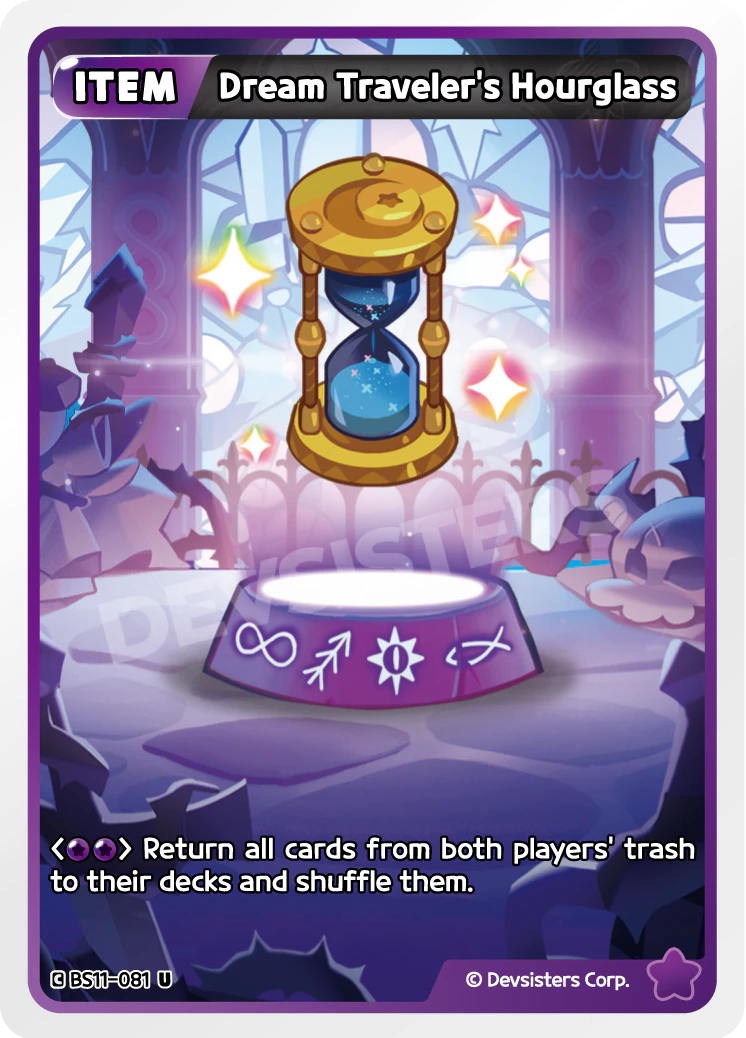
- Dream Traveler's Hourglass (BS11-081, Purple Item, uncommon). For {P}{P}: return ALL cards from BOTH players' trash to their decks and shuffle. Every card the mill deck spent three turns dumping goes back; every "20 or more cards in your trash" payoff - including the Purple Shadow Milk Cookie's EXTRA condition - resets to zero. The hardest single answer to an entire archetype in this game, for two energy. It's the hero image of this article because it deserves to be.
The honest caveat, per binder rule two: against non-trash decks the Hourglass is nearly blank, and it can anti-synergize with your own recursion. Register 2 copies when mill is real in your area, 0 when it isn't - no in-between number is correct.
Against midrange and Ancients
Midrange piles win with big bodies and value permanents - Stage cards that generate advantage every turn. Two answers:
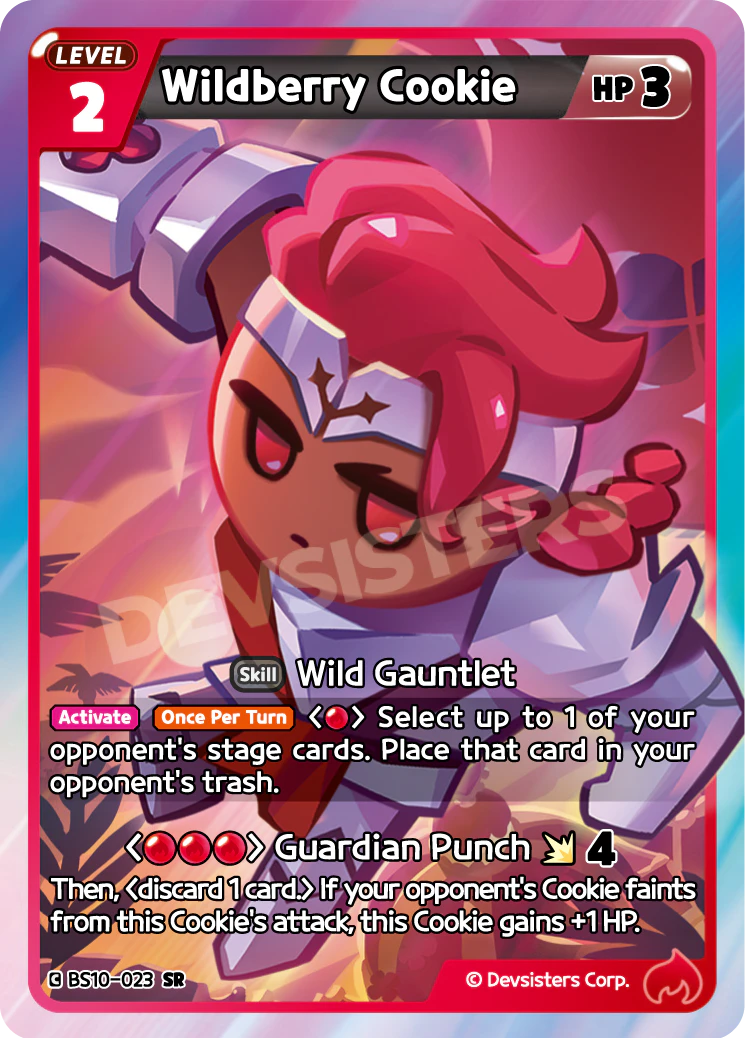
- Wildberry Cookie (BS10-023, Red, Super Rare, LV.2, 3 HP). Once per turn, for a single {R}: trash one of your opponent's stage cards. Repeatable Stage removal on a body that also attacks for 4 with Guardian Punch. If your local midrange decks are built around a Stage engine, Wildberry alone dismantles it - every single turn, for one energy.
- Mystic Flour Cookie (BS11-053, Green, Ultra Rare, LV.2, 4 HP). Once per turn, for {G}: strip 1 card from the top of the HP of every opposing Cookie with 5 or more remaining HP. Note what it doesn't touch - small bodies. This card exclusively punishes decks that go tall, chipping every fat Ancient on their board simultaneously while ignoring aggro entirely. Textbook tech: devastating against one shape of deck, blank against another.
Reading your local meta between events
The swap map is useless without a prediction to aim it at, and prediction in Braverse is mostly showing up and writing things down. Three habits:
- Track your last two events, not your last ten. Braverse sets land frequently and each one reshapes archetypes (BS11, The Dark Enchantress War, printed most of the Traps above). What won six weeks ago is trivia; what won the last two Tuesdays is data.
- Count archetypes, not players. Note the rough split each week - say 40% aggro, 30% trash/mill, 30% midrange - and mirror it in your 6-8 flex slots. Silver bullets only earn a slot when their target is above roughly a quarter of the room.
- Watch what people buy, not just what they play. When three regulars crack boxes of a new set at the same table, the next event's meta is sitting right there. Your mulligan decisions and tech slots should move before the results do, not after.
And a genuinely underrated one: in best-of-3 you can't change cards, but you can change lines. Play game one conservatively until you've identified their archetype; games two and three, mulligan and sequence toward the flex cards that matter. The deck is frozen. The pilot isn't - and that's a bigger edge than any 15-card board ever was.
When not to tech
The trap at the end of all this is over-teching, so here's the counterweight. Don't touch the flex slots when:
- Your losses were pilot error. If you punted game two by walking into an obvious Trap with your last attacker, no registration change fixes that. Reread the matchup notes, not the binder.
- The answer costs consistency you can't spare. Every tech slot displaces a card that made your deck function. A deck that does its own thing reliably beats a deck full of answers it never finds.
- You're guessing. No data on the room? Register the straightest, most proactive version of your list. Proactive decks have fewer dead cards against an unknown field - that's a TCG law, and a locked deck raises the penalty for breaking it.
Quick Action Checklist
- Accept the rule: 60 cards plus up to 6 Extra, registered in advance and locked for the whole event - no sideboarding between games, even in best-of-3.
- Keep a tech binder of 9-18 sleeved answers at home; audit it after every event - what did I miss, and what never fired?
- Split your list into a 52-54 card core and 6-8 flex slots; run tech as 2-3 copies, never singletons.
- Against aggro: your color's damage-denial Trap - Roaring Destruction (BS11-013), Awakened Apathy (BS11-046), or Fragmented Soul (BS9-046).
- Against control: Manju Cookie (BS10-097) taxes big hands; Top of the Spire of Deceit (BS11-062) reveals theirs.
- Against mill: 2 copies of Dream Traveler's Hourglass (BS11-081) - and 0 when mill is absent.
- Against midrange: Wildberry Cookie (BS10-023) strips Stages every turn; Mystic Flour Cookie (BS11-053) chips every 5-HP-plus body.
- Mirror the last two weeks of your local archetype split in the flex slots, then stop - over-teching loses more games than under-teching.
Frequently Asked Questions
Does Cookie Run: Braverse have a sideboard?
Can I change my Braverse deck between tournament rounds?
Does the Extra Deck work like a sideboard in Braverse?
How many flex slots should a Braverse deck have?
What is the best anti-mill card in Cookie Run: Braverse?
Keep Reading
Related Guides
Cookie Run: Braverse Extra Deck Guide — All 17 Cards
The Extra Deck is six free cards that most Braverse players fill wrong. Here is how the zone actually works, all 17 EXTRA cards broken down by their printed conditions, and the build rule that decides whether your slots ever fire.
Cookie Run: Braverse Tech Cards Guide (Flex Slots That Win Games)
Tech cards are the flex slots that answer the deck your list has no plan for. Here's which Braverse answer traps, removal, bounce, and hate cards are worth running - all verified against the official database - plus how many slots to give them.
Cookie Run: Braverse Matchup Guide - Archetype vs Archetype
Knowing your deck cold is half the battle - knowing the matchup is the other half. Here is how Braverse's five archetypes actually play against each other, who has to be the aggressor, and the plan that wins each pairing.

The Break Area Is a Resource, Not a Graveyard (Braverse)
Most players treat the break area like a graveyard pile and forget it exists. It has a number attached to it, 81 cards read that number, and Yellow decks are quietly built to inflate it on purpose.

How to Play Cookie Run: Braverse - A Complete Beginner Guide
Cookie Run: Braverse is the rare TCG you can teach in a single match. This guide covers everything a first-time player needs: card types, setup, turn structure, how you pay for cards, the FLIP mechanic, and how to win.

Cookie Run: Braverse Meta Tier List — Best Decks & Archetypes Ranked
Which Cookie Run: Braverse decks are actually carrying right now? Here's a meta tier list of the strongest archetypes - the real cards that anchor each one, why they rank where they do, and what's overrated.