Disney Lorcana's Bag Explained: How Trigger Order Works
Six other posts on this site mention "the bag" in passing and none of them explain it. Here is the actual rule: what goes in, what never does, the exact order it resolves in when two abilities fire at once, and the two different ways a Lorcana card can make something happen later.
Six posts on this site say the words "the bag" and not one of them explains it. Actions skip it. Locations' passive lore never touches it. Sing Together fills it with several triggers at once. Format Coconut's multiplayer rules pass it around the table. Every one of those claims is true and every one of them assumes you already know what "it" is.
Here is what it actually is: a queue that decides which of Lorcana's triggered abilities goes off first when more than one is waiting, and a set of rules specific enough that Ravensburger gave it its own name for the moment control changes hands - passing the bag. Everything below is checked against the Comprehensive Rules 2.2.0 text (effective 9 July 2026, the same revision every other post here cites) and one pass over the Lorcast bulk card export pulled 25 September 2026, covering the 13 released main sets - 2,476 unique cards, deduped by full name with apostrophes and capitalisation folded, the same method used throughout this vertical.
The thing every other post here mentions and skips
You play an action that damages your opponent's character. That triggers your own "whenever one of my actions deals damage" ability. It also triggers their "whenever one of my characters is damaged" ability. Both conditions are met at the same instant. Whose resolves first?
Nothing about turn order tells you. Whoever has priority in Magic doesn't exist here - Lorcana has no priority system at all, no windows, no passing. What decides it is a specific, numbered process that neither the beginner materials nor how to play Disney Lorcana walk through, because it only matters once you're past your first few games. That process lives in Comprehensive Rules section 7.7, titled, simply, "Bag."
What actually goes in
Rule 7.7.1 is blunt about what this zone even is: not a physical space, just a holding area for triggered abilities waiting their turn to resolve. Rule 7.7.2 is the one worth memorising, because it's a closed list rather than an open one - only triggered abilities go into the bag. Activated abilities, an action's own resolving effect, and the act of playing a character, item or location are all explicitly excluded.
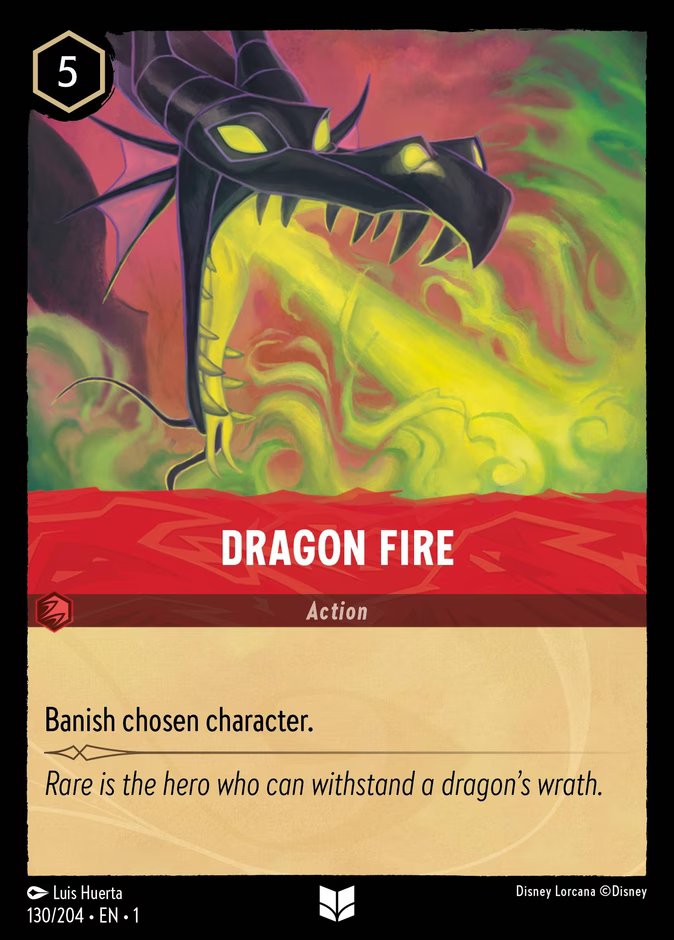
That list rules out more than it sounds like. Actions resolve immediately as they're played and never enter the bag at all - a card like Dragon Fire doesn't queue up, it just happens. Exert-cost activated abilities on items and characters bypass it the same way. What's left is exactly one category: an ability whose text opens with one of seven specific phrases the rules define as a trigger condition - "When," "Whenever," "The first time," "The second time," "The next time," "At the start of," or "At the end of." Meet that condition and the ability goes into the bag, full stop; nothing else does.
The census: how much of the pool touches it
That's a testable claim, so here's the count. Searching all 2,476 unique cards for those seven trigger phrases:
| Trigger phrase | Cards | Share of 2,476 |
|---|---|---|
| Whenever | 604 | 24.4% |
| When | 542 | 21.9% |
| At the start of | 63 | 2.5% |
| At the end of | 38 | 1.5% |
| The first time | 3 | 0.1% |
| The next time | 2 | 0.1% |
| The second time | 0 | 0% |
| Any of the above | 1,160 | 46.8% |
A card can carry more than one phrase, so the rows don't add to the total. What they add up to is this: almost half the card pool generates something that has to go through this exact process, and "The second time" has never been printed on a single card in three years - the rules reserve the phrase, Ravensburger has simply never used it.
The rarest two are worth naming because they're both instructive. Only three cards use "The first time": Lilo - Bundled Up, whose Extra Layers ability shrugs off the first hit each of her opponent's turns; Vine Entrance - Ominous Passageway, a location that punishes the first Floodborn character to move there each turn; and Seven Dwarfs' Mine - Secure Fortress, which does the same for the first character moved to it. Only two use "The next time" - Rapunzel - Ready for Adventure and Next Stop, Olympus - and both of them use it to create a second delayed condition once their own ability has already fired, which is exactly the mechanic covered two sections down.
The order: active player empties their half first
Say two abilities are sitting in the bag right now - one of yours, one of your opponent's. Rule 7.7.4 lays out the process, and it runs like this:
- The bag checks which players actually have anything queued (7.7.4.1).
- If the active player has any, they pick any one of their own waiting abilities and resolve it completely, choices and all (7.7.4.2).
- After a game state check confirms nothing else changed, the bag checks again. If that same player still has queued abilities, they keep going - they don't hand anything over yet (7.7.4.3).
- Only once that player has nothing left does the bag move to the next player in turn order (7.7.4.4).
- That continues around the table until the bag is empty (7.7.4.5).
Two things about that sequence surprise people coming from other card games. First, the active player doesn't resolve one thing and then stop for a response - they clear every one of their own queued triggers, in whatever order they personally prefer, before anyone else gets a single ability off the ground. Second, there's no requirement that abilities resolve in the order they were added. If you have three things waiting, you choose which one goes first, which goes second, and which goes last, on the spot, every time.
Passing the bag, and the line you cannot cut
Rule 7.7.4.4 has an actual name for step 4 above - it calls the moment control moves to the next player "passing the bag." What that phrase is covering for is a scenario the name alone doesn't answer: what happens if a new ability triggers while someone is already partway through resolving theirs?
The answer depends entirely on whose card generated it. Rule 7.7.5: if the ability was added by the player who is currently resolving things, it's visible the very next time the bag is checked and can be picked immediately - it can jump ahead of anything that was already sitting there from earlier in that same player's turn. Rule 7.7.6: if it was added by anyone else, it has to wait. It sits in the bag, fully queued, until the bag actually reaches that player in the rotation - even if that means several more of the active player's own abilities go off first.
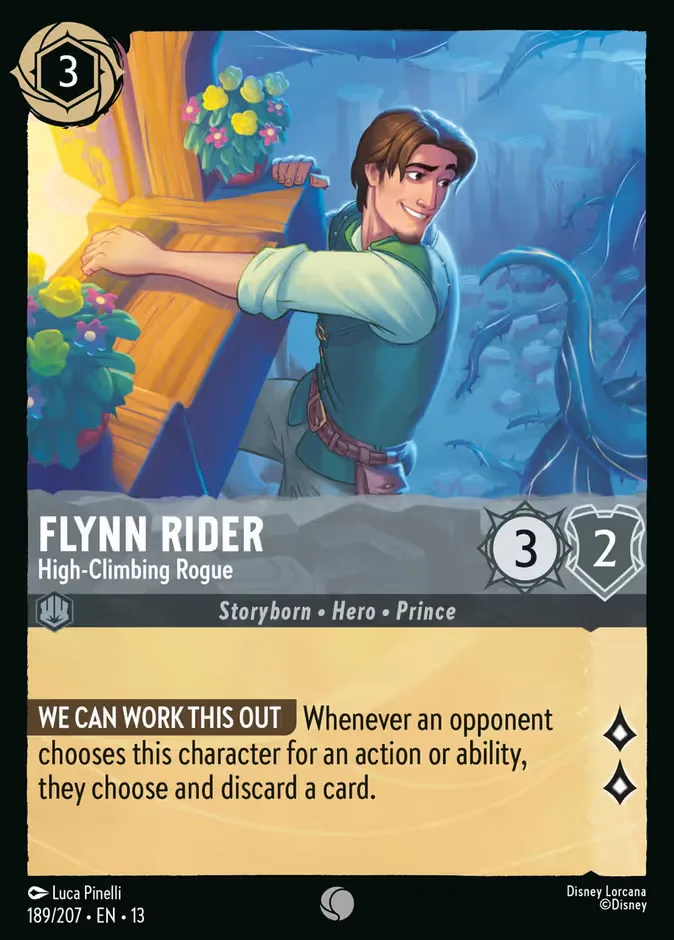
Thirteen cards across the game's history trigger directly off something an opponent does - not a secondary condition checking the opponent's board, but the trigger condition itself naming "an opponent" or "opponents." Only three survive the July 2026 rotation: Ink Amplifier, a Whispers in the Well item that punishes an opponent's second card draw in a turn; Signed Contract, a Fabled item that draws you a card whenever an opponent plays a song; and Flynn Rider - High-Climbing Rogue above, whose We Can Work This Out fires the instant an opponent chooses him for an action or ability. Play Flynn Rider against a deck that both targets him with removal and has its own "whenever I play a song" payoff sitting in play, and here's the practical case: your opponent's removal spell resolves, their ability triggers at the same moment yours does, but it's their turn - their trigger clears the bag before yours is even eligible to be chosen. Yours fired the instant theirs did. It still goes second, because it isn't your turn to pass.
Two abilities that look the same, and are not
Some effects don't create a normal triggered ability at all - they create one that exists outside the bag entirely, until a specific later moment. Rule 6.2.7 splits these into two kinds, and mixing them up is an easy way to misplay a turn.
| Type | Rule | Exists until | Worked example |
|---|---|---|---|
| Floating triggered ability | 6.2.7.1 | A stated duration, usually "this turn." Fires fresh every time its condition is met inside that window, then disappears when the duration ends. | Steal from the Rich |
| Delayed triggered ability | 6.2.7.2 | One specific future moment. Fires exactly once, then is gone. | Candy Drift |
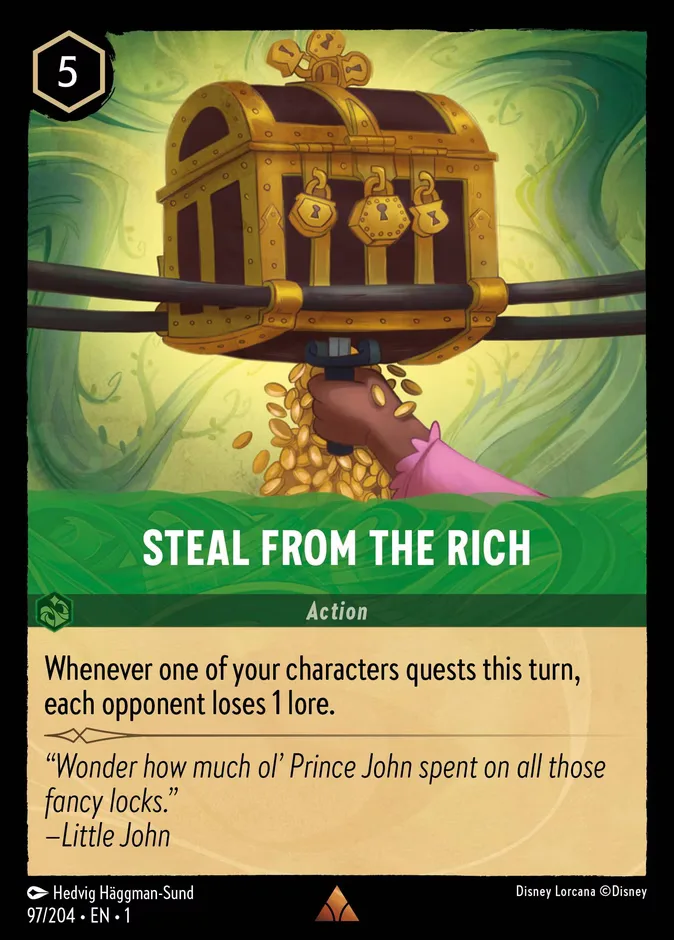
Steal from the Rich is the Comprehensive Rules' own worked example for the floating kind: play it, and for the rest of that turn, every quest from one of your characters adds a fresh instance to the bag - not one trigger, potentially several, one per quest. Restoring the Crown and Hero Work do the same thing with challenges instead of quests, 99 Puppies mirrors Steal from the Rich's quest-based version directly (gain 1 lore per quest instead of draining the opponent), and Who's With Me? bundles the challenge-based version onto a +2 Strength boost for the turn. Of that family, only Hero Work survives Core Constructed after rotation - the rest are Infinity-only now.
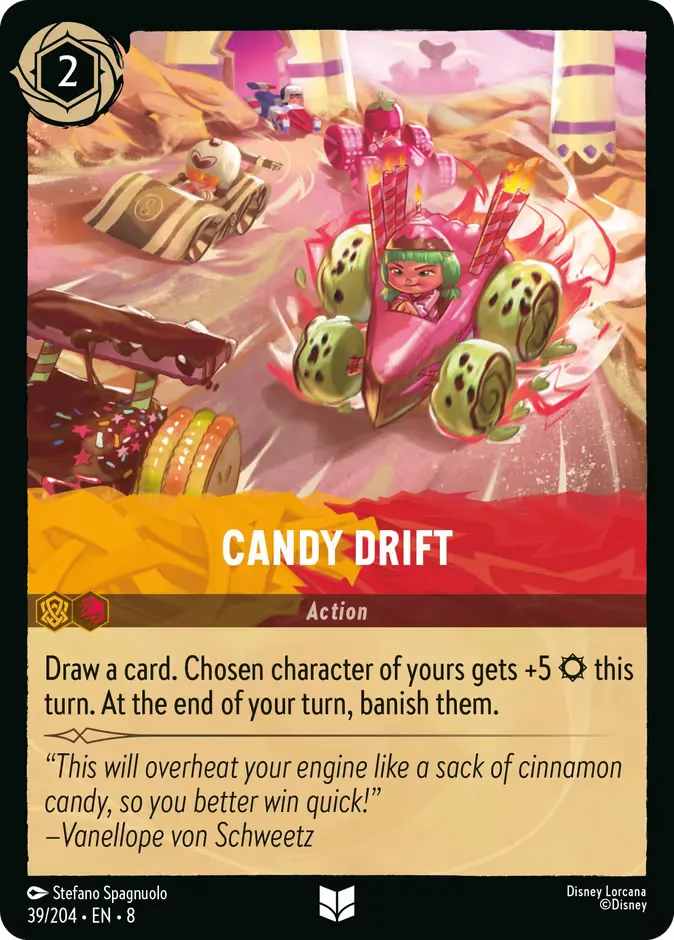
Candy Drift is the delayed kind, and it's a cleaner trap than it looks: draw a card, buff a character, and set a fate in motion that hasn't happened yet. The buff is a normal effect with a duration, resolved the moment you play the card. The banishment is different - it doesn't exist in the bag right now at all. It's floating outside the game state, attached to that specific character, waiting for your End-of-Turn Phase to arrive. Only then does it get added to the bag and actually resolve.
The cleanest examples of this pattern in the current Core pool aren't actions at all - they're the four Temporary Shift characters from Attack of the Vine!: Sun Yee - Red Panda Spirit, Grandma Wu - Fierce Red Panda, Meilin Lee - Popular Red Panda and Ming Lee - Giant Red Panda. Every one of them plays on top of an existing character for a discounted cost, and every one of them carries the identical clause: at the end of your turn, heal all damage and return only that top card to your hand. That's a delayed triggered ability created the moment you Shift the character in, sitting outside the bag for the rest of the turn, then firing on schedule - which is also why it can't be answered by anything that interacts with the bag itself. There's nothing there to interact with until your End-of-Turn Phase arrives.
What never touches the bag
Knowing the exclusions matters as much as knowing the rule. A location's passive lore is the cleanest case - it isn't a triggered ability by the rules' own definition, so a card like McDuck Manor pays out every turn without ever generating anything for the bag to hold, which is exactly why nothing can respond to it. Activated abilities work the same way: exert an item or pay a character's activation cost and the effect just happens, no queue involved. And the biggest exclusion of all is actions themselves - the effect on the card you just played resolves as part of playing it, not as a triggered ability waiting its turn, which is the entire reason Dragon Fire can't be countered and doesn't care what else is sitting in the bag when it goes off.
There's one deliberate exception worth flagging precisely, because Sing Together is the cleanest illustration of rule 7.7.3.1's other half: when multiple triggered abilities happen at the exact same moment, they're added to the bag simultaneously rather than one at a time. Exert three characters to sing a song together and any of them with a "whenever this character sings a song" ability all meet that condition in the same instant - three separate entries land in the bag together, and the active player then picks the order to resolve them in using the normal process above.
Tables with three or more players
Format Coconut and any casual pod bigger than two players run on the same section 7.7 process with one addition. Rule 9.2.1 changes how the bag moves around the table at all: instead of passing back and forth between two players, it goes to the player on the active player's left, then the next player left of them, and so on - the same seating-order logic Format Coconut's own turn structure already uses. Rule 9.2.2 covers the case where an effect needs more than one player to make a choice at the same time - the active player goes first, then the rest of the table follows in that same left-to-right order.
Co-op products change something more fundamental. Illumineer's Quest runs on the simultaneous-turn variant in section 9.3, where every player on a team moves through the Beginning, Main and End-of-Turn phases at the same time rather than taking turns in sequence - which matches what that product's own rulebook already describes as players talking constantly through a shared turn. What the base Comprehensive Rules add is the bag consequence: rule 9.3.2 states that when a simultaneous turn generates triggered abilities from more than one teammate, they aren't sorted by an individual player's queue at all - they go into the bag as belonging to the team as a whole, and the team decides together what order to resolve them in. The Comprehensive Rules cover the standard multiplayer and simultaneous-turn frameworks generally; the specific script an Illumineer's Quest villain runs on is governed by that product's own rulebook, not by section 9.
When a player leaves mid-resolution
One more scenario the rules cover explicitly: what happens to a queued ability if the player who owns it stops being in the game. Rule 7.7.7 is direct about it - if a player leaves while abilities they added are still sitting in the bag, those abilities simply cease to exist. They don't resolve late, they don't transfer to anyone else, they're gone.
Rule 9.2.3 draws the line between what disappears and what doesn't in a multiplayer game where someone decks out mid-round: all of that player's cards and effects leave the game, including any of their unresolved bag entries, but a static effect they'd already generated with its own stated duration keeps running until that duration is actually up. A character with an ongoing "opponents can't play actions until the start of your next turn" effect from a card like Pete - Games Referee doesn't get switched off just because Pete's controller left - the effect finishes on its own clock, even with nobody left to claim it.
Quick reference
- Only triggered abilities enter the bag (rule 7.7.2) - not actions, not activated abilities, not the act of playing a character, item or location.
- About 1,160 of the game's 2,476 unique cards carry at least one of the seven trigger phrases the rules define, and "The second time" has never once been printed.
- The active player clears every one of their own queued abilities, in an order they choose, before the bag passes to the next player - a step the rules name "passing the bag" (7.7.4.4).
- A newly triggered ability from the player currently resolving things can jump straight to the front (7.7.5); one from anyone else waits its turn, even if it fired first in real time (7.7.6).
- Floating triggered abilities (6.2.7.1) refire every time their condition is met within a stated duration, then vanish. Delayed triggered abilities (6.2.7.2) fire exactly once, at one specific future moment, and exist outside the bag entirely until then.
- In games of three or more, the bag passes left instead of back-and-forth (9.2.1); in a simultaneous-turn team format, triggered abilities from multiple teammates go into the bag as the team's, and the team chooses the order (9.3.2).
- If a player leaves the game, their unresolved bag contents disappear with them (7.7.7); a static effect they already generated with its own duration keeps running regardless (9.2.3).
Card counts here reflect the Lorcast bulk export pulled 25 September 2026, covering the 13 released main sets - Hyperia City prereleases three weeks from this post's publish date and isn't included. Rule numbers reflect Comprehensive Rules 2.2.0, effective 9 July 2026, cross-checked against the rules' own searchable text rather than the PDF alone. One methodology note: the trigger-phrase census counts any card whose text contains one of the seven phrases anywhere, the same reasonable-effort approach used elsewhere on this site for text-pattern counts - it will catch the rare case where a phrase shows up outside an actual trigger condition, so treat it as a close estimate of scale rather than a hand-verified list.
Frequently Asked Questions
What is 'the bag' in Disney Lorcana?
What order do triggered abilities resolve from the bag?
Can a new triggered ability jump ahead of ones already waiting in the bag?
What is the difference between a floating triggered ability and a delayed triggered ability in Lorcana?
Does my opponent's triggered ability resolve before mine if we both trigger at the same time?
Do actions or activated abilities go into the bag in Disney Lorcana?
How does the bag work in multiplayer Disney Lorcana?
Keep Reading
- Disney Lorcana Comprehensive Rules 2.2.0 - full searchable text, including section 7.7 'Bag' and section 6.2.7 on floating and delayed triggered abilities (lorcana.gg)
- Disney Lorcana Comprehensive Rules 2.2.0, effective July 9, 2026 (Ravensburger, official PDF)
- Lorcast bulk card export - the card pool counted in this post (pulled 25 September 2026)
- Lorcast set list - set codes and release dates used for the Core cut
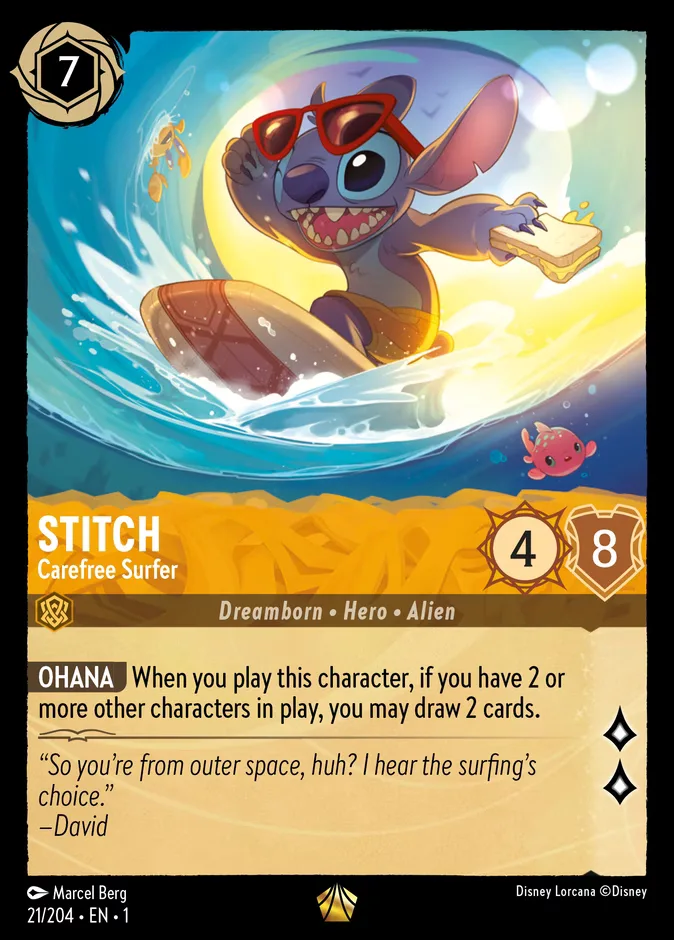
- Stitch - Carefree Surfer #21/204, The First Chapter - the Comprehensive Rules' own worked example for a basic triggered ability (Lorcast)
- Steal from the Rich #97/204, The First Chapter - the Comprehensive Rules' own floating triggered ability example (Lorcast)
- Candy Drift #39/224, Reign of Jafar - the Comprehensive Rules' own delayed triggered ability example (Lorcast)
- Flynn Rider - High-Climbing Rogue #189/245, Attack of the Vine! (Lorcast)
- Ink Amplifier #167/242, Whispers in the Well (Lorcast)
- Signed Contract #101/242, Fabled - the third currently Core-legal card whose trigger names an opponent directly (Lorcast)
Related Guides
Lorcana Shift Explained: Stacks, Damage and All 6 Variants
Shift is 199 cards across the 13 main sets before Hyperia City and a full page of rules, and most of that page is about the card underneath. Here is what a shifted character inherits, why 63 Core-legal cards care about the stack, where every card goes when the top one leaves play, and what each of the six variants actually lets you shift onto.
Disney Lorcana Uninkable Cards: All 585, and How to Ink One
The inkwell symbol is the first rule Lorcana teaches and the last one anybody puts a number on. Here is the whole uninkable pool counted off the live card data - 585 of 2,476 cards - cut by rarity, cost, type and ink, plus the Comprehensive Rules clause that lets five specific cards put an uninkable card into your inkwell anyway.
Disney Lorcana Format Coconut Explained: All 18 Beta Cards
Ravensburger put a new multiplayer format into open beta and then did not print a single card for it. The 18 Coconut cards live in the Companion app, the rules fit on one page, and the deckbuilding restrictions are stranger than the summary makes them sound. Here is the whole thing, with the card pool behind each Coconut counted.
Disney Lorcana Actions Explained: All 196, No Instant Speed
An action in Lorcana resolves the moment it is played, and the rules give your opponent no window to answer it. Here is the whole card type counted from the live pool - 196 non-song actions, what they actually do, and the handful of cards that can interfere before the fact.
How to Play Disney Lorcana - Rules, Turn Structure, and the Race to 20 Lore
Lorcana is the rare TCG where you never attack your opponent directly. You race them to 20 lore. This is the full rules walkthrough - inkwell, turn phases, questing, challenging, drying, card types, and deck limits.
Disney Lorcana Character Classifications Explained: All 47, and Why Storyborn Does Nothing
Rule 5.3.3.2 lists 47 classifications, and a card needs one of them to legally be a character at all. Then you count the card pool and find that the two most common words on the type - Storyborn and Dreamborn, 1,688 characters between them - are referenced by exactly zero cards.