Disney Lorcana Locations Explained: How All 85 Location Cards Work
Locations never quest, never exert and never hit back, and one of them will still out-race your opponent from the corner of the table. Here is the whole card type - every rule that governs it and every one of the 85 cards that exist, counted from the live pool.
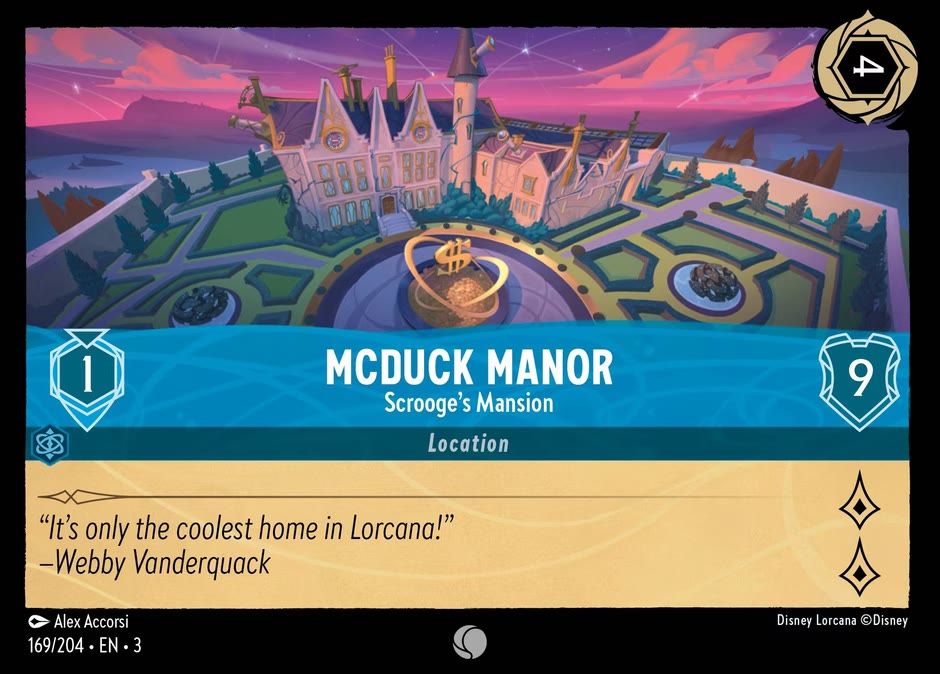
The fastest clock in Lorcana does not quest. McDuck Manor - Scrooge's Mansion costs 4 ink, has no rules text at all, and pays its player 2 lore at the start of every single one of their turns. It never exerts, so it is never open the way a quester is. It has 9 Willpower, the highest in the game. And the majority of removal in the card pool says "chosen character," which means it physically cannot choose a location.
I have watched that card win games in which it was never interacted with once. Not because the opponent misplayed - because their two inks genuinely had no clean answer to a card type they had not built for.
So this is the location deep-dive: every rule that governs the card type in Comprehensive Rules 2.2.0 (effective July 9, 2026), and every location that exists - all 85 of them, pulled from the Lorcast API and counted by hand, from Into the Inklands through Attack of the Vine!
What a location is, by the rules
Locations are the fourth and newest card type, added in Into the Inklands in February 2024, and rule 5.6.3 gives them the game's most recognisable physical tell: they are the only card type printed in landscape. Turn the card sideways and the frame reads like a character with pieces missing. The 2.2.0 update added one more line to that rule: a location can carry additional classifications on that same line.
The states are where they get weird. Rule 5.1.2.3: a location enters play undamaged, in play and faceup, and it can never have the ready, exerted, under or facedown states. Never ready, never exerted. That single line drives almost everything else the card type does - it is why locations cannot quest, why they can always be challenged, and why "exert chosen character" effects slide right off them.
Two more rules that new players miss constantly:
- No drying. Rule 5.6.4: if a location has an ability, you can use it the turn it comes down. Locations and items skip the drying rule entirely; only characters wait a turn.
- Four copies, same as anything else. A location follows the normal deck limit - up to 4 copies of the same full name (name plus version). You can run 4 McDuck Manors.
If the basic turn loop is still new to you, read how to play Disney Lorcana first - the rest of this assumes you know what questing, drying and the Set step are.
How locations score lore
Rule 1.11.2: a location with a Lore value pays out at the start of its player's turn, during the Set step. Rule 3.2.2.2 adds the technical detail that matters at competitive tables: this is not a triggered ability and never touches the bag. It just happens, before your Draw step, every turn, with no window for anything to respond.
The practical consequences:
- Your opponent always gets one full turn to answer it. You play the location, they take a whole turn, and only then does it pay for the first time. A location is an investment, not a burst.
- It scores while doing nothing. A questing character has to exert, which opens it to challenges. A location scores ready - or rather, scores while being incapable of readiness, which is better.
- It stacks with everything. Location lore plus questing lore in the same turn is how the sub-10-minute games happen.
Across the 85 locations, 53 have a Lore value: 42 pay 1 lore per turn, 11 pay 2, and the other 32 pay nothing and justify themselves with abilities instead. The 2-lore club is the one to memorise, because every card in it is a win condition in slow matchups. Four of the eleven cost just 3 ink - Agrabah - Marketplace, Game Preserve - Protected Land, The Frozen Vine - Monstrous Plant and Fat Cat's Club - Seedy Headquarters. Survive two of your own turns and a 3-ink location has already produced more lore than most 3-drops quest for, without ever exerting.
Challenging locations: any time, no counterpunch
Locations can absolutely be removed - the game just makes you do it the hard way. Rule 4.6.8 lets characters challenge locations, with three exceptions to normal challenge rules:
- No exert requirement on the target. Rule 4.6.8.2: since locations are never ready or exerted, they can be challenged at any time during your Main Phase. There is no waiting for an opening; the opening is permanent.
- They do not hit back. Rule 4.6.8.3: locations have no Strength characteristic and deal no damage in the Challenge Damage step. Your challenger takes zero.
- They still die like anything else. Damage is persistent, and rule 1.8.1.4 banishes a location the moment its damage equals or exceeds its Willpower.
Your character does still need to be dry and ready, and still exerts to challenge. That is the real price: every swing at a location is a swing not aimed at a character and an exerted body your opponent can crack back into on their turn. A 9-Willpower location like McDuck Manor is not "hard to kill" in the removal sense - it is a tax of two to three attacks that were supposed to go somewhere else.
Worth knowing for the maths: the Willpower spread across all 85 runs from 3 to 9, with 6 and 7 the joint most common (23 locations each). Only two locations sit at 3 Willpower - The Bayou - Mysterious Swamp and The Great Illuminary - Abandoned Laboratory - and four sit at 9: McDuck Manor, Treasure Mountain - Azurite Sea Island, The Great Illuminary - Radiant Ballroom, and, absurdly for its cost, the 2-ink Snuggly Duckling - Disreputable Pub.
Moving characters: the three rules everyone forgets
Every location has a move cost printed next to its name - the ink you pay to move one of your characters there. Moving is a normal turn action (rule 4.7): declare the character and the location, pay the move cost, done. You can do it as many times as you can pay, and it does not exert the character. A character can move to a location and still quest, challenge or sing that same turn.
The three rules that actually decide games:
- Your characters, your locations, no exceptions. Rule 4.7.1: you cannot move an opposing character, and you cannot move your character to an opposing location. Every "move" effect in the game respects this unless the card says otherwise.
- There is no stepping off. Rule 4.7.2: a character at a location cannot leave it except by moving to another location. There is no "move back to open board" action. Park a character at a location and it lives there until the location leaves play or the character moves to a different one.
- The building can fall down safely. Rule 5.6.6, added in the 2.1.0 update: if a location leaves play, characters there stay in play and are simply no longer at a location. Banishing the location does not banish the tenants.
The move-cost economics are tight: 52 of the 85 locations cost 1 to move to, 27 cost 2, and just six do anything else - two at 0, three at 3, and one glorious outlier at 6 we will get to below.
The census: 85 locations, counted
Everything in one place. Counts are unique full names (name plus version) from the Lorcast card database; 91 total printings exist because Fabled reprinted six.
| Stat | Spread |
|---|---|
| Total locations | 85 unique, across 9 of 13 main sets |
| By ink | Ruby 18, Steel 16, Amber 13, Amethyst 13, Emerald 13, Sapphire 12 |
| Ink cost | 1 (18 cards), 2 (26), 3 (24), 4 (16), 5 (1) |
| Move cost | 0 (2), 1 (52), 2 (27), 3 (3), 6 (1) |
| Willpower | 3 to 9; modes are 6 and 7 with 23 each |
| Lore value | 1 lore: 42 cards, 2 lore: 11, none: 32 |
| Inkable | 70 of 85 |
| No rules text | 9 pure stat-sticks |
A few reads on those numbers. Ruby, the ink with the most locations, is also where the game's movement shenanigans live. The cost curve stops at 4 for all but one card, so locations are early-game plays by design. And 70 of 85 being inkable means a late-drawn location is rarely a dead card - the deckbuilding cost of running them is low.
The nine textless locations are more playable than they look, because their rate is honest: Fat Cat's Club - Seedy Headquarters is 3 ink for 2 lore a turn behind 6 Willpower, and nobody reads it twice because the text box is flavor only.
The year Lorcana stopped printing locations
Here is the design history nobody tells you when you pick up the card type. Locations launched big in Into the Inklands - 18 in one set - then settled to 12 per set through Ursula's Return, Shimmering Skies and Azurite Sea. Then they vanished.
| Set | Released | New locations |
|---|---|---|
| Into the Inklands | Feb 2024 | 18 |
| Ursula's Return | May 2024 | 12 |
| Shimmering Skies | Aug 2024 | 12 |
| Azurite Sea | Nov 2024 | 12 |
| Archazia's Island | Mar 2025 | 0 |
| Reign of Jafar | May 2025 | 0 |
| Fabled | Aug 2025 | 0 (6 reprints) |
| Whispers in the Well | Nov 2025 | 9 |
| Winterspell | Feb 2026 | 7 |
| Wilds Unknown | May 2026 | 8 |
| Attack of the Vine! | Jul 2026 | 7 |
From Azurite Sea in November 2024 to Whispers in the Well in November 2025, Ravensburger shipped a full year of product with zero new locations. Three consecutive sets. Fabled tossed back six reprints and nothing else.
Then the type came back at a deliberately lower density - 7 to 9 per set instead of 12 to 18 - and the support kept pace: by my count 86 characters, 31 actions and 20 items across the game mention locations in their rules text, and the four most recent sets account for 37 of those characters. The 2.1.0 update in April 2026 even added two brand-new location rules (5.6.5.1 on versions and 5.6.6 on characters surviving a banished location). Whatever internal debate benched the card type for a year, it is over. Locations are core Lorcana again, and the pool is growing every set.
While here is the whole identity
Sixty-seven of the 85 locations use the word "here" in their text, and "while here" is an official duration in the rules (6.1.13.5). A location with a while-here ability is an aura you can walk characters into, and the best ones grant keywords - which turns the keyword system into geography:
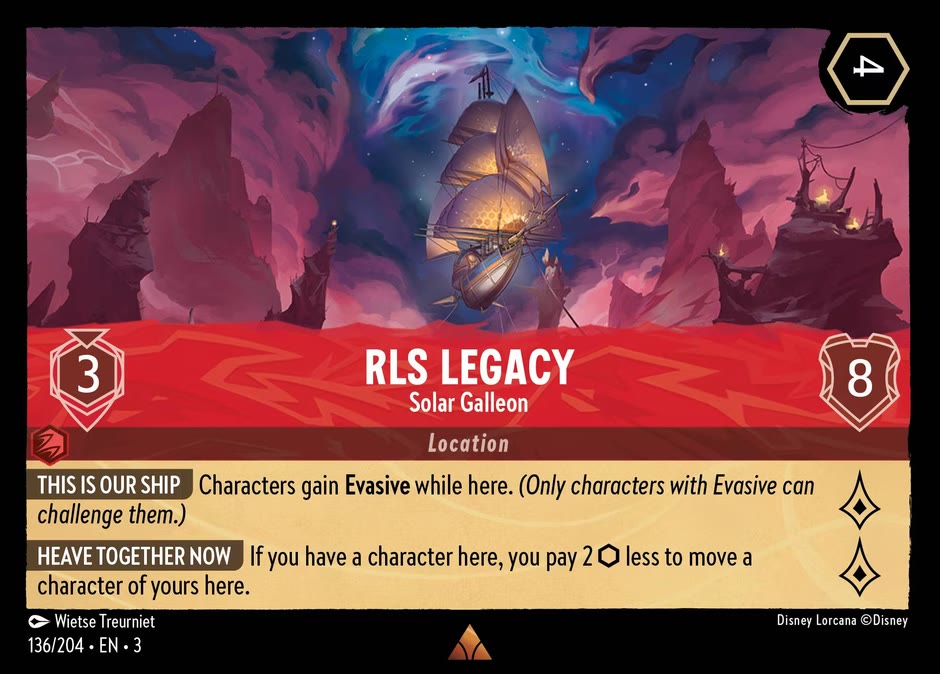
- RLS Legacy - Solar Galleon - characters gain Evasive while here. An entire crew of untouchables, in Ruby, an ink that already owns a third of the game's Evasive.
- Fang - River City - characters gain Ward and Evasive while here. The full "cannot interact with this" package on one Emerald card.
- Castle Wyvern - Above the Clouds - Challenger +1 and Resist +1 while here.
- Jolly Roger - Hook's Ship - characters gain Rush while here, which effectively deletes drying for everything you drop onto the deck.
- Maui's Place of Exile - Hidden Island - Resist +1 while here, at 1 ink.
And exactly one location in the game has a keyword of its own: Scrooge's Counting House - Ebenezer's Office carries Boost 2. The closest anyone else gets is Game Preserve - Protected Land, which temporarily gains Evasive from its own ability while an Evasive character is there - yes, an unchallengeable location, in the narrow window its bodyguard stands on it.
The rulebook's own examples lean on this pattern hard: Pride Lands - Pride Rock granting +2 Willpower while here is the worked example for game state checks in section 1.8, and Thebes - The Big Olive is the worked example for stacked durations. Ravensburger teaches the rules through locations because locations are where durations get complicated.
The oddballs: move 0, move 6 and the only 5-cost
Six of the 85 break the move-cost mould, and they are the most interesting cards in the pool.
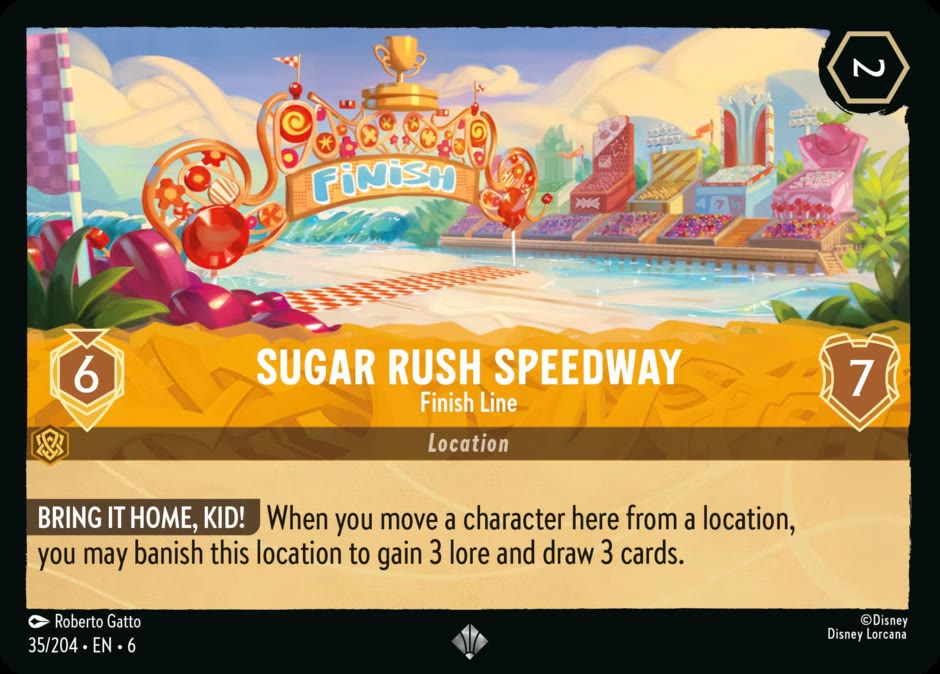
Sugar Rush Speedway - Finish Line has move cost 6, the highest in the game - and you are never supposed to pay it. When a character moves here from another location, you may banish Finish Line to gain 3 lore and draw 3 cards. The printed 6 is a puzzle, and the answer is its set-mate from one set earlier: Sugar Rush Speedway - Starting Line, move cost 0, whose ability exerts a character there and deals it 1 damage to move it to another location for free. Play both (3 ink total), walk a character onto the Starting Line for nothing, slingshot it across, and the Finish Line pays out 3 lore and 3 cards. The whole racing minigame is written in two move costs.
Carl's House - Flying High is the other move-0 location, from Attack of the Vine!: once per turn it moves a character from itself to another location for free and pays you a lore for the trip. Ring of Stones - Place of Legends inverts the discount - move 3, but your exerted characters move there free, and once per turn a character arriving pays you a lore. RLS Legacy prices itself at move 3 and then hands you a 2-ink discount while you have a character aboard. Kuzco's Palace - Home of the Emperor is move 3 with the nastiest defensive text on any location: whenever a character is challenged and banished while here, the challenger is banished too.
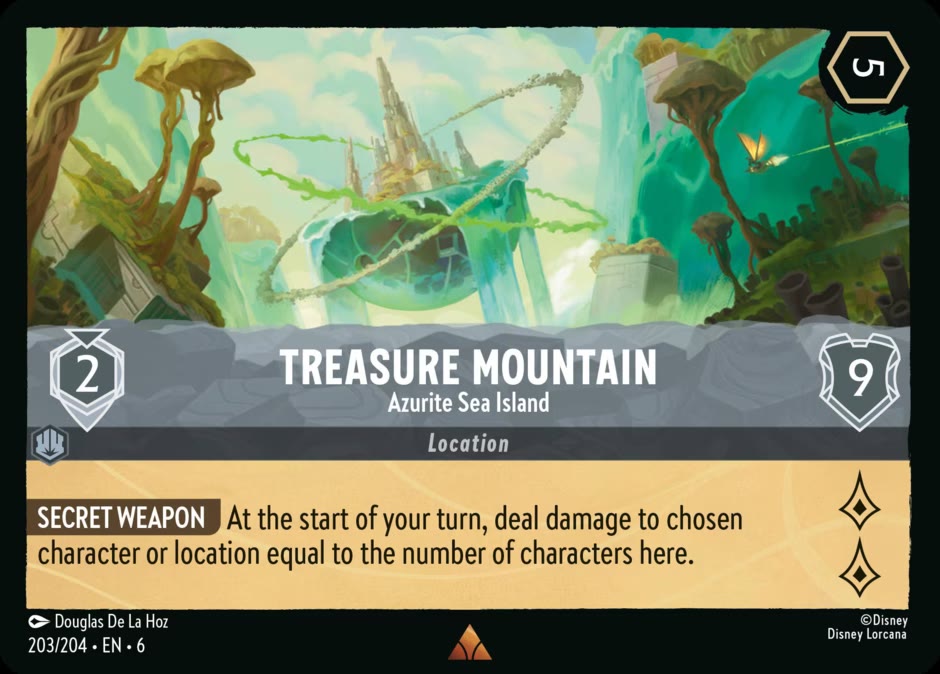
And Treasure Mountain - Azurite Sea Island is the only 5-cost location ever printed: 9 Willpower, 2 lore a turn, and a start-of-turn ability that deals damage equal to the number of characters there to any chosen character or location. It is the entire argument for the card type on one card - a scoreboard, a fortress and a machine gun, and Steel's best reason to go sightseeing.
How to actually play locations
Four takeaways, priced by how many games each one is worth.
Count your outs to a location before you shuffle up. Most removal says "chosen character" and cannot touch one. If your deck's only interaction is character-targeted, a single McDuck Manor forces you to win a race you did not agree to. Know which of your cards can challenge profitably or name a location directly - and if the answer is none, race harder. The same blind-spot logic applies to Evasive, as covered in the inks guide.
Treat passive lore as the deck's floor, not its ceiling. A 3-ink, 2-lore location pays for itself in two of your turns and is pure profit after. Control decks that stall the board still lose to a location they ignored on turn three - it is 10-plus lore over a long game for one card.
Challenge locations with your worst attacker, not your best. The location deals nothing back, so Strength is wasted on it. Send the cheap body that was not trading well anyway; keep your real threats ready so the crack-back costs your opponent something.
Move costs are real ink. A while-here aura is only as good as the fares you pay to use it. Fifty-two of 85 locations charge 1 per trip - budget for it the way you budget for song costs, or the aura ends up buffing an empty building.
The numbers here reflect the pool as of Attack of the Vine! and the rules text reflects Comprehensive Rules 2.2.0. The counts will drift a little each set - the card type is being printed again, after all - but section 5.6 has barely moved since Into the Inklands, and the last two updates only added to it. Sideways cards are here to stay.
Frequently Asked Questions
How do locations work in Disney Lorcana?
Can you challenge a location in Lorcana?
How do locations gain lore in Lorcana?
What is move cost in Disney Lorcana?
Can a character leave a location in Lorcana?
How many location cards are there in Disney Lorcana?
Do location abilities work the turn you play them?
What happens when a Lorcana location is banished with characters at it?
Keep Reading
Related Guides
Lorcana Shift Explained: Stacks, Damage and All 6 Variants
Shift is 199 cards across the 13 main sets before Hyperia City and a full page of rules, and most of that page is about the card underneath. Here is what a shifted character inherits, why 63 Core-legal cards care about the stack, where every card goes when the top one leaves play, and what each of the six variants actually lets you shift onto.
Disney Lorcana's Bag Explained: How Trigger Order Works
Six other posts on this site mention "the bag" in passing and none of them explain it. Here is the actual rule: what goes in, what never does, the exact order it resolves in when two abilities fire at once, and the two different ways a Lorcana card can make something happen later.
Disney Lorcana Uninkable Cards: All 585, and How to Ink One
The inkwell symbol is the first rule Lorcana teaches and the last one anybody puts a number on. Here is the whole uninkable pool counted off the live card data - 585 of 2,476 cards - cut by rarity, cost, type and ink, plus the Comprehensive Rules clause that lets five specific cards put an uninkable card into your inkwell anyway.
Disney Lorcana Format Coconut Explained: All 18 Beta Cards
Ravensburger put a new multiplayer format into open beta and then did not print a single card for it. The 18 Coconut cards live in the Companion app, the rules fit on one page, and the deckbuilding restrictions are stranger than the summary makes them sound. Here is the whole thing, with the card pool behind each Coconut counted.
How to Play Disney Lorcana - Rules, Turn Structure, and the Race to 20 Lore
Lorcana is the rare TCG where you never attack your opponent directly. You race them to 20 lore. This is the full rules walkthrough - inkwell, turn phases, questing, challenging, drying, card types, and deck limits.
Disney Lorcana Actions Explained: All 196, No Instant Speed
An action in Lorcana resolves the moment it is played, and the rules give your opponent no window to answer it. Here is the whole card type counted from the live pool - 196 non-song actions, what they actually do, and the handful of cards that can interfere before the fact.