Disney Lorcana Uninkable Cards: All 585, and How to Ink One
The inkwell symbol is the first rule Lorcana teaches and the last one anybody puts a number on. Here is the whole uninkable pool counted off the live card data - 585 of 2,476 cards - cut by rarity, cost, type and ink, plus the Comprehensive Rules clause that lets five specific cards put an uninkable card into your inkwell anyway.
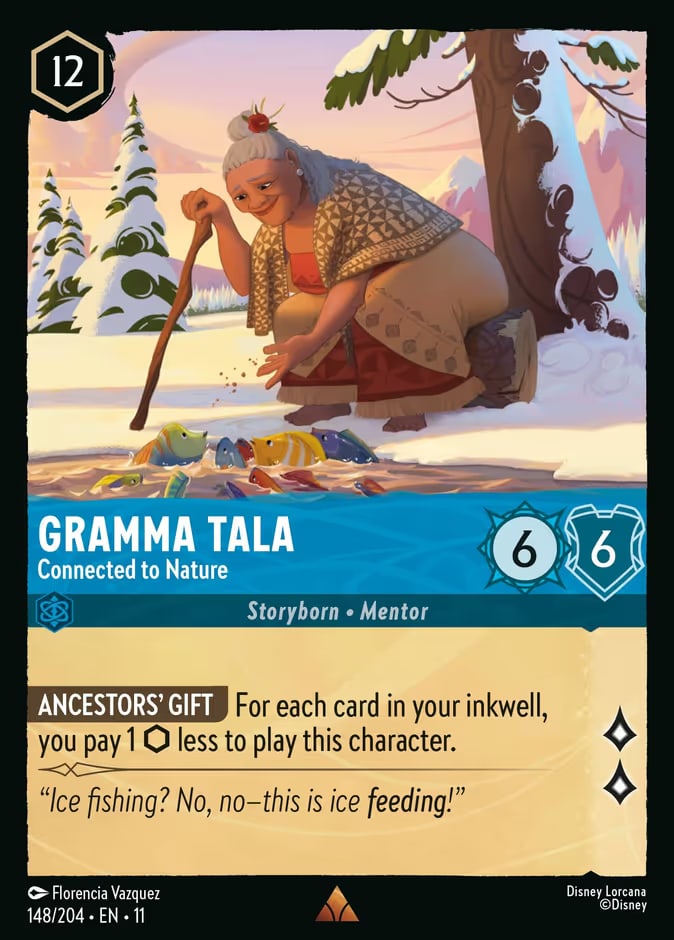
Gramma Tala - Connected to Nature costs 12 ink. That is the highest number printed on any Disney Lorcana card - checked across all 3,192 printings in the card data, nothing else even reaches 11.
Her ability, Ancestors' Gift, reads: "For each card in your inkwell, you pay 1 {I} less to play this character." She is a card that pays you for having a big inkwell, and she has no inkwell symbol - so your once-per-turn ink drop can never be her.
That is the uninkable mechanic in one card, and it is the part of Lorcana's resource system that usually goes unquantified. The rules walkthrough tells you the symbol has to be there. The beginner guide tells you to ink every turn. Neither says how much of the card pool is off-limits when you go looking for something to bury.
It is 585 cards. Here is where they are, and the rule that lets five specific cards put one into your inkwell anyway.
Everything below comes from two sources: Comprehensive Rules 2.2.0, effective 9 July 2026, and one pass over the Lorcast bulk card export pulled on 30 August 2026. Cards are deduped by full name - name plus version, apostrophes and capitalisation folded - across main sets 1 through 13, which gives 2,476 unique cards. Promos, the Challenge and D23 sets, and the app-only Format Coconut set are excluded.
The most expensive card in the game has no swirl
Gramma Tala is a Sapphire Rare from Winterspell, card 148, with a 6/6 body and 2 Lore. In practice she is not a 12-drop at all; with eight cards in your inkwell she costs 4. But the design tension is real and it is deliberate. The card that rewards a deep inkwell is a card your ink drop can never be spent on.
She is also a useful reminder that "uninkable" is not a rarity tier or a power level. She is a Rare. Thirty-eight of the game's 288 one-cost cards are uninkable too. The symbol is a lever Ravensburger pulls independently of everything else on the card, and the numbers below are the shape of how they pull it.
The tell is in the cost frame, and it is worth knowing by sight before you know it by rules text. On Gramma Tala above, the 12 sits in a plain hexagon. On an inkable card the same number sits inside a circular swirl - compare her frame to the Fishbone Quill and Belle images further down. That is the whole difference, and it is what CR 5.2.3 points at.
What the swirl is, in the actual rules
Two rules carry it.
CR 5.2.3, Inkwell Symbol: "If this swirl icon is present around the card's cost, the card can be put into its player's inkwell. Cards in an inkwell represent that player's ink. Each card counts as 1 ink."
CR 4.2.1, the ink-a-card turn action, is a three-step process:
- 4.2.1.1 - the player chooses and reveals a card from their hand with the inkwell symbol.
- 4.2.1.2 - all players verify the symbol is present on the revealed card.
- 4.2.1.3 - the card goes into the inkwell facedown and ready.
CR 4.2.3 caps that turn action at once per turn. Rule 7.5.1 adds the part that makes the whole thing work: "Nothing on the front of an ink card affects the ink it generates." A 12-cost Legendary and a 1-cost Common are both worth exactly 1 ink.
So the symbol is not a property of the card in play. It is a permission slip attached to one specific turn action. That distinction is the entire basis of the loophole further down the page, and it is why the question "can I ink this card?" has a more interesting answer than "look at the cost circle."
The census: 585 of 2,476
585 of the 2,476 unique cards in main sets 1 through 13 have no inkwell symbol. That is 23.6%, or a little under one card in four.
Read that as a deckbuilding fact rather than a trivia one. If you built a 60-card deck by drawing uniformly from the whole legal pool, roughly 14 of your cards could never be a normal ink drop - and rule 4.2.3 gives you exactly one of those per turn. Miss one on turn three and you do not get it back later: absent one of the effects in the second half of this post, the once-per-turn cap means your ink total cannot exceed the number of turns you have taken.
The distribution is not flat. Every cut below is against the same 2,476-card pool.
Rarity: the cliff is at Rare, not Legendary
| Rarity | Cards | Uninkable | Share |
|---|---|---|---|
| Common | 871 | 78 | 9.0% |
| Uncommon | 652 | 134 | 20.6% |
| Rare | 587 | 234 | 39.9% |
| Super Rare | 219 | 85 | 38.8% |
| Legendary | 147 | 54 | 36.7% |
The intuition - rarer means more strings attached - only half holds here. The jump from Common to Rare is enormous: a Common is uninkable 9.0% of the time, a Rare 39.9%. Then it stops. A Legendary is slightly less likely to be uninkable than a Rare, and Super Rare sits between them.
Enchanted, Epic and Iconic are not in the table because they are alternate printings of cards that already exist at a base rarity, which the rarity breakdown covers in full. An Enchanted card carries whatever symbol its base printing carries.
The practical version: the cheap commons that fill out your curve are also the cards you can safely bury. That is not a coincidence, it is how the format stays playable.
Card type: items are the problem child
| Card type | Cards | Uninkable | Share |
|---|---|---|---|
| Item | 205 | 82 | 40.0% |
| Song | 119 | 37 | 31.1% |
| Action (non-song) | 196 | 61 | 31.1% |
| Character | 1,871 | 390 | 20.8% |
| Location | 85 | 15 | 17.6% |
Items are uninkable at more than twice the rate of locations, and our items breakdown explains why that is the bargain for the type: items are the cheapest cards in the game on average, they work the turn they land, and nothing can attack them. The inkwell symbol is the price.
Note how neatly songs and non-song actions land on the same 31.1%. Being a song does not change your odds of being inkable at all, which is a quiet argument that Ravensburger treats the song alternate-cost rule as a separate axis from the ink one.
Characters and locations are the safe types. Four of every five characters can be buried, which is what lets a 60-card deck full of bodies function.
Cost: the climb, and the nine-drop coin flip
| Ink cost | Cards | Uninkable | Share |
|---|---|---|---|
| 1 | 288 | 38 | 13.2% |
| 2 | 542 | 107 | 19.7% |
| 3 | 554 | 126 | 22.7% |
| 4 | 454 | 120 | 26.4% |
| 5 | 294 | 83 | 28.2% |
| 6 | 180 | 49 | 27.2% |
| 7 | 99 | 33 | 33.3% |
| 8 | 38 | 14 | 36.8% |
| 9 | 19 | 9 | 47.4% |
| 10 | 7 | 5 | 71.4% |
| 12 | 1 | 1 | 100.0% |
This is the curve you would expect, and it is worth having the numbers for because the shape is steeper than it feels at the table. One-drops are uninkable 13.2% of the time; nine-drops are basically a coin flip at 47.4%.
It also sets up the specific hand you do not want. 111 cards in the game cost 6 or more and cannot be inked. Those are the cards that are dead weight in an opening hand in both directions - too expensive to cast for several turns, and unable to become the ink that would let you cast anything else. The mirror image is the 145 uninkable cards costing 1 or 2, which cost you almost nothing, because you were going to cast them on curve regardless.
Ink colour barely matters, and that is the finding
| Ink | Cards | Uninkable | Share |
|---|---|---|---|
| Ruby | 438 | 117 | 26.7% |
| Amethyst | 435 | 115 | 26.4% |
| Emerald | 437 | 106 | 24.3% |
| Steel | 435 | 102 | 23.4% |
| Amber | 435 | 97 | 22.3% |
| Sapphire | 432 | 85 | 19.7% |
Dual-ink cards are counted in both of their inks, which is why the rows total more than 2,476.
The whole spread is 7.0 percentage points from Sapphire to Ruby. Compare that to the 31-point spread between Common and Rare, or the 22-point spread between locations and items. Ink colour is the weakest of the four cuts. If you are choosing a pairing, the inkable ratio is not a reason to pick one over another - your curve and your card types decide it, not your colours.
Sapphire being the most inkable ink is at least thematically tidy given that it is Lorcana's ramp-and-card-quality colour, as our ink breakdown lays out. It is also where most of the cards that move other cards into an inkwell live, which the next-but-one section counts. The cards that pay you off for inking are a different story and are spread across all six inks - Archazia's Island printed a Coil for each one, from Amber Coil through Steel Coil, every one of them triggering "whenever a card is put into your inkwell."
Uninkable characters are smaller, not bigger
Here is the result that surprised me, and it is the reason this post exists rather than being three tables.
The natural assumption is that the inkwell symbol is a tax: the card is uninkable because it is over-statted for its cost. Test it against the 1,871 characters and the opposite is true. Average printed Strength + Willpower + Lore, by cost:
| Cost | Inkable (n) | Avg S+W+L | Uninkable (n) | Avg S+W+L | Difference |
|---|---|---|---|---|---|
| 1 | 147 | 4.39 | 20 | 3.90 | -0.49 |
| 2 | 289 | 5.38 | 56 | 5.09 | -0.29 |
| 3 | 335 | 6.96 | 68 | 6.40 | -0.56 |
| 4 | 288 | 8.24 | 90 | 7.96 | -0.28 |
| 5 | 200 | 10.43 | 69 | 9.86 | -0.57 |
| 6 | 127 | 11.87 | 40 | 11.07 | -0.80 |
| 7 | 63 | 13.84 | 26 | 12.58 | -1.26 |
| 8 | 21 | 14.81 | 10 | 14.10 | -0.71 |
| 9 | 9 | 16.78 | 7 | 15.57 | -1.21 |
| 10 | 2 | 25.00 | 3 | 23.00 | -2.00 |
At all ten cost brackets where both groups exist, the uninkable characters have the smaller average stat line, and the gap widens as costs rise. The 12-cost bracket is excluded because it holds one card and it is uninkable, so there is nothing to compare it against.
The premium is in the text box instead. Across those same 1,871 characters:
| Inkable | Uninkable | |
|---|---|---|
| Characters | 1,481 | 390 |
| Average rules text | 122 characters | 153 characters |
| Printed with no rules text at all | 255 (17.2%) | 21 (5.4%) |
An uninkable character carries about a quarter more rules text, and is roughly a third as likely to be a plain body with nothing written on it. So the trade Ravensburger is actually making is not "bigger numbers, no ink." It is "more words, no ink." Of the 276 characters printed with no rules text at all, 255 are inkable; the same body with a two-line ability is where the symbol starts disappearing.
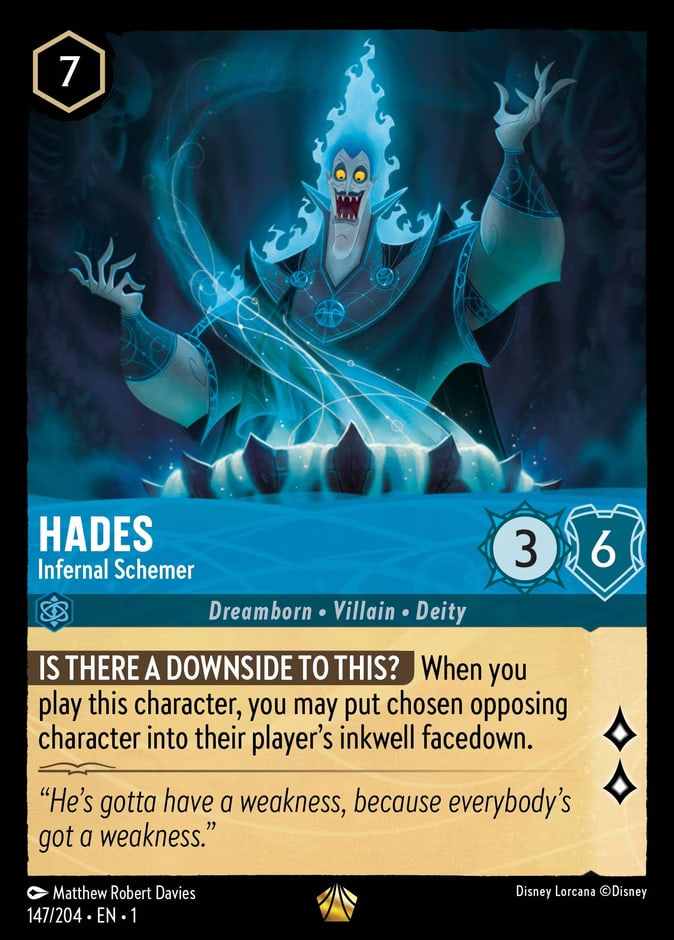
Hades - Infernal Schemer is the archetype. A 7-ink Sapphire Legendary with a modest 3/6 body, uninkable, and what you are paying the symbol for is one sentence: on play, put a chosen opposing character into their player's inkwell facedown. That is removal dressed as a resource gift - the character leaves the board and their controller gets 1 ink for it. It is close to permanent, too: across all 3,192 printings only two cards can pull anything back out of an inkwell, Mufasa - Ruler of Pride Rock and Ink Geyser, and both do it at random from the holder's own inkwell. Searching the card text for the same effect turns up sixteen cards that put a chosen character, item or location into its owner's inkwell, and all sixteen are Sapphire or a Sapphire pairing.
The five cards that ink an uninkable card
Now the part the card frame does not tell you.
Rule 4.2.1 requires the symbol, but it only governs the once-per-turn turn action. Two later rules carve out everything else:
CR 4.2.3.2: "Some effects allow a player to put a card directly into their inkwell. These effects aren't counted toward the once-per-turn limit of the turn action, and the card isn't revealed as it's put into the player's inkwell."
CR 7.5.6: "Whenever an effect puts a card from another zone into the inkwell, the card isn't revealed and isn't required to have the inkwell symbol."
That is explicit. An effect that puts a card into your inkwell does not check the swirl. The Comprehensive Rules even name the card that does it, using Fishbone Quill as the worked example for 4.2.3.2.
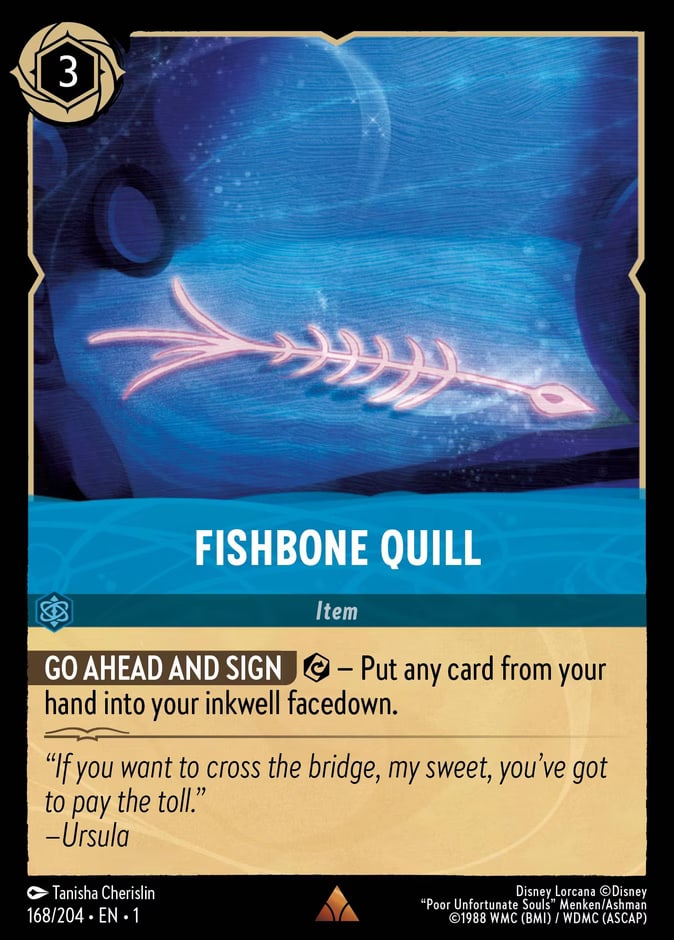
There is an important limit on this. Dozens of cards put the top card of your deck, or a card from your discard, or a character from play into an inkwell - 109 cards in main sets 1 through 13 move a card into an inkwell from somewhere, 43 of them Core-legal. None of those help the uninkable card sitting in your hand right now. For that, you need an effect that specifically moves a card from hand to inkwell, and the game has printed exactly seven:
| Card | Set | Cost | Ink | Moves from hand | Symbol required? |
|---|---|---|---|---|---|
| Fishbone Quill | 1 The First Chapter | 3 | Sapphire | Any card, repeatable | No |
| Winnie the Pooh - Having a Think | 2 Rise of the Floodborn, reprinted in 9 Fabled | 3 | Sapphire | A card, on quest | No |
| Tipo - Growing Son | 5 Shimmering Skies | 2 | Sapphire | A card, on play | No |
| Heihei - Expanded Consciousness | 7 Archazia's Island | 5 | Sapphire/Steel | All cards, on play | No |
| Cinderella - Dream Come True | 10 Whispers in the Well | 4 | Sapphire | A card, end of turn | No |
| Belle - Strange but Special | 1 The First Chapter | 4 | Sapphire | An additional card | Yes |
| Sail the Azurite Sea | 6 Azurite Sea | 2 | Sapphire | An additional card | Yes |
The last two rows are the trap, and the word doing the work is "additional." Rule 4.2.3.1 says effects allowing "additional" cards into the inkwell adjust the once-per-turn limit of the turn action - so you perform the turn action again, symbol check and all. Rule 7.5.5 spells it out: you "follow the normal steps of inking a card."
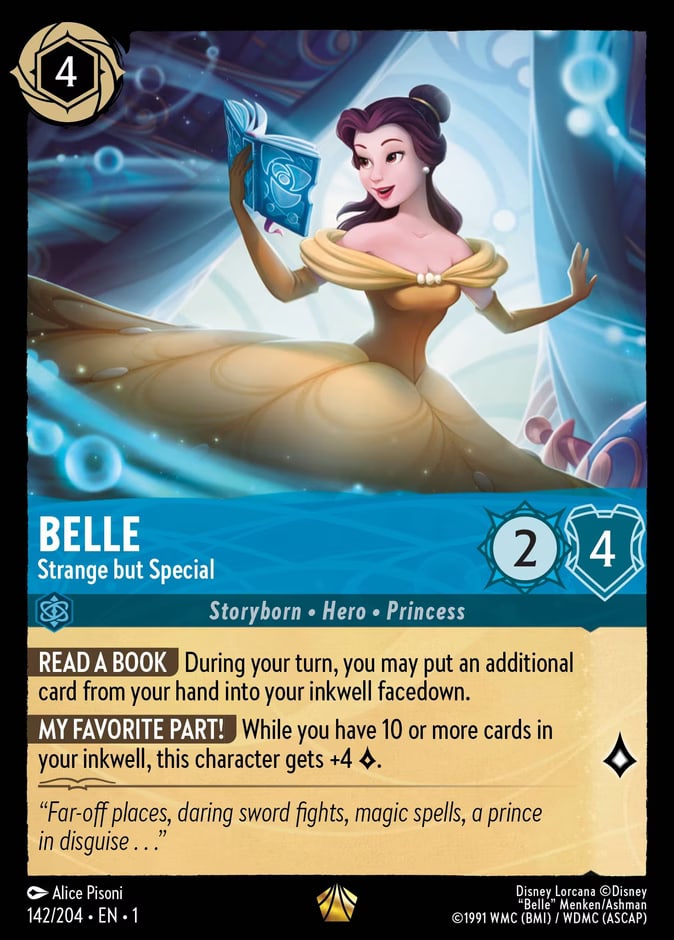
So Belle - Strange but Special gets you a second ink drop every turn and still cannot bury an uninkable card. The Comprehensive Rules use her as the worked example for 4.2.3.1, directly above the Fishbone Quill example for 4.2.3.2. Two cards, adjacent in the rulebook, doing visibly similar things, with opposite answers to the symbol question.
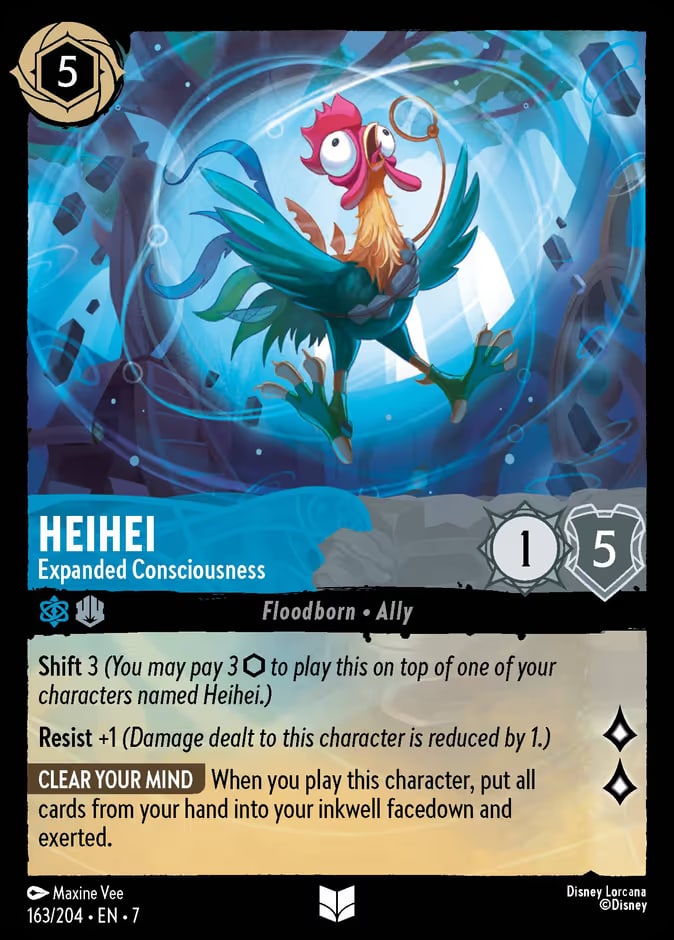
Heihei - Expanded Consciousness is the extreme version: play him and your entire hand becomes ink, facedown and exerted, symbols irrelevant. Five uninkable bombs in hand go from a dead grip to five ink. Note the "exerted" - that ink is not available until your next Ready step, so it is a next-turn payoff, not a same-turn one.
All seven cards are Sapphire or a Sapphire pairing. So is the wider pattern: of the 109 cards that move a card into an inkwell at all, 87 are Sapphire. If a deck wants to break the inkwell rules, it does it in one colour.
What rotation left you: 213 uninkable cards
Core Constructed rotated on Attack of the Vine!'s release - prerelease 17 July 2026, wide release 24 July 2026 - dropping Shimmering Skies, Azurite Sea, Archazia's Island and Reign of Jafar. Sets 9 through 13 are what remain, which is 1,024 unique cards.
213 of them are uninkable, or 20.8% - meaningfully gentler than the 23.6% across all of Lorcana's history.
| Cut | Full pool (1-13) | Core (9-13) |
|---|---|---|
| All cards uninkable | 23.6% | 20.8% |
| Commons uninkable | 9.0% | 9.2% |
| Rares uninkable | 39.9% | 32.5% |
| Items uninkable | 40.0% | 39.0% |
| Locations uninkable | 17.6% | 10.8% |
| Uninkable cards costing 6+ | 111 | 30 |
Two things moved. Rares got noticeably friendlier - the 39.9% lifetime figure drops to 32.5% in Core - and the expensive dead-weight bucket shrank hard, from 111 cards to 30. The Core-legal locations are the standouts at 10.8%: only four of the 37 cannot be inked.
Of the seven hand-to-inkwell cards above, two are Core-legal, and it is worth watching how one of them got there. Cinderella - Dream Come True is a Whispers in the Well card, straightforwardly in. Winnie the Pooh - Having a Think is a Rise of the Floodborn card whose set rotated out - but it was reprinted in Fabled, set 9, which puts it back in the Core pool. Fabled is a reprint set, and checking a card's first printing rather than all of its printings is the easiest way to get a Core legality call wrong.
Fishbone Quill, Belle - Strange but Special, Tipo - Growing Son, Heihei - Expanded Consciousness and Sail the Azurite Sea are Infinity Constructed cards now. Both of the survivors happen to be symbol-bypass effects, so in the current rotating format every way to move a card from hand to inkwell beyond your one turn action ignores the swirl - you are just doing it one card at a time, either on a quest trigger or at the end of a turn in which you played a Princess.
Quick Action Checklist
- Assume about one card in four is uninkable when you are eyeballing a pool - 585 of 2,476 lifetime, 213 of 1,024 in Core.
- Count your 6-plus-cost uninkable cards before anything else. Those are the cards that are dead on both axes in an opening hand; there are 111 of them in the game and 30 in Core.
- Do not pick a pairing for its inkable ratio. The whole spread across the six inks is 7 percentage points, against 31 across rarities.
- Expect your items to be the tight spot. Items are uninkable 40.0% of the time, more than double locations at 17.6%.
- Read the word "additional". Belle - Strange but Special and Sail the Azurite Sea both re-run the turn action under CR 4.2.3.1, so the symbol is still checked.
- Everything else that moves a card to an inkwell ignores the symbol. CR 7.5.6 says a card put in from another zone "isn't required to have the inkwell symbol."
- If you are hoarding uninkable cards, you are hoarding them in Sapphire. 87 of the 109 inkwell-moving cards, and all seven hand-to-inkwell effects, are Sapphire or a Sapphire pairing.
Counts reflect the card pool as of Attack of the Vine!, pulled 30 August 2026, and rule numbers reflect Comprehensive Rules 2.2.0, effective 9 July 2026. One methodology note if you want to reproduce these: the Lorcast export's legalities field is not reliable for the Core cut - filter by set code instead. The inkwell flag itself is solid, and worth saying so: across all 3,192 printings, no card in the export disagrees with itself between printings, so a reprint never gains or loses the symbol.
Frequently Asked Questions
How many Disney Lorcana cards are uninkable?
What does the swirl around the cost mean in Disney Lorcana?
Can you put an uninkable card into your inkwell in Lorcana?
Does Belle - Strange but Special let you ink an uninkable card?
Which Lorcana card type is hardest to ink?
Are rarer Lorcana cards more likely to be uninkable?
Keep Reading
- Disney Lorcana Comprehensive Rules 2.2.0, effective July 9, 2026 (Ravensburger)
- Lorcast bulk card export - the card pool counted in this post
- Lorcast set list - set codes and release dates used for the census
- Disney Lorcana official resources - where Comprehensive Rules 2.2.0 is published (Ravensburger)
- Lorcana Rotation 2026: Every Set Leaving Core Constructed July 24 (InkSight)
Related Guides
Lorcana Shift Explained: Stacks, Damage and All 6 Variants
Shift is 199 cards and a full page of rules, and most of that page is about the card underneath. Here is what a shifted character inherits, why 63 Core-legal cards care about the stack, where every card goes when the top one leaves play, and what each of the six variants actually lets you shift onto.
Disney Lorcana's Bag Explained: How Trigger Order Works
Six other posts on this site mention "the bag" in passing and none of them explain it. Here is the actual rule: what goes in, what never does, the exact order it resolves in when two abilities fire at once, and the two different ways a Lorcana card can make something happen later.
Disney Lorcana Format Coconut Explained: All 18 Beta Cards
Ravensburger put a new multiplayer format into open beta and then did not print a single card for it. The 18 Coconut cards live in the Companion app, the rules fit on one page, and the deckbuilding restrictions are stranger than the summary makes them sound. Here is the whole thing, with the card pool behind each Coconut counted.
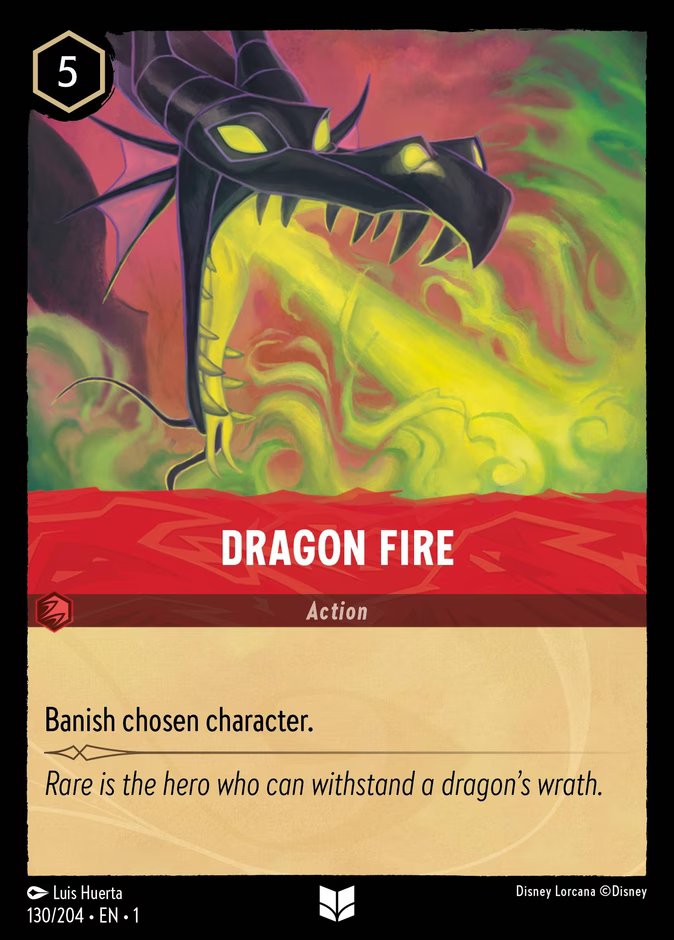
Disney Lorcana Actions Explained: All 196, No Instant Speed
An action in Lorcana resolves the moment it is played, and the rules give your opponent no window to answer it. Here is the whole card type counted from the live pool - 196 non-song actions, what they actually do, and the handful of cards that can interfere before the fact.
How to Play Disney Lorcana - Rules, Turn Structure, and the Race to 20 Lore
Lorcana is the rare TCG where you never attack your opponent directly. You race them to 20 lore. This is the full rules walkthrough - inkwell, turn phases, questing, challenging, drying, card types, and deck limits - with nothing invented and everything checked against Ravensburger's comprehensive rules.
Disney Lorcana Character Classifications Explained: All 47, and Why Storyborn Does Nothing
Rule 5.3.3.2 lists 47 classifications, and a card needs one of them to legally be a character at all. Then you count the card pool and find that the two most common words on the type - Storyborn and Dreamborn, 1,688 characters between them - are referenced by exactly zero cards.