Disney Lorcana Format Coconut Explained: All 18 Beta Cards
Ravensburger put a new multiplayer format into open beta and then did not print a single card for it. The 18 Coconut cards live in the Companion app, the rules fit on one page, and the deckbuilding restrictions are stranger than the summary makes them sound. Here is the whole thing, with the card pool behind each Coconut counted.
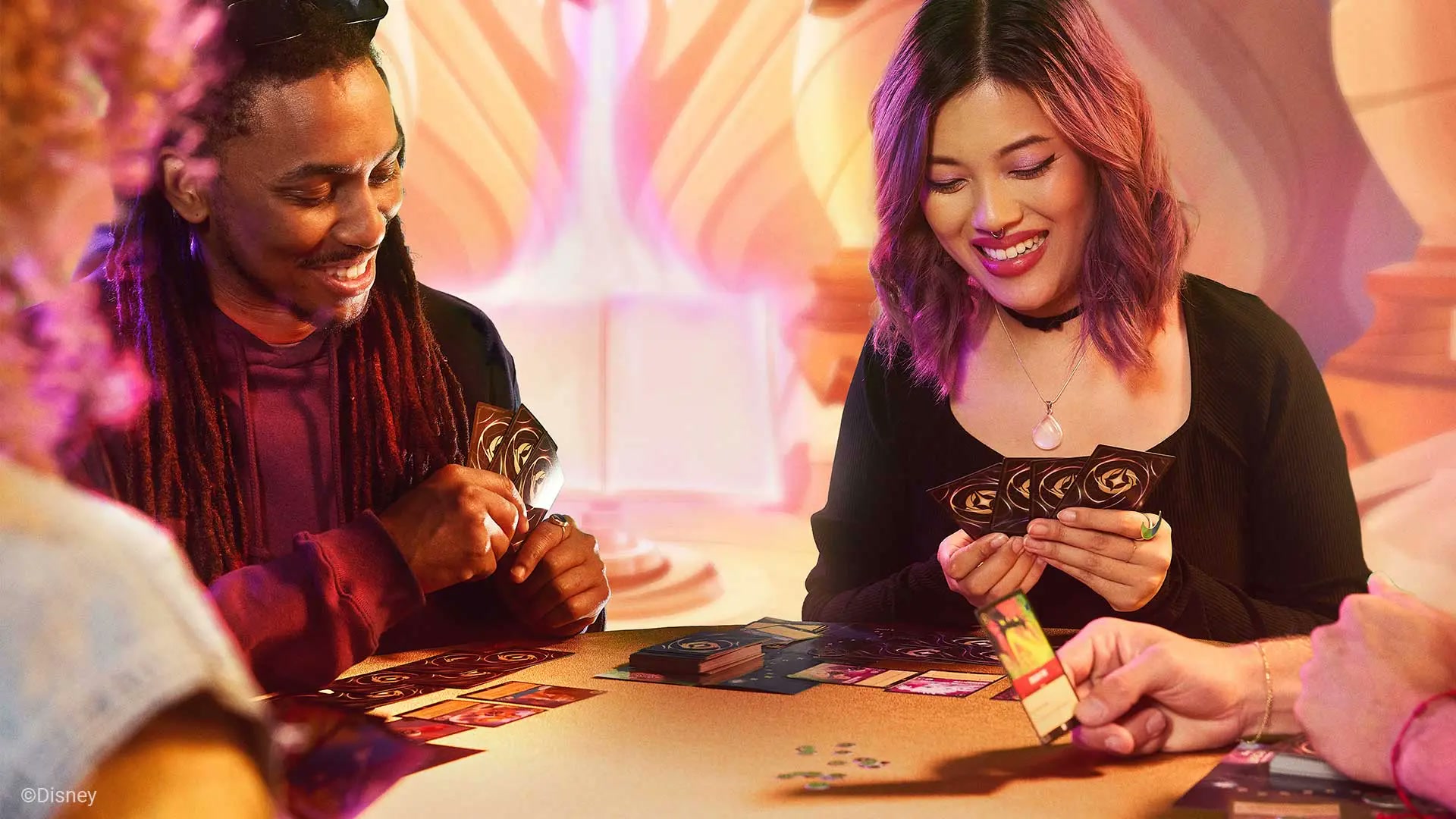
Ravensburger announced a new Disney Lorcana format, published its rules, published its card list, and printed exactly none of the cards. The 18 Coconut cards exist on a screen - the Companion app and a pair of official PDFs - and nowhere in print, and Ravensburger's own announcement puts a physical run in the "someday" column: "Someday we might even get physical copies of [Coconut] cards into your hands."
That is not a hedge about a delayed product. It is the format working as designed. Format Coconut is an open beta, the card texts are explicitly still being tuned, and the delivery mechanism is a phone screen so they can be changed. Everything below comes from Ravensburger's announcement, the one-page beta rules PDF, the official beta card list PDF, Comprehensive Rules 2.2.0 (effective 9 July 2026), and one pass over the Lorcast bulk card export pulled on 23 August 2026 - 2,476 unique cards from 3,192 printings, deduped by full name with apostrophes and capitalisation folded, of which 1,871 are characters.
The whole format fits on one page
The beta rules document is four bullets and one exception. Here is every difference from a normal constructed deck:
| Rule | Standard constructed | Format Coconut |
|---|---|---|
| Deck size | At least 60 cards | At least 60 cards |
| Ink types | Up to 2 | Up to 3, one of which must match your Coconut card's ink |
| Copies of a card | Up to 4 of any full name | 1 of everything, except up to 4 of your Coconut card's associated card |
| Win condition | First to 20 lore | First to 25 lore |
| Players | 2 | 3 or 4 recommended |
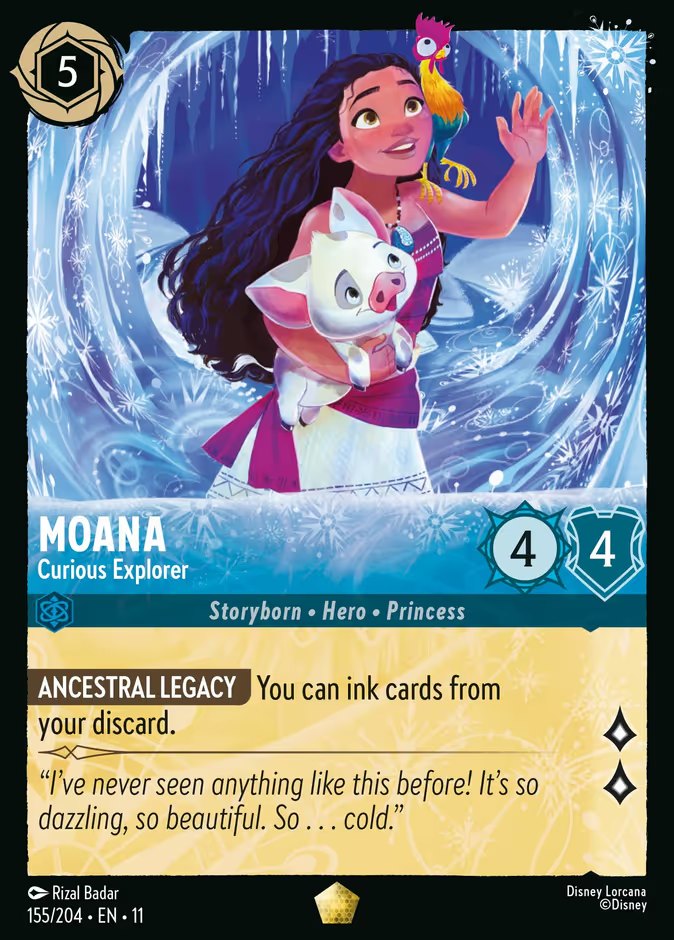
The rules PDF's own worked example is Moana: choose the Sapphire Coconut card Moana - Curious Explorer, and your deck must include Sapphire, may include up to two other inks, may run 4 copies of the Moana - Curious Explorer character card, and no more than 1 copy of anything else.
Two things that summary hides. The third ink is not free - it is granted by the Coconut card, which is why one of your three has to match it. And the beta document's wording is "no more than 1 copy of any other card" - with Lorcana's glossary defining a character's full name as its name plus its version, the same unit the standard 4-copy limit already works on. Read that way, Sisu - Emboldened Warrior and Sisu - Daring Visitor are two different cards, both Ruby, and a Sisu deck may run one of each.
The lore change is the one that reshapes games. Comprehensive Rules 1.8.1.1 makes 20 lore a game state check, something the game tests constantly rather than at a fixed moment. Coconut moves the number to 25 and adds two more players to the table, which stretches every game long enough that the rest of section 9 stops being trivia.
You cannot buy a Coconut card
The beta rules PDF opens with the instruction, not a suggestion: "First, use the app to choose a [Coconut] card." The announcement says the same thing from the other direction - from 28 July 2026 the Format Coconut card list lives in the Disney Lorcana TCG Companion app, described as a way to check the current Coconut cards and reference their abilities.
So there is no booster to crack, no promo to chase, no secondary market to price. If you want to know what the Coconut cards do, you open the app or you read the official PDF. That is a departure for a game otherwise made of printed cardboard, and the reason is not hard to see: a digital card can be rewritten on Thursday. Ravensburger says outright that as feedback comes in, "we'll continue to adjust the current [Coconut] cards."
The official card list gives each Coconut card exactly three things: a name, an ink, and its text. No cost, no Strength, no Willpower, no Lore value. The Lorcast database records all 18 as zero-cost, uninkable, Promo-rarity entries with no Strength, Willpower or Lore printed - which is a database's way of saying the same thing the PDF says by omission. A Coconut card is not a body you play; it is the rule your deck is built under.
All 18 Coconut cards
Three per ink, six inks. Text as published in Ravensburger's beta card list.
| Coconut card | Ink | What it does |
|---|---|---|
| Ariel - "Spectacular Singer" | Amber | Whenever a Princess character of yours sings a song, gain lore equal to her Lore value. |
| Pocahontas - "Peacekeeper" | Amber | Once during your turn, choose a character: until the start of your next turn they get +1 Lore, can't challenge, and must quest if able. |
| Stitch - "Rock Star" | Amber | Once during your turn, play a character costing 2 or less from hand for free - from your discard instead if you have a Stitch in play. |
| Dumbo - "Ninth Wonder of the Universe" | Amethyst | You may use the exert abilities of your characters the turn they're played. |
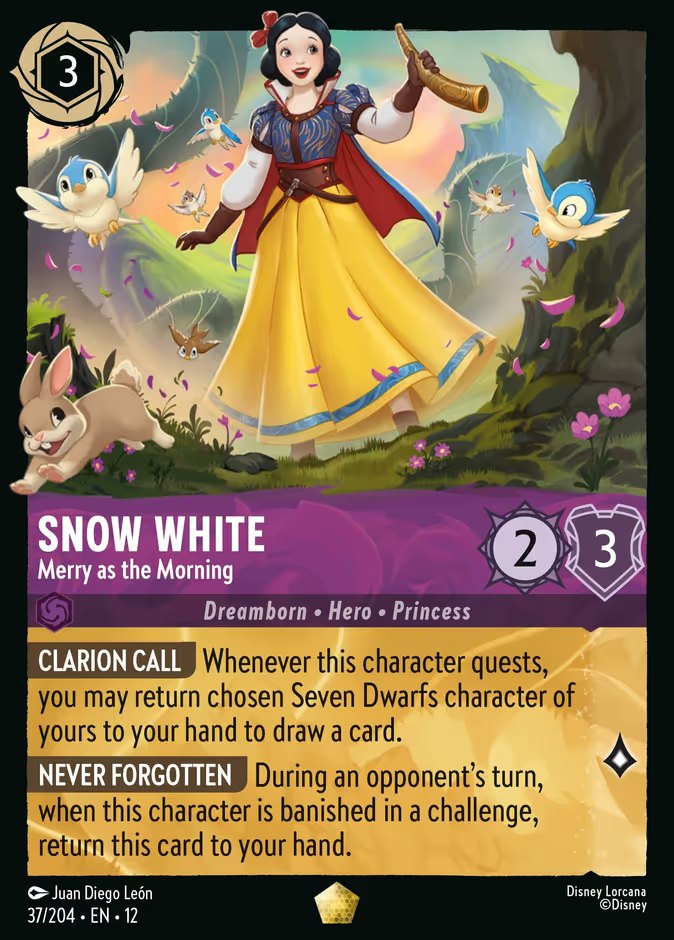
| Snow White - "Merry as the Morning" | Amethyst | Once per game, reveal your hand: with a Snow White and 7+ differently named Seven Dwarfs across hand, discard and play, your characters get +2 Lore for the rest of the game. |
| Winnie the Pooh - "Hunny Wizard" | Amethyst | Whenever you play a character without an ability, you may pay 1 ink to draw a card. |
| Donald Duck - "Fred Honeywell" | Emerald | You pay 1 ink less to use Boost abilities. |
| Robin Hood - "Sneaky Sleuth" | Emerald | Once per game during your turn, deal 1 damage to each opposing character. |
| Ursula - "Deceiver of All" | Emerald | Your characters count as +1 cost for singing songs; your Ursulas count as +2 instead. |
| Mickey Mouse - "Brave Little Tailor" | Ruby | Mickey Mouse character cards in your hand, deck and discard gain Shift 2. |
| Mr. Incredible - "Super Strong" | Ruby | Whenever you play a Super character, they gain Rush this turn and you may exert a chosen opposing character with less Strength. |
| Sisu - "Emboldened Warrior" | Ruby | All characters with more Strength than each opposing character can quest the turn they're played. |
| Moana - "Curious Explorer" | Sapphire | During your turn, with a Moana, Heihei or Pua in play, you may ink an additional card. |
| Mufasa - "Ruler of Pride Rock" | Sapphire | Once per game during your turn, pay 5 ink to put the top 3 cards of your deck into your inkwell facedown and exerted. |
| Nick Wilde - "Wily Fox" | Sapphire | You may run up to 4 Pawpsicle. Once during your turn, banish 4 of your items to gain 4 lore. |
| John Silver - "Greedy Treasure Seeker" | Steel | Each of your locations gains Resist +1 for each character there. |
| Scar - "Finally King" | Steel | During your turn, you pay 1 ink less for the first Ally character you play. |
| Tinker Bell - "Giant Fairy" | Steel | Whenever one of your other abilities or actions deals damage to an opposing character, deal 1 damage to that character. |
Note the quotation marks. Every Coconut card's version is printed in quotes - Ariel - "Spectacular Singer" - which is how the beta card is distinguished on paper from Ariel - Spectacular Singer, the actual character card it points at. Same name, different object.
The 4-of is the expensive part
Your Coconut card is free. The card it unlocks is not, and the beta's selection leans hard on the top of the rarity ladder.
| Coconut card | 4-of it unlocks | Cost | Ink | Rarity | First printed | Core-legal printing? |
|---|---|---|---|---|---|---|
| Ariel - "Spectacular Singer" | Ariel - Spectacular Singer | 3 | Amber | Super Rare | The First Chapter | No |
| Pocahontas - "Peacekeeper" | Pocahontas - Peacekeeper | 5 | Amber | Legendary | Winterspell | Yes |
| Stitch - "Rock Star" | Stitch - Rock Star | 6 | Amber | Super Rare | The First Chapter | Yes (Fabled) |
| Dumbo - "Ninth Wonder..." | Dumbo - Ninth Wonder of the Universe | 4 | Amethyst | Legendary | Fabled | Yes |
| Snow White - "Merry as the Morning" | Snow White - Merry as the Morning | 3 | Amethyst | Legendary | Wilds Unknown | Yes |
| Winnie the Pooh - "Hunny Wizard" | Winnie the Pooh - Hunny Wizard | 5 | Amethyst | Common | Rise of the Floodborn | Yes (Fabled) |
| Donald Duck - "Fred Honeywell" | Donald Duck - Fred Honeywell | 4 | Emerald | Legendary | Winterspell | Yes |
| Robin Hood - "Sneaky Sleuth" | Robin Hood - Sneaky Sleuth | 5 | Emerald | Uncommon | Shimmering Skies | No |
| Ursula - "Deceiver of All" | Ursula - Deceiver of All | 3 | Emerald | Legendary | Into the Inklands | No |
| Mickey Mouse - "Brave Little Tailor" | Mickey Mouse - Brave Little Tailor | 8 | Ruby | Legendary | The First Chapter | No |
| Mr. Incredible - "Super Strong" | Mr. Incredible - Super Strong | 5 | Ruby | Legendary | Wilds Unknown | Yes |
| Sisu - "Emboldened Warrior" | Sisu - Emboldened Warrior | 3 | Ruby | Rare | Ursula's Return | Yes (Fabled) |
| Moana - "Curious Explorer" | Moana - Curious Explorer | 5 | Sapphire | Legendary | Winterspell | Yes |
| Mufasa - "Ruler of Pride Rock" | Mufasa - Ruler of Pride Rock | 8 | Sapphire | Legendary | Shimmering Skies | No |
| Nick Wilde - "Wily Fox" | Nick Wilde - Wily Fox | 4 | Sapphire | Uncommon | Rise of the Floodborn | No |
| John Silver - "Greedy Treasure Seeker" | John Silver - Greedy Treasure Seeker | 3 | Steel | Rare | Into the Inklands | Yes (Fabled) |
| Scar - "Finally King" | Scar - Finally King | 5 | Steel | Legendary | Fabled | Yes |
| Tinker Bell - "Giant Fairy" | Tinker Bell - Giant Fairy | 6 | Steel | Super Rare | The First Chapter | Yes (Fabled) |
Count the rarity column and 13 of the 18 sit at Super Rare or above - 10 Legendary, 3 Super Rare - against one Common, two Uncommons and two Rares. The single non-singleton slot in the format is the one that asks you for four copies of a Legendary.
Count the last column and 6 of the 18 spotlighted characters have no printing in a Core Constructed set - Ariel, Robin Hood, Ursula, Mickey Mouse, Mufasa and Nick Wilde all live in sets that have rotated out of Core Constructed, in two different waves: Robin Hood and Mufasa left with Shimmering Skies in the July 2026 rotation, while Ariel and Mickey Mouse (The First Chapter), Nick Wilde (Rise of the Floodborn) and Ursula (Into the Inklands) went a year earlier, when Fabled dropped the Year One block. Ravensburger's own rotation explainer puts the current line at "cards from Fabled and onward," plus anything reprinted into Fabled or later. The beta rules document never mentions set legality, rotation or bans at all, and that column is the practical evidence for how to read the silence: this is not a Core-legal format.
Two of the 18 are uninkable - Mufasa - Ruler of Pride Rock and Scar - Finally King - which matters more here than usual, because in a singleton deck you cannot smooth a bad ink draw by running a second copy of anything.
How big a pool each Coconut is asking for
This is the number that actually decides which Coconut you pick, and it is not on the card - you have to count the pool to get it. In a singleton deck the size of a tribe is the size of your deck - you cannot run four Supers, you run each Super once.
Counted across all 2,476 unique cards through Attack of the Vine!:
| Coconut card | What its ability keys off | Cards in the pool |
|---|---|---|
| Scar - "Finally King" | Ally characters | 660 |
| Stitch - "Rock Star" | Characters costing 2 or less | 512 |
| Winnie the Pooh - "Hunny Wizard" | Characters with no ability text | 276 |
| Nick Wilde - "Wily Fox" | Items (to banish 4 of) | 205 |
| Ariel - "Spectacular Singer" | Princess characters / songs | 146 / 119 |
| Ursula - "Deceiver of All" | Songs | 119 |
| Tinker Bell - "Giant Fairy" | Cards whose text deals damage | 110 |
| John Silver - "Greedy Treasure Seeker" | Locations | 85 |
| Dumbo - "Ninth Wonder..." | Characters with an exert-cost ability | 61 |
| Mr. Incredible - "Super Strong" | Super characters | 42 |
| Donald Duck - "Fred Honeywell" | Cards with a Boost ability | 32 |
| Mickey Mouse - "Brave Little Tailor" | Mickey Mouse character cards | 29 |
| Moana - "Curious Explorer" | Moana, Heihei and Pua characters | 22 |
| Snow White - "Merry as the Morning" | Seven Dwarfs names | 7 (across 21 cards) |
| Nick Wilde - "Wily Fox" | Pawpsicle printings | 1 |
Four of the 18 - Pocahontas, Robin Hood, Sisu and Mufasa - key off nothing in particular. Their abilities work on any character or on your ink, so their pool is the whole format and they are the closest thing the beta has to a starting point for a deck with no theme.
The spread from 660 down to 7 is the real story here. Scar's Ally discount applies to 660 of the game's 1,871 characters, 35% of the type. Snow White's payoff needs seven specific names.
Three inks, and where the math bites
The third ink slot sounds like pure upside until you check where the cards you want actually are. Three cases where the count decides your build:
Donald Duck - Fred Honeywell is Emerald, and Boost is not. Boost appears on 32 cards in the entire game - 31 characters and one location - and every one of them was printed in Whispers in the Well (18) or Winterspell (14). Split by ink, that is Ruby 8, Sapphire 7, Amethyst 5, and then Amber, Emerald and Steel with 4 apiece (dual-ink cards count in both of their inks). Donald's own Emerald is tied for the thinnest Boost ink in the game. Take Ruby and Sapphire as your other two and you get to 19 of the 32; take anything else and the Coconut card is discounting a mechanic your deck barely contains. Comprehensive Rules 8.4.1 defines Boost N as "Once during your turn, you may pay N to put the top card of your deck facedown under this card," so 1 ink off is a real discount - it just needs cards to discount.
Snow White is the opposite problem, and it solves itself. Her ability needs 7+ differently named Seven Dwarfs characters across hand, discard and play, and there are exactly seven Seven Dwarfs names in Lorcana: Bashful, Doc, Dopey, Grumpy, Happy, Sleepy and Sneezy. Twenty-one cards carry the classification, and they are distributed with suspicious tidiness - every one of the seven names has exactly one Amber printing, one Amethyst printing and one Steel printing. Snow White's Coconut card is Amethyst, so the mandatory ink alone gives you all seven names, for 28 ink in total costs. The Steel set of seven is the cheapest at 19 ink; the Amber set costs 23.
Mickey Mouse - Brave Little Tailor is a Shift engine that needs bodies. His Coconut grants Shift 2 to Mickey Mouse character cards in your hand, deck and discard. There are 29 unique Mickey Mouse characters in the game, and only 5 of them have Shift printed on the card, so the Coconut is handing 24 more characters an alternate cost they never had. Comprehensive Rules 8.10.1 defines Shift as playing a character for its Shift cost and putting it on top of another character you have in play with the same name - and every Mickey shares a name with every other Mickey. The catch is ink: the 29 Mickeys are spread Steel 9, Amber 6, Ruby 5, Sapphire 4, Emerald 3, Amethyst 2. His Coconut card is Ruby, so Ruby plus Steel plus Amber reaches 20 of the 29 and any other trio reaches fewer.
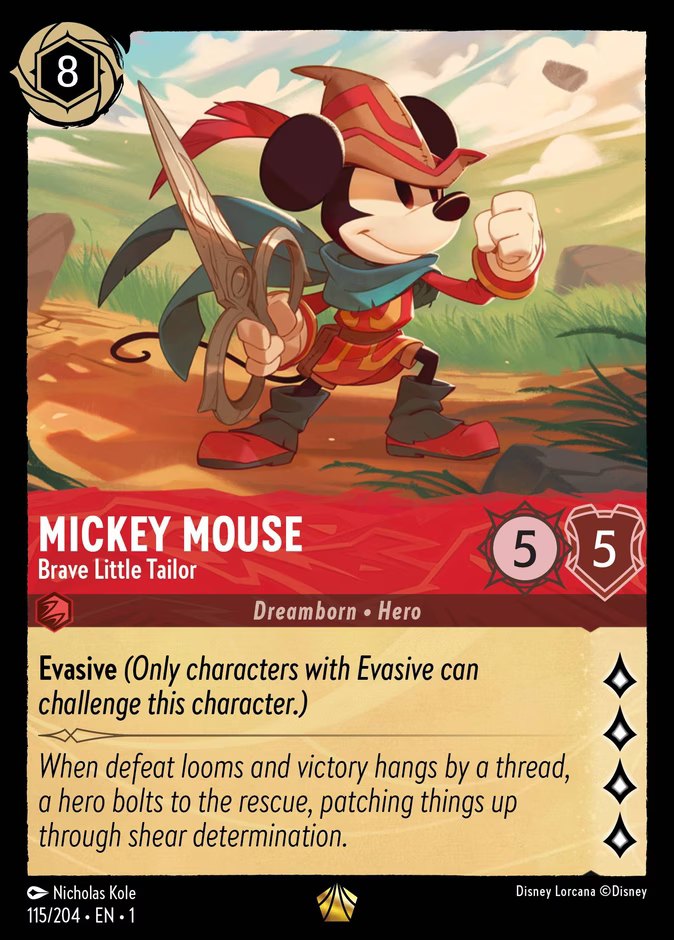
That last one is also the clearest illustration of why the 4-of matters. Brave Little Tailor costs 8 ink. Shift 2 turns him into a 2-ink 5/5/4 with Evasive, provided a Mickey is already down - and you are allowed four copies of the card, in a format where everything else is a singleton.
Nick Wilde unlocks two cards, not one
Read all 18 texts and one of them does something none of the others do. Nick Wilde - "Wily Fox" reads:
(You can have up to 4 copies of Nick Wilde - Wily Fox in your deck.)
You can have up to 4 copies of an item card named Pawpsicle in your deck.
Once during your turn, you may banish 4 of your items. If you do, gain 4 lore.
That is the only Coconut card in the beta 18 that lifts the singleton rule off a second card name. It has to, because the math does not work otherwise: the ability wants you to banish four items in a turn, and Pawpsicle exists in exactly one printing - a 1-ink Sapphire Common from Rise of the Floodborn.
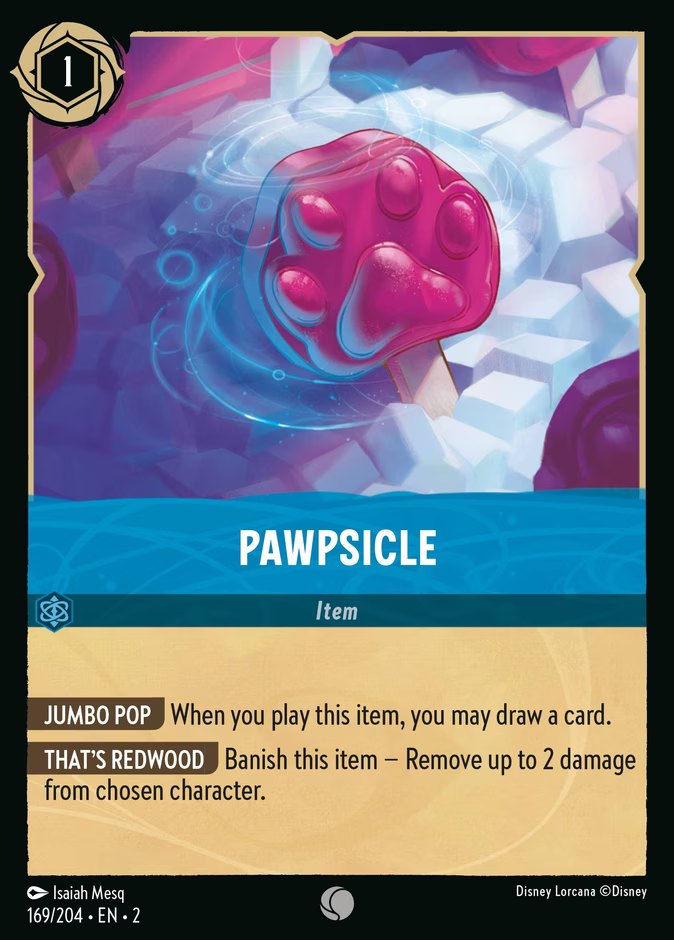
The pieces line up neatly. Pawpsicle draws a card when played and can banish itself to remove damage. Nick Wilde - Wily Fox, the character card, returns a Pawpsicle from your discard to your hand when he enters play. Four Nicks and four Pawpsicles is eight of your sixty slots doing one thing, and the game's whole item pool is 205 cards, one copy each, so filling out to four banishes a turn is a deckbuilding exercise rather than a combo hunt.
The multiplayer rules you inherit
Format Coconut changes one thing about gameplay - 25 lore instead of 20 - and inherits everything else from Comprehensive Rules section 9, which runs to barely a page and never applies at a two-player table. In a 3-4 player game:
- Turn order goes left. Rule 9.2.1: at the end of each player's turn, play proceeds to the player on their left rather than back and forth.
- Simultaneous choices resolve active player first, then left. Rule 9.2.2. This is the one that matters for "each player" effects like Robin Hood's once-per-game sweep.
- "Opponent" means everyone else. Rule 1.3.5.1: in a multiplayer game a player has multiple opponents, and rule 1.3.5.2 says an effect referencing an opponent means any player other than the one who generated it. A card that taxes "opponents" now taxes two or three people.
- Decking out removes you mid-game. Rule 9.2.3: a player who loses by ending their turn with no cards in their deck leaves immediately, their cards and any unresolved triggers of theirs are removed from the bag, but static effects they generated with a stated duration keep running until that duration ends.
- Last player standing wins. Rule 1.8.1.3 is written for multiplayer specifically - "in a multiplayer game, if a player is the last player remaining in the game, that player wins" - so it is a win condition that does not exist at a two-player table.
Worth getting the deck-out rule exactly right, because it is easy to state wrongly: rules 1.8.1.2 and 2.3.3.2 both say you lose if your turn ends with no cards in your deck. Not on a failed draw - at the end of the turn. A 60-card singleton deck, an extra opponent or two and a win condition five lore further away all push a game toward that check rather than away from it.
What beta actually means here
Ravensburger has been unusually specific about the beta's machinery. The announcement names four channels:
| Channel | What it is |
|---|---|
| Companion app | The Coconut card list and abilities, live since 28 July 2026, plus a lore counter |
| Discord | A dedicated Format Coconut channel where, per Ravensburger, a new in-development Coconut card is posted each week for testing |
| Survey | An official feedback form for anyone who has played (US residents only) |
| Weekly Lorecast | Thursdays at 10 a.m. PT on the official Twitch channel, with beta updates |
Two consequences for anyone treating this post as a reference. First, the 18 above are the app's current list, and Ravensburger says more cards are already in development and that existing ones will be adjusted as feedback arrives - so a Coconut card's text is a snapshot, not a printing. Second, on Ravensburger's stated weekly cadence the pool under test is wider than these 18, in a place that is not the official card list - which, four weeks after launch, still stands at exactly these 18.
The next scheduled in-person test is at gamescom in Cologne, 26-30 August 2026, where Ravensburger says it will run two Format Coconut tables with pre-constructed decks or your own, with designers present to explain the format and take feedback. That is after this post goes up, so nothing about how it went is knowable yet. The first in-person beta events open to the public ran at Gen Con at the end of July - Ravensburger says the format had been tested in China and at Disney Lorcana Challenge Indianapolis before that, behind closed doors - and we covered them alongside the rest of the show.
Quick Coconut Checklist
- Open the app first. The Coconut card is not a card you own; rule one of the beta document is "use the app to choose a [Coconut] card."
- 60+ cards, up to 3 inks, one matching your Coconut. Everything is a singleton except up to 4 copies of the one associated card.
- Play to 25, not 20. Everything else follows Comprehensive Rules 2.2.0, including section 9's multiplayer rules.
- Pick your Coconut by pool size, not by picture. Scar reaches 660 Ally characters; Snow White needs seven specific dwarf names; Donald's Boost pool is 32 cards in two sets.
- Check where your tribe's ink is before locking three inks. Mickey's 29 bodies and Boost's 32 cards are both distributed unevenly enough to decide two of your three ink slots.
- Nick Wilde is the only Coconut that unlocks a second name. Four Pawpsicle, and Pawpsicle has exactly one printing.
- Expect the list to move. New Coconut cards are posted weekly in Discord and existing texts are explicitly subject to change.
Card counts here reflect the pool through Attack of the Vine!, deduped by full name as stated at the top; format rules and card texts reflect Ravensburger's beta PDFs and announcement as published, and general rules citations are to Comprehensive Rules 2.2.0. Two methodology notes for anyone reproducing the numbers. For the Boost figure, count it from rules text, because the Lorcast export's keywords array tags Boost on the 14 Winterspell cards and none of the 18 from Whispers in the Well. For the Moana pool, fold capitalisation before you match names: Lorcast prints the same rooster as HeiHei in four sets and Heihei in five, and matching the string exactly costs you four of the 22 bodies that turn Moana's extra ink on.
Frequently Asked Questions
What is Format Coconut in Disney Lorcana?
Can you buy Format Coconut cards?
How many Coconut cards are there in Lorcana?
How many ink types can a Format Coconut deck use?
Is Format Coconut a singleton format?
What is the win condition in Format Coconut?
Which Coconut card has the biggest card pool to build from?
Keep Reading
- New Multiplayer Format Open Beta - the Format Coconut announcement (Ravensburger)
- Rules for [Format Coconut] Beta (Ravensburger)
- Beta [Coconut] Cards - the official 18-card list (Ravensburger)
- Disney Lorcana Comprehensive Rules 2.2.0, effective July 9, 2026 (Ravensburger)
- Everything You Need to Know About Rotation as a New Player - Core Constructed is Fabled onward (Ravensburger)
- Lorcast bulk card export - the card pool counted in this post
- Lorcast set list - set codes and release dates
Related Guides
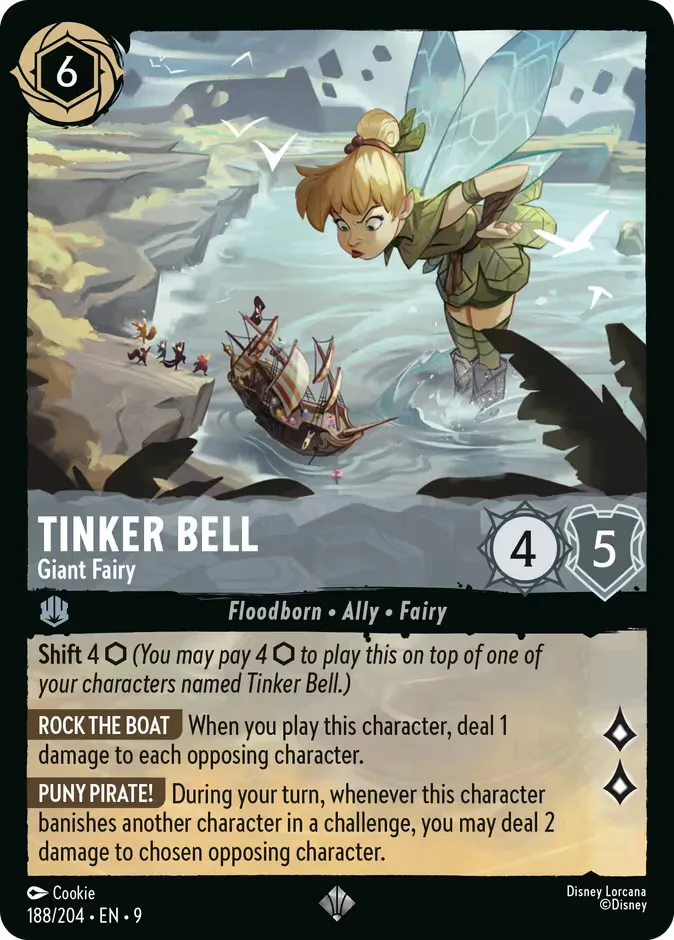
Lorcana Shift Explained: Stacks, Damage and All 6 Variants
Shift is 199 cards across the 13 main sets before Hyperia City and a full page of rules, and most of that page is about the card underneath. Here is what a shifted character inherits, why 63 Core-legal cards care about the stack, where every card goes when the top one leaves play, and what each of the six variants actually lets you shift onto.
Disney Lorcana's Bag Explained: How Trigger Order Works
Six other posts on this site mention "the bag" in passing and none of them explain it. Here is the actual rule: what goes in, what never does, the exact order it resolves in when two abilities fire at once, and the two different ways a Lorcana card can make something happen later.
Disney Lorcana Uninkable Cards: All 585, and How to Ink One
The inkwell symbol is the first rule Lorcana teaches and the last one anybody puts a number on. Here is the whole uninkable pool counted off the live card data - 585 of 2,476 cards - cut by rarity, cost, type and ink, plus the Comprehensive Rules clause that lets five specific cards put an uninkable card into your inkwell anyway.
Disney Lorcana Actions Explained: All 196, No Instant Speed
An action in Lorcana resolves the moment it is played, and the rules give your opponent no window to answer it. Here is the whole card type counted from the live pool - 196 non-song actions, what they actually do, and the handful of cards that can interfere before the fact.
How to Play Disney Lorcana - Rules, Turn Structure, and the Race to 20 Lore
Lorcana is the rare TCG where you never attack your opponent directly. You race them to 20 lore. This is the full rules walkthrough - inkwell, turn phases, questing, challenging, drying, card types, and deck limits.
Disney Lorcana Character Classifications Explained: All 47, and Why Storyborn Does Nothing
Rule 5.3.3.2 lists 47 classifications, and a card needs one of them to legally be a character at all. Then you count the card pool and find that the two most common words on the type - Storyborn and Dreamborn, 1,688 characters between them - are referenced by exactly zero cards.