Disney Lorcana Songs Explained: How Singing Works, All 119
The number printed on a Lorcana song is a requirement, not a price. Here is the exact alternate-cost rule from Comprehensive Rules 2.2.0, all 119 songs counted from the live pool, and the five situations where the character you were counting on cannot open its mouth.
Be Prepared costs 7 ink and banishes all characters. You are not supposed to pay for it.
That 7 is not a price. It is a shopping list. It tells you how big a character you need standing around, ready, before the card becomes free. Ravensburger prices songs on the assumption that you will route around the ink cost entirely, which is why the average song costs 3.82 ink and the average non-song action costs 2.58.
So here is the whole card type, counted rather than guessed. Every number below comes from one pass over the Lorcast bulk card export, deduped one way and one way only: unique cards by full name, case and punctuation ignored, with alternate-rarity and promo reprints collapsed into the original. That rule gives 2,476 unique cards, of which 119 are songs. Then the rules text is checked against Comprehensive Rules 2.2.0, effective July 9, 2026 - the version that shipped with Attack of the Vine!, not the 2.1.0 document that predates it.
If you want to reproduce the count, the dedupe rule is the whole trick. Lorcast prints the same card under a curly apostrophe in one set and a straight one in another, and swaps capitalisation between printings - HeiHei and Heihei, Strike a Good Match and Strike A Good Match. Match names exactly and you get 2,488 cards and 125 songs. Fold the apostrophes only and you get 2,485 and 123. Fold case as well and you land on 2,476 and 119.
What makes a card a song
Rule 5.4.4.1 is the definition, and it is purely a printing question: a song is a card with both "Action" and "Song" on its classification line. There is no separate song card type. Songs are actions that got one extra paragraph of rules.
That paragraph is 5.4.4.2, and it is the entire mechanic:
"You may pay, 'exert a character with ink cost N or greater' to play this card instead of its ink cost," where N equals the ink cost of the song. This is called singing the song.
Three details in that sentence decide most games.
N equals the song's own ink cost. There is no separate sing-cost number on the card. A 5-cost song needs a 5-cost character. The reminder text - "(A character with cost 5 or more can exert to sing this song for free.)" - is that rule restated on the card, and rule 1.1.7 is explicit that reminder text is not rules text.
It is an alternate cost, not a discount. Rule 1.5.5.1 puts singing in the same bucket as Shift. Rule 4.3.2.2 adds the limit that catches people: if multiple alternate costs could apply, you choose one and ignore the others. You cannot stack singing on top of another alternate cost.
Ink cost, not current cost. Cost reducers do not lower the bar. The character's printed ink cost is what gets compared, and rule 4.3.5 says outright that effects changing how you pay for a card do not change its ink cost. If you are used to MTG cost reducers shrinking everything on the stack, this is the opposite instinct.
If turn structure is still new, how to play Disney Lorcana covers questing, challenging and drying - all three matter below.
The census: 119 songs across 13 sets
119 songs out of 2,476 unique cards, so songs are about 4.8 percent of everything ever printed. The spread across the six inks is flatter than the flavour suggests.
| Ink | Songs | What its songs do |
|---|---|---|
| Amber | 28 | Healing, recursion, lore |
| Amethyst | 20 | Card draw and deck manipulation |
| Emerald | 19 | Discard, bounce and item hate |
| Ruby | 19 | Damage and targeted removal |
| Sapphire | 18 | Ramp and tutoring |
| Steel | 17 | Mass damage and hand reset |
Those numbers add to 121 rather than 119 because dual-ink songs land in both columns. Two songs are dual-ink: The Family Madrigal (Amber/Amethyst, Archazia's Island) and Into the Unknown (Amethyst/Sapphire, Reign of Jafar). Steel is the thinnest ink for songs on its own, one behind Sapphire.
Counting each song once under the earliest main set that printed it, the per-set run is 12, 13, 11, 14, 7, 6, 5, 9, 3, 9, 11, 8, 11 - The First Chapter through Attack of the Vine! The peak is Ursula's Return with 14, the set that introduced Sing Together and leaned hard into the theme. The floor is Fabled with 3, which makes sense once you know Fabled is mostly a reprint set: it carries 28 song printings but only 3 songs that had never been printed before.
Rarity skews high on purpose. At their first main-set printing, the 119 songs are 42 Rare, 35 Common, 35 Uncommon, 6 Super Rare and 1 Legendary (Circle of Life). Later printings pile on top: 21 songs have since appeared as an Enchanted, and 4 as an Epic. Our rarities guide covers which of those tiers are mechanical and which are cosmetic.
Songs cost more on purpose
Here is the number that reframes the card type. Average ink cost of a song: 3.82. Average ink cost of the 196 non-song actions: 2.58. Songs are printed more than a full ink above the actions they sit next to.
They are not worse. They are priced against a cost you are expected to dodge.
The inkwell symbol tells the same story from the other side. Across the whole pool 76 percent of cards are inkable, but songs get squeezed as they get more expensive:
| Song cost | Inkable | Rate |
|---|---|---|
| 1-3 | 52 of 66 | 79% |
| 4-6 | 24 of 38 | 63% |
| 7-10 | 6 of 15 | 40% |
Cheap songs are safe to ink away when you draw them early. Expensive ones mostly are not, which means a 7-plus song in your opening hand is a dead card you are holding for six turns. That is a real deckbuilding cost, and it is why the big songs are almost always one-ofs.
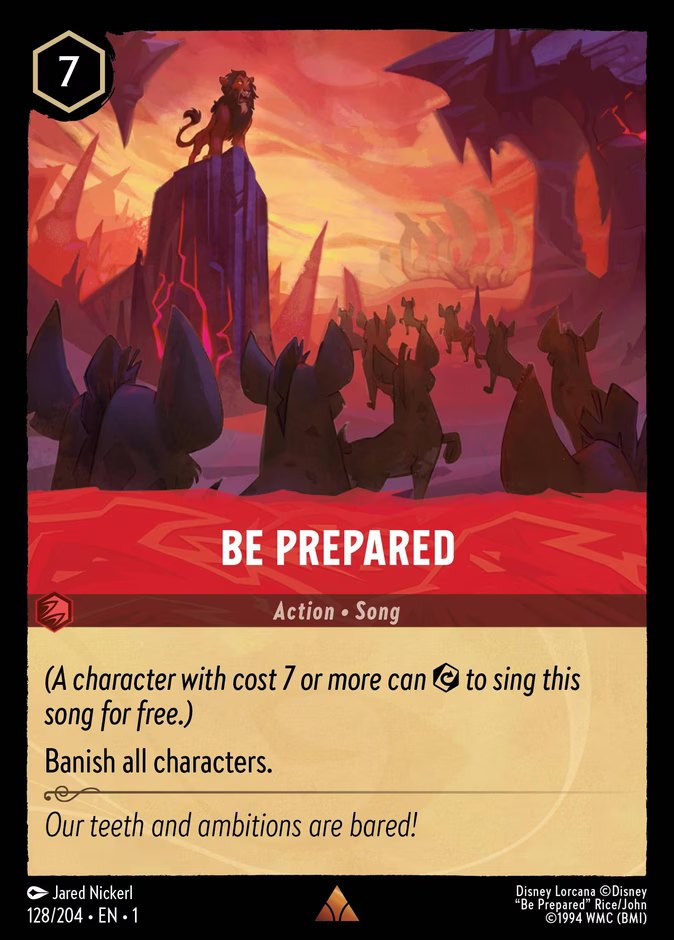
The supply side is the other half. 33 of the 119 songs cost 5 or more, but of the game's 1,871 unique characters only 578 cost 5 or more and only 142 cost 7 or more. Five more characters reach 7 through the Singer keyword despite costing less, so Be Prepared has 147 legal solo singers in the entire card pool before you narrow to your two inks - and one of those five, Mickey Mouse - Amber Champion, only gets there while you control two or more other Amber characters. Plan for that or do not run the card.
The five ways a song gets stuck in your hand
Singing fails more often than the reminder text suggests, and the reasons are spread across five different rules.
Your singer is drying. Rule 5.1.1.11: a character that entered play this turn cannot quest, cannot be declared as a challenging character, and cannot exert. Singing requires exerting. A character played this turn cannot sing, and this is the most common way a planned song turn falls apart.
Your singer is already exerted. You need a ready character. Questing with your big body and then trying to sing with it is the beginner mistake that never fully goes away, because the correct order is usually sing first, quest second - impossible with one character, trivial with two.
Your singer is too small. Rule 8.11.2 is precise: Singer changes what a character counts as for singing only, and only during the process of playing a card. The ink cost printed on the card never moves.
Somebody turned the music off. Three cards shut singing down as an effect, and the wording on each matters. Gantu - Experienced Enforcer reads "characters can't exert to sing songs until the start of your next turn" - all characters, including yours. Pete - Space Pirate stops opposing characters singing, and only while he is exerted. Ursula - Sea Witch Queen says "other characters can't exert to sing songs", which shuts off your own board as well as theirs while leaving her free to sing. Three more characters simply cannot sing themselves: Ariel - On Human Legs (Voiceless), Ulf - Mime (Silent Performance) and Dopey - Drawn to Music (Tongue-Tied). A seventh, Meilin Lee - Lead Vocalist, cannot sing at all without Sing Together.
An effect already handed you the song for free. Rule 6.1.7: if an ability instructs you to play a card for free, you ignore all costs and cannot choose another alternate cost instead. This matters more than it sounds, because a free cast exerts nobody, so any "whenever this character sings a song" trigger never fires. The separate "whenever you play a song" triggers - a different and larger group, covered below - still do.
The clean exception is Shift. Rule 8.10.5: a player can exert a shifted character to sing a song if the character it was put on top of was dry when the shifted character entered play. Stack a 7-cost body onto a dry 3-cost one and you have a legal Be Prepared singer on the turn you played it.
One more that goes the other way: rule 8.7.4 confirms a player can still exert a character with Reckless to use abilities or sing songs. Reckless stops questing, not singing, and turning an otherwise-stuck Ruby body into a free song is often the best line available - one of several places where reading the actual rule beats reading the reminder text, as our keyword breakdown covers in more detail.
Singer is 31 cards and almost entirely Amber
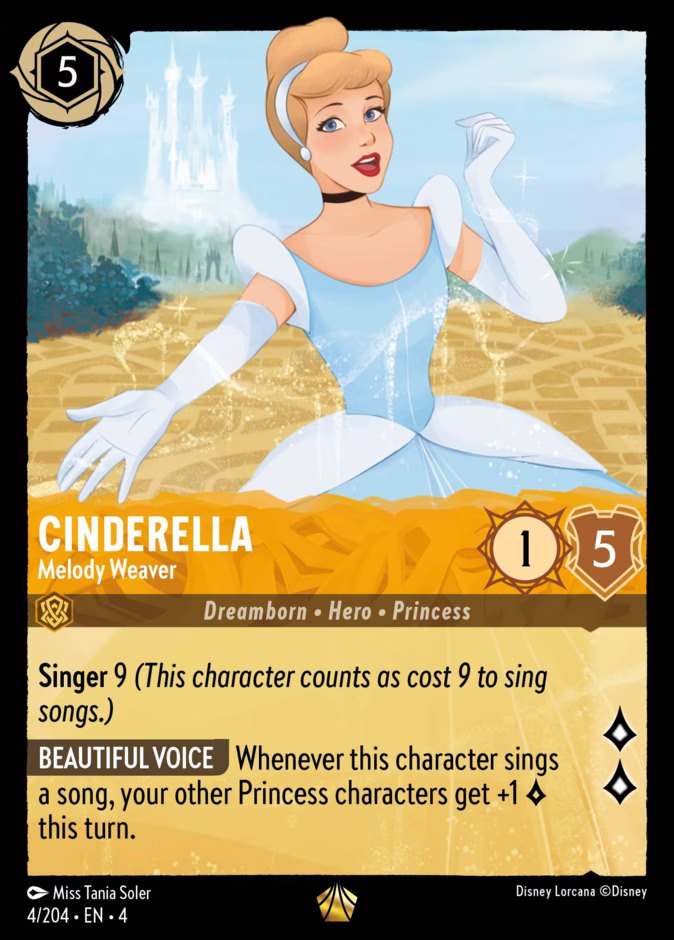
Singer N (rule 8.11.1) lets a character exert to pay a song's alternate cost as though it cost N instead of its own ink cost. Thirty-one cards can do it, all of them characters. Twenty-nine print the keyword outright; two only gain it conditionally - Mickey Mouse - Amber Champion picks up Singer 8 while you control two or more other Amber characters, and Chief Bogo - Gazelle Fan picks up Singer 6 while you control a character named Gazelle.
The ink split is lopsided: counting dual-ink cards under both of their inks, that is Amber 27, Ruby 4, Amethyst 1 and Steel 1 across 33 ink slots. The four Ruby cards are all musicians - both Powerline printings, Max Goof - Rockin' Teen and King Louie - King of Swing. The lone Amethyst and Steel entries are the two dual-ink Singers, Mirabel Madrigal - Hopeful Dreamer (Amber/Amethyst) and The Troubadour - Musical Narrator (Amber/Steel).
Printed values run Singer 3 (4 cards), 4 (7), 5 (11), 6 (3), 7 (2) and 9 (2). What matters is not N, though - it is N minus the card's own ink cost, the gap between what you paid and what you can sing.
| Character | Cost | Sings as | Gap |
|---|---|---|---|
| Cinderella - Melody Weaver | 5 | 9 | +4 |
| Mickey Mouse - Amber Champion | 4 | 8 (conditional) | +4 |
| Powerline - World's Greatest Rock Star | 6 | 9 | +3 |
| Ariel - Singing Mermaid | 4 | 7 | +3 |
| Gazelle - Ballad Singer | 5 | 7 | +2 |
Cinderella - Melody Weaver is the ceiling: a 5-ink Amber Legendary from Ursula's Return that covers 117 of the 119 songs on her own. The two she cannot reach are Second Star to the Right and The Mob Song at 10 ink - and since both carry Sing Together 10, you were never singing them solo anyway.
Three cards push the number higher from outside. Atlantica - Concert Hall, a 1-ink Amber location, gives characters +2 cost to sing while they are there. Naveen's Ukulele costs 1 ink and banishes itself to give one character +3 for the turn. Record Player gives your Stitch characters +1. Rule 8.11.3 confirms these combine with Singer, and the rulebook's own example is Ursula - Vanessa (cost 2, Singer 4) standing on Atlantica and counting as a 6.
The oddest card in the category is Meilin Lee - Lead Vocalist: a 1-ink Amber character with Singer 3 whose own ability, Band Loyalty, says she cannot sing songs without Sing Together. Singer 3 on a 1-drop would be the best rate in the game, so it comes with a leash.
Sing Together turns the whole board into one voice
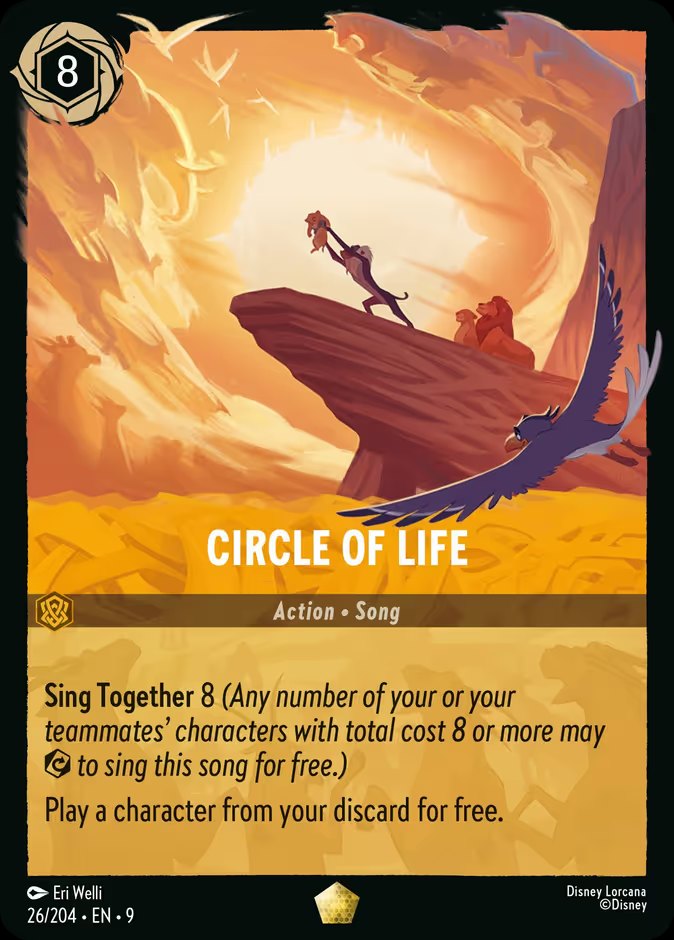
Sing Together N (rule 8.12.1) lets you and your teammates exert a number of your characters whose total ink cost meets or exceeds N. Rule 8.12.2 spells out that those characters have to be ready. Eighteen songs have it, and it has arrived in bursts rather than as an evergreen: 6 in Ursula's Return, 6 in Reign of Jafar, 2 in Fabled and 4 in Attack of the Vine!, with none at all in the six sets in between those runs.
Values run 5 to 10 and cluster at 8 (5 songs). On all 18, the Sing Together number equals the song's printed ink cost, so The Mob Song and Second Star to the Right both sit at 10 - and both are castable off four medium bodies you were not using this turn.
Rule 8.12.3 is the one to build around: a character with a "whenever this character sings a song" trigger that is one of the characters singing with Sing Together has met its condition, so the ability goes to the bag. Every helper counts as having sung.
Sing Together fixes the drying problem partially, not fully. Each contributor still has to be ready and dry. What it removes is the need for one single character to be big enough, which for an Amber board of 2s and 3s is the difference between never casting a 9-cost song and casting it on turn six.
What the July 2026 rules update changed
The current rules document is Comprehensive Rules 2.2.0, effective July 9, 2026, released alongside Attack of the Vine! Section 5.4.4 and the whole of 8.11 came through untouched, and 8.12 changed only in wording, so nothing above changed mechanically - but three things in the update are worth knowing before you quote an older PDF.
8.12.1 was reworded. Ravensburger's own set release notes list the change as "Adjusted the definition to match the language used for songs." Sing Together now reads in the same shape as rule 5.4.4.2 rather than as a separate construction. Functionality is unchanged; only the wording lines up.
Shift can now start from a non-character. Attack of the Vine! introduced Potato Shift on Posey - Vampire Potato, a 7-cost Emerald character you can play for 5 on top of one of your items named Potato. The rules caught up in 8.10.4.1: a shifted character placed on a non-character is dry if the card underneath has been in play since the beginning of its player's turn, and drying otherwise. Ravensburger spells out the singing consequence in the release notes - shift Posey onto a Potato that was already in play and she can quest, challenge and sing that turn; shift her onto a Potato you played the same turn and she cannot.
A "must quest" order still leaves singing legal. The same notes answer it directly for Woody - Town Sheriff, whose Move Along ability makes an opposing character unable to challenge and forced to quest. Ravensburger's answer is that "the chosen character can still sing songs or pay any" exert costs, because the ability only forces a quest before you can end your turn. A restriction on questing or challenging does not by itself stop a character singing. Gantu - Experienced Enforcer makes the same point in the other direction, with a reminder line on his tax ability that reads "This doesn't apply to singing songs."
The songs whose printed cost is a bluff
Twenty-nine of the 119 songs draw cards, eleven put the word banish in their rules text, and eight deal damage. The ones below are where the gap between printed cost and real cost is widest.
| Song | Cost | Ink | Effect |
|---|---|---|---|
| Be Prepared | 7 | Ruby | Banish all characters |
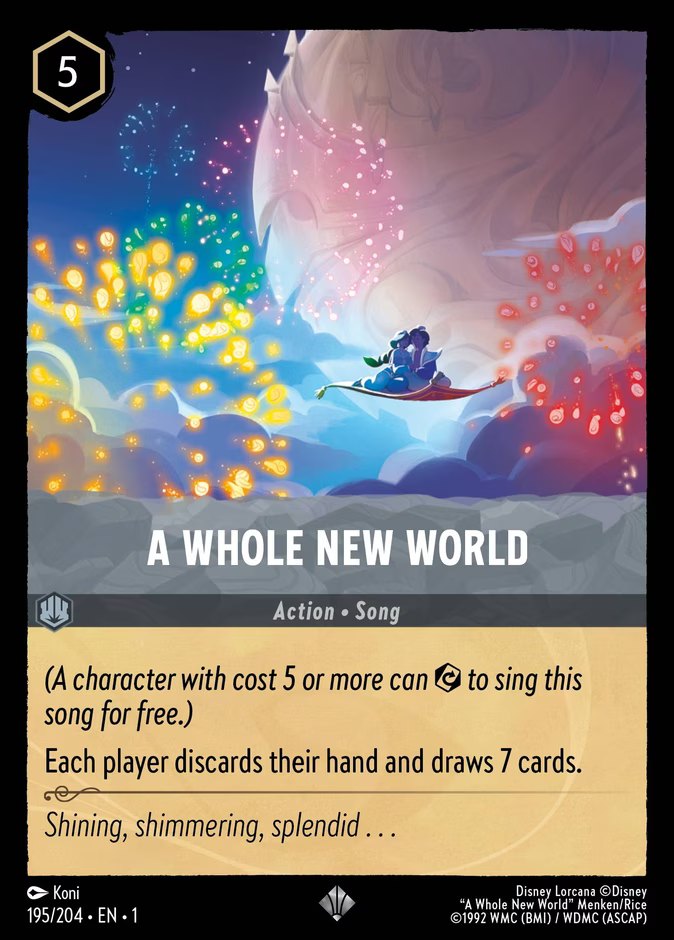
| A Whole New World | 5 | Steel | Each player discards their hand and draws 7 |
| Grab Your Sword | 5 | Steel | Deal 2 damage to each opposing character |
| Under the Sea | 8 | Emerald | Bottom all opposing characters with 2 Strength or less |
| Second Star to the Right | 10 | Amethyst | Chosen player draws 5 cards |
| Circle of Life | 8 | Amber | Play a character from your discard for free |
| The Mob Song | 10 | Steel | Deal 3 damage to up to 3 characters and/or locations |
Note how many of those are Steel and Ruby - the two inks that already own removal per our ink breakdown. A song is how those inks get a board wipe without spending a turn's worth of ink, which is why aggressive Ruby decks tolerate a card as awkward as Be Prepared.
The cheap end is the opposite trade. Six songs cost 1 - Reflection, It Calls Me, A Very Merry Unbirthday (all Amethyst), I Will Find My Way and He's A Tramp (Emerald) and But I'm Much Faster (Steel) - and any ready, dry character that is not specifically barred from singing can pay for one, including a 1-drop with nothing else to do. Those quietly generate value in decks nobody would call a song deck.
The payoff cards that turn songs into an engine
Two different trigger conditions are easy to mix up, and the difference is worth real games.
"Whenever this character sings a song" is on 11 cards. It needs the exert. A song played for free by another effect does not fire it.
"Whenever you play a song" is on 16 cards. It only cares that the song got played, so it fires whether you sang it, hard-cast it for ink, or got it free off something else.
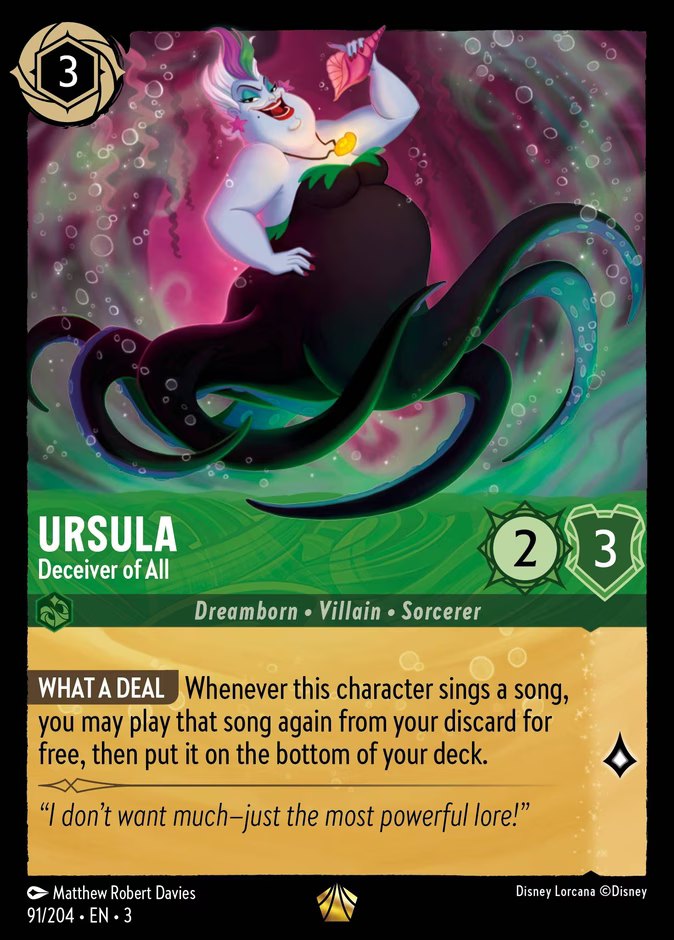
The headline card in the first category is Ursula - Deceiver of All, a 3-ink Emerald Legendary from Into the Inklands: whenever she sings a song, you may play that song again from your discard for free, then put it on the bottom of your deck. She turns one song into two for one exert, and at 3 ink she sings anything costing 3 or less on her own.
Six of the 11 sing triggers belong to the Encanto cast, which is how tightly Ravensburger tied that film to the mechanic:
- Pepa Madrigal - Sensitive Sister (3 ink, Amber) - gain 1 lore whenever one or more of your characters sings
- Alma Madrigal - Accepting Grandmother (6 ink, Amber/Amethyst) - once during your turn, ready the characters that just sang
- Isabela Madrigal - In the Moment (5 ink, Amber) - cannot be challenged until the start of your next turn after any of your characters sings
- Antonio Madrigal - Friend to All (4 ink, Amber/Amethyst) - once a turn, tutor a character costing 3 or less
- Bruno Madrigal - Singing Seer (7 ink, Amber/Amethyst) - draw a card for each character you have in play when he sings
- Dolores Madrigal - Within Earshot (1 ink, Amethyst) - chosen opponent reveals their hand
Alma is the quiet one. Readying the singers refunds the exert entirely, which turns Sing Together from a board-wide tap into a free spell - the whole board sings, readies, and quests on the same turn.
Recursion runs underneath all of it. Gazelle - Ballad Singer puts a song from your discard on top of your deck when she lands, and Kristoff - Reindeer Keeper costs 1 less for each song card in your discard, which on a 9-ink body is a real payoff for a deck that has been singing all game. It is the same design lever Braverse uses for its card types - print a subtype, then print cards that only care about the subtype.
Quick Action Checklist
- Count your singers before you sleeve the song. For anything costing 5 or more, know how many characters in your 60 can legally sing it. Fewer than six and the song is a liability.
- Sing before you quest, every turn. The character you want to sing with is usually the one you were about to exert for lore. Doing it in the wrong order costs you the song.
- Do not plan a song off a character you played this turn. Drying characters cannot exert, so they cannot sing. The exception is a Shift character stacked onto a body that was already dry.
- Ink your 1-3 cost songs freely, hold the big ones. Only 6 of the 15 songs costing 7 or more are inkable, so the expensive ones are dead weight in an opening hand either way.
- If you are in Amber, look at Singer before you look at stats. 27 of the 33 ink slots on Singer cards are Amber, and the gap between a card's cost and its Singer number is the stat that matters.
- Remember Reckless characters can sing. Rule 8.7.4. A Ruby body that cannot quest is a free 7-cost singer sitting right there.
- Check which trigger you actually have. "Sings a song" needs the exert; "whenever you play a song" does not. Free casts fire the second group only.
Counts here reflect the pool through Attack of the Vine! under the dedupe rule stated at the top, and every rule number reflects Comprehensive Rules 2.2.0. Card counts move with every set. Section numbers move too - Ravensburger renumbered the whole document between the February 2025 revision and the 2.x line - so always check the rule text, not just the digits.
Frequently Asked Questions
How do songs work in Disney Lorcana?
How many song cards are in Disney Lorcana?
Can a character sing the turn it is played?
What does the Singer keyword do in Lorcana?
What is Sing Together in Disney Lorcana?
Which Lorcana character can sing the most expensive songs?
Do songs cost more than other actions in Lorcana?
Keep Reading
Related Guides
Lorcana Shift Explained: Stacks, Damage and All 6 Variants
Shift is 199 cards across the 13 main sets before Hyperia City and a full page of rules, and most of that page is about the card underneath. Here is what a shifted character inherits, why 63 Core-legal cards care about the stack, where every card goes when the top one leaves play, and what each of the six variants actually lets you shift onto.
Disney Lorcana's Bag Explained: How Trigger Order Works
Six other posts on this site mention "the bag" in passing and none of them explain it. Here is the actual rule: what goes in, what never does, the exact order it resolves in when two abilities fire at once, and the two different ways a Lorcana card can make something happen later.
Disney Lorcana Uninkable Cards: All 585, and How to Ink One
The inkwell symbol is the first rule Lorcana teaches and the last one anybody puts a number on. Here is the whole uninkable pool counted off the live card data - 585 of 2,476 cards - cut by rarity, cost, type and ink, plus the Comprehensive Rules clause that lets five specific cards put an uninkable card into your inkwell anyway.
Disney Lorcana Format Coconut Explained: All 18 Beta Cards
Ravensburger put a new multiplayer format into open beta and then did not print a single card for it. The 18 Coconut cards live in the Companion app, the rules fit on one page, and the deckbuilding restrictions are stranger than the summary makes them sound. Here is the whole thing, with the card pool behind each Coconut counted.
How to Play Disney Lorcana - Rules, Turn Structure, and the Race to 20 Lore
Lorcana is the rare TCG where you never attack your opponent directly. You race them to 20 lore. This is the full rules walkthrough - inkwell, turn phases, questing, challenging, drying, card types, and deck limits.
Disney Lorcana Actions Explained: All 196, No Instant Speed
An action in Lorcana resolves the moment it is played, and the rules give your opponent no window to answer it. Here is the whole card type counted from the live pool - 196 non-song actions, what they actually do, and the handful of cards that can interfere before the fact.