Disney Lorcana Character Classifications Explained: All 47, and Why Storyborn Does Nothing
Rule 5.3.3.2 lists 47 classifications, and a card needs one of them to legally be a character at all. Then you count the card pool and find that the two most common words on the type - Storyborn and Dreamborn, 1,688 characters between them - are referenced by exactly zero cards.
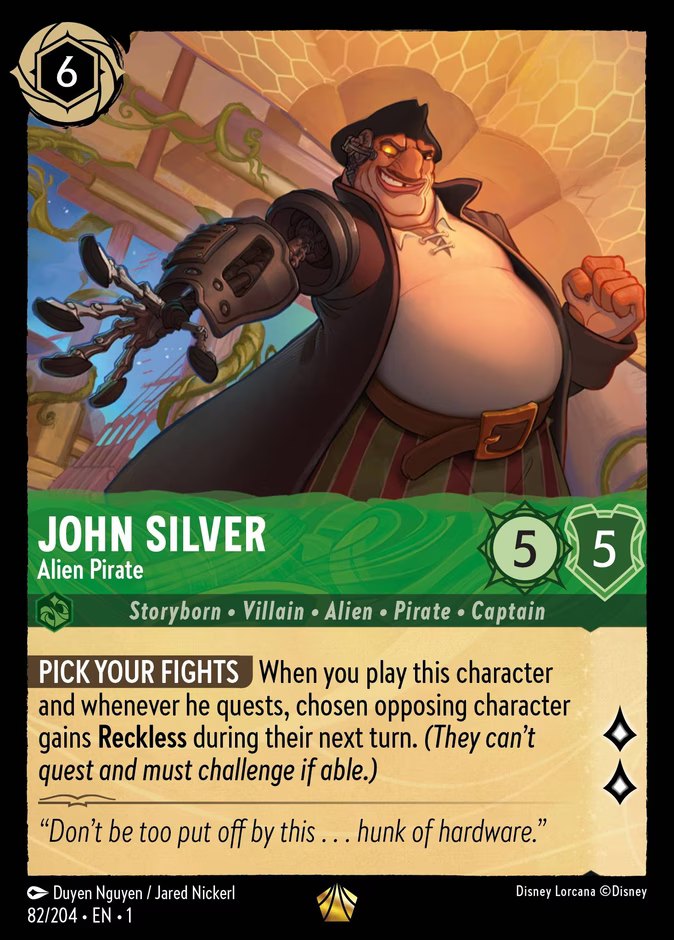
Look at the strip of small text under a Lorcana character's name. On John Silver - Alien Pirate it reads Storyborn, Villain, Alien, Pirate, Captain. Five words. Four of them are referenced by other cards in the game. One of them - the first one, the one printed on more cards than any other word in Lorcana - is referenced by nothing at all.
That is the classification line, and it is doing two completely different jobs at once. Half of it is the legal definition of what a character even is. The other half is tribal deckbuilding text. Telling those halves apart is the whole skill.
Everything below comes from two sources: Comprehensive Rules 2.2.0, effective 9 July 2026, and one pass over the Lorcast bulk card export pulled on 15 August 2026. Cards are deduped by full name - name plus version, apostrophes and capitalisation folded - giving 2,476 unique cards from 3,192 printings, of which 1,871 are characters.
A character is the one type never named on its own card
Rule 5.3.3 is blunt about it: characters do not list "Character" on their classification line. Every other type does. An action says Action, an item says Item, a location says Location, and a song says both Action and Song under rule 5.4.4.1.
So how does the game know a card is a character? Rule 5.3.3 gives two tests, and a card must pass both:
- 5.3.3.1 - it has a Strength value and a Willpower value.
- 5.3.3.2 - it has at least one of 47 specific words on the classification line.
That second test is a closed list. Not "a flavour word," not "anything Disney-sounding" - one of 47 enumerated terms, printed in the rules. If a card has Strength and Willpower but none of those 47 words, rule 5.3.3 says plainly that the card is not a character.
This is why the type reads oddly at first. The classification line on an item is a label. On a character it is load-bearing.
All 47 classifications, and the three with no cards
Here is the list from rule 5.3.3.2 in full, in the order the rules print it:
Alien, Ally, Boss, Broom, Captain, Colossus, Deity, Detective, Dinosaur, Dragon, Dreamborn, Entangled, Fairy, Floodborn, Gargoyle, Ghost, Giant, Hero, Hunny, Hyena, Illusion, Inventor, King, Knight, Madrigal, Mentor, Monster, Musketeer, Pirate, Prince, Princess, Puppy, Queen, Racer, Red Panda, Robot, Seven Dwarfs, Sorcerer, Storyborn, Super, Team, Tigger, Titan, Toy, Villain, Vineling, Whisper.
Count them and you get 47. Count the classifications that actually appear on a character in the 13-set main pool and you get 44. Three words are in the rules with nothing printed under them: Boss, Colossus and Entangled.
That gap has an explanation, and it is the co-op boxes. The Lorcast export covers sets 1 through 13 plus the promo, Challenge, D23 and other special-release sets - it does not carry Illumineer's Quest cards. Entangled is documented as the classification on every card in Ursula's deck in Illumineer's Quest: Deep Trouble, which uses the set code Q1, has gold card backs, and is not legal in standard decks. Those cards are a separate product line that the rules still have to define terms for.
Boss is the newest of the three. The CR 2.2.0 changelog records exactly one classification change from the previous revision: rule 5.3.3.2 "added four new classifications: Boss, Red Panda, Team, and Vineling." Red Panda, Team and Vineling all have printed cards in Attack of the Vine! Boss does not, in this pool.
Every character has exactly one born word
Three of the 47 are the ones people actually mean when they say "classification": Storyborn, Dreamborn, Floodborn. They split the entire character pool cleanly.
| Born word | Characters | Share |
|---|---|---|
| Storyborn | 1,340 | 71.6% |
| Dreamborn | 348 | 18.6% |
| Floodborn | 183 | 9.8% |
| Total | 1,871 | 100% |
Those three numbers add to 1,871, which is the exact number of characters in the game. Every character has one. None has two, and none has zero - checked card by card across all 1,871.
That makes the born word the closest thing Lorcana has to a mandatory slot on the character type. It is not written as a rule anywhere in the Comprehensive Rules; rule 5.3.3.2 treats Storyborn as just another entry in the alphabetical list, no different from Hyena. It is a design convention that has held for thirteen sets without a single exception.
The flavour behind it is simple enough: Storyborn characters are the version from the original story, Dreamborn are an imagined or alternate take, and Floodborn are characters reshaped by the Inkflood - which is why most of the game's Shift characters are Floodborn.
Storyborn and Dreamborn do nothing
Now the part that reframes the whole line.
Search the text box of all 3,192 printings in the game for the word "Storyborn." You get zero results. Search for "Dreamborn." Also zero.
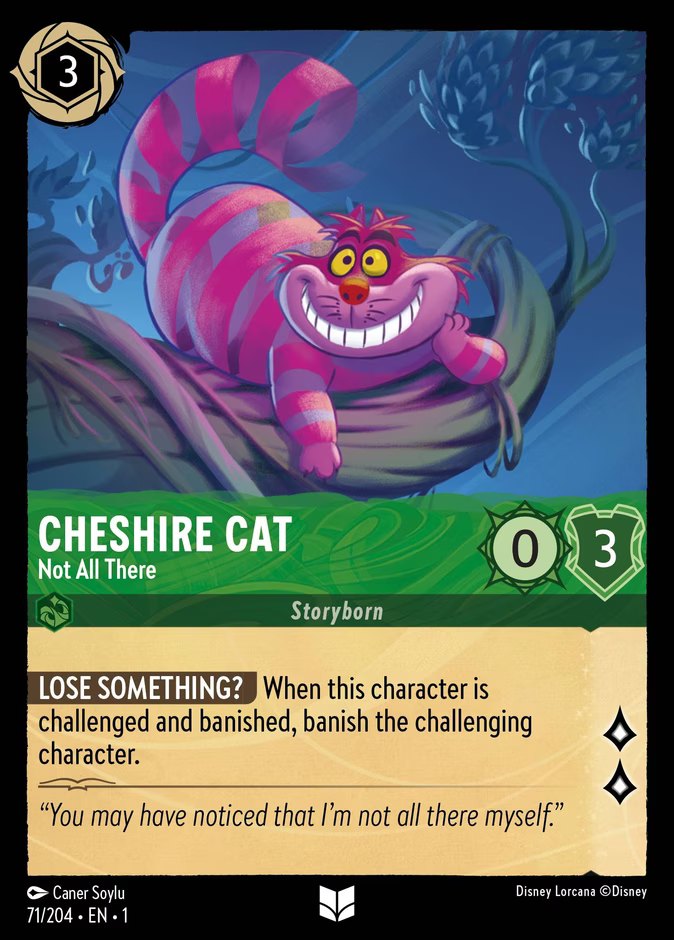
Not one card in Lorcana cares whether a character is Storyborn or Dreamborn. No card buffs them, tutors for them, counts them, or checks for them. Between them those two words sit on 1,688 of 1,871 characters - 90.2% of the type - and they are, mechanically, decoration. Cheshire Cat - Not All There carries Storyborn and nothing else, and that lone word has never once been relevant to a game action.
This is worth internalising because it inverts how the line reads. Read the classification strip left to right and the first word looks like the important one. It is the least important one. The useful information starts at word two.
There is one caveat that keeps this honest: the born word is not inert, it is unreferenced. Effects that reach it could be printed tomorrow, and Floodborn shows exactly what that looks like when it happens.
The nine classifications no card reads
Storyborn and Dreamborn are not alone. Nine of the 44 printed classifications have zero cards anywhere in the pool that name them in text:
| Classification | Characters | Cards referencing it |
|---|---|---|
| Storyborn | 1,340 | 0 |
| Dreamborn | 348 | 0 |
| Mentor | 77 | 0 |
| Whisper | 27 | 0 |
| Team | 16 | 0 |
| Ghost | 7 | 0 |
| Tigger | 5 | 0 |
| Giant | 3 | 0 |
| Dinosaur | 2 | 0 |
Mentor is the surprising entry. Seventy-seven characters carry it - more than King, Alien or Inventor - and after thirteen sets nothing has ever been printed that looks for one. Whisper and Team are newer and may simply be waiting; Whisper arrived with Whispers in the Well and Team with Attack of the Vine!, and both are still 100% Core-legal.
Ally is the other shape of the same problem. It is the second most common classification in the game at 660 characters, and only 8 cards in 2,476 reference it - one of which is Core-legal. Ally is wide and shallow: it tells you a character is a sidekick, and almost never tells the game anything.
Floodborn is the born word that pays
Floodborn is the exception that proves the pattern, and Attack of the Vine! is where it went from a flavour tag to a deck.
Thirty-five unique cards across 44 printings name Floodborn in their text, and 20 of those are Core-legal. Against 183 Floodborn characters that is a real support ratio - better than Villain's 17 cards spread across 298 characters.
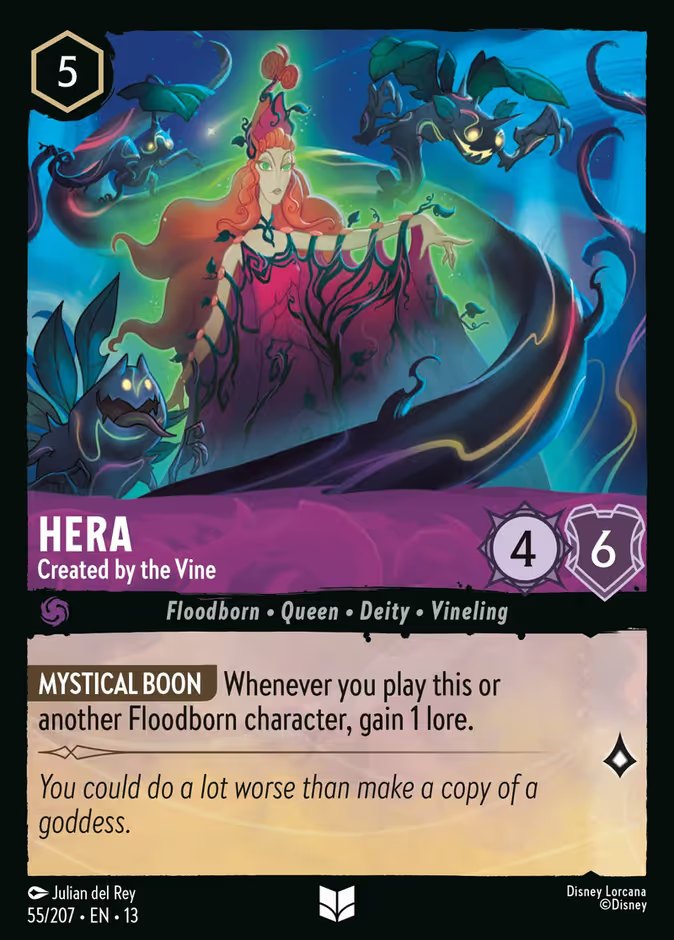
The set 13 payoffs are unusually direct about it. Hera - Created by the Vine gains a lore whenever you play any Floodborn character. Ring of Stones - Taken by the Vine gives your Floodborn characters +1 Lore outright. Rapunzel's Tower - Taken by the Vine gives them +2 Willpower. Pete - Created by the Vine hands them Challenger +1. Ursula - Created by the Vine turns a Floodborn quest into a debuff on an opposing character.
Notice what those cards have in common: they check a born word. Floodborn was already the mechanically distinctive third of the triad because Shift lives there, and Rise of the Floodborn printed six cards back in 2023 that pay you for playing one. Set 13 turned it into the one born word with a critical mass of payoffs, and left the other two exactly as decorative as they were on day one.
How many words one character can carry
The spread across the type:
| Classifications on the card | Characters |
|---|---|
| 1 | 70 |
| 2 | 875 |
| 3 | 756 |
| 4 | 151 |
| 5 | 19 |
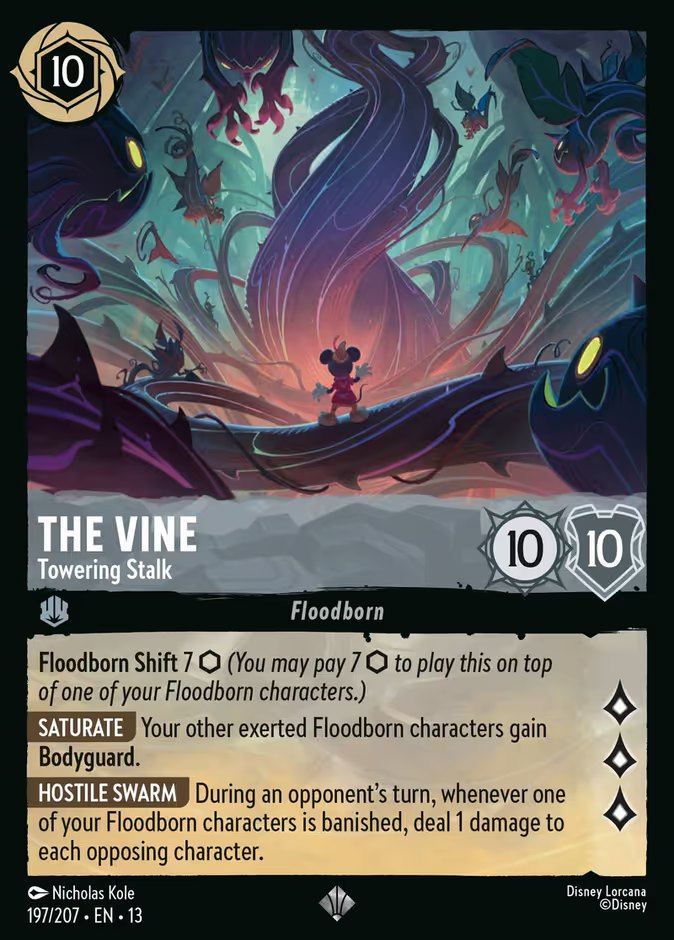
Seventy characters carry only their born word and nothing else - Cheshire Cat - Not All There, Mad Hatter - Gracious Host, Tamatoa - Drab Little Crab. Sixty-four of those seventy are Storyborn-only and three are Dreamborn-only, which in tribal terms makes them dead weight: nothing in the game looks for the one word they carry. The remaining three are Floodborn-only, and that single word is enough to pick them up - The Vine - Towering Stalk is one of them.
At the other end, 19 characters carry five, and the roster is funnier than you would expect. Seven of the 19 are John Silver, who has been printed seven times and reads Storyborn or Dreamborn or Floodborn, Villain, Alien, Pirate, Captain on every single one. Nathaniel Flint - Notorious Pirate is an eighth card with the same Alien-Pirate-Captain stack.
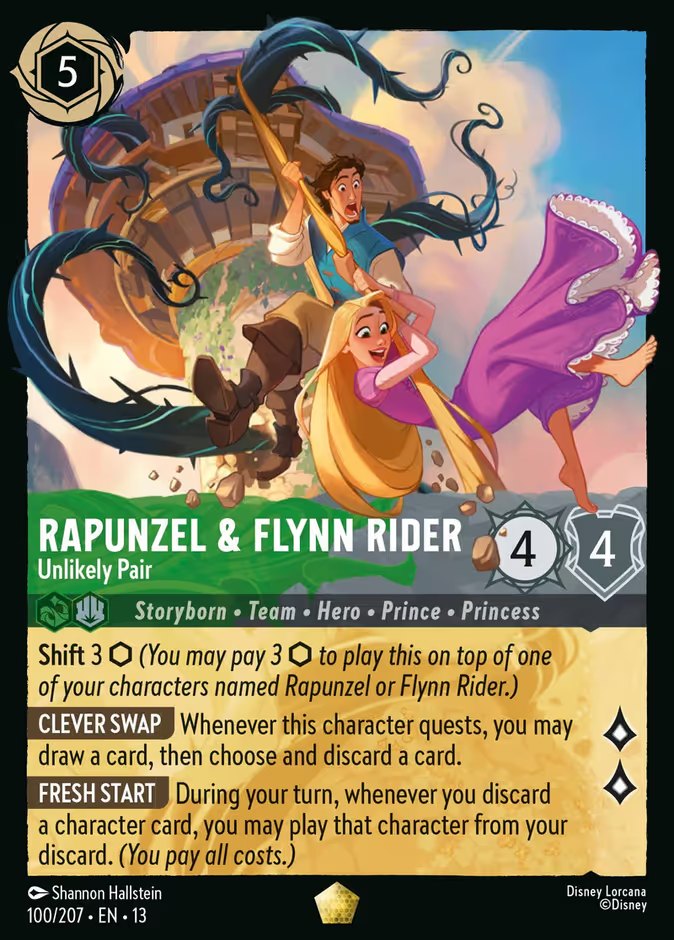
Five more come from Attack of the Vine!, where the new Team classification put two characters on one card and stacked their classifications together. Rapunzel & Flynn Rider - Unlikely Pair reads Storyborn, Team, Hero, Prince, Princess. Winnie the Pooh & Piglet - Hunny Mages reads Dreamborn, Team, Hero, Sorcerer, Hunny. The remaining six are one-offs scattered across sets 6 through 11.
Hero outnumbers Villain more than two to one
Hero sits on 652 characters. Villain sits on 298. For a Disney game, the good guys hold a 2.2-to-1 majority of the roster, and the two words sort into different inks almost as cleanly as they sort into morality.
| Ink | Hero | Villain |
|---|---|---|
| Amber | 161 | 17 |
| Amethyst | 63 | 77 |
| Emerald | 113 | 61 |
| Ruby | 131 | 75 |
| Sapphire | 116 | 44 |
| Steel | 121 | 51 |
Dual-ink characters are counted in both of their inks, so the rows total above the headline figures.
Amber is the outlier at both ends: it has the most Heroes of any ink and the fewest Villains. Amethyst is the only ink where Villains outnumber Heroes. If a card asks you for Villains and you are in Amber, you are going to have a bad time - and Villain is genuinely asked for, with 17 cards referencing it, seven of them Core-legal.
Rotation emptied three classifications completely
Core Constructed rotated on Attack of the Vine!'s prerelease weekend - 17 July 2026 for competitive play, wide release 24 July - dropping Shimmering Skies, Azurite Sea, Archazia's Island and Reign of Jafar. Sets 9 through 13 are what remain, which is 768 of the 1,871 characters.
That cut landed unevenly on the classification line. Three classifications now have zero Core-legal characters:
| Classification | Characters (all) | Characters (Core) | Cards referencing it (Core) |
|---|---|---|---|
| Broom | 9 | 0 | 0 |
| Illusion | 7 | 0 | 0 |
| Titan | 5 | 0 | 0 |
Several more were gutted rather than deleted. Pirate went from 65 characters to 4, and all 22 of its payoff cards are out of the format. Racer went 25 to 1, Musketeer 10 to 1, Hyena 7 to 1, Knight 18 to 2. Puppy is the sharpest case: 3 Core characters left, 13 payoff cards printed, and not one of those payoffs is Core-legal.
If you built a Pirate or Puppy deck before July, the format did not nerf it. It removed both halves.
The tribes that actually work in Core
Twelve classifications are 100% Core-legal, because every card that has ever carried them was printed in sets 9 through 13: Super (42), Whisper (27), Toy (26), Team (16), Monster (15), Vineling (13), Gargoyle (12), Hunny (12), Red Panda (10), Ghost (7), Giant (3) and Dinosaur (2).
Raw count is the wrong measure though. What makes a tribe playable is the ratio of payoff cards to bodies, and by that measure the Core standouts are these:
| Classification | Core characters | Core cards referencing it |
|---|---|---|
| Hunny | 12 | 11 |
| Detective | 31 | 13 |
| Toy | 26 | 13 |
| Floodborn | 62 | 20 |
| Princess | 63 | 13 |
| Hero | 282 | 13 |
Hunny is nearly one payoff per body, and it comes with one of the strangest deckbuilding cards in the game. Christopher Robin - Hunny Sage reads "You can have other Hunny characters in your deck regardless of ink type." Rule 1.10.1.1 caps a Constructed deck at two ink types; rule 1.10.1.3 allows cards to adjust deck construction, and the Comprehensive Rules use this exact card as its worked example. Christopher Robin is Amethyst/Sapphire, so he can only go in an Amethyst/Sapphire deck - but once he is in it, your Hunny characters can come from any ink. That is a classification quietly overriding one of the game's four constructed rules.
Detective and Toy are the cleaner builds. Detective has Judy Hopps - On the Case putting an item into its owner's inkwell if you control another Detective, Flash - Records Specialist buffing chosen Detectives off a quest, and Search for Clues paying you extra for having one. Toy has Jessie - Lively Cowgirl drawing off two other Toys and Woody - Leader of the Toys digging four cards deep for a Toy or Andy's Room.
Four cards can hand out a classification
Classifications are printed, but they are not always fixed. Four cards in the game grant one:
- Detective's Badge - exert and pay 1 ink to give a character Resist +1 and the Detective classification until the start of your next turn.
- Chief Bogo - Calling the Shots - your other characters gain the Detective classification, permanently, while he is in play.
- Magical Hunny Staff - once during your turn, pay 1 ink to give a character of yours the Hunny classification until the start of your next turn.
- The Thunderquack - all opposing characters gain the Villain classification.
The first three are tribal glue: Chief Bogo turns a whole board into Detectives, which switches on every Detective payoff at once. The Thunderquack is the interesting one, because it hands a classification to the other player. Anything you own that punishes Villains suddenly reads "punishes everything they control." It is the only card that weaponises the classification line against its owner.
Classification Shift is only four cards old
Rule 8.10.8 lists six Shift variants: [Classification] Shift, Universal Shift, Duo Shift, Combo Shift, Temporary Shift and Potato Shift. The first of those is the one that ties Shift directly to the classification line - rule 8.10.8.1 lets you play the card on top of any character with the named classification, rather than one sharing its name.
In the whole card pool, exactly four cards have ever used it:
| Card | Set | Variant |
|---|---|---|
| Thunderbolt - Wonder Dog | 7 Archazia's Island | Puppy Shift 3 |
| The Madrigal Family - Every Generation | 13 Attack of the Vine! | Madrigal Shift 3 |
| Sun Yee - Red Panda Spirit | 13 Attack of the Vine! | Temporary Red Panda Shift 2 |
| The Vine - Towering Stalk | 13 Attack of the Vine! | Floodborn Shift 7 |
Three of the four arrived in the same set, which tells you Ravensburger only recently decided this variant was worth pushing. Sun Yee stacks two variants at once - Temporary and [Classification] - and rule 8.10.9 confirms that when variants combine into one ability, every condition has to be met.
The Vine - Towering Stalk is the extreme version. Ten ink, 10/10, three lore, and a Floodborn Shift cost of 7 that lets it land on top of any Floodborn character you control rather than a specific name. That is the single strongest argument the game has made so far that a born word can be a build-around.
Quick Action Checklist
- Read past the first word. Storyborn and Dreamborn sit on 90.2% of characters and no card in the game references either.
- Floodborn is the exception. 35 cards name it, 20 of them Core-legal, and set 13 built real payoffs around it.
- Do not build Ally or Mentor tribal. 660 and 77 characters respectively, with 8 and 0 cards that care.
- Check Core before committing to a tribe. Broom, Illusion and Titan have no Core-legal characters at all, and Pirate is down to 4 with zero Core payoffs.
- For a Core tribal deck start at Hunny, Detective or Toy - Hunny is nearly one payoff card per body.
- Christopher Robin - Hunny Sage breaks the two-ink rule for Hunny characters, under rule 1.10.1.3.
- Remember classifications can be granted. Chief Bogo makes your board Detectives; The Thunderquack makes their board Villains.
- A card with Strength and Willpower but none of the 47 words is not a character under rule 5.3.3.
Counts reflect the pool as of Attack of the Vine!, and rule numbers reflect Comprehensive Rules 2.2.0. Two methodology notes if you want to reproduce these figures. First, do not use the Lorcast export's legalities field - as pulled on 15 August 2026 it still misreports Core status - filter by set code instead. Second, the Promo Set 1 printing of Ursula's Lair - Eye of the Storm is coded in the export as a Character whose sole classification is "Location," which is a data error; its set 4 printing is coded correctly as a location. Counting it as the location it is gives 1,871 characters and 85 locations, and it is the one card in the pool that would otherwise break the born-word partition.
Frequently Asked Questions
What do Storyborn, Dreamborn and Floodborn mean in Disney Lorcana?
How many classifications are there in Disney Lorcana?
Does Storyborn actually do anything in Lorcana?
Which Lorcana classifications are worth building a deck around right now?
Can a Lorcana character gain a classification it was not printed with?
What is Classification Shift in Disney Lorcana?
Keep Reading
- Disney Lorcana Comprehensive Rules 2.2.0, effective July 9, 2026 (Ravensburger)
- Lorcast bulk card export - the card pool counted in this post
- Lorcast set list - set codes and release dates used for the Core cut
- Lorcana Rotation 2026: Every Set Leaving Core Constructed July 24 (InkSight)
- Illumineer's Quest: Deep Trouble product breakdown - the Entangled classification on Ursula's deck (Lorcana Player)
Related Guides
Lorcana Shift Explained: Stacks, Damage and All 6 Variants
Shift is 199 cards across the 13 main sets before Hyperia City and a full page of rules, and most of that page is about the card underneath. Here is what a shifted character inherits, why 63 Core-legal cards care about the stack, where every card goes when the top one leaves play, and what each of the six variants actually lets you shift onto.
Disney Lorcana's Bag Explained: How Trigger Order Works
Six other posts on this site mention "the bag" in passing and none of them explain it. Here is the actual rule: what goes in, what never does, the exact order it resolves in when two abilities fire at once, and the two different ways a Lorcana card can make something happen later.
Disney Lorcana Uninkable Cards: All 585, and How to Ink One
The inkwell symbol is the first rule Lorcana teaches and the last one anybody puts a number on. Here is the whole uninkable pool counted off the live card data - 585 of 2,476 cards - cut by rarity, cost, type and ink, plus the Comprehensive Rules clause that lets five specific cards put an uninkable card into your inkwell anyway.
Disney Lorcana Format Coconut Explained: All 18 Beta Cards
Ravensburger put a new multiplayer format into open beta and then did not print a single card for it. The 18 Coconut cards live in the Companion app, the rules fit on one page, and the deckbuilding restrictions are stranger than the summary makes them sound. Here is the whole thing, with the card pool behind each Coconut counted.
How to Play Disney Lorcana - Rules, Turn Structure, and the Race to 20 Lore
Lorcana is the rare TCG where you never attack your opponent directly. You race them to 20 lore. This is the full rules walkthrough - inkwell, turn phases, questing, challenging, drying, card types, and deck limits.
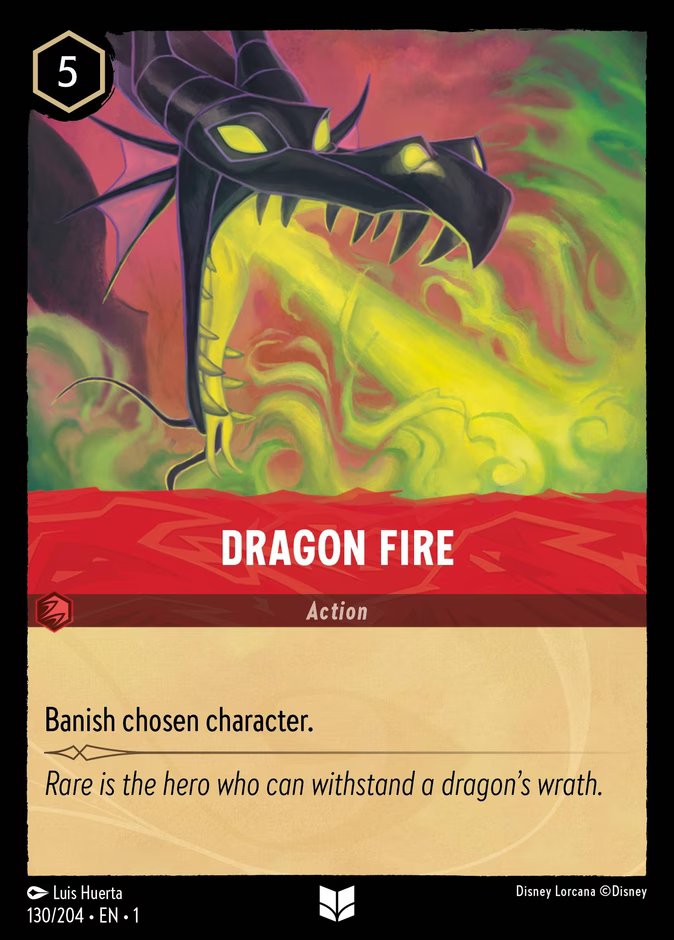
Disney Lorcana Actions Explained: All 196, No Instant Speed
An action in Lorcana resolves the moment it is played, and the rules give your opponent no window to answer it. Here is the whole card type counted from the live pool - 196 non-song actions, what they actually do, and the handful of cards that can interfere before the fact.