Lorcana Shift Explained: Stacks, Damage and All 6 Variants
Shift is 199 cards across the 13 main sets before Hyperia City and a full page of rules, and most of that page is about the card underneath. Here is what a shifted character inherits, why 63 Core-legal cards care about the stack, where every card goes when the top one leaves play, and what each of the six variants actually lets you shift onto.
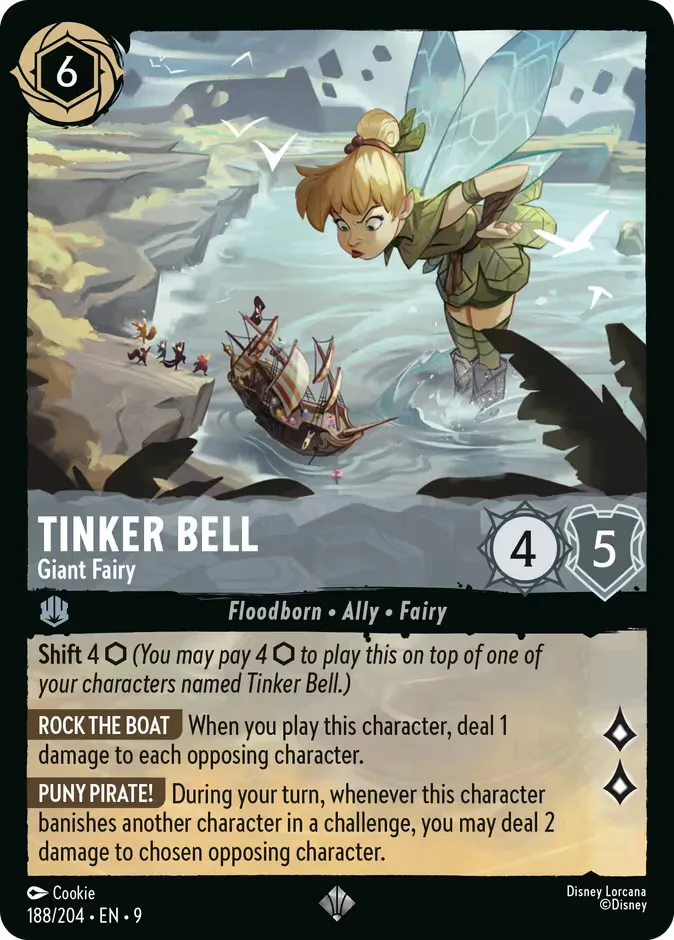
Tinker Bell - Giant Fairy costs 6 ink. Play a Tinker Bell - Tiny Tactician on turn three, and on turn four you can put the Giant Fairy on top of it for 4 ink - dry, able to challenge that same turn, two turns before an unramped inkwell would let you cast her the normal way. Her Rock the Boat still goes off on the way in and deals 1 damage to each opposing character.
That exact pair of cards is the Comprehensive Rules' own worked example for what Shift does to a card's states, and it is the right way to read the keyword. Shift is rarely a discount. It is a way to skip the calendar, and the price is the card you shift onto. This post covers what the new card inherits, what "under" means for the old one, where the whole stack goes when it leaves play, and how the six Shift variants change what you are allowed to shift onto. Every Lorcana keyword explained covers how Shift sits next to the other keywords; this is the one keyword, in full.
Sources: Comprehensive Rules 2.2.0, effective 9 July 2026 and still the version on Ravensburger's resources page on 30 September; Comprehensive Rules 2.3.0, which takes effect on 16 October 2026 and keeps every rule number cited here for the same rule; the Attack of the Vine! set release notes, which explain the four variants that set introduced and answer their edge cases in Q&A form; the Hyperia City set release notes, for that set's ink-drop Shift cost; and one pass over the Lorcast bulk card export pulled on 30 September 2026 and re-checked on 10 October, covering the 13 main sets released before Hyperia City, deduped by full name with apostrophes and capitalisation folded - 2,476 unique cards, 1,871 of them characters, the same method used across this vertical. "Core" means Core Constructed, which Ravensburger's rotation explainer puts at Fabled onward: sets 9 through 13 of the pool counted here.
Shift is a time machine, not a discount
Rule 8.10.1 is the whole keyword: if you have a character in play with the same name as the Shift card, you may pay its Shift cost instead of its ink cost, and put it on top of that character.
Here is how that Shift cost compares with the card's own printed cost, across the 193 characters in those 13 sets whose Shift is paid in ink:
| Shift cost versus ink cost | Cards |
|---|---|
| 2 ink less | 155 |
| 3 ink less | 25 |
| 1 ink less | 8 |
| 4 ink less | 1 |
| 7 ink less | 1 |
| The same | 2 |
| 2 ink more | 1 |
| Total | 193 |
155 of those 193 Shift cards - 80.3% - are exactly 2 ink cheaper than their printed cost. And the character you shift onto cost ink too. Tiny Tactician plus a shifted Giant Fairy is 3 + 4 = 7 ink for a 6-cost card. At the standard 2-ink gap, any base costing more than 2 means the pair costs more in total than casting the top card on its own.
What you are buying is time. The shifted card takes the base's dry state (rule 8.10.4), so on a dry base it can act the turn it lands, and it lands turns earlier because its cost was split across two turns. What you give up is a body: two cards now make one character.
The outliers explain the design better than the average does. Madam Mim - Rhino saves 4 (Shift 2 on a 6-cost card) and then makes you banish her or return another of your characters to your hand. Mickey Mouse & Minnie Mouse - Adventuring Duo saves 7, and its Duo Shift 0 asks for two characters underneath instead of one. Go Go Tomago - Cutting Edge and Magica De Spell - Conniving Sorceress charge the same to shift as to cast, which makes sense once you read them: both carry an "if you used Shift to play" rider, and Magica's is draw 4 cards. And one card charges more to shift than to cast. That card, Mickey Mouse - Brave Little Prince, gets its own section below, because the reason is the best explanation of what the card underneath is for.
Fourteen Shift cards carry an "if you used Shift to play" rider. Four are Core-legal: Mulan - Elite Archer (+3 Strength that turn), Magica De Spell - Conniving Sorceress (draw 4 cards), Pocahontas - Peacekeeper (if none of your characters challenged this turn, characters can't challenge until the start of your next turn) and Omnidroid - V.9 (deal 2 damage to a chosen character).
Three alternate-cost rules that apply to Shift
Rule 1.5.5.2 files shifting as an alternate cost, the same category as singing a song. Three rules follow from that:
- One alternate cost at a time. Rule 4.3.2.2: if more than one alternate cost could apply, you choose one and ignore the others.
- "For free" beats Shift. The rules' own example under rule 6.1.7 has Pride Lands - Jungle Oasis playing Donald Duck - Pie Slinger from the discard for free, and says the player can't choose to pay his Shift cost instead. So his "if you used Shift" rider cannot fire off a free play. The way around this is an effect that tells you to shift for free. Wilds Unknown printed two: Metamorphosis, a 3-ink Amber action whose entire text is "Shift a character from your discard for free," and Syndrome - Out for Revenge, who can "play or shift a Robot character with cost 8 or less for free" whenever he quests. The Wilds Unknown release notes add that either way the card still needs a Shift ability and a character in play to go on top of.
- Discounts still apply. Rule 4.3.6 says a payment modifier for the next character you play applies even when you pay an alternate cost, and rule 4.3.5 says none of it changes the card's printed ink cost. Two Core-legal cards discount shifting specifically: Belle - Always Reading takes 1 ink off anything you shift onto her, and Mrs. Incredible - Created by the Vine takes 1 ink off the next character you shift that turn whenever one of your Floodborn characters quests.
What the card on top inherits
Rules 8.10.2 to 8.10.6 decide what carries over from the character underneath, and the answer is almost everything except its words:
| What | Rule | What happens when you shift |
|---|---|---|
| Dry or drying | 8.10.4 | Copied from the card underneath. Shift onto a dry, ready character and the new one can quest, challenge and exert the turn it lands |
| Ready or exerted | 8.10.2, 8.10.3 | Enters exerted if the card underneath was exerted. An effect on the new card that makes it enter exerted still applies on a ready base |
| Damage | 8.10.6 | Every damage counter on the card underneath stays |
| Effects on the old character | 8.10.5 | Kept, if they apply to it when the new card enters play |
| The old character's rules text | 8.10.5, 5.1.1.6 | Not inherited. The top card has only its own text |
| Turn actions | 8.10.5 | Anything the old character could still do this turn, the new one can do |
| Printed ink cost | 4.3.5 | Unchanged. A Giant Fairy shifted in for 4 is still a 6-cost character |
The damage row decides games. Shift a Giant Fairy onto a Tiny Tactician carrying 3 damage and she arrives with 3 damage on a 5-Willpower body - 2 more damage from being banished, not 5. Shift saves a damaged character's board slot; it does not heal it. Ravensburger has printed one card that undoes this rule for itself: Baymax - Giant Robot, from Archazia's Island, removes all damage from himself when you play him using Shift.
The effects row cuts both ways. If your opponent's Woody - Town Sheriff used Move Along on your character - it can't challenge and must quest if able until the start of their next turn - shifting a new card on top does not shake it, because under rule 8.10.5 the effect applies to the character when the new card enters play. A buff you gave the old character this turn carries over for the same reason.
Two kinds of trigger go off as you shift. A shifted character is played (rule 4.3.3.1), so its own "when you play this character" abilities fire - that is how Rock the Boat goes off in the opening example. And rule 4.3.4.2 lets a card being covered still trigger off the card landing on top of it, even though it is about to stop being in play. That rule is what makes Attack of the Vine! Red Pandas like these work: Grandma Wu - Wise Grandmother gains you 1 lore when you shift a character on top of her, and Ming Lee - Overprotective Parent stops a chosen opposing exerted character from readying at the start of their next turn.
If you want to sing with a shifted character, rule 8.10.5 has one more line on that, and the songs breakdown walks through it.
The card underneath is under, and 63 Core cards care
Rule 5.1.1.5 defines the state: a card with a card on top of it is "under." It isn't in play, it can't be chosen, and because it went under faceup, any player can look at it at any time. The rules' shifting example, Example B under rule 5.1.3, spells it out with the opening pair: as the Giant Fairy goes onto the Tiny Tactician, the Tactician loses every state except faceup and gains "under" and "in a stack."
That wording matters because "a card under this character" is live text in Core Constructed. Search the Core pool's rules text for a card being under a character, item or location and you get 63 cards. Fifty-seven of them come from Whispers in the Well and Winterspell, the two sets that printed Boost, the keyword that puts the top card of your deck facedown under a character. But the rules do not distinguish a facedown Boost card from the faceup character you shifted onto. Both are under. And the two oldest cards that check for a card under something predate Boost entirely, and both of them are Shift cards:
- Hiro Hamada - Armor Designer (Archazia's Island): your Floodborn characters that have a card under them gain Evasive and Ward. Infinity-only since the July 2026 rotation.
- Mickey Mouse - Brave Little Prince (Fabled): a 3-ink Ruby Legendary, 2 Strength and 2 Willpower with Evasive and Shift 5, who gets +3 Strength, +3 Willpower and +3 lore while he has a card under him.
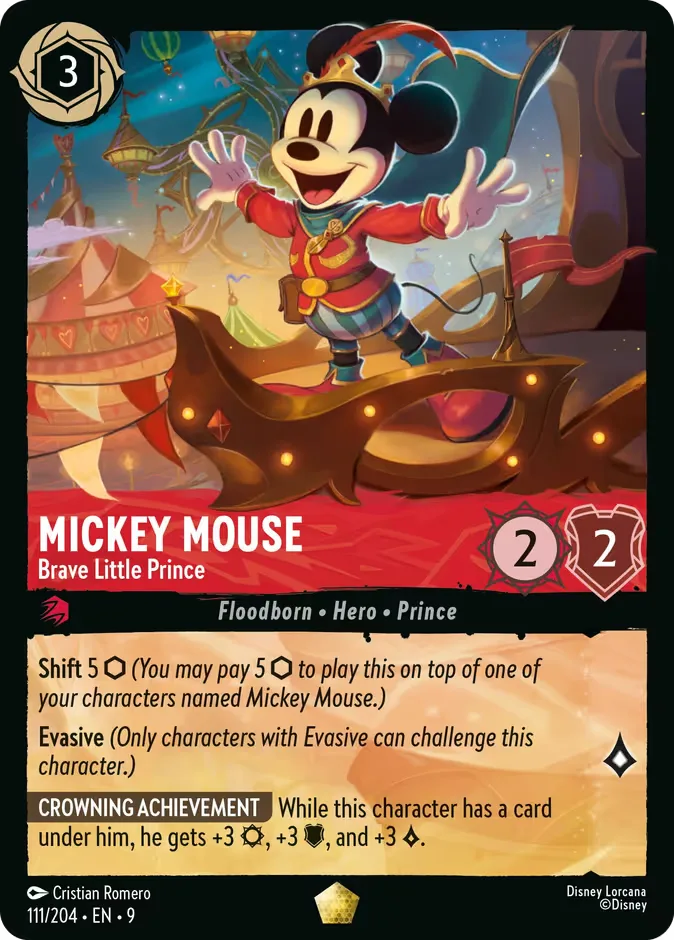
Mickey is the cleanest proof that Shift is not a discount. His Shift cost, 5, is 2 more than his ink cost of 3 - the only card of the 193 in the table above that costs more to shift than to cast. Cast him for 3 and he is a 2/2 Evasive character questing for 1. Shift him onto any Mickey Mouse and he is a 5/5 Evasive character questing for 4. The extra 2 ink buys the card underneath.
Core has more cards that read the stack:
- Omnidroid - V.10 (Wilds Unknown) gains Resist +2 while there's a card under it, which is automatic if you shifted it in.
- Dash Parr & Violet Parr - Super Siblings (Attack of the Vine!) draws a card for each card under them whenever they quest or challenge. Combo Shift them onto a Dash Parr and a Violet Parr and every quest or challenge draws 2.
- Webby Vanderquack - Knowledge Seeker, Flintheart Glomgold - Scheming Billionaire and Lena Sabrewing - Mysterious Duck (all Whispers in the Well) check whether you have any character or location in play with a card under it. A shifted character counts.
- Time to Go! (Whispers in the Well) banishes one of your characters to draw 2 cards, or 3 if that character had a card under it.
The answer to all of it is Come Out and Fight!, a 2-ink Amethyst action from Winterspell: put all cards from under a chosen character, item or location on the bottom of their player's deck in a random order, then draw a card. Aim it at a shifted Brave Little Prince and he stays in play as a 2/2.
When the top card leaves, the whole stack goes
Rule 8.10.7: when a shifted character leaves play, every card under it moves to the same zone. Rule 5.1.1.7, amended in the 2.2.0 update, adds that those cards take on the top card's states in the new zone. So the same removal hits a shifted character harder or softer depending on where it sends the top card:
| Removal sends the top card to | What happens to the stack | Core-legal examples |
|---|---|---|
| The discard | Every card goes to the discard | Any challenge or banish effect |
| Its owner's hand | Every card returns to hand | Mother Knows Best, Put That Thing Back |
| Its owner's inkwell | Every card goes into the inkwell facedown | Let It Go, Hades - Infernal Schemer |
| The bottom of the deck | Every card goes to the bottom, and because they were faceup the order is public (rule 7.2.3) | Under the Sea |
Two consequences follow. Banishing a two-card stack costs its owner two cards, which is the risk you accept every time you shift. And bouncing or inking a stack hands its owner more than one card: Mother Knows Best on a shifted character returns every card in the stack to its owner's hand, and Let It Go on a two-card stack puts two cards into your opponent's inkwell, facedown and exerted, not one. The Comprehensive Rules' own Under the Sea example covers the deck case: the owner of the stacks may mix and order the cards freely, and both players know the order.
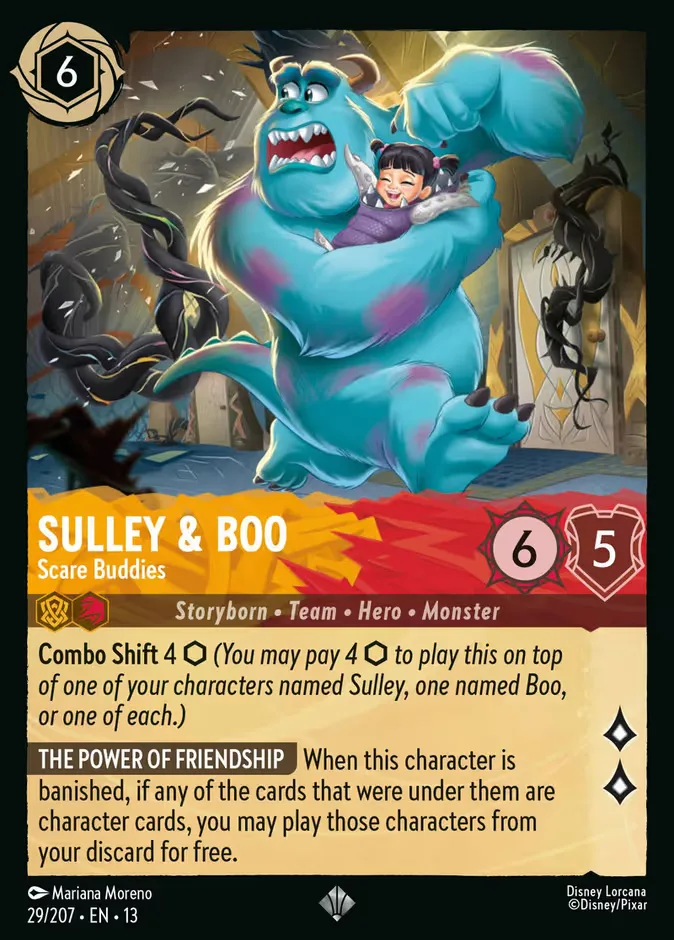
Sulley & Boo - Scare Buddies is built on that rule. When they are banished, The Power of Friendship lets you play any character cards that were under them from your discard for free - and Ravensburger's release notes confirm that all cards under them go to the discard and become faceup, so even a card that was facedown under them can be played if it is a character.
Three pieces of card text carve out their own exceptions:
- Temporary Shift returns "only this card" to your hand at the end of your turn. The release notes add that it returns even from the middle of a stack if you shifted something else on top of it, that damage is removed from the stack on the way, and that if the stack was banished first the card stays in the discard. How that end-of-turn return works as a delayed trigger is covered in the bag breakdown.
- Omnidroid - Ultimate Iteration (Attack of the Vine!), when you shift it, may return all cards under it to your hand - the top card stays, the stack comes home.
- Mickey Mouse & Minnie Mouse - Adventuring Duo reads "If this character would be banished, put them into your inkwell facedown and exerted instead." By the letter of rules 8.10.7 and 5.1.1.7, the two characters it was Duo Shifted onto go into the inkwell with it. The release notes Q&A does not address that case, so treat it as a reading of the rules text rather than a published ruling.
The six variants, and the one the rules do not name
Rule 8.10.8 lists six Shift variants. [Classification] Shift and Universal Shift were first printed in Archazia's Island. Duo, Combo, Temporary and Potato Shift arrived with Attack of the Vine!, and their rules (8.10.8.3 to 8.10.8.6) are listed as new in the 2.2.0 changelog. Ursula's Return added a seventh flavour that the rules never name as a variant: a Shift cost paid with something other than ink, in that set's case by discarding cards. Hyperia City adds a second non-ink Shift cost on 16 October, paid by removing ink drops. The table covers the 13 main sets released before Hyperia City.
| Variant | Rule | Goes on top of | Cards | Core-legal |
|---|---|---|---|---|
| Shift (ink cost) | 8.10.1 | A character with the same name | 181 | 68 |
| Shift: Discard | 8.10.1 | A character with the same name, paid by discarding | 6 | 0 |
| [Classification] Shift | 8.10.8.1 | A character with the named classification | 4 | 3 |
| Universal Shift | 8.10.8.2 | Any character of yours | 1 | 0 |
| Duo Shift | 8.10.8.3 | Two characters, one for each name | 1 | 1 |
| Combo Shift | 8.10.8.4 | One character with either name, or one of each | 2 | 2 |
| Temporary Shift | 8.10.8.5 | A same-name character, returning to hand at end of turn | 4 | 4 |
| Potato Shift | 8.10.8.6 | An item named Potato | 1 | 1 |
Sun Yee - Red Panda Spirit carries Temporary Red Panda Shift - a combined ability that rule 8.10.9 says must meet the conditions of both variants - so she is counted in both the [Classification] and Temporary rows, which is why the Cards column adds to 200 for 199 cards.
Two names means either name. Rule 5.2.6.1 gives a dual-named character each name separately. The release notes' own example: to shift Flotsam & Jetsam - Entangling Eels you need just one Flotsam, Jetsam or Flotsam & Jetsam. Twelve Core-legal dual-named cards print plain Shift that way, all of them from Attack of the Vine!: Pocahontas & Meeko - Adventurous Friends goes onto a Pocahontas or a Meeko, for example, and Winnie the Pooh & Piglet - Hunny Mages onto a Winnie the Pooh or a Piglet.
Duo Shift wants two bodies. Mickey Mouse & Minnie Mouse - Adventuring Duo, the only Duo Shift card, needs a Mickey Mouse and a separate Minnie Mouse. Per the release notes, another Adventuring Duo counts as only one of the two, because it is one character. When the two cards underneath disagree, rule 8.10.4.2 resolves it the strict way: one drying base makes the new card drying, and one exerted base makes it exerted.
Combo Shift is both at once. Sulley & Boo - Scare Buddies (Combo Shift 4) and Dash Parr & Violet Parr - Super Siblings (Combo Shift 6) can go onto one character with either name, or onto one of each - and when it is two, the same 8.10.4.2 rules apply.
Temporary Shift is a loan. All four cards are Turning Red characters from Attack of the Vine!: Grandma Wu - Fierce Red Panda, Meilin Lee - Popular Red Panda, Ming Lee - Giant Red Panda and Sun Yee - Red Panda Spirit. You get the bigger body for one turn and the card back at the end of it.
Potato Shift is the only variant that goes onto a non-character. Posey - Vampire Potato, a 7-cost Emerald 7/8, shifts onto an item named Potato for 5. Ravensburger's release notes put it plainly: until Posey, you could only shift a character on top of another character. Rule 8.10.4.1 makes her dry only if the Potato was in play since the start of your turn.
[Classification] and Universal are the two older variants. The four [Classification] Shift cards - Puppy, Madrigal, Floodborn and Sun Yee's Red Panda - are covered in the classifications breakdown. Universal Shift has exactly one card, Baymax - Giant Robot, and it rotated out of Core in July.
The discard version is six cards, all from Ursula's Return, each paying a different discard: a song card for Ursula - Eric's Bride, 2 cards for Flotsam & Jetsam - Entangling Eels, and an action, character, item or location card for Diablo - Devoted Herald, Li Shang - Valorous General, Olaf - Carrot Enthusiast and Aladdin - Brave Rescuer. None is Core-legal.
The ink-drop version arrives with Hyperia City on 16 October. Baymax - Amped Up, a 7-cost Sapphire Legendary, reads "Shift Remove 2 ink drops": you shift him onto a Baymax by removing 2 of your ink drops rather than paying ink. Ravensburger's Hyperia City release notes rule that removing those 2 drops does not count as paying ink.
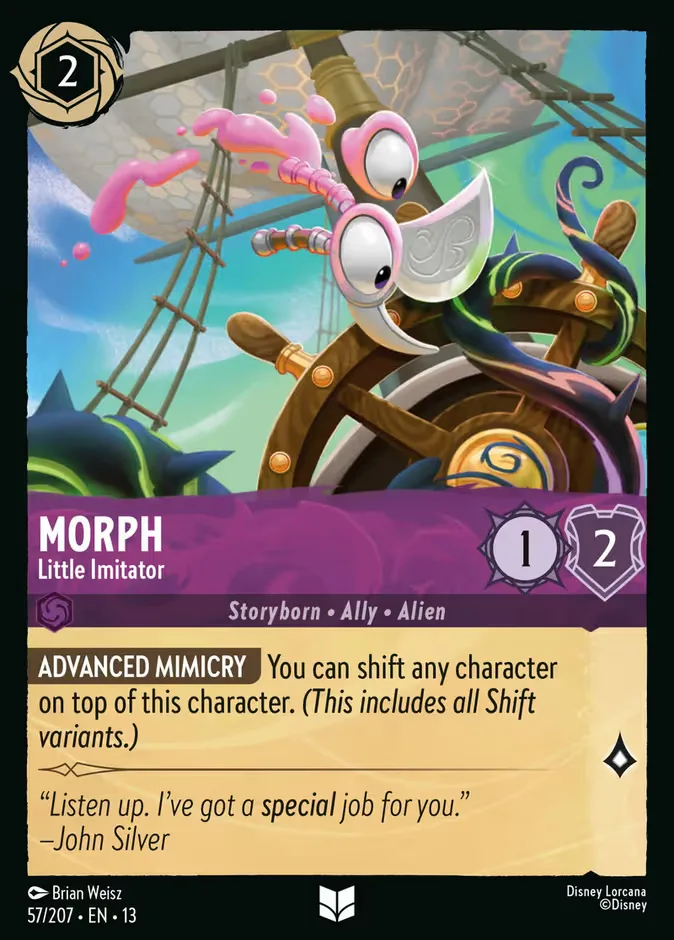
Then there are the cards that bend the name rule. Morph - Little Imitator, a 2-ink Amethyst character from Attack of the Vine!, lets any character with any Shift variant go on top of him - the release notes confirm that Posey can shift onto Morph even though he is neither a Potato nor an item, and that Morph still counts as only one of the two characters Duo Shift needs. Incrediboy - Buddy Pine (Wilds Unknown) counts as being named Syndrome for Shift, and Anna - Soothing Sister (Winterspell) gains Shift 0 onto an Anna on any turn a card has left a player's discard.
Where Shift sits in the card pool
Counting each card once, under the first main set that printed it:
| # | Set | New Shift cards |
|---|---|---|
| 1 | The First Chapter | 12 |
| 2 | Rise of the Floodborn | 24 |
| 3 | Into the Inklands | 12 |
| 4 | Ursula's Return | 18 |
| 5 | Shimmering Skies | 18 |
| 6 | Azurite Sea | 18 |
| 7 | Archazia's Island | 16 |
| 8 | Reign of Jafar | 15 |
| 9 | Fabled | 3 |
| 10 | Whispers in the Well | 12 |
| 11 | Winterspell | 11 |
| 12 | Wilds Unknown | 14 |
| 13 | Attack of the Vine! | 26 |
| Total | 199 |
That is 199 of the 1,871 characters in the 13 main sets released before Hyperia City, 10.6%, and the share barely moves in the rotating format: 78 of Core's 768 characters, 10.2%. Fabled's 3 is the reprint set doing what reprint sets do. Attack of the Vine!'s 26 is the most of any set, and 10 of those 26 use one of the six named variants. The previous twelve sets printed 2 between them - Thunderbolt - Wonder Dog and Baymax - Giant Robot - or 8 if you count Ursula's Return's six discard-cost cards.
The Floodborn classification tracks the keyword closely: 169 of the 199 Shift cards are Floodborn, and so are 48 of the 78 in Core.
Hyperia City, which prereleases on 16 October 2026, keeps the plain version going. Lorcast's full Hyperia City list, pulled on 10 October, has 204 standard cards, and 17 of them carry Shift. Sixteen pay their Shift cost in ink, and all sixteen shift for exactly 2 less than their ink cost - among them Nick Wilde - Inquisitive Harbormaster, Judy Hopps - Always Vigilant, Merlin - Ink Drop Tinkerer and Tiana - Party Hostess. The seventeenth is Baymax - Amped Up, whose Shift cost is removing 2 ink drops. Counted with the earlier sets, that makes 216 Shift characters out of 2,023 characters across the first 14 main sets, and 171 of the 209 ink-cost Shift cards save exactly 2.
Ink drops reach ordinary Shift costs too. From 16 October, rule 4.3.2.4 of Comprehensive Rules 2.3.0 lets a player pay the ink in a card's total cost - which rule 4.3.2.3 says is its ink cost or an alternate cost, and rule 1.5.5.2 makes shifting an alternate cost - by exerting ink cards, removing ink drops, or a combination of the two. Merlin's rider, which pays out in the set's new ink drops, is covered in our ink drops explainer.
Quick reference
- Shift is an alternate cost (rules 8.10.1 and 1.5.5.2): pay the Shift cost instead of the ink cost and put the card on top of a same-name character you have in play.
- It is usually 2 ink off, and rarely a real discount. 155 of the 193 ink-cost Shift cards in the 13 main sets released before Hyperia City save exactly 2; the base cost ink too. You are buying time and a dry character.
- The new card inherits the base's dry or drying state, exerted state, damage and any effects on it (rules 8.10.2 to 8.10.6) - but not its rules text or its printed ink cost.
- "For free" can't be Shift (rule 6.1.7). The exceptions are effects that tell you to shift for free, such as Metamorphosis and Syndrome - Out for Revenge.
- The card underneath is under (rule 5.1.1.5): not in play, can't be chosen, publicly visible - and it satisfies any card that checks for a card under a character, such as Mickey Mouse - Brave Little Prince.
- When the top card leaves play, the whole stack follows it to the same zone (rule 8.10.7) - discard, hand, inkwell or deck. Temporary Shift is the exception: only that card goes back to hand.
- Six named variants (rule 8.10.8): [Classification], Universal, Duo, Combo, Temporary and Potato. Duo and Combo take on the worst state of their two bases (rule 8.10.4.2).
Card counts reflect the Lorcast bulk export pulled 30 September 2026 and re-checked 10 October 2026, covering the 13 main sets released before Hyperia City, with Core Constructed cut by set code (Fabled onward) rather than by Lorcast's own legality field; the Hyperia City figures come from the 10 October pull. The 63 "card under" cards are a text search of Core-legal rules text with Boost's own reminder text excluded. Rule numbers reflect Comprehensive Rules 2.2.0, effective 9 July 2026, and each one cited here refers to the same rule in Comprehensive Rules 2.3.0, effective 16 October 2026; the ink-drop wording in rule 4.3.2.4 is new in 2.3.0. The variant edge cases come from Ravensburger's Attack of the Vine! set release notes, and the Baymax - Amped Up ruling from its Hyperia City set release notes.
Frequently Asked Questions
How does Shift work in Disney Lorcana?
Does a shifted character keep damage in Lorcana?
Can a shifted character quest the turn it is played in Lorcana?
What happens to the cards under a shifted character when it leaves play in Lorcana?
What are the Shift variants in Disney Lorcana?
Can you Shift a character that an effect lets you play for free?
Does a shifted character count as having a card under it in Lorcana?
Keep Reading
- Disney Lorcana Comprehensive Rules 2.2.0, effective 9 July 2026 - rules 1.5.5.2, 4.3.2.2, 4.3.3.1, 4.3.4.2, 4.3.5, 4.3.6, 5.1.1.5 to 5.1.1.7, 5.1.3 Example B, 5.2.6.1, 6.1.7, 7.2.3 and section 8.10 (Ravensburger, official PDF)
- Disney Lorcana TCG Set Release Notes: Attack of the Vine! - the four new Shift variants and the Q&A on Duo Shift, Combo Shift, Temporary Shift, Posey, Morph and Sulley & Boo (Ravensburger)
- Disney Lorcana Comprehensive Rules 2.3.0, effective 16 October 2026 - the same rule numbers for Shift, plus rule 4.3.2.4 on paying ink costs with ink drops (Ravensburger, official PDF)
- Official Disney Lorcana resources page - listed Comprehensive Rules 2.2.0 on 30 September 2026 and the 2.3.0 update by 10 October 2026 (Ravensburger)
- Disney Lorcana TCG Set Release Notes: Hyperia City - ink drops and the Baymax - Amped Up Q&A on removing ink drops for Shift (Ravensburger)
- Everything You Need to Know About Rotation as a New Player - Core Constructed is Fabled onward (Ravensburger)
- Lorcast bulk card export - the card pool counted in this post (pulled 30 September 2026, re-checked 10 October 2026)
- Lorcast set index - set codes and release dates used for the per-set and Core counts
- Tinker Bell - Giant Fairy #188/204, Fabled - the Comprehensive Rules' own shifting example (Lorcast)
- Mickey Mouse - Brave Little Prince #111/204, Fabled (Lorcast)
- Sulley & Boo - Scare Buddies #29/207, Attack of the Vine! (Lorcast)
- Morph - Little Imitator #57/207, Attack of the Vine! (Lorcast)
- Mickey Mouse & Minnie Mouse - Adventuring Duo #99/207, Attack of the Vine! - the only Duo Shift card (Lorcast)
- Omnidroid - V.10 #190/204, Wilds Unknown (Lorcast)
- Magica De Spell - Conniving Sorceress, Whispers in the Well (Lorcast)
- Come Out and Fight! #62, Winterspell (Lorcast)
- Let It Go #163, Winterspell reprint (Lorcast)
- Mother Knows Best #99, Fabled reprint (Lorcast)
- Lorcast card list for set 14, Hyperia City - 204 standard cards, 17 of them with Shift (pulled 10 October 2026)
- Hyperia City product page - prerelease 16 October 2026 (Ravensburger)
- Disney Lorcana TCG Set Release Notes: Wilds Unknown - Q&A on shifting for free with Metamorphosis and Syndrome - Out for Revenge (Ravensburger)
Related Guides
Disney Lorcana's Bag Explained: How Trigger Order Works
Six other posts on this site mention "the bag" in passing and none of them explain it. Here is the actual rule: what goes in, what never does, the exact order it resolves in when two abilities fire at once, and the two different ways a Lorcana card can make something happen later.
Disney Lorcana Uninkable Cards: All 585, and How to Ink One
The inkwell symbol is the first rule Lorcana teaches and the last one anybody puts a number on. Here is the whole uninkable pool counted off the live card data - 585 of 2,476 cards - cut by rarity, cost, type and ink, plus the Comprehensive Rules clause that lets five specific cards put an uninkable card into your inkwell anyway.
Disney Lorcana Format Coconut Explained: All 18 Beta Cards
Ravensburger put a new multiplayer format into open beta and then did not print a single card for it. The 18 Coconut cards live in the Companion app, the rules fit on one page, and the deckbuilding restrictions are stranger than the summary makes them sound. Here is the whole thing, with the card pool behind each Coconut counted.
Disney Lorcana Actions Explained: All 196, No Instant Speed
An action in Lorcana resolves the moment it is played, and the rules give your opponent no window to answer it. Here is the whole card type counted from the live pool - 196 non-song actions, what they actually do, and the handful of cards that can interfere before the fact.
How to Play Disney Lorcana - Rules, Turn Structure, and the Race to 20 Lore
Lorcana is the rare TCG where you never attack your opponent directly. You race them to 20 lore. This is the full rules walkthrough - inkwell, turn phases, questing, challenging, drying, card types, and deck limits.
Disney Lorcana Character Classifications Explained: All 47, and Why Storyborn Does Nothing
Rule 5.3.3.2 lists 47 classifications, and a card needs one of them to legally be a character at all. Then you count the card pool and find that the two most common words on the type - Storyborn and Dreamborn, 1,688 characters between them - are referenced by exactly zero cards.